Edible
Permitted for commercial sale
Set your location to see data for your region.


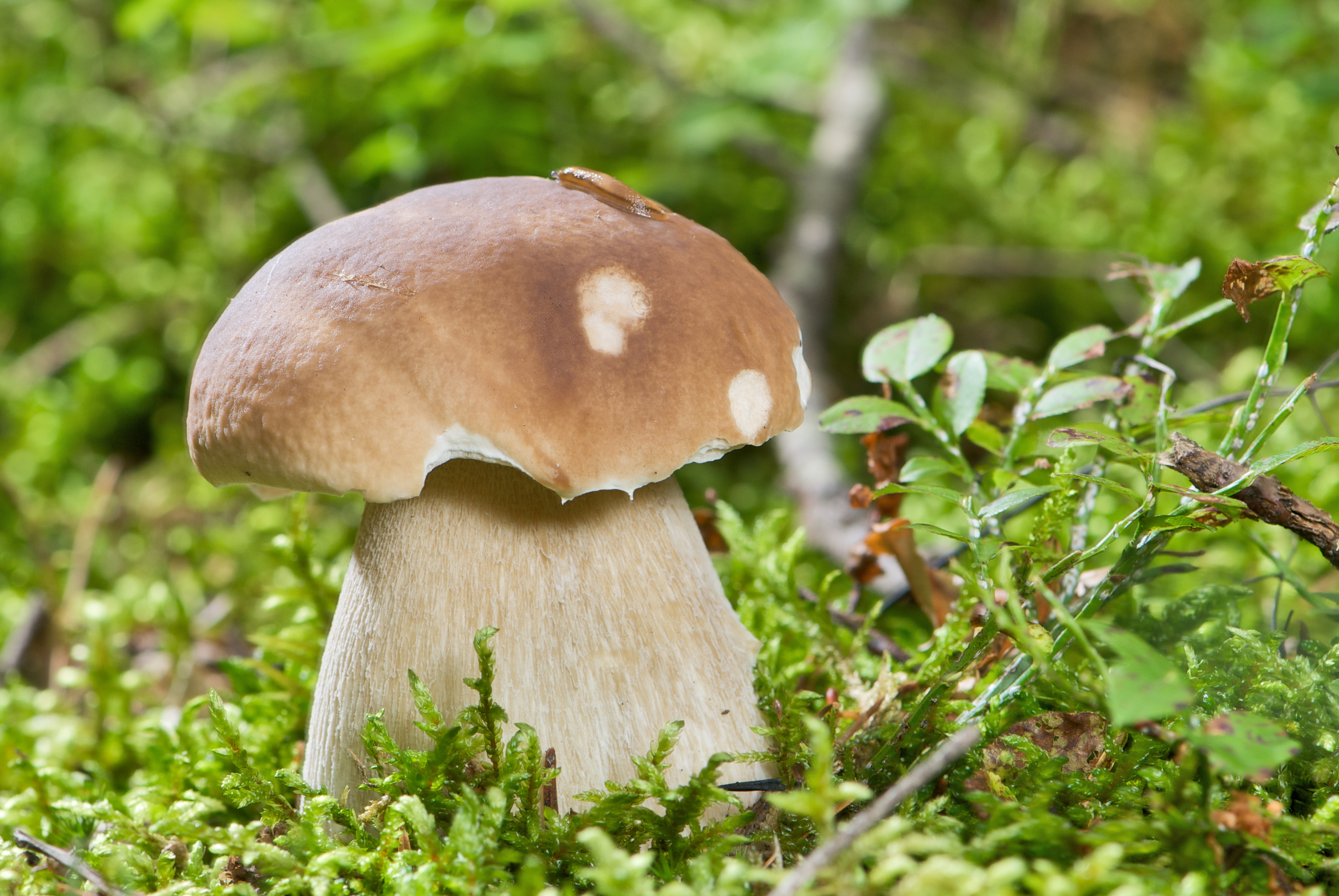


The king bolete (Boletus edulis) is a prized edible mushroom occurring in coniferous, deciduous, and mixed forests on acidic soils. It forms fruit bodies with a fleshy, brown cap and a stipe covered with a fine, whitish or light brown reticulum. The tube pores in young mushrooms are white, and in mature ones they change color to yellow to yellow-olive. The white flesh does not change color when cut. This species forms mycorrhizae with various trees, including spruce, fir, pine, beech, and birch.
Identification, habitat, and key differences.
Forager
Fruitbody structure
- Fruit body form
- Fruit body form: Cap, stipe.
Cap
- Cap shape
- in young fruit bodies: Cap shape: hemispherical.
in mature fruit bodies: Cap shape: convex.
in mature fruit bodies: Cap shape: flat. - Cap surface relief
- Cap surface relief: smooth.
Cap surface relief: wrinkled. - Cap covering
- Cap covering: glabrous.
- Cap surface sheen
- when wet: Cap surface sheen: shiny.
- Cap stickiness and sliminess
- when wet: Cap stickiness and sliminess: sticky.
when wet: Cap stickiness and sliminess: slimy. - Cap colour
- Cap colour: beige.
Cap colour: brown.
Cap colour: dark brown.
in mature fruit bodies: Cap colour: dark brown.
in young fruit bodies: Cap colour: light brown.
Cap colour: light brown.
Cap colour: light ochre.
Cap colour: ochre brown.
in mature fruit bodies: Cap colour: reddish brown.
Cap colour: white (at the cap margin). - Cap diameter
- The cap measures 50–300 mm in diameter.
Underside of the cap
- Hymenophore type
- Hymenophore type: tubes.
Pores at stipe
- Hymenophore attachment to the stipe
- Hymenophore attachment to the stipe: attached to the stipe (tubes).
- Hymenophore profile at the stipe
- Hymenophore profile at the stipe: notched at the stipe (tubes).
- Separability of the hymenophore from the cap
- Separability of the hymenophore from the cap: easily separable (tubes).
- Pore shape
- in young fruit bodies: Pore shape: round.
in mature fruit bodies: Pore shape: angular. - Pore colour after damage
- Pore colour after damage: no colour change.
Pore colour after damage: no colour change. - Tube color after damage
- Tube color after damage: no colour change.
- Natural pore colour
- in young fruit bodies: Natural pore colour: white.
in mature fruit bodies: Natural pore colour: yellow.
in mature fruit bodies: Natural pore colour: yellow-olive.
in mature fruit bodies: Natural pore colour: olive greenish yellow.
in young fruit bodies: Natural pore colour: whitish.
in mature fruit bodies: Natural pore colour: yellow-green. - Natural tube colour
- in mature fruit bodies: Natural tube colour: cream.
in mature fruit bodies: Natural tube colour: pale yellow.
in young fruit bodies: Natural tube colour: white.
in mature fruit bodies: Natural tube colour: yellow-olive.
in mature fruit bodies: Natural tube colour: olive greenish yellow.
in young fruit bodies: Natural tube colour: whitish.
in mature fruit bodies: Natural tube colour: yellow.
in mature fruit bodies: Natural tube colour: yellow-green.
Stem and base
- Stipe shape
- in young fruit bodies: Stipe shape: barrel-shaped.
in mature fruit bodies: Stipe shape: club-shaped.
Stipe shape: cylindrical.
Stipe shape: club-shaped.
Stipe shape: tapering towards the base. - Stipe base
- Stipe base: club-shaped.
Stipe base: swollen. - Stipe colour
- Stipe colour: whitish.
Stipe colour: light brown. - Stipe surface relief
- in the upper part of the stipe: Stipe surface relief: reticulate.
- Stipe length
- Stipe length: 20–300 mm.
- Stipe diameter
- Stipe diameter: 15–120 mm.
- Colour of the stipe reticulum
- in the upper part of the stipe: Colour of the stipe reticulum: whitish.
in the upper part of the stipe: Colour of the stipe reticulum: light brown.
in the upper part of the stipe: Colour of the stipe reticulum: white.
Flesh
- Flesh colour
- Flesh colour: white.
Flesh colour: reddish brown (cap flesh, beneath the surface layer).
Flesh colour: pinkish (cap flesh, beneath the surface layer).
Flesh colour: brownish (flesh at the stipe base). - Flesh firmness
- in young fruit bodies: Flesh firmness: firm.
in mature fruit bodies: Flesh firmness: soft. - Flesh taste
- Flesh taste: weak.
- Flesh elasticity
- in young fruit bodies: Flesh elasticity: elastic.
- Flesh structure
- in mature fruit bodies: Flesh structure: cottony.
in old fruit bodies: Flesh structure: spongy. - Flesh colour after damage
- Flesh colour after damage: no colour change.
Flesh colour after damage: no colour change.
Flesh colour after damage: no colour change. - Flesh odour
- Flesh odour: mushroom-like, weak.
Flesh odour: weak. - Flesh flavour note
- Flesh flavour note: nutty.
Where and when it grows
- Habitat
- Habitat: coniferous woodland.
Habitat: deciduous woodland.
Habitat: mixed woodland. - Substrate
- Substrate: soil.
- Fruit body growth pattern
- Fruit body growth pattern: solitary.
Fruit body growth pattern: in groups. - Occurrence frequency
- Occurrence frequency: common.
- Fruiting season
- Fruit bodies appear from June to November.
- Distribution area
Edibility and culinary use
- Edibility
- Edible
- Culinary rating
- Very tasty
Law
Regulations for location: Poland
- Protection
- In Poland, Boletus edulis is outside the scope of statutory species protection.
- Commercial trade
- Permitted for commercial sale
What it can be confused with
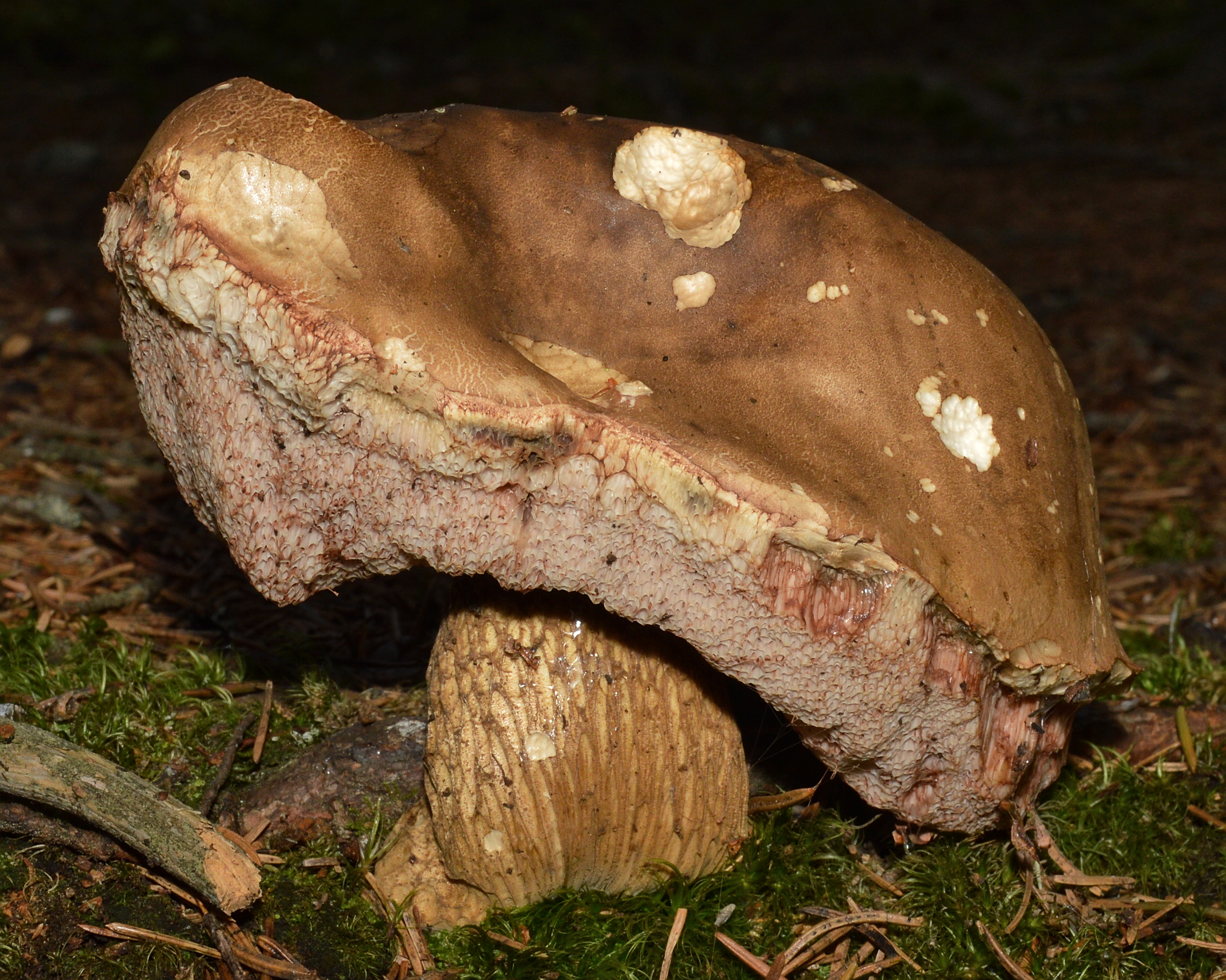
Tylopilus felleus
Key differences
The bitter bolete (Tylopilus felleus) has whitish pores in young specimens, which is why it is sometimes confused with the penny bun (Boletus edulis). As it matures, however, its pores turn dirty pink, the reticulation on the stipe is coarse, dark, and raised, and the cap remains matte and velvety. The flesh of the bitter bolete is characterized by an intense bitterness that is not removed by boiling or drying, causing even a single fruit body to ruin the taste of an entire dish.
The penny bun (Boletus edulis) resembles a young bitter bolete in habit and brown cap. It differs, however, in having a paler, initially white stipe covered with a delicate, pale reticulation (visible mainly in its upper part). Furthermore, the tubes and pores of the penny bun change color with age from white to yellow-green and olive-green, whereas in the bitter bolete they turn pinkish.
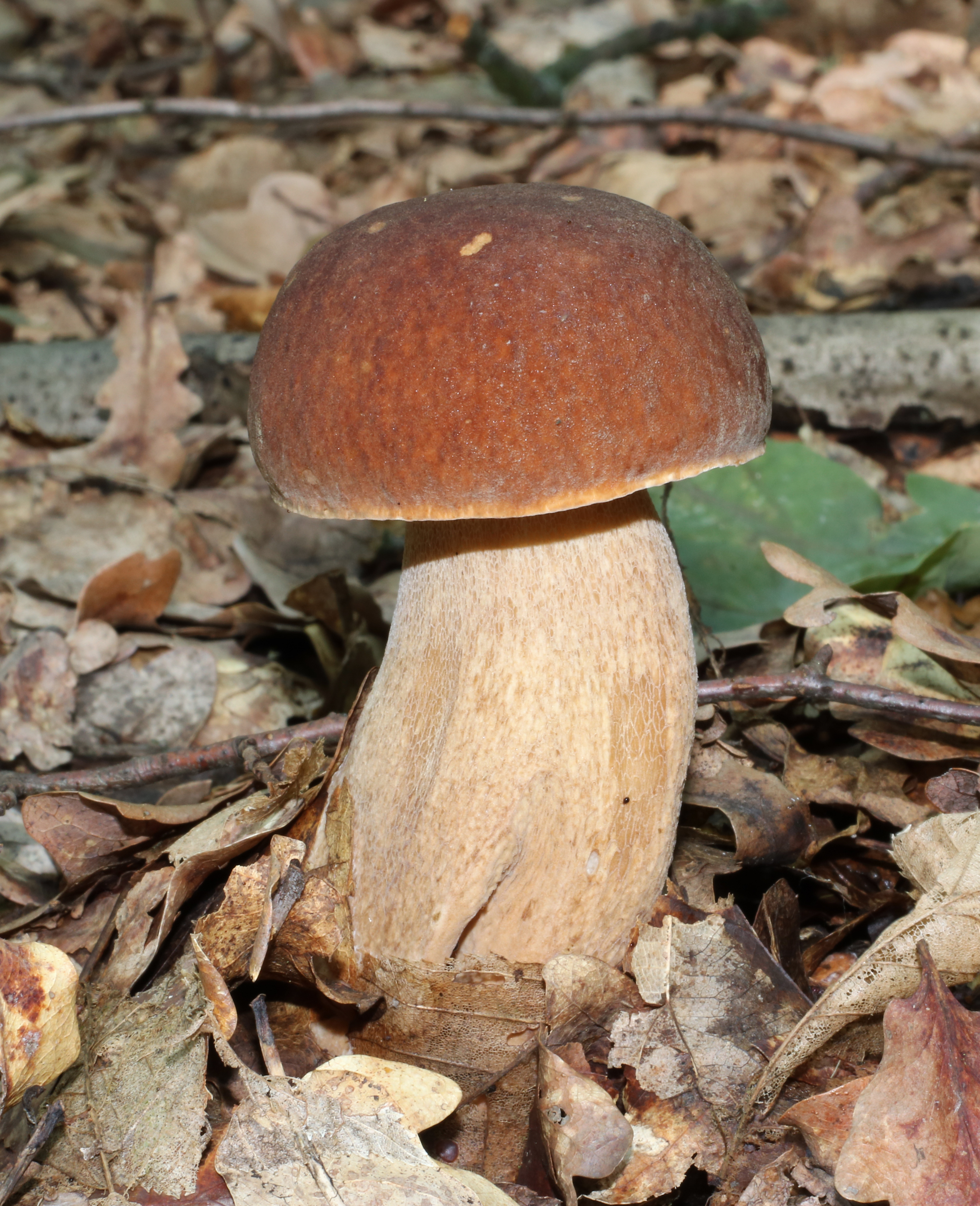
George Chernilevsky · Public domain
Bez zmian względem zachowanego oryginału.
Photo source · Public domainBoletus reticulatus
Key differences
The reticulated bolete (Boletus reticulatus) is characterized by a cap with a matte, velvety, or persistently frosted surface that often cracks into small patches during drought, and a distinct reticulation often covering almost the entire stipe. It occurs mainly under beeches and oaks, usually appearing earlier in the season than the king bolete. Due to the variability of surface features and reticulation extent in both species, the extent of the mesh on the stipe alone does not always allow for their unambiguous distinction.
The king bolete (Boletus edulis) usually has a smoother cap surface that becomes sticky and slimy in wet weather, and a narrow, lighter margin is often visible on its edge. The reticulation on the stipe of the king bolete is generally more delicate and restricted mainly to its upper part. In the reticulated bolete, the cap is usually dry, velvety, and prone to cracking, and the reticulation on the stipe is lighter and more pronounced, although the extent of the network alone does not constitute a definitive distinguishing criterion.
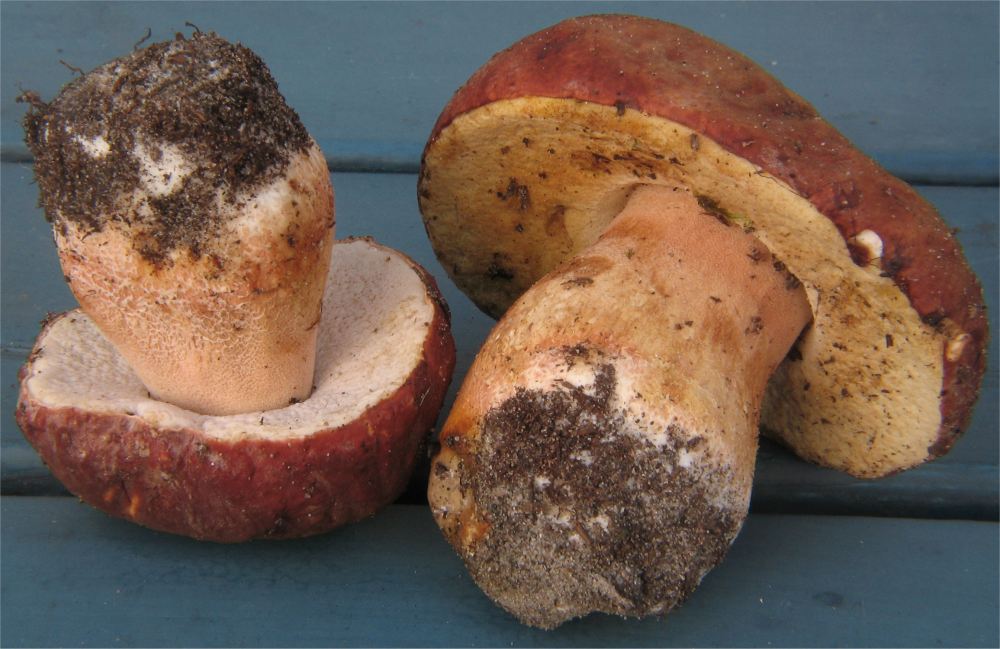
Boletus pinophilus
Key differences
The pine bolete (Boletus pinophilus) is characterized by a dark, reddish-brown or almost blackish-brown cap and grows mainly in association with pines. In its microscopic structure, it is distinguished by a thick, gelatinized cuticle and terminal elements up to 27 µm wide, containing a reddish-brown, parietal incrusting pigment that dissolves in potassium hydroxide (KOH).
The king bolete (Boletus edulis) tends to have a cap in shades from light brown to dark brown, sometimes with a yellowish or reddish tone, but its surface is glabrous, greasy, and the reticulation on the stipe is usually fine and restricted to the upper part. Microscopically, the terminal elements of the cuticle of B. edulis are 4–19 µm wide, and the pigment occurs intracellularly. The presence of a reddish tint and proximity to pines are not exclusive features of B. pinophilus, as B. edulis also grows in pine forests on poor, acidic sands.
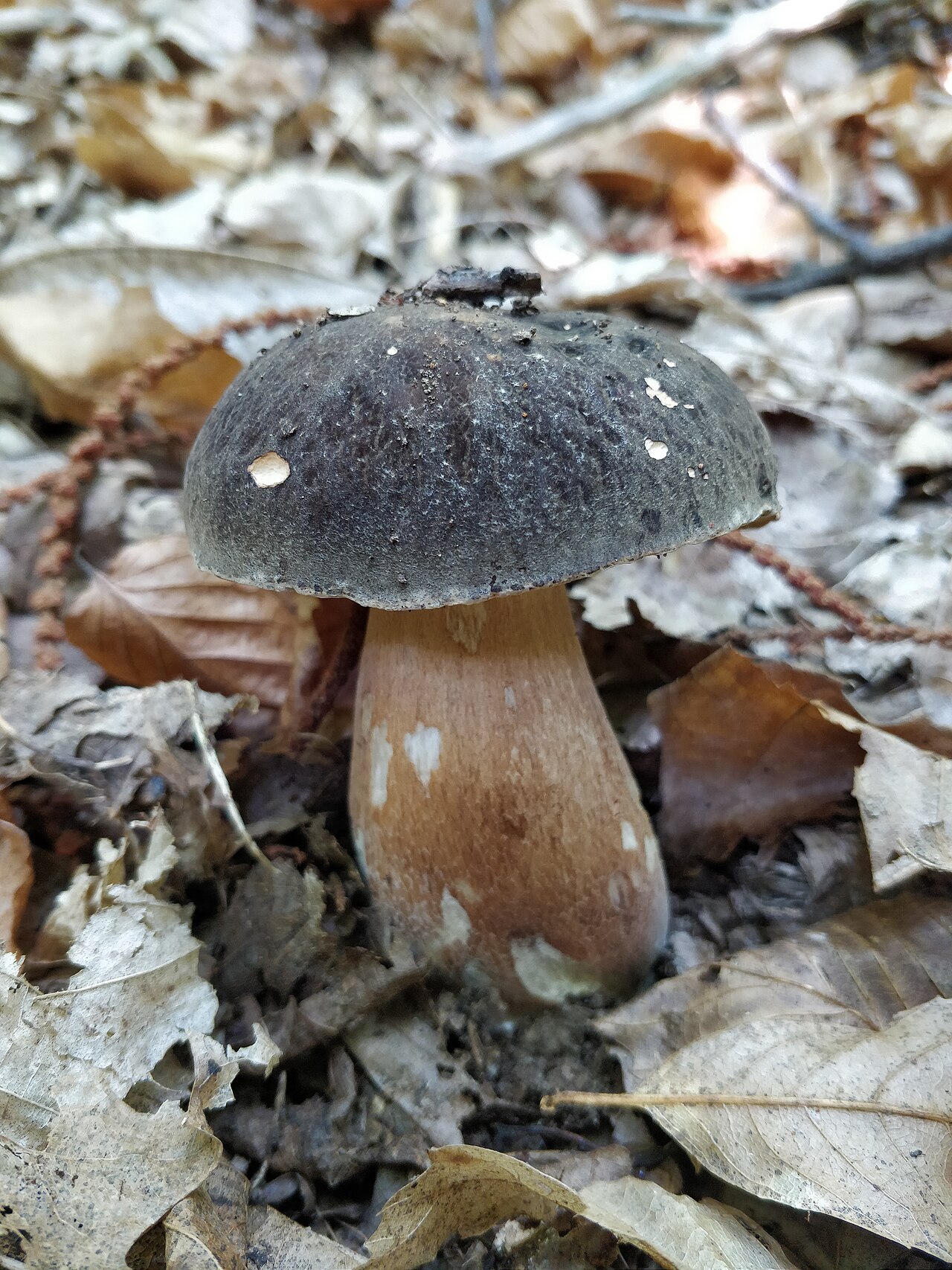
Boletus aereus
Key differences
The king bolete (Boletus edulis) is distinguished by a smooth cap cuticle that feels greasy to the touch in damp conditions, a broader palette of lighter and darker shades of brown, and a whitish reticulum typically present in the upper half of the stipe (less frequently extending lower). Microscopically, the terminal elements of the cap cuticle in B. edulis are 4–19 µm wide, whereas in B. aereus the cap is dry, finely tomentose, and very dark, although individual coloration characteristics may overlap.
The bronze bolete (Boletus aereus) occurs in warm deciduous forests, mainly oak, also on calcareous soils, less frequently under chestnut trees. It has a very dark, dry, delicately downy cap. Under the microscope, the terminal elements of its cuticle reach up to 11 µm in width and contain fine-grained intracellular pigment.
H. Krisp · CC BY 3.0
Plik źródłowy jest oznaczony jako wykadrowany (cropped). Dokładny oryginalny plik Commons; bez dodatkowych lokalnych zmian.
Photo source · CC BY 3.0Caloboletus calopus
Key differences
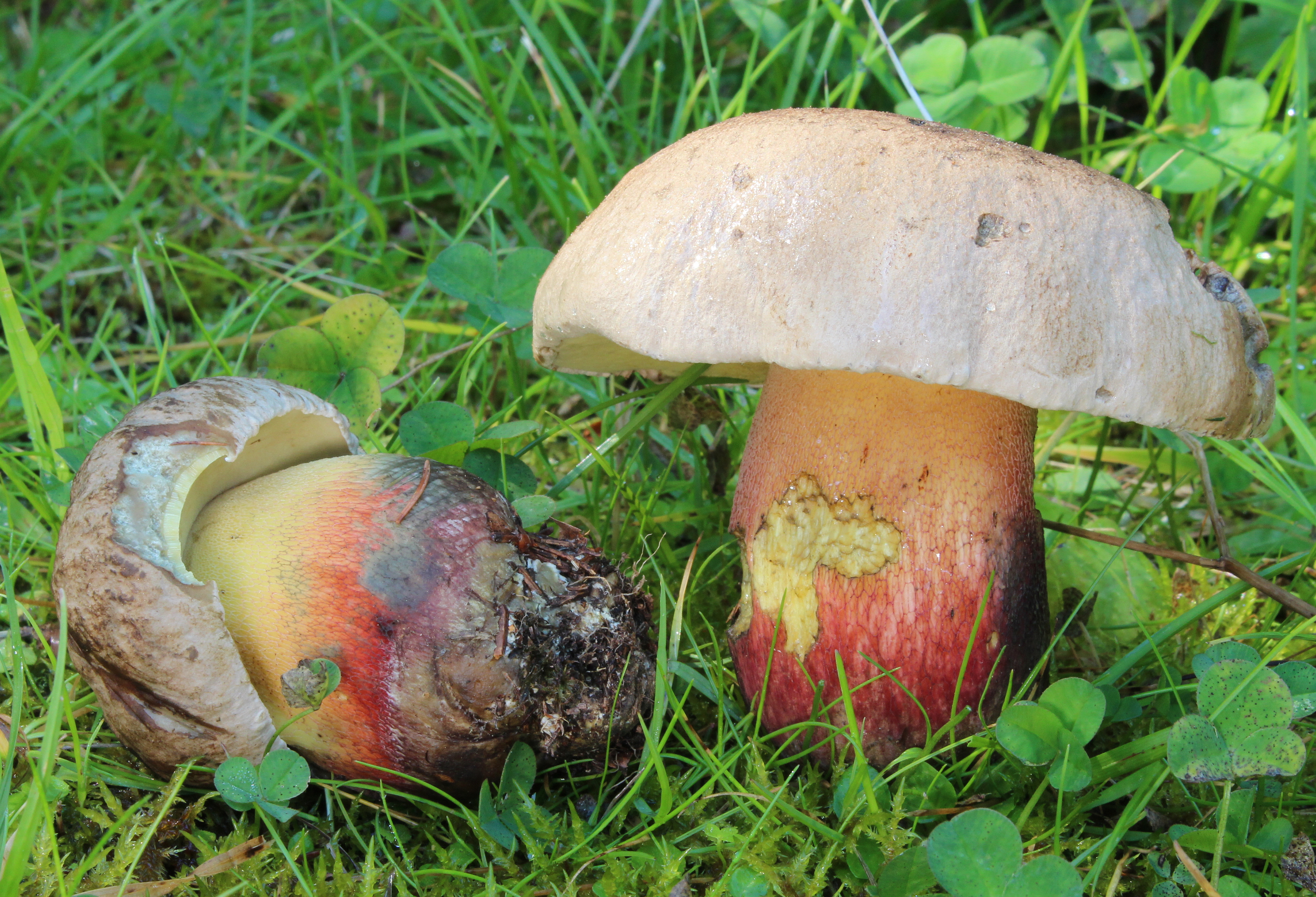
Confusion with the penny bun (Boletus edulis) in the field is possible mainly with a cursory glance from above at young fruit bodies. The penny bun is distinguished by a brown cap, white to yellow-green tubes that do not turn blue when bruised, a pale stipe without a trace of bright red, and a mild, pleasant taste.
Jerzy Opioła · CC BY-SA 4.0
Korekta kolorów: Selso, 2020 (wersja źródłowa).
Photo source · CC BY-SA 4.0Imleria badia
Key differences
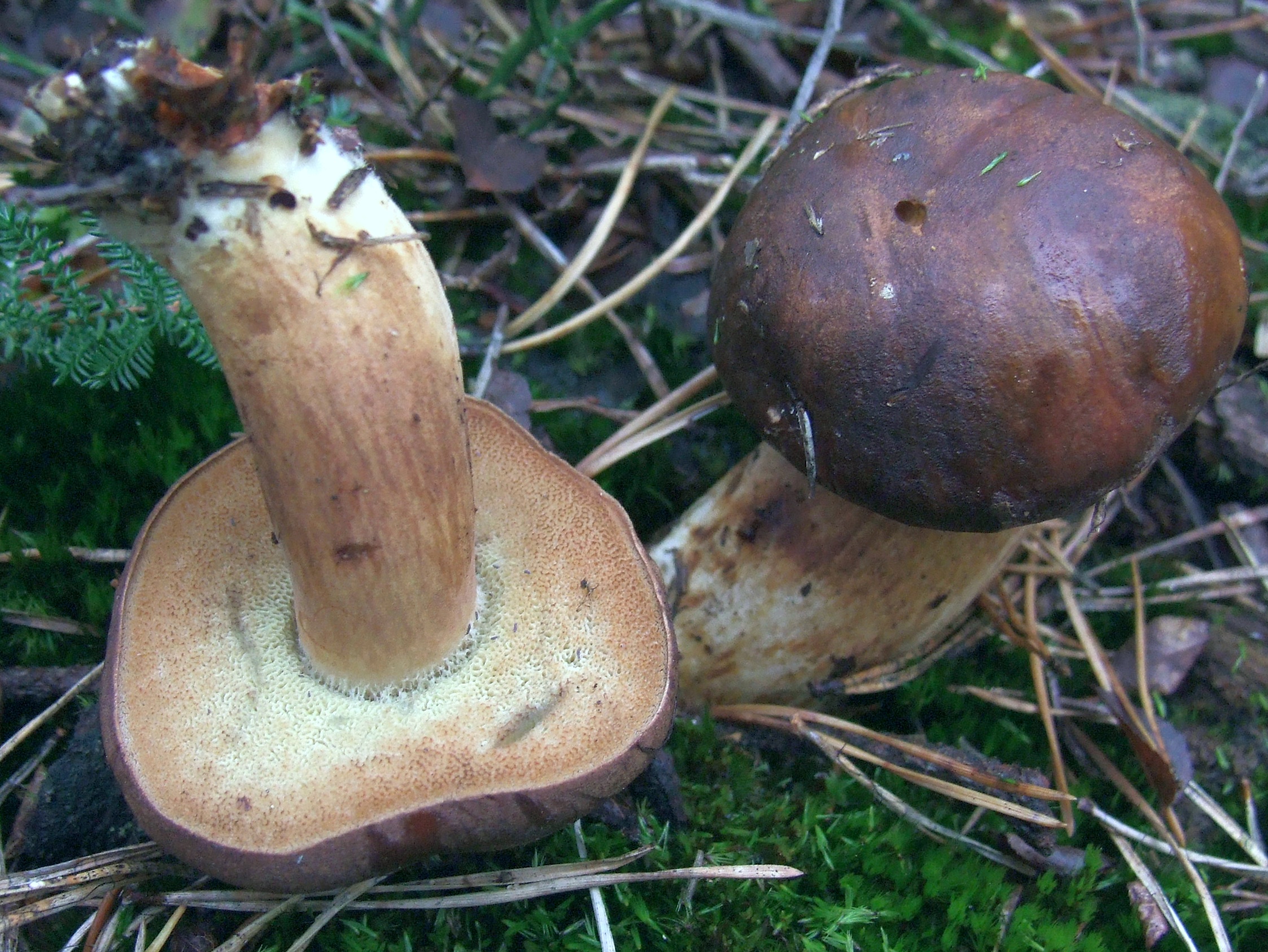
The bay bolete (Imleria badia) and the king bolete (Boletus edulis) are popular edible mushrooms. The king bolete has a stipe with a light reticulation and pores that are initially white, turning yellow to yellow-olive with age, which do not change color under pressure. Its flesh remains white when sliced. The bay bolete has a brownish stipe without reticulation, and the pores distinctly stain blue under pressure. The flesh of the bay bolete turns blue when sliced, especially in the cap and above the tubes.
FAQ
Does the king bolete turn blue when cut?
No. The flesh of the king bolete does not change color when cut – it does not turn blue or darken on contact with air. The absence of color change on cutting is an important diagnostic feature.
Can the bolete's cap be slippery?
Yes. During wet weather, the cap can be slippery, sticky, or slimy and shiny, and in young fruit bodies slightly sticky. The cap surface itself can be smooth or wrinkled.
Does every king bolete have a dark brown cap?
No. The cap color can be variable: from light brown through hazel to dark brown and reddish-brown. In the broad concept of the species, forms with even lighter coloration are also included.
Are the prawdziwek and the king bolete the same thing?
Prawdziwek is the colloquial name for the king bolete, but in common usage it is also sometimes applied to several similar species of boletes collected by mushroom pickers.
Why does the bolete have white pores at one time and yellow-olive at another?
This depends on the maturity of the fruit body. In young mushrooms, the pores are white, while in mature ones they become yellow to yellow-olive. With age, the small, roundish pores also become angular.
Does drying enhance the smell of the bolete?
Yes. Fresh fruit bodies have a weak mushroom odor, while drying distinctly enhances the aroma. Dried bolete smells much stronger and is a traditional ingredient in Polish soups and pierogi.
How large can the cap of the king bolete be?
In Polish sources, Snowarski gives a diameter of 60–250 mm, and the Czech Tejkal 50–250 mm. In turn, studies by Muñoz and Korhonen note caps reaching up to 300 mm (30 cm) for the king bolete.
How to distinguish the king bolete from the bitter bolete?
The bitter bolete has a dark, coarse reticulum on the stipe and mature pores with a pinkish tint. In the king bolete, the reticulum is fine, whitish or light brown, and mature pores are yellow to yellow-olive.
When can the king bolete be found?
This depends on the regional perspective. In Polish sources, the occurrence period is described as summer and autumn, whereas in the Czech Republic, the mushroom fruits in a repeatable interval from June to October.
Under which trees does the king bolete grow?
The king bolete grows in coniferous, deciduous, and mixed forests. It forms mycorrhizal associations with various trees: sources mention spruce, fir, pine, beech, and birch.
Enthusiast
Underside of the cap
- Tube length
- Tube length: 5–30 mm.
Names and history
- Obowiązująca nazwa taksonomiczna
- Boletus edulis Bull.
- Pozostałe nazwy
- Porcini, King Bolete, Cep
Home observations
Spore print
- Required materials
- fresh, mature cap, sheet of paper, glass or small bowl, water
- Time
- 2–24 h
- Procedure
- Place the cap underside down on the paper.
- Add a drop of water on top and cover.
- After 2–24 hours, lift the cap and examine the deposit.
What to look for
- Spore print colour
- Spore print colour: brown. Spore print colour: green.
- Spore print shade
- Spore print shade: dark olive-brown. Spore print shade: brownish-olive.
Under the microscope
- Required materials
- light microscope, microscope slide and cover slip, needle, water, spores from print
- Procedure
- Transfer a small amount of the spore print onto the slide using a needle.
- Add a drop of water, cover with a cover slip, and examine the spores.
What to look for
- Spore shape
- Spore shape: fusiform. Spore shape: elongate ellipsoid. Spore shape: fusiform. Spore shape: fusiform. Spore shape: ellipsoid.
- Spore surface
- Spore surface: smooth. Spore surface: smooth. Spore surface: smooth.
- Spore dimensions
- Length 12–19.5 µm, width 4–7 µm.
Compare dimensions after calibrating the microscope scale.
Ecology and distribution
- Soil reaction
- Soil reaction: acidic.
- Soil calcareousness
- Soil calcareousness: non-calcareous.
- Mycorrhizal hosts
- General species association: Mycorrhizal hosts: Picea (general partner list).
General species association: Mycorrhizal hosts: Abies (general partner list).
General species association: Mycorrhizal hosts: Pinus (general partner list).
General species association: Mycorrhizal hosts: Fagus (general partner list).
General species association: Mycorrhizal hosts: Betula (general partner list).
General species association: Mycorrhizal hosts: Picea abies (general partner list).
Non-culinary uses
Regarding non-culinary applications of the penny bun, scientific sources (including a publication in IMA Fungus, doi:10.1186/s43008-024-00156-7) note sparse, local ethnomycological accounts. Field studies on traditional fungal knowledge documented an account concerning the folk practice of topical application of fruit bodies of this species for skin conditions.
This record constitutes solely a description of an existing ethnomycological account and an element of local herbal folklore, without scientific confirmation of biological efficacy or therapeutic action. Contemporary mycological and ethnobiological literature treats this mention merely as evidence of historical customs, without formulating any therapeutic or medical recommendations or application recipes. Any non-culinary use of the penny bun was marginal and historical compared to its widespread culinary use.
History and culture
The penny bun holds a fundamental place in European culture and forest tradition, being widely recognized as the most prestigious mushroom in foraging traditions. In the history of scientific mycology, a key moment was the formal description and naming of the species Boletus edulis by French naturalist Jean Baptiste Bulliard in 1782.
In Polish literary tradition, the motif of the bolete was immortalized in Book III of Adam Mickiewicz's epic "Pan Tadeusz" ("Flirtation"), where an account of mushroom picking mentions the bolete referred to in song as the "colonel of mushrooms". However, this reference should not be equated directly with the modern, strict taxonomic definition of the species, but rather with the historical cultural perception of prized forest boletes.
The significance of this mushroom in the folk culture of East-Central Europe is confirmed by modern ethnobiological research, including analyses of traditions conducted on the Ukrainian-Romanian border. These studies indicate the exceptional endurance of knowledge about the bolete in the collective memory of local communities. The mushroom also carries strong holiday and ceremonial symbolism, serving as a traditional element of the Christmas Eve supper as a symbol of connection with nature.
Edibility and safety
The penny bun (Boletus edulis) is a widely prized edible mushroom with a mild, nutty flavor and a distinct, forest aroma that intensifies during drying. Healthy, fresh fruit bodies are harvested for consumption. Eating old, overripe, or mold-infested fruit bodies can lead to non-specific food poisoning caused by tissue decomposition processes. The standard practice for culinary preparation is subjecting the mushroom to heat treatment (boiling, stewing, frying), while drying serves as a preservation method.
Consumption traditions display regional variation. In Poland and East-Central Europe, the penny bun is a staple mushroom, traditionally dried and pickled. In Italy, where it is known as porcino, it is a traditional ingredient in braised and fried dishes. In France, under the name cèpe, it is widely utilized in regional gastronomy, whereas in Western European cuisines, its popularity grew under the influence of culinary traditions from the south of the continent.
Habitat and occurrence
The penny bun occurs in the temperate and boreal zones of the Northern Hemisphere, growing in coniferous, deciduous, and mixed forests. As an ectomycorrhizal fungus, it forms associations with numerous forest tree species. According to taxonomic and ecological studies, its primary mycorrhizal partners include conifers, such as spruce (Picea), pine (Pinus), and fir (Abies), as well as deciduous trees, especially oak (Quercus), beech (Fagus), birch (Betula), and chestnut (Castanea).
The species colonizes diverse forest soil types, most commonly acidic, including sandy, sandy-loam, and humic substrates, often in undergrowth with mosses and bilberries. It occurs both in lowlands and in hilly and mountainous regions.
Documented observation ranges of fruit bodies in Central Europe compiled in records cover the period from June to November (VI–XI) in Poland, and from June to October (VI–X) in the Czech Republic. These ranges establish the timeframe of field records depending on weather conditions, without groundlessly singling out monthly peaks or regional comparisons of occurrence frequency.
Researcher
Edibility and culinary use
Ustalenia źródłowe: jadalność, spożycie i wykorzystanie
- Edibility
- Edible — źródło oznaczenia
Źródło bez opisu bibliograficznego · Wartość: source assessment Jadalny; no advice to taste an unidentified specimen.
Źródło bez opisu bibliograficznego · Kuchyňské využití: jedlá houba; a species assessment, not an identification test.
- Culinary rating
- Very tasty
Źródło bez opisu bibliograficznego · Wartość: jeden z najsmaczniejszych grzybów; qualitative source culinary assessment.
- Commercial trade
- Approved for trade
Obszar: PL
W polskim prawie borowik szlachetny jest dopuszczony do obrotu handlowego oraz do produkcji przetworów grzybowych.
Urzędowy status lub tekst aktu ELI · § 2 ust. 1; załącznik 1, pozycja 8, PDF str. 5; wymagania obrotu § 3–6 osobno
Scientific names and taxonomy
- Current scientific name
Boletus edulis Bull.
- Former scientific names
- 1789 — Suillus edulis (Bull.) Lam.
1796 — Boletus elephantinus With.
1801 — Boletus edulis var. elephantinus (With.) Pers.
1801 — Boletus edulis var. tuberosus Pers.
1805 — Boletus edulis var. communis Alb. & Schwein.
1814 — Boletus solidus Sowerby
1821 — Leccinum edule (Bull.) Gray
1821 — Leccinum elephantinum (With.) Gray
1825 — Boletus esculentus var. albus Pers.
1863 — Boletus citrinus A. Venturi
1882 — Tubiporus edulis (Bull.) P. Karst.
1886 — Dictyopus edulis (Bull.) Quél.
1889 — Boletus edulis var. clavipes Peck
1892 — Boletus edulis var. elephantinus Massee
1892 — Boletus edulis var. laevipes Massee
1898 — Suillus citrinus Kuntze
1918 — Boletus edulis var. pseudopurpureus Murr
1921 — Boletus edulis var. abietis Schiemek
1921 — Boletus edulis var. quercus Schiemek
1931 — Boletus edulis var. albus (Pers.) E.-J. Gilbert
1931 — Boletus edulis var. citrinus Pelt. ex E.-J. Gilbert
1933 — Boletus edulis subsp. euedulis Maire
1947 — Boletus edulis subsp. clavipes (Peck) Singer
1947 — Boletus edulis subsp. euedulis (Maire) Singer
1951 — Boletus slovenicus Smotl.
1966 — Boletus edulis f. arcticus Vassilkov
1966 — Boletus edulis f. betulicola Vassilkov
1966 — Boletus edulis f. citrinus (Pelt. ex E.-J. Gilbert) Vassilkov
1966 — Boletus edulis f. laevipes (Massee) Vassilkov
1966 — Boletus edulis f. pseudopurpureus (Murr) Vassilkov
1966 — Boletus edulis f. quercicola Vassilkov
1966 — Boletus edulis f. roseipes Vassilkov
1966 — Boletus edulis f. subaereus Vassilkov
1966 — Boletus edulis f. tardus Vassilkov
1971 — Boletus edulis var. ochraceus A.H. Sm. & Thiers
1974 — Boletus betulicola (Vassilkov) Pilát & Dermek
1974 — Boletus clavipes (Peck) Pilát & Dermek
1974 — Boletus edulis subsp. trisporus U.K. Duncan & Watling
1978 [1977] — Boletus quercicola (Vassilkov) Singer
1983 — Boletus edulis var. arenarius H. Engel
1986 — Boletus venturii Bon
1988 — Boletus persoonii Bon
1994 — Boletus edulis subsp. betulicola (Vassilkov) Hlaváček
1994 — Boletus edulis subsp. slovenicus (Smotl.) Hlaváček
1994 — Boletus edulis var. arcticus (Vassilkov) Hlaváček
1994 — Boletus reticulatus var. albus (Pers.) Hlaváček
1994 — Boletus reticulatus var. citrinus Hlaváček
2005 — Boletus edulis f. albus (Pers.) J.A. Muñoz
2005 — Boletus edulis f. citrinus J.A. Muñoz
2008 — Boletus edulis var. grandedulis D. Arora & Simonini
Tubiporus edulis subsp. euedulis Maire[22]
Boletus edulis Bull. należy do rodziny Boletaceae i rzędu Boletales. W rejestrze Species Fungorum (rekord 356530) jako nazwę przyjętą wskazano publikację w Herbier de la France (tom 2, tablica 60) z datą 1782 [1781–82]. W układzie systematycznym takson zaliczany jest do Basidiomycota, Agaricomycetes oraz Agaricomycetidae. Zapis bibliograficzny samej nazwy stanowi element historii taksonomii, odrębny od współczesnych ustaleń dotyczących biologii gatunku.
Historia nazewnictwa gatunku obejmuje formalne przeniesienia epitetu gatunkowego do innych rodzajów: Suillus edulis (Bull.) Lam., Leccinum edule (Bull.) Gray, Tubiporus edulis (Bull.) P. Karst. oraz Dictyopus edulis (Bull.) Quél. Rejestry mikologiczne notują ponadto liczne nazwy odmian, form i synonimów, z których nie każda stanowi kombinację opartą na tym samym typie. Dawna nazwa Suillus esculentus P. Micheli z 1729 roku reprezentuje nazewnictwo przedsystematyczne i jej status wymaga odrębnej oceny historyczno-nomenklatorycznej.
W polskim atlasie Snowarskiego w zestawieniu nazw angielskich wymieniono formy King Bolete, Cep oraz Porcini. Zapis Porcini odnotowano w tym źródle w grupie określeń angielskich, co nie stanowi udokumentowania jego włoskiego rodowodu językowego. Z kolei niemiecka nazwa Steinpilz nie została w tym wykazie potwierdzona.
Taxon scope and identification limitations
Europejska rewizja taksonomiczna przeprowadzona przez Beugelsdijka i współpracowników w 2008 roku połączyła analizę cech morfologicznych z badaniem markerów molekularnych ITS oraz GAPDH. W analizowanym materiale wyodrębniono cztery wyraźne linie odpowiadające gatunkom: B. edulis, B. aereus, B. pinophilus i B. reticulatus. Jednocześnie kolekcje opisywane wcześniej jako betulicola, persoonii, quercicola, venturii oraz wyróżnione morfotypy A–C wykazały znikomą zmienność obu markerów i zostały włączone do szeroko ujętego B. edulis. Wnioski te opierają się na zbadanych kolekcjach europejskich i nie rozstrzygają automatycznie statusu wszystkich nazw z historycznych rejestrów ani populacji spoza Europy.
W analizie mikroskopowej skórki kapelusza typowego B. edulis szerokość elementów końcowych wynosi 4,0–19 µm, z obecnością pigmentu wewnątrzkomórkowego (dane van der Linde z 2004 r. przytoczone w rewizji z 2008 r.). U morfotypu B elementy końcowe mierzą 12–50 × 4,5–15 µm, a u morfotypu C są lekko poszerzone i osiągają do 15 µm szerokości.
W analizach filogenetycznych Beugelsdijka i współpracowników badano sekwencje ITS oraz GAPDH. Długości wyrównań wynosiły odpowiednio 860 i 496 pozycji (łącznie 1356 pozycji), z czego 96 było informatywnych w sensie parsymonii (57 w ITS i 39 w GAPDH). Test jednorodności podziałów wykazał brak sprzeczności między markerami (P = 0,560). Analiza maksymalnej parsymonii wygenerowała 6600 drzew o długości 305 kroków. Dodatkowe zestawienie ITS z sekwencjami Leonardiego liczyło 964 pozycje (157 informatywnych) i dało ponad 10 000 drzew o długości 214 kroków.
Metodyka badań molekularnych obejmowała amplifikację rejonu ITS za pomocą starterów ITS5 i ITS4 w objętości 25 µl (z udziałem 2 µl matrycowego DNA). Warunki reakcji PCR: wstępna denaturacja w 94 °C przez 4 minuty, 37 cykli złożonych z denaturacji w 94 °C (1 min), przyłączania starterów w 52 °C (1 min) i wydłużania w 72 °C (1 min), oraz końcowe wydłużanie w 72 °C przez 5 minut. Analizowano również markery GAPDH, a sekwencjonowanie prowadzono na sekwenatorze automatycznym ABI 377.
Ecology and distribution
Laboratory diagnostics
Dane ustrukturyzowane
Basidia
Caulocystidia
Pileipellis
Reactions with reagents
- Amyloid reaction
- Amyloid reaction: negative. [14]
Spores
- Spore colour under the microscope
- Spore colour under the microscope: yellow-brown. [20]
- Droplets inside the spore
- Droplets inside the spore: present. [21]
- Spore length
- Spore length: 16–19 µm. [20]
Spore length: 12–18 µm. [17]
Spore length: 12–19.5 µm. [14]
Spore length: 14–18 µm. [24]
Spore length: 13–16.5 µm. [21] - Spore length-to-width ratio
- Spore length-to-width ratio: 2.5–3.9. [14]
Spore length-to-width ratio: 2.8–3.6. [21]
Spore length-to-width ratio: 2.7–3.4. [20] - Spore shape
- Spore shape: fusiform. [24]
Spore shape: elongate ellipsoid. [17]
Spore shape: fusiform. [17]
Spore shape: fusiform. [21]
Spore shape: ellipsoid. [21]
Spore shape: fusiform. [20] - Spore surface
- Spore surface: smooth. [24]
Spore surface: smooth. [17]
Spore surface: smooth. [21]
Spore surface: smooth. [20] - Spore wall thickness
- Spore wall thickness: thick-walled. [20]
Material and research methods
- Results as recorded in the sources — Pileipellis terminal cell length
- Materiał badania: Author species account; microscopic method and specific vouchers unreported; guttules chemically unidentified. 21–60 µm [21]
Materiał badania: Typical B.edulis, 350 mature hymenophoral spores from 7 collections; Fennoscandia. Each collection one fruitbody; do not assign this N to other microscopic structures or to Fagus form. Materiał suszony (przygotowanie opisano w Metodach): 15–30 µm [20] - Results as recorded in the sources — Pileipellis terminal cell width
- Materiał badania: B.edulis var.edulis, Table2; terminal elements 4–19µm wide, intracellular pigment, colour of pigment not specified. Not pinophilus KOH test. 4–19 µm [15]
Materiał badania: Typical B.edulis, 350 mature hymenophoral spores from 7 collections; Fennoscandia. Each collection one fruitbody; do not assign this N to other microscopic structures or to Fagus form. Materiał suszony (przygotowanie opisano w Metodach): 5–15 µm [20]
Materiał badania: Author species account; microscopic method and specific vouchers unreported; guttules chemically unidentified. 6,5–12 µm [21] - Results as recorded in the sources — Spore length
- 14–18 µm [24]
12–18 µm [17]
13–16,5 µm [21]
Materiał badania: Typical B.edulis, 350 mature hymenophoral spores from 7 collections; Fennoscandia. Each collection one fruitbody; do not assign this N to other microscopic structures or to Fagus form. Materiał suszony (przygotowanie opisano w Metodach): 16–19 µm [20]
12–19,5 µm [14] - Results as recorded in the sources — Spore length-to-width ratio
- 2,5–3,9 [14]
Materiał badania: Typical B.edulis, 350 mature hymenophoral spores from 7 collections; Fennoscandia. Each collection one fruitbody; do not assign this N to other microscopic structures or to Fagus form. Materiał suszony (przygotowanie opisano w Metodach): 2,7–3,4 [20]
2,8–3,6 [21] - Results as recorded in the sources — Spore width
- Materiał badania: Typical B.edulis, 350 mature hymenophoral spores from 7 collections; Fennoscandia. Each collection one fruitbody; do not assign this N to other microscopic structures or to Fagus form. Materiał suszony (przygotowanie opisano w Metodach): 5–6 µm [20]
4–7 µm [14]
4–6 µm [17]
4,5–7 µm [24]
4,3–5,5 µm [21]
Metody i zapisy źródłowe — Typical B.edulis, 350 mature hymenophoral spores from 7 collections; Fennoscandia. Each collection one fruitbody; do not assign this N to other microscopic structures or to Fagus form.
Stan materiału: suszony.
Pochodzenie materiału: Fennoscandia; seven typical B.edulis collections, separately from France Fagus-associated form..
Metoda źródłowa. Technika: mikroskopia świetlna (LM). Medium: pure water; no softening or colouring medium. Opis metody w źródle: Leitz Dialux, Pl Apo Oel100/1.32 oil objective; drawing tube2000×; measurements from drawings corrected to1/2µm. Mature spores from pore hymenium; stipe spores excluded. Q from individual paired spores. Mature caulocystidia from stem net; cap scalps at1/3radius from edge.
Liczba zarodników na jednej podstawce; Długość podstawki; Kształt podstawki; Szerokość podstawki; Długość kaulocystyd; Kształt kaulocystyd; Szerokość kaulocystyd; Długość komórki końcowej skórki kapelusza; Kształt komórki końcowej skórki kapelusza; Szerokość komórki końcowej skórki kapelusza; Barwa zarodnika w mikroskopie; Długość zarodnika; Iloraz długości i szerokości zarodnika; Kształt zarodnika; Powierzchnia zarodnika; Grubość ściany zarodnika; Szerokość zarodnika — zapis źródłowy: „Typical B.edulis, 350 mature hymenophoral spores from 7 collections; Fennoscandia. Each collection one fruitbody; do not assign this N to other microscopic structures or to Fagus form.” [20]
Metody i zapisy źródłowe — Exact focal species description, following and separate from generic Boletus introduction. Microscopy medium/N/collection unreported.
Inkrustacja strzępek skórki; Organizacja skórki kapelusza; Długość zarodnika; Iloraz długości i szerokości zarodnika; Szerokość zarodnika — zapis źródłowy: „Exact focal species description, following and separate from generic Boletus introduction. Microscopy medium/N/collection unreported.” [14]
Metody i zapisy źródłowe — Author species account; microscopic method and specific vouchers unreported; guttules chemically unidentified.
Identyfikacja kropli: nierozstrzygnięta.
Długość komórki końcowej skórki kapelusza; Kształt komórki końcowej skórki kapelusza; Szerokość komórki końcowej skórki kapelusza; Krople wewnątrz zarodnika; Długość zarodnika; Iloraz długości i szerokości zarodnika; Kształt zarodnika; Powierzchnia zarodnika; Szerokość zarodnika — zapis źródłowy: „Author species account; microscopic method and specific vouchers unreported; guttules chemically unidentified.” [21]
Metody i zapisy źródłowe — B.edulis var.edulis, Table2; terminal elements 4–19µm wide, intracellular pigment, colour of pigment not specified. Not pinophilus KOH test.
Szerokość komórki końcowej skórki kapelusza — zapis źródłowy: „B.edulis var.edulis, Table2; terminal elements 4–19µm wide, intracellular pigment, colour of pigment not specified. Not pinophilus KOH test.” [15]
Metody i zapisy źródłowe — Species account; individual spore range, exact measurement extent/method/N unreported.
Długość zarodnika; Kształt zarodnika; Powierzchnia zarodnika; Szerokość zarodnika — zapis źródłowy: „Species account; individual spore range, exact measurement extent/method/N unreported.” [24]
Metody i zapisy źródłowe — Species account; individual spore range, exact measurement extent/method/N unreported.
Długość zarodnika; Kształt zarodnika; Powierzchnia zarodnika; Szerokość zarodnika — zapis źródłowy: „Species account; individual spore range, exact measurement extent/method/N unreported.” [17]
Occurrence verification — scope and limitations
Materiał: Marek Snowarski podaje własne kolekcje z okolic Milicza; geograficzny opis Dolnego Śląska pozostaje zakresem źródłowym.
Zakres odczytu: Fragmenty źródeł.
Odczytano fragment źródła; pełny tekst i metody nie zostały zweryfikowane.
Data przeglądu: 21.10.2026.
Ograniczenia: Źródłowe oznaczenie i zakres pojęcia zachowano. Nie zadeklarowano nowego badania okazów ani odczytu wszystkich publikacji cytowanych przez źródło.
[24]- Sample preparation for microscopy
- Materiał suszony. Mikroskop Leitz Dialux, obiektyw olejowy Pl Apo Oel 100/1,32 i tubus rysunkowy przy 2000×; pomiary z rysunków korygowano do 0,5 µm. Dojrzałe zarodniki pobierano z hymenium porów, z wyłączeniem zarodników z trzonu. Q pochodzi z długości i szerokości tego samego zarodnika. Dojrzałe kaulocystydy pobierano z siateczki trzonu, a skórkę kapelusza w odległości 1/3 promienia od brzegu. [20]
Scope of the review
Before completion, the record requires completion or settlement.
- Search for occurrence regions requires reconciliation.
- Connections of earlier findings require re-examination.
- New sources require accounting for information encountered during the review.
Legal basis and scope of assessment
Regulations for location: Poland
Key substances and their effects
W badaniu laboratoryjnym opublikowanym w 2024 roku przez Quero i współpracowników analizowano młode owocniki borowika szlachetnego zebrane w mieszanym lesie sosnowo-dębowym w rejonie Albarracín (prowincja Teruel w Hiszpanii). Badane owocniki miały wyrównaną wielkość i masę świeżą około 70 g. Po 4 dniach liofilizacji wilgotność resztkowa surowca wynosiła około 4%.
Ekstrakt przygotowano z 15 g suchego surowca przy użyciu 150 ml 70-procentowego roztworu etanolu. Proces prowadzono przez 30 minut w temperaturze 55 °C, z mieszaniem 150 obr./min, przy natężeniu pola elektrycznego 13 V/cm i częstotliwości 25 kHz. Zastosowano reaktor o pojemności 250 ml z elektrodami w odstępie 5 cm; przewodność środowiska po 5 minutach mieszania wynosiła 2,1 mS/cm. Następnie mieszaninę wirowano przy 8000 g przez 10 minut w temperaturze 10 °C i filtrowano przez sączek 10 µm. Otrzymany ekstrakt, przechowywany w −20 °C, uzyskano z wydajnością około 32%.
Podstawowy skład chemiczny suchej masy owocnika wynosił: węglowodany 58,1 ± 2,8%, białko 19,7 ± 0,9% (oznaczone metodą Kjeldahla przy współczynniku przeliczeniowym azotu 4,45), tłuszcz 2,4 ± 0,1% (ekstrakcja aparatem Soxhleta z użyciem eteru naftowego) oraz popiół 5,4 ± 0,1% (spalanie w 575 °C). Wartość energetyczna wynosiła 333 kcal/100 g suchej masy. Udział frakcji rozpuszczalnej w wodzie wynosił 36,8 ± 0,3%, a we frakcji etanolowej 43,5 ± 0,5%.
Analiza składu mineralnego suchego owocnika metodą ICP-AES (po mineralizacji w kwasie azotowym) wykazała zawartości pierwiastków (w mg/kg suchej masy): potas (K) 21 500 ± 471, fosfor (P) 4039 ± 69, magnez (Mg) 645 ± 20, sód (Na) 614 ± 19, wapń (Ca) 138 ± 8, glin (Al) 110 ± 6, cynk (Zn) 106 ± 14, żelazo (Fe) 66 ± 9, selen (Se) 62 ± 7, mangan (Mn) 17 ± 0,4, miedź (Cu) 13 ± 0,3, bar (Ba) 6,5 ± 0,2 oraz nikiel (Ni) 5,4 ± 0,1.
W suchym ekstrakcie oznaczono ogólną zawartość związków fenolowych na poziomie 79 ± 4 mg równoważnika kwasu galusowego/g oraz flawonoidów 7,9 ± 0,9 mg równoważnika katechiny/g. W testach aktywności antyoksydacyjnej in vitro uzyskano wyniki: w teście FRAP 103 ± 6 µmol Fe²⁺/g, w teście DPPH 17 ± 0,1 µmol równoważnika Troloxu/g oraz w teście ABTS 52 ± 2,5 µmol równoważnika Troloxu/g.
Profil związków polifenolowych oznaczony metodą HPLC-DAD wykazał w suchym ekstrakcie obecność (w µg/g): kwasu elagowego 532 ± 44, rutyny 465 ± 35, taksyfoliny 259 ± 20, kwasu cynamonowego 172 ± 33, kwercetyny 99 ± 7, kwasu rozmarynowego 97 ± 5, kwasu ferulowego 85 ± 6, kwasu 2,4-dihydroksybenzoesowego 53 ± 5 oraz kempferolu 1,4 ± 0,2. Rozdział prowadzono na kolumnie C18 w temperaturze 40 °C przy przepływie fazy (woda z 0,1% kwasu mrówkowego i acetonitryl) 0,4 ml/min i objętości nastrzyku 5 µl.
W analizie cukrów metodą HPLC z detekcją refraktometryczną (kolumna w 60 °C, eluent 3 mM H₂SO₄ o przepływie 0,6 ml/min, detektor w 35 °C) oznaczono w suchym ekstrakcie (w mg/g): trehalozę 341 ± 0,1, ramnozę 51 ± 6, mannitol 23 ± 0,5, glukozę 16,6 ± 0,3 oraz fruktozę 6,7 ± 0,2. Podana w publikacji łączna zawartość cukrów wynosi 437,5 mg/g, natomiast suma poszczególnych wartości średnich wynosi 438,3 mg/g.
Zawartość pierwiastków w suchym ekstrakcie oznaczona metodą ICP-AES wynosiła (w mg/kg): potas 27 691,9 ± 156, fosfor 3234,3 ± 112, sód 1416 ± 66, magnez 572,4 ± 36, wapń 139,7 ± 13, cynk 49,8 ± 5,1, selen 26,9 ± 1,2, miedź 12,8 ± 1,1, żelazo 12,7 ± 2,3, mangan 4,1 ± 0,4 oraz nikiel 2,4 ± 0,1. Poziom baru w ekstrakcie znajdował się poniżej granicy oznaczalności metody.
W badaniach na liniach komórkowych raka jelita grubego Caco-2 TC7 (hodowanych w 37 °C, w atmosferze 5% CO₂, na pożywce DMEM z 20% surowicy płodowej bydlęcej FBS) oceniano wpływ ekstraktu w teście żywotności z rezazuryną. Dla komórek niezróżnicowanych inkubowanych przez 24, 48 i 72 godziny w stężeniach 250–2000 µg/ml wartości IC₅₀ wynosiły odpowiednio: >2000 µg/ml, 1880 ± 18 µg/ml oraz 1509 ± 43 µg/ml.
W testach mechanistycznych prowadzonych przy stężeniu 1500 µg/ml przez 48 godzin odnotowano zatrzymanie cyklu komórkowego w fazie G₀/G₁ oraz spadek udziału komórek w fazie S. Zaobserwowano również wskaźniki apoptozy w teście aneksyna V-FITC/jodek propidyny, depolaryzację błony mitochondrialnej oraz wzrost aktywności kaspazy 3.
Obserwację pęcherzyków autofagosomalnych prowadzono po inkubacji z ekstraktem w stężeniach 750 i 1500 µg/ml przez 24 godziny. W pomiarach poziomu reaktywnych form tlenu (stężenia 750, 1500 i 3000 µg/ml przez 24 lub 48 godzin) wykazano działanie prooksydacyjne przy stężeniu 3000 µg/ml po 24 godzinach oraz przy 1500 µg/ml po 48 godzinach.
W teście enzymatycznym z rekombinowaną reduktazą tioredoksynową 1 i odczynnikiem DTNB mierzono absorbancję przy 412 nm, wykazując obniżenie aktywności enzymu pod wpływem ekstraktu. W hodowli komórek Caco-2 TC7 ekspresja genów enzymów prozapalnych iNOS i COX-2 w komórkach niezróżnicowanych była wyjściowo odpowiednio 2,9 ± 1,8 oraz 23,8 ± 1,1 razy wyższa niż w zróżnicowanych. Zastosowanie ekstraktu w stężeniu 1500 µg/ml przez 48 godzin obniżyło poziom ekspresji obu badanych markerów (ocena metodą RT-qPCR oraz dodatkowo immunofluorescencji dla COX-2).
W zróżnicowanych komórkach Caco-2 preinkubowanych z ekstraktem przez 24 godziny w stężeniach 750, 1500 lub 3000 µg/ml, a następnie poddanych 20-minutowemu działaniu nadtlenku wodoru w stężeniu 80 mM, odnotowano osłabienie stresu oksydacyjnego. Jednocześnie najwyższe stężenie ekstraktu powodowało spadek żywotności komórek.
Wszystkie analizy biochemiczne i komórkowe w pracy Quero i współpracowników wykonano w co najmniej trzech powtórzeniach, stosując analizę wariancji ANOVA z testem post-hoc Bonferroniego (istotność przy p < 0,05). Doświadczenia te charakteryzują właściwości ekstraktu w warunkach laboratoryjnych i na modelach komórkowych in vitro.
Owocniki poddano mrożeniu w −20 °C przez tydzień, blanszowaniu w wodzie bez dodatku soli, marynowaniu w zalewie z 10% octu spirytusowego rozcieńczonego w proporcji 1:4 lub namaczaniu sproszkowanego suszu (ok. 1 g proszku w 50 ml przegotowanej, ostudzonej wody przez 24 godziny w temperaturze pokojowej). Aktywność izotopów promieniotwórczych ¹³⁷Cs i ⁴⁰K mierzono za pomocą spektrometrii gamma z detektorem germanowym HPGe, wyliczając stężenie potasu z aktywności ⁴⁰K.
Aktywność ¹³⁷Cs w suchej masie (Bq/kg), podana kolejno dla kapeluszy, trzonów oraz całych owocników, wynosiła: w surowcu świeżym 370 ± 7 / 130 ± 4 / 270 ± 6; po blanszowaniu świeżych grzybów 160 ± 4 / 65 ± 5 / 120 ± 4; po blanszowaniu i marynowaniu 59 ± 3 / 24 ± 1 / 45 ± 2; po wymoczeniu wodnym suszu 18 ± 2 / 7,2 ± 1 / 14 ± 1; po blanszowaniu owocników uprzednio zamrożonych 180 ± 3 / 44 ± 3 / 130 ± 3; po blanszowaniu i marynowaniu owocników mrożonych 48 ± 2 / <9,3 / ok. 31. Wartość „<9,3” oznacza poziom poniżej granicy oznaczalności detektora.
Aktywność ⁴⁰K w suchej masie (Bq/kg) dla tych samych wariantów i w tej samej kolejności (kapelusze / trzony / całość) wynosiła: w surowcu wyjściowym 750 ± 32 / 340 ± 50 / 590 ± 39; po blanszowaniu świeżych 520 ± 39 / 200 ± 97 / 390 ± 62; po marynowaniu świeżych 97 ± 36 / 46 ± 18 / 77 ± 29; po namoczeniu suszu 90 ± 50 / 43 ± 23 / 71 ± 39; po blanszowaniu mrożonych 420 ± 31 / 190 ± 70 / 330 ± 47; po marynowaniu mrożonych 150 ± 40 / 68 ± 19 / 120 ± 32. Wyniki te wskazują, że procesy obróbki cieplnej i moczenia powodują wymywanie również naturalnego potasu.
Aktywność ¹³⁷Cs w odniesieniu do mokrej masy (Bq/kg) w poszczególnych frakcjach (kapelusze / trzony / całość) wynosiła: w świeżych owocnikach 37 ± 1 / 13 ± 0 / 27 ± 1; po blanszowaniu świeżych 22 ± 1 / 9 ± 0,7 / 17 ± 1; po marynowaniu świeżych 8,1 ± 0,4 / 3,3 ± 0,1 / 6,2 ± 0,3; po namoczeniu suszu 1,8 ± 0,2 / 0,72 ± 0,1 / 1,4 ± 0,2; po blanszowaniu mrożonych 25 ± 1 / 1,9 ± 0,1 / 18 ± 1; po marynowaniu mrożonych 6,6 ± 0,3 / <1,3 / ok. 4,3.
Aktywność ⁴⁰K w odniesieniu do mokrej masy (Bq/kg) dla kolejnych wariantów obróbki wynosiła: w stanie świeżym 75 ± 3 / 34 ± 5 / 59 ± 4; po blanszowaniu świeżych 72 ± 5 / 28 ± 14 / 54 ± 9; po marynowaniu świeżych 13 ± 5 / 6,3 ± 2,5 / 11 ± 4; po namoczeniu suszu 9 ± 5 / 4,3 ± 2,3 / 7,1 ± 3,9; po blanszowaniu mrożonych 58 ± 4 / 26 ± 10 / 46 ± 6; po marynowaniu mrożonych 21 ± 6 / 9,4 ± 2,6 / 17 ± 5.
W publikacji źródłowej odnotowano nieścisłości w wyliczeniach spadków procentowych: dla ¹³⁷Cs w marynowanych trzonach podano spadek −31%, podczas gdy zmiana z 13 na 3,3 Bq/kg odpowiada obniżeniu o około −74,6%; dla całych owocników mrożonych i blanszowanych podano −67%, podczas gdy przejście z 27 na 18 Bq/kg oznacza spadek o −33,3%. Podobnie dla ⁴⁰K w blanszowanych kapeluszach wydrukowano spadek −40%, podczas gdy wartości 750 i 520 Bq/kg odpowiadają redukcji o ok. −30,7%.
W danych źródłowych stwierdzono również rozbieżności bilansowe: w przypisie tabeli podano średnią wilgotność 90,44%, co nie odpowiada bezpośrednio relacji części par pomiarowych (np. wartości 120 Bq/kg w suchej masie i 17 Bq/kg w mokrej masie wskazują na ok. 14,2% suchej masy, a nie 9,56%). W dyskusji odnotowano ponadto zapis „1900 Bq/kg ww” przy zestawieniu z poziomem potasu 14 000 mg/kg suchej masy oraz zdublowane oznaczenie suchej masy przy przeliczaniu potasu po namaczaniu.
W badaniu handlowych przetworów grzybowych zakupionych w Trójmieście w 2016 roku wykazano dla marynowanego B. edulis: aktywność ¹³⁷Cs na poziomie 10 ± 1 Bq/kg suchej masy i 1,5 ± 0,1 Bq/kg mokrej masy; aktywność ⁴⁰K 50 ± 10 Bq/kg suchej masy i 7,3 ± 1,5 Bq/kg mokrej masy oraz zawartość potasu 1600 ± 300 mg/kg suchej masy i 230 ± 50 mg/kg mokrej masy. W próbach porównawczych podgrzybek brunatny (Imleria badia) zawierał odpowiednio: ¹³⁷Cs 34 ± 1 / 4,6 ± 0,1 Bq/kg, ⁴⁰K 95 ± 11 / 13 ± 2 Bq/kg i potas 3100 ± 400 / 410 ± 60 mg/kg, natomiast maślak zwyczajny (Suillus luteus): ¹³⁷Cs <0,53 / <0,07 Bq/kg, ⁴⁰K 81 ± 11 / 11 ± 1 Bq/kg i potas 2600 ± 400 / 350 ± 30 mg/kg.
Habitat and occurrence
Habitat, region and season
W warunkach Europy Środkowej owocnikowanie trwa zazwyczaj od czerwca do października, od nizin po tereny górskie. Grzyb występuje w lasach iglastych i mieszanych, szczególnie w młodszych drzewostanach świerkowych oraz na ich skrajach, a także poza zwartym drzewostanem w strefie korzeniowej drzew. Preferuje gleby kwaśne.
W bazie Czeskiego Towarzystwa Mykologicznego odnotowano dziewięć konkretnych znalezisk terenowych: w Kraju Środkowoczeskim (Středočeský kraj) owocniki rejestrowano 23 sierpnia 2019 r., 29 października 2020 r., dwa stanowiska 13 września 2022 r., 17 września 2022 r., 20 listopada 2023 r. oraz 6 października 2024 r. Ponadto odnotowano zbiory w Kraju Południowoczeskim (Jihočeský kraj) 14 lipca 2022 r. i Kraju Pilzneńskim (Plzeňský kraj) 6 września 2020 r. Obserwacja z końca listopada wskazuje na możliwość późnego owocnikowania przy sprzyjających warunkach pogodowych.
W polskim atlasie fotograficznym Snowarskiego udokumentowano występowanie borowika szlachetnego m.in. w rejonie Milicza, w Puszczy Białowieskiej, w Kotlinie Kłodzkiej oraz w czeskich Górach Orlickich. Miejsca te stanowią przykłady potwierdzonych stanowisk tego grzyba w regionie.
W europejskiej rewizji taksonomicznej z 2008 roku potwierdzono występowanie B. edulis w mikoryzie ze świerkiem, dębem, brzozą, bukiem, lipą oraz rzadziej z sosną, na siedliskach o zróżnicowanej wilgotności – od wilgotnych po umiarkowanie suche. W badanej próbie 31 kolekcji uwzględniono materiały zielnikowe z Niderlandów, Szwecji, Finlandii, Belgii i Austrii, obok innych gatunków borowików oraz B. fechtneri jako grupy zewnętrznej.
Potwierdzony zasięg występowania
Wszystkie obszary potwierdzone w zapisanych danych źródłowych.
| Kraj | Regiony i stanowiska | Owocnikowanie | Sources |
|---|---|---|---|
| Czech Republic | Nie ustalono regionów w zapisanych danych | VI–X |
|
| Poland | Lower Silesia — scope named by the source | VI–XI |
|
Sources
- archive-boletus-edulis-profile
- Weryfikacja ochrony i handlu borowika szlachetnego w Polsce
- src-assyov-edulis
- src-beugelsdijk 2008
- src-cms-edulis
- Urzędowy status lub tekst aktu ELI
- Urzędowy status lub tekst aktu ELI
- src-korhonen-2009-edulis
- src-munoz-2019-edulis
- src-sf-edulis
- src-snowarski-edulis