Poisonous

Requires preparation

Set your location to see data for your region.


The bulbous honey fungus is a mushroom from the Physalacriaceae family. The cap is initially hemispherical, later flat with an obtuse umbo, honey-yellow or ochre-brown in color, covered with fine, dark scales concentrated mainly in the center. The gills are cream, rusty-spotted with age. The stipe is cylindrical, characteristically club-shaped or bulbous-swollen at the base, with a delicate, woolly ring. The flesh is whitish, with a mild taste and a pleasant mushroom smell.
Identification, habitat, and key differences.
Forager
Fruitbody structure
- Fruit body form
- Fruit body form: Cap, stipe.
Cap
- Cap shape
- Cap shape: conical.
Cap shape: flat. - Cap covering
- in young fruit bodies: Cap covering: scaly.
Cap covering: scaly.
Cap covering: scaly (cap centre). - Cap colour
- when wet: Cap colour: brown.
when wet: Cap colour: light brown.
when wet: Cap colour: red.
Cap colour: grey-brown.
Cap colour: ochre.
Cap colour: ochre brown.
Cap colour: reddish brown. - Margin orientation
- in young fruit bodies: Margin orientation: inrolled.
Margin orientation: straight.
Margin orientation: curved inward.
in old fruit bodies: Margin orientation: turned upwards. - Cap margin outline
- in old fruit bodies: Cap margin outline: wavy.
- Cap margin surface relief
- Cap margin surface relief: grooved.
- Margin covering
- Margin covering: glabrous.
- Cap diameter
- The cap measures 20–150 mm in diameter.
- Cap centre
- Cap centre: with a distinct umbo.
- Cap hygrophaneity
- Cap hygrophaneity: hygrophanous.
Underside of the cap
- Hymenophore type
- Hymenophore type: gills.
Gills at stipe
- Hymenophore attachment to the stipe
- Hymenophore attachment to the stipe: attached to the stipe (gills).
- Hymenophore profile at the stipe
- Hymenophore profile at the stipe: notched at the stipe (gills).
- Decurrence of the hymenophore on the stem
- Decurrence of the hymenophore on the stem: decurrent with a tooth (gills).
- Hymenophore colour
- Hymenophore colour: cream.
Hymenophore colour: whitish. - Gill spacing
- Gill spacing: closely spaced.
Stem and base
- Stipe shape
- Stipe shape: cylindrical.
Stipe shape: tapering upwards. - Stipe base
- Stipe base: club-shaped.
Stipe base: bulbous. - Stipe colour
- at the stem base: Stipe colour: yellow.
above the ring: Stipe colour: whitish.
below the ring: Stipe colour: grey-brown. - Stipe surface covering
- in young fruit bodies: Stipe surface covering: fibrillose.
Stipe surface covering: floccose (yellow covering).
Stipe surface covering: floccose (greyish-brown covering).
Stipe surface covering: fibrillose (yellow covering). - Stipe interior
- in young fruit bodies: Stipe interior: solid.
- Stipe consistency
- Stipe consistency: fibrous and resistant to tearing.
- Stipe length
- Stipe length: up to 100 mm.
- Stipe diameter
- Stipe diameter: 3–20 mm.
Ring
- Ring presence
- Ring presence: present.
Ring presence: present. - Structure of the ring material
- Structure of the ring material: fibrous.
Structure of the ring material: membranous.
Structure of the ring material: fibrous and membranous. - Ring persistence
- Ring persistence: evanescent.
- Ring colour
- Ring colour: white (whole ring).
Ring colour: whitish (whole ring).
Ring colour: white (upper surface of the ring).
Ring colour: grey (underside of the ring). - Descriptive ring thickness
- Descriptive ring thickness: thin.
Descriptive ring thickness: thin.
Descriptive ring thickness: thin.
Bulb
- Width of the basal stipe bulb
- Width of the basal stipe bulb: up to 30 mm.
Flesh
- Flesh taste
- Flesh taste: astringent, unpleasant.
Flesh taste: weak. - Flesh odour
- Flesh odour: mushroom-like.
- Flesh thickness class
- Flesh thickness class: thin.
Where and when it grows
- Habitat
- Habitat: deciduous woodland.
Habitat: coniferous woodland.
Habitat: mixed woodland. - Substrate
- Substrate: buried wood.
Substrate: dead wood. - Fruit body growth pattern
- Fruit body growth pattern: solitary.
Fruit body growth pattern: in small groups.
Fruit body growth pattern: in groups. - Occurrence frequency
- Occurrence frequency: rare.
- Fruiting season
- Fruit bodies appear from September to October (peak fruiting).
Fruit bodies appear from July to November. - Distribution area
- Distribution area: confirmed.
Edibility and culinary use
- Edibility
- Poisonous
- Required processing
- Requires preparation
Law
- Protection
- It is not subject to species protection in Poland.
- Trade
- It is approved in Poland for neither trade nor the production of mushroom products.
What it can be confused with
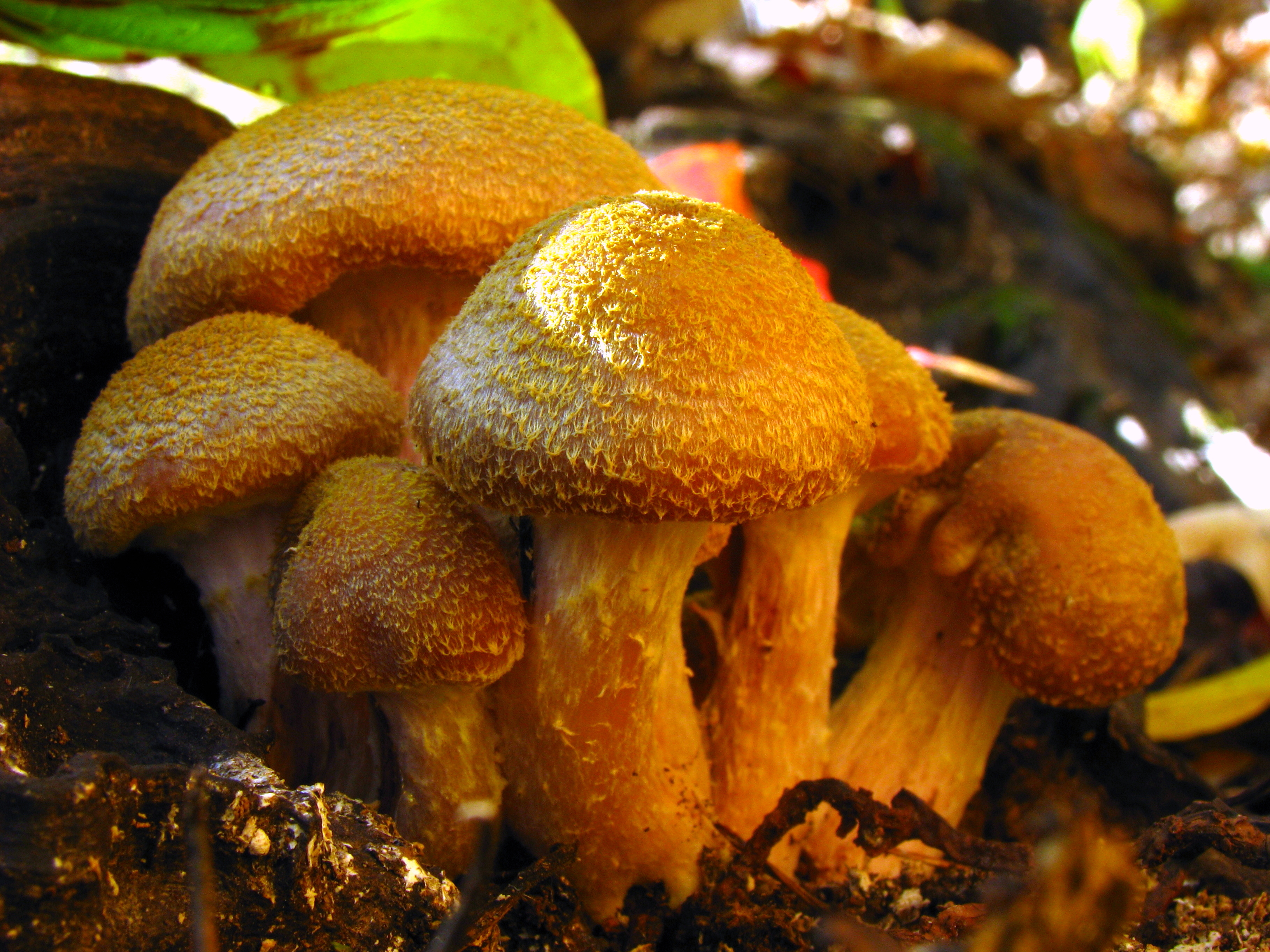
Dan Molter (shroomydan) · CC BY-SA 3.0
Oryginalny plik źródłowy, bez lokalnej zmiany kadru, barw lub treści.
Photo source · CC BY-SA 3.0Armillaria gallica
Key differences
Armillaria gallica differs by a more persistent, often woolly or star-like splitting ring, more abundant yellow velar remnants on the stipe, slower disappearance of scales on the cap margin, and spores that are more frequently ellipsoidal-amygdaliform.
The very similar club-footed honey fungus (Armillaria cepistipes) loses the scales on the cap margin more quickly, has sparser velar remnants on the stipe, and more frequently forms broadly ellipsoid spores measuring 7–9(10) × 4.5–6.5(7) µm.
FAQ
How does the bulbous honey fungus differ from the honey fungus?
This species is distinguished by a stipe that is clearly club-shaped or tuberously swollen at the base, a paler cap with finer scales, and a more delicate, less persistent, and woolly ring.
Can the bulbous honey fungus be consumed raw?
Absolutely not, raw fruit bodies contain substances that irritate the digestive tract and cause gastrointestinal poisoning. The mushrooms require cooking for a minimum of 15 minutes, and the cooking liquid must strictly be discarded.
Which poisonous mushrooms can this species be confused with?
The most dangerous lookalike is the poisonous funeral bell with a rusty spore print. It can also be confused with the sulphur tuft, which has a sulfur-yellow color and bitter-tasting flesh.
Which trees does the bulbous honey fungus most commonly colonize?
It grows mainly on deciduous wood, choosing oaks, beeches, birches, alders, and ashes. It is occasionally found on spruces or pines, where it colonizes dead stumps or fallen logs.
Why are mainly caps collected for culinary purposes?
The stipes of honey fungi are tough, hard, and fibrous, which leaves them unpalatable and difficult to digest after frying or cooking. Young caps, on the other hand, offer a delicate texture that is pleasant to eat.
Does the bulbous honey fungus exhibit bioluminescence?
Yes, its mycelium growing through decaying wood can emit a gentle, greenish light in the dark. This phenomenon can be observed at night on rotten stumps in humid parts of the forest.
Is the bulbous honey fungus a dangerous parasite of trees?
Compared to the honey fungus or dark honey fungus, it is a weaker pathogen. It functions primarily as a saprotroph on dead wood, and attacks living trees only when they are severely weakened or diseased.
How best to preserve this species for the winter?
A great method of preservation is pickling parboiled caps in a vinegar marinade. These mushrooms are also excellently suited for freezing after prior blanching and thorough draining of water.
In which months does the peak fruiting of the bulbous honey fungus occur?
The main flush of fruit bodies occurs in autumn, most often from mid-September to late October. Under favorable, warm, and humid weather, individual tufts can still be found in November.
What are the black mycelial cords visible under tree bark?
These are rhizomorphs, or compact bundles of mycelium used to transport nutrients and colonize subsequent stumps. They allow the honey fungus to spread efficiently in the forest substrate.
Enthusiast
Names and history
- Obowiązująca nazwa krajowa
- opieńka cebulotrzonowa
- Obowiązująca nazwa taksonomiczna
- Armillaria cepistipes Velen.
- Inne nazwy krajowe
- Mullet Honey Fungus
- Pozostałe nazwy
- opieńka drobna, opieńka maczugowata
Home observations
Spore print
- Required materials
- fresh, mature cap, sheet of paper, glass or small bowl, water
- Time
- 2–24 h
- Procedure
- Place the cap underside down on the paper.
- Add a drop of water on top and cover.
- After 2–24 hours, lift the cap and examine the deposit.
What to look for
- Spore print colour
- Spore print colour: white.
Under the microscope
- Required materials
- light microscope, microscope slide and cover slip, needle, water, spores from print
- Procedure
- Transfer a small amount of the spore print onto the slide using a needle.
- Add a drop of water, cover with a cover slip, and examine the spores.
What to look for
- Spore shape
- Spore shape: broadly ellipsoid. Spore shape: subglobose. Spore shape: ellipsoid. Spore shape: broadly ellipsoid. Spore shape: subglobose. Spore shape: ellipsoid. Spore shape: almond-shaped.
- Spore surface
- Spore surface: smooth.
- Spore dimensions
- Length 6.5–10 µm, width 4–7 µm.
- Spore dimensions
- Length 8.3 µm, width 5.3 µm.
- Spore dimensions
- Length 8.5 µm, width 5.4 µm.
Compare dimensions after calibrating the microscope scale.
Ecology and distribution
- Mode of nutrition
- Mode of nutrition: saprotrophic.
Mode of nutrition: parasitic.
Non-culinary uses
After preliminary parboiling, the bulbous honey fungus constitutes a valuable culinary ingredient with a firm texture and distinct aroma. The stipes can be hard and fibrous, which is why mostly only the young caps are used in cooking. They are excellent for pickling in a vinegar marinade with added spices, creating a classic appetizer. This mushroom also works perfectly in cream sauces, fillings for dumplings, mushroom soups, and aromatic dishes braised with meat or vegetables.
History and culture
For decades, the bulbous honey fungus was not distinguished from the common honey fungus and functioned in folk tradition as a single collective taxon. Mass autumn harvests of honey fungi constituted a key element of the rural calendar in Central Europe, securing household winter supplies. Only modern mycological research in the late 20th century separated this species. In forestry culture, honey fungi command respect as powerful mycelia and agents of white rot in weakened forest stands.
Edibility and safety
This species is edible, but only after careful heat treatment. Raw or undercooked fruit bodies are toxic and cause severe gastrointestinal disorders. Before further preparation, honey fungi require boiling for 15–20 minutes, and the resulting water must strictly be discarded. When collecting this species, one must watch out for the poisonous sulphur tuft and the deadly funeral bell, which differs by a smooth stipe, a more delicate ring, and a rusty spore print.
Habitat and occurrence
The bulbous honey fungus is a saprotroph or weak parasite of deciduous trees, more rarely coniferous ones. It occurs in deciduous and mixed forests, parks, and gardens, colonizing stumps, dead logs, roots, and fallen branches. It prefers beech, oak, hornbeam, birch, and ash. Unlike other honey fungi, it more often grows on heavily decomposed wood. Fruit bodies appear from August to November, growing in impressive clusters after heavy autumn rains.
Researcher
Where and when it grows
Fruiting season
Edibility and culinary use
Ustalenia źródłowe: jadalność, spożycie i wykorzystanie
- Required processing
- Requires cooking
Gobarsko društvo Lisička — Armillaria cepistipes, čebulasta mraznica. · Sekcja zastosowań, wiersz 25: wymagane gotowanie i odlanie wody.
Grzegorz Chodacki — Opieńki: rodzaje, sezon i rozpoznawanie. Grzyby.edu.pl. · Wiersze 42 i 103–111: zalecenie dla grupy opieniek w Polsce — gotowanie przez 15–20 minut i odlanie wody.
- Raw consumption
- Poisonous
Material: raw
Österreichische Mykologische Gesellschaft, Speisewert · Wiersz Armillaria cepistipes: Zusatz roh stark giftig; dotyczy surowych owocników.
- Edibility
- Edible
Grzyby.pl — opieńka cebulotrzonowa, opis gatunku i wybrane obserwacje. · Ocena jadalności w wierszu 60; polski atlas, oznaczenie gatunku w nagłówku i ścieżce strony (wiersze 23–28).
- Edibility
- Edible
Material: fully prepared
Grzegorz Chodacki — Opieńki: rodzaje, sezon i rozpoznawanie. Grzyby.edu.pl. · Wiersze 33, 36–42 i 103–111: grupa opieniek w Polsce obejmuje A. cepistipes; warunkowa jadalność grupy, wymagane gotowanie i odlanie wody.
Gobarsko društvo Lisička — Armillaria cepistipes, čebulasta mraznica. · Sekcja zastosowań, wiersz 25: warunkowa jadalność, dokładne gotowanie i odlanie wody.
- Edibility
- Poisonous — źródło oznaczenia
Österreichische Mykologische Gesellschaft, Speisewert · Wiersz Armillaria cepistipes w tabeli: „giftig” — trujący; „roh stark giftig” — surowy silnie trujący. Zachowano wcześniejszy odczyt tabeli i fragment z indeksu; bieżące bezpośrednie otwarcie strony przekroczyło czas oczekiwania.
Scientific names and taxonomy
- Current scientific name
Armillaria cepistipes Velen.
Armillaria cepistipes Velen. należy do rodziny obrzękowcowatych (Physalacriaceae), rzędu pieczarkowców (Agaricales) i klasy pieczarniaków (Agaricomycetes). Gatunek został opisany przez Josefa Velenovskiego w 1920 roku w drugim tomie dzieła České Houby pod pierwotną pisownią Armillaria cepaestipes. Miejsce publikacji materiału typowego to Czechy. W międzynarodowych bazach taksonomicznych takson rejestrowany jest pod kodem EPPO ARMLCE oraz identyfikatorem NCBI Taxonomy ID 47426.
Historical scope of names and species concepts
W źródłach niemieckojęzycznych takson nosi zwyczajową nazwę Zwiebelfüßiger Hallimasch (zapisywaną w wykazach także jako zwiebelfüssiger Hallimasch).
Taxon scope and identification limitations
Morfologiczne odróżnienie starych okazów A. cepistipes i A. gallica w terenie bywa niemożliwe z powodu nakładania się cech pokroju i barw. Pewne rozgraniczenie obu gatunków zapewniają analizy sekwencji genu tef1-α.
- Zakres ujęcia taksonomicznego
Armillaria cepistipes Velen., 1920 (Index Fungorum 260244), w zakresie europejskiego materiału Antonína i współautorów (2009) oraz niezależnego atlasu polskiego. Materiał o pośrednim obrazie ITS PCR-RFLP opisano oddzielnie. Sekwencje tefα trzech takich okazów wspierają oznaczenie A. cepistipes; nie dowodzą hybrydowego pochodzenia ani zsekwencjonowania wszystkich opisanych okazów. Oryginalną pisownię cepaestipes i niepewną nazwę inflata zachowano w dokumentacji źródłowej. Nie przypisano niepotwierdzonych dawnych kombinacji ani synonimów.
[5] [3] [15] [8]
Ecology and distribution
Laboratory diagnostics
Dane ustrukturyzowane
Basidia
Caulocystidia
- Clamp connections
- Clamp connections: present. [1]
Hymenial cystidia
Remaining laboratory characters
- Presence of rhizomorphs
- Presence of rhizomorphs: present. [3]
Pileipellis
- Arrangement of pileipellis hyphae
- Arrangement of pileipellis hyphae: radial. [1]
- Length of pileipellis elements
- Length of pileipellis elements: 25–140 µm. [1]
- Width of pileipellis elements
- Width of pileipellis elements: 7.5–30 µm. [1]
- Structure of the pileipellis
- Structure of the pileipellis: cutis. [1]
- Pileipellis terminal cell length
- Pileipellis terminal cell length: 15–125 µm. [1]
- Shape of the terminal cell of the pileipellis
- Shape of the terminal cell of the pileipellis: conical. [1]
Shape of the terminal cell of the pileipellis: cylindrical. [1] - Pileipellis terminal cell width
- Pileipellis terminal cell width: 5–25 µm. [1]
Spores
- Spore length
- Spore length: 8.3 µm (mean). [1]
Spore length: 7–8 µm. [3]
Spore length: 8.5 µm (mean). [1]
Spore length: 7–10 µm. [1]
Spore length: 6.5–10 µm. [1] - Spore length-to-width ratio
- Spore length-to-width ratio: 1.3–1.9 (range of collection means). [1]
- Spore shape
- Spore shape: broadly ellipsoid. [1]
Spore shape: subglobose. [1]
Spore shape: ellipsoid. [1]
Spore shape: broadly ellipsoid. [1]
Spore shape: subglobose. [1]
Spore shape: ellipsoid. [1]
Spore shape: almond-shaped. [1] - Spore surface
- Spore surface: smooth. [3]
Material and research methods
Description of characteristics — source and scope
Materiał: Polskie obserwacje martwego drewna opisane dla A. cepistipes; opis dyskusji, druk s. 18. Szczegółowych prób gospodarzy nie utożsamiono z konkretną kategorią materiału.
Zakres odczytu: Pełny tekst.
[9]Archiwalny opis siedliska
Gatunek rozwija się na martwym drewnie korzeni, pniaków, pni i gałęzi, w tym na szczątkach zagrzebanych w ściółce, powodując białą zgniliznę drewna. Na osłabionych drzewach może funkcjonować jako słaby patogen nekrotroficzny korzeni i odziomka.
Zasiedla szerokie spektrum drzew liściastych (buk, dąb, grab, olsza, jesion, brzoza, wierzba) oraz iglastych (świerk, jodła, sosna), występując od nizin po regiel górski (w Europie Środkowej głównie na wysokościach 500–900 m n.p.m.).
W Europie Środkowej owocniki pojawiają się od września do pierwszych silniejszych mrozów w listopadzie, rosnąc pojedynczo lub w małych grupach.
- Results as recorded in the sources — Hymenial cystidium length
- na ostrzu blaszki: 14–35 µm [1]
na ostrzu blaszki: 20–50 µm [1] - Results as recorded in the sources — Hymenial cystidium width
- na ostrzu blaszki: 6–11 µm [1]
na ostrzu blaszki: 7–15 µm [1] - Results as recorded in the sources — Spore length
- Średnia długość zarodnika w badanym materiale wynosi 8,5 mikrometra. [1]
Średnia długość zarodnika w badanym materiale wynosi 8,3 mikrometra. [1]
6,5–10 µm [1]
Materiał badania: Materiał atlasowy: strona gatunkowa atlasu grzyby.pl dla A. cepistipes, z atlasowym pomiarem zarodników 7–8 × 5–6 µm. Strona nie podaje vouchera, pojedynczej kolekcji, metody mikroskopowej ani liczebności pomiarów; nie przypisuj tych zakresów do badania Antonína. 7–8 µm [3]
7–9 µm (skrajnie do 10 µm) [1] - Results as recorded in the sources — Spore width
- Materiał badania: Materiał atlasowy: strona gatunkowa atlasu grzyby.pl dla A. cepistipes, z atlasowym pomiarem zarodników 7–8 × 5–6 µm. Strona nie podaje vouchera, pojedynczej kolekcji, metody mikroskopowej ani liczebności pomiarów; nie przypisuj tych zakresów do badania Antonína. 5–6 µm [3]
Średnia szerokość zarodnika w badanym materiale wynosi 5,3 mikrometra. [1]
Średnia szerokość zarodnika w badanym materiale wynosi 5,4 mikrometra. [1]
4–6,5 µm [1]
4,5–6,5 µm (skrajnie do 7 µm) [1]
Metody i zapisy źródłowe — Materiał publikowanego gatunkowego opisu A. cepistipes u Antonín et al. 2009, opartego na własnych obserwacjach pierwszego autora. Badanie obejmowało 51 okazów łącznie dla kilku taksonów; źródło nie mapuje gatunkowych wymiarów mikroskopowych do konkretnych voucherów ani N dla każdej cechy.
Pochodzenie materiału: Badanie obejmuje materiał z Czech i Słowacji (zakres artykułu/Table 1); źródło nie przypisuje każdej cechy gatunkowej lub średniej do pojedynczego stanowiska..
Układ strzępek skórki — zapis źródłowy: „Pileipellis hyphae radially arranged.” [1]
Liczba zarodników na jednej podstawce — zapis źródłowy: „Podstawki czterozarodnikowe.” [1]
Długość podstawki; Kształt podstawki — zapis źródłowy: „Podstawki 29–45 × 8,5–11 µm, dość wąsko maczugowate; długość jest pierwszą osią pomiaru.” [1]
Szerokość podstawki — zapis źródłowy: „Podstawki 29–45 × 8,5–11 µm, dość wąsko maczugowate; szerokość jest drugą osią pomiaru.” [1]
Długość kaulocystyd; Kształt kaulocystyd — zapis źródłowy: „Caulocystydy 15–60 × 10–20(30) µm, maczugowate, pęcherzykowate lub szydłowate, cienko- lub nieco grubościenne, pojedyncze albo w łańcuchach.” [1]
Szerokość kaulocystyd — zapis źródłowy: „Caulocystidia 15–60×10–20 (30) µm.” [1]
Długość elementów skórki kapelusza; Szerokość elementów skórki — zapis źródłowy: „Pileus-scale cells 25–125 (140)×7.5–30 µm.” [1]
Organizacja skórki kapelusza — zapis źródłowy: „Skórka typu cutis: promieniście ułożone cylindryczne, zasadniczo cienkościenne strzępki bez sprzążek; komórki końcowe nieregularnie cylindryczne do koralowatych.” [1]
Długość komórki końcowej skórki kapelusza; Szerokość komórki końcowej skórki kapelusza — zapis źródłowy: „Terminal cells 15–90 (125)×5–25 µm.” [1]
Kształt komórki końcowej skórki kapelusza — zapis źródłowy: „Terminal cells subulate, conical, ellipsoid to cylindrical.” [1]
Długość zarodnika — zapis źródłowy: „Zarodniki 7–9(10) × 4,5–6,5(7) µm, średnio 8,3 × 5,3 µm; długość jest pierwszą osią pomiaru.” [1]
Długość zarodnika; Szerokość zarodnika — zapis źródłowy: „mean=8.3×5.3 µm.” [1]
Kształt zarodnika — zapis źródłowy: „Przeważnie szeroko elipsoidalne do niemal kulistych, wymieszane z rzadziej lub dość często występującymi elipsoidalnymi.” [1]
Grubość ściany zarodnika — zapis źródłowy: „Zarodniki cienko- i grubościenne w tym samym opisie.” [1]
Szerokość zarodnika — zapis źródłowy: „Zarodniki 7–9(10) × 4,5–6,5(7) µm, średnio 8,3 × 5,3 µm; szerokość jest drugą osią pomiaru.” [1]
Metody i zapisy źródłowe — Materiał publikowanego gatunkowego opisu A. cepistipes u Antonín et al. 2009, opartego na własnych obserwacjach pierwszego autora. Badanie obejmowało 51 okazów łącznie dla kilku taksonów; źródło nie mapuje gatunkowych wymiarów mikroskopowych do konkretnych voucherów ani N dla każdej cechy.
Pochodzenie materiału: Badanie obejmuje materiał z Czech i Słowacji (zakres artykułu/Table 1); źródło nie przypisuje każdej cechy gatunkowej lub średniej do pojedynczego stanowiska..
Organizacja cheilocystyd — zapis źródłowy: „Cheilocystidia: mostly single, sometimes in fascicles. The schema has no source-frequency attribute for this field; wording remains literal.” [1]
Długość cystydy hymenialnej; Kształt cystydy hymenialnej; Szerokość cystydy hymenialnej — zapis źródłowy: „Cheilocystydy 14–35 × 6–11 µm, maczugowate lub prawie cylindryczne, regularne do często nieregularnych; pojedyncze albo w wiązkach, dwukomórkowe lub z łańcuchami komórek u dołu, cienko- lub nieco grubościenne.” [1]
Metody i zapisy źródłowe — Cztery kolekcje BRNM 706834, 706877, 695717 i 706816 z pośrednimi profilami PCR-RFLP, opisane oddzielnie od głównego gatunkowego morfu A. cepistipes. Średnie spory źródło podaje dla tej czterokolekcyjnej grupy; tylko trzy z czterech mają w Table 2 wiersz sekwencji tefa grupujący się z A. cepistipes. To nie ustala sekwencji dla BRNM 706877 ani każdej zmierzonej spory.
Pochodzenie materiału: Badanie obejmuje materiał z Czech i Słowacji (zakres artykułu/Table 1); źródło nie przypisuje każdej cechy gatunkowej lub średniej do pojedynczego stanowiska..
Długość cystydy hymenialnej; Szerokość cystydy hymenialnej — zapis źródłowy: „Okazy o pośrednim PCR-RFLP 20–50×7–15 µm; odrębne od podstawowego opisu 14–35×6–11.” [1]
Metody i zapisy źródłowe — Atlasowy opis ryzomorf opieńki cebulotrzonowej, czasem obecnych u podstawy trzonu. Nie wskazano konkretnej kolekcji ani protokołu badania.
Pochodzenie materiału: Atlas grzybów Polski; nie wskazano lokalizacji ocenionego materiału..
Obecność ryzomorf — zapis źródłowy: „Ryzomorfy czasem obecne u podstawy trzonu.” [3]
Metody i zapisy źródłowe — Materiał atlasowy: strona gatunkowa atlasu grzyby.pl dla A. cepistipes, z atlasowym pomiarem zarodników 7–8 × 5–6 µm. Strona nie podaje vouchera, pojedynczej kolekcji, metody mikroskopowej ani liczebności pomiarów; nie przypisuj tych zakresów do badania Antonína.
Pochodzenie materiału: Polski atlas / polski zakres profilu; brak wskazanej kolekcji materiału..
Długość zarodnika — zapis źródłowy: „Atlas Polski: zarodniki 7–8 × 5–6 µm. Długość jest pierwszą osią; metoda i liczba pomiarów niepodane.” [3]
Powierzchnia zarodnika — zapis źródłowy: „Zarodniki gładkie według atlasu; protokół mikroskopii niepodany.” [3]
Szerokość zarodnika — zapis źródłowy: „Atlas Polski: zarodniki 7–8 × 5–6 µm. Szerokość jest drugą osią; metoda i liczba pomiarów niepodane.” [3]
Metody i zapisy źródłowe — Cztery kolekcje BRNM 706834, 706877, 695717 i 706816 z pośrednimi profilami PCR-RFLP, opisane oddzielnie od głównego gatunkowego morfu A. cepistipes. Średnie spory źródło podaje dla tej czterokolekcyjnej grupy; tylko trzy z czterech mają w Table 2 wiersz sekwencji tefa grupujący się z A. cepistipes. To nie ustala sekwencji dla BRNM 706877 ani każdej zmierzonej spory.
Pochodzenie materiału: Badanie obejmuje materiał z Czech i Słowacji (zakres artykułu/Table 1); źródło nie przypisuje każdej cechy gatunkowej lub średniej do pojedynczego stanowiska..
Długość zarodnika — zapis źródłowy: „Okazy o pośrednim PCR-RFLP: zarodniki 6,5–10 × 4–6,5 µm, średnio 8,5 × 5,4 µm. Długość jest pierwszą osią. Trzy analizowane sekwencje tefa przypisano do A. cepistipes.” [1]
Długość zarodnika; Szerokość zarodnika — zapis źródłowy: „average 8.5×5.4 µm.” [1]
Iloraz długości i szerokości zarodnika — zapis źródłowy: „Q=1.3–(1.8)–1.9.” [1]
Kształt zarodnika — zapis źródłowy: „Okazy o pośrednim PCR-RFLP: zarodniki szeroko elipsoidalne do niemal kulistych oraz elipsoidalne do lekko migdałowatych.” [1]
Szerokość zarodnika — zapis źródłowy: „Okazy o pośrednim PCR-RFLP: zarodniki 6,5–10 × 4–6,5 µm, średnio 8,5 × 5,4 µm. Szerokość jest drugą osią. Trzy analizowane sekwencje tefa przypisano do A. cepistipes.” [1]
Żółciak 2003: scope and identification of the material
Materiał i identyfikacja: W latach 1988–1998 z 433 stanowisk w Polsce pozyskano 1700 prób: owocniki, drewno przerośnięte grzybnią i ryzomorfy. W 710 przypadkach zastosowano testy intersterylności, a 990 owocników oznaczono na podstawie cech makro- i mikroskopowych oraz fenologii. Nie podano powiązania rodzaju materiału z każdym gospodarzem.
[9]Occurrence verification — scope and limitations
Materiał: Występowanie opieńki cebulotrzonowej w Polsce: polski atlas i datowane obserwacje oznaczone tym gatunkiem.
Zakres odczytu: Fragmenty źródeł.
Odczytano fragment źródła; pełny tekst i metody nie zostały zweryfikowane.
Data przeglądu: 29.10.2026.
[3]Materiał: Występowanie opieńki cebulotrzonowej w południowej i środkowej Norwegii: 54 izolaty z 20 gmin, opisane w sekcji 3.4 wyników. Izolaty nie są datowanymi obserwacjami owocników.
Zakres odczytu: Fragmenty źródeł.
Odczytano fragment źródła; pełny tekst i metody nie zostały zweryfikowane.
Data przeglądu: 29.10.2026.
[6]Materiał: Owocniki opieńki cebulotrzonowej zebrane 25 września 2020 roku w lesie na granicy obwodów nowogrodzkiego i leningradzkiego w Rosji; oznaczenie V. Volobueva, publikacja Bakanova i współautorów (2022). Kapelusze i trzony stanowią części tego materiału, a nie dwie niezależne obserwacje występowania.
Zakres odczytu: Fragmenty źródeł.
Odczytano fragment źródła; pełny tekst i metody nie zostały zweryfikowane.
Data przeglądu: 29.10.2026.
[12]Scope of the review
Before completion, the record requires completion or settlement.
- Recorded source information is pending review.
- New sources require checking the information encountered during review.
Information awaiting a decision: 14
Legal basis and scope of assessment
Regulations for location: Poland
Key substances and their effects
W badaniach taksonomicznych nad kompleksem A. cepistipes–A. gallica zastosowano metodę PCR-RFLP regionu ITS z użyciem enzymu restrykcyjnego HinfI, co pozwoliło wyodrębnić profile prążkowe charakterystyczne dla poszczególnych gatunków.
Profil trawienia enzymem HinfI dla A. cepistipes daje prążki o długości 294, 227, 132 oraz 43 par zasad, podczas gdy u form o profilu pośrednim widoczne są dodatkowe pasma wynikające z polimorfizmu kopii genu.
Sekwencjonowanie fragmentu genu tef1-α wykazało dystans genetyczny rzędu 0,0526–0,0571 między A. cepistipes a A. gallica, potwierdzając przynależność okazów o nietypowym profilu restrykcyjnym do A. cepistipes.
Analizy molekularne europejskich kolekcji zielnikowych powiązały potwierdzone profile sekwencyjne A. cepistipes m.in. ze zbiorem z Czech na drewnie buka oraz ze Słowacji na świerku i olszy.
Drzewa filogenetyczne oparte na genie tef1-α wskazują na bliższe pokrewieństwo europejskich populacji A. cepistipes z kladem A. ostoyae–A. borealis niż z A. gallica.
W analizach fitochemicznych wysuszonych owocników badano zawartość frakcji lipidowych i cukrowych w tkankach kapelusza i trzonu.
Ekstrakcja frakcyjna rozpuszczalnikami organicznymi (eter naftowy, MTBE, izopropanol, woda) pozwoliła na rozdział lipidów obojętnych, wolnych kwasów tłuszczowych oraz węglowodanów.
Wydajność ekstrakcji wodnej wynosiła 28,8% dla trzonu i 35,1% dla kapelusza w przeliczeniu na suchą masę.
W profilu kwasów tłuszczowych dominują kwas linolowy (34,5% w kapeluszu i 40,7% w trzonie), kwas oleinowy oraz kwas palmitynowy.
Wśród steroli zidentyfikowano obecność ergosterolu i jego pochodnych w tkankach owocników.
Trójglicerydy stanowią około 1,1% suchej masy kapelusza i poniżej 0,1% suchej masy trzonu.
Wśród rozpuszczalnych węglowodanów główną frakcję stanowi mannitol (76,8% frakcji cukrowej w kapeluszu i 52,5% w trzonie) oraz treitol.
W wysuszonych tkankach oznaczano śladowe zawartości metali, w tym żelaza (210–221 mg/kg), kadmu (0,25–0,67 mg/kg) oraz rtęci (0,04 mg/kg).
Badania laboratoryjne potwierdzają dużą zmienność ilościową metabolitów podstawowych między trzonem a kapeluszem owocnika.
Właściwości biochemiczne wykazane w testach laboratoryjnych nie stanowią podstawy do przypisywania owocnikom działania terapeutycznego w diecie człowieka.
Differing taste descriptions and edibility assessments
Smak miąższu: Antonín i in. opisują miąższ jako cierpki i nieprzyjemny w smaku. Gobarsko društvo Lisička (Gobe.si) określa smak jako łagodny, a przy dłuższym żuciu odnotowuje drażniące odczucie w gardle. To różne sformułowania źródłowe; nie dowodzą wspólnego materiału ani tej samej metody oceny.
Oceny jadalności: GRej klasyfikuje gatunek jako jadalny bez podanego warunku przygotowania. Gobarsko društvo Lisička (Gobe.si) podaje jadalność warunkową po dokładnym gotowaniu i odlaniu wody. Chodacki omawia wspólne zasady polskiego kompleksu opieniek i podaje 15–20 minut gotowania z odlaniem wody; A. cepistipes jest w tym kompleksie wymieniona. Tabela ÖMG ocenia gatunek jako trujący, a w uwadze wyróżnia materiał surowy jako silnie trujący.
Zakres twierdzeń o przygotowaniu: Dokładny czas 15–20 minut pochodzi z wtórnego poradnika dla polskiego kompleksu, nie z Gobarsko društvo Lisička (Gobe.si) ani z pierwotnego porównania bezpieczeństwa. Gobarsko društvo Lisička (Gobe.si) wskazuje gotowanie i odlanie wody bez czasu. Wpis ÖMG jest oceną tabelaryczną; podany w nim zwrot o materiale surowym pozostaje odrębnym zakresem przygotowania.
[1] [2] [3] [4] [16]Analytical results
Separate analytical results from the source
- analyte as named in the source: Petroleum ether extract
- 1.3 %; cap; dry-mass basis; solvent extraction, gravimetric yield determination.[12]
- analyte as named in the source: MTBE extract
- 6.3 %; cap; dry-mass basis; solvent extraction, gravimetric yield determination.[12]
- analyte as named in the source: Isopropanol-soluble substances (IPS)
- 10.4 %; cap; dry-mass basis; solvent extraction, gravimetric yield determination.[12]
- analyte as named in the source: Hot-water-soluble substances
- 35.1 %; cap; dry-mass basis; solvent extraction, gravimetric yield determination.[12]
- analyte as named in the source: Neutral substances in MTBE extract
- 68 %; cap; on the mass basis of the tested extract; MTBE extraction, separation of acids and neutral compounds with 1% aqueous NaOH.[12]
- analyte as named in the source: Acids in MTBE extract
- 32 %; cap; on the mass basis of the tested extract; MTBE extraction, separation of acids and neutral compounds with 1% aqueous NaOH.[12]
- analyte as named in the source: 9-Oxo-nonanoic acid
- 0.3 %; cap; on the mass basis of the tested extract; GC–MS of methyl esters after derivatization.[12]
- analyte as named in the source: Lauric acid
- 0.4 %; cap; on the mass basis of the tested extract; GC–MS of methyl esters after derivatization.[12]
- analyte as named in the source: Azelaic acid
- 0.4 %; cap; on the mass basis of the tested extract; GC–MS of methyl esters after derivatization.[12]
- analyte as named in the source: Myristic acid
- 0.4 %; cap; on the mass basis of the tested extract; GC–MS of methyl esters after derivatization.[12]
- analyte as named in the source: Pentadecylic acid
- 0.4 %; cap; on the mass basis of the tested extract; GC–MS of methyl esters after derivatization.[12]
- analyte as named in the source: Palmitoleic acid
- 5.9 %; cap; on the mass basis of the tested extract; GC–MS of methyl esters after derivatization.[12]
- analyte as named in the source: Palmitic acid
- 22.8 %; cap; on the mass basis of the tested extract; GC–MS of methyl esters after derivatization.[12]
- analyte as named in the source: Linoleic acid
- 34.5 %; cap; on the mass basis of the tested extract; GC–MS of methyl esters after derivatization.[12]
- analyte as named in the source: Oleic acid
- 26.9 %; cap; on the mass basis of the tested extract; GC–MS of methyl esters after derivatization.[12]
- analyte as named in the source: 11-octadecenenoic acid
- 4.7 %; cap; on the mass basis of the tested extract; GC–MS of methyl esters after derivatization.[12]
- analyte as named in the source: Stearic acid
- 1.8 %; cap; on the mass basis of the tested extract; GC–MS of methyl esters after derivatization.[12]
- analyte as named in the source: Monoglyceride
- 51.8 %; cap; on the mass basis of the tested extract; GC–MS of the volatile neutral MTBE fraction.[12]
- analyte as named in the source: Unidentified peak(s), retention time 30.6–30.9 and 35.4
- 2.4 %; cap; on the mass basis of the tested extract; GC–MS of the volatile neutral MTBE fraction.[12]
- analyte as named in the source: Anthraergostatetraenol
- 1.6 %; cap; on the mass basis of the tested extract; GC–MS of the volatile neutral MTBE fraction.[12]
- analyte as named in the source: Unidentified peak(s), retention time 34.0–35.8
- 2.3 %; cap; on the mass basis of the tested extract; GC–MS of the volatile neutral MTBE fraction.[12]
- analyte as named in the source: Ergosterol
- 1.5 %; cap; on the mass basis of the tested extract; GC–MS of the volatile neutral MTBE fraction.[12]
- analyte as named in the source: Ergosta-5,8,22-trien-3-ol
- 17.8 %; cap; on the mass basis of the tested extract; GC–MS of the volatile neutral MTBE fraction.[12]
- analyte as named in the source: Unidentified peak(s), retention time 37.4
- 1.0 %; cap; on the mass basis of the tested extract; GC–MS of the volatile neutral MTBE fraction.[12]
- analyte as named in the source: Ergosta-7-en-3β-ol
- 3.0 %; cap; on the mass basis of the tested extract; GC–MS of the volatile neutral MTBE fraction.[12]
- analyte as named in the source: Unidentified peak(s), retention time 39.2–41.4
- 1.5 %; cap; on the mass basis of the tested extract; GC–MS of the volatile neutral MTBE fraction.[12]
- analyte as named in the source: Stigmast-5,22-dien-3-ol
- 6.3 %; cap; on the mass basis of the tested extract; GC–MS of the volatile neutral MTBE fraction.[12]
- analyte as named in the source: Unidentified peak(s), retention time 42.3
- 10.2 %; cap; on the mass basis of the tested extract; GC–MS of the volatile neutral MTBE fraction.[12]
- analyte as named in the source: Triglycerides recovered from petroleum extract
- 83 %; cap; on the mass basis of the tested extract; GC–FID on a high-temperature DB-HT SimDis column after separation of neutral glycerides with acetone at −20 °C for 16 hours.[12]
- analyte as named in the source: Glycerol
- 1.8 %; cap; on the mass basis of the tested extract; analysis after preliminary derivatization.[12]
- analyte as named in the source: Threitol
- 16.6 %; cap; on the mass basis of the tested extract; analysis after preliminary derivatization.[12]
- analyte as named in the source: Erythritol
- 0.6 %; cap; on the mass basis of the tested extract; analysis after preliminary derivatization.[12]
- analyte as named in the source: Ribitol
- 0.1 %; cap; on the mass basis of the tested extract; analysis after preliminary derivatization.[12]
- analyte as named in the source: Arabitol
- 1.2 %; cap; on the mass basis of the tested extract; analysis after preliminary derivatization.[12]
- analyte as named in the source: α-Glucose
- 0.2 %; cap; on the mass basis of the tested extract; analysis after preliminary derivatization.[12]
- analyte as named in the source: Mannitol
- 76.8 %; cap; on the mass basis of the tested extract; analysis after preliminary derivatization.[12]
- analyte as named in the source: Trehalose
- 2.5 %; cap; on the mass basis of the tested extract; analysis after preliminary derivatization.[12]
- analyte as named in the source: Hg
- 0.04 mg/kg; cap; mass basis unspecified in the source; metal analysis after isopropanol extraction, method cited as reference 9 in the source.[12]
- analyte as named in the source: Cd
- 0.67 mg/kg; cap; mass basis unspecified in the source; metal analysis after isopropanol extraction, method cited as reference 9 in the source.[12]
- analyte as named in the source: Fe
- 221.3 mg/kg; cap; mass basis unspecified in the source; metal analysis after isopropanol extraction, method cited as reference 9 in the source.[12]
- analyte as named in the source: Petroleum ether extract
- 0.2 %; stipe; dry-mass basis; solvent extraction, gravimetric yield determination.[12]
- analyte as named in the source: MTBE extract
- 0.7 %; stipe; dry-mass basis; solvent extraction, gravimetric yield determination.[12]
- analyte as named in the source: Isopropanol-soluble substances (IPS)
- 21.2 %; stipe; dry-mass basis; solvent extraction, gravimetric yield determination.[12]
- analyte as named in the source: Hot-water-soluble substances
- 28.8 %; stipe; dry-mass basis; solvent extraction, gravimetric yield determination.[12]
- analyte as named in the source: Neutral substances in MTBE extract
- 24 %; stipe; on the mass basis of the tested extract; MTBE extraction, separation of acids and neutral compounds with 1% aqueous NaOH.[12]
- analyte as named in the source: Acids in MTBE extract
- 76 %; stipe; on the mass basis of the tested extract; MTBE extraction, separation of acids and neutral compounds with 1% aqueous NaOH.[12]
- analyte as named in the source: 9-Oxo-nonanoic acid
- 9.0 %; stipe; on the mass basis of the tested extract; GC–MS of methyl esters after derivatization.[12]
- analyte as named in the source: Azelaic acid
- 1.3 %; stipe; on the mass basis of the tested extract; GC–MS of methyl esters after derivatization.[12]
- analyte as named in the source: Palmitic acid
- 32.5 %; stipe; on the mass basis of the tested extract; GC–MS of methyl esters after derivatization.[12]
- analyte as named in the source: Linoleic acid
- 40.7 %; stipe; on the mass basis of the tested extract; GC–MS of methyl esters after derivatization.[12]
- analyte as named in the source: Oleic acid
- 14.4 %; stipe; on the mass basis of the tested extract; GC–MS of methyl esters after derivatization.[12]
- analyte as named in the source: Stearic acid
- 1.0 %; stipe; on the mass basis of the tested extract; GC–MS of methyl esters after derivatization.[12]
- analyte as named in the source: Monoglyceride
- 3.3 %; stipe; on the mass basis of the tested extract; GC–MS of the volatile neutral MTBE fraction.[12]
- analyte as named in the source: Unidentified peak(s), retention time 30.6–30.9 and 35.4
- 7.4 %; stipe; on the mass basis of the tested extract; GC–MS of the volatile neutral MTBE fraction.[12]
- analyte as named in the source: Anthraergostatetraenol
- 1.7 %; stipe; on the mass basis of the tested extract; GC–MS of the volatile neutral MTBE fraction.[12]
- analyte as named in the source: Unidentified peak(s), retention time 34.0–35.8
- 2.1 %; stipe; on the mass basis of the tested extract; GC–MS of the volatile neutral MTBE fraction.[12]
- analyte as named in the source: Ergosta-5,7,9(11),22-tetraen-3β-ol
- 2.1 %; stipe; on the mass basis of the tested extract; GC–MS of the volatile neutral MTBE fraction.[12]
- analyte as named in the source: Unidentified peak, retention time 36.3
- 2.1 %; stipe; on the mass basis of the tested extract; GC–MS of the volatile neutral MTBE fraction.[12]
- analyte as named in the source: Ergosterol
- 5.8 %; stipe; on the mass basis of the tested extract; GC–MS of the volatile neutral MTBE fraction.[12]
- analyte as named in the source: Ergosta-7,22-dien-3β-ol
- 4.6 %; stipe; on the mass basis of the tested extract; GC–MS of the volatile neutral MTBE fraction.[12]
- analyte as named in the source: Unidentified peak(s), retention time 37.4
- 4.7 %; stipe; on the mass basis of the tested extract; GC–MS of the volatile neutral MTBE fraction.[12]
- analyte as named in the source: Ergosta-14,22-dien-3-ol
- 5.8 %; stipe; on the mass basis of the tested extract; GC–MS of the volatile neutral MTBE fraction.[12]
- analyte as named in the source: Ergosta-7-en-3β-ol
- 19.5 %; stipe; on the mass basis of the tested extract; GC–MS of the volatile neutral MTBE fraction.[12]
- analyte as named in the source: Stigmasterol
- 3.4 %; stipe; on the mass basis of the tested extract; GC–MS of the volatile neutral MTBE fraction.[12]
- analyte as named in the source: Unidentified peak(s), retention time 39.2–41.4
- 23.7 %; stipe; on the mass basis of the tested extract; GC–MS of the volatile neutral MTBE fraction.[12]
- analyte as named in the source: Stigmast-5,22-dien-3-ol
- 11.9 %; stipe; on the mass basis of the tested extract; GC–MS of the volatile neutral MTBE fraction.[12]
- analyte as named in the source: Unidentified peak(s), retention time 42.3
- 4.7 %; stipe; on the mass basis of the tested extract; GC–MS of the volatile neutral MTBE fraction.[12]
- analyte as named in the source: Triglycerides recovered from petroleum extract
- 20 %; stipe; on the mass basis of the tested extract; GC–FID on a high-temperature DB-HT SimDis column after separation of neutral glycerides with acetone at −20 °C for 16 hours.[12]
- analyte as named in the source: Glycerol
- 1.2 %; stipe; on the mass basis of the tested extract; analysis after preliminary derivatization.[12]
- analyte as named in the source: Threitol
- 37.1 %; stipe; on the mass basis of the tested extract; analysis after preliminary derivatization.[12]
- analyte as named in the source: Erythritol
- 0.6 %; stipe; on the mass basis of the tested extract; analysis after preliminary derivatization.[12]
- analyte as named in the source: Arabitol
- 0.8 %; stipe; on the mass basis of the tested extract; analysis after preliminary derivatization.[12]
- analyte as named in the source: α-Glucose
- 0.4 %; stipe; on the mass basis of the tested extract; analysis after preliminary derivatization.[12]
- analyte as named in the source: Mannitol
- 52.5 %; stipe; on the mass basis of the tested extract; analysis after preliminary derivatization.[12]
- analyte as named in the source: β-Glucose
- 0.3 %; stipe; on the mass basis of the tested extract; analysis after preliminary derivatization.[12]
- analyte as named in the source: Trehalose
- 7.0 %; stipe; on the mass basis of the tested extract; analysis after preliminary derivatization.[12]
- analyte as named in the source: Hg
- 0.04 mg/kg; stipe; mass basis unspecified in the source; metal analysis after isopropanol extraction, method cited as reference 9 in the source.[12]
- analyte as named in the source: Cd
- 0.25 mg/kg; stipe; mass basis unspecified in the source; metal analysis after isopropanol extraction, method cited as reference 9 in the source.[12]
- analyte as named in the source: Fe
- 210.8 mg/kg; stipe; mass basis unspecified in the source; metal analysis after isopropanol extraction, method cited as reference 9 in the source.[12]
Ecological studies
Żółciak 2003: hosts and wood in the Polish material
Zestawienie próbek: Tabela 2 przypisuje opieńce cebulotrzonowej 278 prób: 194 związane z 18 nazwanymi gospodarzami oraz 84 oznaczone jako pochodzące z gleby, bez oznaczenia gospodarza. Są to wyniki celowo dobranej próby, a nie ogólnopolska częstość występowania.
Gospodarze z liczbowym wynikiem w tabeli 2: Quercus robur, Picea abies, Fagus silvatica, Abies alba, Carpinus betulus, Betula pendula, Larix decidua, Fraxinus excelsior, Corylus avellana, Acer pseudoplatanus, Prunus avium, Sorbus aucuparia, Alnus glutinosa, Salix caprea, Salix fragilis, Alnus incana, Tilia cordata, Ulmus glabra. Pisownię Fagus silvatica zachowano za publikacją. Lista dotyczy gospodarzy i kolonizacji; nie określa partnerów mikoryzowych.
Rozbieżność 18 i 19: Akapit wyników podaje 18 gospodarzy, natomiast abstrakt, tabela 3 i podsumowanie — 19. Tabela 3 dodatkowo wymienia Robinia pseudoacacia, której nie przypisano liczby w kolumnie A. cepistipes tabeli 2.
Martwe drewno: Autorka opisuje silnie rozłożone pniaki dębowe, bukowe i świerkowe, gałęzie bukowe oraz leżaninę bukową, wierzbową, świerkową i jodłową. Wskazuje wilgotne podłoże, często blisko wody.
[9]Kosonen: Finnish comparative observation
Względny termin owocnikowania: Kosonen w tekście z Suomen Luonto 7/2011, opublikowanym na stronie wydawcy w 2018 r., opisuje pojawianie się Armillaria cepistipes tydzień lub dwa po szczycie pojawu A. borealis. Nie określa miesiąca dla tego gatunku. Wzmianka o połowie września dotyczy opieniek zbiorczo.
[7]Keča and Solheim: scope of the Norwegian material
Materiał a kalendarz: Keča i Solheim (2011) uwzględnili 54 norweskie rekordy A. cepistipes, w tym 16 w kategorii owocników. Tabela materiału podaje rodzaj tkanki i etykiety zawierające lata. Nie podaje miesięcy ani zwykłego sezonu owocnikowania tego gatunku; nie można go odtworzyć z datowania kultur lub ryzomorf.
[6]Habitat and occurrence
Potwierdzony zasięg występowania
Wszystkie obszary potwierdzone w zapisanych danych źródłowych.
| Kraj | Regiony i stanowiska | Owocnikowanie | Sources |
|---|---|---|---|
| Czech Republic | Nie ustalono regionów w zapisanych danych | IX–XI |
|
| Norway | Nie ustalono regionów w zapisanych danych | Nie ustalono |
|
| Poland | Łódź Voivodeship; West Pomeranian Voivodeship | VII–XI — minimalny zakres obserwacji |
|
| Russia | Nie ustalono regionów w zapisanych danych | IX — minimalny zakres obserwacji |
|
| Slovakia | Nie ustalono regionów w zapisanych danych | IX–XI |
|
Sources
- Antonín i in. (2009). Kompleks Armillaria cepistipes–A. gallica w Czechach i na Słowacji. Mycological Progress 8: 259–271. DOI: 10.1007/s11557-009-0597-1.
- Gobarsko društvo Lisička — Armillaria cepistipes, čebulasta mraznica.
- Grzyby.pl — opieńka cebulotrzonowa, opis gatunku i wybrane obserwacje.
- Grzegorz Chodacki — Opieńki: rodzaje, sezon i rozpoznawanie. Grzyby.edu.pl.
- Index Fungorum, Name Record260244
- N. Keča and H. Solheim, Ecology and distribution of Armillaria species in Norway (2011), Forest Pathology 41: 120–132.
- Kosonen (2011), Sienikimppuja lahopuulla, Suomen Luonto — źródłowa wzmianka o Armillaria cepistipes w Finlandii.
- Przegląd źródłowy Armillaria cepistipes — morfologia, zakres materiału i oznaczenie.
- Żółciak 2003. Rozmieszczenie grzybów z rodzaju Armillaria w Polsce oraz ich rośliny żywicielskie. Leśne Prace Badawcze; publisher abstract.
- Przegląd urzędowych wykazów ochrony i obrotu — opieńka cebulotrzonowa, 29.10.2026.
- Bakanov et al. 2022. Extractive substances of saprotrophic mushrooms: Flammulina velutipes, Hypholoma capnoides, Armillaria borealis, Armillaria cepistipes. Heavy metal content. Khimiya Rastitelnogo Syrya 3:257–262. DOI 10.14258/jcprm.20220310984
- Rozporządzenie — ochrona gatunkowa grzybów, Dz.U. 2014 poz. 1408.
- Rozporządzenie — wykaz grzybów dopuszczonych do obrotu, Dz.U. 2026 poz. 258.
- EPPO Global Database, ARMLCE
- Österreichische Mykologische Gesellschaft, Speisewert