Inedible

Set your location to see data for your region.


The bitter bolete (Tylopilus felleus) is a mushroom from the family Boletaceae, often confused with the king bolete. It is distinguished by a brownish cap, tubes with a pinkish hue, and a stipe covered with a dark network. The flesh is white and does not change color when damaged, but due to its strong bitterness it is inedible. The bitterness does not subside during cooking or drying, so even one small mushroom ruins the entire dish. It grows from summer to autumn in coniferous forests, often on sandy soils.
Identification, habitat, and key differences.
Forager
Fruitbody structure
- Fruit body form
- Fruit body form: Cap, stipe.
Cap
- Cap shape
- in young fruit bodies: Cap shape: hemispherical.
Cap shape: convex.
in mature fruit bodies: Cap shape: convex. - Cap covering
- Cap covering: suede-like.
Cap covering: felty.
in old fruit bodies: Cap covering: glabrous. - Cap surface sheen
- Cap surface sheen: matt.
when dry: Cap surface sheen: matt.
when wet: Cap surface sheen: shiny. - Cap stickiness and sliminess
- when wet: Cap stickiness and sliminess: slimy.
when wet: Cap stickiness and sliminess: sticky. - Cap colour
- Cap colour: brown.
Cap colour: grey-brown.
Cap colour: ochre.
Cap colour: yellow.
Cap colour: buff brown.
Cap colour: light brown. - Cap diameter
- The cap measures 40–200 mm in diameter.
- Peelability of the cap cuticle
- Peelability of the cap cuticle: peelable (difficult to peel).
Underside of the cap
- Hymenophore type
- Hymenophore type: tubes.
Pores at stipe
- Hymenophore attachment to the stipe
- Hymenophore attachment to the stipe: attached to the stipe (tubes).
- Hymenophore profile at the stipe
- Hymenophore profile at the stipe: notched at the stipe (tubes).
- Pore shape
- in young fruit bodies: Pore shape: round.
in mature fruit bodies: Pore shape: angular. - Pore colour after damage
- Pore colour after damage: rust-coloured.
- Natural pore colour
- Natural pore colour: pinkish.
in young fruit bodies: Natural pore colour: white. - Natural tube colour
- in mature fruit bodies: Natural tube colour: pinkish.
in young fruit bodies: Natural tube colour: white.
Stem and base
- Stipe shape
- Stipe shape: cylindrical.
Stipe shape: club-shaped.
in young fruit bodies: Stipe shape: barrel-shaped.
in mature fruit bodies: Stipe shape: club-shaped. - Stipe colour
- Stipe colour: olive-yellow.
Stipe colour: olive-brown.
Stipe colour: yellowish.
Stipe colour: yellow-brown. - Stipe surface relief
- Stipe surface relief: reticulate.
- Stipe consistency
- Stipe consistency: fibrous.
- Stipe length
- Stipe length: 40–150 mm.
- Stipe diameter
- Stipe diameter: 20–60 mm.
Flesh
- Flesh colour
- Flesh colour: white.
- Flesh firmness
- Flesh firmness: firm.
in mature fruit bodies: Flesh firmness: soft. - Flesh taste
- Flesh taste: bitter, strong.
Flesh taste: bitter. - Flesh colour after damage
- Flesh colour after damage: no colour change.
- Flesh odour
- Flesh odour: weak.
Where and when it grows
- Habitat
- Habitat: coniferous woodland.
Habitat: deciduous woodland. - Substrate
- Substrate: soil.
- Fruit body growth pattern
- Fruit body growth pattern: solitary.
Fruit body growth pattern: in small groups. - Fruiting season
- Fruit bodies appear from June to November.
- Distribution area
Edibility and culinary use
- Taste change during heat treatment
- Taste change during heat treatment: The bitter taste persists during drying and boiling.
- Edibility
- Inedible
Law
- Protection
- Tylopilus felleus is absent from the Polish lists of fungi covered by species protection.
- Trade
- Tylopilus felleus is absent from the Polish list of species permitted for trade or the production of processed mushroom products.
What it can be confused with
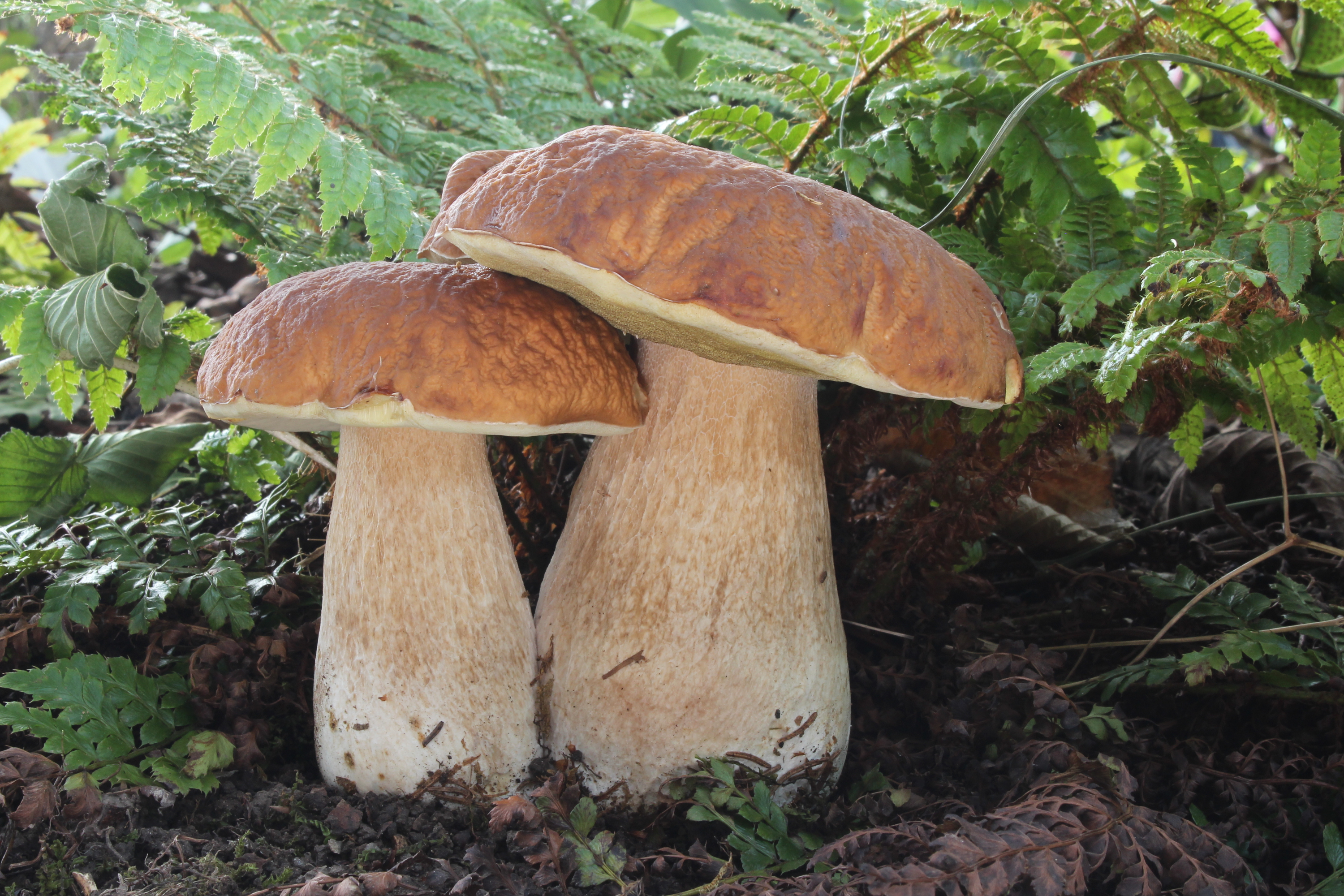
Boletus edulis
Key differences
The bitter bolete (Tylopilus felleus) has whitish pores in young specimens, which is why it is sometimes confused with the penny bun (Boletus edulis). As it matures, however, its pores turn dirty pink, the reticulation on the stipe is coarse, dark, and raised, and the cap remains matte and velvety. The flesh of the bitter bolete is characterized by an intense bitterness that is not removed by boiling or drying, causing even a single fruit body to ruin the taste of an entire dish.
The penny bun (Boletus edulis) resembles a young bitter bolete in habit and brown cap. It differs, however, in having a paler, initially white stipe covered with a delicate, pale reticulation (visible mainly in its upper part). Furthermore, the tubes and pores of the penny bun change color with age from white to yellow-green and olive-green, whereas in the bitter bolete they turn pinkish.
Jerzy Opioła · CC BY-SA 4.0
Korekta kolorów: Selso, 2020 (wersja źródłowa).
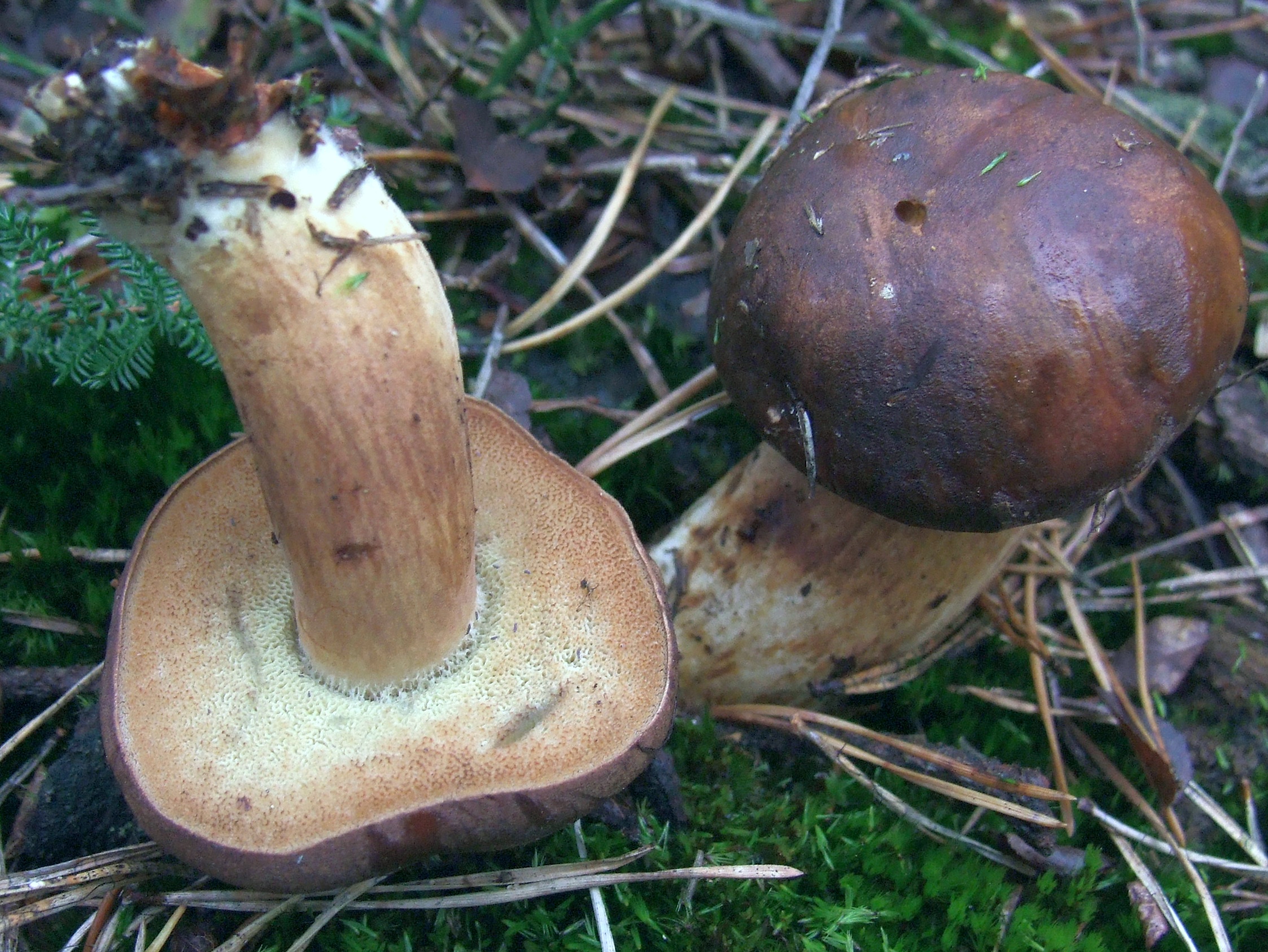
Photo source · CC BY-SA 4.0Imleria badia
Key differences
The bitter bolete (Tylopilus felleus) has pores and tubes that are initially white and turn pinkish with age, a distinct dark reticulation on the stipe, and strongly bitter-tasting flesh, making it an inedible mushroom.
The bay bolete (Imleria badia) is sometimes confused with young, darker fruit bodies of the bitter bolete. The bay bolete, however, has yellowish tubes (in the bitter bolete they are white to pinkish), and the stipe lacks the coarse, dark mesh with raised ridges characteristic of the bitter bolete.
George Chernilevsky · Public domain
Bez zmian względem zachowanego oryginału.
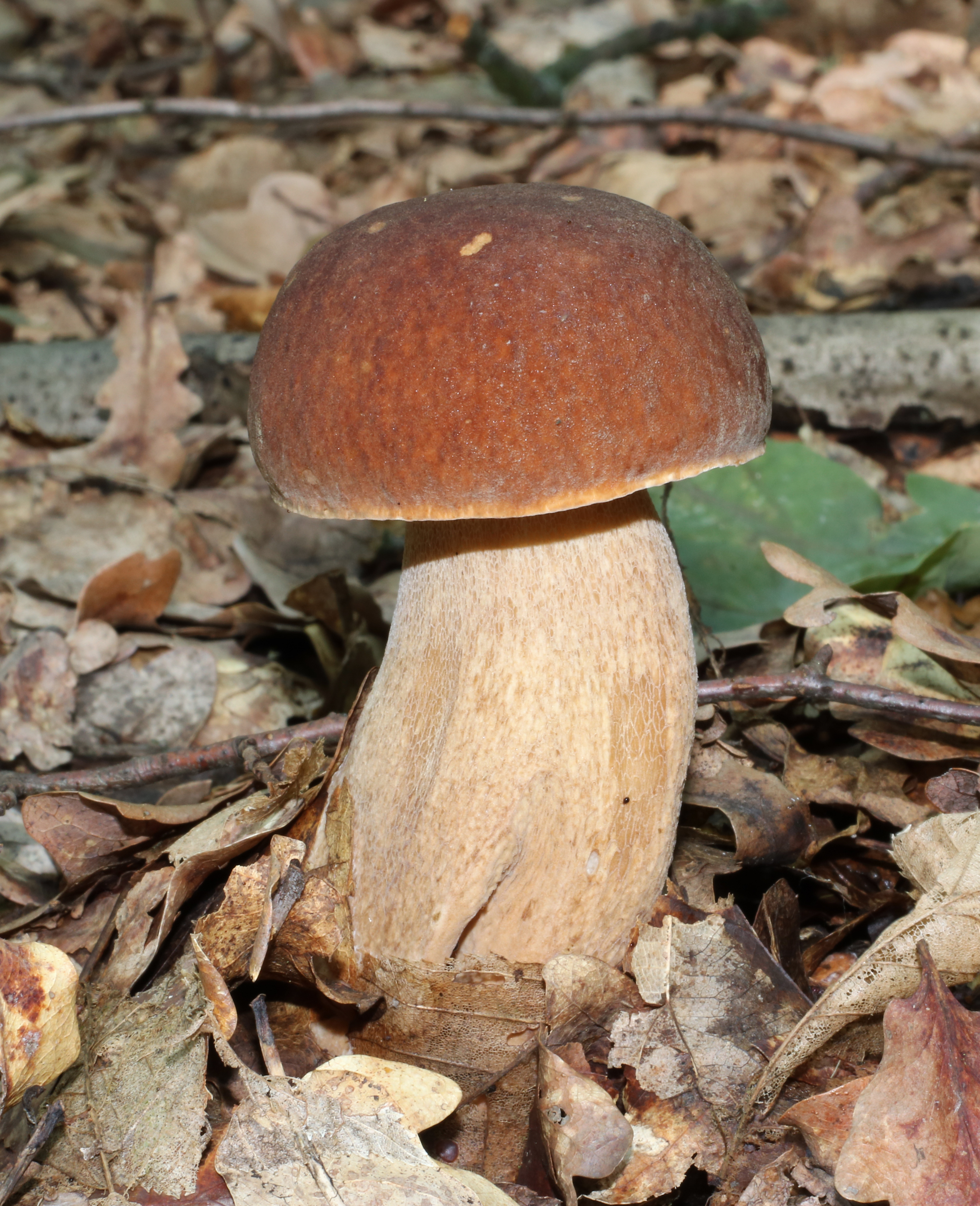
Photo source · Public domainBoletus reticulatus
Key differences
The bitter bolete (Tylopilus felleus) is an inedible mushroom due to the strongly bitter taste of its flesh. Its pores in young fruit bodies are whitish, becoming flesh-pink with age, and the stipe is covered with a raised, coarse mesh of a dark brown color. In the reticulated bolete, the mature hymenophore is yellow-green to olive-green, the taste is mild, and the reticulation on the stipe mostly remains distinctly paler than its background.
Leccinum scabrum
Key differences
The brown birch bolete (Leccinum scabrum) can resemble older, fully grown fruiting bodies of the bitter bolete. It is distinguished by white tubes without any pinkish cast and a stem covered with dark scales, lacking a yellowish background and lacking a mesh pattern.
FAQ
Is the bitter bolete an edible mushroom?
No, it is an inedible mushroom. Although it does not contain potent life-threatening toxins, it has an exceptionally bitter and burning taste that completely disqualifies it from culinary consumption.
What is the easiest way to distinguish the bitter bolete from the king bolete?
In mature fruit bodies, the bitter bolete has a pinkish hymenophore and a dark, raised network on the stipe. In the king bolete, the tubes turn yellow or green, and the network is white on a darker background.
Does the bitterness of the bitter bolete disappear after cooking or drying?
No, the bitterness of the bitter bolete is persistent and does not diminish under the influence of cooking, frying, pickling, or drying. Even a single small piece permanently ruins the taste of the entire prepared dish.
Why is the bitter bolete colloquially called “szatan”?
This name stems from a common linguistic mistake among foragers. The real Satan's bolete is a rare, highly poisonous mushroom with a red stipe and pores, growing mainly on calcareous soils.
Does consuming the bitter bolete risk poisoning?
The mushroom does not contain fatal toxins; however, eating a dish containing it can cause gastrointestinal irritation, nausea, or vomiting caused by potent bitter substances.
In which forests and on what substrate does the bitter bolete most commonly grow?
It occurs primarily in coniferous and mixed forests, particularly under pines and spruces. It prefers acidic, poor, and sandy soils; it also often grows near decaying stumps.
In which months can fruit bodies of the bitter bolete be found?
Fruit bodies typically appear from June to October, with peak emergence occurring during the summer months and early autumn, coinciding with the foraging season for king boletes.
Does a taste test of the raw flesh allow this species to be identified?
Yes, touching a bit of flesh with the tip of the tongue allows you to immediately detect an intense bitterness. Such a test is commonly used by mushroom foragers when in doubt in the field.
Enthusiast
Underside of the cap
- Tube length
- Tube length: 15–20 mm.
Names and history
- Obowiązująca nazwa taksonomiczna
- Tylopilus felleus (Bull.) P. Karst.
- Pozostałe nazwy
- goryczak żółciowy, goryczak, bitter bolete, bitter tylopilus
Home observations
Spore print
- Required materials
- fresh, mature cap, sheet of paper, glass or small bowl, water
- Time
- 2–24 h
- Procedure
- Place the cap underside down on the paper.
- Add a drop of water on top and cover.
- After 2–24 hours, lift the cap and examine the deposit.
What to look for
- Spore print colour
- Spore print colour: pink. Spore print colour: brown.
- Spore print shade
- Spore print shade: flesh pink. Spore print shade: pinkish-brown.
Under the microscope
- Required materials
- light microscope, microscope slide and cover slip, needle, water, spores from print
- Procedure
- Transfer a small amount of the spore print onto the slide using a needle.
- Add a drop of water, cover with a cover slip, and examine the spores.
What to look for
- Spore shape
- Spore shape: fusiform. Spore shape: fusiform. Spore shape: ellipsoid.
- Spore surface
- Spore surface: smooth.
- Spore dimensions
- Length 10–16 µm, width 3.5–5 µm.
Compare dimensions after calibrating the microscope scale.
Ecology and distribution
- Soil reaction
- Soil reaction: acidic.
- Soil texture
- Soil texture: sandy.
Soil texture: loamy. - Soil fertility
- Soil fertility: Nutrient-poor.
- Coniferous trees in the vicinity
- Coniferous trees in the vicinity: pine.
Coniferous trees in the vicinity: spruce.
History and culture
The history of discovery and scientific documentation of this species is directly linked to the evolution of bolete systematics. The species was originally described in 1788 by the French mycologist Jean Baptiste Bulliard under the name Boletus felleus. In 1881, Finnish researcher Petter Adolf Karsten transferred it to the genus Tylopilus, which represents a key point in its nomenclatural history recorded in taxonomic databases such as Index Fungorum. The specific epithet felleus derives from the Latin word fel (bile), which directly refers to the extreme, pungent bitterness of the flesh, described in mycological literature (including in the works of Irmgard Krisai-Greilhuber) alongside the pinkening of the pores. Taxonomic databases, including the EPPO Global Database, document the link between the scientific name and numerous equivalents in European languages (e.g. Polish goryczak żółciowy or German Gallenröhrling), in which the theme of gall or bitterness has consistently persisted as lasting evidence of the cultural perception of this mushroom in nomenclature.
Edibility and safety
The bitter bolete is an inedible mushroom due to the exceptionally strong and burning bitterness of its flesh. This bitterness is persistent and does not disappear under any culinary treatments, such as parboiling, frying, pickling, or drying—even a small fragment of a fruit body completely ruins the flavor of the entire dish. Although this species does not contain fatal toxins that damage organs, its consumption can lead to gastrointestinal distress, nausea, and vomiting caused by the action of irritating bitter substances. Due to its resemblance, it is often confused with the king bolete.
Habitat and occurrence
Tylopilus felleus is a widely distributed species in the temperate zone of the Northern Hemisphere, commonly found in Europe, as well as in Asia and North America. It inhabits mainly coniferous and mixed forests, much more rarely pure deciduous stands. Trophically, it is an ectomycorrhizal fungus, forming associations primarily with pines (Pinus) and spruces (Picea), although it is also occasionally encountered near beeches and oaks. In field observations, fruit bodies are recorded on acidic, sandy, infertile forest soils, as well as directly on heavily decomposed wood, including decaying conifer stumps and in litter; the presence of fruit bodies on such substrates is a microhabitat trait and does not prove that it feeds on the wood itself. In Central Europe, according to the documented range in tables for Poland, fruit bodies appear in the period from June to November (VI–XI).
Sources
- src-cms-felleus
- src-naturalis-felleus
- src-snowarski-felleus
Researcher
Edibility and culinary use
Ustalenia źródłowe: jadalność, spożycie i wykorzystanie
- Edibility
- Inedible — źródło oznaczenia
Źródło bez opisu bibliograficznego · Own Tylopilus felleus account: Kapelusz / Trzon / zarodniki / występowanie / jadalne; compared species excluded.
Źródło bez opisu bibliograficznego · Popis / Výskyt / Kuchyňské využití; only the focal species paragraph, excluding compared species and var. alutarius.
Scientific names and taxonomy
- Current scientific name
Tylopilus felleus (Bull.) P. Karst.
- Former scientific names
- 1788 [1787–88] — Boletus felleus Bull.
1815 — Boletus alutarius Fr.
1825 — Boletus felleus var. roseus Pers.
1844 — Boletus alutarius Rostk.
1882 — Tylopilus felleus var. alutarius (Fr.) P. Karst.
1882 — Tylopilus felleus var. fuscescens P. Karst.
1886 — Dictyopus felleus (Bull.) Quél.
1889 — Boletus felleus var. obesus Peck
1898 — Suillus alutarius (Fr.) Kuntze
1898 — Suillus felleus (Bull.) Kuntze
1898 [1900] — Tylopilus alutarius (Fr.) Henn.
1936 — Boletus felleus f. plumbeoviolaceus Snell
1965 [1964] — Boletus felleus var. alutarius (Fr.) J. Blum
1971 — Tylopilus felleus var. uliginosus A.H. Sm. & Thiers
1986 — Boletus felleus f. albiceps Kauffman & Snell
1986 — Boletus felleus f. rubrobrunneus Snell[6]
Goryczak żółciowy nosi nazwę naukową Tylopilus felleus (Bull.) P. Karst. Należy do rodziny borowikowatych (Boletaceae) i rzędu Boletales w obrębie podklasy Agaricomycetidae, klasy Agaricomycetes, typu Basidiomycota oraz królestwa Fungi. W bazie Species Fungorum nazwa ta jest zarejestrowana jako aktualna pod numerem rekordu 122480.
[6]Kombinację Tylopilus felleus opublikował Petter Adolf Karsten w 1881 r. na łamach „Revue Mycologique, Toulouse” (t. 3, nr 9, s. 16). Jej bazonimem jest Boletus felleus Bull., opisany przez Jeana Baptiste’a Bulliarda w „Herbier de la France” (t. 8, tabl. 379), gdzie rejestr wskazuje datę 1788 z adnotacją [1787–88]. Są to daty dwóch odrębnych aktów nomenklatorycznych.
[6]W rejestrach mykologicznych odnotowano 16 synonimów tego gatunku, obejmujących różne rangi systematyczne oraz datowania:
- Boletus felleus Bull., Herb. Fr. (Paris) 8: pl. 379 (1788) [1787-88]
- Dictyopus felleus (Bull.) Quél., Enchiridion Fungorum in Europa media et praesertim in Gallia Vigentium: 159 (1886)
- Suillus felleus (Bull.) Kuntze, Revis. gen. pl. (Leipzig) 3(3): 535 (1898)
- Boletus alutarius Fr., Observ. mycol. (Havniae) 1: 115 (1815)
- Tylopilus felleus var. alutarius (Fr.) P. Karst., Bidr. Känn. Finl. Nat. Folk 37: 3 (1882)
- Tylopilus alutarius (Fr.) Henn., in Engler & Prantl, Nat. Pflanzenfam., Teil. I (Leipzig) 1(1**): 190 (1898) [1900]
- Suillus alutarius (Fr.) Kuntze, Revis. gen. pl. (Leipzig) 3(3): 535 (1898)
- Boletus felleus var. alutarius (Fr.) J. Blum, Bull. Soc. Mycol. France 80(3): 297 (1965) [1964]
- Boletus felleus var. roseus Pers., Mycologia Europaea (Erlanga) 2: 136 (1825)
- Boletus alutarius Rostk., in Sturm, Deutschl. Fl., 3 Abt. (Pilze Deutschl.) [5](23/24): 131 (1844)
- Tylopilus felleus var. fuscescens P. Karst., Bidr. Känn. Finl. Nat. Folk 37: 2 (1882)
- Boletus felleus var. obesus Peck, Bull. N.Y. St. Mus. 2(no. 8): 154 (1889)
- Boletus felleus f. plumbeoviolaceus Snell, Mycologia 28(5): 465 (1936)
- Tylopilus felleus var. uliginosus A.H. Sm. & Thiers, Boletes of Michigan (Ann Arbor): 114 (1971)
- Boletus felleus f. albiceps Kauffman & Snell, in Wolfe, Mycologia 78(1): 24 (1986)
- Boletus felleus f. rubrobrunneus Snell, in Wolfe, Mycologia 78(1): 24 (1986)
W wykazie tym nazwa Boletus alutarius została użyta dwukrotnie przez różnych autorów (Friesa w 1815 r. oraz Rostkoviusa w 1844 r.).
[6]Laboratory diagnostics
Material and research methods
Metody i zapisy źródłowe — Named focal-species atlas spore account; collection identity and material preparation are not reported.
Pochodzenie materiału: nieokreślona w źródle.
Długość zarodnika; Szerokość zarodnika — zapis źródłowy: „10–16 × 3.5–5 µm; separate length and width axes, no N inferred.” [2]
Kształt zarodnika — zapis źródłowy: „úzce vřetenovité až téměř válcovité; fusiform core retained, near-cylindrical qualifier separately documented.” [2]
Metody i zapisy źródłowe — Named focal-species atlas spore account; collection identity and material preparation are not reported.
Pochodzenie materiału: nieokreślona w źródle.
Kształt zarodnika; Powierzchnia zarodnika — zapis źródłowy: „wrzecionowate lub elipsoidalne; gładkie” [7]
Occurrence verification — scope and limitations
Materiał: Pierwotna polska kolekcja autora atlasu.
Zakres odczytu: Fragmenty źródeł.
Odczytano fragment źródła; pełny tekst i metody nie zostały zweryfikowane.
Data przeglądu: 21.10.2026.
Ograniczenia: Źródłowe oznaczenie i zakres pojęcia zachowano. Nie zadeklarowano nowego badania okazów ani odczytu wszystkich publikacji cytowanych przez źródło.
[7]Scope of the review
Before completion, the record requires completion or settlement.
- Search for occurrence regions requires reconciliation.
- Connections of earlier findings require re-examination.
- New sources require accounting for information encountered during the review.
Legal basis and scope of assessment
Regulations for location: Poland
Key substances and their effects
Badania nad właściwościami biologicznymi ekstraktów z owocników Tylopilus felleus i Suillellus rubrosanguineus opublikowali I. Šušaníková, M. Kvasnicová, A. Brzková, O. Ďuriška oraz P. Mučaji w czasopiśmie „Interdisciplinary Toxicology” (2018, t. 11, nr 3, s. 204–208, DOI: 10.2478/intox-2018-0018). Praca obejmowała testy na liniach komórkowych oraz jakościową analizę fitochemiczną.
[8]W procedurze laboratoryjnej wysuszone owocniki sproszkowano i poddano dwutygodniowej ekstrakcji w 96% etanolu lub stężonym chloroformie z okresowym wstrząsaniem. Następnie rozpuszczalniki odparowano pod zmniejszonym ciśnieniem, a suche ekstrakty rozpuszczono w DMSO i zamrożono w −20 °C. Osobno traktowano rurki hymenoforu oraz kapelusze z trzonami.
[8]W doświadczeniu przygotowano cztery frakcje ekstraktów Tylopilus felleus:
- TylEtCap – ekstrakt etanolowy (96% etanol) z kapeluszy i trzonów łącznie,
- TylEtTub – ekstrakt etanolowy (96% etanol) z rurek hymenoforu,
- TylChCap – ekstrakt chloroformowy (stężony chloroform) z kapeluszy i trzonów łącznie,
- TylChTub – ekstrakt chloroformowy (stężony chloroform) z rurek hymenoforu.
Testy prowadzono na mysich fibroblastach zarodkowych NIH-3T3 oraz ludzkich komórkach gruczolakoraka piersi MCF-7. Linie hodowano w pożywce DMEM z dodatkiem 10% surowicy płodowej bydła (FBS), penicyliny (100 IU/ml) i streptomycyny (100 µg/ml) w temperaturze 37 °C, w wilgotnej atmosferze z zawartością 5% CO₂, pasażując komórki dwa razy w tygodniu.
[8]Komórki wysiewano na płytki 96-dołkowe w gęstości 10 000 komórek na dołek w 100 µl medium. Po 24 godzinach inkubacji dodawano ekstrakty w stężeniach od 6,25 do 100 µg/ml (końcowe stężenie DMSO nie przekraczało 0,1%), stosując kwercetynę (6,25–50 µg/ml) jako substancję referencyjną. Po dobie dodawano odczynnik MTT (0,4 mg/ml), inkubowano przez 4 godziny, po czym rozpuszczano powstalcy formazan w czystym DMSO i mierzono absorbancję przy 570 nm czytnikiem Tecan Infinite M200.
[8]Test MTT opierał się na redukcji soli tetrazoliowej do barwnego formazanu, co stanowi wskaźnik aktywności metabolicznej i żywotności komórek. Wyniki opracowano jako średnie z błędem standardowym (SEM) dla trzech powtórzeń analitycznych, porównując je testem t-Studenta.
[8]W wyższych stężeniach wszystkie cztery ekstrakty goryczaka powodowały statystycznie istotny spadek redukcji MTT w linii MCF-7 (p<0,05 lub p<0,01), co autorzy określili jako łagodną cytotoksyczność. Z kolei w linii mysiej NIH-3T3 wyższe stężenia ekstraktów z rurek (zarówno etanolowego, jak i chloroformowego) powodowały wzrost wskaźnika żywotności, a ekstrakty z kapeluszy i trzonów nieznacznie stymulowały metabolizm komórek.
[8]Zależność odpowiedzi od stężenia przedstawiono graficznie na rycinie 2 w pracy, zestawiając słupki dla linii nowotworowej MCF-7 oraz kontrolnej NIH-3T3 z poziomami istotności statystycznej (* p<0,05, p<0,01, * p<0,001). Autorzy nie wyznaczyli dla badanych frakcji wartości IC₅₀.
[8]W badaniu porównawczym trzy ekstrakty krwistoborowika (Suillellus rubrosanguineus – SuiEtCap, SuiEtTub i SuiChTub) silniej obniżały aktywność metaboliczną obu linii komórkowych bez istotnego zróżnicowania między nimi, natomiast kontrolna kwercetyna działała wyraźniej na fibroblasty NIH-3T3 niż na komórki MCF-7.
[8]W celu wykrycia obecności alkaloidów przeprowadzono próbę Dragendorffa. Frakcje chloroformowe po rozpuszczeniu w chloroformie wytrząsano z 0,5 M kwasem siarkowym i poddawano reakcji z odczynnikiem w fazie wodnej. Frakcje etanolowe rozpuszczano w eterze z dodatkiem 15% amoniaku, ekstrahowano 0,1 M kwasem solnym i traktowano kilkoma kroplami odczynnika Dragendorffa. Jako kontrole pozytywne posłużyły wyciągi z pokrzyku wilczej jagody (Atropa bella-donna) oraz chinowca (Cinchona succirubra).
[8]Reakcja z odczynnikiem Dragendorffa dała we wszystkich badanych ekstraktach wynik dodatni w postaci pomarańczowoczerwonego osadu. W przypadku frakcji etanolowych goryczaka (TylEtCap i TylEtTub) reakcja była silna (*), natomiast we frakcjach chloroformowych (TylChCap i TylChTub) umiarkowana (). Podobne nasilenie wykazano dla ekstraktów Suillellus rubrosanguineus (SuiEtCap i SuiEtTub – silna, SuiChTub – umiarkowana).
[8]Dodatni wynik próby Dragendorffa wskazuje na jakościową obecność związków o charakterze alkaloidowym w owocnikach goryczaka. W pracy nie prowadzono jednak izolacji ani identyfikacji konkretnych cząsteczek, nie określono ich zawartości ilościowej ani nie powiązano ich bezpośrednio ze spadkiem żywotności komórek w teście MTT.
[8]W dyskusji naukowej autorzy odnieśli się do wcześniejszych doniesień o tylopilanie – polisacharydzie z grupy β-glukanów wyizolowanym z Tylopilus felleus, który w badaniach Grzybka i współpracowników z 1994 r. testowano na komórkach mięsaka Crockera 180-TG w zakresie stężeń 37,5–300 µg/ml.
[8]Autorzy wspomnieli także o innych grzybowych β-glukanach, takich jak lentinan z twardnika japońskiego (Lentinus edodes), sugerując celowość dalszych badań nad oczyszczonymi frakcjami goryczaka w modelach wspomagających terapię nowotworową. Praca miała jednak charakter wstępnych badań laboratoryjnych in vitro i nie obejmowała testów klinicznych ani schematów leczniczych.
[8]Habitat and occurrence
Habitat, region and season
W Czechach gatunek występuje obficie od czerwca do października, na obszarach od nizin po tereny górskie. Rośnie w lasach iglastych i liściastych na podłożu kwaśnym, wykazując stosunkowo dużą odporność na suchszą aurę.
[2]Okazy badane przez zespół Šušaníkovej zebrano 19 czerwca 2016 r. w miejscowości Holubičky na Nizinie Zahorskiej na Słowacji. Grzyby rosły w trawie pod sosnami w lesie iglastym; zbiór przeprowadził Drahomír Ďuriška, a oznaczenia dokonał Ondrej Ďuriška.
[8]Goryczak żółciowy jest szeroko rozprzestrzeniony na półkuli północnej, a na Słowacji należy do pospolitych grzybów leśnych, spotykanych w drzewostanach iglastych.
[8]Potwierdzony zasięg występowania
Wszystkie obszary potwierdzone w zapisanych danych źródłowych.
| Kraj | Regiony i stanowiska | Owocnikowanie | Sources |
|---|---|---|---|
| Poland | Lasowice near Milicz | VI–XI |
|
Sources
- src-cms-felleus
- src-eli-protection-2014
- src-eli-trade-2026
- src-sf-felleus
- src-snowarski-felleus
- src-susanikova 2018
- tylopilus_felleus.archived-profile
- tylopilus_felleus.legal-status-verification.20261015