Inedible

Set your location to see data for your region.


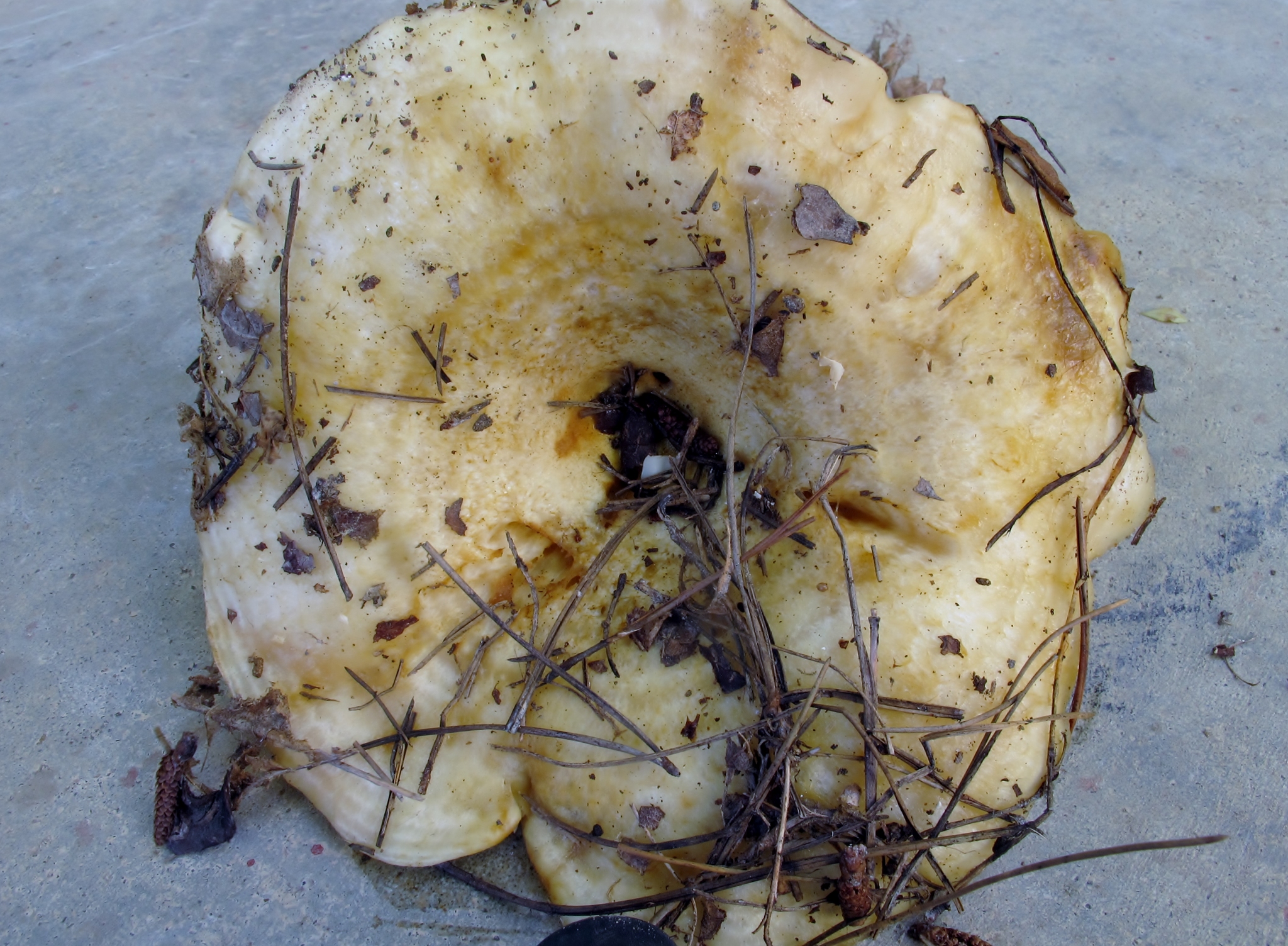
Lactarius resimus, known as the real milkcap or white milkcap, is a mycorrhizal fungus native to boreal and temperate Eurasia. It produces a broad, creamy-white to yellowish cap with a shaggy, inrolled margin and yields an acrid white latex that turns yellow on exposure to air. Celebrated in northern Slavic culinary tradition, it is regarded as a premier edible mushroom of the boreal forest when subjected to thorough traditional processing.
Identification, habitat, and key differences.
Forager
Fruitbody structure
- Fruit body form
- Fruit body form: Cap, stipe.
Cap
- Cap shape
- Cap shape: funnel-shaped.
Cap shape: convex.
Cap shape: depressed. - Cap surface relief
- Cap surface relief: smooth.
- Cap surface sheen
- when dry: Cap surface sheen: shiny.
- Cap stickiness and sliminess
- Cap stickiness and sliminess: sticky.
Cap stickiness and sliminess: slimy.
when wet: Cap stickiness and sliminess: sticky. - Cap colour
- Cap colour: white.
Cap colour: whitish.
Cap colour: cream.
Cap colour: light yellow. - Margin orientation
- in young fruit bodies: Margin orientation: inrolled.
Margin orientation: inrolled. - Margin covering
- in young fruit bodies: Margin covering: felted.
in young fruit bodies: Margin covering: hairy.
in mature fruit bodies: Margin covering: glabrous.
Margin covering: hairy. - Cap diameter
- The cap measures 70–220 mm in diameter.
- Cap centre
- Cap centre: Depressed (deeply).
- Cap colour zoning
- Cap colour zoning: concentric.
Cap colour zoning: unzoned.
Cap colour zoning: concentric (faint zones).
Cap colour zoning: concentric.
Cap underside
- Hymenophore type
- Hymenophore type: gills.
Gills at stipe
- Hymenophore attachment to the stipe
- Hymenophore attachment to the stipe: attached to the stipe (gills).
Hymenophore attachment to the stipe: attached to the stipe (gills).
Hymenophore attachment to the stipe: attached to the stipe (gills).
- Decurrence of the hymenophore on the stem
- Decurrence of the hymenophore on the stem: decurrent (gills).
Decurrence of the hymenophore on the stem: decurrent with a tooth (gills).
Decurrence of the hymenophore on the stem: decurrent (gills). - Hymenophore colour
- Hymenophore colour: whitish.
Hymenophore colour: pale cream.
Hymenophore colour: pinkish.
Hymenophore colour: cream.
Hymenophore colour: reddish. - Gill branching
- Gill branching: forked (sparse, near the stipe).
- Gill spacing
- Gill spacing: closely spaced.
Gill spacing: crowded. - Presence of short gills
- Presence of short gills: present (numerous).
Stem and base
- Stipe shape
- Stipe shape: cylindrical.
Stipe shape: tapering towards the base. - Stipe colour
- Stipe colour: white.
- Stipe surface relief
- Stipe surface relief: smooth.
- Stipe surface covering
- Stipe surface covering: powdery.
Stipe surface covering: hairy (coarse hairs, at the stem base). - Stipe interior
- Stipe interior: hollow.
- Color of stem surface upon damage
- Color of stem surface upon damage: brownish (stipe surface).
- Stipe length
- Stipe length: 25–70 mm.
- Stipe diameter
- Stipe diameter: 15–35 mm.
- Stipe flesh resistance to breaking or tearing
- Stipe flesh resistance to breaking or tearing: brittle.
- Presence of pits on the stem
- Presence of pits on the stem: absent.
- Qualitative relative stem length
- Qualitative relative stem length: short.
- Stem surface moisture
- Stem surface moisture: dry.
Flesh
- Flesh colour
- Flesh colour: white.
- Flesh firmness
- Flesh firmness: soft.
Flesh firmness: firm. - Flesh taste
- Flesh taste: pungent.
Flesh taste: weak.
Flesh taste: bitter. - Flesh resistance to breaking or tearing
- Flesh resistance to breaking or tearing: brittle.
- Flesh odour
- Flesh odour: weak.
Flesh odour: fruity.
fresh specimen: Flesh odour: not distinctive (flesh). - Flesh thickness class
- Flesh thickness class: thin (rather).
- Latex secretion
- Latex secretion: exudes latex.
- Latex abundance
- Latex abundance: scarce.
- Color of fresh latex
- Color of fresh latex: white.
- Latex color change
- Latex color change: sulphur yellow.
- Color of dried latex
- Color of dried latex: lemon yellow.
- Taste of latex
- Taste of latex: burning.
Where and when it grows
- Habitat
- Habitat: mixed woodland.
Habitat: deciduous woodland. - Substrate
- Substrate: soil.
- Fruit body growth pattern
- Fruit body growth pattern: scattered groups or in small groups.
- Occurrence frequency
- Fruiting season
- Fruit bodies appear from July to October.
- Distribution area
- Distribution area: confirmed.
Edibility and culinary use
- Edibility
- Inedible
Law
- Protection
- It is not on the Polish list of protected fungal species.
- Trade
- It is not on the Polish list of mushrooms approved for trade.
FAQ
What is the primary tree associate of Lactarius resimus?
It primarily forms mycorrhizal partnerships with birch trees, though it also occasionally associates with pines in mixed boreal woodlands.
Can Lactarius resimus be eaten raw?
No, raw specimens contain sharp acrid resins that cause severe gastrointestinal irritation and distress if consumed without processing.
How is the acrid taste removed?
It requires either prolonged soaking in cold water with regular water changes or pre-boiling with disposal of the broth, followed by salt fermentation.
In which regions is this species most celebrated?
It is most celebrated across Russia, Belarus, Ukraine, and broader Eastern Europe and Siberia, where it is regarded as a prime delicacy.
What color change occurs in its milky latex?
Its white latex rapidly turns into a distinct sulphur-yellow color upon contact with air.
Does Lactarius resimus grow in North America?
Populations and closely allied forms occur in northern boreal zones of North America, though it is far more prevalent across northern Eurasia.
What color dyes can be obtained from this fungus?
Decoctions combined with mineral mordants produce muted earth tones, including tan, cream, khaki, and soft olive on natural fibers.
When does this mushroom typically fruit?
Fruiting generally takes place between July and October, peaking in late summer and early autumn depending on regional temperatures.
Why do Western European field guides often classify it as inedible?
Western guides often list it as inedible or toxic due to its raw acridity and the necessity of elaborate multi-step detoxifying methods.
What role did it play in historical Orthodox Christian traditions?
Salt-preserved fruit bodies served as a crucial, savory staple during strict religious fasts like Great Lent throughout Russian history.
Enthusiast
Names and history
- Obowiązująca nazwa krajowa
- mleczaj okazały
- Obowiązująca nazwa taksonomiczna
- Lactarius resimus
- Inne nazwy krajowe
- Rollrim Milkcap
Home observations
Spore print
- Required materials
- fresh, mature cap, sheet of paper, glass or small bowl, water
- Time
- 2–24 h
- Procedure
- Place the cap underside down on the paper.
- Add a drop of water on top and cover.
- After 2–24 hours, lift the cap and inspect the deposit.
What to look for
- Spore print colour
- Spore print colour: white. Spore print colour: yellow.
- Spore print shade
- Spore print shade: pale cream. Spore print shade: light yellow.
Under the microscope
- Required materials
- light microscope, microscope slide and cover slip, needle, water, spores from print
- Procedure
- Transfer a small amount of the spore print onto the slide using a needle.
- Add a drop of water, cover with a cover slip, and examine the spores.
What to look for
- Spore shape
- Spore shape: broadly ellipsoid.
- Spore surface
- Spore surface: ornamented. Spore surface: ornamented. Spore surface: ornamented.
- Spore dimensions
- Length 7.7–10 µm, width 5.7–7 µm.
- Spore dimensions
- Length 7–9.5 µm, width 5–7 µm.
Compare dimensions after calibrating the microscope scale.
Ecology and distribution
- Soil reaction
- Soil reaction: acidic.
Soil reaction: alkaline. - Soil moisture
- Soil moisture: dry.
- Broadleaf trees in the vicinity
- Broadleaf trees in the vicinity: birch.
- Coniferous trees in the vicinity
- Coniferous trees in the vicinity: pine.
Coniferous trees in the vicinity: Pinus sylvestris. - Mycorrhizal hosts
- General species association: Mycorrhizal hosts: Betula (general partner list).
- Mode of nutrition
- Mode of nutrition: ectomycorrhizal.
Non-culinary uses
Outside of dietary contexts, Lactarius resimus has recorded applications in rural folk traditions, ethnomycology, and historical regional practices. In several rural communities across northern Eurasia, the pungent, milky exuded latex was occasionally gathered in folk medicine and utilized as a topical counter-irritant or applied to minor skin abrasions, warts, and calluses in the belief that its caustic properties would accelerate tissue renewal.
Furthermore, the dense, fibrous fungal tissue has served in traditional textile dyeing. When combined with various natural mordants such as alum, iron sulfate, or copper, decoctions prepared from aged or dried carpophores produce a range of earth-toned pigments, spanning muted cream, soft khaki, tan, and soft olive shades suitable for coloring unspun wool and natural linen yarn. In historical domestic settings, dried carpophores were occasionally added to outdoor smudges or pest-repellent hearth fires, where the dense smoke was utilized to deter biting midges and mosquitoes around rural farmsteads and forest encampments.
History and culture
Lactarius resimus holds an esteemed position in Eastern European and Russian folklore, literature, and social history, often crowned as the king of milkcaps or the sovereign of the forest floor. In traditional Russian peasant culture, the mass emergence of this mushroom shaped community rhythms, inspiring proverbs, seasonal adages, and traditional festival gatherings centered on the autumn harvest. A well-known Russian proverb declares that whoever calls themselves a milkcap must climb into the basket, symbolizing accountability, duty, and rural perseverance.
Throughout the seventeenth to nineteenth centuries, substantial quantities of salted milkcaps were transported from northern provinces to imperial banquet tables in Moscow and Saint Petersburg. They featured prominently during the severe Orthodox Christian fasting periods, particularly Great Lent, functioning as an essential nutritional and cultural pillar for both monastic communities and ordinary households. In regional Siberian and Baltic folklore, the mushroom is occasionally celebrated as a symbol of abundance, resilience against the harsh northern climate, and community solidarity during long winters.
Edibility and safety
Raw fruit bodies of Lactarius resimus are inedible and cause severe gastrointestinal irritation due to strong acrid and irritating resinous compounds. Safe consumption requires mandatory preliminary detoxification, consisting of prolonged cold-water soaking over several days with frequent water exchanges, or thorough pre-boiling with complete discarding of the cooking water, followed by an extended lactic fermentation period lasting several weeks. When properly processed, the pungent acridity is completely neutralized, yielding a firm, crisp texture and an aromatic, pleasantly tart flavor.
Regarded in Russia, Belarus, Ukraine, and across Siberia as a top-tier delicacy of the highest commercial and culinary category, it has historically fetched premium prices in regional food markets. In contrast, standard mycological literature and consumer guidelines across Western and Southern Europe frequently classify it as inedible, suspicious, or conditionally toxic, reflecting regional aversions to acrid milkcaps requiring multi-step detoxifying procedures. Consumption without rigorous soaking, boiling, or fermentation poses substantial risks of nausea, vomiting, and abdominal distress.
Habitat and occurrence
Lactarius resimus is widespread across the northern temperate and boreal zones of Eurasia, extending across northern and eastern Europe, the Baltic region, Scandinavia, European Russia, Siberia, and parts of northern Asia. Isolated populations or closely allied taxa have also been reported in specific boreal zones of North America. The fungus primarily inhabits mixed and deciduous woodlands, boreal taiga, and forest fringes, forming strict ectomycorrhizal partnerships with birch trees (Betula pendula and Betula pubescens), as well as occasional associations with pine (Pinus) in mixed stands. It thrives on moist, mossy ground, acidic to neutral forest litter, and light sandy or loamy soils with adequate moisture retention.
The fruiting period typically begins in mid-summer and continues into late autumn, spanning July through October depending on latitude and climatic conditions. In southern boreal regions, peak fruiting frequently coincides with the humid weather of August and September, while in far northern or Siberian latitudes, the window may be compressed to between late July and early September before early frost arrives. In western and central Europe, where the species is considerably rarer, fruit bodies appear sporadically in early autumn.
Sources
- Kytövuori I. (1984). Lactarius subsectio Scrobiculati in NW Europe. Karstenia24:41–72. DOI 10.29203/ka.1984.228
- Latvijas Daba: Lactarius resimus, saldūksne
- Česká mykologická společnost, Lactarius resimus
- https://ojs.utlib.ee/index.php/FCE/article/download/13709/8756/11795
- Lietuvos saugomų rūšių informacinė sistema (SRIS), Gelsvasis piengrybis / Lactarius resimus
Researcher
Edibility and culinary use
Ustalenia źródłowe: jadalność, spożycie i wykorzystanie
- Edibility
- Inedible — źródło oznaczenia
Źródło bez opisu bibliograficznego · Kuchyňské využití: Je nejedlý; ČMS atlas's own assessment. Researcher documentation preserves the differing assessment of the Latvian atlas and primary interviews regarding consumption. Toxic or deadly were not recorded.
Scientific names and taxonomy
- Current scientific name
Lactarius resimus
Scientific names and taxonomy
The current scientific name is Lactarius resimus (Fr.) Fr., classified in the family Russulaceae (Russulaceae). This name was published in the work Epicrisis systematis mycologici (1838). The basionym of the species is Agaricus resimus Fr. from 1821. In historical literature, the combinations Lactifluus resimus (Fr.) Kuntze (1891) and Agaricus intermedius var. expallens Fr. (1815) also appeared.
Historical scope of names and materials
Kytövuori's revision (1984) restricts European L. resimus in the strict sense (sensu stricto), distinguishing it from earlier collections later assigned to L. aquizonatus and L. citriolens. In North America, distinct forms and varieties were described (including var. insipidus and var. regalis), whose identity with the European taxon remains uncertain.
Taxon scope and identification limitations
Herbarium specimens exhibit variation in the form of thinner, white fruitbodies or thicker, yellow ones with denser gills. In European phenology, the fungus shows sensitivity to stronger autumn frosts.
Ecology and distribution
- Occurrence frequency
- Lithuania: Occurrence frequency: uncommon. [35]
Laboratory diagnostics
Dane ustrukturyzowane
Basidia
Hymenial cystidia
- Presence of hymenial pseudocystidia
- Presence of hymenial pseudocystidia: present. [16]
- Width of hymenial pseudocystidia
- Width of hymenial pseudocystidia: 3–6 µm. [16]
- Length of cystidium portion beyond basidia
- Length of cystidium portion beyond basidia: 15–50 µm (relative to the basidiole surface). [16]
- Presence of cystidia in the hymenium
- Presence of cystidia in the hymenium: present. [16]
- Abundance of cystidia at the specified location
- Abundance of cystidia at the specified location: scattered. [16]
- Presence of cystidium constrictions
- Presence of cystidium constrictions: absent (often, just below the apex). [16]
- Distribution of hymenial cystidia
- Distribution of hymenial cystidia: clustered (somewhat, between the gills). [16]
- Hymenial cystidium length
- Hymenial cystidium length: 45–90 µm. [16]
- Hymenial cystidium shape
- Hymenial cystidium shape: needle-like (macrocystidium). [16]
Hymenial cystidium shape: awl-shaped (macrocystidium). [16] - Hymenial cystidium width
- Hymenial cystidium width: 5–8 µm. [16]
Reactions with reagents
Spores
- Presence of the basidiospore hilar appendix
- Presence of the basidiospore hilar appendix: present (distinct structure). [16]
- Presence of the basidiospore plage
- Presence of the basidiospore plage: present (distinct structure). [16]
- Form of spore ornamentation
- Form of spore ornamentation: ribbed. [16]
Form of spore ornamentation: warted. [16]
Form of spore ornamentation: warted. [17] - Height of spore ornamentation
- Height of spore ornamentation: up to 0.8 µm. [16]
- Connection of ornamentation elements
- Connection of ornamentation elements: incomplete reticulum. [16]
Connection of ornamentation elements: incomplete reticulum. [18] - Spore length-to-width ratio
- Spore length-to-width ratio: 1.29–1.45. [16]
- Spore shape
- Spore shape: broadly ellipsoid. [16]
Material and research methods
Investigation of composition and activity — Nowak R
Material: Polysaccharide fraction from fruitbodies of L. resimus from forests near Włodawa, from September 2014; identification by Zofia Flisińska and voucher deposited in the Department of Pharmaceutical Botany of the Medical University of Lublin. Fruitbodies were freeze-dried and ground, and after extraction, protein was removed and the fraction was precipitated with ethanol. In vitro study of L. acidophilus ATCC 4356 in glucose-free Rogosa medium; measurement at 600 nm, comparison after 48 h. This is not a single purified compound nor a clinical study.
Reading scope: Full text.
Limitations: Dashes for two L. rhamnosus strains indicate unreported results; neither zero nor a negative result was recorded. Results for gastric acid resistance that could not be read as its own results were not attributed to L. resimus. The source gives 1,5% without resolving the percentage basis; w/v or v/v was not added. The control was kept as a separate group, without assigning the tested material to it.
Study of composition and activity — material and limitations
Material: identified by the authors as L. resimus, from northern Kazakhstan, from August–September 2020. Air-dried basidiocarp powder was extracted with 70% aqueous ethanol. UV–Vis measurement at 420 nm. The authors did not report a voucher specimen number, DNA sequence, or calibration standard in the read description.
Read scope: Full text.
Limitations: The source mg% with an unresolved basis was retained; it was not converted to mg/100 g of material or extract. The type of uncertainty after the ± sign is not stated; it was not designated as SD. The spectrophotometric total termed flavonoids by the authors does not confirm the structure of specific molecules. Proposed future medical applications were not considered a treatment outcome or confirmed implementation.
Archiwalny opis siedliska
W Europie Północnej gatunek rośnie w lasach mieszanych z udziałem brzozy i drzew iglastych (przede wszystkim sosny zwyczajnej), na siedliskach umiarkowanie świeżych po suchawe, na podłożu kwaśnym, jak i zasobniejszym w węglan wapnia.
W Fennoskandii owocnikowanie rozpoczyna się z początkiem sierpnia i trwa do końca września lub pierwszych dni października; w lasach brzozy górskiej gatunku nie stwierdzono.
Częstość występowania jest zmienna regionalnie; gatunek jest częstszy w północno-wschodniej Europie. Owocnikuje od lipca lub sierpnia do października pod brzozami i sosnami, w Europie Środkowej zwłaszcza na obszarach wyżej położonych. W Wielkiej Brytanii notowano go historycznie w lasach mieszanych do 300 m n.p.m.
- Results as recorded in the sources — Spore length
- 7–9,5 µm [17] [18]
7,7–10 µm; zakres pomiaru: korpus [16] - Results as recorded in the sources — Spore width
- 5–7 µm [17]
5,5–7 µm [18]
5,7–7 µm; zakres pomiaru: korpus [16]
Metody i zapisy źródłowe — Europejski L.resimus s.str.; autorskie zbiory1979–1983 i zrewidowane kolekcje zielnikowe, lista druk60. Nie objęto amerykańskich odmian o nieustalonej tożsamości.
Stan materiału: suszony.
Pochodzenie materiału: Fennoscandia and European herbarium material.
Identyfikacja kropli: nierozstrzygnięta.
Metoda źródłowa. Technika: mikroskopia świetlna (LM). Medium: Melzer reagent; source protocol for microscopic sections. Opis metody w źródle: Kytövuori1984, druk41: Leitz Laborlux12, około625× i1560×; preparaty suszonych blaszek. Cystydy: zwilżanie94%etanolem, woda, skrawki w odczynniku Melzera. Dokładny stopień rehydratacji i czas barwienia niepodane.
Obecność pseudocystyd hymenialnych — zapis źródłowy: „Druk57: pseudocystidia3–6µm thick. Obecność pseudocystyd nie jest obecnością gleocystyd ani cheilocystyd.” [16]
Szerokość pseudocystyd hymenialnych — zapis źródłowy: „Druk57: pseudocystidia3–6µm thick; średnica/szerokość3–6µm, nie grubość ściany.” [16]
Obecność cystyd w hymenium — zapis źródłowy: „Druk57: macrocystidia scattered,45–90×5–8µm; jawna obecność w hymenium, bez przypisywania konkretnej powierzchni blaszki.” [16]
Metody i zapisy źródłowe — Europejski L.resimus s.str.; autorskie zbiory1979–1983 i zrewidowane kolekcje zielnikowe, lista druk60. Nie objęto amerykańskich odmian o nieustalonej tożsamości.
Stan materiału: suszony.
Pochodzenie materiału: Fennoskandia oraz europejskie kolekcje zielnikowe.
Identyfikacja kropli: nierozstrzygnięta.
Metoda źródłowa. Technika: mikroskopia świetlna (LM). Medium: Odczynnik Melzera; źródłowy protokół preparatów mikroskopowych. Opis metody w źródle: Kytövuori (1984), s. 41: mikroskop Leitz Laborlux 12, powiększenia około 625× i 1560×; rysunki wykonywano przy powiększeniu 2000×. Zarodniki i wierzchołki cystyd obserwowano w preparatach z suszonych blaszek w odczynniku Melzera. Do przekrojów cystyd suszony materiał zwilżano 94% etanolem, moczono w wodzie i osuszano papierem, a cienkie skrawki obserwowano w Melzerze. Wystającą część cystydy mierzono ponad w przybliżeniu ciągłą płaszczyzną zewnętrznych końców bazydiol. Źródło nie podaje czasu przygotowania i obserwacji.
Wystawanie cystydy ponad powierzchnię bazydiol — zapis źródłowy: „Druk57: projecting15–50µm; metoda druk41/PDF1: ponad ciągłą płaszczyzną końców bazydiol.” [16]
Obecność wyrostka wnęki bazydiospory — zapis źródłowy: „Druk57: apiculus distinct.” [16]
Obecność pola nad wnęką bazydiospory — zapis źródłowy: „Druk57: plage distinct; nie utożsamiono z zagłębieniem nad wnęką.” [16]
Obfitość cystyd — zapis źródłowy: „Druk57: macrocystidia scattered.” [16]
Obecność przewężeń cystydy — zapis źródłowy: „Druk57: often without any subapical constrictions.” [16]
Rozmieszczenie cystyd hymenialnych — zapis źródłowy: „Druk57: somewhat concentrated between the gills.” [16]
Kształt cystydy hymenialnej — zapis źródłowy: „Druk57: macrocystidia ... aculeate to subulate.” [16]
Metody i zapisy źródłowe — Kytövuori I. (1984). Lactarius subsectio Scrobiculati in NW Europe. Karstenia24:41–72. DOI 10.29203/ka.1984.228
Długość cystydy hymenialnej; Szerokość cystydy hymenialnej — zapis źródłowy: „Makrocystydy45–90×5–8µm, igłowate/szydłowate, zwykle brak podszczytowego przewężenia, najszersze w hymenium lub poza nim; rozproszone/skupione między blaszkami, wystają15–50µm. Pseudocystydy3–6µm grubości.” [16]
Długość zarodnika; Szerokość zarodnika — zapis źródłowy: „7,7–10×5,7–7µm; wymiar nie obejmuje ornamentacji.” [16]
Forma ornamentacji zarodnika; Połączenie elementów ornamentacji; Powierzchnia zarodnika — zapis źródłowy: „Długie/krótkie grzbiety i osobne brodawki, niepełna przerywana siatka, wysokość≤0,8µm.” [16]
Iloraz długości i szerokości zarodnika — zapis źródłowy: „Q1,29–1,45, długość i szerokość tej samej spory.” [16]
Kształt zarodnika — zapis źródłowy: „Szeroko elipsoidalne z wyraźnym apiculus i plage.” [16]
Metody i zapisy źródłowe — Česká mykologická společnost, Lactarius resimus
Metody i zapisy źródłowe — Latvijas Daba: Lactarius resimus, saldūksne
Metody i zapisy źródłowe — Kytövuori I. (1984). Lactarius subsectio Scrobiculati in NW Europe. Karstenia24:41–72. DOI 10.29203/ka.1984.228
Names and identification boundaries
Polish and scientific name: Wojewoda provides the Polish name "mleczaj okazały", referring to Gumińska and Wojewoda (1983). Index Fungorum maintains the name Lactarius resimus (Fr.) Fr., 1838, with the basionym Agaricus resimus Fr., 1821. The name "mleczaj wełniasty" in the Polish index refers to L. torminosus. For the designations "mleczaj wełnisty (gruzd)" and "gruzd prawdziwy", no independent confirmation was found as Polish names for L. resimus.
Local names: ČMS uses the Czech name ryzec ohrnutý. In interview studies in Ukraine, Груздь was recorded, and in Russian Kortkeros Груздь настоящий and груздь. These are documented local names attributed by the authors to the studied species; interviews provide no guarantee that everyone using such a name distinguishes L. resimus from all similar milkcaps.
Historical identifications: The revision 1984 separates white-fruitbody L. resimus, L. aquizonatus, and L. citriolens. Kalamees, after checking Estonian specimens TAA 74628 and 76216, confirms that older reports under a single name often encompassed other species. American varieties resimus, intermedius, regalis, and insipidus were not unconditionally included in the European feature ranges.
Morphology: source material and scope of new data
Revision of European material: Kytövuori examined the author's own collections from 1979–1983 and material from multiple herbaria. He describes a depressed pileus center, a hollow and short stipe, brittle stipe context, the presence of lamellulae, an indistinct odor, and fruiting scattered or in groups of a few basidiocarps. The surface of the white stipe turns brown upon bruising; this is a reaction rather than its natural ground color.
Separately retained terms: The source describes a deep depression of the pileus center, fairly thin context, few lamellar bifurcations near the stipe, and numerous lamellulae. The stipe base is coarsely strigose. A dry surface and absence of scrobicules are distinct features: they do not prove that the entire stipe surface lacks hairs or other vestiture elements.
Differences in descriptions: The Latvian atlas describes scrobiculations on the stipe, whereas the 1984 revision reports their absence. The sources may encompass differently circumscribed species. Kytövuori leaves the heterogeneity of dried specimens unresolved: some differences in color and hardness may depend on drying, which does not prove the same variation in fresh basidiocarps with age.
Microscopy: mount, dimensions, and new observations
Material and method: Kytövuori examined dried lamellae with a Leitz Laborlux 12 microscope at approximately 625× and 1560×; drawings were made at 2000×. Spores were measured in Melzer's reagent, selecting those lying horizontally and excluding young, anomalous, and unusually small or giant ones. Measurements do not include ornamentation, and Q is derived from the length and width of the same spore. Sections for cystidia were moistened with 94% ethanol, then water, and observed in Melzer's.
Retained results: The primary series has spores 7,7–10 × 5,7–7 micrometers and Q 1,29–1,45; basidia 32–45 × 7–10 micrometers, 4-spored; macrocystidia 45–90 × 5–8 micrometers. The author notes a distinct apiculus and plage, cystidia in the hymenium, and pseudocystidia 3–6 micrometers wide. The latter range does not denote the pseudocystidium wall thickness. The dimensions of individual series remain linked to their own material and method.
Shape and position of structures: Macrocystidia are aculeate to subulate (in source: aculeate to subulate), scattered, with some crowding between lamellae. They often lack a subapical constriction. Protrusion of 15–50 micrometers was measured above the continuous surface of basidioles, not mature basidia. The plage is a distinct spore region; its distinctness does not imply the presence of a suprahilar depression. The author does not determine the exact location of cheilo- or pleurocystidia in these measurements.
Chemical reactions: distinct study objectives
Latex and KOH: In the revision, 30% KOH was used. The latex of L. resimus turns orange in it; this is a distinct result from the natural yellowing of the latex after exposure to air. The source does not specify the dose, time, temperature, or basis of percentage concentration.
Spore ornamentation: The ornamentation is amyloid in the context of mounts in Melzer's reagent. This positive result concerns the ornamentation; the description does not resolve the reaction of all layers of the spore wall or the fruitbody flesh.
Occurrence verification — scope and limitations
Material: Polskie stanowiska zestawione przez Wojewodę (2003) oraz L. resimus z lasów koło Włodawy, z września 2014 r. Materiał oznaczyła Zofia Flisińska; okazy złożono w Zakładzie Botaniki Farmaceutycznej Uniwersytetu Medycznego w Lublinie. Nowak i współautorzy (2018).
Reading scope: Full text.
Review date: 18.10.2026.
Limitations: No DNA sequence or individual specimen number provided. A collection from a single month does not establish a season. Compilation 2003 refers to earlier authors, preserved in the source chain.
Occurrence verification — scope and limitations
Material: Udokumentowany zbiór z województwa łódzkiego.
Reading scope: Source fragments.
A source fragment was read; full text and methods were not verified.
Review date: 21.10.2026.
Limitations: Source identification and conceptual scope retained. No new examination of specimens or reading of all publications cited by the source was declared.
Scope of elaboration
Required checks are settled.
Legal basis and scope of assessment
Analytical results
Composition and laboratory activity
- Activity of the tested extract
- Activity of the tested extract: stimulation of bacterial growth in vitro (optical density measurement, bacterial strain ATCC 4356, extract, activity detected, polysaccharide fraction, polysaccharide fraction (Nowak et al., 2018), reported assay concentration: 1.5%). [31]
- Concentration reported in a specific bioassay
- Concentration reported in a specific bioassay: 1.5 % (optical density measurement, bacterial strain ATCC 4356, extract, polysaccharide fraction, concentration basis unspecified in the source, polysaccharide fraction (Nowak et al., 2018), reported value). [31]
- Flavonoid content in collective assay
- Flavonoid content in collective assay: 7.229 mg% (UV–Vis spectrophotometry, the reference mass could not be established, no voucher specimen reported in the publication, unspecified measure of variation reported as ±, measurement basis unresolved, calibration standard unreported, reported value after ±: 0.123, mean, identification reported by the study authors, molecular identification not reported). [20]
- Optical density in the bacterial growth assay
- Optical density in the bacterial growth assay: 0.185 (optical density measurement, control group, bacterial strain ATCC 4356, standard deviation: 0.018, mean). [31]
Optical density in the bacterial growth assay: 0.212 (optical density measurement, treatment group, bacterial strain ATCC 4356, extract, polysaccharide fraction, standard deviation: 0.004, polysaccharide fraction (Nowak et al., 2018), mean, reported assay concentration: 1.5%). [31] - p-value in sample comparison
- p-value in sample comparison: 0.012015 (optical density measurement, bacterial strain ATCC 4356, reported value, comparison of treatment and control groups). [31]
Polish extract: preliminary result on bacterial growth
Material: Nowak et al. investigated polysaccharide fractions of 53 species from forests near Włodawa, collected in September 2014 and identified by Zofia Flisińska. Basidiocarps were lyophilized and milled. After removing small molecules with ethanol, an aqueous extract was prepared, deproteinized, and the fraction precipitated with ethanol. The result pertains to a laboratory fraction; not to fresh mushroom, a dish, or a single isolated substance.
Method and numbers: L. acidophilus ATCC 4356 and two strains of L. rhamnosus were tested in Rogosa medium. The 1,5% fraction was added to glucose-free medium; absorbance was read at 600 nanometers, and comparison after 48 hours was performed using Student's t-test. The supplement for L. resimus and L. acidophilus gives 0,212 ± 0,004 versus the control column 0,185 ± 0,018 and p = 0,012015. For both strains of L. rhamnosus there are dashes, which cannot be equated with proven lack of activity.
What the result determines: This is a primary, statistically significant observation of the growth of one strain in vitro. It does not demonstrate therapeutic effect in humans, safety of consumption, or efficacy of a finished prebiotic. Resistance to artificial gastric juice was determined only for selected fractions; results of other species cannot be attributed to L. resimus. The exact numbers cited come from the supplement table, not from estimating bar heights.
Kazakhstan: spectrophotometric determination report
Authors' own result: Roiko and Dryuk (2021) describe material identified as L. resimus from northern Kazakhstan, collected in August–September 2020. Air-dried, ground material and 70% aqueous ethanol were used; the UV–Vis reading was taken at 420 nanometers. Table 2 gives an average of 7,229 ± 0,123 mg%, and the text rounds to 7,23 ± 0,123 mg%. The mass basis of this record is not sufficiently explained in the described method.
Limitations of evidence: No voucher, DNA sequence, reference standard in this description, or full proof of identification of specific molecules was provided. The spectrophotometric result attributed by the authors to flavonoids is not standalone confirmation of compound structure. Table 1 cites studies of other species; they were not transcribed L. resimus. The proposal of future medical use does not constitute a treatment outcome or confirmed implementation.
Contaminants: verified sequence and its limit
From compilation to primary study: The article by Nalbandyan-Schwarz et al. 2024 mentions one Russian sample of L. resimus. It refers to Hansen et al. 2017; the consulted Table 1 of that work confirms one Russian site and one sample. Fungal samples were collected in 2013–2014 in a border region associated with a nickel and copper smelter. Some samples were pooled, so one sample does not mean a single fruitbody.
Without attributing outside concentrations: Table A2 from 2024 summarizes a group of fungi encompassing multiple species. Its minimum, maximum, and mean are not the species-specific composition of L. resimus. A supplement to the primary study from 2017 with Table S1 was found, but full species data could not be retrieved in this review. Environmental contamination results do not resolve the innate toxicity of the species.
Other uses: search result
Search scope: The review covered publications on Lactarius resimus and historical name combinations in the context of medicines, herbal tradition, spices, dyeing, enzymes, cultivation, and bioremediation. A preliminary experiment with a polysaccharide fraction and a spectrophotometric report were confirmed. In the reviewed sources, no distinct medicinal, dyeing, or technical application implemented for this identified European species was confirmed.
Exclusions and limitations: Results for L. necator, L. torminosus, L. deliciosus, L. piperatus, or other milkcaps were not transferred to L. resimus. Some North American root results are designated as cf. resimus or have an uncertain translation to the European concept; they were not included in the Polish mycorrhiza fields. The lack of a confirmed application in this review does not prove that such an application never existed.
Key substances and their effects
Key substances and their effects
In analyses of samples from the Scandinavian-Russian border region, the content of thirteen trace metals (including lead, cadmium, mercury, copper, and arsenic) was determined in fruitbodies of wild mushrooms, including Lactarius resimus.
Key substances and their effects
In radiochemical literature, the ability of this species to accumulate the radioactive cesium isotope (Cs-137) has been noted.
Edibility: tradition, field guide ratings, and strength of evidence
Primary field data: Stryamets et al. conducted a total of 205 interviews in the years 2010–2013:60 in Sweden,90 in Ukraine, and 55 in Russia. Tables 2 and 3 list L. resimus as food in Ukraine and in Kortkeros. Table 1 gives an average of 15 and a maximum of 200 kilograms per family per year for Kortkeros. The material documents reported foraging and tradition, rather than the number of safe meals or a toxicological trial.
Identification and preparation: Herbarium specimens were not collected in the interview study. Identification was based on visual inspection in the field, questions, and illustrations; in Kortkeros, people were surveyed in late autumn. Salting, pickling, and fermentation were described at the level of Lactarius spp., not as an evaluated safety protocol for this single species. The caveat of revision 1984 regarding historical confusion of names remains a current limitation of this type of evidence.
Differing assessments: ČMS rates the species as inedible, while Latvijas Daba rates it as edible and suitable for salting. These are field-guide assessments without an associated species-specific clinical study. The Food Hygiene (2018) manual lists L. resimus among conditionally edible mushrooms causing poisonings when improperly prepared. The table does not provide patient cases, identified toxin, dose, or a verified method for its removal. It therefore does not establish a standard for safe processing.
Trace of earlier claims: Kytövuori reports food use in the USSR citing Zuev 1961, Daryrusskogolesa,gribyi yagody,256 pages. The reference and bibliography of the revision were read, but not the full text of Zuev's book. This branch was not considered primary experimental evidence of edibility; the independent interviews 2015 have a distinct, described scope. No species-specific primary clinical study determining safe preparation was found in the searches conducted.
Ecological studies
Poland: occurrence and fruiting
Confirmed occurrence: Wojewoda's Polish checklist gives localities from Pomerania, the Sudetes, the Tatras, the Pieniny, Białowieża, and Polesie, referring to specific earlier publications. A more recent experimental study lists L. resimus among basidiocarps collected in September 2014 in forests near Włodawa. Zofia Flisińska identified the material, and the specimens were deposited in the Department of Pharmaceutical Botany of the Medical University of Lublin. No individual voucher number or DNA sequence was provided.
Month range for Poland: Wojewoda's national checklist gives July–October for Poland. GRej repeats this range and cites Wojewoda, so it is a dependent atlas confirmation. August–September, with the end of the season in early October, applies to Kytövuori's Fennoscandian material. A single Polish collection from September does not independently establish the full season.
Soil and trees: The Polish checklist describes growth on ground in deciduous and mixed forests under birches and Scots pine. Kytövuori observed in Fennoscandia both acidic and poor sites, as well as fertile or calcareous ones, always with birches and conifers, most often pine. These foreign observations were not converted into a pH measurement of Polish soil. The presence of trees in the vicinity is not experimental confirmation of a specific mycorrhizal partner.
Source documentation
Source findings: The Lithuanian SRIS reports 19 localities of Lactarius resimus, mainly in eastern, southeastern, and southern Lithuania, with few localities in the west. These are directionally described parts of the country, not 19 identified points with separate coordinates. The description mentions birches, sometimes pines, mature mixed forests, and drier sites. The number of localities was not converted into species frequency or into site identifiers that the source does not provide.
Habitat and occurrence
Potwierdzony zasięg występowania
Wszystkie obszary potwierdzone w zapisanych danych źródłowych.
| Kraj | Regiony i stanowiska | Fruiting | Sources |
|---|---|---|---|
| Poland | Łódź Voivodeship | VII–X |
|
Sources
- Rozporządzenie Ministra Środowiska 9.10.2014, Dz.U. 2014 poz. 1408.
- Dz.U. 2026 poz. 258, tekst jednolity rozporządzenia grzybów dopuszczonych do obrotu.
- GRej Lactarius resimus i rekordy196212/349346/361988
- Index Fungorum 168431 (także [24])
- Kytövuori I. (1984). Lactarius subsectio Scrobiculati in NW Europe. Karstenia24:41–72. DOI 10.29203/ka.1984.228
- Latvijas Daba: Lactarius resimus, saldūksne (także [26])
- Česká mykologická společnost, Lactarius resimus (także [28])
- Stryamets, Elbakidze, Ceuterick, Angelstam i Axelsson 2015, J Ethnobiol Ethnomed11:53 DOI 10.1186/s13002-015-0036-0
- Mleczaj okazały — źródłowe dane zapisane po zatwierdzonym rozszerzeniu modelu.
- Roiko M. Yu., Dryuk O. V. (2021). Количественное определение флавоноидов в Lactarius resimus Fr. Молодой ученый 14(356): 45–47.
- Snowarski M. — GRej: Lactarius resimus, ecology, July–October, checklist and observation references.
- Hansen iin. 2017. The Impact of a Nickel-Copper Smelter on Concentrations of Toxic Elements in Local Wild Food from the Norwegian, Finnish, and Russian Border Regions. IJERPH 14:694. DOI 10.3390/ijerph14070694.
- https://ojs.utlib.ee/index.php/FCE/article/download/13709/8756/11795
- Nalbandyan-Schwarz iin. 2024. Combined Contaminant Levels from Local Harvested Food Items in the Norwegian–Finnish–Russian Border Region. Resources13:54. DOI 10.3390/resources13040054.
- Nowak R., Nowacka-Jechalke N., Juda M., Malm A. (2018; online 2017). The preliminary study of prebiotic potential of Polish wild mushroom polysaccharides: the stimulation effect on Lactobacillus strains growth. Eur J Nutr57:1511–1521.
- Mleczaj okazały — źródłowe dane zapisane po zatwierdzonym rozszerzeniu modelu.
- Nowak R., Nowacka-Jechalke N., Juda M., Malm A. (2018; online 2017). Materiał uzupełniający do The preliminary study of prebiotic potential of Polish wild mushroom polysaccharides: the stimulation effect on Lactobacillus strains growth. Tabela absorbancji, kontroli i wartości p; wiersz Lactarius resimus.
- ELI current status of Dz.U. 2014 poz. 1408.
- Lietuvos saugomų rūšių informacinė sistema (SRIS), Gelsvasis piengrybis / Lactarius resimus
- https://elar.ssmu.ru/bitstream/20.500.12701/3267/1/tut_ssmu-2018-43.pdf
- Stryamets iin. 2015, tabela1, DOI 10.1186/s13002-015-0036-0.
- Stryamets iin. 2015, tabela2, DOI 10.1186/s13002-015-0036-0.
- Stryamets iin. 2015, tabela3, DOI 10.1186/s13002-015-0036-0.
- ELI current status of Dz.U. 2026 poz. 258.
- Wojewoda W. (2003). Checklist of Polish larger Basidiomycetes. Biodiversity of Poland7.