Edible
Requires preparation

Poisonous when raw

Set your location to see data for your region.

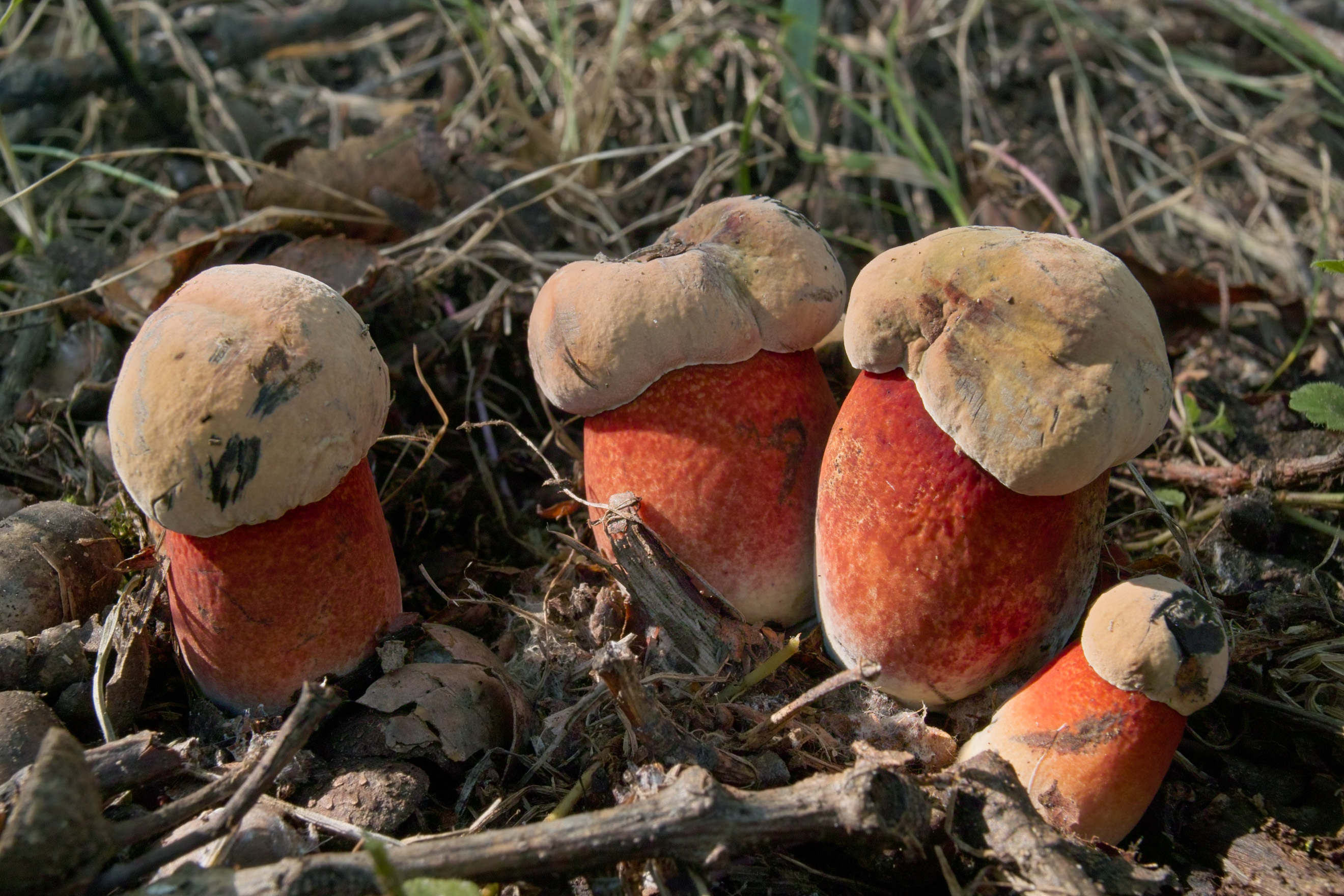


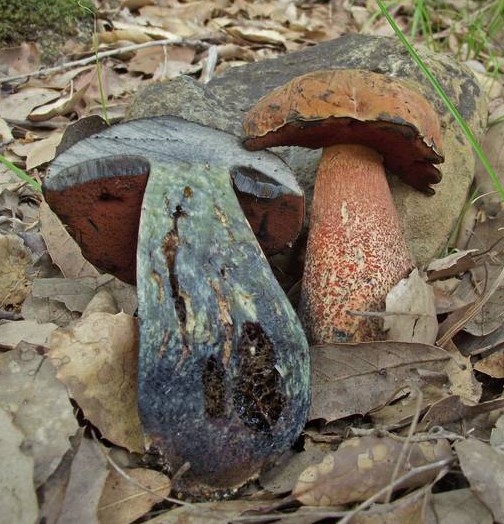
Suillellus mendax is an ectomycorrhizal bolete belonging to the family Boletaceae, characterized by a variable olive-brown to reddish pileus, bright red to deep orange pores, and a slender stipe bearing a pronounced red reticulum over a punctate background. The entire fruitbody rapidly oxidizes to dark blue when bruised or sliced. Native to European temperate and Mediterranean woodlands, it closely mimics other red-pored boletes while retaining distinct microhabitat and climatic affinities.
Identification, habitat, and key differences.
Forager
Fruitbody structure
- Fruit body form
- Fruit body form: Cap, stipe.
Cap
- Cap shape
- in young fruit bodies: Cap shape: hemispherical.
in mature fruit bodies: Cap shape: convex.
in old fruit bodies: Cap shape: flat. - Cap covering
- in young fruit bodies: Cap covering: suede-like.
in mature fruit bodies: Cap covering: felty. - Cap colour
- Cap colour: brown.
Cap colour: red.
Cap colour: yellowish.
Cap colour: crimson.
Cap colour: olive.
Cap colour: olive-brown.
Cap colour: pink.
when wet: Cap colour: vinaceous. - Cap margin outline
- Cap margin outline: wavy.
Cap margin outline: lobed. - Cap margin profile
- Cap margin profile: blunt.
- Cap colour reaction
- Cap colour reaction: blue.
- Cap diameter
- The cap measures up to 200 mm in diameter.
Cap underside
- Hymenophore type
- Hymenophore type: tubes.
Tubes near the stem
- Hymenophore attachment to the stipe
- Hymenophore attachment to the stipe: attached to the stipe (tubes).
- Attachment width of the hymenophore
- Attachment width of the hymenophore: narrowly attached (tubes).
- Pore shape
- Pore shape: round.
- Pore colour after damage
- Pore colour after damage: blue (onset of the reaction).
- Tube color after damage
- Tube color after damage: blue (onset of the reaction).
- Natural pore colour
- in young fruit bodies: Natural pore colour: yellow.
- Pore size
- Pore size: small.
- Natural tube colour
- in young fruit bodies: Natural tube colour: yellow.
in mature fruit bodies: Natural tube colour: olive.
Stem and base
- Stipe shape
- Stipe shape: cylindrical.
- Stipe base
- Stipe base: tapering.
- Stipe colour
- Stipe colour: yellow.
in the upper part of the stipe: Stipe colour: orange-yellow. - Stipe surface relief
- Stipe surface relief: reticulate.
- Stipe surface covering
- Stipe surface covering: scaly.
Stipe surface covering: granulose. - Stipe length
- Stipe length: up to 120 mm.
- Stipe diameter
- Stipe diameter: up to 50 mm.
- Stipe curvature
- Stipe curvature: curved.
- Colour of the stipe reticulum
- Colour of the stipe reticulum: crimson.
Flesh
- Flesh colour
- Flesh colour: yellow.
Flesh colour: crimson (flesh at the stipe base).
Flesh colour: cream pink (cap flesh).
Flesh colour: wine-coloured (flesh at the stipe base). - Flesh taste
- Flesh taste: weak.
- Flesh resistance to breaking or tearing
- Flesh resistance to breaking or tearing: resistant to breaking or tearing.
- Flesh elasticity
- Flesh elasticity: elastic.
- Flesh colour after damage
- Flesh colour after damage: blue.
Flesh colour after damage: blue. - Flesh odour
- Flesh odour: pleasant (flesh).
Flesh odour: not distinctive (flesh).
Flesh odour: weak. - Assessment of flesh taste pleasantness
- Assessment of flesh taste pleasantness: pleasant.
Where and when it grows
- Habitat
- Habitat: deciduous woodland.
Habitat: mixed woodland.
Habitat: park. - Substrate
- Substrate: soil.
Substrate: litter. - Fruit body growth pattern
- Fruit body growth pattern: solitary.
Fruit body growth pattern: in groups. - Occurrence frequency
- Fruiting season
- Distribution area
- Distribution area: confirmed.
Edibility and culinary use
- Edibility
- Edible
- Required processing
- Requires preparation
- Raw consumption
- Poisonous when raw
Law
- Protection
- It is not subject to species protection in Poland.
- Trade
- It is approved in Poland for neither trade nor the production of mushroom products.
Possible confusions
FAQ
Why is this mushroom called "mendax"?
The Latin name "mendax" means "deceitful," reflecting centuries of taxonomic confusion with closely similar species like Suillellus luridus.
Is Suillellus mendax edible raw?
No, it causes severe gastrointestinal poisoning if eaten raw or insufficiently cooked; thorough heating is strictly required.
Does Suillellus mendax blue when bruised?
Yes, both its pores and internal flesh rapidly oxidize to an intense dark blue when handled, bruised, or sliced.
What trees does Suillellus mendax associate with?
It forms ectomycorrhizae mainly with broadleaved trees like deciduous and evergreen oaks (Quercus), sweet chestnut, and beech.
Can it be safely consumed with alcoholic drinks?
Avoid combining it with alcohol, as related boletes can trigger uncomfortable disulfiram-like intolerance reactions.
What is its primary fruiting season?
Fruiting typically occurs from August to November, peaking during warm, rainy autumn periods in southern and central Europe.
What natural dye colors does it produce on wool?
Dyebaths prepared with this bolete yield earthy shades including tan, mustard yellow, olive green, and slate gray.
What soils does Suillellus mendax prefer?
It thrives in warm, well-aerated soils ranging from slightly acidic to calcareous substrates in open woodlands.
In which regions is Suillellus mendax found?
It is predominantly documented in Southern and Central Europe, especially in Mediterranean and sub-Mediterranean regions.
What does thoroughly cooked Suillellus mendax taste like?
When properly prepared and cooked, it has a dense, meaty consistency and a rich, pleasantly savory mushroom flavor.
Enthusiast
Cap underside
- Tube length
- Tube length: 5–18 mm.
Names and history
- Obowiązująca nazwa krajowa
- modroborowik półosiatkowany
- Obowiązująca nazwa taksonomiczna
- Suillellus mendax
- Inne nazwy krajowe
- modroborowik pośredni, Mimic Bolete
Home observations
Spore print
- Required materials
- fresh, mature cap, sheet of paper, glass or small bowl, water
- Time
- 2–24 h
- Procedure
- Place the cap underside down on the paper.
- Add a drop of water on top and cover.
- After 2–24 hours, lift the cap and inspect the deposit.
What to look for
- Spore print colour
- Spore print colour: brown.
- Spore print shade
- Spore print shade: olive-brown.
Under the microscope
- Required materials
- light microscope, microscope slide and cover slip, needle, water, spores from print
- Procedure
- Transfer a small amount of the spore print onto the slide using a needle.
- Add a drop of water, cover with a cover slip, and examine the spores.
What to look for
- Spore shape
- Spore shape: fusiform (nearly). Spore shape: fusiform (nearly). Spore shape: ellipsoid.
- Spore dimensions
- Length 11.7–15.7 µm, width 4.7–6.3 µm.
- Spore dimensions
- Length 12.4–15.5 µm, width 4.5–5.7 µm.
Compare dimensions after calibrating the microscope scale.
Ecology and distribution
- Soil reaction
- Soil reaction: neutral.
Soil reaction: alkaline.
Soil reaction: acidic. - Broadleaf trees in the vicinity
- Broadleaf trees in the vicinity: oak.
Broadleaf trees in the vicinity: lime tree.
Broadleaf trees in the vicinity: beech.
Broadleaf trees in the vicinity: hornbeam.
Broadleaf trees in the vicinity: Fagus sylvatica.
Broadleaf trees in the vicinity: Castanea sativa.
Broadleaf trees in the vicinity: Quercus cerris.
Broadleaf trees in the vicinity: Quercus suber.
Broadleaf trees in the vicinity: Quercus ilex. - Mycorrhizal hosts
- General species association: Mycorrhizal hosts: Quercus (general partner list).
- Mode of nutrition
- Mode of nutrition: ectomycorrhizal.
Non-culinary uses
Beyond culinary applications, Suillellus mendax has documented utility in natural pigment extraction and artisanal textile dyeing. Traditional textile enthusiasts and wool crafters use mature, pigment-dense basidiocarps to create substantive dyebaths. Depending on the soil chemistry of the harvest location and the mordanting agents employed, the mushroom yields an earthy palette ranging from pale mustard yellow and tan to olive-drab, slate green, and warm beige. Mordants such as iron sulfate drive the colors toward deeper, mossy greenish tones, while alum preserves warmer, golden-brown shades.
Historically, dried fragments of spongy, porous bolete caps were occasionally used in rural workshops as gentle polishing materials or absorbent pads for wiping fine carpentry joinery, as the fibrous dried structure absorbs moisture and light oils without scratching polished wooden surfaces. Additionally, regional ethnographic accounts from Southern Europe note the occasional incorporation of dried fungal remains into traditional smudges and aromatic hearth fires, where the slow-burning material produced a dense, insect-repelling smoke inside rustic livestock shelters and storage outbuildings.
History and culture
The specific epithet "mendax", meaning "deceitful" or "lying" in Latin, reflects the species' longstanding historical confusion with Suillellus luridus and other red-pored boletes. For centuries, Mediterranean foragers and mycologists encountered this fungus without recognizing its distinct taxonomic identity, absorbing it into broader folkloric narratives regarding deceptive forest mushrooms. In traditional Italian and Iberian rural societies, mushrooms that instantly transformed from golden yellow to dark indigo were viewed with deep ambivalence, often associated with shapeshifters, deceptive woodland spirits, or hidden venom.
Historical folk tales from the Apennine foothills recounted warnings against eating mushrooms that "bleed blue," warning that deceptive spirits used beautiful red and yellow pigments to entice unwary wanderers. Despite such mythical warnings, practical knowledge in select rural communities eventually acknowledged that certain bluing boletes were valuable provisions, provided traditional cooking rituals were respected. The formal recognition of Suillellus mendax in modern botanical history validated centuries of subtle distinctions whispered by observant village gatherers who had long claimed that certain "luridus" variants behaved differently in woods.
Edibility and safety
Suillellus mendax is classified as an edible mushroom solely when subjected to thorough, comprehensive thermal preparation. In its raw or undercooked state, the species contains gastrointestinal irritants capable of precipitating rapid gastrointestinal distress, including violent emesis, abdominal cramps, and diarrhea. Adequate cooking deactivates these thermolabile toxins, allowing safe consumption.
A critical safety consideration relates to the co-ingestion of alcoholic beverages. While the exact concentration of coprine-like compounds in Suillellus mendax remains a subject of ongoing observation, caution is traditionally warranted due to its close relationship to Suillellus luridus, which has been reported to induce disulfiram-like adverse reactions when paired with alcohol in susceptible individuals.
In terms of regional culinary reputation, the mushroom is gathered and appreciated in parts of Italy, France, and Spain, where collectors praise its solid texture and rich, savory taste once properly cooked. In contrast, British and Northern European traditions maintain a widespread precautionary avoidance of all bluing, red-pored species, regarding them as inherently treacherous table fungi.
Habitat and occurrence
Suillellus mendax is distributed predominantly throughout Southern and Central Europe, with its core range encompassing Mediterranean and sub-Mediterranean woodland systems, extending into temperate broadleaved zones. It is an ectomycorrhizal partner of diverse deciduous trees, forming strong mutualistic affinities with Quercus species (including Quercus ilex, Quercus suber, and Quercus pubescens), Fagus sylvatica, and Castanea sativa. Rarely, it associates with conifers such as Pinus or Abies in mixed montane stands.
The fungus prefers warm, sunny, well-aerated environments, frequently emerging in Mediterranean macchia, open thermophilous deciduous forests, woodland borders, and grassy forest clearings. It thrives on moderately dry to moist, predominantly acidic or siliceous substrates, showing significant ecological tolerance across variable soil chemistries. Fruiting begins in late summer, commonly from August onward, and reaches its zenith during September, October, and November in Mediterranean latitudes where autumn rains break summer droughts. In central continental areas, fruiting is more compressed, typically terminating with the first sharp October frosts.
Sources
- retained-cd9bc44843b40f08
- Matthias Dondl, Boletaceae 2022 Nr2
- Jarling 2015 — porównanie S. mendax i S. luridus
- L.Opat/V.Sojka ČMS Suillellus mendax
- Machiel Noordeloos 2022/2025 NDFF
- Grzyby.pl / GRej — dwa polskie wpisy
- Vizzini, Simonini, Ercole i Voyron 2013/2014 — Boletus mendax, Mycological Progress13:95–109
- Jihočeské muzeum v Českých Budějovicích, Houby českobudějovických parků a trávníků: Suillellus mendax
Researcher
Edibility and culinary use
Ustalenia źródłowe: jadalność, spożycie i wykorzystanie
- Edibility
- Edible — źródło oznaczenia
Materiał: po obróbce
Kraj źródła: CZ
myko · Kuchyňské využití: Je to jedlá houba průměrné kvality, za syrova mírně jedovatá. Atlas assessment by L. Opat/V. Sojka; not an in-house safety study, processing condition recorded separately.
- Raw consumption
- Poisonous
Materiał: surowy
Kraj źródła: CZ
Stopień wskazany w źródle: łagodnie trujący
myko · myko.cz, Kuchyňské využití: za syrova mírně jedovatá. Opat/Sojka atlas author assessment, no cited primary toxicology experiment for this statement.
- Required processing
- Requires cooking
myko · Kuchyňské využití: recommended cooking, source text min. 20 min remains in Badacz as an author recommendation, not a verified universal threshold for inactivation of a specific toxin.
Scientific names and taxonomy
- Current scientific name
Suillellus mendax
Scientific names and taxonomy
Suillellus mendax belongs to the bolete family, Boletaceae. Index Fungorum and Species Fungorum indicate this name as current; a former combination is Boletus mendax. In the preserved GBIF match result of 30 September 2026, the authorship of the current combination was recorded as (Simonini & Vizzini) Vizzini, Simonini & Gelardi. The Index Fungorum entry links the combination in the genus Suillellus to the year 2014.
Scientific names and taxonomy
For the name Boletus mendax, Index Fungorum gives Simonini & Vizzini and the year 2013, while in the Czech atlas and the NCBI record the year 2014 appears. The metadata of the paper by Vizzini, Simonini, Ercole, and Voyron indicate volume 13 of the journal Mycological Progress from 2014, pages 95–109. The nomenclatural date and the volume date should be kept separate; the divergent records of the year are not resolved merely by equating them with the publication year of the journal.
Taxon scope and identification limitations
Jarling, in a study from 2015, compared about 30 collections from Berlin and Brandenburg. In the available abstract excerpt, the average spore length-to-width ratio was indicated as the best distinguishing feature separating Suillellus mendax and Suillellus luridus in the examined sample; well-developed collections facilitated separation based on macrofeatures. This is the result of a regional comparison of two taxa. Access to an abstract excerpt does not allow the reconstruction of the full key or all methods of the work.
Ecology and distribution
- Occurrence frequency
- Czechia: Occurrence frequency: uncommon. [39]
Laboratory diagnostics
Dane ustrukturyzowane
Basidia
- Clamp connections
- Clamp connections: not observed. [43]
Hymenial cystidia
- Presence of hymenial pseudocystidia
- Presence of hymenial pseudocystidia: present. [43]
- Pseudocystidia septa visibility
- Pseudocystidia septa visibility: indistinct (often, at the stem base). [43]
- Shape of hymenial pseudocystidia
- Shape of hymenial pseudocystidia: worm-shaped (mostly). [43]
- Hymenial cystidium color
- Hymenial cystidium color: yellow (pale). [43]
Hymenial cystidium color: yellow (pale). [43] - Appearance of hymenial cystidium contents
- Appearance of hymenial cystidium contents: amorphous. [43]
- Color of hymenial cystidium contents
- Color of hymenial cystidium contents: yellow (dark). [43]
- Hymenial cystidium length
- Hymenial cystidium length: 40.2–62.4 µm. [43]
Hymenial cystidium length: 60–69.1 µm. [43] - Optical appearance of the hymenial cystidium
- Optical appearance of the hymenial cystidium: hyaline. [43]
Optical appearance of the hymenial cystidium: hyaline. [43] - Hymenial cystidium shape
- Hymenial cystidium shape: fusiform. [43]
Hymenial cystidium shape: fusiform. [43] - Hymenial cystidium width
- Hymenial cystidium width: 11.1–12.9 µm. [43]
Hymenial cystidium width: 10.2–13.3 µm. [43] - Width of hymenial pseudocystidia
- Width of hymenial pseudocystidia: 4.8–6.2 µm. [43]
- Presence of pleurocystidia
- Presence of pleurocystidia: present. [43]
Pileipellis
- Length of pileipellis elements
- Length of pileipellis elements: 26.4–46.1 µm. [43]
- Shape of pileipellis elements
- Shape of pileipellis elements: cylindrical. [43]
- Width of pileipellis elements
- Width of pileipellis elements: 5.5–7.9 µm. [43]
- Incrustation of cuticle hyphae
- Incrustation of cuticle hyphae: not observed (pronounced). [43]
- Color of cuticle pigment
- Color of cuticle pigment: pale brown. [43]
- Structure of the pileipellis
- Structure of the pileipellis: trichoderm. [43]
- Shape of pileipellis terminal cell apex
- Shape of pileipellis terminal cell apex: tapering. [43]
Reactions with reagents
- Amyloid reaction
- Amyloid reaction: positive. [43]
Spores
- Mean spore length-to-width ratio
- Mean spore length-to-width ratio: 2.68 (standard deviation: 0.11, mean). [41]
- Spore colour under the microscope
- Spore colour under the microscope: golden yellow. [43]
- Spore length
- Spore length: 11.7–15.7 µm. [8]
Spore length: 12.4–15.5 µm (range of collection means). [43]
Spore length: 11.9–15.6 µm. [8]
Spore length: 13–15 µm. [15] - Spore length-to-width ratio
- Spore length-to-width ratio: 2.5–2.9 (range of collection means). [43]
Spore length-to-width ratio: 1.98–2.91. [8]
Spore length-to-width ratio: 2.25–2.77. [8]
Spore length-to-width ratio: 2.4–3. [17] - Spore shape
- Spore shape: fusiform (nearly). [15]
Spore shape: fusiform (nearly). [43]
Spore shape: ellipsoid. [43] - Basidiospore suprahilar depression
- Basidiospore suprahilar depression: present. [43]
- Spore volume
- Spore volume: 156–255 µm³ (range of collection means). [43]
Material and research methods
Description of characteristics — source and scope
Material: Fresh fruitbodies of B.mendax from the Italian original description material; source odor assessment.
Reading scope: Full text.
Limitations: Author's sensory evaluation; not a clinical panel or a recommendation for taste testing.
Microscopic data — source and limitations
Material: Aggregated result of 23 Italian collections from the original work; Qm comes from the author's paired measurements.
Reading scope: Full text.
Limitations: SD is not a min–max range nor instrument uncertainty.
Study of composition and activity — Martins et al. (2023)
Material: Fruit bodies identified as Suillellus mendax, Sabugal, Portugal, July 2021. The material was dried at 40°C and ground; extraction was carried out with 40% ethanol (v/v), using 75 ml per 1 g of dry material and ultrasound for 20 minutes. Individual compounds were determined by HPLC-DAD. The work also includes separate colorimetric determinations and extract activity tests.
Reading scope: Full text.
Limitations: No exsiccatum identifier or DNA sequence of the studied material S. mendax was provided. In the HPLC-DAD table, means and standard deviations from three determinations are reported. Replicates of the assay do not constitute independent populations of the fungus. The source amounts from table 3 are expressed in micrograms per 100 grams of dry mass. In quantitative rows, equivalent values in milligrams are given; one milligram corresponds to one thousand micrograms. Means and deviations were converted using the same factor. A specific material and extract were studied under laboratory conditions. The results do not establish consumption safety or treatment efficacy. Concentrations of 0,1, 1, and 10 milligrams of extract per milliliter apply to separate variants of the tyrosinase assay. The mere application of a concentration does not imply effective inhibition of the enzyme; the numerical effect and the authors' assessment remain separate study results.
- Results as recorded in the sources — Spores per basidium
- Materiał badania: Materiał włoski B.mendax z opisu23kolekcji Vizziniego i in.; holotyp AMB12633 i izotyp GS10009, Rifugio Zamboni,27.08.2010. Opis zbiorczy nie jest pomiarem wyłącznie holotypu. Liczba zarodników na jednej podstawce wynosi 2. [43]
Materiał badania: Materiał włoski B.mendax z opisu23kolekcji Vizziniego i in.; holotyp AMB12633 i izotyp GS10009, Rifugio Zamboni,27.08.2010. Opis zbiorczy nie jest pomiarem wyłącznie holotypu. Liczba zarodników na jednej podstawce wynosi 4. [43] - Results as recorded in the sources — Spore length
- Materiał badania: Materiał włoski B.mendax z opisu23kolekcji Vizziniego i in.; holotyp AMB12633 i izotyp GS10009, Rifugio Zamboni,27.08.2010. Opis zbiorczy nie jest pomiarem wyłącznie holotypu. Średnie długości zarodników z badanych kolekcji mogą wynosić od 12,4 do 15,5 mikrometra. [43]
11,7–15,7 µm [8]
13–15 µm [15]
11,9–15,6 µm [8] - Results as recorded in the sources — Spore length-to-width ratio
- 2,4–3 [17]
Materiał badania: Materiał włoski B.mendax z opisu23kolekcji Vizziniego i in.; holotyp AMB12633 i izotyp GS10009, Rifugio Zamboni,27.08.2010. Opis zbiorczy nie jest pomiarem wyłącznie holotypu. Średnie ilorazy długości i szerokości zarodników z badanych kolekcji mogą wynosić od 2,5 do 2,9. [43]
1,98–2,91 [8]
2,25–2,77 [8] - Results as recorded in the sources — Spore width
- 4,9–6,3 µm [8]
5,1–6,3 µm [8]
4,7–5,6 µm [15]
Materiał badania: Materiał włoski B.mendax z opisu23kolekcji Vizziniego i in.; holotyp AMB12633 i izotyp GS10009, Rifugio Zamboni,27.08.2010. Opis zbiorczy nie jest pomiarem wyłącznie holotypu. Średnie szerokości zarodników z badanych kolekcji mogą wynosić od 4,5 do 5,7 mikrometra. [43]
Metody i zapisy źródłowe — Materiał włoski B.mendax z opisu23kolekcji Vizziniego i in.; holotyp AMB12633 i izotyp GS10009, Rifugio Zamboni,27.08.2010. Opis zbiorczy nie jest pomiarem wyłącznie holotypu.
Metoda źródłowa. Technika: mikroskopia świetlna (LM). Opis metody w źródle: Suszony materiał rehydratowany w L4, odczynniku Melzera lub amoniakalnej czerwieni Kongo; mikroskop Jenamed Variant, pomiary1000× okularem mikrometrycznym. Dla poszczególnych zakresów nie ustalono jednego wyłącznego medium.
Metoda źródłowa. Technika: mikroskopia świetlna (LM). Opis metody w źródle: Widok boczny zarodnika w opisie źródłowym; nie alternatywne stadium rozwoju. Materiał suszony i rehydratowany, bez dowodu określenia jednego medium dla całego opisu kształtu.
Metoda źródłowa. Technika: mikroskopia świetlna (LM). Opis metody w źródle: Widok z przodu zarodnika w opisie źródłowym; odrębna projekcja tego samego typu komórki.
Metoda źródłowa. Technika: mikroskopia świetlna (LM). Medium: woda lub L4. Opis metody w źródle: Barwa złocistożółta podana wspólnie dla wody lub L4; nie reakcja w Melzerze.
Metoda źródłowa. Technika: mikroskopia świetlna (LM). Medium: amoniakalna czerwień Kongo. Opis metody w źródle: Źródłowe metodyPDF3 wskazują amoniakalną czerwień Kongo dla hymenium; podpisryc.4PDF8 potwierdza to medium dla cystyd. Nie dopisano niepodanego stężenia.
Wygląd optyczny podstawki — zapis źródłowy: „Vizzini2013/2014 PDF7: hyaline, rarely yellowish; brak reguły częstości nie zamienia rarely w zawsze.” [43]
Obecność pseudocystyd hymenialnych — zapis źródłowy: „Vizzini2013/2014 PDF7: PSEUDOCYSTIDIA also present.” [43]
Kształt pseudocystyd hymenialnych — zapis źródłowy: „Vizzini PDF7: PSEUDOCYSTIDIA ... mostly worm shaped.” [43]
Szerokość pseudocystyd hymenialnych — zapis źródłowy: „Vizzini2013/2014 PDF7: 4.8–6.2µm broad.” [43]
Liczba zarodników na jednej podstawce — zapis źródłowy: „Vizzini2013/2014 PDF7: usually4-spored; rarely2-spored. Częstości pozostają w source_expression; są dwiema odrębnymi możliwościami liczbowymi.” [43]
Liczba zarodników na jednej podstawce — zapis źródłowy: „Vizzini2013/2014 PDF7: rarely2-spored; nie zakres ciągły2–4.” [43]
Długość podstawki — zapis źródłowy: „Vizzini2013/2014 PDF7: 24.9–30.5µm, c=23kolekcje.” [43]
Szerokość podstawki — zapis źródłowy: „Vizzini2013/2014 PDF7: 9.5–12.7µm, c=23kolekcje.” [43]
Barwa cystydy hymenialnej — zapis źródłowy: „Vizzini2013/2014 PDF7: hyaline to pale yellow; źródłowo blada żółć, odrębna od bezbarwności.” [43]
Wygląd zawartości cystydy hymenialnej — zapis źródłowy: „Vizzini PDF7: PSEUDOCYSTIDIA ... dark yellow amorphous content.” [43]
Barwa zawartości cystydy hymenialnej — zapis źródłowy: „Vizzini PDF7: dark yellow ... content; medium not assigned to this individual colour result.” [43]
Długość cystydy hymenialnej — zapis źródłowy: „Vizzini2013/2014 PDF7: FACIAL cystidia, dokładne położenie zachowane rodzicem celu.” [43]
Długość cystydy hymenialnej — zapis źródłowy: „Vizzini2013/2014 PDF7: MARGINAL cystidia, dokładne położenie zachowane rodzicem celu.” [43]
Wygląd optyczny cystydy hymenialnej — zapis źródłowy: „Vizzini2013/2014 PDF7: hyaline to pale yellow; optical appearance separate from the colour.” [43]
Kształt cystydy hymenialnej — zapis źródłowy: „Vizzini2013/2014 PDF7: fusiform; marginal similar, shorter.” [43]
Szerokość cystydy hymenialnej — zapis źródłowy: „Vizzini2013/2014 PDF7: Dla dokładnego celu face-cell, bez sumowania ściennych i brzeżnych.” [43]
Szerokość cystydy hymenialnej — zapis źródłowy: „Vizzini2013/2014 PDF7: Dla dokładnego celu marginal-cell, bez sumowania ściennych i brzeżnych.” [43]
Widoczność przegród pseudocystydy — zapis źródłowy: „Vizzini PDF7: often with no evident septa at the base; visibility result, not absence of septa.” [43]
Długość elementów skórki kapelusza — zapis źródłowy: „Vizzini2013/2014 PDF7: 26.4–46.1µm.” [43]
Kształt elementów skórki kapelusza — zapis źródłowy: „Vizzini2013/2014 PDF7: cylindrical hyphae with tapered end cells; zwężenie wierzchołka jest osobną cechą.” [43]
Szerokość elementów skórki — zapis źródłowy: „Vizzini2013/2014 PDF7: 5.5–7.9µm.” [43]
Inkrustacja strzępek skórki — zapis źródłowy: „Vizzini PDF7: no relevant incrustations; significant/relevant qualification retained.” [43]
Barwa pigmentu skórki — zapis źródłowy: „Vizzini2013/2014 PDF7: intracellular pale brown pigment.” [43]
Organizacja skórki kapelusza — zapis źródłowy: „Vizzini2013/2014 PDF7: regular trichodermium; strzępki wyprostowane, później bardziej przeplecione.” [43]
Kształt wierzchołka komórki końcowej skórki kapelusza — zapis źródłowy: „Vizzini2013/2014 PDF7: tapered end cells.” [43]
Obecność pleurocystyd — zapis źródłowy: „Vizzini2013/2014 PDF7: FACIAL CYSTIDIA: wyraźnie opisane i zilustrowane.” [43]
Barwa zarodnika w mikroskopie — zapis źródłowy: „Vizzini2013/2014 PDF7: golden yellow in water or L4.” [43]
Długość zarodnika — zapis źródłowy: „Vizzini2013/2014 PDF7: (12.4–)13.3–14.7(–15.5)µm, c=23kolekcje.” [43]
Iloraz długości i szerokości zarodnika — zapis źródłowy: „Vizzini2013/2014 PDF7: Q=(2.5–)2.6–2.8(–2.9); oryginalny iloraz z badania.” [43]
Kształt zarodnika — zapis źródłowy: „Vizzini2013/2014 PDF7: subfusiform in side view.” [43]
Kształt zarodnika — zapis źródłowy: „Vizzini2013/2014 PDF7: ellipsoid in front view.” [43]
Zagłębienie nad wnęką bazydiospory — zapis źródłowy: „Vizzini2013/2014 PDF7: weak but always present suprahilar depression, side view; słaby stopień zachowano w źródle, nie rozciągnięto na inne wyniki.” [43]
Objętość zarodnika — zapis źródłowy: „Vizzini2013/2014 PDF7: V=(156–)173–231(–255)µm³; źródłowa objętość konwencjonalna modelowana z osi, nie własne przeliczenie.” [43]
Szerokość zarodnika — zapis źródłowy: „Vizzini2013/2014 PDF7: (4.5–)4.9–5.5(–5.7)µm, c=23kolekcje.” [43]
Metody i zapisy źródłowe — Exact source material and scope: [{"collection_id": null, "sample_material": null, "sample_n": null, "taxon": "Suillellus mendax"}, {}, null, null]
Długość zarodnika; Szerokość zarodnika — zapis źródłowy: „Zarodniki 13–15 × 4,7–5,6 µm. Atlas nie określa metody, preparatu, odczynnika ani liczebności pomiaru.” [15]
Kształt zarodnika — zapis źródłowy: „Zarodniki prawie wrzecionowate, z depresją suprahilarną. Nie podano preparatu ani metody atlasowego pomiaru.” [15]
Metody i zapisy źródłowe — Exact source material and scope: [{"collection_id": "DE-Dondl-2022-2", "sample_material": "spore_print", "sample_n": 30, "taxon": "Suillellus mendax"}, {}, null, 30]
Długość zarodnika; Szerokość zarodnika — zapis źródłowy: „Z wysypu tej samej kolekcji: 11,7–15,7 × 5,1–6,3 µm, średnio 13,7 × 5,7 µm, n = 30.” [8]
Iloraz długości i szerokości zarodnika — zapis źródłowy: „Q 1,98–2,91, średnio 2,38, z wysypu; 30 zarodników tej kolekcji.” [8]
Metody i zapisy źródłowe — Exact source material and scope: [{"collection_id": "DE-Dondl-2022-2", "sample_material": "tubes", "sample_n": 30, "taxon": "Suillellus mendax"}, {}, null, 30]
Długość zarodnika; Szerokość zarodnika — zapis źródłowy: „Z rurek tej samej kolekcji: 11,9–15,6 × 4,9–6,3 µm, średnio 13,9 × 5,6 µm, n = 30.” [8]
Iloraz długości i szerokości zarodnika — zapis źródłowy: „Q 2,25–2,77, średnio 2,49, z rurek; 30 zarodników tej samej kolekcji.” [8]
Metody i zapisy źródłowe — Exact source material and scope: [{"collection_id": null, "sample_material": null, "sample_n": null, "taxon": "Suillellus mendax"}, {}, null, null]
Iloraz długości i szerokości zarodnika — zapis źródłowy: „NDFF: Q 2,4–3 dla S. mendax oraz 1,9–2,5 dla porównywanego S. luridus. Zakresy częściowo się nakładają.” [17]
Names and species identity
Polish name: The current primary name is modroborowik półosiatkowany: recommendation no. 3/2024 of the Committee for Polish Names of Fungi of the Polish Mycological Society (PTMyk), 21.03.2024. The older PTMyk website still lists modroborowik pośredni with reference to KPNG 1/2021; this documented variant remains an alternative name. Older trade names krasnoborowik oszukańczy and borowik oszukańczy did not obtain independent verification and are not promoted to confirmed names.
Description and type: Suillellus mendax (Simonini & Vizzini) Vizzini, Simonini & Gelardi is a combination for the species described as Boletus mendax Simonini & Vizzini. The article has DOI 10.1007/s 11557-013-0896-4, online publication 2013, and volume 13 of 2014, pp. 95–109. Holotype AMB12633, isotype GS10009: Rifugio Zamboni, Italy, 27.08.2010, under Fagus sylvatica at 1150 m a.s.l.; ITS sequence KC734548. The collective description of 23 collections was not equated with the measurement of the holotype alone.
Distinctness and boundaries: In the ITS study, six Italian sequences of B. mendax had 99,6% mutual identity. The Portuguese sequence HM347662, previously identified as B. luridus and distinct from B. mendax, was not unconditionally assigned to the new species by the authors; they considered a separate, undescribed taxon. Historical data of the entire S. luridus complex was not transferred to S. mendax. Bataille's line and the extent of the reticulum are variable and do not independently provide a reliable identification.
Morphology — source conditions and results
Field variations: The Italian description gives cap 40–120(–200) mm and stipe 40–120 × 8–30(–50) mm. The surface is velvety, then felt-like, described as never viscid. The reticulum is sometimes weakly visible and limited to the apex, but in some collections reaches the base; granules may partially overlap the reticulum. A constant extent of half of the stipe was not recorded for the entire species. In older basidiomata, brown tomentum may occur at the base.
Context and reaction: The context is lemon yellow or chrome yellow, beet red at the base. Upon exposure it immediately turns indigo blue, strongest at the stipe base, then fades to dirty white. The layer above the tubes usually matches the color of the pores, but in more than 20% of collections it was yellow. In one fresh collection GS10047 from moist conditions, about half of the fruitbodies had Bataille's line; moisture does not explain all cases.
Odor and taste: The authors described odor and taste as weak, pleasant, indistinctive. The claim of weak intensity does not equate to absence of odor or taste. The taste description is a source report, not a recommendation to taste raw material.
Microscopy — material, methods, and limitations
Material and measurement: The original work includes 23 collections for microfeature descriptions. Mounts from dried material were rehydrated in L4, Melzer's reagent, or ammoniacal Congo red. A Jenamed Variant and 1000× magnification were used, with a micrometer eyepiece. The method required at least 31 spores per collection; c=23 denotes collections, not the number of cells. An identical reagent was not declared for all measurements. The authors explicitly indicated that the standard deviation, minimum, and maximum refer to collection means. The outer limits of the summary should not be read as extreme sizes of all individual spores.
Spores and projection: The outer limits of the source summary are 12,4–15,5 × 4,5–5,7 µm, with the original notation (12,4–)13,3–14,7(–15,5)×(4,5–)4,9–5,5(–5,7) µm. Q=2,5–2,9, Qm=2,68±0,11. Conventional volume V=156–255 µm³, Vm=202±29 µm³, derived by the authors from an ellipsoidal model. The spore is nearly fusiform from the side and ellipsoidal from the front; it has a weak, constantly observed suprahilar depression in side view. Q was not calculated from independent extreme axes.
Colors and reagent: In water or L4, spores were described as golden yellow; in Melzer's reagent as brown with a lilac tint. These are distinct mount contexts, not unconditional color alternatives. A strongly positive amyloid reaction applies to tissue at the base of the stipe: violet-blue-black color, Imler's method. This reaction was not attributed to the spores themselves.
Basidia and cystidia: Basidia are 24,9–30,5 × 9,5–12,7 µm, usually four-, rarely two-spored; they are hyaline, rarely yellowish. Pleurocystidia measure 60–69,1 × 11,1–12,9 µm, cheilocystidia 40,2–62,4 × 10,2–13,3 µm; both groups are described as fusiform, but measurements remain separate. Pseudocystidia are 4,8–6,2 µm wide, usually vermiform in shape, and have dark yellow amorphous contents. They were not called chrysocystidia.
Pileipellis and non-observation result: The pileipellis forms a regular trichoderm of erect parallel cylindrical hyphae, later more interwoven; elements 26,4–46,1 × 5,5–7,9 µm, ends narrowed. Pigment is intracellular, light brown. The wording no relevant incrustations does not establish a complete absence of encrustations. Clamp connections were not observed; the result was not converted into proof of their species absence.
Occurrence and fruiting in Poland
Two records: GRej shows no. 354673: Bydlin, 1.08.2020, hornbeam monoculture with single oaks on a limestone hill, two fruitbodies on the ground; leg. Sławomir Magier, det. Błażej Gierczyk, exsiccatum BGF0008644. No. 370394: Krukówka, 11.08.2023, oak forest, singly in over a dozen places along the road; leg. det. Robert Kozak, declared dispatch of exsiccatum. Entry numbers are not laboratory sample numbers.
Level of confirmation: The PTMyk recommendation from 2024 refers to the same entries and reports a lack of published localities. Citing it does not create a third independent confirmation. Reading the page does not retroactively establish DNA or curator status for both records. The level of documented observations is maintained, with stronger corroboration of the exsiccatum in Bydlin. This is not a claim of the species' absence in Poland.
Season: The two August records are event dates, not proof of a nationwide August–August season. The Czech atlas gives June–September for its area; the Italian description gives summer and early autumn, late autumn in Sardinia. These dates were not automatically attributed to Poland. For Poland, no sufficiently documented general month range was found.
Ecology — distinct areas and conditions
Preferences and environment: Italian collections came mainly from acidic soils under European beech and sweet chestnut, less frequently Quercus cerris, Q. suber, Q. ilex;500–1200 m a.s.l. It was not recorded then in pure coniferous stands. This is the scope of the authors from 2013, not proof of the species' absence under conifers everywhere. Observation of a tree in the surroundings is not automatically confirmed mycorrhiza for a given pair.
Apparent soil contradiction: The Czech atlas usually associates the species with basic and neutral soils, whereas the original Italian description with acidic ones. Polish Bydlin is described as a limestone hill, without measurement of soil pH. pH was not derived from the rock alone, and the differing ranges were not combined into a statement about a lack of preference. The information on acidic substrate applies to the Italian material and does not determine the preferences of Polish populations.
Law in Poland — basis of the result
Protection: The current official status and complete annexes 1–4 of the regulation Dz.U.2014 item 1408 were checked. Neither S. mendax nor its basionym B. mendax is listed; there is no collective entry protecting the entire genus Suillellus. Result: not subject to national species protection. This is not a red list category or permission for collection everywhere.
Trade: The applicable consolidated text published in March 2026, Dz.U.2026 item 258, §2 para. 1, and the entire Annex 1, items 1–72, were checked. Absence of S. mendax and B. mendax as well as any collective scope covering this species. Result: not approved for commercial trade or production of mushroom products in Poland. The entry for Boletus edulis does not cover this distinct species.
Source documentation
Source findings: The museum description of Suillellus mendax compares it with S. luridus as a species with more slender fruit bodies. This is a qualitative comparison of habitus, without deriving a numerical stipe length-to-width ratio. The source reports a mycorrhizal association with oaks and does not attribute to it a preference for calcareous substrates.
Occurrence verification — scope and limitations
Material: Odczytane polskie wpisy GRej 354673 i 370394; Bydlin z oznaczeniem B.Gierczyka i voucherem BGF0008644; Krukówka z deklaracją eksykatu.
Reading scope: Documented observation.
Review date: 18.10.2026.
Limitations: Observational register level, not own DNA identification or re-measurement of exsiccata.
Occurrence verification — scope and limitations
Material: Potwierdzony zbiór z Bydlina w województwie małopolskim;1 sierpnia 2020 to data zbioru.
Reading scope: Source fragments.
A source fragment was read; the full text and methods were not verified.
Review date: 21.10.2026.
Limitations: No regular Polish season was established. Dates of specific Polish collections do not define the calendar for the entire country. Seasons from other countries or aggregate species were not transferred. The national atlas and preserved sources specific to the given taxon were read; details of the verified sources and reading boundaries were recorded in the review report P0. The TARGET_SEASON_REQUIRED requirement remains active. The source identification and concept scope were retained. No new examination of specimens or reading of all publications cited by the source was declared.
Occurrence verification — scope and limitations
Material: Osobny zapis obserwacyjny z województwa lubelskiego; nie utożsamiono statusu formalnie przyjęty ze zweryfikowanym przez kustosza.
Reading scope: Source fragments.
A source fragment was read; the full text and methods were not verified.
Review date: 21.10.2026.
Limitations: No regular Polish season was established. Dates of specific Polish collections do not define the calendar for the entire country. Seasons from other countries or aggregate species were not transferred. The national atlas and preserved sources specific to the given taxon were read; details of the verified sources and reading boundaries were recorded in the review report P0. The TARGET_SEASON_REQUIRED requirement remains active. The source identification and concept scope were retained. No new examination of specimens or reading of all publications cited by the source was declared.
Scope of elaboration
Before completion, the record requires completion or settlement.
- For a confirmed country, the season or the minimum range of confirmed observations must be established.
- Searching for regions of occurrence requires accounting.
Legal basis and scope of assessment
Analytical results
Composition and laboratory activity
- Detected phenolic compounds
- Detected phenolic compounds: gallic acid. [41]
Detected phenolic compounds: 4-hydroxybenzoic acid. [41]
Detected phenolic compounds: gallic acid (identifier in the source: I, isomer reported in the source). [41]
Detected phenolic compounds: homogentisic acid (identifier in the source: I, derivative reported in the source). [41]
Detected phenolic compounds: morin. [41]
Detected phenolic compounds: rutin. [41]
Detected phenolic compounds: diosmetin. [41] - Activity of the tested extract
- Activity of the tested extract: antioxidant activity (DPPH). [41]
Activity of the tested extract: enzyme inhibition (hyaluronidase). [41]
Activity of the tested extract: enzyme inhibition (tyrosinase, did not meet the authors’ activity criterion). [41] - Quantitative content of component in material
- Quantitative content of component in material: 9.93 µg/100g (rutin, assay replicates, number of replicates: 3, on a dry mass basis, standard deviation: 0.76, mean). [41]
Quantitative content of component in material: 4.1 µg/100g (diosmetin, assay replicates, number of replicates: 3, on a dry mass basis, standard deviation: 0.53, mean). [41]
Quantitative content of component in material: 0.04103 mg/100g (4-hydroxybenzoic acid, assay replicates, number of replicates: 3, on a dry mass basis, standard deviation: 0.00849, mean). [41]
Quantitative content of component in material: 0.03496 mg/100g (gallic acid, assay replicates, number of replicates: 3, on a dry mass basis, standard deviation: 0.00738, mean). [41]
Quantitative content of component in material: 13.3 µg/100g (homogentisic acid, assay replicates, number of replicates: 3, on a dry mass basis, identifier in the source: I, derivative reported in the source, standard deviation: 1.18, mean). [41]
Quantitative content of component in material: 35.39 µg/100g (morin, assay replicates, number of replicates: 3, on a dry mass basis, standard deviation: 3.1, mean). [41]
Quantitative content of component in material: 32.67 µg/100g (gallic acid, assay replicates, number of replicates: 3, on a dry mass basis, identifier in the source: I, isomer reported in the source, standard deviation: 5.64, mean). [41] - Reducing capacity in the Folin–Ciocalteu assay
- Reducing capacity in the Folin–Ciocalteu assay: 13.95 mgGAE/g (Folin–Ciocalteu assay, relative to the mass of the starting material, assay replicates, number of replicates: 3, on a dry mass basis, standard deviation: 1.76, calibration standard: gallic acid, mean). [41]
- Exposure concentration of the tested material
- Exposure concentration of the tested material: 10 mg/ml (tyrosinase, extract, hydroethanolic extract (Martins et al., 2023), reported value). [41]
Exposure concentration of the tested material: 1 mg/ml (tyrosinase, extract, hydroethanolic extract (Martins et al., 2023), reported value). [41]
Exposure concentration of the tested material: 0.1 mg/ml (tyrosinase, extract, hydroethanolic extract (Martins et al., 2023), reported value). [41]
Exposure concentration of the tested material: 1 mg/ml (hyaluronidase, extract, hydroethanolic extract (Martins et al., 2023), reported value). [41]
Exposure concentration of the tested material: 0.1 mg/ml (hyaluronidase, extract, hydroethanolic extract (Martins et al., 2023), reported value). [41]
Exposure concentration of the tested material: 10 mg/ml (hyaluronidase, extract, hydroethanolic extract (Martins et al., 2023), reported value). [41] - Mass-related antioxidant activity
- Mass-related antioxidant activity: 113.7 µM Trolox/g (ABTS assay, extract, relative to the mass of the starting material, assay replicates, number of replicates: 3, on a dry mass basis, standard deviation: 36.59, hydroethanolic extract (Martins et al., 2023), Trolox, unit discrepancy in the publication; the method section specifies µmol Trolox/g, mean). [41]
Mass-related antioxidant activity: 156.6 µM Trolox/g (FRAP assay, extract, relative to the mass of the starting material, assay replicates, number of replicates: 3, on a dry mass basis, standard deviation: 7.65, hydroethanolic extract (Martins et al., 2023), Trolox, unit discrepancy in the publication; the method section specifies µmol Trolox/g, mean). [41]
Mass-related antioxidant activity: 718 µM Trolox/g (DPPH assay, extract, relative to the mass of the starting material, assay replicates, number of replicates: 3, on a dry mass basis, standard deviation: 187, hydroethanolic extract (Martins et al., 2023), Trolox, unit discrepancy in the publication; the method section specifies µmol Trolox/g, mean). [41] - Flavonoid content in collective assay
- Flavonoid content in collective assay: 6 mgCE/g (aluminium chloride assay, relative to the mass of the starting material, assay replicates, number of replicates: 3, on a dry mass basis, standard deviation: 0.36, catechin, mean). [41]
- Minimum bactericidal concentration — MBC
- Minimum bactericidal concentration — MBC: > 20 mg/ml (broth microdilution, bacterial strain MJMC 109, extract, hydroethanolic extract (Martins et al., 2023), reported value). [41]
Minimum bactericidal concentration — MBC: 10 mg/ml (broth microdilution, bacterial strain MJMC 525, extract, hydroethanolic extract (Martins et al., 2023), reported value). [41]
Minimum bactericidal concentration — MBC: 20 mg/ml (broth microdilution, bacterial strain MJMC 534-A, extract, hydroethanolic extract (Martins et al., 2023), reported value). [41]
Minimum bactericidal concentration — MBC: 20 mg/ml (broth microdilution, bacterial strain MJH 540, extract, hydroethanolic extract (Martins et al., 2023), reported value). [41]
Minimum bactericidal concentration — MBC: 10 mg/ml (broth microdilution, bacterial strain MJH 513, extract, hydroethanolic extract (Martins et al., 2023), reported value). [41]
Minimum bactericidal concentration — MBC: 10 mg/ml (broth microdilution, bacterial strain MJMC 565-A, extract, hydroethanolic extract (Martins et al., 2023), reported value). [41]
Minimum bactericidal concentration — MBC: 5 mg/ml (broth microdilution, bacterial strain MJMC 534-B, extract, hydroethanolic extract (Martins et al., 2023), reported value). [41]
Minimum bactericidal concentration — MBC: > 20 mg/ml (broth microdilution, bacterial strain MJMC 531-B, extract, hydroethanolic extract (Martins et al., 2023), reported value). [41]
Minimum bactericidal concentration — MBC: 5 mg/ml (broth microdilution, bacterial strain ATCC 25923, extract, hydroethanolic extract (Martins et al., 2023), reported value). [41]
Minimum bactericidal concentration — MBC: 10 mg/ml (broth microdilution, bacterial strain ATCC 25922, extract, hydroethanolic extract (Martins et al., 2023), reported value). [41] - Minimum inhibitory concentration — MIC
- Minimum inhibitory concentration — MIC: 5 mg/ml (broth microdilution, bacterial strain ATCC 25923, extract, hydroethanolic extract (Martins et al., 2023), reported value). [41]
Minimum inhibitory concentration — MIC: 10 mg/ml (broth microdilution, bacterial strain MJMC 525, extract, hydroethanolic extract (Martins et al., 2023), reported value). [41]
Minimum inhibitory concentration — MIC: 10 mg/ml (broth microdilution, bacterial strain ATCC 25922, extract, hydroethanolic extract (Martins et al., 2023), reported value). [41]
Minimum inhibitory concentration — MIC: 20 mg/ml (broth microdilution, bacterial strain MJMC 531-B, extract, hydroethanolic extract (Martins et al., 2023), reported value). [41]
Minimum inhibitory concentration — MIC: 5 mg/ml (broth microdilution, bacterial strain MJMC 565-A, extract, hydroethanolic extract (Martins et al., 2023), reported value). [41]
Minimum inhibitory concentration — MIC: 5 mg/ml (broth microdilution, bacterial strain MJMC 534-B, extract, hydroethanolic extract (Martins et al., 2023), reported value). [41]
Minimum inhibitory concentration — MIC: 20 mg/ml (broth microdilution, bacterial strain MJMC 109, extract, hydroethanolic extract (Martins et al., 2023), reported value). [41]
Minimum inhibitory concentration — MIC: 10 mg/ml (broth microdilution, bacterial strain MJH 513, extract, hydroethanolic extract (Martins et al., 2023), reported value). [41]
Minimum inhibitory concentration — MIC: 20 mg/ml (broth microdilution, bacterial strain MJMC 534-A, extract, hydroethanolic extract (Martins et al., 2023), reported value). [41]
Minimum inhibitory concentration — MIC: 20 mg/ml (broth microdilution, bacterial strain MJH 540, extract, hydroethanolic extract (Martins et al., 2023), reported value). [41] - Enzyme inhibition — quantitative result
- Enzyme inhibition — quantitative result: 14.8 % (tyrosinase, test extract concentration: 1 mg/ml, extract, assay replicates, number of replicates: 3, standard deviation: 1.4, hydroethanolic extract (Martins et al., 2023), mean). [41]
Enzyme inhibition — quantitative result: 0.4 % (hyaluronidase, test extract concentration: 0.1 mg/ml, extract, assay replicates, number of replicates: 3, standard deviation: 0.5, hydroethanolic extract (Martins et al., 2023), mean). [41]
Enzyme inhibition — quantitative result: 77.9 % (hyaluronidase, test extract concentration: 10 mg/ml, extract, assay replicates, number of replicates: 3, standard deviation: 8.6, hydroethanolic extract (Martins et al., 2023), mean). [41]
Enzyme inhibition — quantitative result: 1.6 % (hyaluronidase, test extract concentration: 1 mg/ml, extract, assay replicates, number of replicates: 3, standard deviation: 1.5, hydroethanolic extract (Martins et al., 2023), mean). [41]
Enzyme inhibition — quantitative result: 14.7 % (tyrosinase, test extract concentration: 0.1 mg/ml, extract, assay replicates, number of replicates: 3, standard deviation: 3.9, hydroethanolic extract (Martins et al., 2023), mean). [41]
Enzyme inhibition — quantitative result: 15.1 % (tyrosinase, test extract concentration: 10 mg/ml, extract, assay replicates, number of replicates: 3, standard deviation: 2.2, hydroethanolic extract (Martins et al., 2023), mean). [41] - Orthodiphenol content in group determination
- Orthodiphenol content in group determination: 8.93 mgCAE/g (sodium molybdate assay, relative to the mass of the starting material, assay replicates, number of replicates: 3, on a dry mass basis, standard deviation: 1.24, caffeic acid, mean). [41]
Portuguese extract — material and chemical profile
Material and methods: Martins et al.2023, DOI 10.3390/applmicrobiol 3020040, investigated material identified as S. mendax from Sabugal in Portugal, collected in July 2021. Fruitbodies were dried at 40 °C, pulverized, and extracted with 40% ethanol using ultrasound:1 g of dry material per 75 ml, for 20 minutes. This is a laboratory procedure, distinct from cooking fruitbodies. The paper mentions taxonomic identification, but does not provide a voucher code or DNA sequence of the investigated S. mendax. Three technical replicates do not mean three independent populations. The results do not prove clinical efficacy, nutritional value, or culinary preparation safety.
Aggregate assays: Table 1 reports total phenols 13,95±1,76 mg GA/g dry weight, ortho-diphenols 8,93±1,24 mg CA/g, and flavonoids 6,00±0,36 mg catechin equivalent/g. These are results of colorimetric methods, in three replicates, mean ± SD. They are not the mass of each identified compound and do not replace separate HPLC-DAD.
HPLC-DAD profile: Table 3 for S. mendax: gallic acid 34,96±7,38; gallic acid isomer I 32,67±5,64; p-hydroxybenzoic acid 41,03±8,49; homogentisic acid derivative I 13,30±1,18; morin 35,39±3,10; rutin 9,93±0,76; diosmetin 4,10±0,53 µg/100 g dry weight. These are means ± SD from three determinations. A complete, unproven structure was not assigned to the derivative, and an individual range was not derived from the mean ± SD.
Laboratory activity and applications
Antioxidant assays: For the extract, Table 2 reports ABTS 113,70±36,59, DPPH 718,00±187,00, and FRAP 156,60±7,65. In the table header, the unit is µM Trolox/g dry weight, while the method description says µmol Trolox/g; this discrepancy was preserved, and the result was not converted into a dose or efficacy in humans. These are three different chemical assays in three replicates, not three clinical trials.
Enzymes: Table 6: hyaluronidase inhibition 0,4±0,5%, 1,6±1,5%, and 77,9±8,6% at 0,1;1;10 mg extract/ml. Table 7: 14,7±3,9%, 14,8±1,4%, and 15,1±2,2% respectively for tyrosinase. The authors did not consider the observed low tyrosinase effects to be effective inhibition. Both the numbers and the author's interpretation were retained, without presenting them as confirmed skin-whitening activity.
Bacteria: For ten strains, Table 4–5 gives MIC S. mendax 5–20 mg/ml, with strain-dependent MBC 5,10,20 or >20 mg/ml. E. coli ATCC 25922: MIC 10, MBC 10 mg/ml; S. aureus ATCC 25923:5 and 5 mg/ml. The result >20 is bounded on the right and was not converted to 20. In vitro cultures were studied, not infection treatment or safe domestic use.
What was actually done: The documented application of this species in the study was obtaining and investigating the extract. Creams were made from I. hispidus and P. tinctorius, not from S. mendax; the stability or efficacy of those formulations was not transferred to it. No sufficiently documented technical implementation, herbal, dyeing, or spice application specific to S. mendax was found. The lack of a result in the review does not rule out unfound applications.
Key substances and their effects
Edibility — author assessment vs. toxicological evidence
Evaluation of available atlas: The Česká mykologická společnost atlas by Lubomír Opat and Vladimír Sojka describes the species as edible of mediocre quality, slightly poisonous when raw, and recommends cooking for at least 20 minutes. This is an author's assessment and recommendation; the site does not provide a clinical study of S. mendax, the identity of an identified toxin, nor an experiment confirming such a time threshold. 20 minutes was not presented as a safety guarantee.
Limit of inference: Vizzini's original description concerns taxonomy, morphology, and ITS, not personal consumption trials or toxin determination. The work by Martins 2023 investigates an extract, rather than poisonings, safety after cooking, or a safe dose for humans. In the searched sources, no primary series of poisonings specific to this species or study identifying a thermolabile toxin was found. This is a review gap, not proof of safety or falsity of atlas assessments.
Ecological studies
Source documentation
Source findings: The Museum of South Bohemia describes Suillellus mendax in warmer sites of the České Budějovice region, including on pond dikes, and documents a park locality by the Vltava River from 2014. This information refers to the listed sites and material. The word "warm" was not converted into a temperature threshold, nor were dikes or parks generalized as the species' exclusive habitat type.
Habitat and occurrence
Habitat, region, and season
The NDFF atlas describes Suillellus mendax as an ectomycorrhizal fungus, associated with tree roots. In the Dutch context, it lists oak, also linden, and, with noted uncertainty, beech. It lists clay soils and rich forests along the dune edges. The uncertain association with beech in this description remains distinct from the documented proximity of beeches in German collections.
Habitat, region, and season
Česká mykologická společnost reports warm, light deciduous forests, most often under oaks, usually on basic or neutral soils. In this Czech context, the species is described as rare. The habitat description does not establish an exclusive association with limestone nor the national frequency of occurrence in Poland.
Habitat, region, and season
The typical fruiting period in the Czech atlas covers June–September, i.e., months 6–9. The peak of the season is not indicated. Separate from this range, two records are noted: Prague from 18 August 2019 and the Central Bohemian Region from 16 September 2023. The dates of these records are individual observations, not a second method of determining the national peak.
Habitat, region, and season
In Jarling's regional sample, collections identified as Suillellus mendax were associated with oaks (Quercus) and beeches (Fagus), while collections of S. luridus were associated with lindens (Tilia) and birches (Betula). The relationship applies to the studied sample from Berlin and Brandenburg. The available abstract excerpt does not provide the months of collection and does not justify host exclusivity outside this area.
Habitat, region, and season
Dondl recorded four fruit bodies on 29 September 2022 in Baierbrunn, at an altitude of 590 m, near old beeches in a mixed beech forest on a fluvioglacial gravel landslide. The fruit bodies were associated with litter near beeches. The presence of spruce and maple in this forest does not confirm that all of these trees were mycorrhizal partners. This is a single September collection, distinct from Jarling's undated sample.
Habitat, region, and season
The material described by Martins and co-authors in a 2023 study as Suillellus mendax was collected in July 2021 in Sabugal, in the Guarda District in Portugal. The date has the precision of a month, 7; it does not define the Portuguese season or the national peak. The available methodological note does not provide a voucher specimen number or DNA identification confirmation for this sample.
Potwierdzony zasięg występowania
Wszystkie obszary potwierdzone w zapisanych danych źródłowych.
| Kraj | Regiony i stanowiska | Fruiting | Sources |
|---|---|---|---|
| Czech Republic | Nie ustalono regionów w zapisanych danych | VI–IX |
|
| Poland | Lesser Poland Voivodeship; Lublin Voivodeship | Nie ustalono |
|
Sources
- Matthias Dondl, Boletaceae 2022 Nr2
- Rozporządzenie Ministra Środowiska 9.10.2014, Dz.U. 2014 poz. 1408.
- Dz.U. 2026 poz. 258, tekst jednolity rozporządzenia grzybów dopuszczonych do obrotu.
- Zachowany wynik GBIF name match
- Index Fungorum550746
- Jarling 2015 — porównanie S. mendax i S. luridus
- Martins et al. 2023 Applied Microbiology3:562–579 DOI 10.3390/applmicrobiol3020040
- L.Opat/V.Sojka ČMS Suillellus mendax (także [39])
- NCBI Taxonomy 2100784
- Machiel Noordeloos 2022/2025 NDFF
- Vizzini i in. 2014 — rekord pracy oryginalnej
- Grzyby.pl / GRej — dwa polskie wpisy (także [35])
- Polskie Towarzystwo Mykologiczne — KPNG 1/2021
- Species Fungorum synonimia 550746
- PTMyk — RekomendacjaKPNG3/2024,21.03.2024
- Modroborowik półosiatkowany — aktualne polskie wykazy,18.10.2026
- Martins i in. 2023 — Antioxidant, Antimicrobial and Cosmeceutical Potential, Applied Microbiology3:562–579
- protection-status
- Modroborowik półosiatkowany — potwierdzone uzupełnienie źródłowe
- trade-status
- Vizzini, Simonini, Ercole i Voyron 2013/2014 — Boletus mendax, Mycological Progress13:95–109
- Jihočeské muzeum v Českých Budějovicích, Houby českobudějovických parků a trávníků: Suillellus mendax