Inedible

Set your location to see data for your region.


The bitter beech bolete (Caloboletus calopus) is a mushroom from the family Boletaceae. It is distinguished by a pale grey, matt cap and lemon-yellow pores that turn blue when touched. The massive stipe is yellow at the apex and carmine red in the lower part, covered by a distinct reticulation. The flesh quickly turns blue upon damage. Due to strong bitterness, the fruit body is inedible and mildly poisonous. It occurs from summer to autumn in coniferous and mixed forests, encountered mainly in mountainous and submontane regions.
Identification, habitat, and key differences.
Forager
Fruitbody structure
- Fruit body form
- Fruit body form: Cap, stipe.
Cap
- Cap shape
- in young fruit bodies: Cap shape: hemispherical.
Cap shape: convex. - Cap surface relief
- in mature fruit bodies: Cap surface relief: smooth.
- Cap covering
- in young fruit bodies: Cap covering: suede-like.
Cap covering: scaly (cap centre).
Cap covering: suede-like. - Cap surface sheen
- Cap surface sheen: matt.
- Surface cracking pattern
- when dry: Surface cracking pattern: cracked into irregular patches.
- Cap colour
- Cap colour: beige.
Cap colour: light brown.
Cap colour: gray.
Cap colour: olive.
Cap colour: whitish. - Margin orientation
- Margin orientation: inrolled.
- Cap margin overhang beyond the hymenophore
- Cap margin overhang beyond the hymenophore: projecting past the hymenophore.
- Cap diameter
- The cap measures 30–200 mm in diameter.
Underside of the cap
- Hymenophore type
- Hymenophore type: tubes.
Tubes at the stem
- Hymenophore profile at the stipe
- Hymenophore profile at the stipe: notched at the stipe (tubes).
- Pore colour after damage
- Pore colour after damage: Blue-green.
Pore colour after damage: blue. - Natural pore colour
- in young fruit bodies: Natural pore colour: lemon yellow.
in mature fruit bodies: Natural pore colour: olive.
Natural pore colour: yellow. - Pore size
- Pore size: small.
- Natural tube colour
- in young fruit bodies: Natural tube colour: lemon yellow.
in mature fruit bodies: Natural tube colour: olive.
Natural tube colour: yellow.
Stem and base
- Stipe shape
- Stipe shape: club-shaped.
Stipe shape: barrel-shaped.
Stipe shape: cylindrical. - Stipe colour
- in the upper part of the stipe: Stipe colour: lemon yellow.
Stipe colour: red.
in mature fruit bodies: Stipe colour: red.
in the upper part of the stipe: Stipe colour: light yellow.
in the middle part of the stipe: Stipe colour: red.
in the lower part of the stipe: Stipe colour: reddish brown.
in the lower part of the stipe: Stipe colour: reddish. - Stipe surface relief
- Stipe surface relief: reticulate.
- Stipe interior
- Stipe interior: solid.
- Stipe length
- Stipe length: 30–150 mm.
- Stipe diameter
- Stipe diameter: 10–50 mm.
- Colour of the stipe reticulum
- Colour of the stipe reticulum: pale yellow.
in the upper part of the stipe: Colour of the stipe reticulum: yellow.
in the middle part of the stipe: Colour of the stipe reticulum: red.
Flesh
- Flesh colour
- Flesh colour: pale straw (cap flesh).
Flesh colour: pale straw (stipe flesh).
Flesh colour: whitish.
Flesh colour: pale cream.
Flesh colour: pale yellow.
Flesh colour: dirty pink (flesh at the stipe base). - Flesh firmness
- Flesh firmness: hard and firm.
- Flesh taste
- Flesh taste: bitter.
- Flesh consistency type
- Flesh consistency type: fleshy.
- Flesh colour after damage
- Flesh colour after damage: white (cap flesh).
then: Flesh colour after damage: turquoise blue (cap flesh).
Flesh colour after damage: white (stipe flesh).
then: Flesh colour after damage: turquoise blue (stipe flesh).
Flesh colour after damage: blue. - Flesh odour
- Flesh odour: mushroom-like, strong.
Flesh odour: weak.
Where and when it grows
- Habitat
- Habitat: deciduous woodland.
Habitat: coniferous woodland. - Substrate
- Substrate: soil.
- Fruit body growth pattern
- Fruit body growth pattern: in small groups.
Fruit body growth pattern: solitary. - Occurrence frequency
- Occurrence frequency: rare.
- Fruiting season
- Fruit bodies appear from June to November.
- Distribution area
Edibility and culinary use
- Edibility
- Inedible
Law
- Protection
- In Poland, the bitter beech bolete is not subject to legal species protection.
- Commercial trade
- The bitter beech bolete is not listed in the Polish register of mushrooms permitted for trade and the manufacture of mushroom products.
What it can be confused with
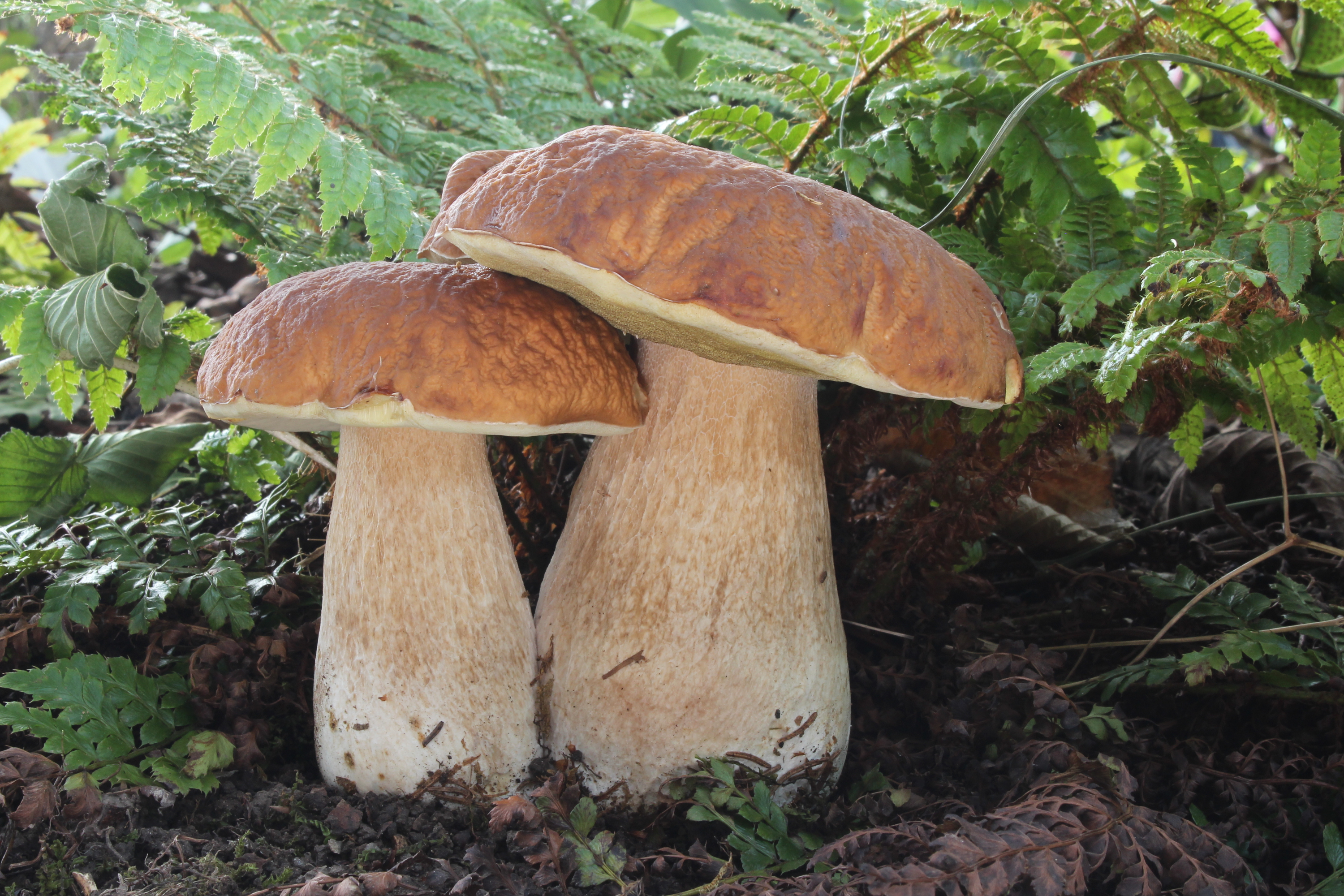
Boletus edulis
Key differences
Confusion with the penny bun (Boletus edulis) in the field is possible mainly with a cursory glance from above at young fruit bodies. The penny bun is distinguished by a brown cap, white to yellow-green tubes that do not turn blue when bruised, a pale stipe without a trace of bright red, and a mild, pleasant taste.
Caloboletus radicans
Key differences
In turn, the rooting bolete (Caloboletus radicans) has an entirely yellow stipe (without a carmine zone)
Rubroboletus satanas
Key differences
the Devil's bolete (Rubroboletus satanas) has intensely blood-red pores rather than lemon-yellow ones.
FAQ
Is the bitter beech bolete an edible mushroom?
No, the bitter beech bolete is an inedible mushroom due to severe bitterness, and consumed raw or undercooked it may cause unpleasant gastrointestinal upsets.
How to distinguish the bitter beech bolete from the penny bun?
The bitter beech bolete has a grey cap, vivid yellow pores that turn blue, and a red lower stipe, whereas the penny bun has a brown cap, non-bluing tubes, and a mild taste.
Does the bitterness of the bitter beech bolete disappear after cooking?
No, the substances responsible for the bitter taste (calopin and derivatives) are temperature resistant. Neither boiling, nor frying, nor drying removes the bitterness from the fruit body.
Why does the flesh of the bitter beech bolete turn blue?
The bluing of the flesh and pores upon damage is the result of the oxidation of phenolic pigments under the influence of atmospheric oxygen. This is a completely natural reaction for this species.
In what forests and habitats does the bitter beech bolete occur?
It grows mainly in coniferous and mixed forests of the lower and upper montane zones, most often under spruces, firs, and beeches, on acidic soils poor in calcium.
When is the fruiting season of the bitter beech bolete?
In Polish sources, its season is described simply as summer and autumn, on the calendar from June to November. No strict boundary dates or peak month are indicated here.
Is the bitter beech bolete covered by species protection in Poland?
The species is not subject to strict legal protection, but owing to its rarity in the lowlands and its affinity for submontane forests, it is included on red lists of threatened fungi.
Which mushrooms is the bitter beech bolete most commonly confused with?
It is sometimes confused with the rooting bolete, the lurid bolete, and the scarletina bolete. It is distinguished by the lemon-yellow top of the stipe and an ashen cap.
Enthusiast
Underside of the cap
- Tube length
- Tube length: 3–16 mm.
Names and history
- Obowiązująca nazwa krajowa
- gorzkoborowik żółtopory
- Obowiązująca nazwa taksonomiczna
- Caloboletus calopus
- Dawne nazwy krajowe
- borowik żółtopory, grzyb pięknotrzonowy
Home observations
Spore print
- Required materials
- fresh, mature cap, sheet of paper, glass or small bowl, water
- Time
- 2–24 h
- Procedure
- Place the cap underside down on the paper.
- Add a drop of water on top and cover.
- After 2–24 hours, lift the cap and inspect the deposit.
What to look for
- Spore print colour
- Spore print colour: brown.
- Spore print shade
- Spore print shade: Olive tobacco-brown. Spore print shade: olive-brown.
Under the microscope
- Required materials
- light microscope, microscope slide and cover slip, needle, water, spores from print
- Procedure
- Transfer a small amount of the spore print onto the slide using a needle.
- Add a drop of water, cover with a cover slip, and examine the spores.
What to look for
- Spore shape
- Spore shape: nearly spindle-shaped. Spore shape: fusiform.
- Spore surface
- Spore surface: smooth.
- Spore dimensions
- Length 12–16 µm, width 4.5–6 µm.
Compare dimensions after calibrating the microscope scale.
Ecology and distribution
- Soil reaction
- Soil reaction: neutral.
Soil reaction: alkaline.
Soil reaction: acidic. - Mycorrhizal hosts
- General species association: Mycorrhizal hosts: Fagus (general partner list).
General species association: Mycorrhizal hosts: Quercus (general partner list).
General species association: Mycorrhizal hosts: Pinus (general partner list).
General species association: Mycorrhizal hosts: Picea (general partner list). - Mode of nutrition
- Mode of nutrition: ectomycorrhizal.
History and culture
The taxonomic and literary history of the bitter beech bolete dates back to the 18th century and constitutes a significant chapter in the annals of European mycology. An early depiction of this fungus appeared in the iconography of Jacob Christian Schaeffer from 1770, representing one of the oldest documented iconographic records of this taxon. A formal scientific description of the species was published by Christiaan Hendrik Persoon in 1801 under the name Boletus calopus. This name was subsequently sanctioned by Elias Fries in his foundational work Systema Mycologicum in 1821, cementing the position of this taxon in classical mycological literature for nearly two centuries.
In the modern era, progress in phylogenetic research on the family Boletaceae led to a profound revision of the traditional genus Boletus. In 2014, Italian mycologist Alfredo Vizzini established a new nomenclatural combination, transferring the species to the newly segregated genus Caloboletus. This species has entered the history of science as a textbook example of the evolution of capped mushroom systematics – from early 18th-century engravings and classical morphological descriptions to modern molecular analyses.
Edibility and safety
The bitter beech bolete (Caloboletus calopus) is an inedible mushroom, and slightly poisonous when raw or undercooked. Its consumption causes gastrointestinal distress, such as nausea, abdominal cramps, and vomiting, although it does not cause permanent damage to internal organs.
The primary obstacle to consumption is its taste. At first contact, the flesh may seem mild, but after just a few seconds it reveals an intense, piercing, and lasting bitterness of a wormwood nature. The mushroom's odor is faint, slightly sour, or unpleasant. This bitterness is fully thermostable—no pretreatment methods, including prolonged parboiling, discarding the water, drying, or leaching, remove the bitter compounds. Even a small fragment of a fruiting body added to a dish makes it unfit to eat.
For this reason, conditions for safe and satisfactory consumption do not exist. In all European countries, including Poland, Germany, and Italy, this species is universally classified as an inedible mushroom and completely avoided by foragers.
Habitat and occurrence
The bitter beech bolete (Caloboletus calopus) occurs in coniferous, mixed, and deciduous forests. As an ectomycorrhizal fungus, it forms associations with conifers, primarily Norway spruce (Picea abies) and silver fir (Abies alba), as well as broadleaved trees, particularly European beech (Fagus sylvatica). It grows on diverse soils, thriving both on acidic substrate and under other edaphic conditions, with no justification for attributing to it a strict preference for a single substrate type.
Geographically, the species is widely distributed in Europe, where it is recorded in many countries of Central and Southern Europe, extending north to the southern regions of Scandinavia. Molecular studies (including Zhao et al.) have shown that Asian taxa formerly assigned to this species represent distinct evolutionary lineages, although the conclusion of distinctness should not be generalized to all global records outside the European continent.
In Poland, the fruiting body occurrence range documented in compilations covers the period from June to November (VI–XI), which represents a local observation window that should not be directly equated with a phenologically unified season across all of Europe.
Sources
- fn_calopus
- src-atlas-calopus
Researcher
Edibility and culinary use
Ustalenia źródłowe: jadalność, spożycie i wykorzystanie
- Edibility
- Inedible — źródło oznaczenia
caloboletus calopus · Culinary Notes, first paragraph; exact subject Caloboletus calopus; clause “this bolete is not edible”
Scientific names and taxonomy
- Current scientific name
Caloboletus calopus
Gatunek został zdiagnozowany naukowo w 1801 roku przez Christiaana Hendrika Persoona jako Boletus calopus. W 2014 roku włoski mykolog Alfredo Vizzini, w oparciu o badania filogenetyczne wykazujące odrębność linii borowików o gorzkim miąższu i specyficznej budowie anatomicznej, przeniósł ten gatunek do nowo utworzonego rodzaju Caloboletus jako Caloboletus calopus.
- Zakres ujęcia taksonomicznego
C. calopus według obserwacji brytyjskiego autora; zasięg siedliska nie utożsamiony z Polską
[6]
Ecology and distribution
Laboratory diagnostics
Material and research methods
- Results as recorded in the sources — Spore length
- Materiał badania: Named-species literature description; the two source contexts are independent. 12–16 µm [9] [5]
- Results as recorded in the sources — Spore width
- Materiał badania: Named-species literature description; the two source contexts are independent. 4,5–5,5 µm [9]
Materiał badania: Named-species literature description; the two source contexts are independent. 4,5–6 µm [5]
Metody i zapisy źródłowe — Named-species literature description; the two source contexts are independent.
Metody i zapisy źródłowe — Named-species literature description; the two source contexts are independent.
Długość zarodnika — zapis źródłowy: „Atlas: zarodniki długości12–16µm.” [9]
Kształt zarodnika — zapis źródłowy: „Atlas: zarodniki wrzecionowate.” [9]
Powierzchnia zarodnika — zapis źródłowy: „Atlas: zarodniki gładkie.” [9]
Szerokość zarodnika — zapis źródłowy: „Atlas: zarodniki szerokości4,5–5,5µm.” [9]
Occurrence verification — scope and limitations
Materiał: Zrewidowana obserwacja z Beskidu Makowskiego; geograficznie przypisano tylko nazwany region.
Zakres odczytu: Fragmenty źródeł.
Odczytano fragment źródła; pełny tekst i metody nie zostały zweryfikowane.
Data przeglądu: 21.10.2026.
Ograniczenia: Źródłowe oznaczenie i zakres pojęcia zachowano. Nie zadeklarowano nowego badania okazów ani odczytu wszystkich publikacji cytowanych przez źródło.
[7]Scope of the review
Before completion, the record requires completion or settlement.
- Search for occurrence regions requires reconciliation.
- Connections of earlier findings require re-examination.
- New sources require accounting for information encountered during the review.
Legal basis and scope of assessment
Key substances and their effects
Badania chemiczne i farmakologiczne owocników gorzkoborowika żółtoporego pozwoliły zidentyfikować kluczowe związki odpowiedzialne za jego właściwości smakowe oraz reakcje barwne:
Związki odpowiedzialne za gorycz (kalopiny i cyklokalopiny): W 2002 roku zespół Vereny Hellwig wyizolował z owocników Boletus calopus grupę unikalnych związków seskwiterpenowych o szkielecie laktonowym, nazwanych kalopinami i cyklokalopinami. Główną substancją wywołującą intensywną gorycz miąższu jest O-acetylocyklokalopina A (O-acetylcyclocalopin A), której towarzyszą w mniejszych stężeniach kalopina i jej inne pochodne. Związki te charakteryzują się bardzo niskim progiem wyczuwalności smaku gorzkiego u ludzi oraz wysoką stabilnością termiczną, przez co tradycyjne zabiegi kulinarne nie usuwają goryczy.
Pochodne kwasu pulwinowego i reakcja sinienia: Owocniki zawierają barwniki polifenylowe wywodzące się z kwasu pulwinowego, w tym kwas wariegatowy, kwas kserokomowy oraz kwas atromentowy. W nienaruszonym miąższu związki te są bezbarwne lub żółtawe, lecz pod wpływem uszkodzenia komórek i kontaktu z tlenem atmosferycznym enzymy z grupy oksydaz utleniają je do chinonodioksanów o intensywnie błękitnej barwie, co odpowiada za szybkie sinienie rurek i miąższu. W badaniach laboratoryjnych in vitro (Huang i in. 2009) związki te testowano pod kątem hamowania ludzkich enzymów cytochromu P450, wykazując hamowanie izoenzymu CYP3A4 w warunkach probówkowych (wartości IC50 odpowiednio 65,1 µM dla kwasu atromentowego, 2,2 µM dla wariegatowego i 2,4 µM dla kserokomowego). Wyniki te dotyczą jednak wyłącznie izolowanych enzymów w laboratorium i nie oznaczają wpływu spożycia grzyba na metabolizm leków u człowieka.
Badania ekstraktów komórkowych i aktywność antyoksydacyjna: W badaniach laboratoryjnych (Morel i in. 2018) cztery ekstrakty z owocników (cykloheksanowy, chloroformowy, etanolowy i wodny) badano pod kątem wpływu na proliferację komórek linii HCT116 oraz aktywności zmiatania wolnych rodników (test DPPH). W teście hamowania proliferacji komórek HCT116 ekstrakty nie wykazały istotnej aktywności (wszystkie wartości IC50 przekraczały 100 µg/mL), natomiast w teście DPPH najwyższą aktywność antyoksydacyjną wykazała frakcja chloroformowa (EC50 = 0,14 mg/mL). W dyskusji publikacji autorzy odnotowali brak ogólnej toksyczności i gorzki smak tego gatunku jako cechę ograniczającą jego wykorzystanie.
Habitat and occurrence
Potwierdzony zasięg występowania
Wszystkie obszary potwierdzone w zapisanych danych źródłowych.
| Kraj | Regiony i stanowiska | Fruiting | Sources |
|---|---|---|---|
| Poland | Lesser Poland Voivodeship | VI–XI |
|
Sources
- Paweł Zarzyński 2021, Grzyby polskich lasów, CILP, s.94; ISBN978-83-65659-43-9.
- NDFF Verspreidingsatlas: Caloboletus calopus
- archive-caloboletus-calopus-profile
- Weryfikacja polskiej ochrony i handlu Caloboletus calopus, 16.10.2026
- fn_calopus
- kpng_calopus
- Pierwotny zapis źródłowy — P0: caloboletus_calopus
- src-atlas-calopus
- ELI, DU/2026/258
- ELI, DU/2014/1408