Edible
Set your location to see data for your region.
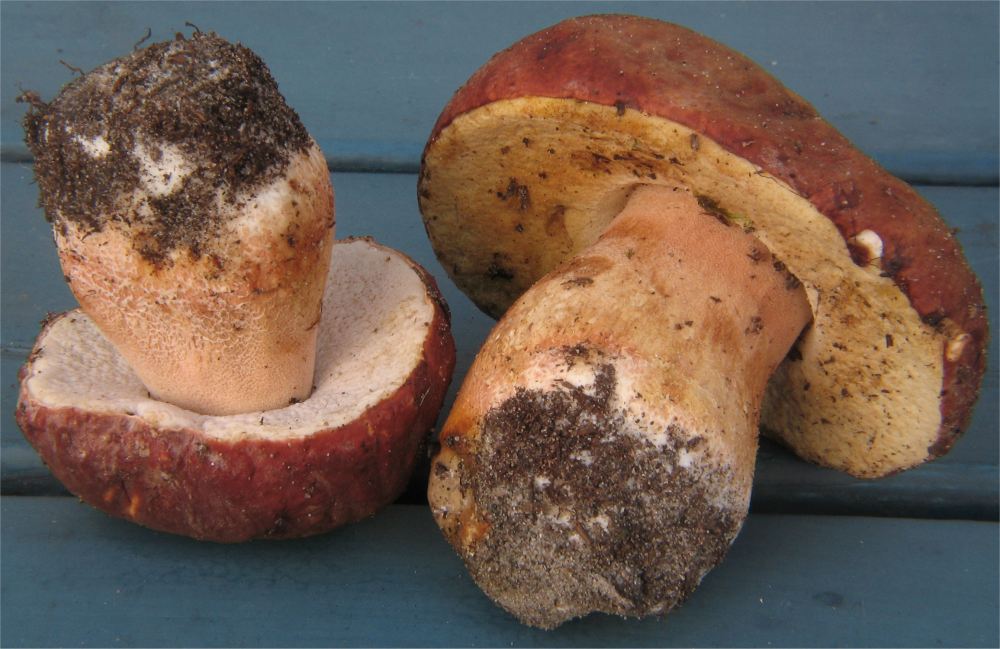
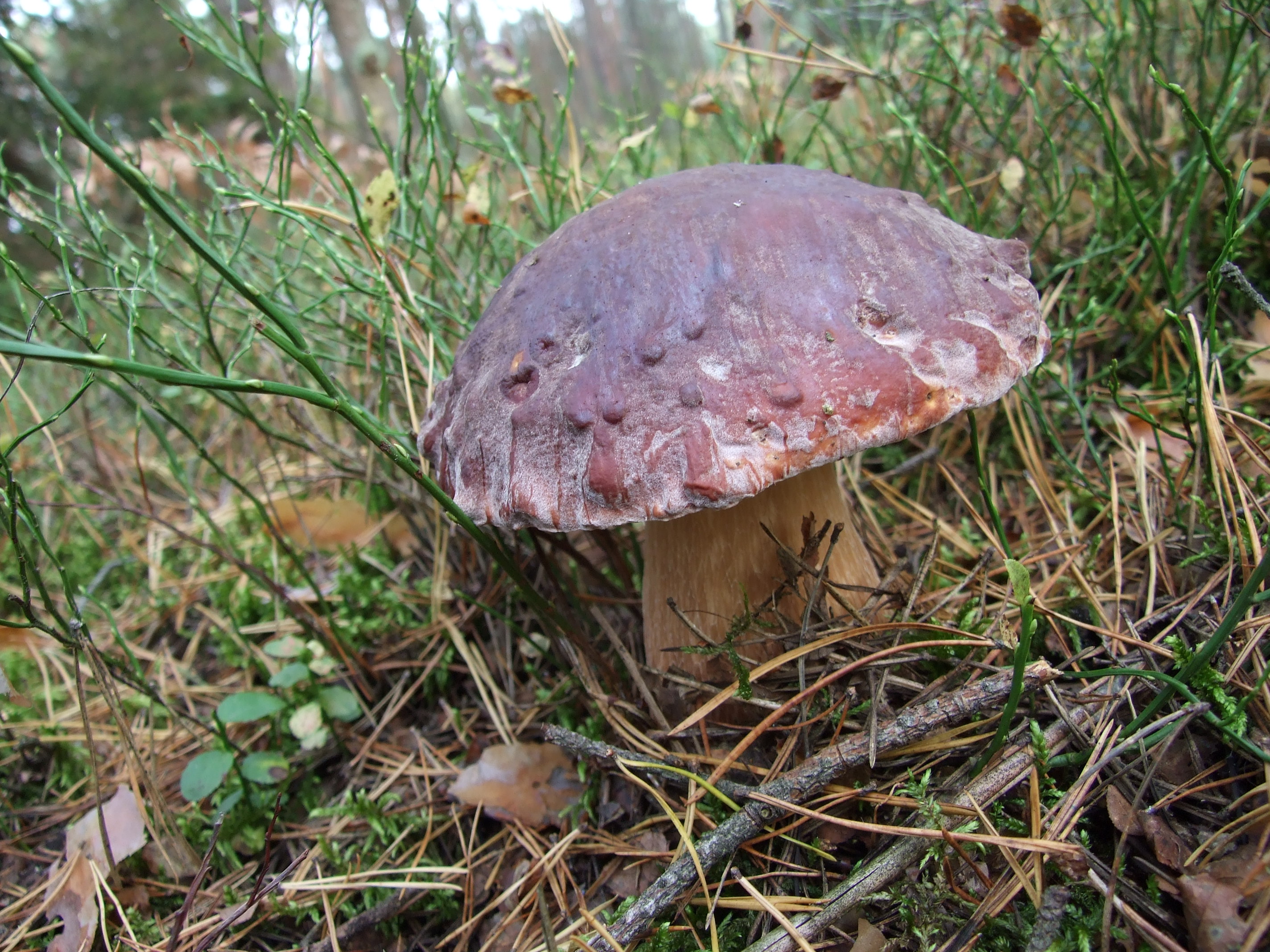
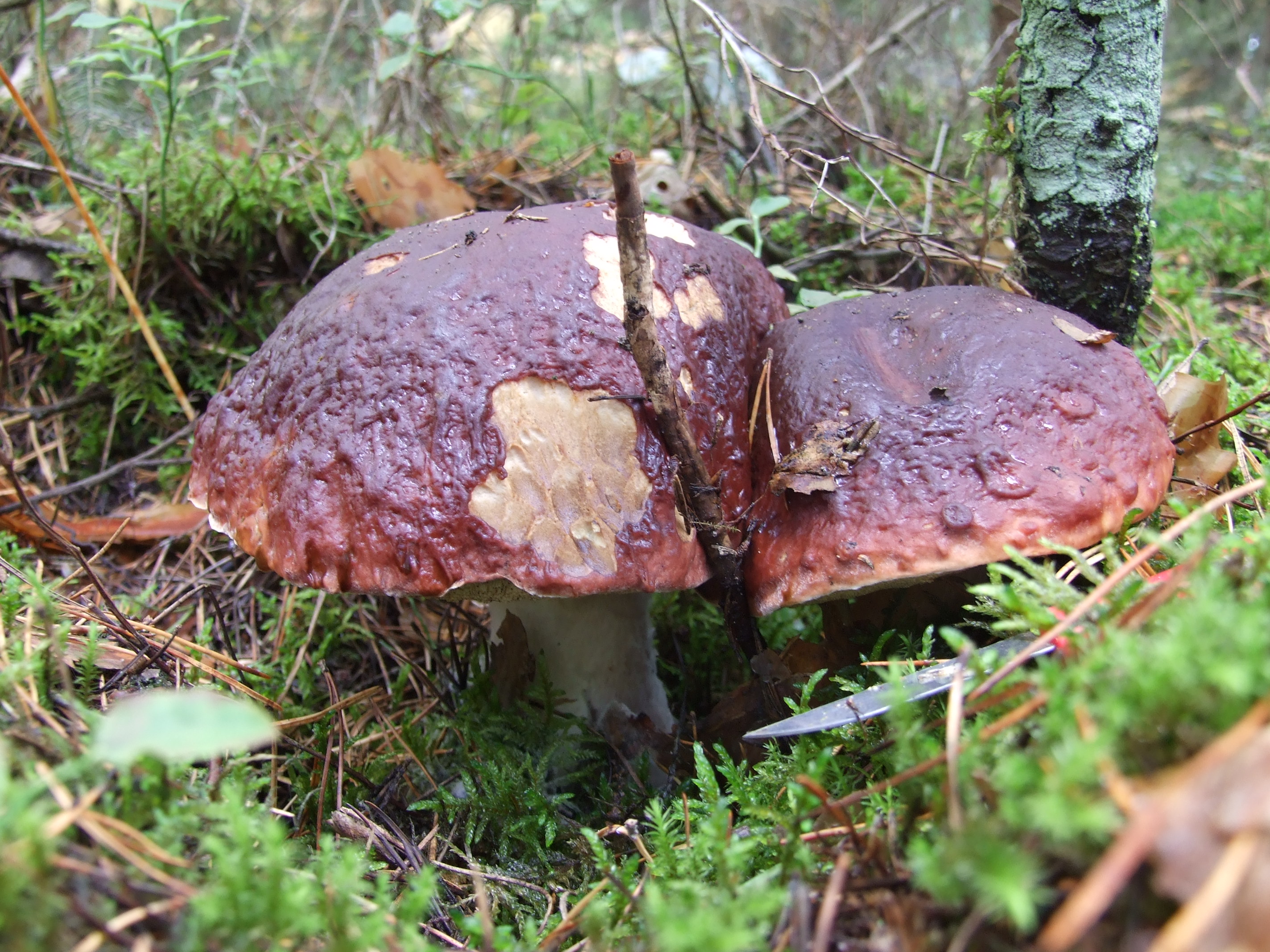
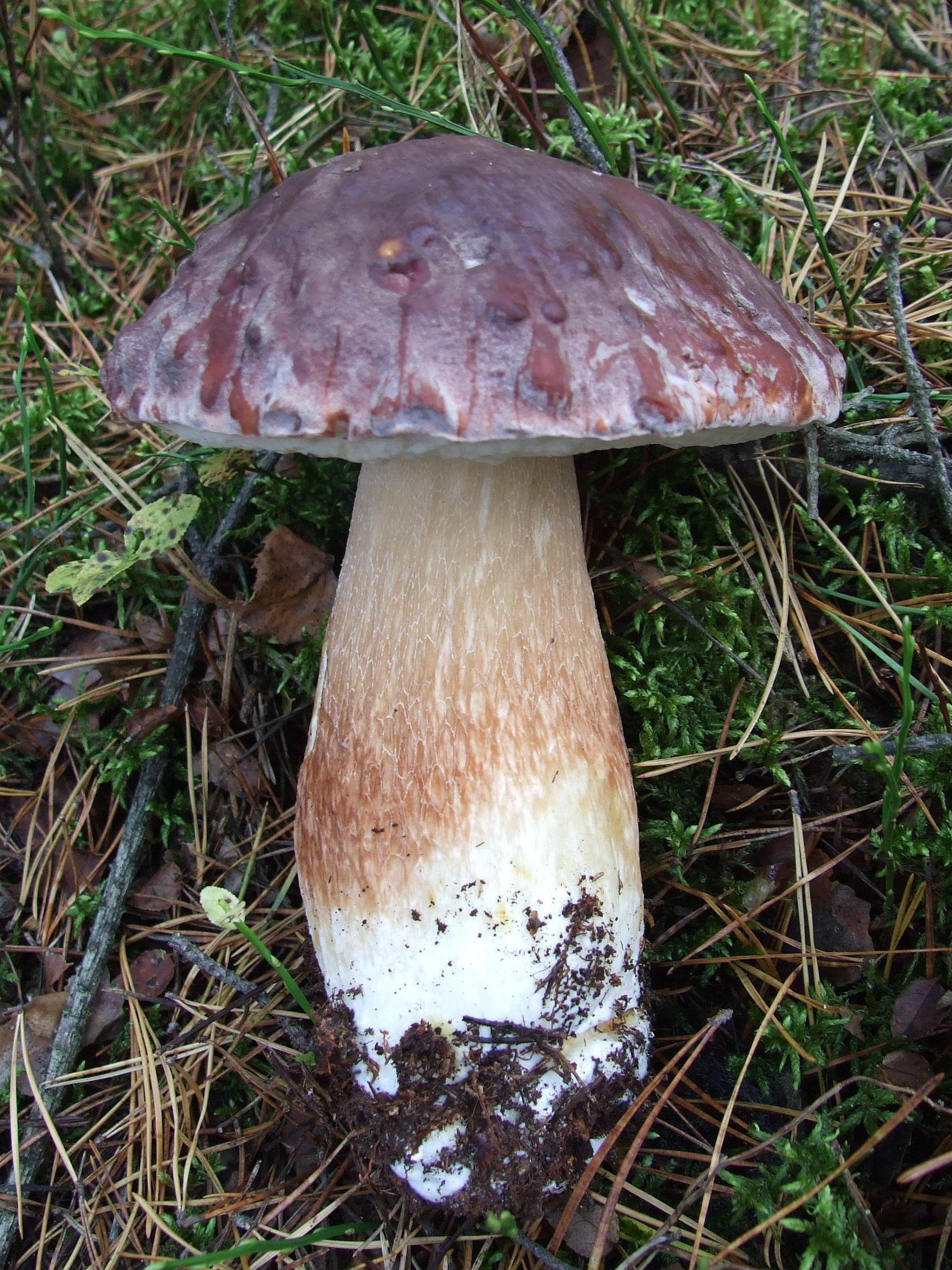
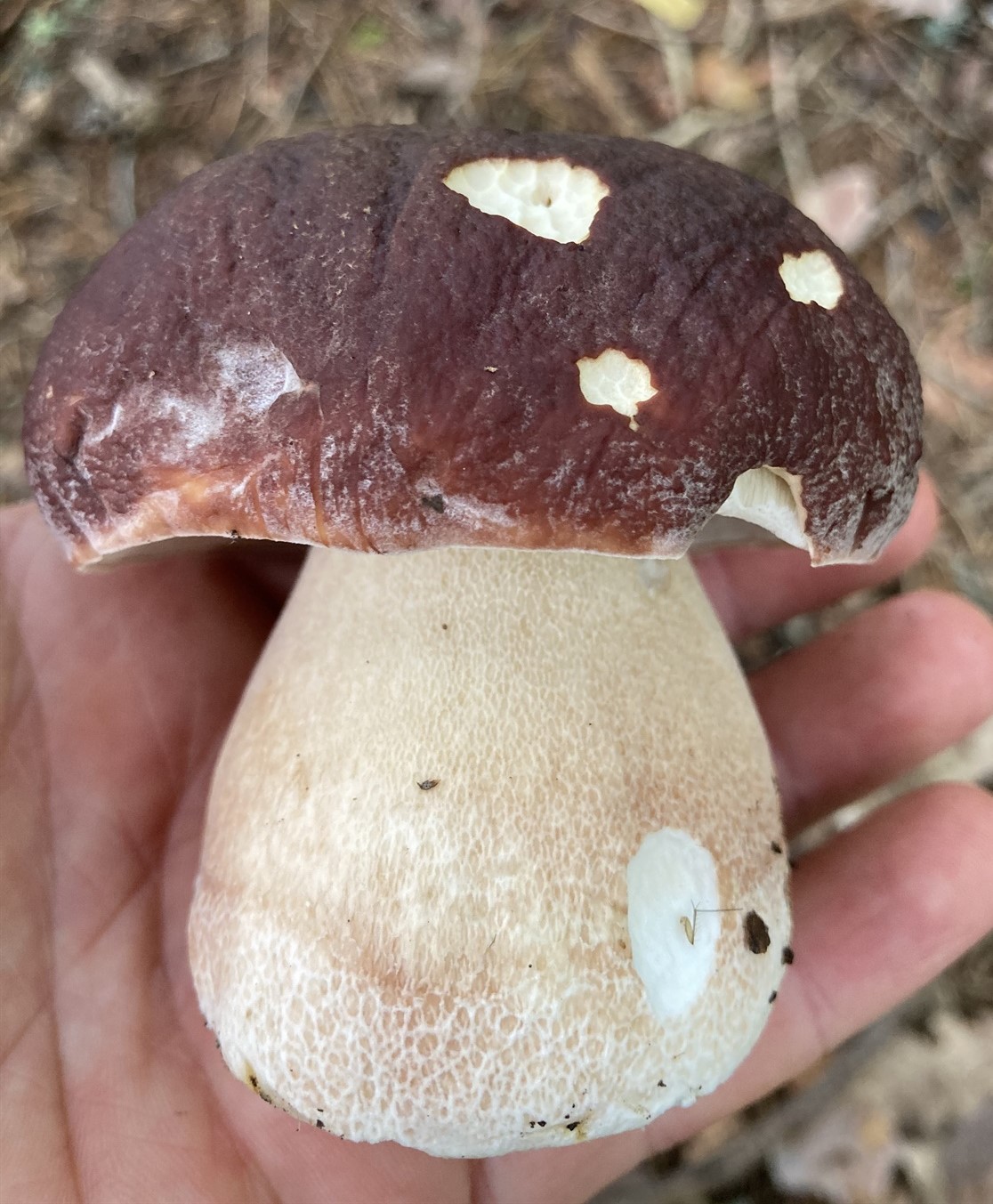
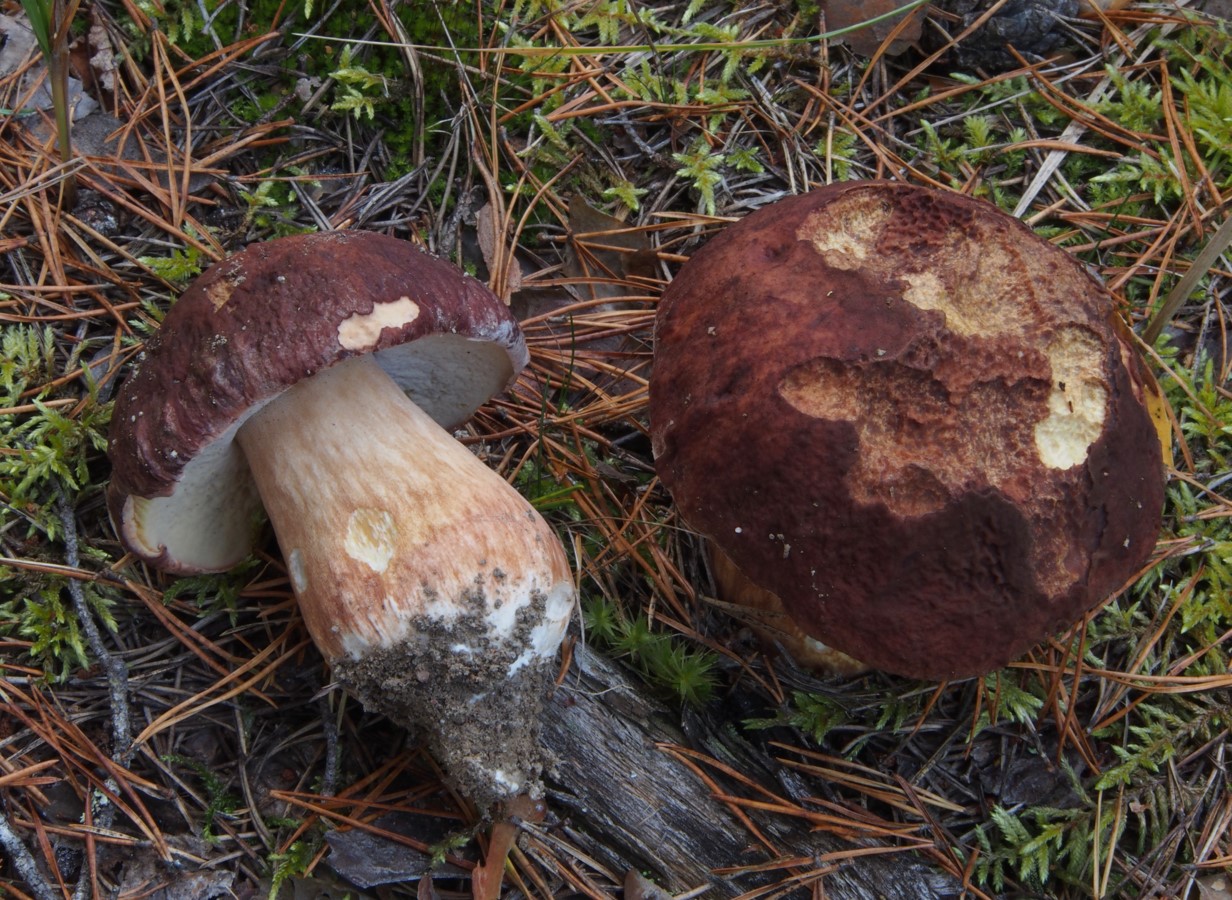
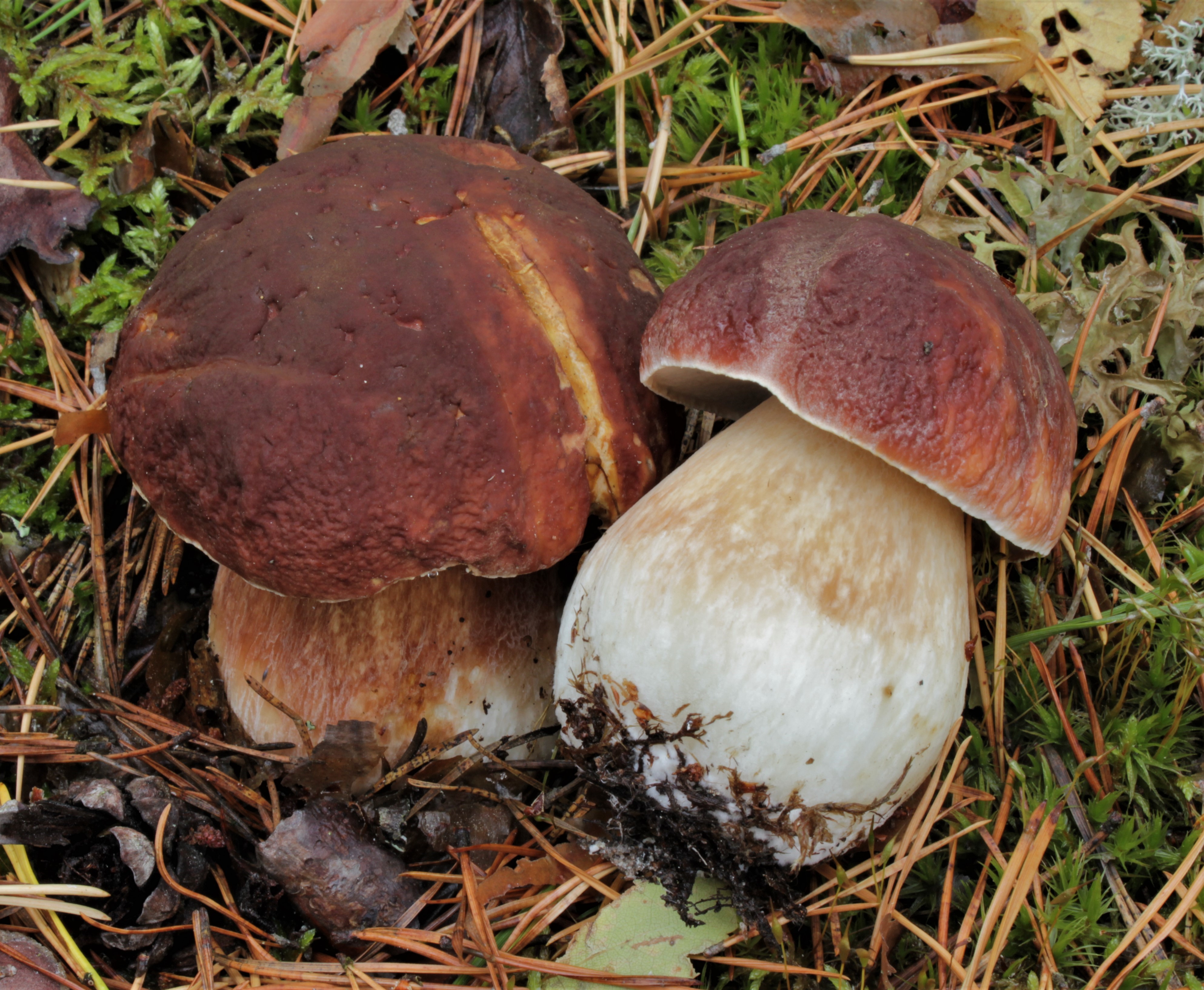
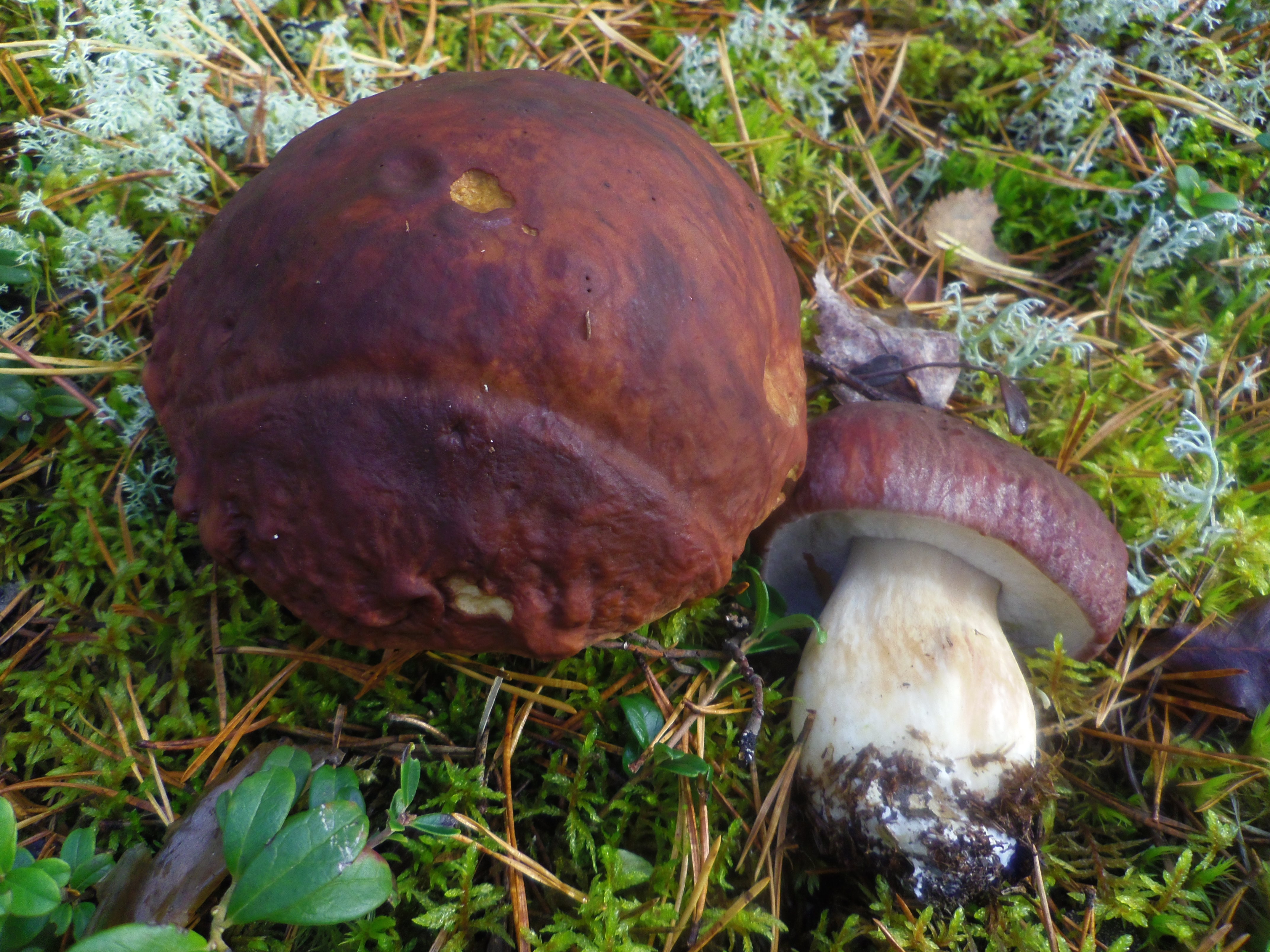
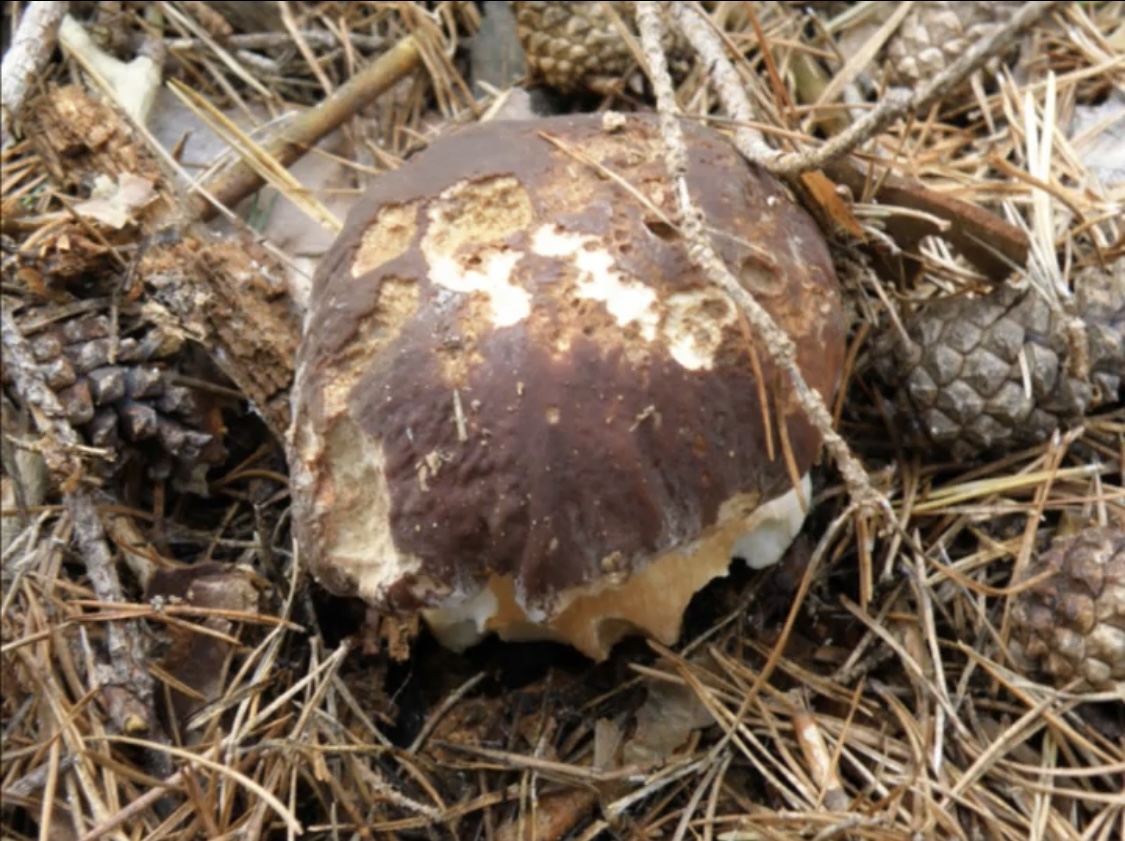
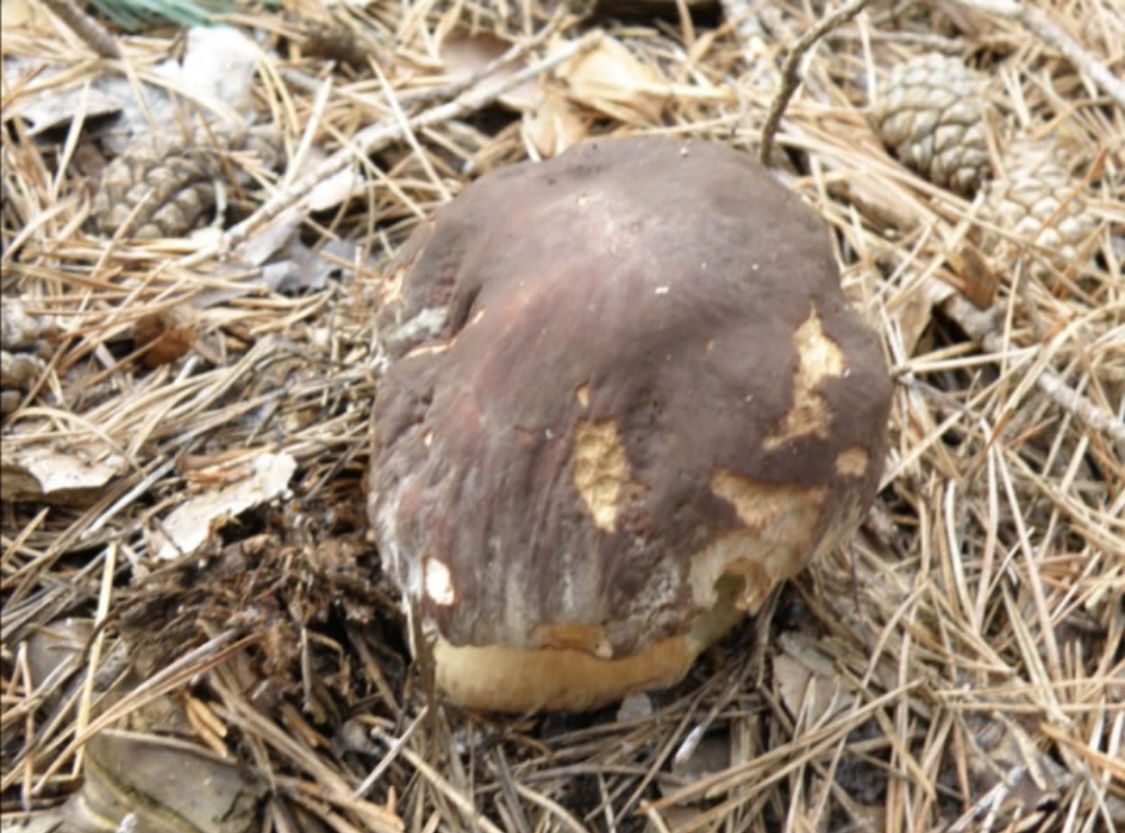
The fruit body of the pine bolete has a massive cap-and-stipe structure with a tubular hymenophore under the cap. It is exceptionally stocky and fleshy, often more robust than that of the king bolete. These mushrooms grow singly or in small groups. The cap reaches 50 to 250–300 mm in diameter. It is characterized by a dark reddish-brown, mahogany, or dark chestnut-brown color, sometimes with a purple tint. A young cap is hemispherical, with an inrolled margin covered by a delicate bloom, later becoming convex to pulvinate. Its surface can be wrinkled, bumpy, and sometimes pitted. The cuticle can be delicately velvety or smooth; in wet weather, it becomes slightly sticky, shiny, and projects slightly beyond the cap margin. The margin is concolorous, without a yellow zone, although in young specimens it can be paler—whitish, pinkish, or purplish. The tubes are up to 25 mm long and sinuate-depressed near the stipe. Initially white or cream, they turn yellow with age, and olive in mature fruit bodies. The pores do not change color upon pressure, and in older specimens their edges may turn brown. The stipe measures 60–150 mm in length and 30–100 mm in thickness. It is robust, compact, and strongly fleshy. When young, it is barrel-shaped or spherical-ovoid bulbous, becoming cylindrical-clavate with age. The apex is sometimes whitish, below which the stipe is yellowish-brown to light brown, in older specimens often reddish. It is covered by a reticulation with whitish meshes in the upper part, browning downwards, sometimes extending almost to the base of the stipe. The flesh is white, hard, and compact, with a reddish to reddish-brown hue directly beneath the cap cuticle. When cut, it does not turn blue or darken. The smell of fresh fruit bodies is mild and pleasantly bolete-like, more intense after drying; the taste is mild, mushroom-like. The spore print is dark olive to brownish-olive. Under the microscope, the spores are smooth, with visible drops, cylindrical-ellipsoidal, narrowly elliptical to fusiform in shape. Spore measurements are 15.5–20 × 4.5–5.5 µm (according to Polish sources) and 12–17 × 4–6 µm (according to Czech sources). In the cap cuticle, there is a thick gelatinous layer with terminal elements up to 27 µm wide and a reddish-brown parietal and incrusting pigment, soluble in KOH.
Identification, habitat, and key differences.
Forager
Fruitbody structure
- Fruit body form
- Fruit body form: Cap, stipe.
- Consistency of the entire fruitbody
- Consistency of the entire fruitbody: fleshy.
Cap
- Cap shape
- in young fruit bodies: Cap shape: hemispherical.
in mature fruit bodies: Cap shape: convex. - Cap surface relief
- Cap surface relief: wrinkled.
in mature fruit bodies: Cap surface relief: wrinkled.
in mature fruit bodies: Cap surface relief: pitted.
in mature fruit bodies: Cap surface relief: tuberculate. - Cap covering
- Cap covering: felty or glabrous.
in mature fruit bodies: Cap covering: glabrous.
Cap covering: glabrous.
in young fruit bodies: Cap covering: powdery. - Cap surface sheen
- when wet, in mature fruit bodies: Cap surface sheen: shiny.
- Cap stickiness and sliminess
- when wet: Cap stickiness and sliminess: sticky.
- Cap colour
- in mature fruit bodies: Cap colour: dark brown.
in mature fruit bodies: Cap colour: reddish brown.
in young fruit bodies: Cap colour: whitish (at the cap margin).
Cap colour: dark reddish brown. - Margin orientation
- in young fruit bodies: Margin orientation: inrolled.
- Cap margin overhang beyond the hymenophore
- in mature fruit bodies: Cap margin overhang beyond the hymenophore: projecting past the hymenophore.
- Cap diameter
- The cap measures 50–300 mm in diameter.
- Cap colour zoning
- Cap colour zoning: unzoned.
Underside of the cap
- Hymenophore type
- Hymenophore type: tubes.
Pores at stipe
- Hymenophore profile at the stipe
- Hymenophore profile at the stipe: notched at the stipe (tubes).
- Pore colour after damage
- Pore colour after damage: no colour change.
- Natural pore colour
- in young fruit bodies: Natural pore colour: white.
in mature fruit bodies: Natural pore colour: yellow.
in mature fruit bodies: Natural pore colour: olive. - Natural tube colour
- in young fruit bodies: Natural tube colour: cream.
in mature fruit bodies: Natural tube colour: olive.
in young fruit bodies: Natural tube colour: pale yellow.
in young fruit bodies: Natural tube colour: white.
in mature fruit bodies: Natural tube colour: yellow.
Stem and base
- Stipe shape
- in young fruit bodies: Stipe shape: barrel-shaped.
in mature fruit bodies: Stipe shape: club-shaped.
in young fruit bodies: Stipe shape: globose or ovoid.
in mature fruit bodies: Stipe shape: cylindrical-clavate. - Stipe colour
- in young fruit bodies, in the upper part of the stipe: Stipe colour: whitish.
in the lower part of the stipe: Stipe colour: yellow-brown.
Stipe colour: light brown.
Stipe colour: reddish.
in mature fruit bodies: Stipe colour: reddish. - Stipe surface relief
- in the upper part of the stipe: Stipe surface relief: reticulate.
in the lower part of the stipe: Stipe surface relief: reticulate. - Stipe consistency
- Stipe consistency: firm.
- Stipe length
- Stipe length: 60–150 mm.
- Stipe diameter
- Stipe diameter: 30–100 mm.
- Colour of the stipe reticulum
- in the upper part of the stipe: Colour of the stipe reticulum: whitish.
in the lower part of the stipe: Colour of the stipe reticulum: brownish.
Flesh
- Flesh colour
- Flesh colour: white.
Flesh colour: reddish brown (cap flesh, beneath the surface layer). - Flesh firmness
- Flesh firmness: firm.
- Flesh colour after damage
- Flesh colour after damage: no colour change.
- Flesh odour
- Flesh odour: mushroom-like, weak.
Where and when it grows
- Habitat
- Habitat: coniferous woodland.
Habitat: mixed woodland.
Habitat: deciduous woodland. - Substrate
- Substrate: soil.
- Fruit body growth pattern
- Fruit body growth pattern: solitary.
Fruit body growth pattern: in small groups. - Fruiting season
- Fruit bodies appear from June to September.
- Distribution area
Edibility and culinary use
- Edibility
- Edible
What it can be confused with
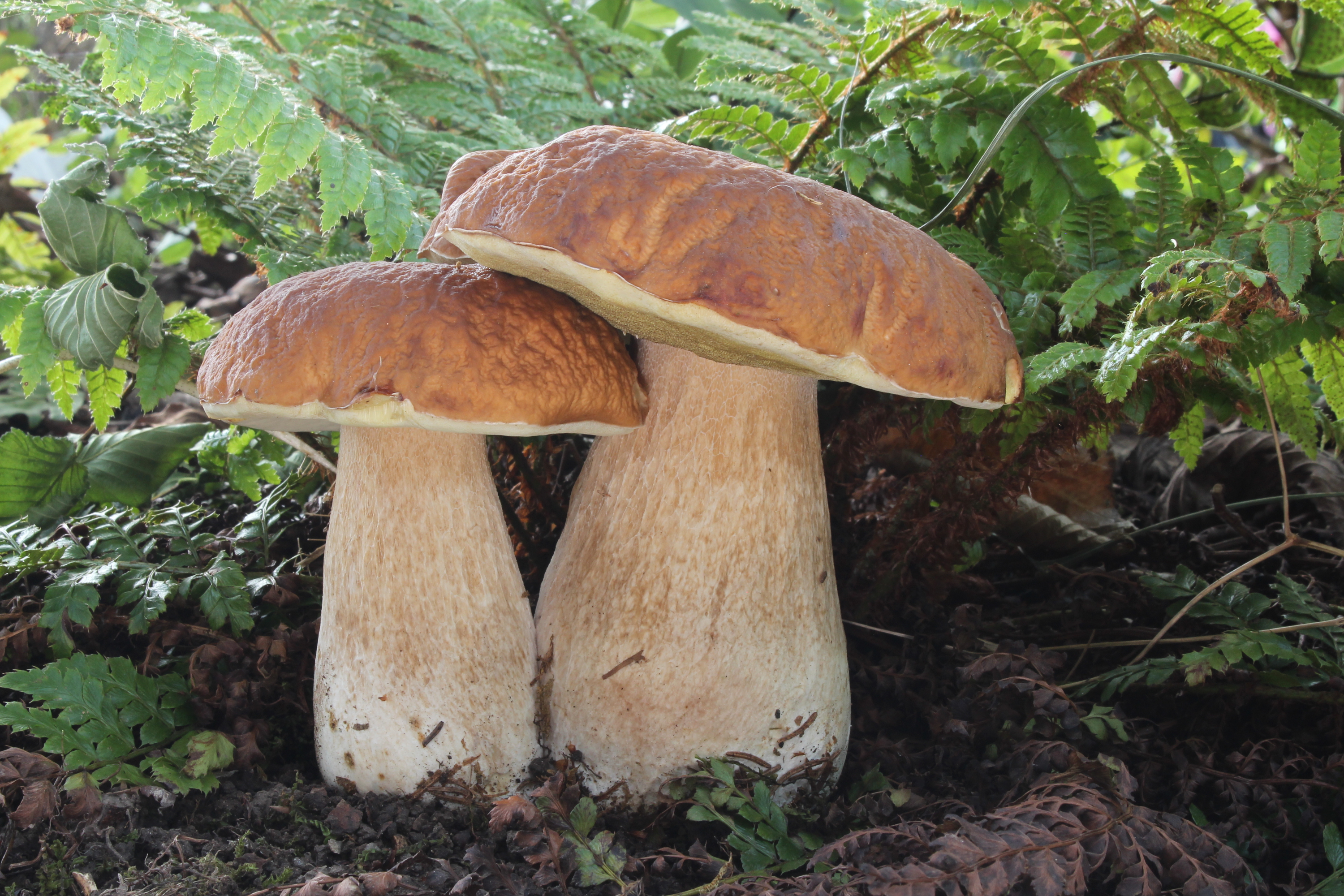
Boletus edulis
Key differences
The pine bolete (Boletus pinophilus) is characterized by a dark, reddish-brown or almost blackish-brown cap and grows mainly in association with pines. In its microscopic structure, it is distinguished by a thick, gelatinized cuticle and terminal elements up to 27 µm wide, containing a reddish-brown, parietal incrusting pigment that dissolves in potassium hydroxide (KOH).
The king bolete (Boletus edulis) tends to have a cap in shades from light brown to dark brown, sometimes with a yellowish or reddish tone, but its surface is glabrous, greasy, and the reticulation on the stipe is usually fine and restricted to the upper part. Microscopically, the terminal elements of the cuticle of B. edulis are 4–19 µm wide, and the pigment occurs intracellularly. The presence of a reddish tint and proximity to pines are not exclusive features of B. pinophilus, as B. edulis also grows in pine forests on poor, acidic sands.
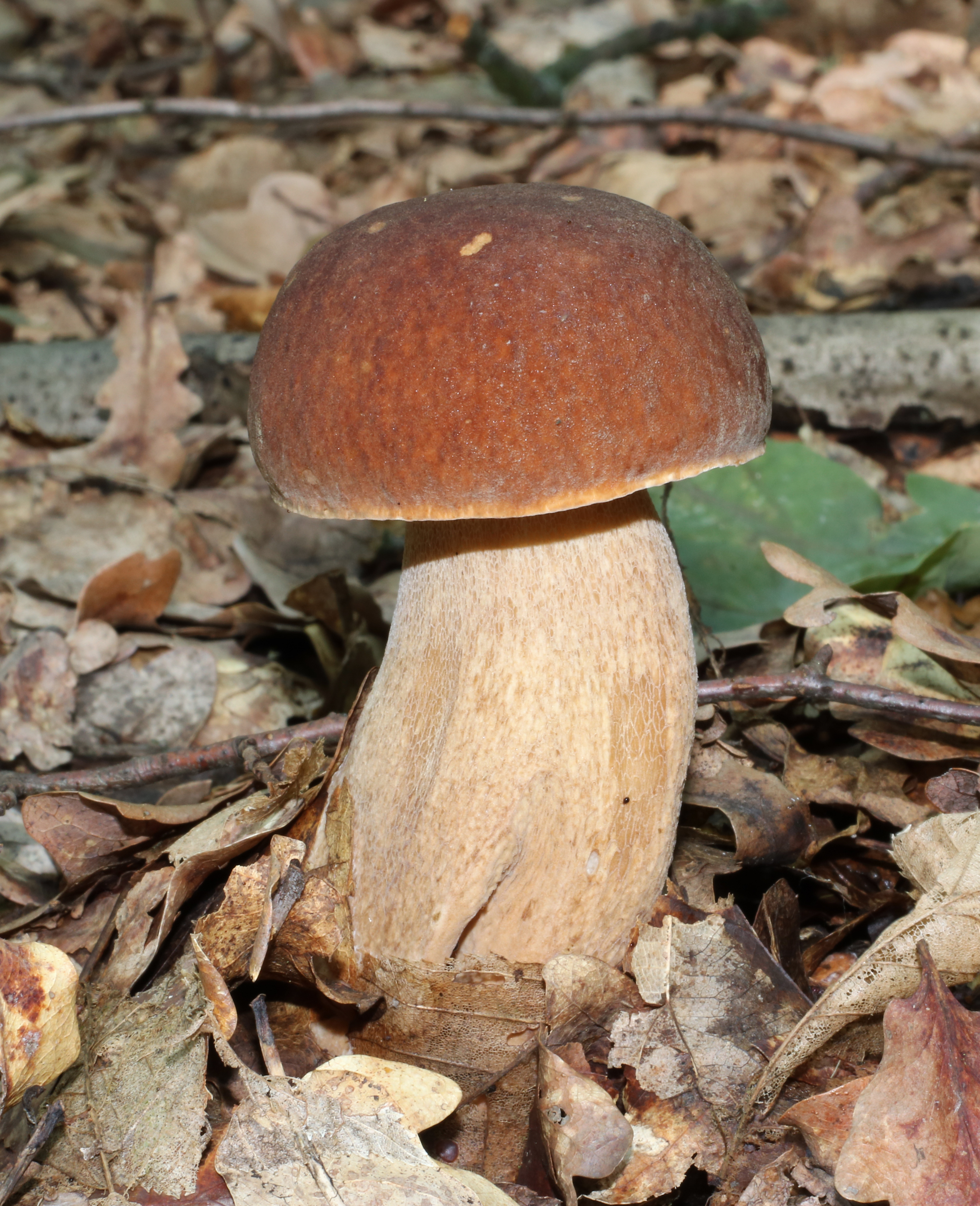
George Chernilevsky · Public domain
Bez zmian względem zachowanego oryginału.
Photo source · Public domainBoletus reticulatus
Key differences
The reticulated bolete (Boletus reticulatus) is distinguished by a dry, velvety cap of moderately yellowish-brown to reddish-brown color, which often characteristically cracks in older fruit bodies. Along the entire length of its stipe, a prominent, raised reticulation is visible. In the microscopic image, the terminal elements of the cuticle reach up to 20 µm in width and contain fine grains of intracellular pigment. This species grows mainly under oaks, on clay or sandy-clay soils, including in parks and along roadsides.
The pine bolete (Boletus pinophilus) differs from the reticulated bolete in having a much darker cap with a distinct, deep reddish-brown or mahogany tone.
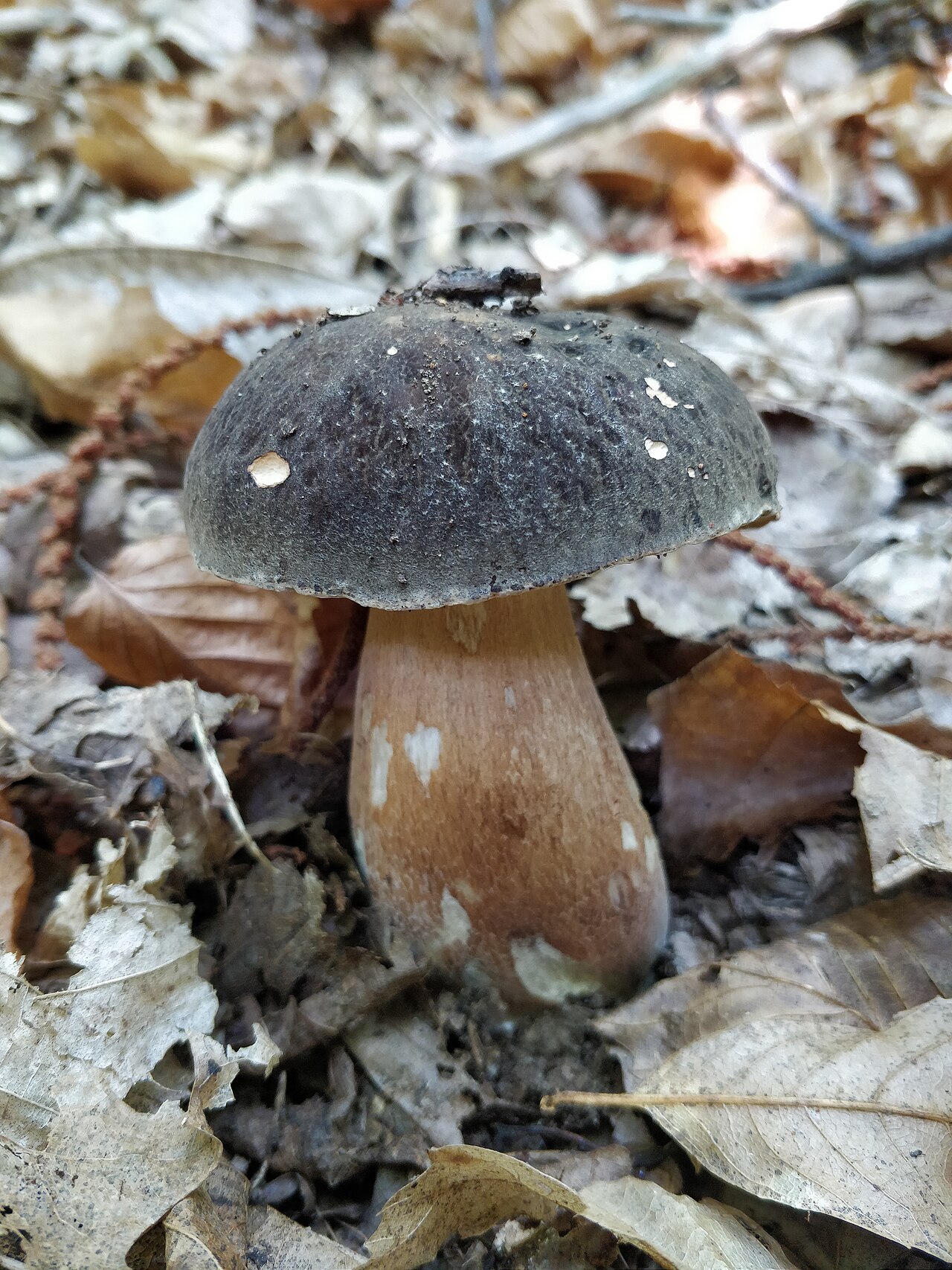
Boletus aereus
Key differences
The pine bolete (Boletus pinophilus) is characterized by a reddish-brown, chestnut to mahogany cap color with a surface that is often wrinkled and gelatinized, a thicker reticulum at the stipe apex, and broader elements of the cap cuticle (up to 27 µm wide) whose brown pigment dissolves in potassium hydroxide (KOH).
The bronze bolete (Boletus aereus) is distinguished by a cap devoid of reddish shades, very dark brown to almost blackish-brown in color, with a dry, finely hairy surface and a frosted margin. A dark brown reticulum occurs on the stipe, covering almost its entire length. The terminal elements of the cuticle hyphae are narrower (up to 11 µm wide) and contain fine intracellular pigment granules.
FAQ
Can pine bolete be eaten raw?
Eating the mushroom raw is explicitly discouraged based on general PSSE guidelines for wild mushrooms. It requires heat treatment, and drying is solely a preservation method.
Under which trees does pine bolete grow most often?
In studies, it is associated almost exclusively with pine (Pinus), rarely with spruce (Picea). Sources from Cuneo note coniferous and broadleaved forests without evidence for specific tree genera.
In which months can pine bolete be found in Poland?
Under Polish climatic conditions, the fruiting period of this species is documented from June to September (VI–IX), depending on humidity and temperature.
What does pine bolete taste like?
It has a pleasant taste and a rather faint smell of fresh flesh. Its flesh is white and does not change color when cut.
Why is pine bolete sometimes called "porcino rosso"?
The Italian term "porcino rosso" refers to the characteristic mahogany or reddish-brown coloration of this species' cap.
On what soils does this species prefer to grow?
It is frequently found on sandy and acidic soils typical of pine forests, but it also colonizes other types of forest substrates.
Does pine bolete accumulate heavy metals?
Scientific studies have published measurements of mercury concentrations in fruit bodies of this species, indicating its uptake from the substrate, without generalizations regarding clinical effects.
Is pine bolete a protected species in Poland?
It is not subject to species protection in Poland. It does not appear on the list of fungi under strict or partial protection in the regulation of the Minister of the Environment.
When was the name Boletus pinophilus formally published?
The formal species name Boletus pinophilus was published in mycological literature in 1973.
Why is it not recommended to collect old fruit bodies of this mushroom?
Old, overripe fruit bodies undergo natural processes of tissue decay, and their consumption carries a risk of non-specific stomach discomfort.
Enthusiast
Underside of the cap
- Tube length
- Tube length: up to 25 mm.
Home observations
Spore print
- Required materials
- fresh, mature cap, sheet of paper, glass or small bowl, water
- Time
- 2–24 h
- Procedure
- Place the cap underside down on the paper.
- Add a drop of water on top and cover.
- After 2–24 hours, lift the cap and examine the deposit.
What to look for
- Spore print colour
- Spore print colour: green.
- Spore print shade
- Spore print shade: dark olive. Spore print shade: brownish-olive.
Under the microscope
- Required materials
- light microscope, microscope slide and cover slip, needle, water, spores from print
- Procedure
- Transfer a small amount of the spore print onto the slide using a needle.
- Add a drop of water, cover with a cover slip, and examine the spores.
What to look for
- Spore shape
- Spore shape: Cylindrical-ellipsoid.
- Spore surface
- Spore surface: smooth.
- Spore dimensions
- Length 12–21 µm, width 3.5–6.5 µm.
Compare dimensions after calibrating the microscope scale.
Ecology and distribution
- Soil reaction
- Soil reaction: acidic.
- Soil texture
- Soil texture: sandy.
- Soil fertility
- Soil fertility: Nutrient-poor.
History and culture
Pine bolete occupies an important place in European foraging traditions, being an element of the culinary and forest culture of many regions. In Italian tradition, it is colloquially referred to as "porcino rosso", which refers to the reddish-brown, mahogany color of its cap, distinguishing it visually from other boletes.
In the history of mycological taxonomy, the status of this mushroom was the subject of long-standing discussions and systematic revisions. Although this taxon was described in the 19th century as a variety of the penny bun (Boletus edulis), the formal species name Boletus pinophilus was published in 1973. These changes reflected the gradual refinement of morphological and ecological criteria by mycologists studying pine forest fungi.
Interest in this species in mycological and regional literature was associated primarily with its characteristic appearance and strict attachment to pine habitats. This mushroom remains a recognizable element of European natural heritage, valued by mycology enthusiasts for its massive stature and specific habitat requirements.
Edibility and safety
Pine bolete is a prized edible mushroom. According to the description from the province of Cuneo, it is characterized by a pleasant taste, a rather faint smell of fresh flesh, and white flesh that does not change color when cut. Only healthy fruit bodies are intended for consumption. As with other wild mushrooms, consuming old or decaying fruit bodies carries a risk of non-specific gastrointestinal distress.
Scientific publications have noted the ability of this species to accumulate trace elements, including mercury, which is the subject of biomonitoring studies on the chemical composition of fruit bodies, without drawing direct conclusions regarding clinical risk.
Eating pine bolete raw is explicitly discouraged based on general sanitary guidelines (PSSE) concerning wild mushrooms, without attributing specific toxic effects to this species and without guaranteeing safety after eating a raw fruit body. It requires appropriate heat treatment (e.g., boiling, stewing, or frying) prior to consumption. A distinction must be made between the culinary preparation process and preservation methods: drying is merely a method of preserving the fruit bodies, not a preparation for direct consumption. In the Italian tradition, where it is sometimes called "porcino rosso", it finds culinary use due to the firm texture of its flesh.
Habitat and occurrence
Pine bolete is an ectomycorrhizal fungus associated primarily with pine (Pinus). Detailed mycological studies (Beugelsdijk et al. 2008) report that this species occurs almost exclusively in association with pines, less frequently with spruces (Picea), growing on poor, acidic sandy soils. In turn, the official description of the Italian province of Cuneo records fruit bodies in both coniferous and broadleaved forests, albeit without providing evidence for specific host tree genera.
It occurs mainly in pine forests as well as coniferous and mixed forests. The geographical range of the species covers Europe. In Northern and Central Europe, including Poland, it is recorded in lowlands and highlands, whereas in the southern part of the continent it grows, among other habitats, in submontane and mountainous areas in coniferous and broadleaved stands.
Under Polish climatic conditions, the period of fruit body appearance documented in the literature falls in the months from June to September (VI–IX), depending on favorable thermal and moisture conditions in a given season.
Sources
- Snowarski M. Atlas grzybów Polski: Boletus pinophilus (borowik sosnowy). Page generated 2026-09-01; content changed 2025-10-19.
- Tejkal K. Česká mykologická společnost: Boletus pinophilus — hřib borový.
- Beugelsdijk D.C.M. et al. (2008). A phylogenetic study of Boletus section Boletus in Europe. Persoonia20:1–7. DOI 10.3767/003158508X283692.
Researcher
Edibility and culinary use
Ustalenia źródłowe: jadalność, spożycie i wykorzystanie
- Edibility
- Edible — źródło oznaczenia
Snowarski M. Atlas grzybów Polski: Boletus pinophilus (borowik sosnowy). Page generated 2026-09-01; content changed 2025-10-19. · jadalne czy trujące? / Jadalny; edible and choice
Scientific names and taxonomy
Borowik sosnowy (Boletus pinophilus Pilát & Dermek) należy do królestwa Fungi, typu Basidiomycota, podklasy Agaricomycetidae, klasy Agaricomycetes, rzędu Boletales oraz rodziny Boletaceae. Rejestr Species Fungorum uznaje tę nazwę za bieżącą, a numer rekordu nomenklatorycznego w bazie Index Fungorum to 309751.
[2] [3]Nazwę Boletus pinophilus utworzono w 1973 r. jako nową nazwę (nomen novum) dla grzyba określanego wcześniej jako Boletus pinicola w ujęciu wywodzącym się od Boletus edulis var. pinicola Vittad. 1835. Zmiana ta wynikała z kolizji ze starszą nazwą Boletus pinicola Sw. 1810, odnoszącą się do innej linii taksonomicznej związanej z rodzajem Fomitopsis. Zbieżność samego epitetu gatunkowego nie oznacza powiązania tych grzybów. Publikację nomenklatoryczną przygotował Albert Pilát, natomiast formalne autorstwo nazwy przypisane jest duetowi Pilát & Dermek.
[3] [4]Rejestr Species Fungorum wymienia w synonimii tego gatunku następujące nazwy oraz kombinacje historyczne:
| Nazwa i autorstwo | Rok w rejestrze | Publikacja |
|---|---|---|
| Boletus edulis var. pinicola Vittad. | 1835 | Descr. fung. mang. Italia: 168 |
| Boletus pinicola (Vittad.) A. Venturi | 1863 | I Miceti dell’Agro Bresciano: tab. 46 |
| Boletus aestivalis var. pinicola (Vittad.) Sacc. | 1910 | Syll. Fung. 19: 154 |
| Boletus pinicola (Vittad.) Rea | 1922 | Brit. basidiomyc.: 567 |
| Boletus edulis f. pinicola (Vittad.) Vassilkov | 1966 | C. r. Soc. Phys. Hist. nat. Genève: 14 |
| Dictyopus edulis var. fuscoruber Forq. | 1890 (1889) | C. r. Assoc. Franç. Avancem. Sci. 18(2): 511 |
| Boletus pinophilus var. fuscoruber (Forq.) Cetto | 1987 | Enzyklopädie der Pilze 1: 529 |
| Boletus pinophilus f. fuscoruber (Forq.) Estadès & Lannoy | 2001 | Docums Mycol. 31 (no 121): 60 |
| Boletus pinophilus var. viridicaerulescens Estadès & Lannoy | 2001 | Docums Mycol. 31 (no 121): 60 |
| Boletus pinophilus f. frondosophilus Klofac & Krisai | 2018 | Österr. Z. Pilzk. 27: 262 |
Taxon scope and identification limitations
Badania filogenetyczne Beugelsdijka i współpracowników z 2008 r. rozgraniczyły cztery europejskie linie ewolucyjne: Boletus pinophilus, Boletus edulis, Boletus aereus oraz Boletus reticulatus. Analiza sekwencji ITS1–5.8S–ITS2 oraz fragmentu genu Gapdh objęła matrycę o długości 1356 pozycji (860 dla ITS i 496 dla Gapdh), z których 96 stanowiło pozycje informatywne parsymonijnie. Test jednorodności partycji dał wynik P = 0,56. W uzyskanych drzewach filogenetycznych B. pinophilus tworzył odrębną linię siostrzaną względem B. edulis. Na poziomie badanych markerów nie stwierdzono zróżnicowania genetycznego na linii północ–południe.
[7]W analizie filogenetycznej z 2008 r. uwzględniono m.in. szwedzkie kolekcje B. pinophilus: okaz SvdL12 (numery GenBank: ITS EU417865, Gapdh EU417903) oraz okaz SvdL18 (ITS EU417866, Gapdh EU417902). Jako przypuszczalnego partnera mikoryzowego wskazano dla nich rodzaj Pinus.
[7]Skórka kapelusza charakteryzuje się grubą galaretowatą warstwą. Jej elementy końcowe osiągają do 27 µm szerokości. W ścianach komórkowych oraz w postaci inkrustacji występuje czerwonobrązowy pigment, który ulega rozpuszczeniu wodorotlenkiem potasu (KOH).
[7]- Zakres ujęcia taksonomicznego
Boletus pinophilus w odrębnym ujęciu wskazanego atlasu i zachowanych źródeł rekordu. Starsze nazwy i źródłowe oznaczenia pozostają zachowane; nie wykonano rewizji typów, sekwencji ani ponownej identyfikacji dawnych okazów. Dane gatunków podobnych nie są danymi tego taksonu.
[5]
Laboratory diagnostics
Dane ustrukturyzowane
Pileipellis
- Incrustation of cuticle hyphae
- Incrustation of cuticle hyphae: present. [7]
Incrustation of cuticle hyphae: absent. [1] - Color of cuticle pigment
- Color of cuticle pigment: reddish brown. [7]
- Structure of the pileipellis
- Structure of the pileipellis: trichoderm. [1]
- Pileipellis terminal cell width
- Pileipellis terminal cell width: up to 27 µm. [7]
Spores
Material and research methods
- Results as recorded in the sources — Spore length
- Materiał badania: B. pinophilus species synopsis; individual analysed collection unreported. 15,5–20 µm [5]
Materiał badania: B. pinophilus species synopsis; individual analysed collection unreported. 13–21 µm [1]
Materiał badania: B. pinophilus species synopsis; individual analysed collection unreported. 12–17 µm [6] - Results as recorded in the sources — Spore width
- Materiał badania: B. pinophilus species synopsis; individual analysed collection unreported. 4–6 µm [6]
Materiał badania: B. pinophilus species synopsis; individual analysed collection unreported. 4,5–5,5 µm [5]
Materiał badania: B. pinophilus species synopsis; individual analysed collection unreported. 3,5–6,5 µm [1]
Metody i zapisy źródłowe — B. pinophilus species synopsis; individual analysed collection unreported.
Pochodzenie materiału: nieokreślona w źródle.
Identyfikacja kropli: nierozstrzygnięta.
Inkrustacja strzępek skórki; Barwa pigmentu skórki — zapis źródłowy: „Pigment czerwonobrązowy, ścienny i inkrustujący.” [7]
Szerokość komórki końcowej skórki kapelusza — zapis źródłowy: „Końcowe elementy skórki do27µm w tabeli syntezy morfologicznej.” [7]
Metody i zapisy źródłowe — B. pinophilus species synopsis; individual analysed collection unreported.
Pochodzenie materiału: nieokreślona w źródle.
Identyfikacja kropli: nierozstrzygnięta.
Inkrustacja strzępek skórki; Organizacja skórki kapelusza; Długość zarodnika; Iloraz długości i szerokości zarodnika; Szerokość zarodnika — zapis źródłowy: „Boletus pinophilus: spores 13.0–21.0 × 3.5–6.5 µm, ratio 2.7–4.3; pileipellis trichodermium, hyphae not incrusted.” [1]
Metody i zapisy źródłowe — B. pinophilus species synopsis; individual analysed collection unreported.
Pochodzenie materiału: nieokreślona w źródle.
Identyfikacja kropli: nierozstrzygnięta.
Krople wewnątrz zarodnika — zapis źródłowy: „W zarodnikach obecne krople; liczba i podłoże preparatu niewskazane.” [5]
Długość zarodnika — zapis źródłowy: „Zarodniki15.5–20µm; atlas polski.” [5]
Kształt zarodnika — zapis źródłowy: „Cylindryczno-elipsoidalne; atlas polski.” [5]
Powierzchnia zarodnika — zapis źródłowy: „Zarodniki gładkie w źródle polskim.” [5]
Szerokość zarodnika — zapis źródłowy: „Zarodniki4.5–5.5µm; atlas polski.” [5]
Metody i zapisy źródłowe — B. pinophilus species synopsis; individual analysed collection unreported.
Pochodzenie materiału: nieokreślona w źródle.
Identyfikacja kropli: nierozstrzygnięta.
Długość zarodnika — zapis źródłowy: „Zarodniki12–17µm; atlas czeski.” [6]
Szerokość zarodnika — zapis źródłowy: „Zarodniki4–6µm; atlas czeski.” [6]
Occurrence verification — scope and limitations
Materiał: Udokumentowana obserwacja z województwa łódzkiego; nie użyto daty zbioru jako sezonu.
Zakres odczytu: Fragmenty źródeł.
Odczytano fragment źródła; pełny tekst i metody nie zostały zweryfikowane.
Data przeglądu: 21.10.2026.
Ograniczenia: Źródłowe oznaczenie i zakres pojęcia zachowano. Nie zadeklarowano nowego badania okazów ani odczytu wszystkich publikacji cytowanych przez źródło.
[5]Scope of the review
Before completion, the record requires completion or settlement.
- Search for occurrence regions requires reconciliation.
- Connections of earlier findings require re-examination.
- New sources require accounting for information encountered during the review.
Key substances and their effects
Badania składu biochemicznego dojrzałych owocników zebranych w 2017 r. w pobliżu Bataku w bułgarskich Rodopach Zachodnich (Dospatliev i wsp., 2023) objęły analizę podstawowych składników odżywczych, profilu lipidowego oraz pierwiastków w porównaniu z pieprznikiem jadalnym (Cantharellus cibarius) i lejkkowcem dętym (Craterellus cornucopioides).
[8]Analizy laboratoryjne obejmowały standaryzowane metody badania żywności, spektrometrię absorpcji atomowej (AAS) oraz ICP do oznaczania pierwiastków, a także chromatografię gazową (GC) dla kwasów tłuszczowych i steroli oraz rozdział chromatograficzny ze spektrofotometrią dla fosfolipidów. Wyniki opracowano statystycznie za pomocą analizy wariancji ANOVA i testu Duncana (p < 0,05).
[8]Podstawowy skład chemiczny owocników borowika sosnowego z Rodopów:
| Składnik | Wynik | Jednostka | Mianownik | n w tabeli | Litera porównania |
|---|---|---|---|---|---|
| Woda | 90,4 ± 1,22 | % | świeża masa | 3 | b |
| Tłuszcz surowy | 4,42 ± 0,07 | % | sucha masa | 3 | a |
| Białko ogólne | 22,82 ± 0,59 | % | sucha masa | 3 | a |
| Węglowodany ogółem | 66,81 ± 0,63 | % | sucha masa | 3 | b |
| Cukry rozpuszczalne | 6,98 ± 0,16 | % | sucha masa | 3 | a |
| Skrobia | 18,25 ± 0,11 | % | sucha masa | 3 | a |
| Włókno surowe | 7,49 ± 0,04 | % | sucha masa | 3 | a |
| Popiół | 5,95 ± 0,09 | % | sucha masa | 3 | a |
| Energia ogółem | 1687,23 ± 0,53 | kJ/100 g | sucha masa | 3 | a |
Zawartość makro- i mikroelementów oraz metali w suchej masie owocników (mg/kg s.m.):
| Składnik | Wynik | Jednostka | Mianownik | n w tabeli | Litera porównania |
|---|---|---|---|---|---|
| N | 36517,33 ± 945,43 | mg/kg | sucha masa | 15 | a |
| P | 7347,93 ± 807,51 | mg/kg | sucha masa | 15 | a |
| K | 30555,6 ± 2735,73 | mg/kg | sucha masa | 15 | a |
| Na | 94,75 ± 23,57 | mg/kg | sucha masa | 15 | a |
| Ca | 256,96 ± 50,86 | mg/kg | sucha masa | 15 | a |
| Mg | 647,26 ± 98,79 | mg/kg | sucha masa | 15 | a |
| Fe | 98,42 ± 32,56 | mg/kg | sucha masa | 15 | a |
| Pb | 0,58 ± 0,29 | mg/kg | sucha masa | 15 | a |
| Cd | 0,61 ± 0,21 | mg/kg | sucha masa | 15 | a |
| Ni | 0,59 ± 0,11 | mg/kg | sucha masa | 15 | a |
| Mn | 10,42 ± 1,57 | mg/kg | sucha masa | 15 | a |
| Co | 0,26 ± 0,08 | mg/kg | sucha masa | 15 | a |
| Cu | 23,67 ± 6,15 | mg/kg | sucha masa | 15 | a |
| Zn | 69,01 ± 6,29 | mg/kg | sucha masa | 15 | a |
Zawartość głównych frakcji lipidowych:
| Składnik | Wynik | Jednostka | Mianownik | n w tabeli | Litera porównania |
|---|---|---|---|---|---|
| Substancje niezmydlające się | 10,1 ± 0,2 | % | frakcja oleju glicerydowego | 3 | a |
| Substancje niezmydlające się | 0,5 ± 0,01 | % | suchy ekstrakt według opisu autorów | 3 | a |
| Sterole ogółem | 7,3 ± 0,3 | % | frakcja oleju glicerydowego | 3 | a |
| Sterole ogółem | 0,3 ± 0,01 | % | suchy ekstrakt według opisu autorów | 3 | a |
| Fosfolipidy ogółem | 9,3 ± 0,4 | % | frakcja oleju glicerydowego | 3 | a |
| Fosfolipidy ogółem | 0,4 ± 0,02 | % | suchy ekstrakt według opisu autorów | 3 | a |
Profil kwasów tłuszczowych we frakcji triacylogliceroli (TAG):
| Składnik | Wynik | Jednostka | Mianownik | n w tabeli | Litera porównania |
|---|---|---|---|---|---|
| Kwas dekanowy C10:0 | 0,1 ± 0,05 | % | profil kwasów tłuszczowych frakcji TAG | 3 | a |
| Kwas laurynowy C12:0 | 0,1 ± 0,02 | % | profil kwasów tłuszczowych frakcji TAG | 3 | a |
| Kwas tridekanowy C13:0 | nie zidentyfikowano | % | profil kwasów tłuszczowych frakcji TAG | 3 | — |
| Kwas mirystynowy C14:0 | 0,2 ± 0,05 | % | profil kwasów tłuszczowych frakcji TAG | 3 | a |
| Kwas pentadekanowy C15:0 | 0,2 ± 0,03 | % | profil kwasów tłuszczowych frakcji TAG | 3 | b |
| Kwas palmitynowy C16:0 | 14,6 ± 0,2 | % | profil kwasów tłuszczowych frakcji TAG | 3 | c |
| Kwas palmitooleinowy C16:1 | 0,5 ± 0,03 | % | profil kwasów tłuszczowych frakcji TAG | 3 | a |
| Kwas heptadekanowy C17:0 | 0,2 ± 0,02 | % | profil kwasów tłuszczowych frakcji TAG | 3 | a |
| Kwas heptadecenowy C17:1 | 0,1 ± 0,01 | % | profil kwasów tłuszczowych frakcji TAG | 3 | a |
| Kwas stearynowy C18:0 | 4,2 ± 0,2 | % | profil kwasów tłuszczowych frakcji TAG | 3 | c |
| Kwas oleinowy C18:1 | 52,6 ± 0,5 | % | profil kwasów tłuszczowych frakcji TAG | 3 | b |
| Kwas linolowy C18:2 | 25,8 ± 0,6 | % | profil kwasów tłuszczowych frakcji TAG | 3 | a |
| Kwas linolenowy C18:3 | 0,8 ± 0,1 | % | profil kwasów tłuszczowych frakcji TAG | 3 | a |
| Kwas eikozanowy C20:0 | 0,4 ± 0,1 | % | profil kwasów tłuszczowych frakcji TAG | 3 | b |
| Kwas eikozadienowy C20:2 | 0,2 ± 0,05 | % | profil kwasów tłuszczowych frakcji TAG | 3 | a |
| Kwas arachidonowy C20:4 | nie zidentyfikowano | % | profil kwasów tłuszczowych frakcji TAG | 3 | — |
| Kwas behenowy C22:0 | nie zidentyfikowano | % | profil kwasów tłuszczowych frakcji TAG | 3 | — |
Skład frakcji steroli (udział w całkowitej sumie steroli):
| Składnik | Wynik | Jednostka | Mianownik | n w tabeli | Litera porównania |
|---|---|---|---|---|---|
| Cholesterol | 4 ± 0,2 | % | suma steroli | 3 | a |
| Brassikasterol | 0,9 ± 0,1 | % | suma steroli | 3 | c |
| Kampesterol | 5,7 ± 0,1 | % | suma steroli | 3 | a |
| Stigmasterol | 15,2 ± 0,3 | % | suma steroli | 3 | b |
| Ergosterol | 66,8 ± 0,5 | % | suma steroli | 3 | b |
| β-sitosterol | 6,1 ± 0,1 | % | suma steroli | 3 | b |
| Δ5-awenasterol | 0,5 ± 0,1 | % | suma steroli | 3 | a |
| Δ7-stigmasterol | 0,8 ± 0,1 | % | suma steroli | 3 | a |
Skład frakcji fosfolipidów (udział w całkowitej sumie fosfolipidów):
| Składnik | Wynik | Jednostka | Mianownik | n w tabeli | Litera porównania |
|---|---|---|---|---|---|
| Lizofosfatydylocholina | 8,9 ± 0,2 | % | suma fosfolipidów | 3 | a |
| Lizofosfatydyloetanoloamina | 8,1 ± 0,2 | % | suma fosfolipidów | 3 | a |
| Sfingomielina | 9,9 ± 0,1 | % | suma fosfolipidów | 3 | b |
| Fosfatydyloinozytol | 8,9 ± 0,1 | % | suma fosfolipidów | 3 | c |
| Fosfatydylocholina | 8,8 ± 0,2 | % | suma fosfolipidów | 3 | a |
| Fosfatydyloetanoloamina | 14 ± 0,3 | % | suma fosfolipidów | 3 | b |
| Monofosfatydyloglicerol | nie zidentyfikowano | % | suma fosfolipidów | 3 | — |
| Difosfatydyloglicerol | 8,3 ± 0,1 | % | suma fosfolipidów | 3 | a |
| Kwasy fosfatydowe | 33,1 ± 0,5 | % | suma fosfolipidów | 3 | a |
Udział wybranych kwasów tłuszczowych w poszczególnych frakcjach lipidowych:
| Składnik | Wynik | Jednostka | Mianownik | n w tabeli | Litera porównania |
|---|---|---|---|---|---|
| Jednonienasycone kwasy tłuszczowe TAG | 53,2 | % | frakcja kwasów tłuszczowych TAG | nie podano | — |
| Wielonienasycone kwasy tłuszczowe TAG | 26,8 | % | frakcja kwasów tłuszczowych TAG | nie podano | — |
| Kwas oleinowy PI | 40,6 | % | frakcja kwasów tłuszczowych PI | nie podano | — |
| Kwas palmitynowy PI | 36,1 | % | frakcja kwasów tłuszczowych PI | nie podano | — |
| Kwas stearynowy PI | 11,5 | % | frakcja kwasów tłuszczowych PI | nie podano | — |
| Kwas linolowy PI | 6,4 | % | frakcja kwasów tłuszczowych PI | nie podano | — |
| Nasycone kwasy tłuszczowe PI | 51,2 | % | frakcja kwasów tłuszczowych PI | nie podano | — |
| Nasycone kwasy tłuszczowe PE | 55,0 | % | frakcja kwasów tłuszczowych PE | nie podano | — |
W analizie głównych składowych (PCA) profile lipidowe charakteryzowały się wyjaśnieniem 68% zmienności przez pierwszą oś oraz 32% przez drugą oś. Sterole stanowiły około 72% frakcji niezmydlającej się. We frakcjach fosfolipidowych odnotowano wzrost udziału kwasu palmitynowego w szeregu PC < PI < PA < PE (p < 0,05), któremu towarzyszył spadek udziału kwasu oleinowego z 40,6% do 25,8%.
[8]Wyniki badań biochemicznych charakteryzują profil odżywczy owocników z bułgarskich Rodopów i potwierdzają ich wysokie walory konsumpcyjne.
[8]Analiza substancji lotnych świeżych owocników B. pinophilus zebranych w listopadzie 2013 r. w Beypınar (Turcja, prowincja Kırklareli, 733 m n.p.m.) przeprowadzona metodą chromatografii gazowej sprzężonej ze spektrometrią mas (GC-MS) pozwoliła na identyfikację związków tworzących profil zapachowy grzyba w porównaniu z B. edulis. Udziały poszczególnych substancji wyrażono jako procent powierzchni pików w całkowitym prądzie jonowym (TIC).
[10] [11]Skład frakcji lotnej świeżych owocników B. pinophilus według analizy GC-MS:
| Przypisanie w publikacji | Udział TIC, % | RT w tabeli | RI w tabeli |
|---|---|---|---|
| 2-Propenoic acid | 1,95 | 2.147 | 685 |
| 1,3-Octadiene | 1,75 | 2.438 | 988 |
| 2-Fluoro-5-trifluoromethylbenzoic acid, propyl ester | nd | 3.010 | 847 |
| 4-Penten-2-ol, 4 methyl | nd | 3.996 | 973 |
| Hexanal | 0,47 | 4.008 | 801 |
| Tricosanoic acid | 0,18 | 4.656 | 2731 |
| D-Norpropoxyphene | nd | 6.091 | 2240 |
| 1-Chloro-decane | 0,11 | 6.190 | 1250 |
| 3-Methyl-1-butanol | 0,7 | 6.459 | 736 |
| 1,2-Ethanedithiol | nd | 6.511 | 746 |
| 3-Octanone | 7,43 | 6.617 | 983 |
| Octanal | 0,37 | 7.200 | 1075 |
| 1-Octen-3-one | 5,8 | 7.544 | 956 |
| 2-Chloro-pentane | 0,35 | 7.749 | 1331 |
| 1-Hepten-3-one | nd | 8.233 | 1465 |
| Formic acid, ethenyl ester | nd | 8.420 | 989 |
| Octen-1-ol, acetate | nd | 8.851 | 1110 |
| Nonanal | 0,16 | 9.178 | 1106 |
| (E)-2-Octenal | 6,79 | 9.412 | 1151 |
| 5-Methyl-1-heptanol | 0,3 | 9.452 | 1053 |
| Benzene, 1,4-dichloro | nd | 10.048 | 839 |
| 3-Flouro-benzenamine | 0,39 | 10.106 | 1026 |
| Cyclooctanone | 0,2 | 10.229 | 746 |
| Phosphonic acid, methyl-, dioctyl ester | nd | 10.287 | 1165 |
| Isoprophyl5,11-dihydroxy-3,7,11trimethyl-2-dodecenoate | nd | 10.474 | 1334 |
| 1-Octen-3-ol | 55,97 | 10.777 | 998 |
| 1,7,7-Trimethyl-heptane-2-one | 2,04 | 11.378 | 1031 |
| 2,4-Octadienal | 0,14 | 12.294 | 1653 |
| 2-Octen-1-ol | 13,55 | 14.027 | 1610 |
| 4-(Benzoylmethyl)-6-methyl-2H-1,4-benzoxazin-3-one | nd | 15.037 | — |
| 4-Hexenoic acid, 6-hydroxy-4-methyl-, methyl ester | nd | 15.235 | 480 |
| 1,1,1,5,5,5-Hexafluoro-4-oxo-2-pentene-2-amine | nd | 15.626 | — |
| 1,2-Dimethyl-3,5-diphenyl-1H-Pyrazolium | nd | 16.140 | — |
| Cyclohexanemethyl propanoate | 0,1 | 22.173 | 744 |
| 3-Methyl-1-octyn-3-ol | 0,22 | 22.290 | 942 |
| 3-Methyl-3-hexanethiol | 0,46 | 22.833 | 988 |
| Pentanoic acid | 0,16 | 23.195 | 927 |
Głównymi składnikami aromatu były: 1-octen-3-ol (55,97%), 2-octen-1-ol (13,55%), 3-octanone (7,43%), (E)-2-octenal (6,79%) oraz 1-octen-3-one (5,80%). W tabeli 2 publikacji z 2015 r. zamieniono wartości 5,80 i 6,79 przypisane dwóm ostatnim związkom, lecz tabela 1, abstrakt i opis wyników podają wartości zgodne z zestawieniem. Do pozostałych zidentyfikowanych związków należały m.in. 1,7,7-trimethylheptan-2-one (2,04%), 2-propenoic acid (1,95%) oraz 1,3-octadiene (1,75%).
[10]Wyraźna dominacja alifatycznych związków ośmiowęglowych (C8) odpowiada za typowy, intensywny grzybowy aromat świeżego owocnika borowika sosnowego.
[10]Habitat and occurrence
Habitat, region and season
Borowik sosnowy jest grzybem ektomikoryzowym związanym przede wszystkim z sosnami, zwłaszcza z sosną zwyczajną (Pinus sylvestris). Występuje na glebach ubogich, kwaśnych i piaszczystych, wyrastając bezpośrednio z ziemi. W runie towarzyszą mu często śmiałek pognieciony (Deschampsia flexuosa) oraz chrobotki (Cladonia).
[4] [5] [7]W Czechach owocniki pojawiają się od maja przez całe lato i jesień, niekiedy aż do listopada przy sprzyjających warunkach termicznych. Wcześniejsze opracowania Piláta z 1973 r. podawały przedział od maja do września. Lokalnie grzyb ten bywa liczny, choć w wielu rejonach pozostaje rzadki lub w ogóle nie występuje.
[4] [6]Zestawienie wybranych europejskich stanowisk i kolekcji badawczych:
| Miejsce | Data podana w źródle | Rodzaj zapisu |
|---|---|---|
| Czechy, Bělá koło Semil | 14 V 1950 | Nejdlová; typ PR608363; bór sosnowy |
| Czechy, Konstantinovy Lázně | 3 VII 1963 | A. Pilát; czysty bór sosnowy; figura 1 w opisie z 1973 r. |
| Polska, Łódzkie, Pawlikowice 2 km NW, DD95 | 14 X 2017 | GRej 307426; Beata Łyszkowska; 1 owocnik z ziemi; las mieszany |
| Polska, Łódzkie, Pawlikowice 2 km NW, DD95 | 14 X 2018 | GRej 320351; Beata Łyszkowska; 2 sąsiadujące owocniki; las mieszany |
| Polska, Mazowieckie, Osówiec Szlachecki 1 km N, EC25 | 13 IX 2020 | GRej 335617; Romuald Tomaszewski; 2 owocniki z ziemi; nasadzenie sosnowe |
| Czechy, Plzeňský kraj | 18 VIII 2023 | CMS0066-2023-0246 |
| Czechy, Plzeňský kraj | 17 VIII 2023 | CMS0071-2023-0086 |
| Czechy, Středočeský kraj | 21 V 2022 | CMS0087-2022-0076 |
| Czechy, Jihočeský kraj | 27 IX 2020 | CMS0071-2020-0247 |
| Czechy, Plzeňský kraj | 5 IX 2020 | CMS0071-2020-0189 |
| Czechy, Vysočina | 27 IX 2018 | CMS0066-2018-0113 |
| Finlandia, Salo, Tuohittu, Tuohitunnummi | 30 IX 2020 | Jukka Vauras; 2 owocniki; GBIF 3441186229 / FinBIF JX.1160813#20 |
| Bułgaria, Batak, zachodnie Rodopy | 2017 | Materiał badań biochemicznych; 41°46′02,6″N 24°08′48,4″E |
| Turcja, Beypınar, Kırklareli, Marmara | XI 2013 | Materiał analizy aromatu; 41°48′35″N 27°33′33″E; 733 m n.p.m. |
Potwierdzony zasięg występowania
Wszystkie obszary potwierdzone w zapisanych danych źródłowych.
| Kraj | Regiony i stanowiska | Owocnikowanie | Sources |
|---|---|---|---|
| Poland | Łódź Voivodeship | VI–IX |
|
Sources
- B. pinophilus — species account, Boris Assyov
- Species Fungorum: Boletus pinophilus Pilát & Dermek, record 309751, current synonymy
- Index Fungorum: Boletus pinophilus, name record 309751
- Pilát A. (1973). Boletus pinophilus nomen novum pro Boletum pinicolam (Vittadini 1835) Venturi 1863. Česká Mykologie 27(1): 6–8.
- Snowarski M. Atlas grzybów Polski: Boletus pinophilus (borowik sosnowy). Page generated 2026-09-01; content changed 2025-10-19.
- Tejkal K. Česká mykologická společnost: Boletus pinophilus — hřib borový.
- Beugelsdijk D.C.M. et al. (2008). A phylogenetic study of Boletus section Boletus in Europe. Persoonia20:1–7. DOI 10.3767/003158508X283692.
- Dospatliev L., Petkova Z., Antova G., Angelova-Romova M., Ivanova M., Mustafa S. (2023). Proximate composition of wild edible mushrooms from the Batak Mountain, Bulgaria. JMBFS12(6):e4718. DOI 10.55251/jmbfs.4718.
- FinBIF / Atlas of Finnish Fungi via GBIF occurrence3441186229; Jukka Vauras; occurrence http://tun.fi/JX.1160813#20.
- Bozok F., Zarifikhosroshahi M., Kafkas E., Taşkın H., Büyükalaca S. (2015). Comparison of Volatile Compounds of Fresh Boletus edulis and B.pinophilus in Marmara Region of Turkey. NBHA43(1): 192–195. DOI 10.15835/nbha4319731.
- NBHA publisher metadata for Bozok et al. 2015, article9731