Edible
Requires preparation

Set your location to see data for your region.


The red cracking bolete (Xerocomellus chrysenteron) is a common mushroom from the family Boletaceae. It is distinguished by a brownish cap with a matte surface that characteristically cracks as it dries, revealing reddish cracks and yellowish flesh. The stem is slender, yellow at the top and carmine red towards the bottom. An edible mushroom, eagerly gathered when young, mycorrhizal, and widely distributed in temperate forests.
Identification, habitat, and key differences.
Forager
Fruitbody structure
- Fruit body form
- Fruit body form: Cap, stipe.
- Color of mycelium at the base of the fruitbody
- Color of mycelium at the base of the fruitbody: yellowish white.
Cap
- Cap shape
- in young fruit bodies: Cap shape: hemispherical.
Cap shape: hemispherical.
in mature fruit bodies: Cap shape: convex or flat. - Cap surface
- when dry: Cap surface: matt.
- Cap covering
- when dry: Cap covering: suede-like.
- Cap stickiness and sliminess
- when wet: Cap stickiness and sliminess: sticky.
- Surface cracking pattern
- in mature fruit bodies: Surface cracking pattern: cracked into irregular patches.
- Cap colour
- Cap colour: brown.
Cap colour: dark brown.
Cap colour: grey-brown.
Cap colour: olive-brown.
in young fruit bodies: Cap colour: blackish. - Cracking and splitting of the margin
- Cracking and splitting of the margin: split.
- Cap diameter
- The cap measures 30–100 mm in diameter.
- Cap centre
- in old fruit bodies: Cap centre: flat.
Underside of the cap
- Hymenophore type
- Hymenophore type: tubes.
- Pore shape
- in mature fruit bodies: Pore shape: angular.
- Pore colour after damage
- Pore colour after damage: blue.
- Tube color after damage
- Tube color after damage: blue.
- Natural pore colour
- in mature fruit bodies: Natural pore colour: greenish yellow.
in young fruit bodies: Natural pore colour: yellow. - Natural tube colour
- in mature fruit bodies: Natural tube colour: greenish yellow.
in young fruit bodies: Natural tube colour: yellow.
Stem and base
- Stipe shape
- Stipe shape: cylindrical.
- Stipe base
- Stipe base: tapering.
- Stipe colour
- in the upper part of the stipe: Stipe colour: yellow.
Stipe colour: yellowish.
in the lower part of the stipe: Stipe colour: red. - Stipe surface relief
- Stipe surface relief: smooth or grooved.
- Stipe surface covering
- in the lower part of the stipe: Stipe surface covering: floccose.
- Colour of stipe ornamentation
- in the lower part of the stipe: Colour of stipe ornamentation: wine-coloured.
- Stipe length
- Stipe length: 30–100 mm.
- Stipe diameter
- Stipe diameter: 5–20 mm.
- Stipe curvature
- Stipe curvature: curved.
Flesh
- Flesh colour
- Flesh colour: red (cap flesh).
Flesh colour: reddish (cap flesh).
Flesh colour: yellowish.
Flesh colour: reddish or brownish (flesh at the stipe base). - Flesh firmness
- Flesh firmness: soft.
- Flesh taste
- Flesh taste: weak.
Flesh taste: sour. - Flesh odour
- Flesh odour: mushroom-like, weak.
Where and when it grows
- Habitat
- Habitat: coniferous woodland, deciduous woodland, mixed woodland or park.
Habitat: coniferous woodland or deciduous woodland. - Fruit body growth pattern
- Fruit body growth pattern: solitary or in groups.
- Occurrence frequency
- Occurrence frequency: common.
- Fruiting season
- Fruit bodies appear from June to November.
- Distribution area
Edibility and culinary use
- Edibility
- Edible
- Required preparation
- Requires preparation
What it can be confused with
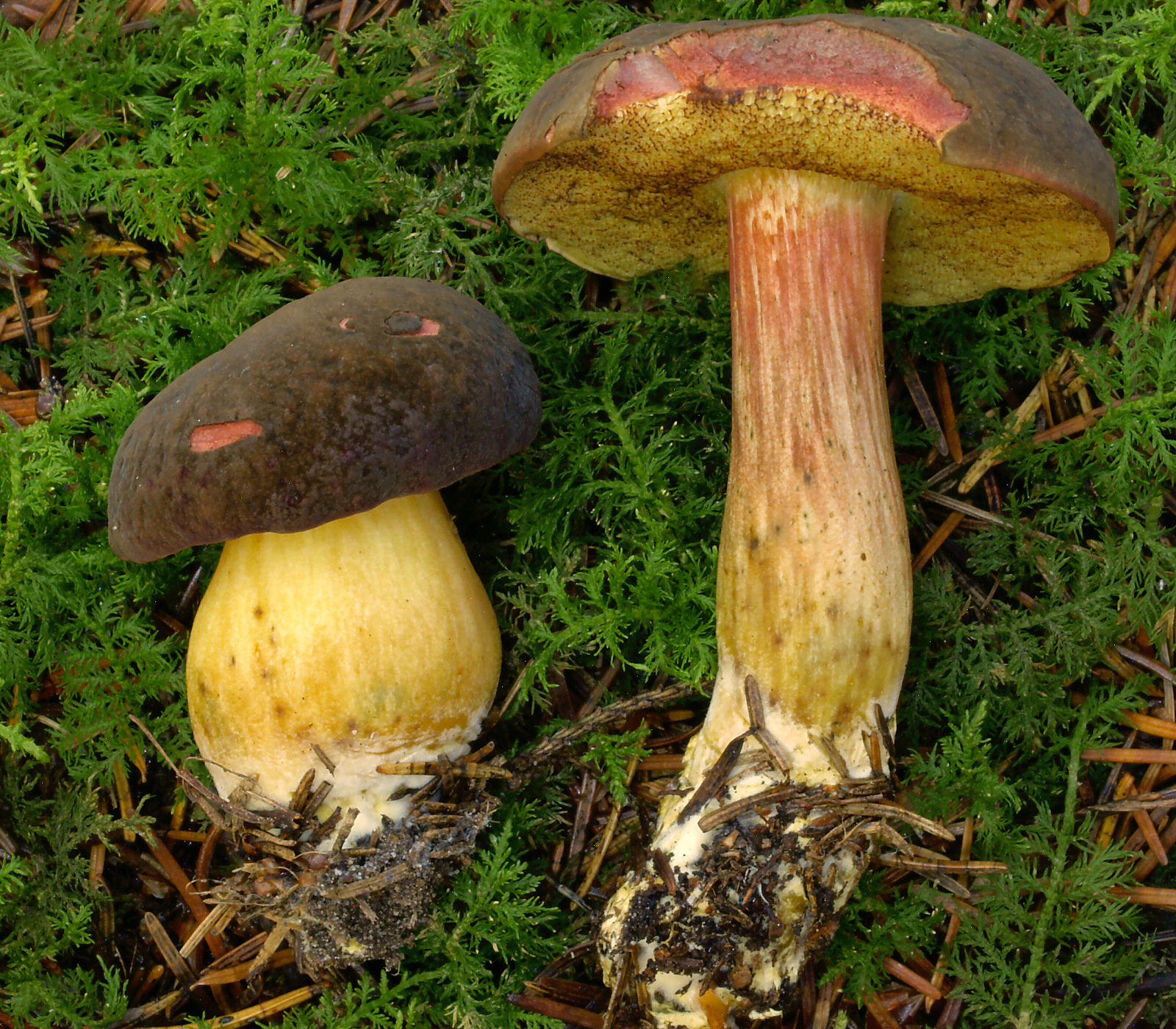
Xerocomellus pruinatus
Key differences
The red cracking bolete (Xerocomellus chrysenteron) is characterized by a cap that cracks distinctly and deeply into patches, revealing reddish flesh beneath, as well as smooth spores. The matt bolete usually has a uniform, uncracked cuticle, and its spores are covered with fine longitudinal striations. Furthermore, the Czech atlas emphasizes that X. chrysenteron appears earlier in the season, already in early summer.
FAQ
Is the red cracking bolete an edible mushroom?
Yes, it is an edible mushroom, but due to its flesh softening quickly, it is recommended to collect only young, firm fruit bodies.
What does the red cracking bolete taste like?
It has a mild, slightly acidic taste and a subtle, pleasant mushroom aroma.
In which forests does it most commonly occur?
It grows in deciduous, coniferous, and mixed forests, especially under beech, oak, spruce, and pine trees.
When is the foraging season for this mushroom?
Fruit bodies typically appear from June to November, peaking in early autumn.
Why does the cap skin of this species crack?
The cracking of the outer skin layer into a fine network is a natural characteristic that intensifies during dry and windy weather.
Why does the flesh turn blue when cut?
Slight and slow bluing or bruising of the flesh is a natural oxidation reaction of pigments upon contact with air.
Is the red cracking bolete suitable for drying?
As a rule, it is not recommended for drying because its flesh is spongy, soft, and often heavily infested with maggots.
What danger does collecting old fruit bodies pose?
Older mushrooms often fall victim to molds of the genus Sepedonium, which produce toxins dangerous to health.
Can this species be eaten raw?
No, the red cracking bolete requires heat treatment (boiling or frying), as it may cause indigestion when eaten raw.
What is this mushroom used for outside the kitchen?
In handicrafts, it is sometimes used for the natural dyeing of wool in shades of yellow, beige, and olive brown.
Enthusiast
Names and history
- Obowiązująca nazwa krajowa
- suchogrzybek złotopory
- Obowiązująca nazwa taksonomiczna
- Xerocomellus chrysenteron (Bull.) Šutara
- Inne nazwy krajowe
- podgrzybek złotawy, podgrzybek złotopory, podgrzybek złocisty
Home observations
Spore print
- Required materials
- fresh, mature cap, sheet of paper, glass or small bowl, water
- Time
- 2–24 h
- Procedure
- Place the cap underside down on the paper.
- Add a drop of water on top and cover.
- After 2–24 hours, lift the cap and examine the deposit.
What to look for
- Spore print colour
- Spore print colour: green.
- Spore print shade
- Spore print shade: yellow-olive. Spore print shade: brownish-olive.
Under the microscope
- Required materials
- light microscope, microscope slide and cover slip, needle, water, spores from print
- Procedure
- Transfer a small amount of the spore print onto the slide using a needle.
- Add a drop of water, cover with a cover slip, and examine the spores.
What to look for
- Spore shape
- Spore shape: fusiform. Spore shape: fusiform. Spore shape: elongate ellipsoid. Spore shape: elongated ovoid.
- Spore surface
- Spore surface: smooth.
- Spore dimensions
- Length 10.5–16 µm, width 4–6.5 µm.
Compare dimensions after calibrating the microscope scale.
Non-culinary uses
The main documented non-culinary application of the red cracking bolete is its use in textile crafts for the natural dyeing of fibers. In modern and traditional mushroom dyeing, mature fruit bodies of this species are used to dye animal yarns, particularly wool and silk. Depending on the metallic mordant used, the pigments present in the fruit bodies allow for a range of earthy colors: from delicate yellows and shades of ochre using alum, to muted beiges, olive browns, and grayish-green hues when applying iron sulfate.
Historically and ethnographically, this species found no application in traditional folk medicine, unlike some other wood-decaying fungi or puffballs; it was not used as a hemostatic agent or dressing material due to its soft, rapidly decomposing flesh. Nor is there any evidence of its use in ritual or shamanic practices, or as tinder for striking fire.
Today, apart from niche artistic and educational dyeing, the species has no industrial or commercial application in non-food processing.
History and culture
The red cracking bolete was introduced into scientific nomenclature in 1791 by the French mycologist Jean Baptiste François Pierre Bulliard under the name Boletus chrysenteron. In 1888, Lucien Quélet transferred it to the genus Xerocomus, while its modern taxonomic position in the genus Xerocomellus was established in 2008 by Czech mycologist Josef Šutara. The specific epithet chrysenteron derives from the Ancient Greek words chryso- (golden) and enteron (interior), which aptly reflects the golden-yellow color of the flesh visible when the fruit body is broken open.
In Polish folk culture, this species did not develop distinct myths or beliefs, sharing the fate of other small boletes collectively referred to as "zajączki". In traditional regional nomenclature, it functioned under names such as "złotak", "podgrzybek czerwonotrzonowy", or "grzyb czerwony". In the rural culture of Central and Eastern Europe, it was an element of traditional foraging among poorer social classes—treated as an ordinary mushroom, gathered during periods of lower availability of nobler species. In early natural history literature of the 19th and 20th centuries, it was described as a common representative of forest flora, drawing attention to the picturesque appearance of its cracked cap, which was sometimes a motif in classical mycological engravings documenting European macromycetes.
Edibility and safety
The red-cracking bolete is an edible mushroom, commonly collected for culinary purposes, though valued only moderately due to its soft flesh. It is distinguished by a mild taste, sometimes with a subtle hint of acidity, and a delicate aroma.
Only young and firm fruit bodies are suitable for consumption. This species is characterized by exceptionally rapid softening and susceptibility to insect damage. The most serious risk inherent to this mushroom is widespread infection of older specimens by the parasitic mold Hypomyces chrysospermus. Infected fruit bodies become soft, turn covered in a yellow moldy coating, and produce toxins that carry a risk of acute food poisoning. An essential condition for safe consumption is the absolute rejection of flaccid and moldy specimens.
The mushroom strictly requires heat treatment—eating it raw may cause gastrointestinal discomfort. It requires prompt processing after picking, as it rapidly loses freshness.
The tradition of consuming this species varies regionally. In Poland, the Czech Republic, Slovakia, and Germany, it is considered a popular, widely accepted culinary mushroom. In contrast, in many Western and Southern European countries, it is usually ignored and rarely reaches tables, yielding precedence to firmer boletes.
Habitat and occurrence
The red-cracking bolete (Xerocomellus chrysenteron) is a widespread species in the temperate climate zone of the Northern Hemisphere. It occurs commonly throughout almost all of Europe, including the entirety of Poland, both in lowlands and in lower mountain areas. It is also recorded in North America and in temperate regions of Asia.
This species inhabits diverse forest ecosystems—it can be found in deciduous, coniferous, and mixed forests, as well as in old parks. As a mycorrhizal fungus, it forms symbiotic relationships with many tree species. In deciduous forests, it most often grows under beeches, oaks, and hornbeams, whereas in coniferous stands, it mainly accompanies spruces and pines. It prefers humic, sandy-loam soils, moderately acidic to neutral. Fruit bodies develop singly or in small groups directly on the ground, in forest litter, on moss, and occasionally on heavily decayed, moss-covered wood debris buried in the ground.
The fruiting season begins in early summer, usually in June, and lasts continuously until late autumn, up to the first harder frosts in November. The peak appearance of fruit bodies occurs between August and October, although in warmer regions of southern and western Europe, the season can be extended compared to regions with harsher climates.
Researcher
Edibility and culinary use
Ustalenia źródłowe: jadalność, spożycie i wykorzystanie
- Edibility
- Edible — źródło oznaczenia
Marek Snowarski, grzyby.pl: Xerocomellus chrysenteron, Tx230 · jadalne czy trujące? / Grzyb jadalny
- Required processing
- Requires preparation
Źródło bez opisu bibliograficznego · Unverträglichkeit: raw intolerance; explicit minimum cooking recommendation. https://123pilzsuche.de/daten/details/Rotfuss.htm
Scientific names and taxonomy
- Current scientific name
Xerocomellus chrysenteron (Bull.) Šutara
Ecology and distribution
- Occurrence frequency
- Poland: Occurrence frequency: common. [3]
Laboratory diagnostics
Dane ustrukturyzowane
Pileipellis
- Structure of the pileipellis
- in young fruit bodies: Structure of the pileipellis: palisadoderm. [5]
Spores
Material and research methods
Metody i zapisy źródłowe — Author's own young dried specimen X. chrysenteron JŠ5004; cap 14 mm.
Stan materiału: suszony.
Numer okazu: JŠ5004.
Organizacja skórki kapelusza — zapis źródłowy: „Fig.9 caption: palisadoderm; author's own young dried X. chrysenteron JŠ5004, cap 14 mm.” [5]
Metody i zapisy źródłowe — ČMS species entry; specimen, preparation and measurement count unreported.
Długość zarodnika — zapis źródłowy: „12–15 × 4–6 µm; first axis.” [2]
Kształt zarodnika — zapis źródłowy: „Výtrusy: úzce vřetenovité (boletoidní).” [2]
Szerokość zarodnika — zapis źródłowy: „12–15 × 4–6 µm; second axis.” [2]
Metody i zapisy źródłowe — Grzyby.pl species entry; specimen, preparation and measurement count unreported.
Długość zarodnika — zapis źródłowy: „10.5–16 × 4–6.5 µm; first axis.” [3]
Kształt zarodnika — zapis źródłowy: „Zarodniki: wydłużone, wrzecionowate do elipsoidalnych lub jajowato-elipsoidalnych.” [3]
Powierzchnia zarodnika — zapis źródłowy: „Zarodniki: gładkie.” [3]
Szerokość zarodnika — zapis źródłowy: „10.5–16 × 4–6.5 µm; second axis.” [3]
Occurrence verification — scope and limitations
Materiał: Pierwotne polskie kolekcje autora atlasu pod źródłowym historycznym nazewnictwem.
Zakres odczytu: Fragmenty źródeł.
Odczytano fragment źródła; pełny tekst i metody nie zostały zweryfikowane.
Data przeglądu: 21.10.2026.
Ograniczenia: Źródłowe oznaczenie i zakres pojęcia zachowano. Nie zadeklarowano nowego badania okazów ani odczytu wszystkich publikacji cytowanych przez źródło.
[3]- Sample preparation for microscopy
- Materiał suszony. [5]
Scope of the review
Required checks are settled.
Habitat and occurrence
Potwierdzony zasięg występowania
Wszystkie obszary potwierdzone w zapisanych danych źródłowych.
| Kraj | Regiony i stanowiska | Fruiting | Sources |
|---|---|---|---|
| Czech Republic | Nie ustalono regionów w zapisanych danych | V–XI |
|
| Poland | Wrocław | VI–XI |
|
Sources
- Karel Tejkal, atlas České mykologické společnosti: Xerocomellus chrysenteron
- Marek Snowarski, grzyby.pl: Xerocomellus chrysenteron, Tx230
- Species Fungorum/Kew, Xerocomellus chrysenteron, rekord 511893
- Josef Šutara 2008, Xerocomus s.l. in the light of the present state of knowledge, Czech Mycol.60:29–62