Edible
Set your location to see data for your region.
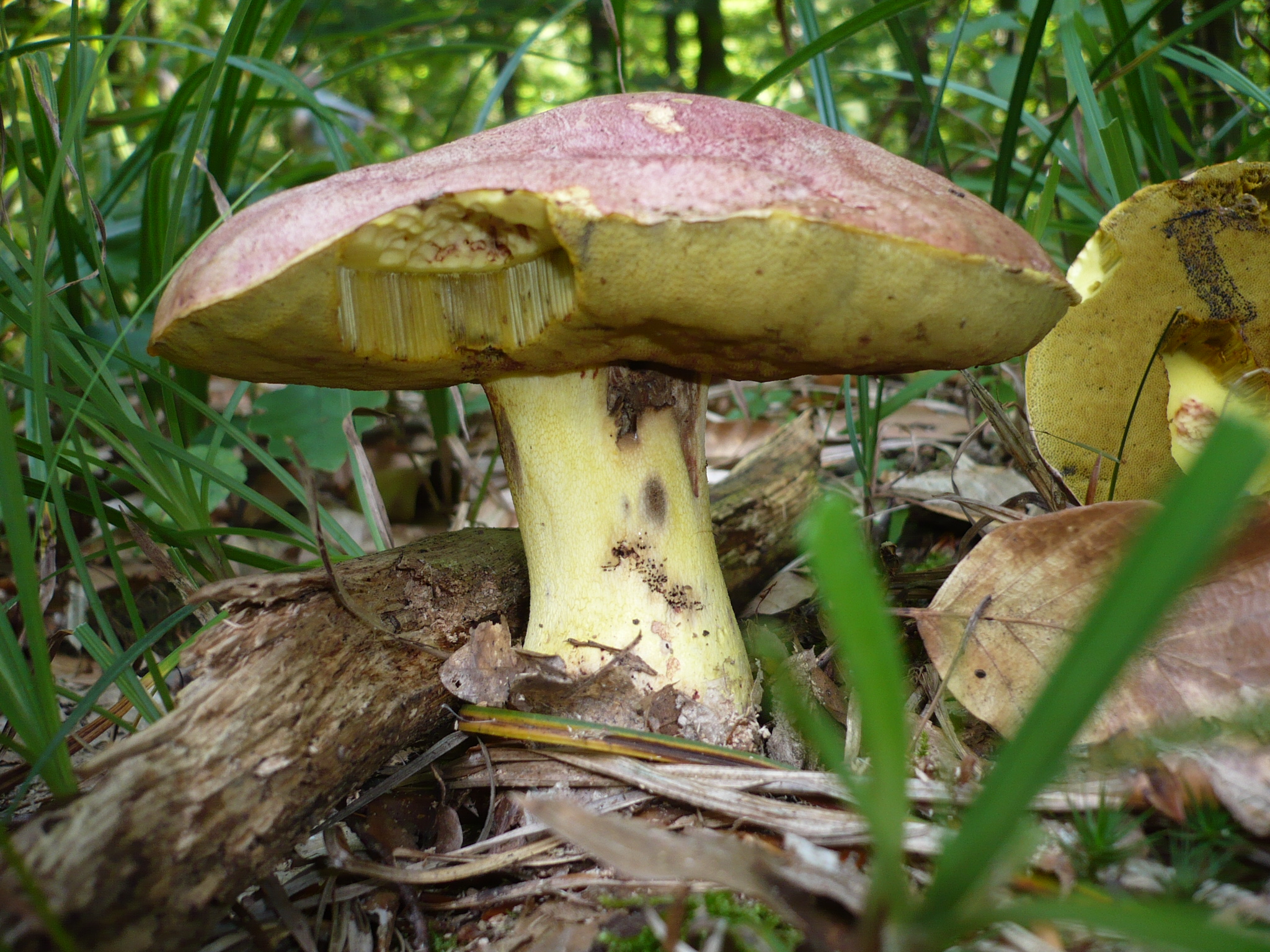
The royal bolete (Butyriboletus regius), formerly known as the red-capped butter bolete, is a rare mushroom belonging to the family Boletaceae. The cap is pink, raspberry-red, or reddish-pink in color, initially hemispherical, and later convex to flattened. The tubes and small pores are lemon yellow, turning olive-yellow with age, and do not turn blue under pressure. The stipe is yellow with a delicate reticulation, and the flesh is firm, yellowish, mild, and unchanging in color. Thermophilic, growing under oaks; in Poland, it is subject to species protection.
Identification, habitat, and key differences.
Forager
Fruitbody structure
- Fruit body form
- Fruit body form: Cap, stipe.
- Consistency of the entire fruitbody
- Consistency of the entire fruitbody: fleshy.
Cap
- Cap shape
- in young fruit bodies: Cap shape: hemispherical.
in mature fruit bodies: Cap shape: convex. - Cap covering
- in young fruit bodies: Cap covering: felty.
in mature fruit bodies: Cap covering: glabrous.
Cap covering: fibrillose. - Cap stickiness and sliminess
- when wet: Cap stickiness and sliminess: sticky.
- Cap colour
- Cap colour: pink.
Cap colour: pinkish. - Margin orientation
- in young fruit bodies: Margin orientation: inrolled.
- Cap diameter
- The cap measures up to 200 mm in diameter.
Underside of the cap
- Hymenophore type
- Hymenophore type: tubes.
- Pore shape
- Pore shape: round.
- Natural pore colour
- in young fruit bodies: Natural pore colour: yellow.
in mature fruit bodies: Natural pore colour: yellow-olive. - Pore size
- Pore size: small.
- Natural tube colour
- in young fruit bodies: Natural tube colour: yellow.
in mature fruit bodies: Natural tube colour: yellow-olive.
Stem and base
- Stipe shape
- in young fruit bodies: Stipe shape: barrel-shaped.
in mature fruit bodies: Stipe shape: club-shaped.
in mature fruit bodies: Stipe shape: cylindrical.
in young fruit bodies: Stipe shape: ventricose. - Stipe base
- Stipe base: swollen.
Stipe base: tapering. - Stipe colour
- Stipe colour: lemon yellow.
Stipe colour: vivid yellow.
Stipe colour: yellow. - Stipe surface relief
- Stipe surface relief: reticulate.
- Stipe interior
- Stipe interior: solid.
- Stipe length
- Stipe length: 50–200 mm.
- Stipe diameter
- Stipe diameter: 15–65 mm.
- Colour of the stipe reticulum
- Colour of the stipe reticulum: yellow.
Flesh
- Flesh colour
- Flesh colour: lemon yellow.
Flesh colour: vivid yellow.
Flesh colour: pale pink (flesh at the stipe base).
Flesh colour: dirty pink (flesh at the stipe base). - Flesh firmness
- Flesh firmness: hard.
- Flesh taste
- Flesh taste: weak.
- Flesh odour
- Flesh odour: weak.
Flesh odour: mushroom-like, weak.
Where and when it grows
- Habitat
- Habitat: deciduous woodland.
- Substrate
- Substrate: soil.
- Fruit body growth pattern
- Fruit body growth pattern: solitary.
Fruit body growth pattern: in small groups.
Fruit body growth pattern: fused fruit bodies. - Occurrence frequency
- Occurrence frequency: rare.
- Fruiting season
- Fruit bodies appear from June to November.
- Distribution area
Edibility and culinary use
- Edibility
- Edible
What it can be confused with
Butyriboletus appendiculatus
Key differences
The appendiculate bolete (Butyriboletus appendiculatus) differs by the brown coloration of the cap, in contrast to the pink in the royal bolete. Although B. regius was formerly treated as its red variety or subspecies, modern taxonomy unequivocally treats them as separate species.
Butyriboletus fuscoroseus
Key differences
The brownish-pink bolete (Butyriboletus fuscoroseus, formerly known as Boletus pseudoregius) has a cap with a more subdued, brownish-pink, reddish-brown, or purplish-brown tone. In the lower third of the stem, there is often a pink, orange-red, or reddish-purple zone, and its flesh, tubes, pores, and stem surface clearly turn blue after damage. The base of the stem in section is usually pink to light carmine.
Rubroboletus legaliae
Key differences
In youth, the lovage bolete (Rubroboletus legaliae) has a cap covered with a grayish tomentum, which only with age reveals pinkish or purplish-red tones. Its stem is red, and the pores in young fruiting bodies are red or orange-red, becoming almost yellow with age. The flesh turns intensely blue, and dried fruiting bodies emit the scent of Maggi seasoning or lovage. The spores of this species are wider, measuring (4.5)5.0–6.0(7.0) µm.
Rubroboletus pulchrotinctus
Key differences
Rubroboletus pulchrotinctus produces a whitish to light gray cap, often with pink coloration near the margin, and sometimes entirely pink. Its pores and stem have yellow-orange to orange-pink shades, and the flesh exhibits bluing. It is a species with a range restricted to the Mediterranean zone.
Rubroboletus satanas
Key differences
The poisonous Satan's bolete (Rubroboletus satanas) has an off-white, grayish, or slightly olive cap and a massive, barrel-shaped stem covered with a scarlet-red reticulation. The pores in very young specimens are yellow, becoming orange, reddish, or purple with age, and the pale flesh slowly turns blue after being cut. Consumption of this mushroom causes severe gastrointestinal distress.
FAQ
Is the royal bolete an edible mushroom?
In many countries, it is considered an exquisite edible mushroom, but in Poland, it is under strict species protection. Due to its rarity and legal prohibition, it is forbidden to collect or destroy it.
Does the flesh of the royal bolete turn blue when damaged?
No. The flesh of the royal bolete essentially does not change color after being cut and remains yellowish. The absence of distinct bluing of the flesh is a key feature distinguishing it from the yellow-brown bolete.
How does the royal bolete differ from the yellow-brown bolete?
The royal bolete has a pink cap, and its flesh and pores do not turn blue. The butter bolete (B. appendiculatus) has a brown or ochre cap, and its pores and flesh turn blue upon touching.
What color are the pores and tubes of the royal bolete?
The tubes and pores are intensely lemon-yellow from youth, darkening with age to golden-yellow or yellow-olive. The pores are small, round, and do not change color to blue under finger pressure.
In what forests and on what soils does this species occur?
It grows in warm deciduous forests, mainly oak and beech, less frequently under sweet chestnuts. It requires a substrate with a neutral or alkaline reaction, especially on warm calcareous soils.
What does the stem of the royal bolete look like?
The stem is massive, initially bulbous, with age club-shaped, light yellow or chrome yellow in color. On the surface, it has a delicate yellow network, and at the base it is sometimes stained with reddish spots.
In what period do the fruiting bodies of this bolete appear?
The fruiting bodies of the royal bolete appear in the warmer months of the year, usually from June to September or early October, mainly after heavy rains during hot periods.
Why was the name changed from Boletus regius to Butyriboletus regius?
Phylogenetic studies demonstrated the distinctness of the butter bolete group from true boletes (Boletus sensu stricto). In 2014, the genus Butyriboletus was formally segregated by mycologists.
Enthusiast
Underside of the cap
- Pore diameter
- in mature fruit bodies: Pore diameter: up to 1 mm.
- Tube length
- in mature fruit bodies: Tube length: 10–25 mm.
Names and history
- Obowiązująca nazwa krajowa
- masłoborowik królewski
- Obowiązująca nazwa taksonomiczna
- Butyriboletus regius (Krombh.) D. Arora & J.L. Frank
- Pozostałe nazwy
- borowik królewski, borowik żółtobrązowy królewski, borowik żółtobrązowy podgat. królewski
Home observations
Spore print
- Required materials
- fresh, mature cap, sheet of paper, glass or small bowl, water
- Time
- 2–24 h
- Procedure
- Place the cap underside down on the paper.
- Add a drop of water on top and cover.
- After 2–24 hours, lift the cap and examine the deposit.
What to look for
- Spore print colour
- Spore print colour: brown. Spore print colour: green.
- Spore print shade
- Spore print shade: olive-brown. Spore print shade: olive. Spore print shade: olive-brown.
Under the microscope
- Required materials
- light microscope, microscope slide and cover slip, needle, water, spores from print
- Procedure
- Transfer a small amount of the spore print onto the slide using a needle.
- Add a drop of water, cover with a cover slip, and examine the spores.
What to look for
- Spore shape
- Spore shape: fusiform. Spore shape: cylindrical. Spore shape: fusiform. Spore shape: fusiform.
- Spore surface
- Spore surface: smooth. Spore surface: smooth. Spore surface: smooth.
- Spore dimensions
- Length 10–17.5 µm, width 3–5 µm.
Compare dimensions after calibrating the microscope scale.
Ecology and distribution
- Mycorrhizal hosts
- General species association: Mycorrhizal hosts: Quercus (general partner list).
General species association: Mycorrhizal hosts: Fagus (general partner list).
History and culture
The royal bolete occupies a special place in the history of European taxonomy thanks to its distinctive, vivid coloration. The species was originally described in 1832 by the Czech physician and mycologist Julius Vincenz von Krombholz in a work dedicated to fungi, under the name Boletus regius. The epithet "regius" alluded to the royal appearance of the fruit bodies, which was reflected in traditional regional names in Europe, such as the French "bolet royal" or the Czech "hřib královský".
A breakthrough in the modern taxonomic understanding of the species came with molecular and phylogenetic studies. In 2014, David Arora and Jonathan L. Frank established the new genus Butyriboletus for mushrooms of the butter bolete group, placing the species in the new combination Butyriboletus regius. In the same work, the researchers demonstrated the distinctiveness of the European taxon and separated North American species from it, which had previously sometimes been erroneously conflated with or described under the name of the royal bolete.
In European mycological literature since the 19th century, this mushroom has remained one of the most recognizable representatives of the Boletaceae of warm deciduous forests, described primarily in the context of its rarity of occurrence and the necessity of habitat conservation.
Edibility and safety
The royal bolete (butter bolete) is described in the literature as an edible mushroom with a mild taste and delicate aroma; however, for legal and conservation reasons, it is not harvested. Regarding potential consumption, prior heat treatment is indicated as a requirement, without attributing specific symptoms undocumented in the sources to consumption in the raw state.
In Poland, this species is subject to strict species protection. The Regulation of the Minister of the Environment of 9 October 2014 on the protection of fungal species (Journal of Laws of 2014, item 1408), in Annex No. 1 under item 7, specifically lists it under the name "Boletus appendiculatus ssp. regius (Krombh.) Konr. – borowik żółtobrązowy podgat. królewski". These provisions entail a prohibition on harvesting, destroying, and damaging fruit bodies in natural habitats as part of ordinary mushroom foraging, although Article 56 of the Nature Conservation Act provides for the possibility of issuing decisions granting derogations from these prohibitions.
Although historically in some regions of southern Europe (e.g., in Italy) it was locally considered an edible mushroom, today, due to its extreme rarity and protected status across many European countries, harvesting from the wild is not conducted.
Habitat and occurrence
The royal bolete is a thermophilic mycorrhizal fungus associated with deciduous trees, entering into symbiosis primarily with oaks (Quercus) and beeches (Fagus), and less frequently with sweet chestnut or hornbeam. It inhabits thermophilous, open deciduous forests, especially oak woods and thermophilous beech forests. It prefers permeable, humus-rich substrates high in calcium carbonate, with a neutral or alkaline reaction, most often on sun-exposed slopes and elevations.
Its geographical range covers Europe, mainly its warmer, southern and central regions. In Poland, it belongs to extreme mycological rarities and is known only from very few historical and contemporary records.
The fruit body observation periods documented in Central European compilations show variation: in Poland, they have been recorded from June to November (VI–XI), whereas in the Czech Republic, the observation range falls between May and September (V–IX). The emergence of fruit bodies depends strictly on the presence of adequate moisture and high soil temperature.
Researcher
Edibility and culinary use
Ustalenia źródłowe: jadalność, spożycie i wykorzystanie
- Edibility
- Edible — źródło oznaczenia
Źródło bez opisu bibliograficznego · Kuchyňské využití / jadalny
Scientific names and taxonomy
- Current scientific name
Butyriboletus regius (Krombh.) D. Arora & J.L. Frank
- Former scientific names
- 1832 — Boletus regius Krombh.
1882 — Tubiporus regius (Krombh.) P. Karst.
1886 — Dictyopus appendiculatus var. regius (Krombh.) Quél.
1888 — Dictyopus regius (Krombh.) Quél.
1891 — Boletus appendiculatus var. regius (Krombh.) Costantin & L.M. Dufour
1898 — Suillus regius (Krombh.) Kuntze
1903 — Boletus subtomentosus subsp. cerasinus C. Martín
1925 — Boletus appendiculatus subsp. regius (Krombh.) Konrad
1965 — Boletus regius var. peltereaui J. Blum
2007 [2006] — Boletus regius f. aureus M. Lamb. & Estadès
2016 — Butyriboletus regius f. aureus (M. Lamb. & Estadès) Klofac[4] [11]
Masłoborowik królewski nosi nazwę naukową Butyriboletus regius (Krombh.) D. Arora & J.L. Frank. Należy do rodziny borowikowatych (Boletaceae) w rzędzie borowikowców (Boletales). Krombholz opisał go w 1832 roku pod nazwą Boletus regius. David Arora i Jonathan L. Frank przenieśli ten gatunek do rodzaju Butyriboletus w 2014 roku; nową kombinację opublikowano na stronie 466 czasopisma „Mycologia”, z rejestracją w MycoBank pod numerem MB803323.
[11] [4]W synonimice taksonomicznej według Species Fungorum znajdują się m.in.: Boletus regius Krombh. (1832), Tubiporus regius (Krombh.) P. Karst. (1882), Dictyopus appendiculatus var. regius (Krombh.) Quél. (1886), Dictyopus regius (Krombh.) Quél. (1888), Boletus appendiculatus var. regius (Krombh.) Costantin & L.M. Dufour (1891), Suillus regius (Krombh.) Kuntze (1898), Boletus appendiculatus subsp. regius (Krombh.) Konrad (1925), Boletus subtomentosus subsp. cerasinus C. Martín (1903), Boletus regius var. peltereaui J. Blum (1965), Boletus regius f. aureus M. Lamb. & Estadès (publikacja z 2007 roku oznaczona rokiem 2006) oraz Butyriboletus regius f. aureus (M. Lamb. & Estadès) Klofac (2016).
[11]Taxon scope and identification limitations
Epitet regius bywał historycznie odnoszony także do innych grzybów, w tym Butyriboletus fuscoroseus, Rubroboletus legaliae oraz pokrewnych taksonów spoza Europy. Z tego względu dawne oznaczenia jako „Boletus regius” w publikacjach z Ameryki Północnej lub Azji nie mogą być automatycznie utożsamiane z europejskim masłoborowikiem królewskim, jego zasięgiem czy regionalnym wykorzystaniem.
[7] [4]W obrębie gatunku wyróżniano formę żółtą, opisaną jako Butyriboletus regius f. aureus. Janda i współautorzy uznają jej rangę taksonomiczną za niepewną: może stanowić skrajny wariant barwny, a na niemal wszystkich obserwowanych żółtych kapeluszach stwierdzano ślady różu lub czerwieni. Żółte fragmenty powierzchni kapelusza obserwowano również pod osłaniającymi go liśćmi.
[7] [11]W opisach masłoborowika królewskiego występują rozbieżności dotyczące obecności szarych tonów. O ile polskie źródła mówią o barwie płoworóżowej lub różowej z fioletem, o tyle wzmianki o odcieniach szaroróżowych lub szaroczerwonych są przez część badaczy kwestionowane jako wynik pomylenia z Butyriboletus roseogriseus lub Rubroboletus legaliae. Obecność szarości na kapeluszu nie jest cechą typową dla tego gatunku.
[7] [12]- Zakres ujęcia taksonomicznego
European Butyriboletus regius in the focal species treatment of Janda, Kříž & Kolařík2019 and the accepted combination of Arora & Frank2014. Historical combinations preserve nomenclatural context; data of other Butyriboletus species and historical North-American misapplications are not transferred.
[7] [4]
Ecology and distribution
Laboratory diagnostics
Dane ustrukturyzowane
Basidia
Pileipellis
Spores
- Presence of the basidiospore hilar appendix
- Presence of the basidiospore hilar appendix: present. [7]
- Spore colour under the microscope
- Spore colour under the microscope: yellowish. [7]
Spore colour under the microscope: yellow-brown. [12] - Spore length
- Spore length: 10.5–16 µm. [5]
Spore length: 10–16 µm. [6]
Spore length: 10.5–17.5 µm. [7]
Spore length: 13–17 µm. [12] - Spore length-to-width ratio
- Spore length-to-width ratio: 2.7–4.3. [5]
- Spore shape
- Spore shape: fusiform. [7]
Spore shape: cylindrical. [7]
Spore shape: fusiform. [12]
Spore shape: fusiform. [6] - Spore wall thickness
- Spore wall thickness: thin-walled. [12]
Material and research methods
- Results as recorded in the sources — Spore length
- Materiał badania: Exact focal species source account; named specimens and pooled sample limits remain source-specific. No universal collection assignment. 10–16 µm [6]
Materiał badania: Exact focal species source account; named specimens and pooled sample limits remain source-specific. No universal collection assignment. 13–17 µm [12]
Materiał badania: Exact focal species source account; named specimens and pooled sample limits remain source-specific. No universal collection assignment. Materiał suszony (przygotowanie opisano w Metodach): 12–16 µm (skrajnie 10,5–17,5 µm) [7]
Materiał badania: Exact focal species source account; named specimens and pooled sample limits remain source-specific. No universal collection assignment. 10,5–16 µm [5] - Results as recorded in the sources — Spore width
- Materiał badania: Exact focal species source account; named specimens and pooled sample limits remain source-specific. No universal collection assignment. 3–5 µm [5] [6]
Materiał badania: Exact focal species source account; named specimens and pooled sample limits remain source-specific. No universal collection assignment. Materiał suszony (przygotowanie opisano w Metodach): 4–5 µm [7]
Materiał badania: Exact focal species source account; named specimens and pooled sample limits remain source-specific. No universal collection assignment. 4–5 µm [12]
Metody i zapisy źródłowe — Exact focal species source account; named specimens and pooled sample limits remain source-specific. No universal collection assignment.
Stan materiału: suszony.
Pochodzenie materiału: Czech Republic; macroscopic observations on fresh fruitbodies and microscopic preparations from dried material..
Metoda źródłowa. Technika: mikroskopia świetlna (LM). Opis metody w źródle: Olympus CX21/CX31/CX41, oil-immersion1000×; mounts in ammoniacal Congo Red,5%KOH,Melzer and water. Exact medium of ordinary spore colour is unreported. Spore sizes: at least20 per fruitbody, several fruitbodies/localities; main90%range with parenthesised extremes. This N does not apply to basidia or hyphae.
Liczba zarodników na jednej podstawce — zapis źródłowy: „Mostly4-spored basidia, not an assertion of every basidium or sample size.” [7]
Obecność wyrostka wnęki bazydiospory; Kształt podstawki; Inkrustacja strzępek skórki; Organizacja skórki kapelusza; Barwa zarodnika w mikroskopie; Kształt zarodnika; Powierzchnia zarodnika — zapis źródłowy: „Focal species description; exact named anatomical target, no other taxa or collection inference.” [7]
Długość podstawki; Szerokość podstawki; Szerokość elementów skórki; Długość zarodnika; Szerokość zarodnika — zapis źródłowy: „Original independent numerical result; source bounds and qualifications retained in the primary source and this study.” [7]
Metody i zapisy źródłowe — Exact focal species source account; named specimens and pooled sample limits remain source-specific. No universal collection assignment.
Inkrustacja strzępek skórki; Organizacja skórki kapelusza — zapis źródłowy: „Focal species description; exact named anatomical target, no other taxa or collection inference.” [5]
Długość zarodnika; Iloraz długości i szerokości zarodnika; Szerokość zarodnika — zapis źródłowy: „Original independent numerical result; source bounds and qualifications retained in the primary source and this study.” [5]
Metody i zapisy źródłowe — Exact focal species source account; named specimens and pooled sample limits remain source-specific. No universal collection assignment.
Barwa zarodnika w mikroskopie; Kształt zarodnika; Powierzchnia zarodnika; Grubość ściany zarodnika — zapis źródłowy: „Focal species description; exact named anatomical target, no other taxa or collection inference.” [12]
Długość zarodnika; Szerokość zarodnika — zapis źródłowy: „Original independent numerical result; source bounds and qualifications retained in the primary source and this study.” [12]
Metody i zapisy źródłowe — Exact focal species source account; named specimens and pooled sample limits remain source-specific. No universal collection assignment.
Długość zarodnika; Szerokość zarodnika — zapis źródłowy: „Original independent numerical result; source bounds and qualifications retained in the primary source and this study.” [6]
Kształt zarodnika; Powierzchnia zarodnika — zapis źródłowy: „Focal species description; exact named anatomical target, no other taxa or collection inference.” [6]
Occurrence verification — scope and limitations
Materiał: Opublikowane polskie stanowisko pod źródłową nazwą Boletus regius. Zachowano poziom odczytu atlasowego odsyłacza do publikacji.
Zakres odczytu: Fragmenty źródeł.
Odczytano fragment źródła; pełny tekst i metody nie zostały zweryfikowane.
Data przeglądu: 21.10.2026.
Ograniczenia: Źródłowe oznaczenie i zakres pojęcia zachowano. Nie zadeklarowano nowego badania okazów ani odczytu wszystkich publikacji cytowanych przez źródło.
[12]- Sample preparation for microscopy
- Materiał suszony. Mikroskopy Olympus CX21/CX31/CX41, powiększenie 1000× z immersją olejową; preparaty w amoniakalnej czerwieni Kongo, 5% KOH, odczynniku Melzera i wodzie. Dokładnego medium zwykłej barwy zarodników nie podano. Mierzono co najmniej 20 zarodników na owocnik, z kilku owocników i stanowisk; podano główny zakres 90% oraz skrajności w nawiasach. Tej liczebności nie przypisano podstawkom ani strzępkom. [7]
Scope of the review
Before completion, the record requires completion or settlement.
- Search for occurrence regions requires reconciliation.
- Connections of earlier findings require re-examination.
- New sources require accounting for information encountered during the review.
Habitat and occurrence
Habitat, area and season
Masłoborowik królewski rośnie na ziemi w ciepłych, dobrze naświetlonych lasach liściastych, zwłaszcza w prześwietlonych dąbrowach, na nasłonecznionych zboczach, groblach stawowych oraz ciepłolubnych murawach leśnych. Preferuje podłoża o odczynie zasadowym, bogate w węglan wapnia, chociaż powierzchniowa warstwa gleby bywa w jego siedliskach zakwaszona. W Europie Środkowej tworzy mikoryzę z dębami, rzadziej z bukami, a w cieplejszych rejonach południa Europy także z kasztanem jadalnym.
[7]W Czechach gatunek ten jest bardzo rzadki i spotykany głównie na nizinach oraz pogórzach w ciepłolubnych dąbrowach na wapieniu. Owocniki pojawiają się od maja do września lub początku października. W fitosocjologii czeskiej grzyb ten jest uważany za gatunek wskaźnikowy dla środkowoeuropejskich grądów subkontynentalnych (Galio-Carpinetum) oraz lasów dębowych typu lasostepowego.
[7] [6]W analizach genetycznych wykorzystywano europejskie zbiory masłoborowika królewskiego z Włoch (region Lacjum, pod Quercus cerris oraz w drzewostanie mieszanym z dębem, bukiem i kasztanem), Bułgarii (Kostinbrod, pod dębami) oraz topotyp z Pragi-Točnej w Czechach (znaleziony pod dębem i lipą). Obecność określonych gatunków drzew w otoczeniu znaleziska nie oznacza jednak automatycznie potwierdzonej mikoryzy ze wszystkimi z nich.
[4] [7]W Hiszpanii, w regionie Estremadury, masłoborowik królewski owocuje jesienią w lasach kasztana jadalnego (Castanea sativa), dębu korkowego (Quercus suber) oraz dębu pirenejskiego (Quercus pyrenaica). W dąbrowach dębu pirenejskiego bywa lokalnie spotykany dość często i owocuje obficie, co kontrastuje z jego wybitną rzadkością w Europie Środkowej.
[9]W Macedonii Północnej gatunek rośnie na wysokościach od 400 do 1600 m n.p.m. w starych, widnych lasach liściastych na podłożu wapiennym, towarzysząc dębom, bukom i kasztanom. Owocniki pojawiają się nieregularnie od połowy wiosny do połowy jesieni, zazwyczaj nielicznie, z wyraźniejszym pojawem w wilgotniejszych sezonach letnich.
[10]Potwierdzony zasięg występowania
Wszystkie obszary potwierdzone w zapisanych danych źródłowych.
| Kraj | Regiony i stanowiska | Owocnikowanie | Sources |
|---|---|---|---|
| Czech Republic | Nie ustalono regionów w zapisanych danych | V–IX |
|
| Poland | Subcarpathian Voivodeship | VI–XI |
|