Edible
Set your location to see data for your region.


The oyster mushroom is a popular wood-decaying edible mushroom from the Pleurotaceae family. It produces characteristic shell-shaped or spatula-shaped caps ranging in color from ash-gray, through steel-gray, to dark brown with a bluish tint. The gills are whitish to light gray, crowded, and distinctly decurrent down a short, asymmetrical stem. The flesh is firm, meaty, with a pleasant smell and a mild, slightly nutty flavor. It fruits in late autumn and winter, growing in clusters on the trunks of deciduous trees.
Identification, habitat, and key differences.
Forager
Fruitbody structure
- Fruit body form
- Fruit body form: Cap.
Fruit body form: stipe. - Color of mycelium at the base of the fruitbody
- Color of mycelium at the base of the fruitbody: white.
Cap
- Cap shape
- Cap shape: convex.
Cap shape: flat.
Cap shape: depressed. - Cap surface relief
- Cap surface relief: smooth.
- Cap covering
- Cap covering: glabrous.
- Cap surface sheen
- Cap surface sheen: matt.
- Cap colour
- Cap colour: creamy white.
Cap colour: buff.
Cap colour: grey-violet.
Cap colour: violet-brown.
Cap colour: gray.
Cap colour: grey-brown.
Cap colour: blue-grey.
Cap colour: whitish.
Cap colour: pale brown.
Cap colour: dark brown. - Margin orientation
- in young fruit bodies: Margin orientation: inrolled.
Margin orientation: inrolled. - Cap margin outline
- in old fruit bodies: Cap margin outline: wavy.
- Cap margin profile
- Cap margin profile: acute.
- Cap diameter
- The cap measures up to 300 mm in diameter.
- Cap outline
- in mature fruit bodies: Cap outline: shell-shaped.
Cap outline: fan-shaped.
Cap outline: kidney-shaped.
in young fruit bodies: Cap outline: tongue-shaped.
in mature fruit bodies: Cap outline: spatulate.
Cap outline: tongue-shaped.
Cap outline: spatulate.
Underside of the cap
- Hymenophore type
- Hymenophore type: gills.
Gills at stipe
- Hymenophore attachment to the stipe
- Hymenophore attachment to the stipe: attached to the stipe (gills).
- Decurrence of the hymenophore on the stem
- Decurrence of the hymenophore on the stem: decurrent (gills).
- Hymenophore colour
- Hymenophore colour: orange.
Hymenophore colour: pinkish.
Hymenophore colour: whitish.
Hymenophore colour: grayish.
in old fruit bodies: Hymenophore colour: yellowish. - Degree of gill anastomosis
- Degree of gill anastomosis: present.
- Gill spacing
- Gill spacing: rather widely spaced.
Gill spacing: closely spaced.
Gill spacing: widely spaced. - Gill thickness
- Gill thickness: thick.
Stem and base
- Stipe position
- Stipe position: lateral.
Stipe position: off-centre.
Stipe position: central. - Stipe colour
- Stipe colour: whitish.
- Stipe surface covering
- Stipe surface covering: glabrous.
in the lower part of the stipe: Stipe surface covering: hairy (white covering).
in the lower part of the stipe: Stipe surface covering: Felted.
Stipe surface covering: fibrillose.
Stipe surface covering: hairy.
Stipe surface covering: suede-like. - Stipe consistency
- Stipe consistency: fibrous.
- Stipe length
- Stipe length: 10–70 mm.
- Stipe diameter
- Stipe diameter: 10–30 mm.
- Stipe flesh resistance to breaking or tearing
- Stipe flesh resistance to breaking or tearing: resistant to breaking or tearing.
- Qualitative relative stem length
- Qualitative relative stem length: short.
Flesh
- Flesh colour
- Flesh colour: white.
- Flesh firmness
- Flesh firmness: firm.
- Flesh elasticity
- Flesh elasticity: elastic.
- Flesh structure
- Flesh structure: fibrous.
- Flesh consistency type
- in old fruit bodies: Flesh consistency type: leathery (slightly, especially in the stipe).
- Flesh odour
- Flesh odour: mushroom-like, pleasant.
Flesh odour: distinctive.
raw: Flesh odour: unpleasant (whole fruit body, possible). - Taste character of the flesh
- Taste character of the flesh: mild.
- Flesh thickness class
- Flesh thickness class: thick.
Where and when it grows
- Habitat
- Habitat: deciduous woodland.
Habitat: park.
Habitat: forest of unspecified type.
Habitat: trees amid fields. - Substrate
- Substrate: dead wood.
Substrate: living wood. - Fruit body growth pattern
- Fruit body growth pattern: in clusters.
Fruit body growth pattern: overlapping. - Occurrence frequency
- Occurrence frequency: common.
- Fruiting season
- Fruit bodies appear from October to December or in March.
- Distribution area
- Potwierdzono występowanie w Polsce.
- Substrate wood group
- Substrate wood group: broadleaf wood.
Substrate wood group: conifer wood.
Edibility and culinary use
- Edibility
- Edible
Law
- Protection
- It is not subject to species protection in Poland.
- Trade
- It is approved in Poland for trade and for the production of mushroom products.
What it can be confused with
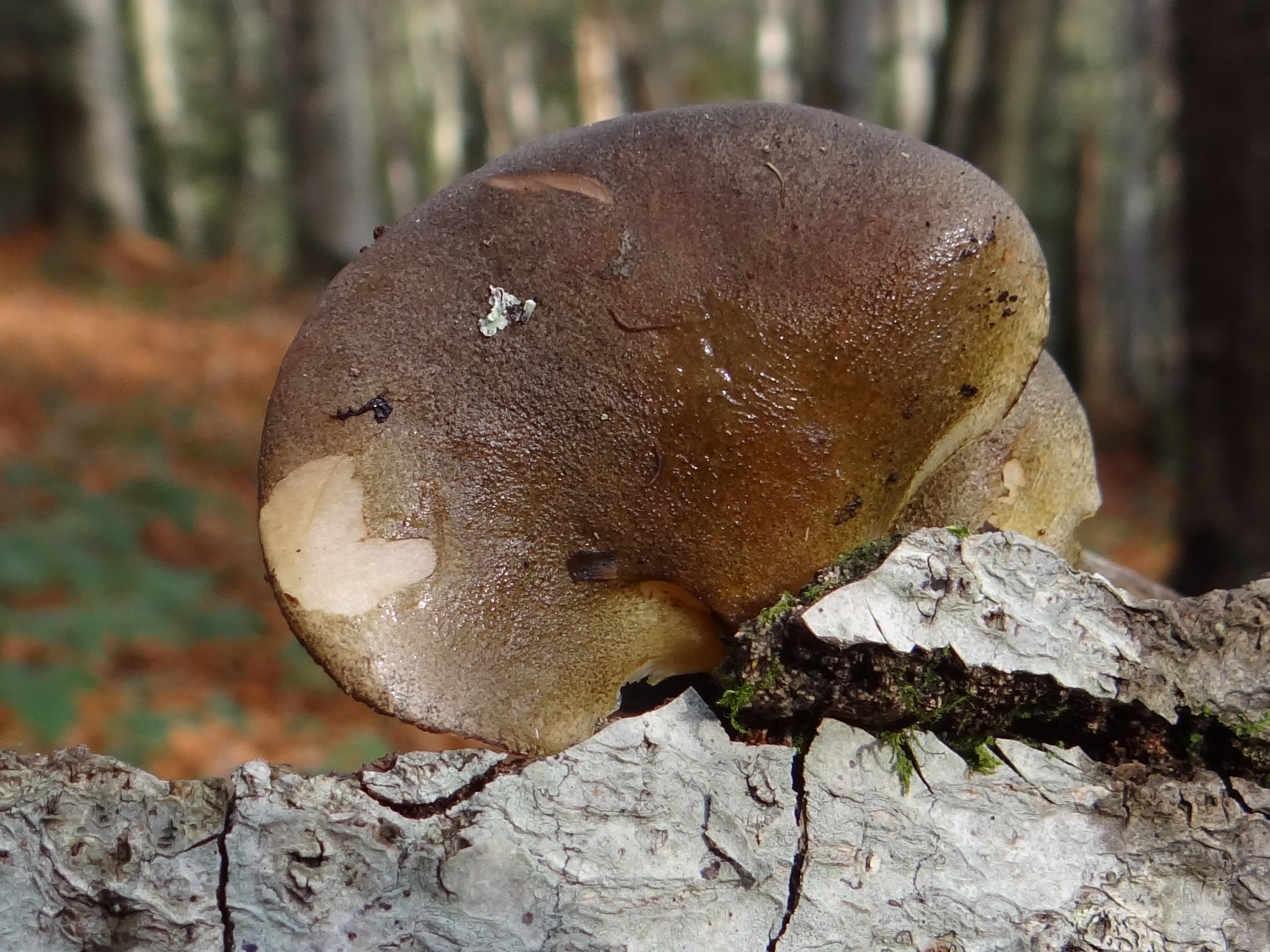
Sarcomyxa serotina
Key differences
The late oyster mushroom (Sarcomyxa serotina, syn. Panellus serotinus) differs in the presence of olive shades on the cap, an orange-tinted, rudimentary stem covered with fine brown scales, and yellow-ochre gills that distinctly terminate at the stem instead of running down it.
The similar oyster mushroom (Pleurotus ostreatus) fruits during the same period, but differs in having larger fruit bodies in shades of gray and brown, pure white gills, and the absence of yellow-olive colors and scales on the stem.
Pleurotus pulmonarius
Key differences
The pale oyster mushroom (Pleurotus pulmonarius) is typically smaller and forms a thinner, whitish cap whose margin and gills turn yellow with age. It fruits mainly in the warmer months of the year – from late spring to autumn.
Pleurotus dryinus
Key differences
The veiled oyster mushroom (Pleurotus dryinus) differs in its firmer flesh, whitish, felty cap, and the presence of distinct veil remnants on young fruit bodies, which the oyster mushroom never develops.
FAQ
Can the oyster mushroom be eaten raw?
It should not be eaten raw. It contains thermolabile hemolysins and hard-to-digest chitin, which can cause stomach upsets. It requires frying or boiling for at least a few minutes.
Where does the oyster mushroom most commonly grow in the wild?
It can be found in deciduous and mixed forests, on trunks and branches of dead or old trees. It most readily colonizes beeches, poplars, willows, hornbeams, and birches, fruiting in characteristic clusters.
When is the peak season for harvesting oyster mushrooms?
Fruiting bodies appear in late autumn, usually from October to December, and during a mild winter even until February. The stimulus for cap formation is the first autumn cold spells and drops in temperature.
Can the oyster mushroom be confused with poisonous mushrooms?
The risk of confusion is negligible. However, one should watch out for the olive oysterling with its olive tint and the poisonous oysterling, which tends to be smaller and has a rusty-brown rather than whitish spore print.
What nutritional and health-promoting properties does this mushroom have?
It is rich in protein, dietary fiber, B vitamins, and vitamin D. It also contains lovastatin, which regulates cholesterol levels, and pleuran – a beta-glucan that stimulates the human immune system.
Can the oyster mushroom be successfully cultivated at home?
Yes, it is one of the easiest mushrooms to grow at home. All you need to do is buy a substrate block with fully colonized mycelium on straw or sawdust, ensure high humidity, access to light, and a cool location.
Why are oyster mushroom stems sometimes tough and how can they be used?
The stems of older specimens contain a lot of fibrous chitin. Although they are tough and stringy after frying, they should not be thrown away – they are excellent for making flavorful broths, soups, and sauce bases.
What is the best way to store freshly harvested oyster mushrooms?
Fresh mushrooms should be kept in the refrigerator, preferably in a breathable paper bag, without plastic wrap. Under these conditions, they retain full firmness, aroma, and freshness for about 5 to 7 days.
Is the oyster mushroom a predatory fungus?
Yes, the oyster mushroom is a carnivorous fungus. Its mycelium developing in wood produces microscopic paralyzing toxins with which it captures and digests nematodes, obtaining scarce nitrogen from them.
Can oyster mushrooms be frozen or dried?
Oyster mushrooms are excellent for freezing, but it is worth blanching them briefly beforehand so they do not become bitter. They tolerate traditional drying less well, as they become tough, stringy, and rubbery after soaking.
Enthusiast
Names and history
- Obowiązująca nazwa krajowa
- Boczniak ostrygowaty
- Obowiązująca nazwa taksonomiczna
- Pleurotus ostreatus
Home observations
Spore print
- Required materials
- fresh, mature cap, sheet of paper, glass or small bowl, water
- Time
- 2–24 h
- Procedure
- Place the cap underside down on the paper.
- Add a drop of water on top and cover.
- After 2–24 hours, lift the cap and examine the deposit.
What to look for
- Spore print colour
- Spore print colour: white. Spore print colour: violet.
- Spore print shade
- Spore print shade: pale cream. Spore print shade: gray-violet.
Under the microscope
- Required materials
- light microscope, microscope slide and cover slip, needle, water, spores from print
- Procedure
- Transfer a small amount of the spore print onto the slide using a needle.
- Add a drop of water, cover with a cover slip, and examine the spores.
What to look for
- Spore shape
- Spore shape: ellipsoid. Spore shape: ellipsoid. Spore shape: cylindrical. Spore shape: Cylindrical-ellipsoid.
- Spore surface
- Spore surface: smooth. Spore surface: smooth. Spore surface: smooth.
- Spore dimensions
- Length 7–12 µm, width 2–4.5 µm.
Compare dimensions after calibrating the microscope scale.
Ecology and distribution
- Mode of nutrition
- Mode of nutrition: saprotrophic.
Mode of nutrition: parasitic.
Mode of nutrition: nematophagous.
Non-culinary uses
In cooking, the oyster mushroom is considered an excellent meat substitute – breaded caps are fried just like traditional pork cutlets, and cut into strips they form the base of vegetarian tripe soup. It also tastes great in soups, sauces, and stir-fry dishes. In medicine, extracts from this mushroom are an ingredient in preparations that lower blood cholesterol and glucose levels. Furthermore, oyster mushroom mycelium exhibits mycoremediation abilities, breaking down toxins, petroleum hydrocarbons, and industrial waste.
History and culture
The history of oyster mushroom cultivation dates back to World War I, when its cultivation on tree stumps began in Germany as a valuable source of protein during a time of crisis. In traditional Far Eastern medicine, it was considered a remedy that strengthened blood vessels and vitality. Today, it is one of the most widely cultivated mushrooms in the world, second only to the button mushroom. It enjoys immense popularity among ecology enthusiasts thanks to easy amateur cultivation on straw or coffee grounds.
Edibility and safety
It is an excellent edible mushroom, prized for its high nutritional and taste qualities. It contains easily digestible protein, B vitamins, vitamin D, and pleuran – a valuable beta-glucan that supports immunity. It requires heat treatment, as raw it can cause stomach discomfort due to the presence of natural hemolysins destroyed by heat. Foraged in the wild, it is fairly safe, but novice mushroom hunters should watch out for the inedible olive oysterling and the poisonous oysterling.
Habitat and occurrence
In the wild, the oyster mushroom is a saprotroph or parasite, colonizing dead or weakened trunks and branches of deciduous trees, mainly beeches, poplars, willows, hornbeams, and birches. It grows exceptionally rarely on coniferous trees. The fruiting bodies form striking, dense clusters with a shingled arrangement. This species is common in temperate zone forests. The harvest season lasts from late October into winter, and a trigger in the form of pronounced cold is necessary to initiate fruiting.
Sources
- Lee et al. Science Advances 2023;9(3):eade4809. Published 2023-01-18. DOI 10.1126/sciadv.ade4809
- Karel Tejkal, Česká mykologická společnost — Pleurotus ostreatus
- Michael Kuo (2017), Pleurotus ostreatus, MushroomExpert.Com
- Paweł Zarzyński 2021, Grzyby polskich lasów, CILP, Boczniak ostrygowaty
- Marek Snowarski, Atlas grzybów Polski — boczniak ostrygowaty
Researcher
Edibility and culinary use
Ustalenia źródłowe: jadalność, spożycie i wykorzystanie
- Edibility
- Edible — źródło oznaczenia
Marek Snowarski, Atlas grzybów Polski — boczniak ostrygowaty · Jadalne czy trujące? Jadalny. Smaczny.
Scientific names and taxonomy
- Current scientific name
Pleurotus ostreatus
Nazwą przyjętą w rejestrze Species Fungorum jest Pleurotus ostreatus (Jacq.) P.Kumm., opublikowana w Der Führer in die Pilzkunde (s. 104, 1871 r.). Bazonim stanowi Agaricus ostreatus Jacq., opisany w Flora austriaca (tom 2, s. 3, 1774 r.). Takson należy do rodziny boczniakowatych (Pleurotaceae), rzędu pieczarkowców (Agaricales), podklasy Agaricomycetidae, klasy pieczarniaków (Agaricomycetes), typu podstawczaków (Basidiomycota) i królestwa grzybów (Fungi).
[21]Taxon scope and identification limitations
Rejestr Species Fungorum łączy z przyjętą nazwą liczne historyczne nazwy, kombinacje, odmiany i formy, m.in. Pleurotus salignus, Pleurotus columbinus, Pleurotus floridanus oraz opisaną w 1937 r. przez Teodorowicza Pleurotus ostreatus f. polonicus. Dla Pleurotus salignus (Pers.) P.Kumm. bazonimem jest Agaricus salignus Pers. z 1801 r., a jego bieżącą nazwą pozostaje Pleurotus ostreatus. Ujęcie synonimiczne w rejestrze nie oznacza jednakowej charakterystyki wszystkich szczepów hodowlanych i dawniej wydzielanych form, a sam epitet polonicus nie wyznacza granic występowania taksonu w Polsce.
[21]Lista synonimów w rejestrze Species Fungorum obejmuje następujące pozycje wraz z autorstwem i datami: Agaricus ostreatus Jacq., Fl. austriac. 2: 3 (1774); Crepidopus ostreatus (Jacq.) Gray, Nat. Arr. Brit. Pl. (London) 1: 616 (1821); Pleuropus ostreatus (Jacq.) Zaw., Enum. plant. Galic. Bucow. (Breslau): 171, n° 2748 (1835); Clitocybe ostreata (Jacq.) P. Karst., Bidr. Känn. Finl. Nat. Folk 32: 87 (1879); Agaricus conchatus subsp. ostreatus (Jacq.) Romell, in Krok & Almquist, Svensk Flora för skolor, II. Kryptogamer (edn 2) (Stockholm): 173 (1898); Pleurotus conchatus subsp. ostreatus (Jacq.) Romell, in Krok & Almquist, Svensk Flora för skolor, II. Kryptogamer (edn 2) (Stockholm): 220 (1932); Pleurotus peregrinus Hazsl.; Pleurotus ostreatus f. peregrinus (Hazsl.) Pilát, Atlas Champ. l'Europe, II: Pleurotus Fries (Praha): 121 (1935); Agaricus glandulosus Bull., Herb. Fr. (Paris) 9: pl. 426 (1789); Pleurotus ostreatus var. glandulosus (Bull.) Fr., Hymenomyc. eur. (Upsaliae): 174 (1874); Pleurotus glandulosus (Bull.) Gillet, Les Hyménomycètes ou Description de tous les Champignons (Fungi) qui Croissent en France avec l'indication de leurs propriétés utiles ou vénéneuses (Alençon): 346 (1876) [1878]; Clitocybe ostreata var. glandulosa (Bull.) P. Karst., Bidr. Känn. Finl. Nat. Folk 32: 87 (1879); Agaricus ostreatus subsp. glandulosus (Bull.) G. Winter, Rabenh. Krypt.-Fl., Edn 2 (Leipzig) 1.1: 736 (1882) [1884]; Pleurotus ostreatus subf. glandulosus (Bull.) Pilát, Atlas Champ. l'Europe, II: Pleurotus Fries (Praha): 119 (1935); Agaricus fuligineus Pers., Syn. meth. fung. (Göttingen) 2: 427 (1801); Agaricus salignus var. fuligineus Pers., Syn. meth. fung. (Göttingen) 2: 478 (1801); Agaricus salignus Pers., Syn. meth. fung. (Göttingen) 2: 478 (1801); Pleurotus salignus (Pers.) P. Kumm., Führ. Pilzk. (Zerbst): 105 (1871); Clitocybe saligna (Pers.) P. Karst., Bidr. Känn. Finl. Nat. Folk 32: 87 (1879); Pleurotus ostreatus f. salignus (Pers.) Pilát, Atlas Champ. l'Europe, II: Pleurotus Fries (Praha): 119 (1935); Agaricus ostreatus var. flavocinereus Pers., Syn. meth. fung. (Göttingen) 2: 478 (1801); Pleurotus ostreatus var. flavocinereus (Pers.) Sacc., Syll. Fung. (Abellini) 5: 356 (1887); Agaricus ochraceus Pers., Syn. meth. fung. (Göttingen) 2: 443 (1801); Agaricus salignus var. ochraceus Pers., Syn. meth. fung. (Göttingen) 2: 478 (1801); Agaricus ostreatus var. atroalbus Pers., Syn. meth. fung. (Göttingen) 2: 477 (1801); Pleuropus atroalbus (Pers.) Zaw., Enum. plant. Galic. Bucow. (Breslau): 171, n° 2749 (1835); Agaricus salignus a. ochraceus (Pers.) Fr., Systema Mycologicum (Lundae) 1: 183 (1821); Agaricus allochrous var. ochraceus (Pers.) Pers., Mycologia Europaea (Erlanga) 3: 38 (1828); Agaricus reticulatus Schumach., Enum. pl. (Kjøbenhavn) 2: 363 (1803); Agaricus ostreatus var. reticulatus (Schumach.) Fr., Systema Mycologicum (Lundae) 1: 183 (1821); Agaricus ostreatus var. glaucoumbrinus Schumach., Enum. pl. (Kjøbenhavn) 2: 362 (1803); Agaricus glandulosus var. horizontalis Alb. & Schwein., Consp. fung. (Leipzig): 227 (1805); Agaricus ostreatus var. fuscescens Alb. & Schwein., Consp. fung. (Leipzig): 228 (1805); Agaricus ostreatus var. dryadeus Fr., Systema Mycologicum (Lundae) 1: 183 (1821); Crepidopus ostreatus β atroalbus Gray, Nat. Arr. Brit. Pl. (London) 1: 616 (1821); Crepidopus ostreatus var. atroalbus Gray, Nat. Arr. Brit. Pl. (London) 1: 616 (1821); Agaricus ostreatus subsp. gyrinus Pers., Mycologia Europaea (Erlanga) 3: 36, tab. 25:2 (1828); Agaricus ostreatus var. melanoderma V. Brig., in Briganti & Briganti, Hist. fung. Neapol. (Neapoli): 121, tab. 45, fig. 1-3 (1844); Pleurotus ostreatus var. melanodon (V. Brig.) Sacc., Syll. Fung. (Abellini) 5: 356 (1887); Agaricus ostreatus var. flavovirens V. Brig., in Briganti & Briganti, Hist. fung. Neapol. (Neapoli): tab. 44, figs 1-3 (1848); Pleurotus ostreatus var. flavovirens (V. Brig.) Sacc., Syll. Fung. (Abellini) 5: 356 (1887); Agaricus ostreatus var. nigripes Inzenga, Funghi Siciliani, stud. Giuseppe Inzenga (Palermo) 1: 48 (1865); Panus carpathicus Fr. ex Kalchbr., Math. Term. Közlem., Magy. Tudom. Akad. 5: 256 (1867); Pleurotus ostreatus f. carpathicus (Fr. ex Kalchbr.) Pilát, Atlas Champ. l'Europe, II: Pleurotus Fries (Praha): 120 (1935); Agaricus revolutus J. Kickx f., Fl. Crypt. Flandres (Paris) 2: 158 (1867); Pleurotus revolutus (J. Kickx f.) Gillet, Les Hyménomycètes ou Description de tous les Champignons (Fungi) qui Croissent en France avec l'indication de leurs propriétés utiles ou vénéneuses (Alençon): 347 (1876) [1878]; Agaricus ostreatus var. macropus Bagl., Erb. critt. Ital., Ser. 2, fasc.: no. 337 (1871); Agaricus macropus (Bagl.) Bagl., Nuovo G. bot. ital. 18(3): 244 (1886); Pleurotus columbinus Quél., in Bresadola, Fung. trident. 1(1): 10 (1881); Pleurotus ostreatus var. columbinus (Quél.) Quél., Enchiridion Fungorum in Europa media et praesertim in Gallia Vigentium: 148 (1886); Pleurotus ostreatus f. columbinus (Quél.) Pilát, Atlas Champ. l'Europe, II: Pleurotus Fries (Praha): 120 (1935); Pleurotus suberis Pat., J. Bot., Paris 8(12): 212 (1894); Pleurotus ostreatus f. suberis (Pat.) Malençon & Bertault, Trav. Inst. Sci. Chérifien, Sér. Bot. Biol. Veg. 33: 468 (1975); Pleurotus ostreatus var. nudipes Boud., Bull. Soc. Mycol. France 13(1): 11 (1897); Pleurotus ostreatus var. stipitatus Scalia, Atti Accad. Giorn. di Sci. Natur., Catania, Ser. IV 13: 20 (1900); Pleurotus ostreatus var. magnificus Peck, Bull. N.Y. St. Mus. 167: 36 (1913) [1914]; Pleurotus ostreatus subf. hirsutus Pilát, Atlas Champ. l'Europe, II: Pleurotus Fries (Praha): 119 (1935); Pleurotus ostreatus f. polonicus F. Teodorowicz, Acta Soc. Bot. Pol. 14(4): 307 (1937); Pleurotus floridanus Singer, Pap. Mich. Acad. Sci. 32: 134 (1948) [1946]; Pleurotus ostreatus f. subalutaceus Malençon & Bertault, Trav. Inst. Sci. Chérifien, Sér. Bot. Biol. Veg. 33: 467 (1975); Pleurotus ostreatus var. praecox E. Ludw., Pilzkompendium (Eching) 1([2]): 567 (2001).
[21]W ujęciu Czeskiego Towarzystwa Mykologicznego (ČMS) wykaz synonimów obejmuje: Crepidopus ostreatus (Jacq.) Gray 1821; Dendrosarcus opuntiae (Lév.) Kuntze 1898; Dendrosarcus ostreatus (Jacq.) Kuntze 1898; Dendrosarcus revolutus (J. Kickx f.) Kuntze 1898; Panellus opuntiae (Durieu & Lév.) Z.S. Bi 1987; Pleurotus columbinus Quél. 1881; Pleurotus opuntiae (Durieu & Lév.) Sacc. 1887; Pleurotus revolutus (J. Kickx f.) Gillet 1876 oraz Pleurotus salignus (Pers.) P. Kumm. 1871.
[8]W historycznym polskim piśmiennictwie mykologicznym cytowanym przez Marka Snowarskiego występuje nazwa „boczniak ostrygowaty odm. wierzbowa”, odnoszona do taksonu opisywanego jako f. salignus. Jest to zapis dawnego nazewnictwa i nie stanowi podstawy do wydzielania odrębnego współczesnego gatunku.
[22]Fotografia poglądowa owocników Pleurotus ostreatus (plik Pleurotus ostreatus G3.jpg) została wykonana przez Jerzego Opiołę w dniu 18 października 2012 r. i udostępniona w repozytorium Wikimedia Commons na licencji CC BY-SA 3.0 Unported.
[20]- Zakres ujęcia taksonomicznego
Pleurotus ostreatus (Jacq.) P.Kumm. w zaakceptowanym dokładnym dopasowaniu GBIF2526530. Opisy atlasów zachowują własne źródła i zakresy; Pleurotus pulmonarius,populinus,eryngii i inne porównywane gatunki nie dostarczają automatycznie cech temu rekordowi. Archiwalne synonimy i dawne ujęcia pozostają udokumentowane przy własnych źródłach.
[4] [8]
Ecology and distribution
- Occurrence frequency
- Poland: Occurrence frequency: common. [22]
- Substrate wood taxon
- Substrate wood taxon: Fagus. [22] [8]
Substrate wood taxon: Populus. [22] [8]
Substrate wood taxon: Betula. [22] [8]
Substrate wood taxon: Fagus (most frequently). [17] [6]
Substrate wood taxon: Betula (most frequently). [17] [6]
Substrate wood taxon: Carpinus (most frequently). [17] [6]
Substrate wood taxon: Fraxinus (most frequently). [17] [6]
Substrate wood taxon: Salix (most frequently). [17] [6]
Substrate wood taxon: Populus (most frequently). [17] [6]
Substrate wood taxon: walnuts (Juglans). [8] [6]
Substrate wood taxon: Tilia. [8] [6]
Substrate wood taxon: Picea (rarely). [22] [6]
Laboratory diagnostics
Dane ustrukturyzowane
Basidia
- Spores per basidium
- The number of spores per basidium is 4. [16]
- Clamp connections
- Clamp connections: present. [16]
Hymenial cystidia
- Presence of cystidia in the hymenium
- Presence of cystidia in the hymenium: absent. [16]
Pileipellis
Reactions with reagents
- Reaction to alkaline reagents
- Reaction to alkaline reagents: no colour change.
Spores
Material and research methods
Description of characteristics — source and scope
Materiał: Drewno drzew wymienionych w opisie gatunku, bez oznaczenia poszczególnych okazów.
Zakres odczytu: Pełny tekst.
[22]Materiał: Drewno drzew wymienionych w opisie gatunku, bez oznaczenia poszczególnych okazów.
Zakres odczytu: Pełny tekst.
[8]Materiał: Drewno drzew wymienionych w opisie gatunku, bez oznaczenia poszczególnych okazów.
Zakres odczytu: Pełny tekst.
[17]Composition and activity study — Mirończuk-Chodakowska I et al. (2019)
Materiał: Uprawne owocniki z lokalnego rynku; kapelusze i trzony razem, 4 odrębne próbki partii rynkowych. Nie podano lokalizacji rynku, podłoża uprawy ani dat zakupu.
Zakres odczytu: Pełny tekst.
Ograniczenia: N=4 dotyczy próbek, nie pojedynczych owocników ani powtórzeń aparatu. Geografia dzikich zbiorów tego badania nie opisuje rynkowego boczniaka. Se w świeżej masie <0.01 mg/100 g zachowano w odczycie; nie zamieniono na zero lub wynik oznaczony.
[19]Composition and activity study — materials and limitations
Materiał: Grzybnia szczepu PC9; toksocysty analizowane metodą GC–MS.
Zakres odczytu: Pełny tekst.
Oznaczenie źródłowe szczepu: PC9; Pleurotus ostreatus.
Ograniczenia: Nie podano stężenia 3-oktanonu w toksocystach. Wynik nie dotyczy zawartości w owocnikach ani skuteczności polowej.
[2]Cultivation account — oyster mushroom — source documentation
Materiał: Podłoże uprawy profesjonalnej — deklaracja plonu CILP 2021
Zakres odczytu: Fragmenty źródeł.
Odczytano fragment źródła; pełny tekst i metody nie zostały zweryfikowane.
Data przeglądu: 30.10.2026.
Ograniczenia: Opis instruktażowy w książce; nie jest wynikiem kontrolowanego doświadczenia. Okres plonu i podstawa masy nie zostały podane.
[17]Nematode experiment — Lloyd M (2026)
Materiał: Grzybnia szczepu T112 — Lloyd i in. 2026, tabela S4
Zakres odczytu: Fragmenty źródeł.
Odczytano fragment źródła; pełny tekst i metody nie zostały zweryfikowane.
Data przeglądu: 30.10.2026.
Oznaczenie źródłowe szczepu: T112; Pleurotus ostreatus. Identyfikator źródłowy: RGT 831122/01; DAOM 195402. Pochodzenie szczepu: Guelph, Ontario, Canada.
Porównanie wariantów bez nicieni i z nicieniami: autorzy podali „N.S.” — różnica nieistotna statystycznie; dokładnej wartości p nie podano.
[3]Materiał: Grzybnia szczepu TM1 31178 — Lloyd i in. 2026, tabela S4
Zakres odczytu: Fragmenty źródeł.
Odczytano fragment źródła; pełny tekst i metody nie zostały zweryfikowane.
Data przeglądu: 30.10.2026.
Oznaczenie źródłowe szczepu: TM1 31178; Pleurotus ostreatus. Identyfikator źródłowy: RGT 910926/01. Pochodzenie szczepu: Kokoge, Tottori, Japan.
Porównanie wariantów bez nicieni i z nicieniami: autorzy podali „N.S.” — różnica nieistotna statystycznie; dokładnej wartości p nie podano.
Ograniczenia: Odczytano suplement i abstrakt; pełna treść artykułu pozostaje niedostępna. N.S. nie określa dokładnej wartości p. Tabela S1: TM1 31178; tabela S4: TMI31178. Zachowano odmienną pisownię oznaczenia w zapisie źródłowym; zestawienie według odpowiadającego wiersza, bez zmiany zapisu oryginału.
[3]Materiał: Grzybnia szczepu T55 — Lloyd i in. 2026, tabela S4
Zakres odczytu: Fragmenty źródeł.
Odczytano fragment źródła; pełny tekst i metody nie zostały zweryfikowane.
Data przeglądu: 30.10.2026.
Oznaczenie źródłowe szczepu: T55; Pleurotus ostreatus. Identyfikator źródłowy: DAOM 48649. Pochodzenie szczepu: Ridge Road, Gatineau Park, Quebec, Canada.
Porównanie wariantów bez nicieni i z nicieniami: autorzy podali „N.S.” — różnica nieistotna statystycznie; dokładnej wartości p nie podano.
[3]Materiał: Grzybnia szczepu L10 — Lloyd i in. 2026, tabela S4
Zakres odczytu: Fragmenty źródeł.
Odczytano fragment źródła; pełny tekst i metody nie zostały zweryfikowane.
Data przeglądu: 30.10.2026.
Oznaczenie źródłowe szczepu: L10; Pleurotus ostreatus. Identyfikator źródłowy: BD 230422/01. Pochodzenie szczepu: Broughdale Ave, London, Ontario, Canada.
Porównanie wariantów bez nicieni i z nicieniami: autorzy podali „N.S.” — różnica nieistotna statystycznie; dokładnej wartości p nie podano.
[3]Materiał: Grzybnia szczepu L9 — Lloyd i in. 2026, tabela S4
Zakres odczytu: Fragmenty źródeł.
Odczytano fragment źródła; pełny tekst i metody nie zostały zweryfikowane.
Data przeglądu: 30.10.2026.
Oznaczenie źródłowe szczepu: L9; Pleurotus ostreatus. Identyfikator źródłowy: BS 230116/01. Pochodzenie szczepu: T&T Supermarket, Kitchener, Ontario, Canada.
Porównanie wariantów bez nicieni i z nicieniami: autorzy podali „N.S.” — różnica nieistotna statystycznie; dokładnej wartości p nie podano.
[3]Materiał: Grzybnia szczepu L8 — Lloyd i in. 2026, tabela S4
Zakres odczytu: Fragmenty źródeł.
Odczytano fragment źródła; pełny tekst i metody nie zostały zweryfikowane.
Data przeglądu: 30.10.2026.
Oznaczenie źródłowe szczepu: L8; Pleurotus ostreatus. Identyfikator źródłowy: RGT 221023/03. Pochodzenie szczepu: Silver Creek Conservation Area, Halton Hills, Ontario, Canada.
Porównanie wariantów bez nicieni i z nicieniami: autorzy podali „N.S.” — różnica nieistotna statystycznie; dokładnej wartości p nie podano.
[3]Materiał: Grzybnia szczepu L3 — Lloyd i in. 2026, tabela S4
Zakres odczytu: Fragmenty źródeł.
Odczytano fragment źródła; pełny tekst i metody nie zostały zweryfikowane.
Data przeglądu: 30.10.2026.
Oznaczenie źródłowe szczepu: L3; Pleurotus ostreatus. Identyfikator źródłowy: JK 221017/01. Pochodzenie szczepu: Springwater Woods, Aylmer, Ontario, Canada.
Porównanie wariantów bez nicieni i z nicieniami: autorzy podali „N.S.” — różnica nieistotna statystycznie; dokładnej wartości p nie podano.
[3]Materiał: Grzybnia szczepu T35 — Lloyd i in. 2026, tabela S4
Zakres odczytu: Fragmenty źródeł.
Odczytano fragment źródła; pełny tekst i metody nie zostały zweryfikowane.
Data przeglądu: 30.10.2026.
Oznaczenie źródłowe szczepu: T35; Pleurotus ostreatus. Identyfikator źródłowy: RGT 820923/12; DAOM 190190. Pochodzenie szczepu: Nominigan Road, Algonquin Provincial Park, Ontario, Canada.
Porównanie wariantów bez nicieni i z nicieniami: autorzy podali „N.S.” — różnica nieistotna statystycznie; dokładnej wartości p nie podano.
[3]Common limitations of source reading
Ograniczenia: Odczytano suplement i abstrakt; pełna treść artykułu pozostaje niedostępna. N.S. nie określa dokładnej wartości p.
[3]Metody i zapisy źródłowe — Opis mikroskopowy boczniaka ostrygowatego — Michael Kuo (2017), Pleurotus ostreatus, MushroomExpert.Com.
Liczba zarodników na jednej podstawce — zapis źródłowy: „Basidia 4-sterigmate.” [16]
Obecność cystyd w hymenium — zapis źródłowy: „Hymenial cystidia not found.” [16]
Szerokość elementów skórki — zapis źródłowy: „Pileipellis elements 2.5–10 µm wide.” [16]
Organizacja skórki kapelusza — zapis źródłowy: „Pileipellis a partially gelatinized, tangled cutis.” [16]
Długość zarodnika; Szerokość zarodnika — zapis źródłowy: „Microscopic Features: Spores 7–11 × 2–4 µm; cylindric-ellipsoid; smooth; Basidia 4-sterigmate; Hymenial cystidia not found; Pileipellis partially gelatinized, tangled cutis 2.5–10 µm.” [16]
Kształt zarodnika — zapis źródłowy: „Spores cylindric-ellipsoid.” [16]
Powierzchnia zarodnika — zapis źródłowy: „Spores smooth.” [16]
Metody i zapisy źródłowe — Opis mikroskopowy boczniaka ostrygowatego — Karel Tejkal, Česká mykologická společnost — Pleurotus ostreatus.
Barwa zarodnika w mikroskopie — zapis źródłowy: „Výtrusy průsvitné.” [8]
Długość zarodnika; Szerokość zarodnika — zapis źródłowy: „Výtrusy: 7–12 × 3–4,5 µm, elipsoidní až válcovité, průsvitné, hladké.” [8]
Kształt zarodnika — zapis źródłowy: „Výtrusy elipsoidní až válcovité.” [8]
Powierzchnia zarodnika — zapis źródłowy: „Výtrusy hladké.” [8]
Metody i zapisy źródłowe — Opis mikroskopowy boczniaka ostrygowatego — Marek Snowarski, Atlas grzybów Polski — boczniak ostrygowaty.
Długość zarodnika; Szerokość zarodnika — zapis źródłowy: „Zarodniki: 7,5–11 × 3–4 µm; elipsoidalne, gładkie, nieamyloidalne.” [22]
Kształt zarodnika — zapis źródłowy: „Zarodniki elipsoidalne.” [22]
Powierzchnia zarodnika — zapis źródłowy: „Zarodniki gładkie.” [22]
Occurrence verification — scope and limitations
Materiał: Źródłowo wskazane stanowiska i kolekcje; bez domniemania pełnego zasięgu.
Zakres odczytu: Pełny tekst.
Data przeglądu: 30.10.2026.
Ograniczenia: Przykładowe lokalizacje nie wyczerpują krajowego zasięgu.
[16]Cultivation account — material and scope
Materiał: Lista możliwych materiałów w instrukcji uprawy
Zakres odczytu: Fragmenty źródeł.
Odczytano fragment źródła; pełny tekst i metody nie zostały zweryfikowane.
Data przeglądu: 30.10.2026.
Materiały wymienione jako możliwości: trociny drewna liściastego, rozdrobnione łodygi o zdrewniałej budowie, kolby kukurydzy, słoma pszenna, łodygi grochu, łodygi rzepaku, niezadrukowany papier. Jest to lista możliwości podłoża, bez receptury jednej mieszanki.
[17]Common limitations of source reading
Ograniczenia: Opis instruktażowy w książce; nie jest wynikiem kontrolowanego doświadczenia. Okres plonu i podstawa masy nie zostały podane.
[17]Scope of the review
Before completion, the record requires completion or settlement.
- Recorded source information is pending review.
- New sources require checking the information encountered during review.
Information awaiting a decision: 1
Legal basis and scope of assessment
Regulations for location: Poland
Basis of trade information
Pleurotus ostreatus (Jacq.) P. Kumm. figuruje pod lp. 5 załącznika nr 1 do obowiązującego tekstu jednolitego ogłoszonego w Dz.U. 2026 poz. 258; § 2 ust. 1 odsyła do tego wykazu dla obrotu, produkcji przetworów i środków spożywczych zawierających grzyby. W lp. 5 nie ma ograniczenia pochodzenia.
[13] [15] [14] [9] [7]Analytical results
Composition and laboratory activity
- Quantitative content of component in material
- Quantitative content of component in material: 72.4 mg/kg (zinc (Zn), sample count: 4, fruit body preparation, on a dry mass basis, sample count reported in the source, in the biochemical measurement, standard deviation: 10.1, pooled sample of caps and stipes from retail material, mean). [19]
Quantitative content of component in material: 0.11 mg/100g (manganese (Mn), sample count: 4, fruit body preparation, on a fresh mass basis, sample count reported in the source, in the biochemical measurement, standard deviation: 0.01, pooled sample of caps and stipes from retail material, mean). [19]
Quantitative content of component in material: 12.9 mg/kg (manganese (Mn), sample count: 4, fruit body preparation, on a dry mass basis, sample count reported in the source, in the biochemical measurement, standard deviation: 0.61, pooled sample of caps and stipes from retail material, mean). [19]
Quantitative content of component in material: 90.9–91.9 g/100g (moisture, fruit body preparation, on a fresh mass basis, pooled sample of caps and stipes from retail material, reported value). [19]
Quantitative content of component in material: < 0.01 mg/100g (selenium (Se), sample count: 4, fruit body preparation, on a fresh mass basis, sample count reported in the source, in the biochemical measurement, pooled sample of caps and stipes from retail material, reported value). [19]
Quantitative content of component in material: 14.1 mg/kg (copper (Cu), sample count: 4, fruit body preparation, on a dry mass basis, sample count reported in the source, in the biochemical measurement, standard deviation: 2.5, pooled sample of caps and stipes from retail material, mean). [19]
Quantitative content of component in material: 0.61 mg/100g (zinc (Zn), sample count: 4, fruit body preparation, on a fresh mass basis, sample count reported in the source, in the biochemical measurement, standard deviation: 0.06, pooled sample of caps and stipes from retail material, mean). [19]
Quantitative content of component in material: 0.19 mg/kg (selenium (Se), sample count: 4, fruit body preparation, on a dry mass basis, sample count reported in the source, in the biochemical measurement, standard deviation: 0.01, pooled sample of caps and stipes from retail material, mean). [19]
Quantitative content of component in material: 0.12 mg/100g (copper (Cu), sample count: 4, fruit body preparation, on a fresh mass basis, sample count reported in the source, in the biochemical measurement, standard deviation: 0.02, pooled sample of caps and stipes from retail material, mean). [19] - Result of component detection in material
- Result of component detection in material: detected (3-octanone, mycelium, identified in the source, in toxocysts, mycelium of strain PC9). [2]
- Time to first cultivation event
- Time to first cultivation event: 3–4 month (from the start of the described procedure, with no precise starting point given, until first fruiting, covered growing substrate, CILP 2021 account, reported value). [17]
Time to first cultivation event: 2–3 year (from the start of the described procedure, with no precise starting point given, until first harvest, stump inoculated with mycelium, CILP 2021 account, reported value). [17] - Number of fruiting seasons in cultivation
- Number of fruiting seasons in cultivation: 2–3 season (successive fruiting seasons, stump inoculated with mycelium, CILP 2021 account, reported value). [17]
- Cultivation yield per substrate area
- Cultivation yield per substrate area: 100–150 kg/m² (per unit of substrate surface area, mass basis unspecified, production period unspecified, professional growing substrate, CILP 2021 yield statement, reported value). [17]
- Surface density of hyphal droplets
- Surface density of hyphal droplets: 732.22 count/cm² (standard error: 106.71 count/cm², droplets reported by the source, strain: L10, mean). [3]
Surface density of hyphal droplets: 298.33 count/cm² (standard error: 128.33 count/cm², droplets reported by the source, strain: L3, mean). [3]
Surface density of hyphal droplets: 2.11 count/cm² (standard error: 0.77 count/cm², droplets reported by the source, strain: TM1_31178, mean). [3]
Surface density of hyphal droplets: 449.67 count/cm² (standard error: 216.07 count/cm², droplets reported by the source, strain: L10, mean). [3]
Surface density of hyphal droplets: 517.56 count/cm² (standard error: 77.79 count/cm², droplets reported by the source, strain: T112, mean). [3]
Surface density of hyphal droplets: 345.33 count/cm² (standard error: 77.83 count/cm², droplets reported by the source, strain: L8, mean). [3]
Surface density of hyphal droplets: 402.11 count/cm² (standard error: 116.78 count/cm², droplets reported by the source, strain: T55, mean). [3]
Surface density of hyphal droplets: 313.67 count/cm² (standard error: 163.8 count/cm², droplets reported by the source, strain: L8, mean). [3]
Surface density of hyphal droplets: 959.67 count/cm² (standard error: 97.51 count/cm², droplets reported by the source, strain: T35, mean). [3]
Surface density of hyphal droplets: 165.89 count/cm² (standard error: 53.69 count/cm², droplets reported by the source, strain: T112, mean). [3]
Surface density of hyphal droplets: 792.78 count/cm² (standard error: 554.76 count/cm², droplets reported by the source, strain: L3, mean). [3]
Surface density of hyphal droplets: 431.44 count/cm² (standard error: 196.18 count/cm², droplets reported by the source, strain: L9, mean). [3]
Surface density of hyphal droplets: 942.11 count/cm² (standard error: 284.64 count/cm², droplets reported by the source, strain: T35, mean). [3]
Surface density of hyphal droplets: 186.67 count/cm² (standard error: 29.1 count/cm², droplets reported by the source, strain: L9, mean). [3]
Surface density of hyphal droplets: 29.89 count/cm² (standard error: 11.01 count/cm², droplets reported by the source, strain: T55, mean). [3]
Surface density of hyphal droplets: 4.22 count/cm² (standard error: 1.2 count/cm², droplets reported by the source, strain: TM1_31178, mean). [3]
Key substances and their effects
W badaniu laboratoryjnym z 2019 r. (Mirończuk-Chodakowska i in.) oznaczano zawartość miedzi, manganu, selenu i cynku w grzybach, w tym w czterech niezależnych partiach boczniaka ostrygowatego pochodzących z obrotu rynkowego.
[19]W analizie zbadano w pełni wykształcone, zdrowe owocniki. Z próbki 200–300 g pobierano 100 g części jadalnych (kapelusze wraz z trzonami). Materiał suszono w suszarce MPM GP-101 w temperaturze 60–70 °C, mielono i umieszczano w pojemnikach polietylenowych w eksykatorze. Następnie naważkę 0,300 g mineralizowano w 4 cm³ stężonego kwasu azotowego (HNO₃) w naczyniach teflonowych DAP100 w mikrofalowym systemie Speedwave. Do 0,25 cm³ mineralizatu dodawano 4,75 cm³ wody dejonizowanej. Oznaczenia pierwiastków wykonano metodą spektrometrii mas z plazmą sprzężoną indukcyjnie (ICP-MS) na aparacie NexION 300D (czas pomiaru: 50 ms na jednostkę masy atomowej, 35 s pomiaru, 15 s opóźnienia).
[19]W procedurze ICP-MS wykorzystano certyfikowane materiały odniesienia INCT-CF-3 i INCT-TL-1, z kontrolą co 10 pomiarów. Granice wykrywalności wynosiły odpowiednio: dla Cu 3,2 µg/L, dla Mn 0,09 µg/L, dla Se 0,19 µg/L, a dla Zn 4,3 µg/L; powtarzalność oznaczania osiągnęła 1,4% (Cu), 2,4% (Mn), 4,7% (Se) i 1,2% (Zn). W analizie statystycznej w programie Statistica 10 zastosowano testy Lillieforsa i Shapiro–Wilka, testy Manna–Whitneya i Kruskala–Wallisa oraz korelację rang Spearmana przy poziomie istotności p < 0,05.
[19]Dla zbadanych próbek boczniaka (n = 4) o wilgotności 90,9–91,9% wykazano średnie stężenia w suchej masie: Cu 14,1 ± 2,50 µg/g, Mn 12,9 ± 0,61 µg/g, Se 0,19 ± 0,01 µg/g oraz Zn 72,4 ± 10,1 µg/g. W przeliczeniu na 100 g świeżej masy wartości te odpowiadały 0,12 ± 0,02 mg miedzi, 0,11 ± 0,01 mg manganu, poniżej 0,01 mg selenu i 0,61 ± 0,06 mg cynku, co daje sumę czterech pierwiastków na poziomie 99,5 µg/g suchej masy i 0,8 mg/100 g świeżej masy.
[19]W modelowaniu dietetycznym porcja 100 g świeżych owocników pokrywała 13,2% zalecanego dziennego spożycia (RDA) na miedź dla kobiet i mężczyzn (przy normie 0,9 mg/d), 6,1% wystarczającego spożycia (AI) na mangan dla kobiet i 4,8% dla mężczyzn (normy 1,8 i 2,3 mg/d), 3,6% RDA na selen (norma 0,055 mg/d) oraz 7,7% RDA na cynk dla kobiet i 5,6% dla mężczyzn (normy 8 i 11 mg/d).
[19]Model toksykologiczny dla porcji 100 g świeżych owocników u osoby o masie ciała 70 kg wykazał odpowiednio: dla Cu 2,38% górnego tolerowanego poziomu spożycia (UL) oraz 0,34% tymczasowego maksymalnego tolerowanego dziennego pobrania (PMTDI); dla Mn 1,00% UL; dla Se 0,67% UL; dla Zn 2,46% UL oraz 0,88% PMTDI. Przyjęte wartości referencyjne wynosiły: UL równe 5 mg Cu, 11 mg Mn, 0,3 mg Se i 25 mg Zn, a PMTDI 0,5 mg/kg masy ciała dla Cu i 1 mg/kg dla Zn.
[19]W badaniach nad biologią strzępek Pleurotus ostreatus (Lee i in., 2023) wykazano obecność 3-oktanonu w drobnych toksocystach grzybni. Związek ten w modelu laboratoryjnym z nicieniem Caenorhabditis elegans wywołuje szybki paraliż nicieni, naruszenie integralności błon komórkowych, gwałtowny napływ jonów wapnia do cytoplazmy i mitochondriów oraz obumieranie komórek nerwowych nicienia.
[18]Habitat and occurrence
Habitat, region and season
W Czechach grzyb ten rośnie na żywym i martwym drewnie drzew liściastych, w tym buka, orzecha, topoli, lipy i brzozy, sporadycznie na iglastych, często formując wielkie skupienia owocników.
[8]W Republice Czeskiej owocniki pojawiają się od października do grudnia, a przy łagodnej pogodzie również w miesiącach zimowych i wiosennych, co potwierdzają m.in. zarejestrowane znaleziska ze stycznia z lat 2021–2025.
[8]Potwierdzony zasięg występowania
Wszystkie obszary potwierdzone w zapisanych danych źródłowych.
| Kraj | Regiony i stanowiska | Owocnikowanie | Sources |
|---|---|---|---|
| Czechia | Prague; Central Bohemian Region | X–XII |
|
| Poland | Wrocław; Lower Silesia (area named in the source); Białowieża Primeval Forest; Lublin Voivodeship | III, X–XII |
|
| United States | California; Illinois | X–IV |
|
Sources
- Kotowski et al. J Ethnobiol Ethnomed. 2019;15:12. DOI 10.1186/s13002-019-0291-6
- Lee et al. Science Advances 2023;9(3):eade4809. Published 2023-01-18. DOI 10.1126/sciadv.ade4809
- Lloyd M, Sinka J, Bernards MA, Thorn RG. Chemical Carnivory in Pleurotus: Induced Toxin Droplets Contain 3-Octanone and Candidate Nematicides. J Chem Ecol. 2026;52:86. Published 2026-09-19. DOI 10.1007/s10886-026-01762-y; PMID 42762336.
- GBIF Backbone Taxonomy — Pleurotus ostreatus, dokładne dopasowanie zaakceptowanej nazwy
- Źródłowe uzupełnienie boczniaka — materiał, warunki i wyniki z zachowanych oryginałów
- Źródłowe uzupełnienie boczniaka — materiał, warunki i wyniki z zachowanych oryginałów
- ELI — weryfikacja ochrony gatunkowej i dopuszczenia do obrotu boczniaka ostrygowatego (także [13])
- Karel Tejkal, Česká mykologická společnost — Pleurotus ostreatus
- ELI — aktualny status przywołanego aktu prawnego
- Rozporządzenie Ministra Środowiska 9.10.2014, Dz.U. 2014 poz. 1408
- ELI — aktualny status przywołanego aktu prawnego
- ELI — aktualny status przywołanego aktu prawnego
- ELI — aktualny status przywołanego aktu prawnego
- ELI — aktualny status przywołanego aktu prawnego
- Michael Kuo (2017), Pleurotus ostreatus, MushroomExpert.Com
- Paweł Zarzyński 2021, Grzyby polskich lasów, CILP, Boczniak ostrygowaty
- Lee CH i in. 2023, A carnivorous mushroom paralyzes and kills nematodes via a volatile ketone, Science Advances 9(3), 18.01.2023; abstrakt IMB Academia Sinica
- Mirończuk-Chodakowska I i in. 2019, Copper, Manganese, Selenium and Zinc in Wild-Growing Edible Mushrooms from the Eastern Territory of Green Lungs of Poland: Nutritional and Toxicological Implications, IJERPH 16(19): 3614, DOI 10.3390/ijerph16193614
- Wikimedia Commons, File:Pleurotus_ostreatus_G3.jpg
- Species Fungorum, Pleurotus ostreatus (Jacq.) P.Kumm., rekord 174220
- Marek Snowarski, Atlas grzybów Polski — boczniak ostrygowaty