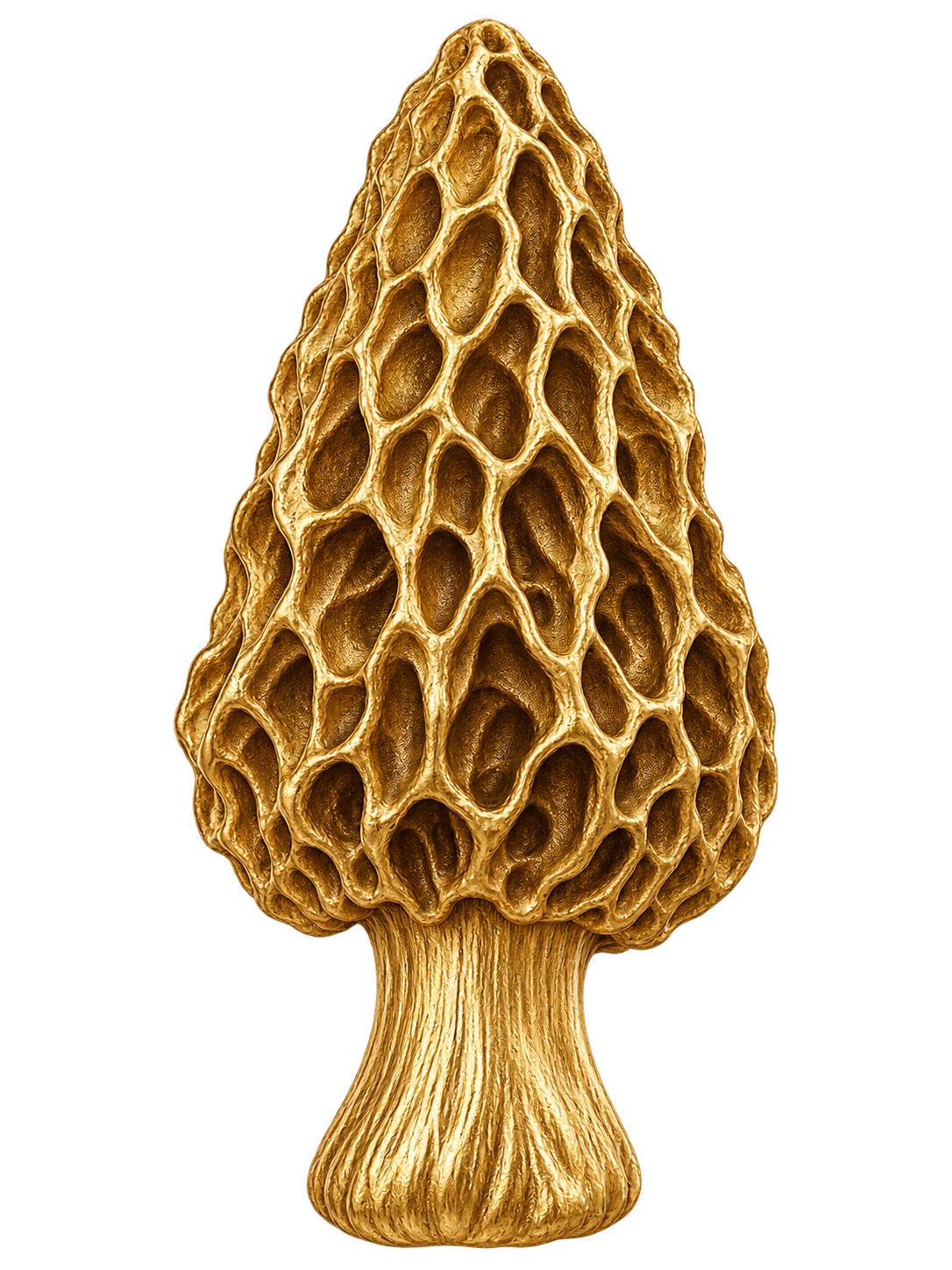
Edible
Requires preparation
Set your location to see data for your region.


Morchella steppicola, commonly known as the steppe morel, is a distinctive and robust morel adapted to open grassland environments. It features a dense, heavily convoluted, cerebriform cap with thick internal walls and a chambered, furrowed stem. Fruiting in early spring across arid Eurasian steppes and loess grasslands, it is celebrated for its dense, firm texture and remarkable drought tolerance.
Identification, habitat, and key differences.
Forager
Fruitbody structure
- Fruit body form
- Fruit body form: Cap, stipe.
- Fruitbody height
- Fruitbody height: 50–120 mm.
Cap
- Cap shape
- Cap shape: globose (nearly).
Cap shape: ovoid.
Cap shape: subconical.
Cap shape: bell-shaped. - Cap surface relief
- Cap surface relief: pitted.
- Cap colour
- Cap colour: brownish-grey.
Cap colour: yellowish-grey.
Cap colour: rusty-brown (on the ridges). - Cap colour reaction
- Cap colour reaction: reddish.
- Cap diameter
- The cap measures 20–90 mm in diameter.
- Cap height
- Cap height: 25–100 mm.
- Interior of head / cap
- Interior of head / cap: hollow (sterile, large).
- Branching of pit channels
- Branching of pit channels: branched.
- Qualitative depth of pit channels
- Qualitative depth of pit channels: deep.
- Appearance of pit channels in cross section
- Appearance of pit channels in cross section: apparently isolated chambers (in longitudinal section, sometimes).
- Qualitative width of pit channels
- Qualitative width of pit channels: narrow.
- Connections of head pits
- Connections of head pits: interconnected.
- Outline of head pits
- Outline of head pits: irregular.
- Cap ridge pattern
- Cap ridge pattern: labyrinthine.
- Spacing of cap ridges
- Spacing of cap ridges: densely packed.
- Qualitative thickness of cap ridges
- Qualitative thickness of cap ridges: thick.
- Attachment of head to stem
- Attachment of head to stem: lower margin fused to the stem.
Underside of the cap
- Hymenophore type
- Hymenophore type: pitted.
Stem and base
- Stipe shape
- Stipe shape: cylindrical.
- Stipe base
- Stipe base: swollen.
- Stipe colour
- Stipe colour: dingy whitish.
- Stipe surface relief
- at the stem base: Stipe surface relief: Ribbed.
Stipe surface relief: folded.
Stipe surface relief: with raised areas (numerous). - Cracking of the stem surface
- Cracking of the stem surface: cracked.
- Stipe interior
- in young fruit bodies: Stipe interior: solid.
in mature fruit bodies: Stipe interior: Chambered. - Stipe consistency
- in young fruit bodies: Stipe consistency: firm.
- Color of stem surface upon damage
- Color of stem surface upon damage: reddish (stipe surface).
- Stipe length
- Stipe length: 25–60 mm.
- Stipe diameter
- Stipe diameter: 15–60 mm.
- Stem robustness
- Stem robustness: stout.
Flesh
- Flesh odour
- Flesh odour: not distinctive (flesh).
- Distinctiveness of flesh taste
- Distinctiveness of flesh taste: indistinctive.
- Assessment of flesh taste pleasantness
- Assessment of flesh taste pleasantness: pleasant.
Where and when it grows
- Habitat
- Habitat: pasture.
Habitat: meadow.
Habitat: garden.
Habitat: roadside.
Habitat: former cultivated field. - Substrate
- Substrate: soil.
- Fruit body growth pattern
- Fruit body growth pattern: in groups or in rings.
- Occurrence frequency
- Fruiting season
- Nie potwierdzono występowania w Polsce.
- Distribution area
- Distribution area: occurrence unconfirmed.
Edibility and culinary use
- Edibility
- Edible
- Required preparation
- Requires preparation
- Culinary rating
- Very tasty
Law
- Protection
- It is not subject to species protection in Poland.
- Trade
- It is approved in Poland for neither trade nor the production of mushroom products.
FAQ
Can Morchella steppicola be consumed raw?
No, it contains heat-sensitive toxins that cause digestive illness unless thoroughly cooked.
What culinary qualities distinguish Morchella steppicola?
It has a remarkably dense, meaty texture that stays firm when heated, paired with a savory flavor.
Where does this species naturally occur?
It occurs in open steppes and loess meadows across Ukraine, southern Russia, and Central Asia.
What types of soil does Morchella steppicola prefer?
It thrives on alkaline, calcareous, and rich chernozem soils in uncultivated grassland biomes.
When does the fruiting season occur?
The brief fruiting window occurs in early to mid-spring, from late March through early May.
Does this morel require forest trees to fruit?
No, it flourishes in treeless grasslands, occasionally near thorny shrubs like Spiraea.
What historical significance did it hold in steppe culture?
It was celebrated in rural folklore as a seasonal herald of spring and pasture renewal.
Was this mushroom used in traditional folk customs?
Yes, dried specimens were hung as domestic talismans representing prosperity and abundance.
How was it used in traditional beekeeping?
Dried fragments were burned in smoke pots to generate gentle, fragrant smoke for calming bees.
Why is it featured in grassland conservation programs?
It serves as a flagship species for the preservation of fragile virgin steppe ecosystems.
Enthusiast
Names and history
- Obowiązująca nazwa taksonomiczna
- Morchella steppicola
- Pozostałe nazwy
- Blistered Morel, Steppe Morel
Home observations
Under the microscope
- Required materials
- light microscope, microscope slide and cover slip, needle, water, spores from print
- Procedure
- Transfer a small amount of the spore print onto the slide using a needle.
- Add a drop of water, cover with a cover slip, and examine the spores.
What to look for
- Spore shape
- Spore shape: ellipsoid. Spore shape: ellipsoid.
- Spore surface
- Spore surface: smooth. Spore surface: smooth.
- Spore dimensions
- Length 18–29 µm, width 10–16.5 µm.
Compare dimensions after calibrating the microscope scale.
Ecology and distribution
- Soil texture
- Soil texture: clayey.
Soil texture: sandy.
Soil texture: silty. - Shrubs in the vicinity
- Shrubs in the vicinity: Caragana frutex.
Shrubs in the vicinity: Chamaecytisus. - Nearby ground-layer plants
- Nearby ground-layer plants: Tanacetum vulgare.
Nearby ground-layer plants: Cichorium intybus.
Nearby ground-layer plants: Eryngium campestre.
Nearby ground-layer plants: Ranunculus illyricus.
Nearby ground-layer plants: Galatella villosa.
Nearby ground-layer plants: Cerastium.
Nearby ground-layer plants: Poaceae. - Mode of nutrition
- Mode of nutrition: saprotrophic.
Non-culinary uses
Beyond culinary consumption, Morchella steppicola has documented ethnobotanical and non-culinary applications in steppe communities. Traditionally, whole dried specimens were threaded onto strings and hung in steppe homes as seasonal talismans believed to symbolize agricultural abundance and fertility for the coming harvest season. In traditional rural beekeeping and pastoral practices, dried fragments were historically placed in smoke pots to produce a mild, fragrant grassland smoke used to calm honeybees and scent livestock enclosures. Additionally, the species is utilized in academic conservation exhibits and botanical teaching collections as a flagship indicator species for preserving unplowed steppe ecosystems.
History and culture
In traditional steppe cultures of Eastern Europe and Central Asia, Morchella steppicola carries longstanding cultural reverence as an unmistakable herald of spring. In historical Cossack settlements and rural agricultural communities along the Black Sea and Volga steppes, its brief emergence coincided with the awakening of pasture lands, celebrated in seasonal folklore and vernacular spring rhymes. Unlike woodland morels associated with deep forests, this species holds a distinct cultural identity as the wild bounty of the open horizon. It was extensively documented in twentieth-century regional Soviet botanical literature as a unique steppe-dwelling curiosity, holding commemorative value in local regional natural history museums.
Edibility and safety
Morchella steppicola is a prized and highly sought-after edible mushroom throughout its native steppe range. However, it contains heat-sensitive gastrointestinal toxins typical of the morel genus and cannot be safely consumed raw. Safe consumption requires rigorous heat treatment, such as parboiling followed by frying or thorough roasting, which completely destroys the thermolabile irritants. In rural regions of Ukraine, southern Russia, and Kazakhstan, it is regarded as a premier spring delicacy, celebrated for its dense, meaty, firm texture that does not shrink significantly during cooking, and its deeply savory, earthy, and aromatic flavor profile.
Habitat and occurrence
Morchella steppicola is endemic to the temperate grassland and steppe biomes of Eurasia. Its geographic distribution encompasses the Pontic-Caspian steppe, extending across southern Ukraine, the Don and Volga river basins of Russia, northern and central Kazakhstan, and disjunct populations in the Anatolian steppe of Turkey and eastern Hungary. The species inhabits virgin feather grass and fescue steppes, dry loess meadows, grazing pastures, and shrubby steppe ravines. It develops on calcareous, alkaline, and chernozem soils, often without direct tree associations, though sometimes fruiting near thorny steppe shrubs such as Spiraea and Caragana. Its fruiting season is exceptionally brief, concentrated in early to mid-spring from late March to early May, immediately following winter snowmelt before high summer temperatures and arid conditions set in.
Sources
- Red Data Book of Ukraine — Morchella steppicola Zerova
- sha256:1599e8e9fe6d7d65278b41def2b3c8517150b0a1b6d5f7fcf8f2ddcf76d006b4
- Smardz stepowy — źródłowe badanie mikroskopowe, morchella_steppicola.w10.yatsiuk 2016
Researcher
Edibility and culinary use
Ustalenia źródłowe: jadalność, spożycie i wykorzystanie
- Edibility
- Edible — źródło oznaczenia
Źródło bez opisu bibliograficznego · Yatsiuk et al.2016, Phytotaxa284, Taxonomic treatment pp35–36: source explicitly assesses M.steppicola as edible/choice; no preparation parameters inferred
- Culinary rating
- Very tasty
Źródło bez opisu bibliograficznego · Print p. 35: Edible, choice. Culinary evaluation of the authors, without clinical proof of safety.
- Required preparation
- Requires preparation
Tox Info Suisse / VAPKO — informacja o przygotowaniu smardzów, czerwiec 2026 · PDF, pp. 1–2: the recommendation for thorough heat treatment applies to all morels, including dried and frozen.
Scientific names and taxonomy
- Current scientific name
Morchella steppicola
Scientific names and taxonomy
The steppe morel was introduced into mycological literature in 1941 by Zerova under the name Morchella steppicola Zerova in a journal cited in the registry as Bot. Zh., Kyyiv 2(1): 155. The taxonomic registry Index Fungorum (Record ID 334468) confirms the current status of this name at the species rank within the family Morchellaceae (morels, Pezizales), indicating Ukraine as the place of origin of the original material.
Taxon scope and identification limitations
Phylogenetic analysis of DNA sequences demonstrated that this species represents an early-diverging lineage (early-diverging lineage) within the Esculenta clade of the genus Morchella.
Ecology and distribution
- Occurrence frequency
- Slovakia: Occurrence frequency: rare. [8]
Laboratory diagnostics
Dane ustrukturyzowane
Asci
- Number of spores in the ascus
- Number of spores in the ascus: 8. [6]
- Shape of the ascus apex
- Shape of the ascus apex: rounded. [6]
Shape of the ascus apex: slightly flattened. [6] - Branching of the ascus base
- Branching of the ascus base: forked. [6]
- Waviness of the ascus base
- Waviness of the ascus base: undulate. [6]
- Microscopic colour of ascus
- Microscopic colour of ascus: hyaline. [7]
- Total ascus length
- Total ascus length: 300–370 µm. [6]
- Presence of asci
- Presence of asci: present. [6] [7]
Presence of asci: present. [6] [7]
Presence of asci: present. [6] [7]
Presence of asci: present. [6] [7]
Presence of asci: present. [6] [7]
Presence of asci: present. [6] [7]
Presence of asci: present. [6] [7] - Ascus shape
- Ascus shape: cylindrical. [6]
- Length of the sporiferous part of the ascus
- Length of the sporiferous part of the ascus: 120–160 µm. [7]
- Ascus width
- Ascus width: 19–26 µm. [6]
Remaining laboratory characters
- Length of sterile side hairs
- Length of sterile side hairs: 70–115 µm. [6]
- Shape of the entire sterile side hair
- Shape of the entire sterile side hair: cylindrical. [6]
Shape of the entire sterile side hair: flask-shaped. [6]
Shape of the entire sterile side hair: ampulla-shaped. [6] - Width of sterile side hairs
- Width of sterile side hairs: 13–25 µm. [6]
- Paraphysis branching
- Paraphysis branching: branched. [22]
- Microscopic colour of the paraphysis
- Microscopic colour of the paraphysis: hyaline. [6]
Microscopic colour of the paraphysis: hyaline. [22] - Paraphysis swelling
- Paraphysis swelling: swollen. [6]
Spores
- Arrangement of spores in the ascus
- Arrangement of spores in the ascus: in one row. [7]
- Spore colour under the microscope
- Spore colour under the microscope: hyaline. [7]
Spore colour under the microscope: hyaline. [22] - Spore contents
- Spore contents: granulose. [6]
- Droplets inside the spore
- Droplets inside the spore: present. [7]
- Form of spore ornamentation
- Form of spore ornamentation: striate. [6]
- Direction of spore ornamentation
- Direction of spore ornamentation: longitudinal. [6]
- Spore length-to-width ratio
- Spore length-to-width ratio: 1.4–2.1. [7]
Material and research methods
Pure mycelial culture
- Colony texture
- Colony texture: woolly. [28]
- Colony density
- Colony density: dense. [28]
- Presence of microsclerotia
- Presence of microsclerotia: present (usually). [28]
- Arrangement of microsclerotia
- Arrangement of microsclerotia: solitary. [28]
- Relative abundance of microsclerotia
- Relative abundance of microsclerotia: higher abundance. [28]
- Conidiation type
- Conidiation type: Costantinella terrestris. [28]
- Structure of culture hyphae
- Structure of culture hyphae: with lacunae and atypical. [28]
- Anastomoses of culture hyphae
- Anastomoses of culture hyphae: present. [28]
Composition and activity study — material and limitations
Material: Morchella steppicola and examined extracts.
Scope of reading: Abstract.
Limitations: Full tables, concentrations, full extraction protocol, and sample sizes were not reviewed. Laboratory activity does not prove treatment in humans.
Hairs of the sterile stipe surface
Material: The description refers to hairs on the sterile surface of the stipe of the steppe morel. Specimen CWU-D208 is associated with the documentation of this feature. The dimension range given in the publication is part of the species description; it was not presented as the result of a new series of measurements performed exclusively on this specimen.
Method: Published microscopic observations and measurements of hair length and width are cited. The description of the hairs does not separately specify the mount medium, magnification, or number of measured hairs.
Scope of interpretation: The number 20 given in the publication refers to spore measurements; it does not indicate the number of examined hairs. Preparation and evaluation parameters for spores were not attributed to the hairs in the description. The hairs were described as hairs of the sterile surface of the stipe, without designating them as caulocystidia.
- Results as recorded in the sources — Paraphysis width
- 6–9 µm [22]
9–11 µm [6]
Materiał badania: Source fresh paraphyses; not merged with dried spore measurements. do 15 µm [6]
Metody i zapisy źródłowe — Source-described microscopic hairs on stipe surface, Fig4a CWU-D208; no caulocystidium or sampleN inference.
Kształt całego włoska strony płonnej — zapis źródłowy: „Yatsiuk taxonomic treatment and Fig4 / hair.shape.cylindrical” [6]
Kształt całego włoska strony płonnej — zapis źródłowy: „Yatsiuk taxonomic treatment and Fig4 / hair.shape.lageniform” [6]
Kształt całego włoska strony płonnej — zapis źródłowy: „Yatsiuk taxonomic treatment and Fig4 / hair.shape.ampulliform” [6]
Metody i zapisy źródłowe — Własny materiał z południowo-wschodniej części wsi Hasakça, prowincja Çankırı, Turcja, z 6 i 14 kwietnia 2024 r. Autorzy podają około 948 m n.p.m. Okazy opisano makro- i mikroskopowo; brak identyfikatora zielnikowego i liczebności pomiarów. Materiał był suszony, lecz nie przypisano wprost każdemu pomiarowi stopnia uwodnienia preparatu. Nie przyjęto, że wszystkie wyniki pochodzą z jednego owocnika.
Metoda źródłowa. Technika: mikroskopia świetlna (LM). Opis metody w źródle: Druk s. 360–362: mikroskopia świetlna Leica DM500; ryc. 5–6 dokumentują worki, zarodniki i wstawki. Źródło nie przypisuje indywidualnym wynikom odczynnika, medium i liczby pomiarów. Osobne obrazy FE-SEM nie są wynikiem mikroskopii świetlnej.
Rozgałęzienie wstawki — zapis źródłowy: „Keçeli i in. 2025, druk s. 361: paraphyses ... branched at the tip.” [22]
Barwa mikroskopowa wstawki; Przegrody wstawki; Kształt wstawki; Barwa zarodnika w mikroskopie; Kształt zarodnika; Powierzchnia zarodnika — zapis źródłowy: „Druk s. 361, Spores/Paraphyses: ellipsoidal, hyaline, smooth spores; cylindrical, hyaline, septate paraphyses. Każdy wynik dotyczy własnego narządu.” [22]
Długość wstawki; Szerokość wstawki; Długość zarodnika; Szerokość zarodnika — zapis źródłowy: „Druk s. 361: spores 18–24 × 10–14 µm; paraphyses 120–200 × 6–9 µm. Wynik i narząd wskazane oddzielnie, bez wyliczania Q ze skrajnych osi.” [22]
Metody i zapisy źródłowe — Source fresh paraphyses; not merged with dried spore measurements.
Barwa mikroskopowa wstawki; Nabrzmienie wstawki; Szerokość wstawki — zapis źródłowy: „Yatsiuk pp35–36: fresh paraphyses hyaline, apices swollen up to15 µm” [6]
Długość wstawki — zapis źródłowy: „paraphysis_length: 200–220 µm.” [6]
Przegrody wstawki; Kształt wstawki — zapis źródłowy: „Parafizy maczugowate, bezbarwne, septowane, ze zgrubiałymi szczytami.” [6]
Szerokość wstawki — zapis źródłowy: „Parafizy 9–11 µm szerokości; szczyty rozdęte do 15 µm.” [6]
Metody i zapisy źródłowe — Source-reported dried specimens; no identified fresh collection inferred.
Barwa zarodnika w mikroskopie — zapis źródłowy: „Yatsiuk: zarodniki bezbarwne; nie jest to opis wysypu.” [7]
Iloraz długości i szerokości zarodnika — zapis źródłowy: „Yatsiuk: Q=(1,4)1,5–1,8(2,1), z pomiarów zarodników w materiale suchym.” [7]
Metody i zapisy źródłowe — Source-reported young spores, not young fruitbodies.
Zawartość zarodnika — zapis źródłowy: „Młode zarodniki z ziarnistą zawartością; nie przenosić automatycznie do dojrzałych.” [6]
Metody i zapisy źródłowe — Zarodniki z materiału CWU-D0208 opisanego w podpisie ryc. 4d jako świeżo zebrany. Nie utożsamiono tego materiału z suchymi okazami użytymi do zakresów wielkości zarodników.
Identyfikacja kropli: nierozstrzygnięta.
Metoda źródłowa. Technika: mikroskopia świetlna (LM). Opis metody w źródle: Ry c. 4d, druk s. 37: zdjęcie zarodników z kroplami w mikroskopii świetlnej. Nie określono składu chemicznego kropli ani ich liczby; nie są automatycznie lipidami.
Krople wewnątrz zarodnika — zapis źródłowy: „Podpis ryc. 4d, druk s. 37: Freshly collected ascospores with guttules (CWU-D208).” [7]
Metody i zapisy źródłowe — Source-reported dried specimens; no identified fresh collection inferred.
Długość zarodnika — zapis źródłowy: „Zarodniki z suchych okazów zwykle 18–24 µm, skrajne do 29 µm.” [6]
Kształt zarodnika — zapis źródłowy: „Zarodniki elipsoidalne, bezbarwne.” [6]
Szerokość zarodnika — zapis źródłowy: „Zarodniki zwykle 11.5–14 µm, skrajne 10 i 16.5 µm.” [6]
Metody i zapisy źródłowe — Mature epitype ascospores CWU-D0208: air dried on a1cm² glass slide and gold-palladium coated; this SEM preparation is not fresh light microscopy.
Metoda źródłowa. Technika: skaningowa mikroskopia elektronowa (SEM). Opis metody w źródle: JEOL6400V, source preparation air drying and gold-palladium coating; no unreported magnification.
Forma ornamentacji zarodnika — zapis źródłowy: „Yatsiuk taxonomic treatment and Fig4 / sem.striate” [6]
Kierunek ornamentacji zarodnika — zapis źródłowy: „Yatsiuk taxonomic treatment and Fig4 / sem.longitudinal” [6]
Powierzchnia zarodnika — zapis źródłowy: „Yatsiuk taxonomic treatment and Fig4 / sem.ornamented” [6]
Metody i zapisy źródłowe — Source light-microscopy appearance, not interchangeable with SEM.
Metoda źródłowa. Technika: mikroskopia świetlna (LM).
Powierzchnia zarodnika — zapis źródłowy: „Gładkie w mikroskopii optycznej.” [6]
Names and identity of the studied species
Name basis: The current scientific name is Morchella steppicola Zerova. The work of Yatsiuk et al. from 2016 designates a lectotype from the original illustration and an epitype CWU-D 0208 from Ukraine, with isoepitype TAAM204905. The authors combine morphological data and sequences; they consider the earlier holotype as probably lost. The examined transcription of the diagnosis from 1941 remains an indirect access to the original.
Common names: GBIF documents Polish “Smardz stepowy”, German “Steppen-Morchel”, and other language names, citing Catalogue of Life as the source. This confirms name usage, but does not constitute a decision by the Polish naming committee. In the verified KPNG recommendation 6/2025, this species was not found. The record “morchella stepowa” was not confirmed as a Polish species name; a record of the check was preserved without promoting it to a confirmed alternative. The language of the entry does not establish the country of use.
Local names vs. synonyms: Yatsiuk et al. report the regional “pozharka” in the Luhansk and Donetsk regions, associated with steppe burning. This name is a folk usage, not a scientific synonym. Historical designation of a specimen as M. crassipes does not thereby become a synonym of the whole species. M. palazonii was not included as a synonym: molecular study separates these names and lineages.
Epitype description — material, measurements, and microscopy
Material and method: The description from 2016 includes the epitype and additional collections from central Eurasia. Individual results pertain to fresh or dried material; the entire set was not assigned to a single specimen. Light microscopy and SEM remain separate methods. The full earlier Polish description of hair examination and its documentation have been preserved.
Spore dimensions: In dried specimens, length was described as 18–24, extreme up to 29 µm, and width as 11,5–14, extreme 10–16,5 µm. The summary of dimensions thus encompasses 18–29 × 10–16,5 µm, retaining all original limits in the source results. The source Q is (1,4–)1,5–1,8(–2,1), and mean Q is 1,7; it was not calculated from the quotient of independent extreme axes.
Separation of structures: Fresh asci are 300–370 × 19–23(–26) µm, with a spore-bearing part 120–160 µm long. Fresh paraphyses are 200–220 × 9–11 µm, with apices swollen up to 15 µm. Stipe surface hairs are 70–115 × 13–25 µm; cylindrical, lageniform, and ampullaceous shape does not indicate three successive phases.
Visibility of characters: Spores are smooth in the light microscopy description. In mature cells, SEM reveals longitudinal striation. Granular contents pertain to immature spores, and the caption of the fresh spore photograph confirms droplets of undetermined composition. Cell maturity was not equated with fruit body age, nor droplets with identified fat.
Material from Turkey — additional features and discrepancies
Scope of own observations: Keçeli, Allı, and Gül studied specimens collected on 6 and 14 April 2024 near Hasakça in Çankırı province. They described caps 2,5–6 cm high and 2–8 cm wide, and stipes 2,5–4 × 1,5–3 cm. The stipe is solid when young, later developing hollow spaces; the surface has cracks and folds. A pleasant taste and reddish discoloration of the cap and stipe upon touching or bruising were reported. No numerical timeframe for this reaction is given.
Microscopy: The source reports spores 18–24 × 10–14 µm and paraphyses 120–200 × 6–9 µm, cylindrical, hyaline, and septate. Branching was described near the apex of paraphyses; the exact location was preserved in documentation. Material was examined stereoscopically, under light microscopy, and FE-SEM. Electron microscopy images were not used to describe the surface under a light microscope.
Result requiring clarification: The published dimensions of asci are 240–380 × 5–14 µm. The lower end of their width range is smaller than the width of the described spores. It was not determined whether this refers to the ascus base, a typographical error, or another measurement issue. Exact numbers were retained, but were not combined with the dimension summary from the epitype work. The text also swaps the names of class and order; this was not transferred to the record's taxonomy.
Citation path and assessment of independence
Composition and medicinal potential: The field work of Keçeli and co-authors refers regarding composition and health potential to Sarikurkcu and co-authors (2022). The abstract of the original study was accessed; the full material and tables remain unverified. The Turkish mention and the abstract do not constitute two independent experiments. The extract activity result was not extended to confirmed medicinal activity.
Own results versus review: Slovak locality measurements are Kunca's own data. This work's mention of edibility refers, among others, to Yatsiuk and co-authors; it does not replace own toxicological experience. Badalyan and co-authors in 2023 studied other morel species; the mention of M. steppicola in the literature background is not a result of their test on this species.
Occurrence verification — scope and limitations
Material: Dostępne publikacje i rekordy występowania Morchella steppicola dla Polski.
Reading scope: Source excerpts.
A source excerpt was read; the full text and methods were not verified.
Review date: 18.10.2026.
Limitations: No confirmed Polish locality was found in the checked material. A zero GBIF count does not prove biological absence. A Polish-language description or spawn offer is not a Polish record.
Pure mycelium culture — material and limitations
Material: Pure mycelial culture Morchella steppicola, entry 73 of the culture atlas. This is not a description of a fruit body.
Scope of reading: Full text.
Limitations: The full strain number and parameters of all cultures were not provided in this entry. Substrate conditions and colony side were distinguished.
Pure mycelium culture — protocol of results
Culture conditions: According to the description of the material. Results under these conditions:
p. 78: cream or light brown — first alternative.
p. 78: cream or light brown — second alternative with separate lightness.
p. 78: reverse is brown.
Culture conditions: On agar media. Results under these conditions:
Usually microsclerotia are formed.
Microsclerotia occur singly.
Culture conditions: On PDA medium. Results under these conditions:
Microsclerotia occur more abundantly.
Scope of elaboration
Required checks are settled.
Legal basis and scope of assessment
Analytical results
Composition and laboratory activity
- Detected phenolic compounds
- Detected phenolic compounds: gallic acid, protocatechuic acid, 4-hydroxybenzoic acid and vanillic acid. [28]
Edibility — consumption, authors' assessments, and composition study
Evidence of culinary practice: An ethnomycological study from Uzbekistan included interviews with 60 individuals aged 40–70 years in the years 2022–2023, with field visits and identification checks. In the description of M. steppicola, harvesting and consumption in the Jizzakh region were documented: frying in oil with onion, sometimes potatoes. This is primary evidence of local practice, not a controlled food safety study. The somsa recipe from an adjacent section concerns the king oyster mushroom and was not transferred to the morel.
Edibility evaluation: The paper on the epitype classifies the species as edible with high culinary value. A note on drying and fruit bodies up to 2 kg refers to Vasilkov from 1955; the original of this book was not examined in this review. This part of the chain is not an independently verified measurement. Poisoning reports from other morels were not attributed to M. steppicola.
Metals and limitation of evidence: Sarikurkcu et al. studied the composition and activity of M. steppicola material. The available abstract reports iron, cobalt, and calculated risk indices, on the basis of which the authors suggest occasional consumption. Full tables, the origin of all samples, and data allowing determination of a serving size were not obtained. Therefore, no universal safe quantity or poisoning diagnosis was entered.
Applications and studies of non-culinary potential
Mycelial cultures: Király and Czövek studied pseudosclerotia formation in cultures of M. steppicola; they describe strains Mst 1–Mst 3 and the relationships between oxidative stress, trehalose, and resting structures. The abstract and part of the methods of the author's copy were reviewed. This is not evidence of reliable fruit body cultivation or implemented therapy.
Technical extraction: The original conference abstract by Krivošija et al. from 2023 describes supercritical CO₂ extraction and GC-MS analysis of M. steppicola material and Macrolepiota procera. It confirms the research direction on recovering the lipid fraction. The combined list of dominant acids from both mushrooms was not attributed entirely to the steppe morel; the abstract does not document commercial implementation.
Folk practice and patents: Uzbek interviews record beliefs about health benefits, but do not provide proven treatment or a specific herbal preparation for this species. In WO2020232347A1, M. steppicola appears in the list of optional species. The patent list alone does not prove that an experiment was performed with this species, product efficacy, or implementation. In the conducted review, no distinct dyeing or spice application was confirmed.
Key substances and their effects
Key substances and their effects
In in vitro biological activity assays, statistical analysis linked primarily 4-hydroxybenzoic acid and vanillic acid to the antioxidant activity of extracts and the inhibition of enzymes: alpha-amylase (involved in carbohydrate breakdown) and tyrosinase (involved in melanin synthesis). The therapeutic potential indicated by the authors of the publication represents their own interpretation of enzymatic assay results at the in vitro laboratory level. The abstract of the publication contains no clinical trials or evidence of medicinal effects in humans.
Ecological studies
Ecology — own measurements versus species preferences
Slovakia: Kunca collected data on 30 localities from the years 2014–2025. For 26 localities, pH was measured at 6,6–7,75, on average 7,25; soil was sampled from a depth of approximately 5–20 cm. Localities were situated at an elevation of 97–326 m a.s.l., mainly in pastures and dry grasslands, also in human-transformed sites. Geological substrate was evaluated in 28 cases, and different land-use methods in 37 evaluations. These denominators do not indicate 37 independent localities.
Soil from Hasakça: The Turkish study reported 59% clay fraction, 23% sand, and 18% silt, pH 7,55, CaCO₃ 32,25%, organic matter 4,65%, EC 0,083 dS/m, total salt 0,04%, and nitrogen 0,23%. Samples came from a depth of 0–30 cm; soil texture was determined hydrometrically, pH in a 1:5 soil:water mixture, and organic matter by the modified Walkley–Black method. Fraction percentages co-occur in a single soil and are not three alternative preferences.
Limits of data transferability: The results of these studies apply to the specified foreign localities. They do not establish a Polish season, Polish occurrence frequency, or universal preference of the entire species. The Slovak study indicates that clay soils were not dominant in its sample. Co-occurrence of field eryngo or shrubs does not prove mycorrhiza; the nutritional mode of the species still requires separate evidence.
Habitat and occurrence
Habitat, area and season
The occurrence of Morchella steppicola is associated with the steppe environment. In the work by Yatsiuk et al. (2016), this species was characterized as a taxon associated with temperate steppe grasslands of central Eurasia, documenting 13 herbarium collections originating from six countries of this area (this number refers to the aggregate research material from Eurasia, and not to localities in Poland).
Habitat, area and season
Detailed habitat parameters were provided by ecological studies by Kunca (Folia Oecologica 2026), conducted at 30 localities in Slovakia. At the studied Slovak localities, fruit bodies were recorded at elevations from 97 to 326 m a.s.l. Soil pH ranged from 6,6 to 7,75 (with a mean value of 7,25). The substrate consisted of soils developed mainly on loess or sandstones, within thermophilic pastures and dry steppe grasslands. The author identifies the cessation of livestock grazing and the encroachment of shrubs and trees on grasslands as significant threats to the persistence of these localities.
Potwierdzony zasięg występowania
Wszystkie obszary potwierdzone w zapisanych danych źródłowych.
| Kraj | Regiony i stanowiska | Fruiting | Sources |
|---|---|---|---|
| Slovakia | Nie ustalono regionów w zapisanych danych | III–IV |
|
| Ukraine | Nie ustalono regionów w zapisanych danych | IV–V |
|
| Uzbekistan | Nie ustalono regionów w zapisanych danych | IV–V |
|
Sources
- archive-morchella-steppicola-profile
- Independent Polish protection/trade verification, 2026-10-16
- Weryfikacja strukturalnych polskich wyników prawnych, 17.10.2026
- Polskie statusy prawne smardza stepowego — wnioski z pełnych wykazów, 17.10.2026
- sha256:1599e8e9fe6d7d65278b41def2b3c8517150b0a1b6d5f7fcf8f2ddcf76d006b4
- Smardz stepowy — źródłowe badanie mikroskopowe, morchella_steppicola.w10.yatsiuk 2016
- Kautmanová 2020, Spravodajca Slovenskej mykologickej spoločnosti 52 — Smrčok stepný
- src-eli-protection-2014
- src-eli-trade-2026
- Ascomycete.org. Morchella steppicola; transcription of Zerova 1941 diagnosis.
- Buchalo et al. (2009). Microstructures of Vegetative Mycelium of Macromycetes in Pure Cultures; entry 73 Morchella steppicola.
- Király I., Czövek P. (2007). Oxidative burst induced pseudosclerotium formation of Morchella steppicola Zerova on different malt agar media. Canadian Journal of Microbiology 53:975–982.
- Badalyan et al. (2023). Morphological observation and biomass formation in different edible medicinal Morchella collections. IJM 52:50–61. DOI 10.6092/issn.2531-7342/16112. Taxon exclusion check.
- Mustafaev I.M. i in. (2025). Exploring edible and medicinal mushrooms: Ethnomycological insights from Samarkand, Jizzakh and Kashkadarya regions of Uzbekistan. Plant Science Today.
- Krivošija S. i in. (2023). Supercritical extraction of wild edible mushrooms (Morchella steppicola and Macrolepiota procera) and their lipid composition. 1st European Green Conference, Book of Abstracts, s. 300; CROSBI 805141.
- GBIF: dokładne dopasowanie przyjętej nazwy Morchella steppicola, 18.10.2026.
- GBIF Backbone Taxonomy — vernacular names of Morchella steppicola
- GBIF, Morchella steppicola, Polska: wynik zapytania o stanowiska, 18.10.2026.
- GBIF Backbone Taxonomy — accepted Morchella steppicola, original publication
- GBIF, Morchella steppicola: kontrolny wynik światowy, 18.10.2026.
- Keçeli, Allı, Gül (2025). New provincial record and habitat characterization of the endangered Morel Morchella steppicola Zerova (Ascomycota) in Çankırı, Turkey.
- KPNG PTMyk — Rekomendacja 6/2025 polskich nazw grzybów.
- Smardz stepowy — aktualna weryfikacja prawa polskiego, 18.10.2026
- Du et al. (2020). Heterothallism and potential hybridization events inferred for twenty-two yellow morel species. IMA Fungus.
- WO2020232347A1 — patent publication; scope of optional Morchella species
- Sarikurkcu i in. 2022. Minerals, phenolics, and biological activity of wild edible mushroom, Morchella steppicola Zerova. PMID 35285371; DOI 10.1080/14786419.2022.2050910. Abstrakt autorów w PubMed.
- Smardz stepowy — rozdzielone źródłowe wyniki kultur, analizy składu i przeglądu występowania, 18.10.2026.