Fairy rings — why do mushrooms grow in circles?The mystery of rings in the grass: how underground mycelium expands and what truly shapes fairy rings
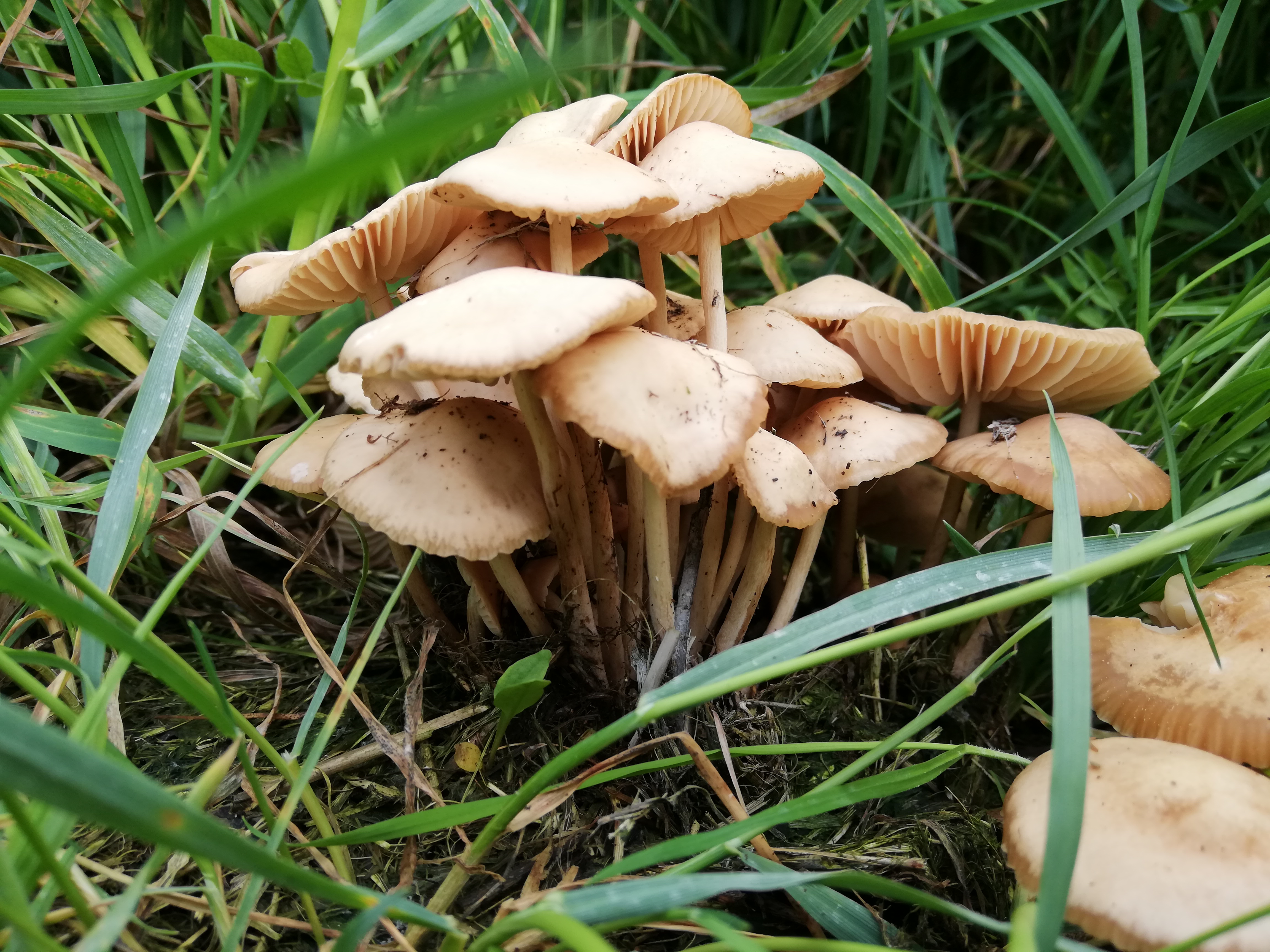
Table of contents
The sight of a regular ring of mushrooms in a meadow, woodland clearing, or domestic lawn has caught the eye and stirred human imagination for centuries. Ancient folklore attributed the formation of such patterns to supernatural phenomena — the nocturnal dances of woodland elves or witches, from which their traditional folk names arose. From a distance, the phenomenon looks curious, as the fruit bodies appear to grow along a deliberate circumference. In some instances, a band of darker grass or a zone of desiccated vegetation can also be seen in the turf, whilst in others the lawn reveals no visible changes whatsoever.
Modern mycology explains this phenomenon without resorting to magic, revealing natural biological processes occurring beneath the soil surface. What we observe above ground — mushroom caps emerging from the earth and any potential changes in the turf — is merely the outward manifestation of a far larger organism. The true structure lies concealed within the soil and litter layer. Understanding why fungi form circles or arcs in the wild requires looking beneath the surface to examine how the subterranean mycelium develops and functions in a variable environment.
What lies underground between the fruit bodies?
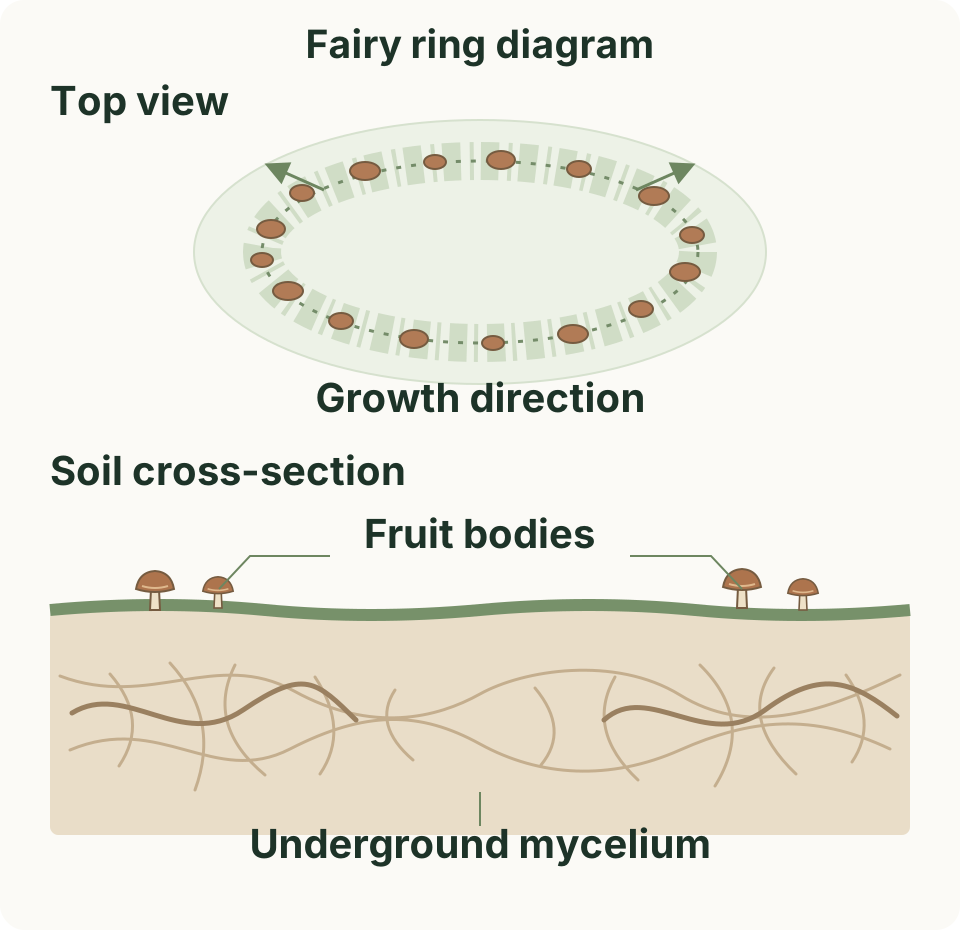
To understand the nature of a fairy ring, one must recognise that the fruit bodies visible on the surface are primarily reproductive structures, serving to produce and disperse spores. The main body of the fungal organism is the vegetative mycelium — an extensive network of microscopic, thread-like hyphae permeating the soil, leaf litter, and organic debris. In the case of basidiomycete fungi forming fruiting rings, the active mycelium is typically dikaryotic, formed following the earlier fusion of compatible hyphae. From this initial locus, the colony expands outwards, although the rate of this growth across different sections is subject to natural fluctuations.
As the colony extends its range, the active growth zone is generally concentrated in a narrow marginal band. Molecular studies conducted on rings of the fairy ring champignon have confirmed that the fungus's genetic material is distinctly concentrated near the active front, beneath the fruiting zone. The interior of the ring remains a subject of scientific discussion: researchers consider hypotheses regarding the gradual dieback of older hyphae in the centre, but the exact subterranean processes may vary depending on the species and habitat. This growth does not proceed continuously; rather, it pauses and resumes depending on moisture levels and the time of year.
Why is a complete circle visible sometimes, and only an arc at others?
Although the popular imagination holds the image of an ideal circle, incomplete formations are very frequently observed in the field: arcs, ring segments, wavy lines, or isolated clusters of fruit bodies. A closed, circular shape can form when substrate conditions allow the colony to expand relatively unhindered in all directions from the starting point. This is facilitated, amongst other factors, by adequate space and a more uniform distribution of moisture and nutrients in the soil.
In the natural environment, the substrate is rarely entirely uniform. Diverse environmental features — such as thick tree roots, boulders, compacted paths, or local variations in soil structure — can influence the mycelium's growth rate and modify its development locally. Importantly, the appearance of an arc rather than a complete circle does not necessarily signify a physical break in the underground mycelium. Sometimes the subterranean front remains continuous, yet microclimatic conditions, moisture, or sunlight exposure in a given season favour fruit body initiation along only one portion of the perimeter.
What causes the ring of darker or dying grass?
The presence of fairy rings in grasslands can become noticeable through the reactions of vegetation, although it is worth emphasising that many colonies cause no visible changes in turf colouration. Where modifications do occur, they take varied forms. Sometimes a band of lusher, dark green grass is observed; in other situations, a zone of weakened or withered plants appears; and occasionally both symptoms occur alongside each other in a concentric arrangement. These differences depend on the fungal species, substrate properties, and the prevailing water balance.
The zone of stimulated grass growth is usually linked to the breakdown of organic matter by fungal enzymes, which can release bioavailable nitrogen compounds into the root zone. Conversely, the dieback or desiccation of grass is in some instances explained by water stress, where densely interwoven hyphae impart hydrophobic properties to the soil, hindering the penetration of rainwater deeper into the soil profile. Scientific literature also investigates the potential effect of fungal metabolites on plants, though the significance and prevalence of individual mechanisms remain subjects of ongoing research.
Which species form fairy rings?
The formation of circular patterns is by no means restricted to a mere handful of organisms. Mycological literature describes over a hundred fungal taxa known to form fairy rings or arcs. These include both saprotrophic species, which decompose dead plant debris in turf or leaf litter, and fungi that form mycorrhizal associations with trees. In the case of the latter, the arrangement of fruit bodies in the woodland ground flora is often further modified by the distribution of the host trees' roots.
The dimensions of observed rings and the persistence of their fruiting display great diversity depending on the biology of the particular organism and the nature of the habitat. In grasslands and woodland clearings, formations of varying scales can be encountered, from modest clusters to wide rings spanning many metres. Within the diverse group of fungi displaying this trait, it is worth highlighting three distinct examples featured in scientific literature and educational materials on the subject.
- Fairy ring champignon (Marasmius oreades) — A small grassland mushroom with a tough, pliable stem and a pale buff cap, renowned for forming rings in lawns and pastures. Depending on turf conditions, it may produce a band of scorched grass, a zone of darker green, or cause no noticeable changes.
- Trooping funnel (Infundibulicybe geotropa) — A stately mushroom with a funnel-shaped cap featuring a small central umbo, found in woodland clearings, forest edges, and scrub. In mycological literature, it is cited as an example of a species that forms rings or arcs of fruit bodies across the forest floor.
- Horse mushroom (Agaricus arvensis) — A large terrestrial mushroom with a whitish cap and an aniseed scent, occurring in meadows and pastures. It represents a field-documented example of a species whose rings have been observed in open terrain alongside varied effects on soil and turf.
Does diameter indicate the age of a ring?
A popular notion surrounds fairy rings suggesting that a colony's age can be simply calculated by dividing the ring's radius by a constant annual growth rate. On this basis, earlier literature ascribed an age of many centuries to certain impressive rings. However, contemporary biological understanding indicates that the size visible on the surface is merely an approximate observation of where fruit bodies have emerged. It is neither a direct reflection of the underground mycelium's full extent nor a precise dating tool.
The annual rate of advancement of the mycelial front fluctuates considerably depending on environmental factors. Precipitation levels, periodic droughts, temperature variations, and soil differences mean that expansion may be pronounced in some seasons, whilst in others it slows substantially or halts temporarily. For this reason, assuming a constant growth rate is an oversimplification, and calculating age solely from the geometry of the visible ring carries a high degree of uncertainty.
Fairy rings demonstrate how subterranean fungal biology interacts with the surrounding environment to produce distinctive spatial patterns across the landscape. Although ancient legends looked to supernatural forces to explain them, the scientific explanation proves equally fascinating. Observing a ring or arc of fruit bodies in the field reveals the surface trace of an organism expanding through the soil during favourable periods, offering a reminder of the complexity and natural dynamism of biological processes.
Sources and literature
- University of Warsaw Botanic Garden — Fascinating fungi
- Royal Horticultural Society — Fairy rings in lawns
- University of Wisconsin-Madison Horticulture — Fairy Rings
- PMC13483757 — Research into the biology and colony structure of Marasmius oreades