Edible
Permitted for commercial sale
Set your location to see data for your region.
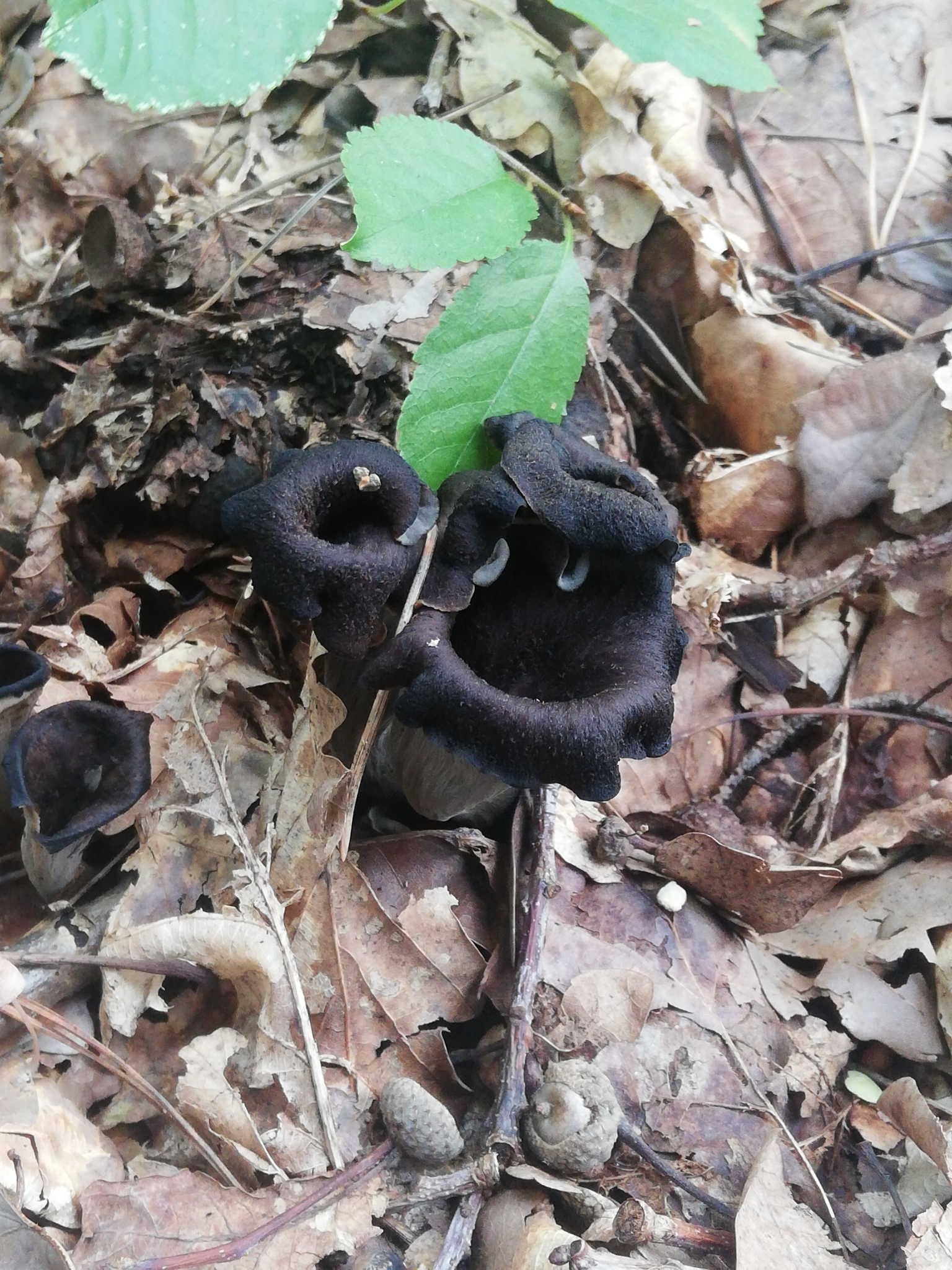
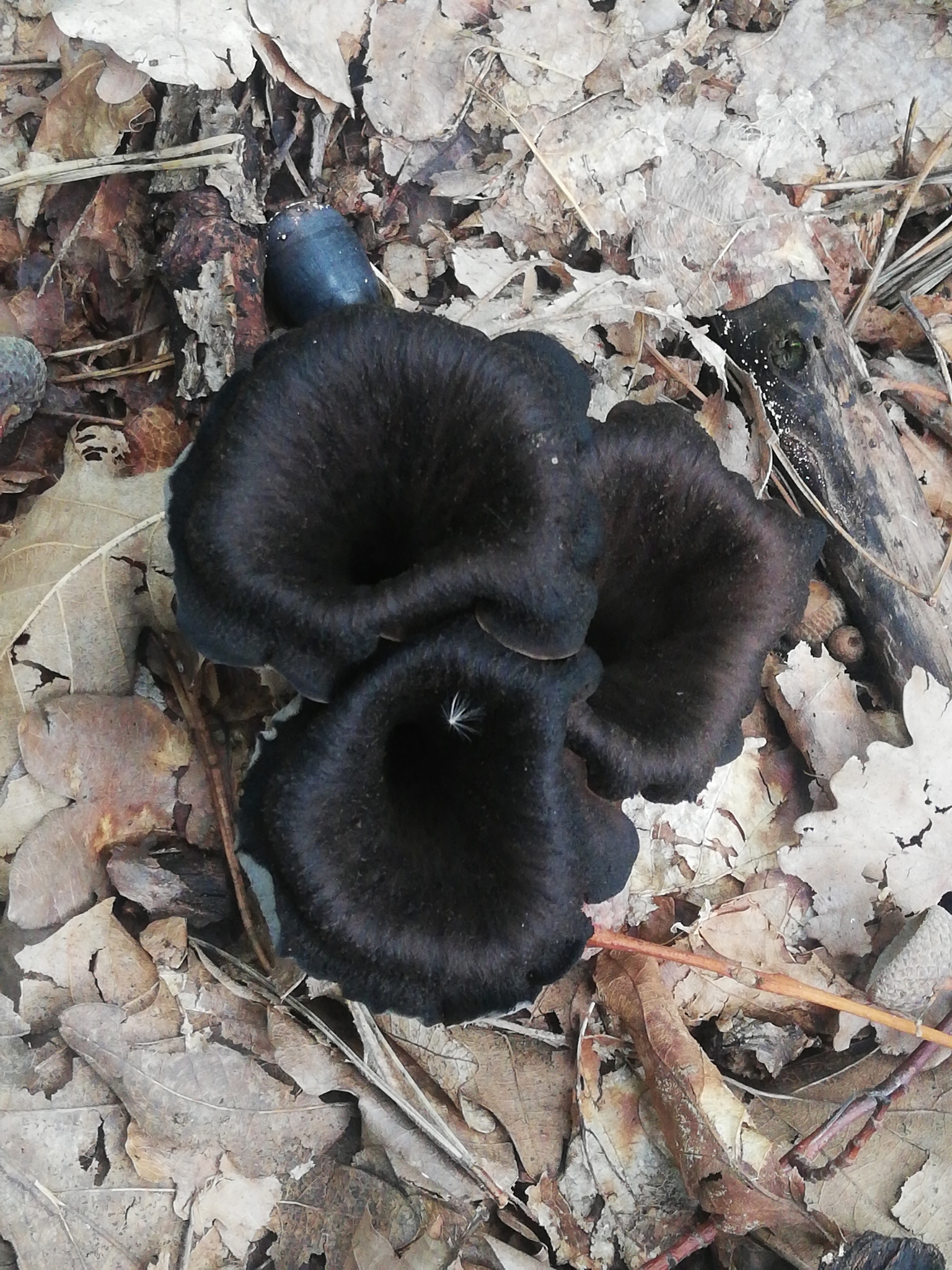
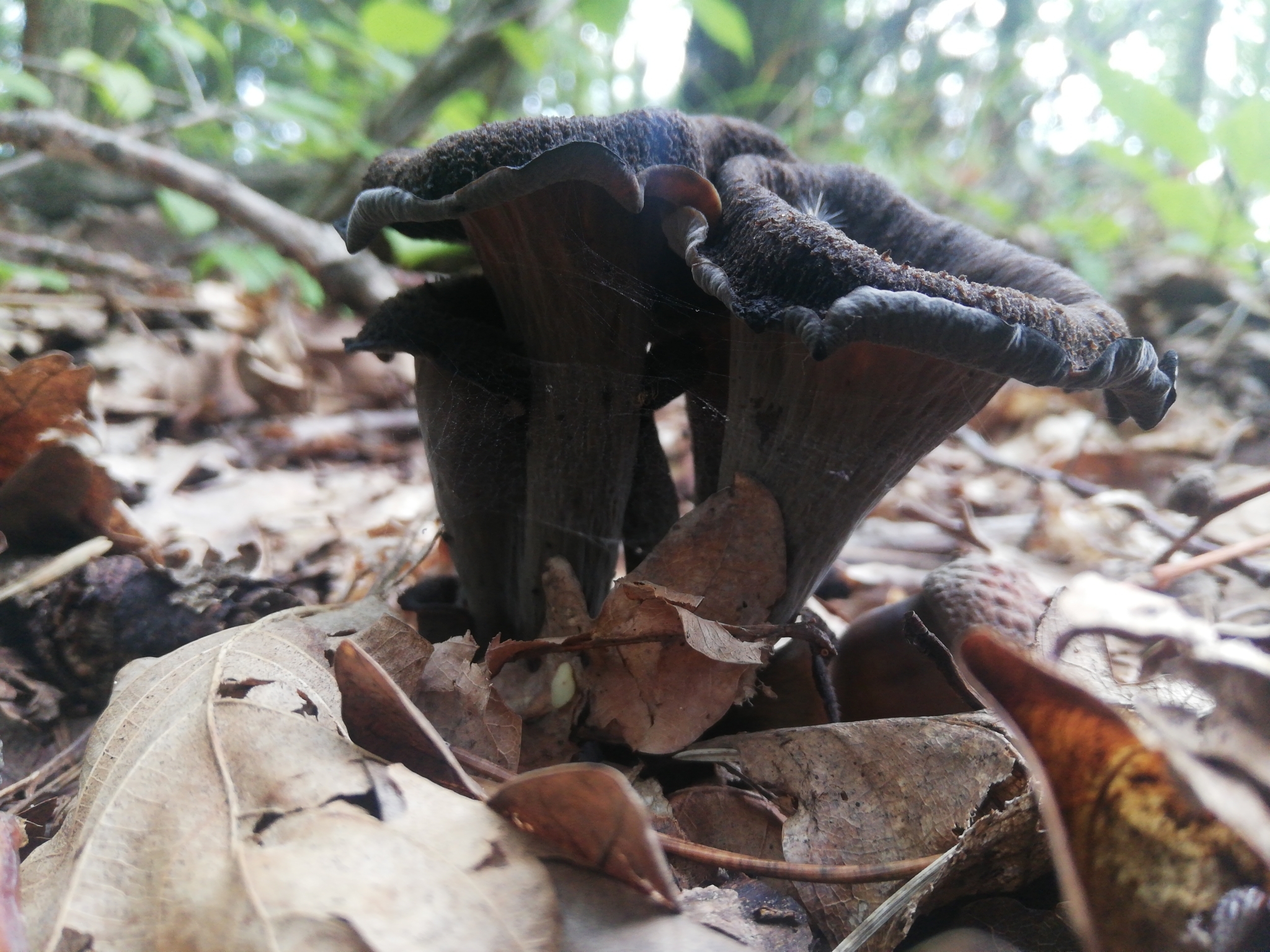
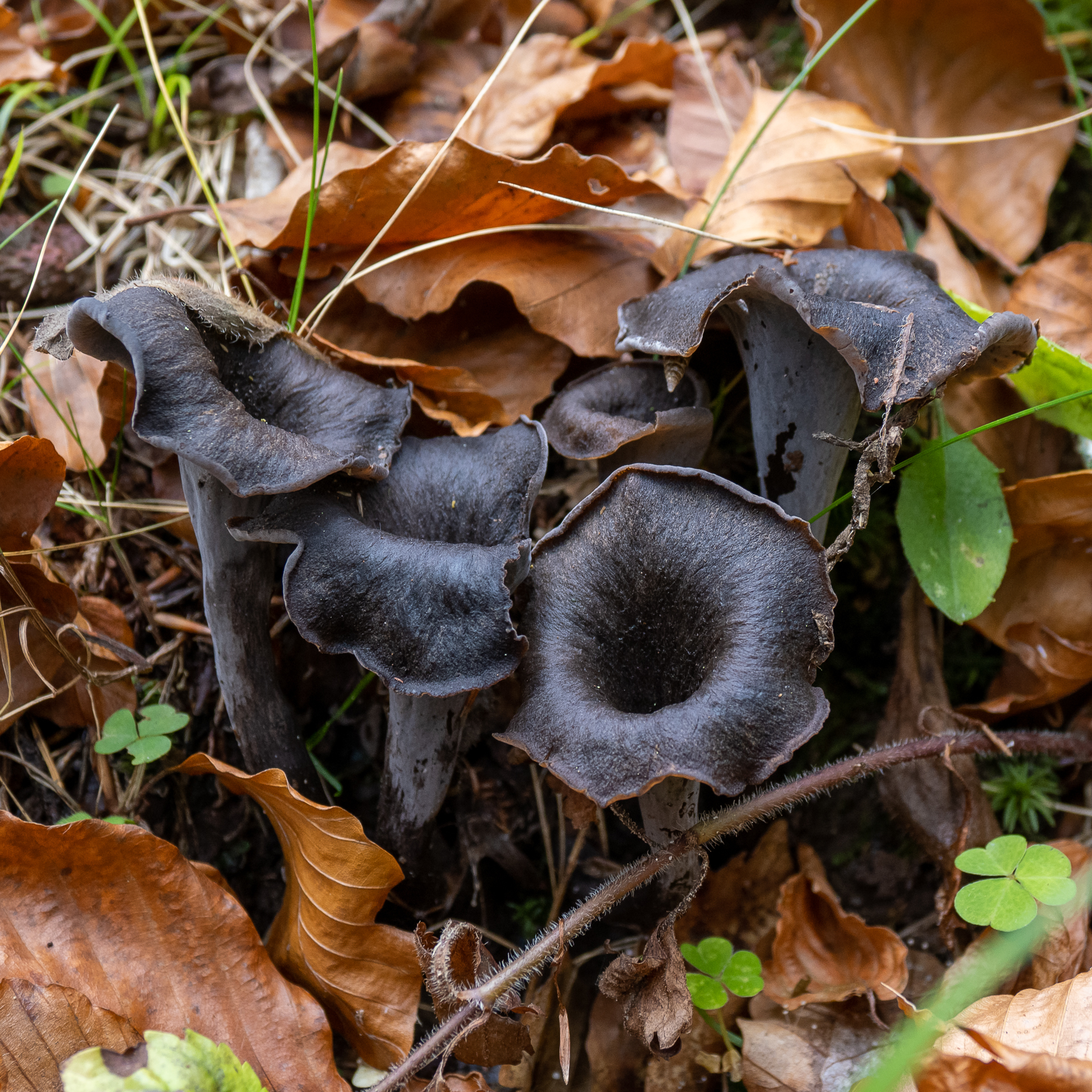
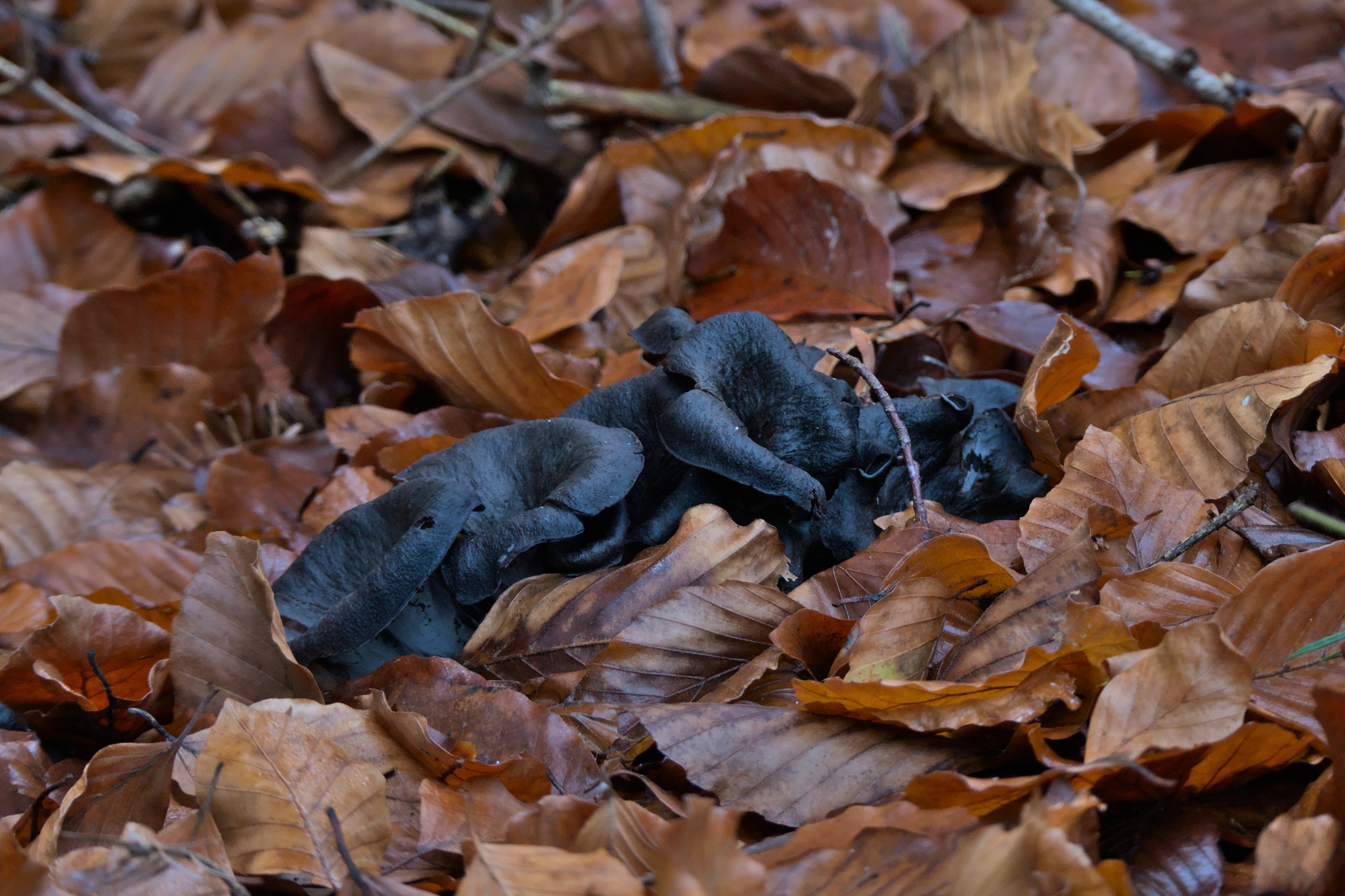
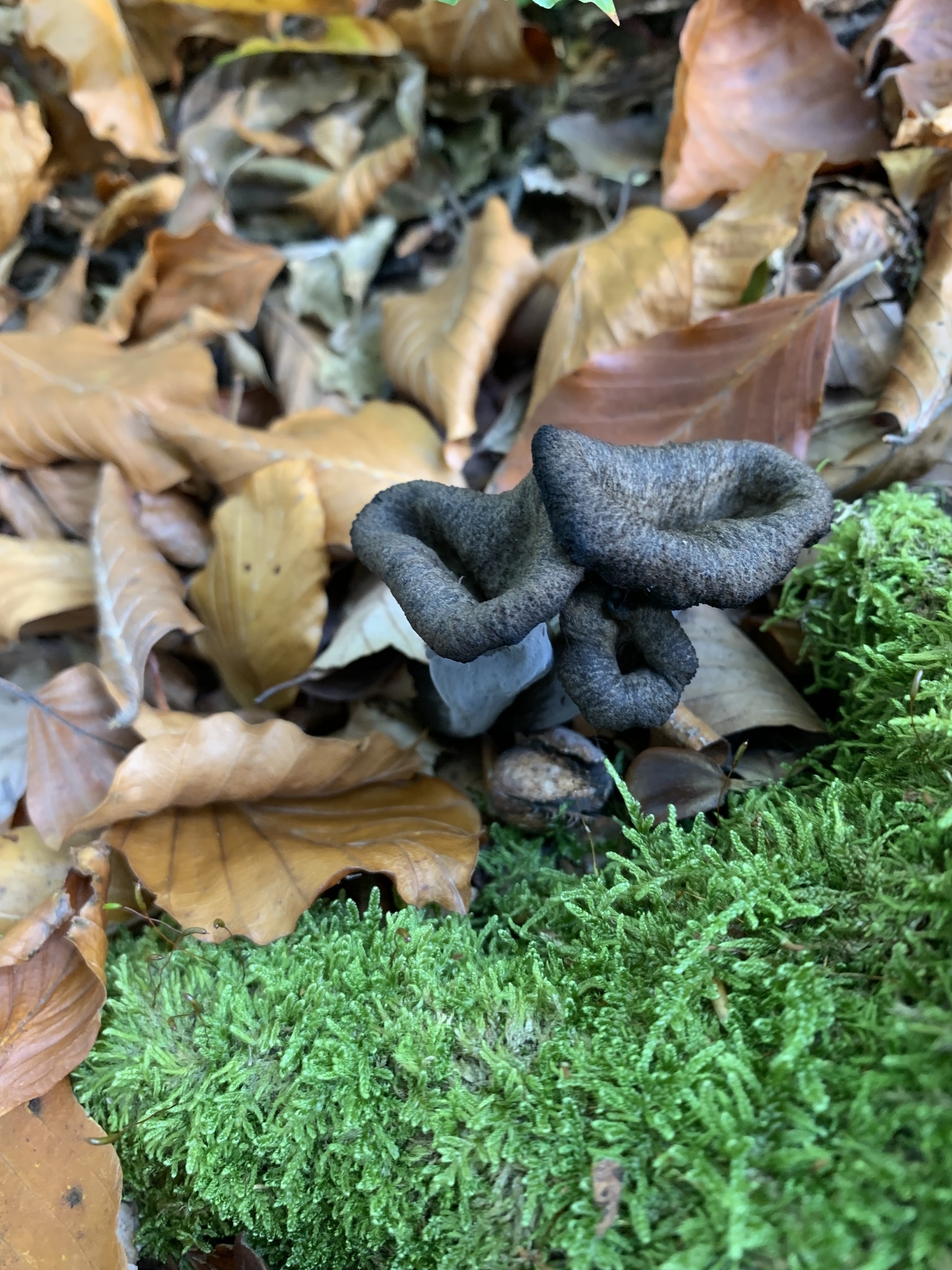
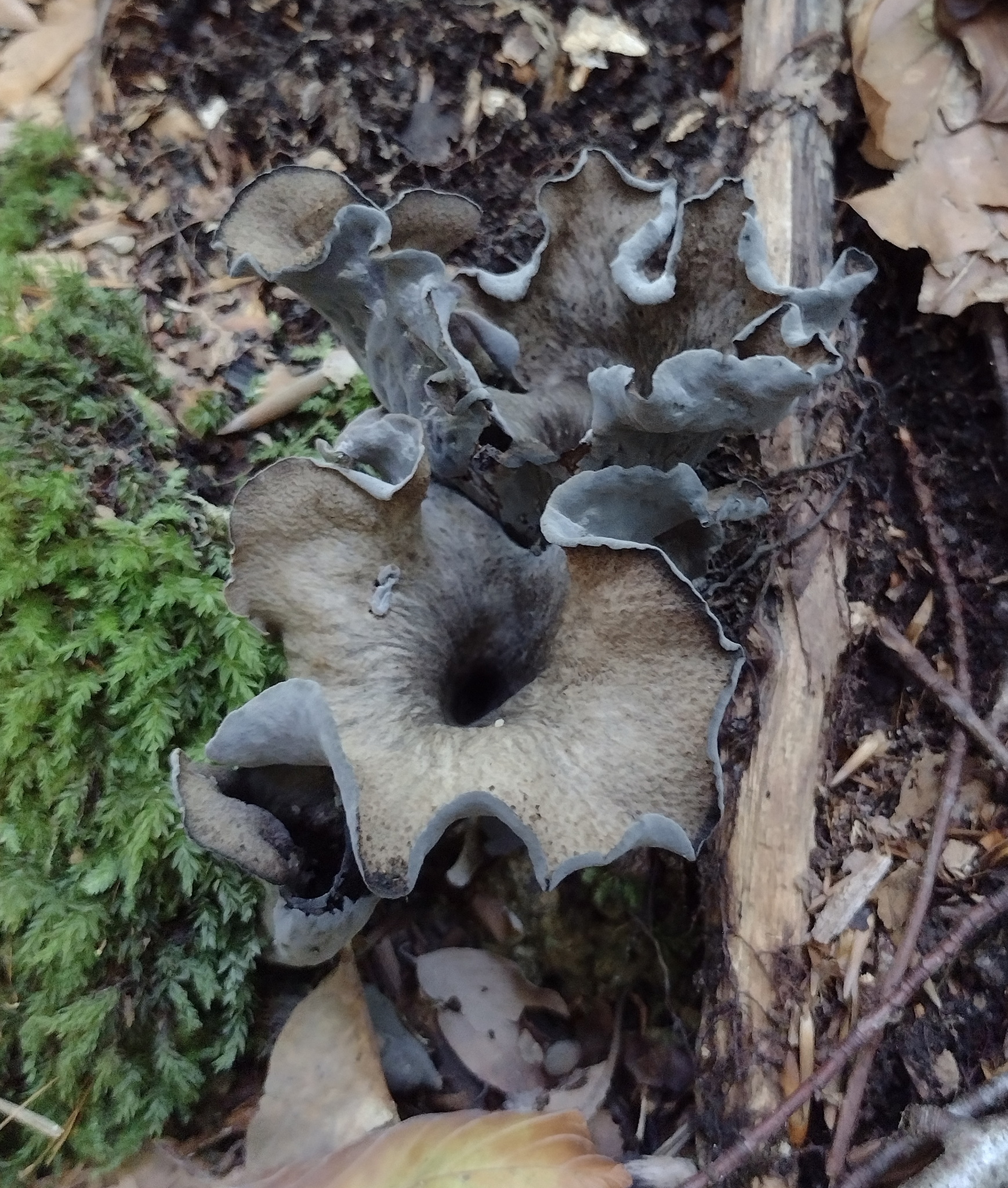
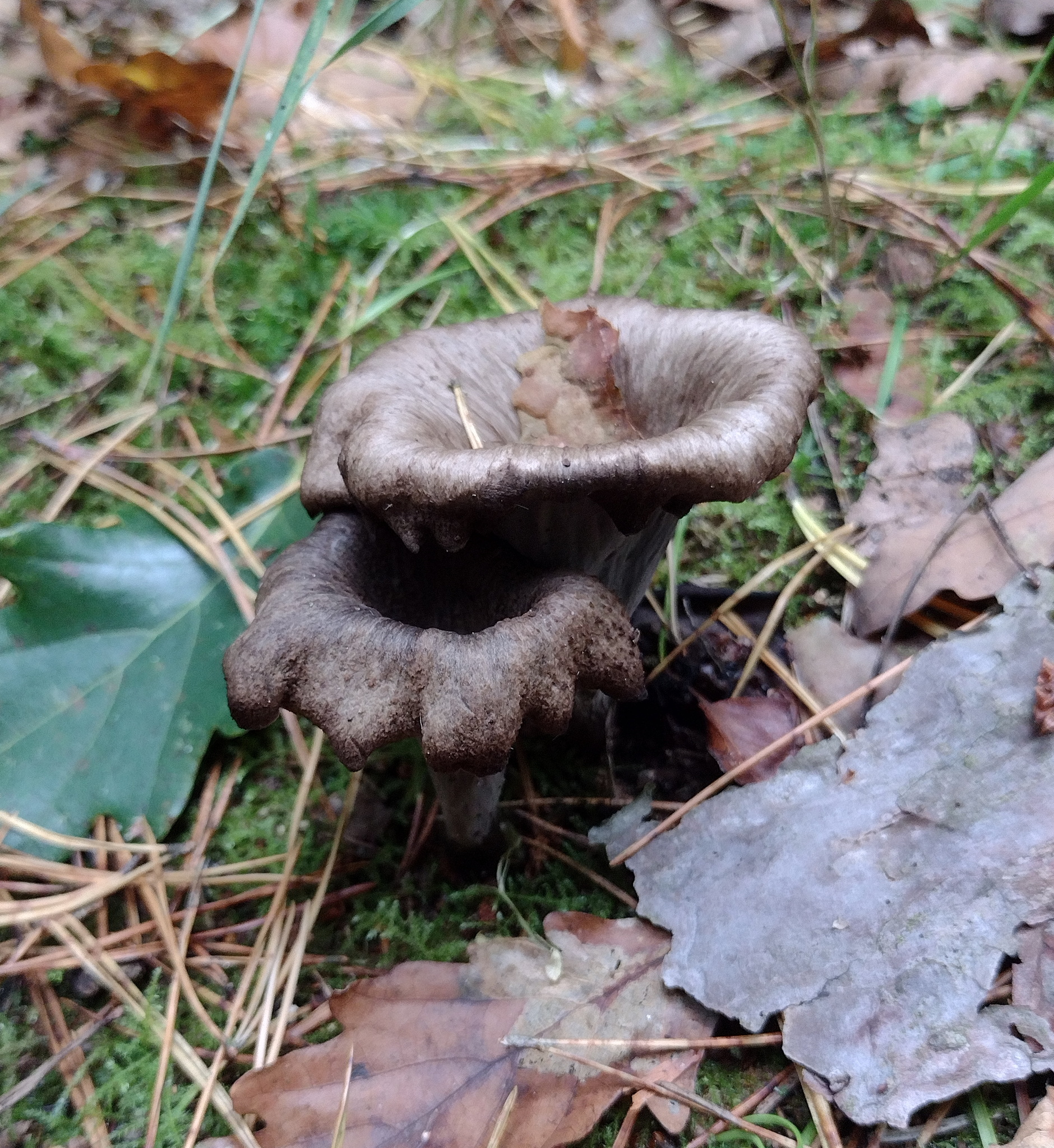
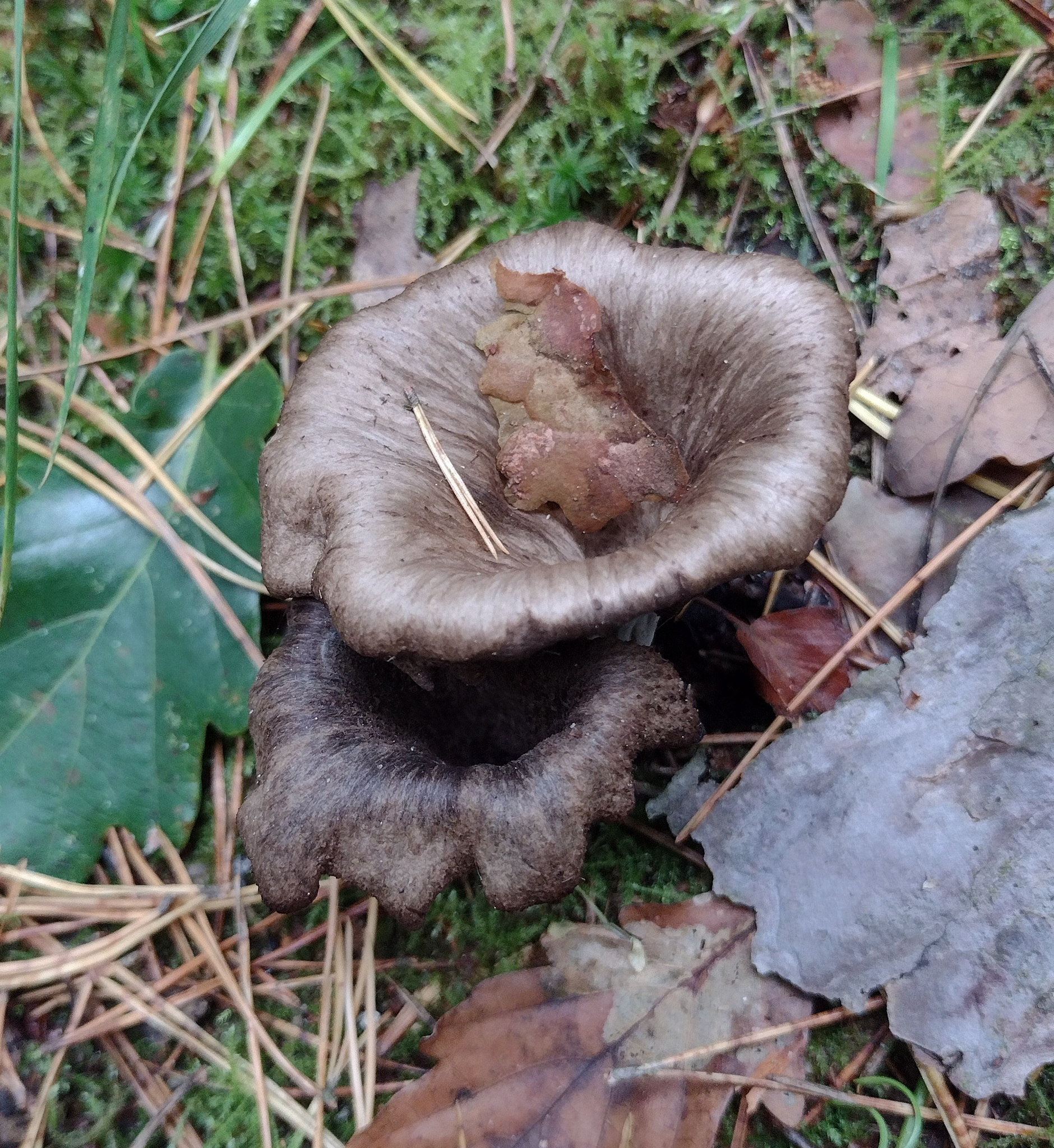
Craterellus cornucopioides, commonly known as the black chanterelle, black trumpet, or horn of plenty, is an edible wild fungus prized for its deep, smoky flavor. It features a dark, funnel-shaped fruiting body with an inrolled, wavy margin and a hollow interior extending down to the base. It forms mycorrhizal relationships primarily with broadleaf trees across temperate regions of the Northern Hemisphere, appearing in late summer and autumn on moist, leaf-covered woodland floors.
Identification, habitat, and key differences.
Forager
Fruitbody structure
- Fruit body form
- Fruit body form: Cap, stipe.
- Consistency of the entire fruitbody
- Consistency of the entire fruitbody: cartilaginous.
- Fruitbody height
- Fruitbody height: 30–200 mm.
- Fruitbody width
- Fruitbody width: 20–100 mm.
Cap
- Cap shape
- Cap shape: funnel-shaped.
- Cap surface relief
- Cap surface relief: wrinkled.
- Cap covering
- Cap covering: scaly.
- Cap colour
- Cap colour: black-brown.
Cap colour: black.
when dry: Cap colour: gray. - Margin orientation
- Margin orientation: turned upwards.
Margin orientation: curved downwards. - Cap margin outline
- in mature fruit bodies: Cap margin outline: wavy.
- Peelability of the cap cuticle
- Peelability of the cap cuticle: cannot be peeled.
- Head / cap width
- Head / cap width: 20–150 mm.
Cap underside
- Hymenophore type
- Hymenophore type: smooth, folded.
Hymenophore type: smooth. - Hymenophore colour
- Hymenophore colour: blue-grey.
Hymenophore colour: grey.
Stem and base
- Stipe shape
- Stipe shape: tapering towards the base.
- Stipe colour
- Stipe colour: black.
- Stipe interior
- Stipe interior: hollow.
- Stipe length
- Stipe length: 50–100 mm.
- Stipe diameter
- Stipe diameter: 5–15 mm.
Flesh
- Flesh colour
- Flesh colour: black.
- Flesh taste
- Flesh taste: sweet.
- Flesh resistance to breaking or tearing
- Flesh resistance to breaking or tearing: brittle.
Flesh resistance to breaking or tearing: resistant to breaking or tearing. - Flesh elasticity
- Flesh elasticity: elastic.
- Flesh consistency type
- Flesh consistency type: cartilaginous.
- Flesh odour
- Flesh odour: mushroom-like.
Flesh odour: fruity.
Flesh odour: pleasant (flesh). - Taste character of the flesh
- Taste character of the flesh: mild.
- Distinctiveness of flesh taste
- Distinctiveness of flesh taste: indistinctive.
- Flesh thickness class
- Flesh thickness class: thin.
Where and when it grows
- Habitat
- Habitat: forest of unspecified type.
- Substrate
- Substrate: soil.
- Fruit body growth pattern
- Fruit body growth pattern: in groups and fused fruit bodies.
- Occurrence frequency
- Occurrence frequency: moderately frequent.
- Fruiting season
- Fruit bodies appear from July to October.
- Distribution area
- Distribution area: confirmed.
Edibility and culinary use
- Edibility
- Edible
- Culinary rating
- Very tasty
Law
Regulations for location: Poland
- Protection
- It is not subject to species protection in Poland.
- Commercial trade
- Permitted for commercial sale
FAQ
Can black trumpets be eaten raw?
No. Raw black trumpets can cause stomach distress and nausea; thorough heating is required.
What is the typical texture of the cooked flesh?
It is tender, slightly elastic, and thin-fleshed rather than fleshy or fibrous.
Can this species be preserved by drying?
Yes, it dries remarkably well and retains its concentrated aroma indefinitely.
Does Craterellus cornucopioides grow on decaying wood?
No, it is ectomycorrhizal and grows on soil associated with living broadleaf trees.
When does it typically fruit in Central Europe?
Peak fruiting occurs from August through November, depending on seasonal moisture.
Why is it called the horn of plenty?
Its flaring, funnel-like shape resembles the classical cornucopia symbol of abundance.
Can the dried fungus be ground into a seasoning powder?
Yes, dried black trumpets are commonly pulverized and stored as a fragrant spice.
Are there any lethal toxic look-alikes?
No deadly look-alikes share its unique, hollow, black funnel morphology in temperate woods.
Does it grow in urban parks or lawns?
Rarely, as it requires mature ectomycorrhizal partner trees and undisturbed forest floor.
Is it suitable for natural yarn dyeing?
Yes, textile artisans use it to create natural grey, charcoal, and taupe hues.
Enthusiast
Names and history
- Obowiązująca nazwa krajowa
- Lejkowiec dęty
- Obowiązująca nazwa taksonomiczna
- Craterellus cornucopioides (L.) Pers.
- Inne nazwy krajowe
- cholewa, cholewka, czarna kurka, fioletowa trąba
- Dawne nazwy krajowe
- stroczek ciemnobrunatny, lejkowiec gładki
Home observations
Spore print
- Required materials
- fresh, mature cap, sheet of paper, glass or small bowl, water
- Time
- 2–24 h
- Procedure
- Place the cap underside down on the paper.
- Add a drop of water on top and cover.
- After 2–24 hours, lift the cap and inspect the deposit.
What to look for
- Spore print colour
- Spore print colour: white.
- Spore print shade
- Spore print shade: white. Spore print shade: cream. Spore print shade: white. Spore print shade: pale cream. Spore print shade: ivory-colored.
Under the microscope
- Required materials
- light microscope, microscope slide and cover slip, needle, water, spores from print
- Procedure
- Transfer a small amount of the spore print onto the slide using a needle.
- Add a drop of water, cover with a cover slip, and examine the spores.
What to look for
- Spore shape
- Spore shape: ellipsoid. Spore shape: ovoid. Spore shape: ellipsoid. Spore shape: ellipsoid. Spore shape: broadly ellipsoid.
- Spore surface
- Spore surface: smooth. Spore surface: smooth. Spore surface: smooth. Spore surface: smooth. Spore surface: smooth.
- Spore dimensions
- Length 10–17 µm, width 5.8–11 µm.
Compare dimensions after calibrating the microscope scale.
Ecology and distribution
- Soil texture
- Soil texture: sandy.
Soil texture: loamy. - Soil fertility
- Soil fertility: Nutrient-poor.
- Mycorrhizal hosts
- General species association: Mycorrhizal hosts: Fagus (general partner list).
General species association: Mycorrhizal hosts: Quercus robur (general partner list). - Mode of nutrition
- Mode of nutrition: Mycorrhizal.
Mode of nutrition: ectomycorrhizal.
Non-culinary uses
Craterellus cornucopioides has documented historical and contemporary applications outside the kitchen, primarily in textile dyeing and botanical pigment crafts. The dense natural dark pigments present in the cap and hymenium are utilized by natural fiber artisans to yield subtle shades ranging from dove grey and charcoal to olive-tinted taupe and muted slate on mordanted sheep wool and unbleached silk. Depending on the mineral mordant applied—such as alum or iron—textile crafters achieve durable, lightfast earthy tones without requiring synthetic colorants.
In traditional rural domestic settings in Central and Eastern Europe, dried and ground trumpets were occasionally blended into natural smudge mixtures or burned over hearth embers to produce a distinct, fragrant smoke used to mask musty cellar odors. In folk decorative crafts, the dried, leathery fruiting bodies have been incorporated into autumn wreaths, woodland displays, and herbal potpourri arrangements due to their persistent form and rich, dark texture. In historical herbalist traditions, gentle infusions were occasionally used as an external topical wash for minor skin blemishes, though such applications remained strictly regional.
History and culture
Craterellus cornucopioides holds a prominent place in European folklore, often shaped by its somber, charcoal-black coloration and hollow, trumpet-like form. In French and Italian traditions, folk names such as 'trompette de la mort' or 'trombetta dei morti' reflect old associations with All Saints' Day and All Souls' Day in early November, when the fruiting bodies typically appear in broadleaf forests. Superstitions historically linked the dark, flaring horns rising from damp earth to the underworld, portraying them as horns blown by the deceased underground or symbols of mortality and spiritual passage.
In Germanic and Slavic folk cultures, the species was historically regarded with suspicion in certain rural districts due to the general belief that black mushrooms were associated with witchcraft, hexes, or cursed ground. Conversely, classical Renaissance references and later gastronomic literature reclaimed the fungus under the classical cornucopia motif—the 'horn of plenty'—shifting its cultural image from ominous harbinger to a symbol of autumn bounty. By the nineteenth century, French culinary scholars and market records documented its high standing, cementing its transition from macabre rural specter to revered forest treasure.
Edibility and safety
Craterellus cornucopioides is classified as a prime edible species, celebrated worldwide for its rich aroma and concentrated, earthy savor. While it is safe for consumption when cooked, raw consumption must be strictly avoided, as uncooked specimens contain indigestible chitin, potential gastrointestinal irritants, and microflora from the woodland soil that can induce stomach upset and nausea. Thorough thermal processing, such as gentle sauteing or simmering, is required to render the tissues fully digestible and break down heat-sensitive components.
Only clean, intact, and thoroughly dried or freshly cooked specimens should be ingested. In France and Italy, it is hailed under regional names like 'trompette de la mort' and 'trombetta dei morti' as one of the finest wild forest delicacies, commanding high commercial value. In Central and Eastern Europe, it is universally dried and prized as a seasoning powder, while in Nordic countries and North America, its pungent fragrance is regarded as an acquired delicacy. Because it carries no notable intrinsic toxins when cooked, adverse reactions are almost exclusively linked to spoilage, insect infestation, or undercooking.
Habitat and occurrence
Craterellus cornucopioides is widely distributed across temperate regions of Europe, North America, and parts of Asia. It forms ectomycorrhizal relationships predominantly with deciduous trees, most notably European beech (Fagus sylvatica), oak (Quercus spp.), sweet chestnut (Castanea sativa), and occasionally hornbeam (Carpinus betulus). In North America, it also associates with eastern hemlock and mixed hardwood-conifer woods on acidic, nutrient-poor, well-drained soils rich in leaf litter.
The fruiting season generally spans from late summer to late autumn, with peak abundance occurring between August and November in Central and Northern Europe. In southern European regions around the Mediterranean, fruiting can extend well into December or January during mild, humid winters. In eastern North America, fruiting begins around July following heavy summer rains and continues until early hard frosts in October or November. Regional moisture regimes dictate its phenology, as prolonged dry spells can suppress fruiting entirely for a season, whereas consistent rainfall promotes abundant flushes across mossy slopes and moss-covered depressions along woodland paths.
Sources
- NDFF Verspreidingsatlas: Craterellus cornucopioides — Hoorn-van-overvloed
- K.Tejkal, ČMS, Craterellus cornucopioides
- R.H.Petersen 1975, Notes on cantharelloid fungi.VI, s.199–204
- M.Snowarski, Craterellus cornucopioides, aktualizacja8VIII 2026
- W.Wojewoda 2003, Checklist of Polish larger Basidiomycetes, s.198/PDF200
Researcher
Edibility and culinary use
Ustalenia źródłowe: jadalność, spożycie i wykorzystanie
- Edibility
- Edible — źródło oznaczenia
M.Snowarski, Craterellus cornucopioides, aktualizacja8VIII2026 · Edible — atlas author's assessment, not proof of unconditional safety.
- Culinary rating
- Very tasty
M.Snowarski, Craterellus cornucopioides, aktualizacja8VIII2026 · Edible, very tasty due to a pleasant aroma.
- Commercial trade
- Approved for trade
Obszar: PL
Wpis w wykazie nie jest ogólnym zezwoleniem na handel bez wymaganych warunków ani na zbiór na dowolnym terenie.
§ 3: atesty przy skupie i przetwórstwie grzybów ze stanu naturalnego oraz nadzór grzyboznawcy
§ 4: oferowanie objętych nim świeżych/suszonych grzybów konsumentowi finalnemu w placówkach handlowych lub na targowiskach i z odpowiednim atestem
§ 6: susz dla konsumenta finalnego w opakowaniu
Załącznik nr 2: odrębne wymagania dla poszczególnych przetworów
W Polsce jest dopuszczony do obrotu handlowego oraz do produkcji przetworów grzybowych.
Dz.U. 2026 poz. 258, załącznik nr 1 poz. 19 (PDF s. 5); § 2 ust. 1. · Dz.U. 2026 item 258, § 2 para. 1; Annex no. 1 item 19, PDF p. 5: horn of plenty – Craterellus cornucopioides (L.) Pers.; requirements of §§ 3–6 remain separate.
Źródłowa weryfikacja polskiej ochrony gatunkowej i wykazu handlowego lejkowca dętego, 23.10.2026. · /records/1: confirmation of the Polish commercial list, Annex No. 1, item 19.
Scientific names and taxonomy
- Current scientific name
Craterellus cornucopioides (L.) Pers.
- Former scientific names
- Peziza cornucopioides L.[32]
Source variety and names of compared species
In the preserved entry, variety var. flavicans is listed separately. This entry and the names of species compared in the remarks were not automatically considered synonyms of the accepted Craterellus cornucopioides.
Historical scope of determinations in Petersen's work
Petersen discusses primarily other North American Craterellus species. For C. cornucopioides, he compares the light cream or ivory spore print and gray-black color of several Swedish collections from 1970. The dimensions of C. fallax, C. hesleri, C. venosus, and C. subundulatus described there were not transferred to this record.
List of synonyms in the Merino card
Craterellus ochrosporus Burt appears in the source list of synonyms on the first page of the Merino card. This claim by the source author has been retained; the name has not been added to accepted synonyms, nor has its identity within the current species concept been resolved.
Taxon scope in IUCN assessment
The scope of determinations outside Europe in the IUCN assessment depends on the adopted taxon concept. Not every historical determination from other continents was treated as confirmation of the occurrence of the adopted European concept of Craterellus cornucopioides. The source limitation does not establish a new synonym or country of occurrence.
Ecology and distribution
- Occurrence frequency
- Poland: Occurrence frequency: moderately frequent. [37]
Laboratory diagnostics
Dane ustrukturyzowane
Basidia
- Qualitative width of the basidium part
- whole structure: Qualitative width of the basidium part: narrow. [11]
- Spores per basidium
- The number of spores per basidium is 2. [11]
The number of spores per basidium is 1. [11]
The number of spores per basidium is 2. [8]
The number of spores per basidium is 4. [8]
The number of spores per basidium is 2. [9]
The number of spores per basidium is 2. [28] - Presence of basidium contents
- Presence of basidium contents: present (oily contents, large droplets). [8]
- Basidium length
- Basidium length: 90 µm (mean). [11]
- Basidium width
- Basidium width: 8 µm (mean). [11]
Other laboratory characteristics
- Width
- Width: 3–18 µm. [11]
Pileipellis
- Deformability of pileipellis elements
- Deformability of pileipellis elements: easily deformed. [8]
- Shape of pileipellis elements
- Shape of pileipellis elements: sausage-shaped (in chains). [8]
- Width of pileipellis elements
- Width of pileipellis elements: up to 20 µm. [8]
Width of pileipellis elements: 5 µm (approximate value). [8]
Width of pileipellis elements: 6–14 µm. [11]
Width of pileipellis elements: 9 µm (mean). [11] - Septation of cuticle hyphae
- Septation of cuticle hyphae: septate. [8]
- Pileipellis hyphal wall class
- Pileipellis hyphal wall class: thin-walled. [8]
Spores
- Presence of the basidiospore hilar appendix
- Presence of the basidiospore hilar appendix: present. [11]
- Spore colour under the microscope
- Spore colour under the microscope: hyaline. [11]
Spore colour under the microscope: hyaline. [8] - Spore contents
- Spore contents: nucleus (central nucleus, large nucleus). [11]
- Cyanophily of spores
- Cyanophily of spores: positive. [8]
- Droplets inside the spore
- Droplets inside the spore: present. [9]
- Spore length
- Spore length: 10–14 µm. [34]
Spore length: 10.1–13.4 µm. [28]
Spore length: 12–17 µm. [37]
Spore length: 12.6–13.7 µm. [9]
Spore length: 11–14 µm. [11]
Spore length: 10.5–13 µm. [8] - Spore length-to-width ratio
- Spore length-to-width ratio: 1.4–1.8. [28]
Spore length-to-width ratio: 1.26–1.58. [9]
Spore length-to-width ratio: 1.4–1.7. [11] - Spore shape
- Spore shape: ellipsoid. [37]
Spore shape: ovoid. [34]
Spore shape: ellipsoid. [28]
Spore shape: ellipsoid. [11]
Spore shape: broadly ellipsoid. [9]
Material and research methods
Description of characteristics — source and scope
Material: Atlas taste assessment of the described fruit body, without a sensory trial or voucher.
Reading scope: Source excerpts.
A source excerpt was read; the full text and methods were not verified.
Limitations: Material, method, statistics, and species scope were retained; the result is not a clinical effect.
Study of composition and activity — material and limitations
Material: 70% ethanol extract from source dried basidiomes CE4, Suceava 2023. Not equated with extract mass or the effect of eating the mushroom.
Reading scope: Source excerpts.
An excerpt of the source was read; full text and methods were not verified.
Limitations: Material, method, statistics, and species scope retained; the result is not a clinical effect.
Study of composition and activity — material and limitations
Material: 70% ethanol extract from source dried basidiomes CE3, Suceava 2022. Not equated with extract mass or the effect of eating the mushroom.
Reading scope: Source excerpts.
An excerpt of the source was read; full text and methods were not verified.
Limitations: Material, method, statistics, and species scope retained; the result is not a clinical effect.
Study of composition and activity — material and limitations
Material: 70% ethanol extract from source dried fruit bodies CE2, Sălaj 2022. Not equated with extract mass nor the effect of eating the mushroom.
Reading scope: Source excerpts.
A source excerpt was read; the full text and methods were not verified.
Limitations: Material, method, statistics, and species scope were retained; the result is not a clinical effect.
Study of composition and activity — material and limitations
Material: 70% ethanol extract from source dried basidiomes CE1, Cluj 2022. Not equated with extract mass or the effect of eating the mushroom.
Reading scope: Source excerpts.
An excerpt of the source was read; full text and methods were not verified.
Limitations: Material, method, statistics, and species scope retained; the result is not a clinical effect.
Study of composition and activity — material and limitations
Material: Bumbu 2025: dried basidiomes from Romania, Suceava 2023, collected in August; voucherCL672126. Results in Table 1 are given per declared dry weight. Kjeldahl protein N×4.38; carbohydrates and energy calculated.
Reading scope: Source excerpts.
An excerpt of the source was read; full text and methods were not verified.
Limitations: Material, method, statistics, and species scope retained; the result is not a clinical effect.
Study of composition and activity — material and limitations
Material: Bumbu 2025: dried basidiomes from Romania, Suceava 2022, collected in August; voucherCL672126. Results in Table 1 are given per declared dry weight. Kjeldahl protein N×4.38; carbohydrates and energy calculated.
Reading scope: Source excerpts.
An excerpt of the source was read; full text and methods were not verified.
Limitations: Material, method, statistics, and species scope retained; the result is not a clinical effect.
Study of composition and activity — material and limitations
Material: Bumbu 2025: dried fruit bodies from Romania, Sălaj 2022, collected in August; voucherCL672126. Table 1 results are given per declared dry weight. Kjeldahl protein N×4.38; carbohydrates and energy calculated.
Reading scope: Source excerpts.
A source excerpt was read; the full text and methods were not verified.
Limitations: Material, method, statistics, and species scope were retained; the result is not a clinical effect.
Study of composition and activity — material and limitations
Material: Bumbu 2025: dried basidiomes from Romania, Cluj 2022, collected in August; voucherCL672126. Results in Table 1 are given per declared dry weight. Kjeldahl protein N×4.38; carbohydrates and energy calculated.
Reading scope: Source excerpts.
An excerpt of the source was read; full text and methods were not verified.
Limitations: Material, method, statistics, and species scope retained; the result is not a clinical effect.
Experiment on material application — Actual source result matrices
Material: Dried crushed basidiome biomass of C.cornucopioides from Kemalpaşa–İzmir, tested as a Congo red biosorbent; not an extraction residue and not a living culture.
Reading scope: Full text.
Limitations: Result of specific source material/extract, not a universal trait of the basidiome nor efficacy in humans. Source dry weight denominator and separate calibrations retained; not converted to extract mass.
Composition and activity study — Actual source result matrices
Material: Bumbu 2025, CE4: separate extract from Romanian material collected in August 2022/2023, source voucherCL672126; result per gram of dry material.
Reading scope: Full text.
Limitations: Result of specific source material/extract, not a universal feature of the fruit body nor efficacy in humans. Source dry matter denominator and separate calibrations retained; not converted to extract mass.
Composition and activity study — Actual source result matrices
Material: Bumbu 2025, CE3: separate extract from Romanian material collected in August 2022/2023, source voucherCL672126; result per gram of dry material.
Reading scope: Full text.
Limitations: Result of specific source material/extract, not a universal feature of the fruit body nor efficacy in humans. Source dry matter denominator and separate calibrations retained; not converted to extract mass.
Composition and activity study — Actual source result matrices
Material: Bumbu 2025, CE2: separate extract from Romanian material collected in August 2022/2023, source voucherCL672126; result per gram of dry material.
Reading scope: Full text.
Limitations: Result of specific source material/extract, not a universal feature of the fruit body nor efficacy in humans. Source dry matter denominator and separate calibrations retained; not converted to extract mass.
Composition and activity study — Actual source result matrices
Material: Bumbu 2025, CE1: separate extract from Romanian material collected in August 2022/2023, source voucherCL672126; result per gram of dry material.
Reading scope: Full text.
Limitations: Result of specific source material/extract, not a universal feature of the fruit body nor efficacy in humans. Source dry matter denominator and separate calibrations retained; not converted to extract mass.
Composition and activity study — Actual source result matrices
Material: ČakićSemenčić 2026,UE4: own extract of commercial dried BlackTrumpet; separate sample code Table 1/2. Denominator of results: dry source material. No unstated voucher or wild collection site assigned.
Reading scope: Full text.
Limitations: Result of specific source material/extract, not a universal trait of the basidiome nor efficacy in humans. Source dry weight denominator and separate calibrations retained; not converted to extract mass.
Composition and activity study — Actual source result matrices
Material: ČakićSemenčić 2026,UE3: own extract of commercial dried BlackTrumpet; separate sample code Table 1/2. Denominator of results: dry source material. No unstated voucher or wild collection site assigned.
Reading scope: Full text.
Limitations: Result of specific source material/extract, not a universal trait of the basidiome nor efficacy in humans. Source dry weight denominator and separate calibrations retained; not converted to extract mass.
Composition and activity study — Actual source result matrices
Material: ČakićSemenčić 2026,UE2: own extract of commercial dried BlackTrumpet; separate sample code Table 1/2. Denominator of results: dry source material. No unstated voucher or wild collection site assigned.
Reading scope: Full text.
Limitations: Result of specific source material/extract, not a universal trait of the basidiome nor efficacy in humans. Source dry weight denominator and separate calibrations retained; not converted to extract mass.
Composition and activity study — Actual source result matrices
Material: ČakićSemenčić 2026,UE1: own extract of commercial dried BlackTrumpet; separate sample code Table 1/2. Denominator of results: dry source material. No unstated voucher or wild collection site assigned.
Reading scope: Full text.
Limitations: Result of specific source material/extract, not a universal trait of the basidiome nor efficacy in humans. Source dry weight denominator and separate calibrations retained; not converted to extract mass.
Composition and activity study — Actual source result matrices
Material: ČakićSemenčić 2026,UW4: own extract of commercial dried BlackTrumpet; separate sample code Table 1/2. Denominator of results: dry source material. No unstated voucher or wild collection site assigned.
Reading scope: Full text.
Limitations: Result of specific source material/extract, not a universal trait of the basidiome nor efficacy in humans. Source dry weight denominator and separate calibrations retained; not converted to extract mass.
Composition and activity study — Actual source result matrices
Material: ČakićSemenčić 2026,UW3: own extract of commercial dried BlackTrumpet; separate sample code Table 1/2. Denominator of results: dry source material. No unstated voucher or wild collection site assigned.
Reading scope: Full text.
Limitations: Result of specific source material/extract, not a universal trait of the basidiome nor efficacy in humans. Source dry weight denominator and separate calibrations retained; not converted to extract mass.
Composition and activity study — Actual source result matrices
Material: ČakićSemenčić 2026,UW2: own extract of commercial dried BlackTrumpet; separate sample code Table 1/2. Denominator of results: dry source material. No unstated voucher or wild collection site assigned.
Reading scope: Full text.
Limitations: Result of specific source material/extract, not a universal trait of the basidiome nor efficacy in humans. Source dry weight denominator and separate calibrations retained; not converted to extract mass.
Composition and activity study — Actual source result matrices
Material: ČakićSemenčić 2026,UW1: own extract of commercial dried BlackTrumpet; separate sample code Table 1/2. Denominator of results: dry source material. No unstated voucher or wild collection site assigned.
Reading scope: Full text.
Limitations: Result of specific source material/extract, not a universal trait of the basidiome nor efficacy in humans. Source dry weight denominator and separate calibrations retained; not converted to extract mass.
Composition and activity study — Actual source result matrices
Material: ČakićSemenčić 2026,ME4: own extract of commercial dried BlackTrumpet; separate sample code Table 1/2. Denominator of results: dry source material. No unstated voucher or wild collection site assigned.
Reading scope: Full text.
Limitations: Result of specific source material/extract, not a universal trait of the basidiome nor efficacy in humans. Source dry weight denominator and separate calibrations retained; not converted to extract mass.
Composition and activity study — Actual source result matrices
Material: ČakićSemenčić 2026,ME3: own extract of commercial dried BlackTrumpet; separate sample code Table 1/2. Denominator of results: dry source material. No unstated voucher or wild collection site assigned.
Reading scope: Full text.
Limitations: Result of specific source material/extract, not a universal trait of the basidiome nor efficacy in humans. Source dry weight denominator and separate calibrations retained; not converted to extract mass.
Composition and activity study — Actual source result matrices
Material: ČakićSemenčić 2026,ME2: own extract of commercial dried BlackTrumpet; separate sample code Table 1/2. Denominator of results: dry source material. No unstated voucher or wild collection site assigned.
Reading scope: Full text.
Limitations: Result of specific source material/extract, not a universal trait of the basidiome nor efficacy in humans. Source dry weight denominator and separate calibrations retained; not converted to extract mass.
Composition and activity study — Actual source result matrices
Material: ČakićSemenčić 2026,ME1: own extract of commercial dried BlackTrumpet; separate sample code Table 1/2. Denominator of results: dry source material. No unstated voucher or wild collection site assigned.
Reading scope: Full text.
Limitations: Result of specific source material/extract, not a universal trait of the basidiome nor efficacy in humans. Source dry weight denominator and separate calibrations retained; not converted to extract mass.
Composition and activity study — Actual source result matrices
Material: ČakićSemenčić 2026,MW4: own extract of commercial dried BlackTrumpet; separate sample code Table 1/2. Denominator of results: dry source material. No unstated voucher or wild collection site assigned.
Reading scope: Full text.
Limitations: Result of specific source material/extract, not a universal trait of the basidiome nor efficacy in humans. Source dry weight denominator and separate calibrations retained; not converted to extract mass.
Composition and activity study — Actual source result matrices
Material: ČakićSemenčić 2026,MW3: own extract of commercial dried BlackTrumpet; separate sample code Table 1/2. Denominator of results: dry source material. No unstated voucher or wild collection site assigned.
Reading scope: Full text.
Limitations: Result of specific source material/extract, not a universal trait of the basidiome nor efficacy in humans. Source dry weight denominator and separate calibrations retained; not converted to extract mass.
Composition and activity study — Actual source result matrices
Material: ČakićSemenčić 2026,MW2: own extract of commercial dried BlackTrumpet; separate sample code Table 1/2. Denominator of results: dry source material. No unstated voucher or wild collection site assigned.
Reading scope: Full text.
Limitations: Result of specific source material/extract, not a universal trait of the basidiome nor efficacy in humans. Source dry weight denominator and separate calibrations retained; not converted to extract mass.
Composition and activity study — Actual source result matrices
Material: ČakićSemenčić 2026,MW1: own extract of commercial dried BlackTrumpet; separate sample code Table 1/2. Denominator of results: dry source material. No unstated voucher or wild collection site assigned.
Reading scope: Full text.
Limitations: Result of specific source material/extract, not a universal trait of the basidiome nor efficacy in humans. Source dry weight denominator and separate calibrations retained; not converted to extract mass.
- Results as recorded in the sources — Spores per basidium
- Liczba zarodników na jednej podstawce wynosi 2. [9] [28] [11] [8]
Liczba zarodników na jednej podstawce wynosi 1. [11]
Liczba zarodników na jednej podstawce wynosi 4. [8] - Results as recorded in the sources — Width of pileipellis elements
- Materiał badania: Jeden zbiór: South Hants (VC11), OSGR SU20, 7 XI 2014, pod ostrokrzewem, bukiem i dębem; voucher „7 Nov 2014[J]”. do 20 µm [8]
Materiał badania: Materiał suszony: Puente la Reina de Jaca (Huesca), 660 m, las Quercus ilex, zbiory 23 XII 2003 i 2 XI 2006 (leg./fot. J. Hernanz wg karty). Nie przypisano pomiaru jednemu zbiorowi. Materiał suszony (przygotowanie opisano w Metodach): 6–14 µm [11]
Materiał badania: Materiał suszony jawnie wskazany przy pomiarach Merino; nie przypisano pomiarów jednemu z dwóch zbiorów. Materiał suszony (przygotowanie opisano w Metodach): Średnia szerokość elementów skórki kapelusza w badanym materiale wynosi 9 mikrometrów. [11]
Materiał badania: Jeden zbiór: South Hants (VC11), OSGR SU20, 7 XI 2014, pod ostrokrzewem, bukiem i dębem; voucher „7 Nov 2014[J]”. Szerokość strzępek skórki kapelusza wynosi około 5 mikrometrów. [8] - Results as recorded in the sources — Spore length
- 11–14 µm [11]
12–17 µm [37]
10,1–13,4 µm [28]
10–14 µm [34]
12,6–13,7 µm [9]
10,5–13 µm [8] - Results as recorded in the sources — Spore length-to-width ratio
- 1,4–1,7 [11]
Materiał badania: Źródłowy opis europejskiego lejkowca; własne N=60 pomiarów strony CRO, oddzielone od ogólnego zakresu atlasowego. 1,4–1,8 [28]
1,26–1,58 [9] - Results as recorded in the sources — Spore width
- 9–11 µm [37]
8,3–10,8 µm [9]
6–8 µm [8]
7–9,7 µm [11]
5,8–8,2 µm [28]
7–9 µm [34]
Metody i zapisy źródłowe — Materiał suszony: Puente la Reina de Jaca (Huesca), 660 m, las Quercus ilex, zbiory 23 XII 2003 i 2 XI 2006 (leg./fot. J. Hernanz wg karty). Nie przypisano pomiaru jednemu zbiorowi.; Materiał opisu mikroskopowego Merino; zbiory Puente la Reina de Jaca (Huesca),23XII2003 i2XI2006. Stan jakościowo opisanych struktur nie został osobno podany.; Materiał suszony jawnie wskazany przy pomiarach Merino; nie przypisano pomiarów jednemu z dwóch zbiorów.
Stan materiału: suszony.
Materiał źródłowy: Materiał opisu mikroskopowego Merino; zbiory Puente la Reina de Jaca (Huesca),23XII2003 i2XI2006. Stan jakościowo opisanych struktur nie został osobno podany.
Materiał źródłowy: Materiał suszony jawnie wskazany przy pomiarach Merino; nie przypisano pomiarów jednemu z dwóch zbiorów.
Stan materiału: suszony.
Jakościowa szerokość części podstawki — zapis źródłowy: „Basidios…Claviformes, estrechos” [11]
Długość podstawki; Szerokość podstawki — zapis źródłowy: „Medidas media de los basidios(material seco):90×8µm” [11]
Szerokość — zapis źródłowy: „Medidas del ancho de las hifas del himenio:3–18(material seco)µm” [11]
Szerokość elementów skórki — zapis źródłowy: „p.3 item4: Hifas de la cutícula. Medidas del ancho…6 a14, media9µm (material seco).” [11]
Szerokość elementów skórki — zapis źródłowy: „Hifas de la cutícula…6a14,media9µm(material seco)” [11]
Zawartość zarodnika — zapis źródłowy: „Esporas…con un gran nucleo central” [11]
Metody i zapisy źródłowe — Źródłowy opis europejskiego lejkowca; własne N=60 pomiarów strony CRO, oddzielone od ogólnego zakresu atlasowego.
Liczba zarodników na jednej podstawce; Długość zarodnika; Iloraz długości i szerokości zarodnika; Kształt zarodnika; Powierzchnia zarodnika; Szerokość zarodnika — zapis źródłowy: „Źródłowe mikrocechy: pełne granice wraz z wartościami skrajnymi; dokładny oryginał przy źródle.” [28]
Metody i zapisy źródłowe — Materiał suszony: Puente la Reina de Jaca (Huesca), 660 m, las Quercus ilex, zbiory 23 XII 2003 i 2 XI 2006 (leg./fot. J. Hernanz wg karty). Nie przypisano pomiaru jednemu zbiorowi.; Materiał opisu jakościowego Merino; stan preparatyki niepodany przy liczbie sterygm, osobno od pomiarów material seco.
Materiał źródłowy: Materiał opisu jakościowego Merino; stan preparatyki niepodany przy liczbie sterygm, osobno od pomiarów material seco.
Liczba zarodników na jednej podstawce — zapis źródłowy: „Basidios con2esterigmas; en algunos casos un único esterigma.” [11]
Obecność wyrostka wnęki bazydiospory — zapis źródłowy: „apiculadas” [11]
Kształt podstawki — zapis źródłowy: „Clavifomes, estrechos” [11]
Barwa zarodnika w mikroskopie — zapis źródłowy: „hialinas; medium niepodane” [11]
Długość zarodnika — zapis źródłowy: „11 [11,2; 13,7] 14 µm (N=30, materiał suchy)” [11]
Iloraz długości i szerokości zarodnika — zapis źródłowy: „Q = 1,4 [1,4; 1,6] 1,7; N = 30” [11]
Kształt zarodnika — zapis źródłowy: „Esporas elipsoidales” [11]
Powierzchnia zarodnika — zapis źródłowy: „lisas” [11]
Szerokość zarodnika — zapis źródłowy: „7 [7,3; 9,1] 9,7 µm (N=30)” [11]
Metody i zapisy źródłowe — Jeden zbiór: Cles (TN), 900 m, 4 XI 2020, las mieszany z przewagą buka, leg./det. G. Bortoletto; materiał świeży czy suchy — nie zaznaczono czytelnie w tekście.
Liczba zarodników na jednej podstawce — zapis źródłowy: „basidi cilindrico-clavati, bisporici” [9]
Długość zarodnika — zapis źródłowy: „12.6-(13.18)-13.7 μ” [9]
Iloraz długości i szerokości zarodnika — zapis źródłowy: „Q: 1.26-(1.47)-1.58” [9]
Kształt zarodnika — zapis źródłowy: „Spore largamente ellissoidali, guttulate” [9]
Szerokość zarodnika — zapis źródłowy: „8.3-(9.0)-10.8 μ” [9]
Metody i zapisy źródłowe — Jeden zbiór: South Hants (VC11), OSGR SU20, 7 XI 2014, pod ostrokrzewem, bukiem i dębem; voucher „7 Nov 2014[J]”.
Liczba zarodników na jednej podstawce — zapis źródłowy: „Basidia mostly2-spored, occasionally4-spored.” [8]
Kształt podstawki — zapis źródłowy: „Basidia: … cylindric” [8]
Barwa zarodnika w mikroskopie — zapis źródłowy: „hyaline; medium niepodane” [8]
Cyjanofilia zarodników — zapis źródłowy: „cyanophilic; protokół niepodany” [8]
Długość zarodnika; Szerokość zarodnika — zapis źródłowy: „10.5-13/6-8µm” [8]
Powierzchnia zarodnika — zapis źródłowy: „Spores: smooth” [8]
Metody i zapisy źródłowe — Jeden zbiór: South Hants (VC11), OSGR SU20, 7 XI 2014, pod ostrokrzewem, bukiem i dębem; voucher „7 Nov 2014[J]”.
Obecność zawartości podstawki — zapis źródłowy: „Basidia…with large oil droplets” [8]
Podatność elementów skórki na odkształcanie — zapis źródłowy: „Cap cuticle…thin-walled and easily distorted” [8]
Kształt elementów skórki kapelusza — zapis źródłowy: „ending with chains of sausage-shaped cells upto20µm wide” [8]
Szerokość elementów skórki — zapis źródłowy: „…ending with chains of sausage-shaped cells upto20µm wide.” [8]
Szerokość elementów skórki — zapis źródłowy: „Cap cuticle…filamentous hyphae c.5µm diam” [8]
Przegrody strzępki skórki — zapis źródłowy: „Cap cuticle: unclamped, septate, filamentous hyphae…” [8]
Klasa ściany strzępki skórki — zapis źródłowy: „Cap cuticle…thin-walled and easily distorted.” [8]
Metody i zapisy źródłowe — Jeden zbiór: Cles (TN), 900 m, 4 XI 2020, las mieszany z przewagą buka, leg./det. G. Bortoletto; materiał świeży czy suchy — nie zaznaczono czytelnie w tekście.
Identyfikacja kropli: nierozstrzygnięta.
Krople wewnątrz zarodnika — zapis źródłowy: „Spore largamente ellissoidali, guttulate.” [9]
Metody i zapisy źródłowe — Źródłowy opis europejskiego lejkowca; atlasowe podsumowanie bez identyfikatora voucheru.
Długość zarodnika; Kształt zarodnika; Powierzchnia zarodnika; Szerokość zarodnika — zapis źródłowy: „Źródłowe mikrocechy: pełne granice wraz z wartościami skrajnymi; dokładny oryginał przy źródle.” [37]
Metody i zapisy źródłowe — Źródłowy opis europejskiego lejkowca; atlasowe podsumowanie bez identyfikatora voucheru.
Długość zarodnika; Kształt zarodnika; Powierzchnia zarodnika; Szerokość zarodnika — zapis źródłowy: „Źródłowe mikrocechy: pełne granice wraz z wartościami skrajnymi; dokładny oryginał przy źródle.” [34]
Names and species boundaries
The primary name is horn of plenty — Craterellus cornucopioides (L.) Pers. Wojewoda cites stroczek ciemnobrunatny and lejkowiec gładki. A study from Mazovia attests to cholewa, cholewka, czarna kurka, and fioletowa trąba. Newer phylogeny cautions against treating all past identifications from different continents as a single species.
Occurrence and fruiting in Poland
The national checklist gives July–October, forests especially with beech, and soil among litter and mosses. In the Mazovian study, material WA0000071019 has ITS sequence MK028881. Czech, Croatian dates and collection dates of Romanian materials were not used to extend the Polish season.
What Petersen's work actually describes
Petersen discusses primarily other North American Craterellus species. For C. cornucopioides, he compares the light cream or ivory spore print and gray-black color of several Swedish collections from 1970. The dimensions of C. fallax, C. hesleri, C. venosus, and C. subundulatus described there were not transferred to this record.
Microscopy — separate sources and scopes
Snowarski's atlas gives spores 12–17 × 9–11 µm, and the Czech atlas 10–14 × 7–9 µm. CROmushrooms separates the general atlas range from its own 60 measurements: extremes 10,1–13,4 × 5,8–8,2 µm; Q 1,4–1,8, means 11,3 × 7,2 µm and Qe 1,6. The information about two spores per basidium was retained as a separate feature.
Edibility — practice and strength of evidence
A Polish ethnomycological study records the food use of the horn of plenty in 13 reports from Masovia; the whole project encompassed 695 interviews in 38 localities in the years 2014–2018. The atlas designation "edible" is the author's assessment, and documentation of a consumption tradition is not a controlled toxicological test.
Clinical report of a mixed meal
In a retrospective study from Bern, the horn of plenty was among ten taxa from a single mixed meal of four persons. Symptoms occurred in one person; three were asymptomatic. The authors designated the horn of plenty as edible. Such a description does not establish it as the cause of the ailment nor does it demonstrate a specific toxin.
Composition — four Romanian materials
Bumbu and co-authors examined four dried materials: CE1 Cluj 2022, CE2 Sălaj 2022, CE3 Suceava 2022, and CE4 Suceava 2023, collected in August. Voucher CL672126 was deposited in the botanical garden in Cluj-Napoca. Composition, protein by the Kjeldahl method with conversion factor 4,38, and calculated carbohydrates and energy were determined. Each row and its SD remain separate.
Phenolic compounds — identity and units
In four ethanol extracts from the Bumbu study, eight phenolic acids were determined. Gentisic acid is not homogentisic acid. Identifications and table results were retained, but contradictory units and inconsistent numbers from the text were not silently corrected. The determination of total phenolics in gallic acid equivalents is not the mass of a single specific compound.
Extract activity — results depend on material and assay
Romanian extracts were evaluated using chemical antioxidant assays and microbial assays. In turn, the Croatian study from 2026 detected no antimicrobial activity for its aqueous and ethanolic extracts across the three assays used. This negative result was also retained; different extracts do not constitute a single unconditional trait of the fungus.
Discrepancies within the Bumbu publication
In Table 4, CE1 has the highest FRAP, despite a broader evaluation of the advantage of CE3 in the text. Table 7 provides qualitative biofilm symbols; CE3 also has ++ in T0, although the description suggests a good result exclusively in T24. Both records and their discrepancy were retained. Symbols were not replaced with fabricated exact percentages.
CCP2 — isolated polysaccharide and limited scope
Zhang and co-authors studied purified CCP2 from material collected in Yunnan, described as C. cornucopioides. They reported a molecular weight of 82,8 kDa and a mannose:galactose:glucose:xylose ratio of 1,86:1,57:1:1,14. Cells and a mouse model were studied. A relationship of this material to the European type was not confirmed; the result does not establish a medicinal effect of Polish basidiomes.
Technical application — biosorption of Congo red
In the experiment by Çakar and co-authors, dried biomass from Kemalpaşa–İzmir was used. At pH6 and 25°C, the authors reported a sorption capacity of 46,22 ± 2,14 mg/g after two hours, for an initial 150 mg/L of Congo red. They also evaluated five regeneration cycles. A laboratory solution and biomass preparation were tested, with no demonstrated implementation in a treatment plant.
Food technology — study from 2026.
Čakić Semenčić and co-authors compared the recovery of components from commercial Croatian dried material using microwaves and ultrasound. Protein results depended strongly on whether the Lowry or Bradford method was used; they are not interchangeable with the composition of the whole basidiome. The authors noted the lack of external validation of the optimization models; active packaging is a direction for future work.
Seasoning and non-culinary applications
The Croatian atlas describes drying and grinding horns of plenty as a seasoning for soups, stews, and sauces. Primary studies document dye sorption and the extraction of constituents. In the reviewed corpus, no registered therapy or industrial implementation of these results was confirmed. Collective information about other horns of plenty was not considered an application of this species.
Polish regulations — separate trade and protection
The horn of plenty is listed in Annex 1 under item 19 of the current consolidated text of the list of mushrooms permitted for marketing, Dz.U. 2026, item 258. In the full annexes of the applicable regulation on mushroom species protection, neither this species nor any collective entry covering it was found. These are two separate legal determinations.
Supplemented results and preserved source scope
Material and supplementary measurements: Merino describes dried Spanish material: narrow basidia and pileipellis hyphae 6–14 µm wide, with a mean of 9 µm. The source basidium mean of 90×8 µm remains a mean. Hymenium hyphae of 3–18 µm were retained under that name; trama anatomy was not assigned to them.
Clamps and reactions: Merino reports inamyloid spores and the absence of clamps in basidia and described hyphae. Storey separately states an inamyloid spore print and absence of clamps in pileipellis hyphae. These are different source targets. Missing sample parameters were not supplemented by conjecture.
Spore interior and pileipellis structure: Bortoletto describes droplets in spores without determining their composition. Storey reports oil droplets in basidia, septate and thin-walled pileipellis hyphae, and terminal chains of sausage-shaped cells up to 20 µm wide. The hyphal width of about 5 µm is an approximation.
Data structure limitations: The source nucleus was not moved to the droplet or vacuole category. Missing boundaries of basidial dimensions were not constructed. Names of structures and terms without a faithful equivalent in the closed model remain in the source documentation.
Source-confirmed countries: Separate collections document Spain (Puente la Reina de Jaca), Italy (Cles), the United Kingdom (South Hants), and Romania (Cluj, Sălaj, Suceava). Their dates were not combined with the Polish season. Contemporary boundaries of the European complex require retaining source identifications.
Occurrence verification — scope and limitations
Material: Polskie opracowanie krajowe oraz mazowieckie wywiady i voucher WA0000071019 z ITS MK028881.
Reading scope: Source excerpts.
An excerpt of the source was read; full text and methods were not verified.
Review date: 20.10.2026.
Limitations: Material, method, statistics, and species scope retained; the result is not a clinical effect.
Occurrence verification — scope and limitations
Material: Dwa źródłowo nazwane zbiory z Puente la Reina de Jaca, Huesca, Hiszpania;23 XII 2003 i 2XI 2006.
Reading scope: Full text.
Review date: 22.10.2026.
Limitations: Source country and collection confirmed; no full season or full range boundary derived. Author's identification retained; not considered a separate modern revision of the entire species complex.
Occurrence verification — scope and limitations
Material: Źródłowy zbiór z Cles, prowincja Trydent, Włochy;4 XI 2020,900 m, leg./det.G.Bortoletto.
Reading scope: Full text.
Review date: 22.10.2026.
Limitations: Source country and collection confirmed; no full season or full range boundary derived. Author's identification retained; not considered a separate modern revision of the entire species complex.
Occurrence verification — scope and limitations
Material: Źródłowy brytyjski zbiór: South Hants(VC11),OSGR SU20,7 XI 2014[J].
Reading scope: Full text.
Review date: 22.10.2026.
Limitations: Source country and collection confirmed; no full season or full range boundary derived. Author's identification retained; not considered a separate modern revision of the entire species complex.
Occurrence verification — scope and limitations
Material: Materiały CE1–CE4 z Rumunii:Cluj 2022,Sălaj 2022,Suceava 2022 i 2023; źródłowo oznaczone jako C.cornucopioides.
Reading scope: Full text.
Review date: 22.10.2026.
Limitations: Source country and collection confirmed; no full season or full range boundary derived. Author's identification retained; not considered a separate modern revision of the entire species complex.
Occurrence verification — scope and limitations
Material: Źródłowo oznaczony materiał Craterellus cornucopioides: Kemalpaşa–İzmir.
Reading scope: Source excerpts.
A source excerpt was read; the full text and methods were not verified.
Review date: 22.10.2026.
Limitations: The country follows from the explicitly named İzmir, not from the language of the article or author affiliation. In the reviewed excerpt, a voucher or molecular identification was not verified. There is no exact collection date. Reference [13] for biomass preparation was not opened; there is no declaration of a second independent confirmation. Reading of the indicated publication or index; this is not a re-examination of the physical specimen nor of unread cited works. No regular season was derived.
Occurrence verification — scope and limitations
Material: Źródłowo oznaczony materiał Craterellus cornucopioides: Szwecja.
Reading scope: Source excerpts.
An excerpt of the source was read; full text and methods were not verified.
Review date: 22.10.2026.
Limitations: No more specific locality, month, or modern voucher/sequence verification. Do not transfer localities of North American taxa discussed alongside. Reading of the indicated publication or index; this is not a re-examination of the physical specimen or unread cited works. No regular season derived.
Occurrence verification — scope and limitations
Material: Źródłowo oznaczony materiał Craterellus cornucopioides: Středočeský kraj.
Reading scope: Source excerpts.
An excerpt of the source was read; full text and methods were not verified.
Review date: 22.10.2026.
Limitations: Two snapshots of the same two records are not independent sources. Individual records, photos, specimens, or determinations were not opened. Maintain the summary reading level. Observation dates do not constitute a regular season and do not supplement the Polish season. Earlier incorrect decoding as UTF-8 concealed region names; encoding is explicitly declared in HTML. Reading of the indicated publication or index; this is not a re-examination of the physical specimen or unread cited works. No regular season derived.
Occurrence verification — scope and limitations
Material: Źródłowo oznaczony materiał Craterellus cornucopioides: Chorwacja.
Reading scope: Source excerpts.
An excerpt of the source was read; full text and methods were not verified.
Review date: 22.10.2026.
Limitations: The original UNITE record and the publication Mešić 2020 were not opened. Do not treat the sequence panel and the reused table row as independent collections without comparing their identities. Date or more precise locality not confirmed. The European species complex remains unresolved. Reading of the indicated publication or index; this is not a re-examination of the physical specimen or unread cited works. No regular season derived.
Occurrence verification — scope and limitations
Material: Źródłowo oznaczony materiał Craterellus cornucopioides: Norwegia.
Reading scope: Source excerpts.
An excerpt of the source was read; full text and methods were not verified.
Review date: 22.10.2026.
Limitations: Zhang 2022 uses earlier Dahlman 2000 data; the original publication, specimen, and sequence record were not read. Do not declare directly verified primary evidence or a new independent collection. No month or more specific locality; preserve the restriction of the European complex. Reading of the indicated publication or index; this is not a re-examination of the physical specimen or unread cited works. No regular season derived.
Occurrence verification — scope and limitations
Material: Źródłowy wpis Craterellus cornucopioides: Góra Chełmowa w Świętokrzyskim Parku Narodowym.
Reading scope: Source excerpts.
A source excerpt was read; the full text and methods were not verified.
Review date: 22.10.2026.
Limitations: Wojewoda's secondary list 2003; the cited Pachlewski 1953 was not read. 1953 is not an established observation date. An exact locality does not imply all localities in the region.
Occurrence verification — scope and limitations
Material: Středočeský kraj
Reading scope: Source excerpts.
A source excerpt was read; the full text and methods were not verified.
Review date: 24.10.2026.
Limitations: Source recording of an area; does not confirm occurrence throughout its entire territory nor personal revision of the identification. Names of source areas are not geometry, an ISO code, or proof of a new independent collection.
Occurrence verification — scope and limitations
Material: Dwa źródłowe zbiory Puente la Reina de Jaca(Huesca),660 m,Bosque deQuercusilex; tabela nie podaje numerów herbarialnych; daty źródłowe: 2003-12-23, 2006-11-02
Reading scope: Source excerpts.
A source excerpt was read; the full text and methods were not verified.
Review date: 24.10.2026.
Limitations: Source recording of an area; does not confirm occurrence throughout its entire territory nor personal revision of the identification. Names of source areas are not geometry, an ISO code, or proof of a new independent collection.
Occurrence verification — scope and limitations
Material: South Hants, VC no:11;England;OSGR SU20;7Nov 2014[J]
Reading scope: Source excerpts.
A source excerpt was read; the full text and methods were not verified.
Review date: 24.10.2026.
Limitations: Source recording of an area; does not confirm occurrence throughout its entire territory nor personal revision of the identification. Names of source areas are not geometry, an ISO code, or proof of a new independent collection.
Occurrence verification — scope and limitations
Material: Cles,COMUNE Cles,PROV.TN;leg./det.GiorgioBortoletto,900 m,Faggio,ekspozycjaNE; daty źródłowe: 2020-11-04; źródłowe oznaczenia materiału: SCHEDA0576AMS_PD
Reading scope: Source excerpts.
A source excerpt was read; the full text and methods were not verified.
Review date: 24.10.2026.
Limitations: Source recording of an area; does not confirm occurrence throughout its entire territory nor personal revision of the identification. Names of source areas are not geometry, an ISO code, or proof of a new independent collection.
Occurrence verification — scope and limitations
Material: Tocchi Natural Reserve (Siena, Italy)
Reading scope: Source excerpts.
A source excerpt was read; the full text and methods were not verified.
Review date: 24.10.2026.
Limitations: Source recording of an area; does not confirm occurrence throughout its entire territory nor personal revision of the identification. Names of source areas are not geometry, an ISO code, or proof of a new independent collection.
Occurrence verification — scope and limitations
Material: Cluj,2022;CE1
Reading scope: Source excerpts.
A source excerpt was read; the full text and methods were not verified.
Review date: 24.10.2026.
Limitations: Source recording of an area; does not confirm occurrence throughout its entire territory nor personal revision of the identification. Names of source areas are not geometry, an ISO code, or proof of a new independent collection.
Occurrence verification — scope and limitations
Material: Sălaj,2022;CE2
Reading scope: Source excerpts.
A source excerpt was read; the full text and methods were not verified.
Review date: 24.10.2026.
Limitations: Source recording of an area; does not confirm occurrence throughout its entire territory nor personal revision of the identification. Names of source areas are not geometry, an ISO code, or proof of a new independent collection.
Occurrence verification — scope and limitations
Material: Suceava,2022 i 2023;CE3/CE4
Reading scope: Source excerpts.
A source excerpt was read; the full text and methods were not verified.
Review date: 24.10.2026.
Limitations: Source recording of an area; does not confirm occurrence throughout its entire territory nor personal revision of the identification. Names of source areas are not geometry, an ISO code, or proof of a new independent collection.
Occurrence verification — scope and limitations
Material: Craterellus cornucopioides mantarı Kemalpaşa-İzmir’den toplanmış
Reading scope: Source excerpts.
A source excerpt was read; the full text and methods were not verified.
Review date: 24.10.2026.
Limitations: Source recording of an area; does not confirm occurrence throughout its entire territory nor personal revision of the identification. Names of source areas are not geometry, an ISO code, or proof of a new independent collection.
Occurrence verification — scope and limitations
Material: Łagiewniki, Polska
Reading scope: Source excerpts.
A source excerpt was read; the full text and methods were not verified.
Review date: 24.10.2026.
Limitations: Source recording of an area; does not confirm occurrence throughout its entire territory nor personal revision of the identification. Names of source areas are not geometry, an ISO code, or proof of a new independent collection.
Occurrence verification — scope and limitations
Material: Ochotnica Górna, Poland
Reading scope: Source excerpts.
A source excerpt was read; the full text and methods were not verified.
Review date: 24.10.2026.
Limitations: Source recording of an area; does not confirm occurrence throughout its entire territory nor personal revision of the identification. Names of source areas are not geometry, an ISO code, or proof of a new independent collection.
Occurrence verification — scope and limitations
Material: Kasina Wielka, Polska
Reading scope: Source excerpts.
A source excerpt was read; the full text and methods were not verified.
Review date: 24.10.2026.
Limitations: Source recording of an area; does not confirm occurrence throughout its entire territory nor personal revision of the identification. Names of source areas are not geometry, an ISO code, or proof of a new independent collection.
Occurrence verification — scope and limitations
Material: Wisła, Wisła, Śląskie, PL
Reading scope: Source excerpts.
A source excerpt was read; the full text and methods were not verified.
Review date: 24.10.2026.
Limitations: Source recording of an area; does not confirm occurrence throughout its entire territory nor personal revision of the identification. Names of source areas are not geometry, an ISO code, or proof of a new independent collection.
Occurrence verification — scope and limitations
Material: Powiat wejherowski, Polska
Reading scope: Source excerpts.
A source excerpt was read; the full text and methods were not verified.
Review date: 24.10.2026.
Limitations: Source recording of an area; does not confirm occurrence throughout its entire territory nor personal revision of the identification. Names of source areas are not geometry, an ISO code, or proof of a new independent collection.
Occurrence verification — scope and limitations
Material: Powiat Nowosądecki, Polska
Reading scope: Source excerpts.
A source excerpt was read; the full text and methods were not verified.
Review date: 24.10.2026.
Limitations: Source recording of an area; does not confirm occurrence throughout its entire territory nor personal revision of the identification. Names of source areas are not geometry, an ISO code, or proof of a new independent collection.
Occurrence verification — scope and limitations
Material: Spuścizna, Myślenice, Lesser Poland, PL
Reading scope: Source excerpts.
A source excerpt was read; the full text and methods were not verified.
Review date: 24.10.2026.
Limitations: Source recording of an area; does not confirm occurrence throughout its entire territory nor personal revision of the identification. Names of source areas are not geometry, an ISO code, or proof of a new independent collection.
Occurrence verification — scope and limitations
Material: Hrubieszów, Polska
Reading scope: Source excerpts.
A source excerpt was read; the full text and methods were not verified.
Review date: 24.10.2026.
Limitations: Source recording of an area; does not confirm occurrence throughout its entire territory nor personal revision of the identification. Names of source areas are not geometry, an ISO code, or proof of a new independent collection.
Occurrence verification — scope and limitations
Material: Pyrtkówka, Sułkowice, Małopolskie, PL
Reading scope: Source excerpts.
A source excerpt was read; the full text and methods were not verified.
Review date: 24.10.2026.
Limitations: Source recording of an area; does not confirm occurrence throughout its entire territory nor personal revision of the identification. Names of source areas are not geometry, an ISO code, or proof of a new independent collection.
Occurrence verification — scope and limitations
Material: Chwarzno-Wiczlino, Gdynia, Polska
Reading scope: Source excerpts.
A source excerpt was read; the full text and methods were not verified.
Review date: 24.10.2026.
Limitations: Source recording of an area; does not confirm occurrence throughout its entire territory nor personal revision of the identification. Names of source areas are not geometry, an ISO code, or proof of a new independent collection.
Occurrence verification — scope and limitations
Material: Pomeranian
Reading scope: Source excerpts.
A source excerpt was read; the full text and methods were not verified.
Review date: 24.10.2026.
Limitations: Source recording of an area; does not confirm occurrence throughout its entire territory nor personal revision of the identification. Names of source areas are not geometry, an ISO code, or proof of a new independent collection.
Occurrence verification — scope and limitations
Material: Greater Poland
Reading scope: Source excerpts.
A source excerpt was read; the full text and methods were not verified.
Review date: 24.10.2026.
Limitations: Source recording of an area; does not confirm occurrence throughout its entire territory nor personal revision of the identification. Names of source areas are not geometry, an ISO code, or proof of a new independent collection.
Occurrence verification — scope and limitations
Material: Łódź
Reading scope: Source excerpts.
A source excerpt was read; the full text and methods were not verified.
Review date: 24.10.2026.
Limitations: Source recording of an area; does not confirm occurrence throughout its entire territory nor personal revision of the identification. Names of source areas are not geometry, an ISO code, or proof of a new independent collection.
Occurrence verification — scope and limitations
Material: Warmian-Masurian
Reading scope: Source excerpts.
A source excerpt was read; the full text and methods were not verified.
Review date: 24.10.2026.
Limitations: Source recording of an area; does not confirm occurrence throughout its entire territory nor personal revision of the identification. Names of source areas are not geometry, an ISO code, or proof of a new independent collection.
Occurrence verification — scope and limitations
Material: Podlachian
Reading scope: Source excerpts.
A source excerpt was read; the full text and methods were not verified.
Review date: 24.10.2026.
Limitations: Source recording of an area; does not confirm occurrence throughout its entire territory nor personal revision of the identification. Names of source areas are not geometry, an ISO code, or proof of a new independent collection.
Occurrence verification — scope and limitations
Material: Silesian
Reading scope: Source excerpts.
A source excerpt was read; the full text and methods were not verified.
Review date: 24.10.2026.
Limitations: Source recording of an area; does not confirm occurrence throughout its entire territory nor personal revision of the identification. Names of source areas are not geometry, an ISO code, or proof of a new independent collection.
Occurrence verification — scope and limitations
Material: Lesser Poland
Reading scope: Source excerpts.
A source excerpt was read; the full text and methods were not verified.
Review date: 24.10.2026.
Limitations: Source recording of an area; does not confirm occurrence throughout its entire territory nor personal revision of the identification. Names of source areas are not geometry, an ISO code, or proof of a new independent collection.
Occurrence verification — scope and limitations
Material: Lubusz
Reading scope: Source excerpts.
A source excerpt was read; the full text and methods were not verified.
Review date: 24.10.2026.
Limitations: Source recording of an area; does not confirm occurrence throughout its entire territory nor personal revision of the identification. Names of source areas are not geometry, an ISO code, or proof of a new independent collection.
Occurrence verification — scope and limitations
Material: Subcarpathian
Reading scope: Source excerpts.
A source excerpt was read; the full text and methods were not verified.
Review date: 24.10.2026.
Limitations: Source recording of an area; does not confirm occurrence throughout its entire territory nor personal revision of the identification. Names of source areas are not geometry, an ISO code, or proof of a new independent collection.
Occurrence verification — scope and limitations
Material: Lublin
Reading scope: Source excerpts.
A source excerpt was read; the full text and methods were not verified.
Review date: 24.10.2026.
Limitations: Source recording of an area; does not confirm occurrence throughout its entire territory nor personal revision of the identification. Names of source areas are not geometry, an ISO code, or proof of a new independent collection.
Occurrence verification — scope and limitations
Material: West Pomeranian
Reading scope: Source excerpts.
A source excerpt was read; the full text and methods were not verified.
Review date: 24.10.2026.
Limitations: Source recording of an area; does not confirm occurrence throughout its entire territory nor personal revision of the identification. Names of source areas are not geometry, an ISO code, or proof of a new independent collection.
Occurrence verification — scope and limitations
Material: Podkarpackie
Reading scope: Source excerpts.
A source excerpt was read; the full text and methods were not verified.
Review date: 24.10.2026.
Limitations: Source recording of an area; does not confirm occurrence throughout its entire territory nor personal revision of the identification. Names of source areas are not geometry, an ISO code, or proof of a new independent collection.
Occurrence verification — scope and limitations
Material: Lower Silesian
Reading scope: Source excerpts.
A source excerpt was read; the full text and methods were not verified.
Review date: 24.10.2026.
Limitations: Source recording of an area; does not confirm occurrence throughout its entire territory nor personal revision of the identification. Names of source areas are not geometry, an ISO code, or proof of a new independent collection.
Occurrence verification — scope and limitations
Material: Opole
Reading scope: Source excerpts.
A source excerpt was read; the full text and methods were not verified.
Review date: 24.10.2026.
Limitations: Source recording of an area; does not confirm occurrence throughout its entire territory nor personal revision of the identification. Names of source areas are not geometry, an ISO code, or proof of a new independent collection.
Occurrence verification — scope and limitations
Material: Masovian
Reading scope: Source excerpts.
A source excerpt was read; the full text and methods were not verified.
Review date: 24.10.2026.
Limitations: Source recording of an area; does not confirm occurrence throughout its entire territory nor personal revision of the identification. Names of source areas are not geometry, an ISO code, or proof of a new independent collection.
Occurrence verification — scope and limitations
Material: Świętokrzyskie
Reading scope: Source excerpts.
A source excerpt was read; the full text and methods were not verified.
Review date: 24.10.2026.
Limitations: Source recording of an area; does not confirm occurrence throughout its entire territory nor personal revision of the identification. Names of source areas are not geometry, an ISO code, or proof of a new independent collection.
Occurrence verification — scope and limitations
Material: Zachowany inat: 6 wierszy; daty od 2022-09-13 do 2023-10-10. To metadane obserwacji, nie regularny sezon ani niezależne oznaczenia molekularne.
Reading scope: Documented observation.
Review date: 24.10.2026.
Limitations: Provider's source identifications; no independent personal revision. Sources partially repeat the same observation_key.
Occurrence verification — scope and limitations
Material: Zachowany inat_history: 13 wierszy; daty od 2022-09-13 do 2025-09-26. To metadane obserwacji, nie regularny sezon ani niezależne oznaczenia molekularne.
Reading scope: Documented observation.
Review date: 24.10.2026.
Limitations: Provider's source identifications; no independent personal revision. Sources partially repeat the same observation_key.
Occurrence verification — scope and limitations
Material: Zachowany gbif: 100 wierszy; daty od 2021-08-07 do 2026-10-05. To metadane obserwacji, nie regularny sezon ani niezależne oznaczenia molekularne.
Reading scope: Documented observation.
Review date: 24.10.2026.
Limitations: Provider's source identifications; no independent personal revision. Sources partially repeat the same observation_key.
- Sample preparation for microscopy
- Materiał suszony. [11]
Scope of elaboration
Before completion, the record requires completion or settlement.
- Searching for regions of occurrence requires accounting.
Legal basis and scope of assessment
Analytical results
Composition and laboratory activity
- Detected phenolic compounds
- Detected phenolic compounds: gallic acid, protocatechuic acid and 4-hydroxybenzoic acid. [38]
Detected phenolic compounds: gallic acid, protocatechuic acid and 4-hydroxybenzoic acid. [38]
Detected phenolic compounds: gallic acid, protocatechuic acid and 4-hydroxybenzoic acid. [38]
Detected phenolic compounds: gallic acid, protocatechuic acid and 4-hydroxybenzoic acid. [38] - Quantitative content of component in material
- Quantitative content of component in material: 132.739 mg/100g (4-hydroxybenzoic acid, extract, assay replicates, number of replicates: 3, on a dry mass basis, standard deviation: 0.035, extract CE1 from Romanian material, voucher CL672126 (Bumbu, 2025), mean). [24]
Quantitative content of component in material: 2.58 g/100g (fat, fruit body preparation, assay replicates, number of replicates: 3, on a dry mass basis, standard deviation: 0.07, mean). [38]
Quantitative content of component in material: 10.4 g/100g (ash, fruit body preparation, assay replicates, number of replicates: 3, on a dry mass basis, standard deviation: 0.02, mean). [38]
Quantitative content of component in material: 44.6 mg/100g (chlorogenic acid, extract, assay replicates, number of replicates: 3, on a dry mass basis, standard deviation: 0.033, extract CE4 from Romanian material, voucher CL672126 (Bumbu, 2025), mean). [24]
Quantitative content of component in material: 439.365 mg/100g (protocatechuic acid, extract, assay replicates, number of replicates: 3, on a dry mass basis, standard deviation: 0.058, extract CE4 from Romanian material, voucher CL672126 (Bumbu, 2025), mean). [24]
Quantitative content of component in material: 67.181 mg/100g (ferulic acid, extract, assay replicates, number of replicates: 3, on a dry mass basis, standard deviation: 0.077, extract CE3 from Romanian material, voucher CL672126 (Bumbu, 2025), mean). [24]
Quantitative content of component in material: 194.302 mg/100g (protocatechuic acid, extract, assay replicates, number of replicates: 3, on a dry mass basis, standard deviation: 0.041, extract CE1 from Romanian material, voucher CL672126 (Bumbu, 2025), mean). [24]
Quantitative content of component in material: 46.97 g/100g (protein, fruit body preparation, assay replicates, number of replicates: 3, on a dry mass basis, standard deviation: 0.12, mean). [38]
Quantitative content of component in material: 56.997 mg/100g (chlorogenic acid, extract, assay replicates, number of replicates: 3, on a dry mass basis, standard deviation: 0.099, extract CE2 from Romanian material, voucher CL672126 (Bumbu, 2025), mean). [24]
Quantitative content of component in material: 38.401 mg/100g (caffeic acid, extract, assay replicates, number of replicates: 3, on a dry mass basis, standard deviation: 0.098, extract CE1 from Romanian material, voucher CL672126 (Bumbu, 2025), mean). [24]
Quantitative content of component in material: 47.32 g/100g (protein, fruit body preparation, assay replicates, number of replicates: 3, on a dry mass basis, standard deviation: 0.08, mean). [38]
Quantitative content of component in material: 805.77 mg/100g (gentisic acid, extract, assay replicates, number of replicates: 3, on a dry mass basis, standard deviation: 0.069, extract CE4 from Romanian material, voucher CL672126 (Bumbu, 2025), mean). [24]
Quantitative content of component in material: 757.59 mg/100g (gentisic acid, extract, assay replicates, number of replicates: 3, on a dry mass basis, standard deviation: 0.061, extract CE1 from Romanian material, voucher CL672126 (Bumbu, 2025), mean). [24]
Quantitative content of component in material: 37.515 mg/100g (ferulic acid, extract, assay replicates, number of replicates: 3, on a dry mass basis, standard deviation: 0.026, extract CE4 from Romanian material, voucher CL672126 (Bumbu, 2025), mean). [24]
Quantitative content of component in material: 4.14 g/100g (fat, fruit body preparation, assay replicates, number of replicates: 3, on a dry mass basis, standard deviation: 0.01, mean). [38]
Quantitative content of component in material: 28.04 g/100g (carbohydrates, fruit body preparation, assay replicates, number of replicates: 3, on a dry mass basis, standard deviation: 0.1, mean). [38]
Quantitative content of component in material: 76.036 mg/100g (caffeic acid, extract, assay replicates, number of replicates: 3, on a dry mass basis, standard deviation: 0.063, extract CE3 from Romanian material, voucher CL672126 (Bumbu, 2025), mean). [24]
Quantitative content of component in material: 146.717 mg/100g (gallic acid, extract, assay replicates, number of replicates: 3, on a dry mass basis, standard deviation: 0.029, extract CE4 from Romanian material, voucher CL672126 (Bumbu, 2025), mean). [24]
Quantitative content of component in material: 3.46 g/100g (fat, fruit body preparation, assay replicates, number of replicates: 3, on a dry mass basis, standard deviation: 0.01, mean). [38]
Quantitative content of component in material: 39.286 mg/100g (chlorogenic acid, extract, assay replicates, number of replicates: 3, on a dry mass basis, standard deviation: 0.067, extract CE1 from Romanian material, voucher CL672126 (Bumbu, 2025), mean). [24]
Quantitative content of component in material: 51.844 mg/100g (gallic acid, extract, assay replicates, number of replicates: 3, on a dry mass basis, standard deviation: 0.063, extract CE3 from Romanian material, voucher CL672126 (Bumbu, 2025), mean). [24]
Quantitative content of component in material: 41.5 mg/100g (p-coumaric acid, extract, assay replicates, number of replicates: 3, on a dry mass basis, standard deviation: 0.059, extract CE1 from Romanian material, voucher CL672126 (Bumbu, 2025), mean). [24]
Quantitative content of component in material: 9.15 g/100g (ash, fruit body preparation, assay replicates, number of replicates: 3, on a dry mass basis, standard deviation: 0.02, mean). [38]
Quantitative content of component in material: 659.743 mg/100g (gentisic acid, extract, assay replicates, number of replicates: 3, on a dry mass basis, standard deviation: 0.047, extract CE2 from Romanian material, voucher CL672126 (Bumbu, 2025), mean). [24]
Quantitative content of component in material: 29.71 g/100g (carbohydrates, fruit body preparation, assay replicates, number of replicates: 3, on a dry mass basis, standard deviation: 0.03, mean). [38]
Quantitative content of component in material: 70.723 mg/100g (ferulic acid, extract, assay replicates, number of replicates: 3, on a dry mass basis, standard deviation: 0.029, extract CE2 from Romanian material, voucher CL672126 (Bumbu, 2025), mean). [24]
Quantitative content of component in material: 20.616 mg/100g (gallic acid, extract, assay replicates, number of replicates: 3, on a dry mass basis, standard deviation: 0.066, extract CE2 from Romanian material, voucher CL672126 (Bumbu, 2025), mean). [24]
Quantitative content of component in material: 3.94 g/100g (fat, fruit body preparation, assay replicates, number of replicates: 3, on a dry mass basis, standard deviation: 0.02, mean). [38]
Quantitative content of component in material: 9.55 g/100g (ash, fruit body preparation, assay replicates, number of replicates: 3, on a dry mass basis, standard deviation: 0.01, mean). [38]
Quantitative content of component in material: 38.843 mg/100g (p-coumaric acid, extract, assay replicates, number of replicates: 3, on a dry mass basis, standard deviation: 0.099, extract CE4 from Romanian material, voucher CL672126 (Bumbu, 2025), mean). [24]
Quantitative content of component in material: 73.822 mg/100g (chlorogenic acid, extract, assay replicates, number of replicates: 3, on a dry mass basis, standard deviation: 0.043, extract CE3 from Romanian material, voucher CL672126 (Bumbu, 2025), mean). [24]
Quantitative content of component in material: 29.16 g/100g (carbohydrates, fruit body preparation, assay replicates, number of replicates: 3, on a dry mass basis, standard deviation: 0.04, mean). [38]
Quantitative content of component in material: 67.012 mg/100g (gallic acid, extract, assay replicates, number of replicates: 3, on a dry mass basis, standard deviation: 0.026, extract CE1 from Romanian material, voucher CL672126 (Bumbu, 2025), mean). [24]
Quantitative content of component in material: 46.21 g/100g (protein, fruit body preparation, assay replicates, number of replicates: 3, on a dry mass basis, standard deviation: 0.05, mean). [38]
Quantitative content of component in material: 41.057 mg/100g (caffeic acid, extract, assay replicates, number of replicates: 3, on a dry mass basis, standard deviation: 0.022, extract CE4 from Romanian material, voucher CL672126 (Bumbu, 2025), mean). [24]
Quantitative content of component in material: 65.853 mg/100g (p-coumaric acid, extract, assay replicates, number of replicates: 3, on a dry mass basis, standard deviation: 0.011, extract CE2 from Romanian material, voucher CL672126 (Bumbu, 2025), mean). [24]
Quantitative content of component in material: 100.389 mg/100g (caffeic acid, extract, assay replicates, number of replicates: 3, on a dry mass basis, standard deviation: 0.009, extract CE2 from Romanian material, voucher CL672126 (Bumbu, 2025), mean). [24]
Quantitative content of component in material: 111.028 mg/100g (4-hydroxybenzoic acid, extract, assay replicates, number of replicates: 3, on a dry mass basis, standard deviation: 0.044, extract CE4 from Romanian material, voucher CL672126 (Bumbu, 2025), mean). [24]
Quantitative content of component in material: 75.934 mg/100g (protocatechuic acid, extract, assay replicates, number of replicates: 3, on a dry mass basis, standard deviation: 0.052, extract CE2 from Romanian material, voucher CL672126 (Bumbu, 2025), mean). [24]
Quantitative content of component in material: 46.71 g/100g (protein, fruit body preparation, assay replicates, number of replicates: 3, on a dry mass basis, standard deviation: 0.07, mean). [38]
Quantitative content of component in material: 342.41 mg/100g (4-hydroxybenzoic acid, extract, assay replicates, number of replicates: 3, on a dry mass basis, standard deviation: 0.065, extract CE2 from Romanian material, voucher CL672126 (Bumbu, 2025), mean). [24]
Quantitative content of component in material: 325.458 mg/100g (4-hydroxybenzoic acid, extract, assay replicates, number of replicates: 3, on a dry mass basis, standard deviation: 0.091, extract CE3 from Romanian material, voucher CL672126 (Bumbu, 2025), mean). [24]
Quantitative content of component in material: 60.097 mg/100g (p-coumaric acid, extract, assay replicates, number of replicates: 3, on a dry mass basis, standard deviation: 0.069, extract CE3 from Romanian material, voucher CL672126 (Bumbu, 2025), mean). [24]
Quantitative content of component in material: 29.545 mg/100g (ferulic acid, extract, assay replicates, number of replicates: 3, on a dry mass basis, standard deviation: 0.073, extract CE1 from Romanian material, voucher CL672126 (Bumbu, 2025), mean). [24]
Quantitative content of component in material: 9.87 g/100g (ash, fruit body preparation, assay replicates, number of replicates: 3, on a dry mass basis, standard deviation: 0.01, mean). [38]
Quantitative content of component in material: 377.504 mg/100g (protocatechuic acid, extract, assay replicates, number of replicates: 3, on a dry mass basis, standard deviation: 0.051, extract CE3 from Romanian material, voucher CL672126 (Bumbu, 2025), mean). [24]
Quantitative content of component in material: 842.946 mg/100g (gentisic acid, extract, assay replicates, number of replicates: 3, on a dry mass basis, standard deviation: 0.102, extract CE3 from Romanian material, voucher CL672126 (Bumbu, 2025), mean). [24]
Quantitative content of component in material: 26.42 g/100g (carbohydrates, fruit body preparation, assay replicates, number of replicates: 3, on a dry mass basis, standard deviation: 0.04, mean). [38] - Energy value of the examined material
- Energy value of the examined material: 324.7 kcal/100g (on a dry mass basis, calculated in the source, standard deviation: 0.03, mean). [38]
Energy value of the examined material: 338.7 kcal/100g (on a dry mass basis, calculated in the source, standard deviation: 0.09, mean). [38]
Energy value of the examined material: 337.86 kcal/100g (on a dry mass basis, calculated in the source, standard deviation: 0.02, mean). [38]
Energy value of the examined material: 327.98 kcal/100g (on a dry mass basis, calculated in the source, standard deviation: 0.04, mean). [38] - Reducing capacity in the Folin–Ciocalteu assay
- Reducing capacity in the Folin–Ciocalteu assay: 4.87 mgGAE/g (Folin–Ciocalteu assay, extract, relative to the mass of the starting material, assay replicates, number of replicates: 2, on a dry mass basis, standard deviation: 0.3, extract UE4 from commercially dried Black Trumpet (Čakić Semenčić, 2026), calibration standard: gallic acid, mean). [24]
Reducing capacity in the Folin–Ciocalteu assay: 5.21 mgGAE/g (Folin–Ciocalteu assay, extract, relative to the mass of the starting material, assay replicates, number of replicates: 2, on a dry mass basis, standard deviation: 0.1, extract MW3 from commercially dried Black Trumpet (Čakić Semenčić, 2026), calibration standard: gallic acid, mean). [24]
Reducing capacity in the Folin–Ciocalteu assay: 4.63 mgGAE/g (Folin–Ciocalteu assay, extract, relative to the mass of the starting material, assay replicates, number of replicates: 2, on a dry mass basis, standard deviation: 0.2, extract MW2 from commercially dried Black Trumpet (Čakić Semenčić, 2026), calibration standard: gallic acid, mean). [24]
Reducing capacity in the Folin–Ciocalteu assay: 3.79 mgGAE/g (Folin–Ciocalteu assay, extract, relative to the mass of the starting material, assay replicates, number of replicates: 2, on a dry mass basis, standard deviation: 0.17, extract UE2 from commercially dried Black Trumpet (Čakić Semenčić, 2026), calibration standard: gallic acid, mean). [24]
Reducing capacity in the Folin–Ciocalteu assay: 3.84 mgGAE/g (Folin–Ciocalteu assay, extract, relative to the mass of the starting material, assay replicates, number of replicates: 2, on a dry mass basis, standard deviation: 0.11, extract UE3 from commercially dried Black Trumpet (Čakić Semenčić, 2026), calibration standard: gallic acid, mean). [24]
Reducing capacity in the Folin–Ciocalteu assay: 4.61 mgGAE/g (Folin–Ciocalteu assay, extract, relative to the mass of the starting material, assay replicates, number of replicates: 2, on a dry mass basis, standard deviation: 0.2, extract MW1 from commercially dried Black Trumpet (Čakić Semenčić, 2026), calibration standard: gallic acid, mean). [24]
Reducing capacity in the Folin–Ciocalteu assay: 4.35 mgGAE/g (Folin–Ciocalteu assay, extract, relative to the mass of the starting material, assay replicates, number of replicates: 2, on a dry mass basis, standard deviation: 0.1, extract ME2 from commercially dried Black Trumpet (Čakić Semenčić, 2026), calibration standard: gallic acid, mean). [24]
Reducing capacity in the Folin–Ciocalteu assay: 5.36 mgGAE/g (Folin–Ciocalteu assay, extract, relative to the mass of the starting material, assay replicates, number of replicates: 2, on a dry mass basis, standard deviation: 0.17, extract MW4 from commercially dried Black Trumpet (Čakić Semenčić, 2026), calibration standard: gallic acid, mean). [24]
Reducing capacity in the Folin–Ciocalteu assay: 23.01 mgGAE/g (Folin–Ciocalteu assay, extract, relative to the mass of the starting material, assay replicates, number of replicates: 3, on a dry mass basis, standard deviation: 0.02, extract CE2 from Romanian material, voucher CL672126 (Bumbu, 2025), calibration standard: gallic acid, mean). [24]
Reducing capacity in the Folin–Ciocalteu assay: 5.85 mgGAE/g (Folin–Ciocalteu assay, extract, relative to the mass of the starting material, assay replicates, number of replicates: 2, on a dry mass basis, standard deviation: 0.01, extract UW3 from commercially dried Black Trumpet (Čakić Semenčić, 2026), calibration standard: gallic acid, mean). [24]
Reducing capacity in the Folin–Ciocalteu assay: 26.64 mgGAE/g (Folin–Ciocalteu assay, extract, relative to the mass of the starting material, assay replicates, number of replicates: 3, on a dry mass basis, standard deviation: 0.36, extract CE4 from Romanian material, voucher CL672126 (Bumbu, 2025), calibration standard: gallic acid, mean). [24]
Reducing capacity in the Folin–Ciocalteu assay: 4.22 mgGAE/g (Folin–Ciocalteu assay, extract, relative to the mass of the starting material, assay replicates, number of replicates: 2, on a dry mass basis, standard deviation: 0.07, extract ME1 from commercially dried Black Trumpet (Čakić Semenčić, 2026), calibration standard: gallic acid, mean). [24]
Reducing capacity in the Folin–Ciocalteu assay: 5.14 mgGAE/g (Folin–Ciocalteu assay, extract, relative to the mass of the starting material, assay replicates, number of replicates: 2, on a dry mass basis, standard deviation: 0.02, extract UW2 from commercially dried Black Trumpet (Čakić Semenčić, 2026), calibration standard: gallic acid, mean). [24]
Reducing capacity in the Folin–Ciocalteu assay: 28.74 mgGAE/g (Folin–Ciocalteu assay, extract, relative to the mass of the starting material, assay replicates, number of replicates: 3, on a dry mass basis, standard deviation: 0.25, extract CE3 from Romanian material, voucher CL672126 (Bumbu, 2025), calibration standard: gallic acid, mean). [24]
Reducing capacity in the Folin–Ciocalteu assay: 4.47 mgGAE/g (Folin–Ciocalteu assay, extract, relative to the mass of the starting material, assay replicates, number of replicates: 2, on a dry mass basis, standard deviation: 0.32, extract ME3 from commercially dried Black Trumpet (Čakić Semenčić, 2026), calibration standard: gallic acid, mean). [24]
Reducing capacity in the Folin–Ciocalteu assay: 23.21 mgGAE/g (Folin–Ciocalteu assay, extract, relative to the mass of the starting material, assay replicates, number of replicates: 3, on a dry mass basis, standard deviation: 0.21, extract CE1 from Romanian material, voucher CL672126 (Bumbu, 2025), calibration standard: gallic acid, mean). [24]
Reducing capacity in the Folin–Ciocalteu assay: 6.06 mgGAE/g (Folin–Ciocalteu assay, extract, relative to the mass of the starting material, assay replicates, number of replicates: 2, on a dry mass basis, standard deviation: 0.18, extract UW4 from commercially dried Black Trumpet (Čakić Semenčić, 2026), calibration standard: gallic acid, mean). [24]
Reducing capacity in the Folin–Ciocalteu assay: 3.52 mgGAE/g (Folin–Ciocalteu assay, extract, relative to the mass of the starting material, assay replicates, number of replicates: 2, on a dry mass basis, standard deviation: 0.22, extract UE1 from commercially dried Black Trumpet (Čakić Semenčić, 2026), calibration standard: gallic acid, mean). [24]
Reducing capacity in the Folin–Ciocalteu assay: 4.86 mgGAE/g (Folin–Ciocalteu assay, extract, relative to the mass of the starting material, assay replicates, number of replicates: 2, on a dry mass basis, standard deviation: 0.04, extract ME4 from commercially dried Black Trumpet (Čakić Semenčić, 2026), calibration standard: gallic acid, mean). [24]
Reducing capacity in the Folin–Ciocalteu assay: 4.66 mgGAE/g (Folin–Ciocalteu assay, extract, relative to the mass of the starting material, assay replicates, number of replicates: 2, on a dry mass basis, standard deviation: 0.2, extract UW1 from commercially dried Black Trumpet (Čakić Semenčić, 2026), calibration standard: gallic acid, mean). [24] - Mass-related antioxidant activity
- Mass-related antioxidant activity: 24.47 µM Trolox/g (FRAP assay, extract, relative to the mass of the starting material, assay replicates, number of replicates: 3, on a dry mass basis, standard deviation: 8.28, extract CE3 from Romanian material, voucher CL672126 (Bumbu, 2025), Trolox, mean, source table µM TE/g dw, method section µmol Trolox/g; the unit interpretation remains unresolved). [24]
Mass-related antioxidant activity: 13.01 µM Trolox/g (DPPH assay, extract, relative to the mass of the starting material, assay replicates, number of replicates: 3, on a dry mass basis, standard deviation: 2.08, extract CE1 from Romanian material, voucher CL672126 (Bumbu, 2025), Trolox, mean, source table μM TE/g dw, method section µmol Trolox/g; the unit interpretation remains unresolved). [24]
Mass-related antioxidant activity: 30.6 µM Trolox/g (FRAP assay, extract, relative to the mass of the starting material, assay replicates, number of replicates: 3, on a dry mass basis, standard deviation: 0.25, extract CE1 from Romanian material, voucher CL672126 (Bumbu, 2025), Trolox, mean, source table µM TE/g dw, method section µmol Trolox/g; the unit interpretation remains unresolved). [24]
Mass-related antioxidant activity: 23.03 µM Trolox/g (DPPH assay, extract, relative to the mass of the starting material, assay replicates, number of replicates: 3, on a dry mass basis, standard deviation: 1.34, extract CE3 from Romanian material, voucher CL672126 (Bumbu, 2025), Trolox, mean, source table μM TE/g dw, method section µmol Trolox/g; the unit interpretation remains unresolved). [24]
Mass-related antioxidant activity: 8.31 µM Trolox/g (DPPH assay, extract, relative to the mass of the starting material, assay replicates, number of replicates: 3, on a dry mass basis, standard deviation: 2.21, extract CE2 from Romanian material, voucher CL672126 (Bumbu, 2025), Trolox, mean, source table μM TE/g dw, method section µmol Trolox/g; the unit interpretation remains unresolved). [24]
Mass-related antioxidant activity: 29.83 µM Trolox/g (FRAP assay, extract, relative to the mass of the starting material, assay replicates, number of replicates: 3, on a dry mass basis, standard deviation: 1.98, extract CE2 from Romanian material, voucher CL672126 (Bumbu, 2025), Trolox, mean, source table µM TE/g dw, method section µmol Trolox/g; the unit interpretation remains unresolved). [24]
Mass-related antioxidant activity: 20.97 µM Trolox/g (FRAP assay, extract, relative to the mass of the starting material, assay replicates, number of replicates: 3, on a dry mass basis, standard deviation: 3.38, extract CE4 from Romanian material, voucher CL672126 (Bumbu, 2025), Trolox, mean, source table µM TE/g dw, method section µmol Trolox/g; the unit interpretation remains unresolved). [24]
Mass-related antioxidant activity: 12.98 µM Trolox/g (DPPH assay, extract, relative to the mass of the starting material, assay replicates, number of replicates: 3, on a dry mass basis, standard deviation: 0.61, extract CE4 from Romanian material, voucher CL672126 (Bumbu, 2025), Trolox, mean, source table μM TE/g dw, method section µmol Trolox/g; the unit interpretation remains unresolved). [24] - Flavonoid content in collective assay
- Flavonoid content in collective assay: 2.35 mgQE/g (aluminium chloride assay, extract, relative to the mass of the starting material, assay replicates, number of replicates: 2, on a dry mass basis, standard deviation: 0.05, extract MW3 from commercially dried Black Trumpet (Čakić Semenčić, 2026), quercetin, mean). [24]
Flavonoid content in collective assay: 2.29 mgQE/g (aluminium chloride assay, extract, relative to the mass of the starting material, assay replicates, number of replicates: 2, on a dry mass basis, standard deviation: 0.09, extract MW4 from commercially dried Black Trumpet (Čakić Semenčić, 2026), quercetin, mean). [24]
Flavonoid content in collective assay: 1.87 mgQE/g (aluminium chloride assay, extract, relative to the mass of the starting material, assay replicates, number of replicates: 2, on a dry mass basis, standard deviation: 0.04, extract UE1 from commercially dried Black Trumpet (Čakić Semenčić, 2026), quercetin, mean). [24]
Flavonoid content in collective assay: 2.63 mgQE/g (aluminium chloride assay, extract, relative to the mass of the starting material, assay replicates, number of replicates: 2, on a dry mass basis, standard deviation: 0.08, extract UE2 from commercially dried Black Trumpet (Čakić Semenčić, 2026), quercetin, mean). [24]
Flavonoid content in collective assay: 2.31 mgQE/g (aluminium chloride assay, extract, relative to the mass of the starting material, assay replicates, number of replicates: 2, on a dry mass basis, standard deviation: 0.12, extract UE3 from commercially dried Black Trumpet (Čakić Semenčić, 2026), quercetin, mean). [24]
Flavonoid content in collective assay: 1.43 mgQE/g (aluminium chloride assay, extract, relative to the mass of the starting material, assay replicates, number of replicates: 2, on a dry mass basis, standard deviation: 0.05, extract ME2 from commercially dried Black Trumpet (Čakić Semenčić, 2026), quercetin, mean). [24]
Flavonoid content in collective assay: 3.85 mgQE/g (aluminium chloride assay, extract, relative to the mass of the starting material, assay replicates, number of replicates: 2, on a dry mass basis, standard deviation: 0.14, extract UW2 from commercially dried Black Trumpet (Čakić Semenčić, 2026), quercetin, mean). [24]
Flavonoid content in collective assay: 2.53 mgQE/g (aluminium chloride assay, extract, relative to the mass of the starting material, assay replicates, number of replicates: 2, on a dry mass basis, standard deviation: 0, extract UW1 from commercially dried Black Trumpet (Čakić Semenčić, 2026), quercetin, mean). [24]
Flavonoid content in collective assay: 1.9 mgQE/g (aluminium chloride assay, extract, relative to the mass of the starting material, assay replicates, number of replicates: 2, on a dry mass basis, standard deviation: 0.04, extract ME3 from commercially dried Black Trumpet (Čakić Semenčić, 2026), quercetin, mean). [24]
Flavonoid content in collective assay: 3.36 mgQE/g (aluminium chloride assay, extract, relative to the mass of the starting material, assay replicates, number of replicates: 2, on a dry mass basis, standard deviation: 0.07, extract UE4 from commercially dried Black Trumpet (Čakić Semenčić, 2026), quercetin, mean). [24]
Flavonoid content in collective assay: 5.79 mgQE/g (aluminium chloride assay, extract, relative to the mass of the starting material, assay replicates, number of replicates: 2, on a dry mass basis, standard deviation: 0.28, extract UW4 from commercially dried Black Trumpet (Čakić Semenčić, 2026), quercetin, mean). [24]
Flavonoid content in collective assay: 1.9 mgQE/g (aluminium chloride assay, extract, relative to the mass of the starting material, assay replicates, number of replicates: 2, on a dry mass basis, standard deviation: 0.01, extract ME4 from commercially dried Black Trumpet (Čakić Semenčić, 2026), quercetin, mean). [24]
Flavonoid content in collective assay: 1.49 mgQE/g (aluminium chloride assay, extract, relative to the mass of the starting material, assay replicates, number of replicates: 2, on a dry mass basis, standard deviation: 0.02, extract MW1 from commercially dried Black Trumpet (Čakić Semenčić, 2026), quercetin, mean). [24]
Flavonoid content in collective assay: 1.67 mgQE/g (aluminium chloride assay, extract, relative to the mass of the starting material, assay replicates, number of replicates: 2, on a dry mass basis, standard deviation: 0.16, extract MW2 from commercially dried Black Trumpet (Čakić Semenčić, 2026), quercetin, mean). [24]
Flavonoid content in collective assay: 4.73 mgQE/g (aluminium chloride assay, extract, relative to the mass of the starting material, assay replicates, number of replicates: 2, on a dry mass basis, standard deviation: 0.22, extract UW3 from commercially dried Black Trumpet (Čakić Semenčić, 2026), quercetin, mean). [24]
Flavonoid content in collective assay: 1.26 mgQE/g (aluminium chloride assay, extract, relative to the mass of the starting material, assay replicates, number of replicates: 2, on a dry mass basis, standard deviation: 0, extract ME1 from commercially dried Black Trumpet (Čakić Semenčić, 2026), quercetin, mean). [24]
Sorption parameters
- Model-fitted sorption capacity
- Model-fitted sorption capacity: 15.97 mg/g (Congo red, pseudo-second-order model, calculated equilibrium sorption capacity Qe,c, fruit body preparation, controlled pH, pH 6, dried, ground fruit body biomass from Kemalpaşa–İzmir (Çakar, 2024), reported value, kinetic model fit). [24]
Model-fitted sorption capacity: 11.55 mg/g (Congo red, pseudo-second-order model, calculated equilibrium sorption capacity Qe,c, fruit body preparation, controlled pH, pH 6, dried, ground fruit body biomass from Kemalpaşa–İzmir (Çakar, 2024), reported value, kinetic model fit). [24]
Model-fitted sorption capacity: 3.63 mg/g (Congo red, pseudo-first-order model, calculated equilibrium sorption capacity Qe,c, fruit body preparation, controlled pH, pH 6, dried, ground fruit body biomass from Kemalpaşa–İzmir (Çakar, 2024), reported value, kinetic model fit). [24]
Model-fitted sorption capacity: 3.44 mg/g (Congo red, pseudo-first-order model, calculated equilibrium sorption capacity Qe,c, fruit body preparation, controlled pH, pH 6, dried, ground fruit body biomass from Kemalpaşa–İzmir (Çakar, 2024), reported value, kinetic model fit). [24]
Model-fitted sorption capacity: 31.05 mg/g (Congo red, pseudo-second-order model, calculated equilibrium sorption capacity Qe,c, fruit body preparation, controlled pH, pH 6, dried, ground fruit body biomass from Kemalpaşa–İzmir (Çakar, 2024), reported value, kinetic model fit). [24]
Model-fitted sorption capacity: 1.14 mg/g (Congo red, pseudo-first-order model, calculated equilibrium sorption capacity Qe,c, fruit body preparation, controlled pH, pH 6, dried, ground fruit body biomass from Kemalpaşa–İzmir (Çakar, 2024), reported value, kinetic model fit). [24] - Measured sorption capacity
- Measured sorption capacity: 8.01 mg/g (Congo red, fruit body preparation, controlled pH, unspecified measure of variation reported as ±, pH 6, dried, ground fruit body biomass from Kemalpaşa–İzmir (Çakar, 2024), reported value after ±: 0.15, reported value, series with varying initial concentration). [24]
Measured sorption capacity: 11.02 mg/g (Congo red, fruit body preparation, controlled pH, pH 6, dried, ground fruit body biomass from Kemalpaşa–İzmir (Çakar, 2024), reported value, equilibrium measurement in the kinetics experiment). [24]
Measured sorption capacity: 43.88 mg/g (Congo red, fruit body preparation, pH left unadjusted, unspecified measure of variation reported as ±, dried, ground fruit body biomass from Kemalpaşa–İzmir (Çakar, 2024), reported value after ±: 1.02, reported value, series with varying biosorbent mass). [24]
Measured sorption capacity: 35.87 mg/g (Congo red, fruit body preparation, pH left unadjusted, unspecified measure of variation reported as ±, dried, ground fruit body biomass from Kemalpaşa–İzmir (Çakar, 2024), reported value after ±: 0.25, reported value, series with varying biosorbent mass). [24]
Measured sorption capacity: 33.06 mg/g (Congo red, fruit body preparation, controlled pH, pH 6, dried, ground fruit body biomass from Kemalpaşa–İzmir (Çakar, 2024), reported value, equilibrium measurement in the kinetics experiment). [24]
Measured sorption capacity: 21.12 mg/g (Congo red, fruit body preparation, controlled pH, unspecified measure of variation reported as ±, pH 6, dried, ground fruit body biomass from Kemalpaşa–İzmir (Çakar, 2024), reported value after ±: 1.53, reported value, series with varying initial concentration). [24]
Measured sorption capacity: 2.76 mg/g (Congo red, fruit body preparation, controlled pH, unspecified measure of variation reported as ±, pH 6, dried, ground fruit body biomass from Kemalpaşa–İzmir (Çakar, 2024), reported value after ±: 0.1, reported value, series with varying initial concentration). [24]
Measured sorption capacity: 46.22 mg/g (Congo red, fruit body preparation, controlled pH, unspecified measure of variation reported as ±, pH 6, dried, ground fruit body biomass from Kemalpaşa–İzmir (Çakar, 2024), reported value after ±: 2.14, reported value, series with varying initial concentration). [24]
Measured sorption capacity: 16.84 mg/g (Congo red, fruit body preparation, controlled pH, unspecified measure of variation reported as ±, pH 6, dried, ground fruit body biomass from Kemalpaşa–İzmir (Çakar, 2024), reported value after ±: 1.53, reported value, series with varying initial concentration). [24]
Measured sorption capacity: 0.87 mg/g (Congo red, fruit body preparation, controlled pH, unspecified measure of variation reported as ±, pH 6, dried, ground fruit body biomass from Kemalpaşa–İzmir (Çakar, 2024), reported value after ±: 0.76, reported value, series with varying initial concentration). [24]
Measured sorption capacity: 18.98 mg/g (Congo red, fruit body preparation, controlled pH, pH 6, dried, ground fruit body biomass from Kemalpaşa–İzmir (Çakar, 2024), reported value, equilibrium measurement in the kinetics experiment). [24] - Sorption model fit coefficient R²
- Sorption model fit coefficient R²: 0.78 (Congo red, pseudo-first-order model, calculated equilibrium sorption capacity Qe,c, fruit body preparation, source table, controlled pH, refers to model fit cakar2024.biosorption_fitted_capacity.91, pH 6, dried, ground fruit body biomass from Kemalpaşa–İzmir (Çakar, 2024), reported value, kinetic model fit). [24]
Sorption model fit coefficient R²: 0.94 (Congo red, pseudo-second-order model, calculated equilibrium sorption capacity Qe,c, fruit body preparation, source table, controlled pH, refers to model fit cakar2024.biosorption_fitted_capacity.95, pH 6, dried, ground fruit body biomass from Kemalpaşa–İzmir (Çakar, 2024), reported value, kinetic model fit). [24]
Sorption model fit coefficient R²: 0.83 (Congo red, pseudo-first-order model, calculated equilibrium sorption capacity Qe,c, fruit body preparation, source table, controlled pH, refers to model fit cakar2024.biosorption_fitted_capacity.89, pH 6, dried, ground fruit body biomass from Kemalpaşa–İzmir (Çakar, 2024), reported value, kinetic model fit). [24]
Sorption model fit coefficient R²: 0.93 (Congo red, pseudo-first-order model, calculated equilibrium sorption capacity Qe,c, fruit body preparation, source table, controlled pH, refers to model fit cakar2024.biosorption_fitted_capacity.87, pH 6, dried, ground fruit body biomass from Kemalpaşa–İzmir (Çakar, 2024), reported value, kinetic model fit). [24]
Sorption model fit coefficient R²: 0.86 (Congo red, pseudo-second-order model, calculated equilibrium sorption capacity Qe,c, fruit body preparation, source table, controlled pH, refers to model fit cakar2024.biosorption_fitted_capacity.97, pH 6, dried, ground fruit body biomass from Kemalpaşa–İzmir (Çakar, 2024), reported value, kinetic model fit). [24]
Sorption model fit coefficient R²: 0.99 (Congo red, pseudo-second-order model, calculated equilibrium sorption capacity Qe,c, fruit body preparation, source table, controlled pH, refers to model fit cakar2024.biosorption_fitted_capacity.93, pH 6, dried, ground fruit body biomass from Kemalpaşa–İzmir (Çakar, 2024), reported value, kinetic model fit). [24]
Source determination of material moisture
- Source determination of material moisture
- CE1 — source denominator of dry mass, without conversion to fresh mass: 103,1 ± 0,2 (SD) mg/g dw. CE2 — source denominator of dry mass, without conversion to fresh mass: 125,3 ± 0,3 (SD) mg/g dw. CE3 — source denominator of dry mass, without conversion to fresh mass: 106,3 ± 1,5 (SD) mg/g dw. CE4 — source denominator of dry mass, without conversion to fresh mass: 129 ± 0,2 (SD) mg/g dw. Header states dry mass. It was not changed to fresh mass nor used as moisture content of a typical fruiting body.[26]
Response of calibration assays of extracts
- Response of calibration assays of extracts
- CE1 — Arnow — caffeic acid equivalent per gram of dry material: 15,96 ± 0,14 (SD) mg CAE/g dw. CE2 — Arnow — caffeic acid equivalent per gram of dry material: 16,05 ± 0,45 (SD) mg CAE/g dw. CE3 — Arnow — caffeic acid equivalent per gram of dry material: 19,74 ± 0,26 (SD) mg CAE/g dw. CE4 — Arnow — caffeic acid equivalent per gram of dry material: 18,64 ± 0,26 (SD) mg CAE/g dw. This is a response of a method calibrated with caffeic acid, not a determination of the mass of a single compound nor a Folin–Ciocalteu result.[26]
HPLC peak identification parameters
- HPLC peak identification parameters
- gallic acid — retention time: 4,63 min; UV maximum: 275 nm; source ion [M+H]+: 171 m/z. gentisic acid — retention time: 8,39 min; UV maximum: 280 nm; source ion [M+H]+: 155 m/z. protocatechuic acid — retention time: 9,17 min; UV maximum: 280 nm; source ion [M+H]+: 155 m/z. p-hydroxybenzoic acid — retention time: 11,66 min; UV maximum: 280 nm; source ion [M+H]+: 139 m/z. chlorogenic acid — retention time: 12,33 min; UV maximum: 330 nm; source ion [M+H]+: 355 m/z. caffeic acid — retention time: 13,83 min; UV maximum: 330 nm; source ion [M+H]+: 181 m/z. p-coumaric acid — retention time: 15,5 min; UV maximum: 310 nm; source ion [M+H]+: 165 m/z. ferulic acid — retention time: 17,31 min; UV maximum: 331 nm; source ion [M+H]+: 195 m/z. Discrepancy in the source: Tabela3: CE2, p-hydroxybenzoic acid 3424,10 µg/g dw; Text: 3244,10 µg/g dw. It was neither resolved nor was the unit converted. Identification parameters of source peaks, not the size or length of the fungal structure. The value of p-hydroxybenzoic CE2 was retained from the table, and the discrepant text does not replace the measurement.[26]
Source antioxidant assays of extracts
- Source antioxidant assays of extracts
- CE1 — CUPRAC — source unit dimensionally unresolved: 157,61 ± 32,02 (SD) µM TE/g dw; ORAC — source unit dimensionally unresolved: 133,75 ± 0,49 (SD) µM TE/g dw; ABTS — source unit dimensionally unresolved: 34,78 ± 2,2 (SD) µM TE/g dw. CE2 — CUPRAC — source unit dimensionally unresolved: 83,13 ± 9,45 (SD) µM TE/g dw; ORAC — source unit dimensionally unresolved: 123,96 ± 2,93 (SD) µM TE/g dw; ABTS — source unit dimensionally unresolved: 32,28 ± 3,14 (SD) µM TE/g dw. CE3 — CUPRAC — source unit dimensionally unresolved: 258,31 ± 12,89 (SD) µM TE/g dw; ORAC — source unit dimensionally unresolved: 147,06 ± 2,92 (SD) µM TE/g dw; ABTS — source unit dimensionally unresolved: 48,05 ± 1,26 (SD) µM TE/g dw. CE4 — CUPRAC — source unit dimensionally unresolved: 185,62 ± 13,42 (SD) µM TE/g dw; ORAC — source unit dimensionally unresolved: 132,77 ± 2,72 (SD) µM TE/g dw; ABTS — source unit dimensionally unresolved: 38,68 ± 0,63 (SD) µM TE/g dw. Discrepancy in the source: Tabela4: μM TE/g dw; CUPRAC/ORAC methods: TE/g; ABTS without an unambiguous unit. Dimension and quantity basis remain unresolved.. It was neither resolved nor was the unit converted. The notation µM TE/g dw was retained verbatim. Without volume, the concentration in µM was not converted to the amount in µmol. Extract response does not imply clinical benefit.[26]
Source growth inhibition zones
- Source growth inhibition zones
- CE1 — Staphylococcus aureus (MSSA) — diffusion zone diameter: 15,75 ± 0,43 (SD) mm (source statistical designation: a); Staphylococcus aureus (MRSA) — diffusion zone diameter: 15 ± 0 (SD) mm; Bacillus cereus — diffusion zone diameter: 16 ± 0 (SD) mm (source statistical designation: b); Enterococcus faecalis — diffusion zone diameter: 11,75 ± 0,43 (SD) mm; Listeria monocytogenes — diffusion zone diameter: 11 ± 0 (SD) mm (source statistical designation: a); Escherichia coli — diffusion zone diameter: 10 ± 0 (SD) mm (source statistical designation: a); Pseudomonas aeruginosa — diffusion zone diameter: 0 mm; Candida albicans — diffusion zone diameter: 10 ± 0 (SD) mm (source statistical designation: a). CE2 — Staphylococcus aureus (MSSA) — diffusion zone diameter: 15 ± 0 (SD) mm (source statistical designation: a); Staphylococcus aureus (MRSA) — diffusion zone diameter: 14,25 ± 0,43 (SD) mm (source statistical designation: b); Bacillus cereus — diffusion zone diameter: 16,75 ± 0,83 (SD) mm (source statistical designation: b); Enterococcus faecalis — diffusion zone diameter: 9 ± 0 (SD) mm; Listeria monocytogenes — diffusion zone diameter: 14,25 ± 0,43 (SD) mm (source statistical designation: a); Escherichia coli — diffusion zone diameter: 9 ± 0 (SD) mm (source statistical designation: a); Pseudomonas aeruginosa — diffusion zone diameter: 0 mm; Candida albicans — diffusion zone diameter: 10 ± 0 (SD) mm (source statistical designation: a). CE3 — Staphylococcus aureus (MSSA) — diffusion zone diameter: 16,5 ± 0,5 (SD) mm (source statistical designation: b); Staphylococcus aureus (MRSA) — diffusion zone diameter: 15,25 ± 0,43 (SD) mm; Bacillus cereus — diffusion zone diameter: 17 ± 0,71 (SD) mm; Enterococcus faecalis — diffusion zone diameter: 10,75 ± 0,43 (SD) mm; Listeria monocytogenes — diffusion zone diameter: 10 ± 0 (SD) mm (source statistical designation: a); Escherichia coli — diffusion zone diameter: 9 ± 0 (SD) mm (source statistical designation: a); Pseudomonas aeruginosa — diffusion zone diameter: 0 mm; Candida albicans — diffusion zone diameter: 10 ± 0 (SD) mm (source statistical designation: a). CE4 — Staphylococcus aureus (MSSA) — diffusion zone diameter: 15 ± 1 (SD) mm (source statistical designation: a); Staphylococcus aureus (MRSA) — diffusion zone diameter: 14,25 ± 0,43 (SD) mm (source statistical designation: b); Bacillus cereus — diffusion zone diameter: 17 ± 0 (SD) mm; Enterococcus faecalis — diffusion zone diameter: 16,5 ± 0,5 (SD) mm (source statistical designation: b); Listeria monocytogenes — diffusion zone diameter: 14 ± 1 (SD) mm (source statistical designation: a); Escherichia coli — diffusion zone diameter: 9 ± 0 (SD) mm (source statistical designation: a); Pseudomonas aeruginosa — diffusion zone diameter: 0 mm; Candida albicans — diffusion zone diameter: 10 ± 0 (SD) mm (source statistical designation: a). Discrepancy in the source: Tabela5: mean ± SD, n=2; Methods: experiments in triplicate. It was neither resolved nor was the unit converted. This is an in vitro diffusion result, not treatment efficacy. Strain designations were retained as in the source; for Listeria and Candida the full number is missing. Zero in the table does not automatically have SD=0.[26]
Source MIC, MBC, and MFC values
- Source MIC, MBC, and MFC values
- CE1 — Staphylococcus aureus (MSSA) — MIC — source gallic acid equivalents; not extract mass: 0,23 µmol GAE/mL; Staphylococcus aureus (MSSA) — MBC — source gallic acid equivalents; not extract mass: 0,46 µmol GAE/mL; Staphylococcus aureus (MRSA) — MIC — source gallic acid equivalents; not extract mass: 0,46 µmol GAE/mL; Staphylococcus aureus (MRSA) — MBC — source gallic acid equivalents; not extract mass: 0,46 µmol GAE/mL; Bacillus cereus — MIC — source gallic acid equivalents; not extract mass: 0,46 µmol GAE/mL; Bacillus cereus — MBC — source gallic acid equivalents; not extract mass: 0,46 µmol GAE/mL; Enterococcus faecalis — MIC — source gallic acid equivalents; not extract mass: 0,93 µmol GAE/mL; Enterococcus faecalis — MBC — source gallic acid equivalents; not extract mass: 0,93 µmol GAE/mL; Listeria monocytogenes — MIC — source gallic acid equivalents; not extract mass: 0,93 µmol GAE/mL; Listeria monocytogenes — MBC — source gallic acid equivalents; not extract mass: 0,93 µmol GAE/mL; Escherichia coli — MIC — source gallic acid equivalents; not extract mass: 0,93 µmol GAE/mL; Escherichia coli — MBC — source gallic acid equivalents; not extract mass: >0,93 µmol GAE/mL; Candida albicans — MIC — source gallic acid equivalents; not extract mass: 0,93 µmol GAE/mL; Candida albicans — MFC — source gallic acid equivalents; not extract mass: >0,93 µmol GAE/mL. CE2 — Staphylococcus aureus (MSSA) — MIC — source gallic acid equivalents; not extract mass: 0,23 µmol GAE/mL; Staphylococcus aureus (MSSA) — MBC — source gallic acid equivalents; not extract mass: 0,23 µmol GAE/mL; Staphylococcus aureus (MRSA) — MIC — source gallic acid equivalents; not extract mass: 0,47 µmol GAE/mL; Staphylococcus aureus (MRSA) — MBC — source gallic acid equivalents; not extract mass: 0,47 µmol GAE/mL; Bacillus cereus — MIC — source gallic acid equivalents; not extract mass: 0,47 µmol GAE/mL; Bacillus cereus — MBC — source gallic acid equivalents; not extract mass: 0,47 µmol GAE/mL; Enterococcus faecalis — MIC — source gallic acid equivalents; not extract mass: 0,94 µmol GAE/mL; Enterococcus faecalis — MBC — source gallic acid equivalents; not extract mass: 0,94 µmol GAE/mL; Listeria monocytogenes — MIC — source gallic acid equivalents; not extract mass: 0,47 µmol GAE/mL; Listeria monocytogenes — MBC — source gallic acid equivalents; not extract mass: 0,94 µmol GAE/mL; Escherichia coli — MIC — source gallic acid equivalents; not extract mass: 0,94 µmol GAE/mL; Escherichia coli — MBC — source gallic acid equivalents; not extract mass: >0,94 µmol GAE/mL; Candida albicans — MIC — source gallic acid equivalents; not extract mass: 0,94 µmol GAE/mL; Candida albicans — MFC — source gallic acid equivalents; not extract mass: >0,94 µmol GAE/mL. CE3 — Staphylococcus aureus (MSSA) — MIC — source gallic acid equivalents; not extract mass: 0,29 µmol GAE/mL; Staphylococcus aureus (MSSA) — MBC — source gallic acid equivalents; not extract mass: 0,29 µmol GAE/mL; Staphylococcus aureus (MRSA) — MIC — source gallic acid equivalents; not extract mass: 0,58 µmol GAE/mL; Staphylococcus aureus (MRSA) — MBC — source gallic acid equivalents; not extract mass: 0,58 µmol GAE/mL; Bacillus cereus — MIC — source gallic acid equivalents; not extract mass: 0,58 µmol GAE/mL; Bacillus cereus — MBC — source gallic acid equivalents; not extract mass: 0,58 µmol GAE/mL; Enterococcus faecalis — MIC — source gallic acid equivalents; not extract mass: 1,16 µmol GAE/mL; Enterococcus faecalis — MBC — source gallic acid equivalents; not extract mass: 1,16 µmol GAE/mL; Listeria monocytogenes — MIC — source gallic acid equivalents; not extract mass: 1,16 µmol GAE/mL; Listeria monocytogenes — MBC — source gallic acid equivalents; not extract mass: 1,16 µmol GAE/mL; Escherichia coli — MIC — source gallic acid equivalents; not extract mass: 1,16 µmol GAE/mL; Escherichia coli — MBC — source gallic acid equivalents; not extract mass: >1,16 µmol GAE/mL; Candida albicans — MIC — source gallic acid equivalents; not extract mass: 1,16 µmol GAE/mL; Candida albicans — MFC — source gallic acid equivalents; not extract mass: >1,16 µmol GAE/mL. CE4 — Staphylococcus aureus (MSSA) — MIC — source gallic acid equivalents; not extract mass: 0,27 µmol GAE/mL; Staphylococcus aureus (MSSA) — MBC — source gallic acid equivalents; not extract mass: 0,27 µmol GAE/mL; Staphylococcus aureus (MRSA) — MIC — source gallic acid equivalents; not extract mass: 0,27 µmol GAE/mL; Staphylococcus aureus (MRSA) — MBC — source gallic acid equivalents; not extract mass: 0,27 µmol GAE/mL; Bacillus cereus — MIC — source gallic acid equivalents; not extract mass: 0,54 µmol GAE/mL; Bacillus cereus — MBC — source gallic acid equivalents; not extract mass: 0,54 µmol GAE/mL; Enterococcus faecalis — MIC — source gallic acid equivalents; not extract mass: 0,27 µmol GAE/mL; Enterococcus faecalis — MBC — source gallic acid equivalents; not extract mass: 0,54 µmol GAE/mL; Listeria monocytogenes — MIC — source gallic acid equivalents; not extract mass: 0,54 µmol GAE/mL; Listeria monocytogenes — MBC — source gallic acid equivalents; not extract mass: 1,09 µmol GAE/mL; Escherichia coli — MIC — source gallic acid equivalents; not extract mass: 1,09 µmol GAE/mL; Escherichia coli — MBC — source gallic acid equivalents; not extract mass: >1,09 µmol GAE/mL; Candida albicans — MIC — source gallic acid equivalents; not extract mass: 1,09 µmol GAE/mL; Candida albicans — MFC — source gallic acid equivalents; not extract mass: >1,09 µmol GAE/mL. The unit is µmol GAE/mL according to the source; it was not converted to extract mass. Limits marked with > remain limits, not exact values. MFC applies to Candida; it is not MBC.[26]
Source qualitative biofilm assessment
- Source qualitative biofilm assessment
- CE1 — Staphylococcus aureus (MSSA) — T0 — source category −, + or ++: weak activity according to the source scale; Staphylococcus aureus (MSSA) — T24 — source category −, + or ++: good activity according to the source scale; Staphylococcus aureus (MRSA) — T0 — source category −, + or ++: no activity according to the source scale; Staphylococcus aureus (MRSA) — T24 — source category −, + or ++: weak activity according to the source scale; Escherichia coli — T0 — source category −, + or ++: no activity according to the source scale; Escherichia coli — T24 — source category −, + or ++: no activity according to the source scale. CE2 — Staphylococcus aureus (MSSA) — T0 — source category −, + or ++: weak activity according to the source scale; Staphylococcus aureus (MSSA) — T24 — source category −, + or ++: good activity according to the source scale; Staphylococcus aureus (MRSA) — T0 — source category −, + or ++: no activity according to the source scale; Staphylococcus aureus (MRSA) — T24 — source category −, + or ++: no activity according to the source scale; Escherichia coli — T0 — source category −, + or ++: no activity according to the source scale; Escherichia coli — T24 — source category −, + or ++: weak activity according to the source scale. CE3 — Staphylococcus aureus (MSSA) — T0 — source category −, + or ++: good activity according to the source scale; Staphylococcus aureus (MSSA) — T24 — source category −, + or ++: good activity according to the source scale; Staphylococcus aureus (MRSA) — T0 — source category −, + or ++: weak activity according to the source scale; Staphylococcus aureus (MRSA) — T24 — source category −, + or ++: weak activity according to the source scale; Escherichia coli — T0 — source category −, + or ++: no activity according to the source scale; Escherichia coli — T24 — source category −, + or ++: weak activity according to the source scale. CE4 — Staphylococcus aureus (MSSA) — T0 — source category −, + or ++: weak activity according to the source scale; Staphylococcus aureus (MSSA) — T24 — source category −, + or ++: good activity according to the source scale; Staphylococcus aureus (MRSA) — T0 — source category −, + or ++: no activity according to the source scale; Staphylococcus aureus (MRSA) — T24 — source category −, + or ++: no activity according to the source scale; Escherichia coli — T0 — source category −, + or ++: no activity according to the source scale; Escherichia coli — T24 — source category −, + or ++: no activity according to the source scale. The −/+/++ symbols originally denote no, weak, and good activity; they were not converted to percentages. T0 and T24 are stages described in the source, not the fruiting season.[26]
Source assay correlation coefficients
- Source assay correlation coefficients
- TPC compared with DPPH, FRAP, ABTS, and ORAC — source Pearson correlation coefficient: 0,83–0,95 1. TPC compared with CUPRAC — source Pearson correlation coefficient: -0,8 1. Zakres0,83–0,95 were reported collectively for four methods and fictitious separate values were not assigned to each pair. Causality was not inferred.[26]
Source precipitation context
- Source precipitation context
- 2022 — annual precipitation reported descriptively: 1000–1200 mm. 2023 — annual precipitation reported descriptively: 1200–1400 mm. Discrepancy in the source: The text compares Suceava, CE3 and CE4, zbiory2022 i2023; The sentence on precipitation indicates CE2 and CE3; an unambiguous link between the material and the year and location was not established.. It was neither resolved nor was the unit converted. This is the study author's context with unclear assignment of material codes. The ranges were not transferred to the species' weather preference, season, or predictive map.[26]
Response of calibration assays of extracts
- Response of calibration assays of extracts
- MW1 — Bradford — BSA albumin equivalent per gram of dry material: 2,8 ± 0,09 (SD) mg BSA/g d.m.; Lowry — BSA albumin equivalent per gram of dry material: 41,04 ± 0,61 (SD) mg BSA/g d.m.. MW2 — Bradford — BSA albumin equivalent per gram of dry material: 3,2 ± 0,05 (SD) mg BSA/g d.m.; Lowry — BSA albumin equivalent per gram of dry material: 42,84 ± 0,39 (SD) mg BSA/g d.m.. MW3 — Bradford — BSA albumin equivalent per gram of dry material: 3,24 ± 0,17 (SD) mg BSA/g d.m.; Lowry — BSA albumin equivalent per gram of dry material: 47,79 ± 0,92 (SD) mg BSA/g d.m.. MW4 — Bradford — BSA albumin equivalent per gram of dry material: 4,43 ± 0,24 (SD) mg BSA/g d.m.; Lowry — BSA albumin equivalent per gram of dry material: 53,96 ± 0,11 (SD) mg BSA/g d.m.. ME1 — Bradford — BSA albumin equivalent per gram of dry material: 1,52 ± 0,12 (SD) mg BSA/g d.m.; Lowry — BSA albumin equivalent per gram of dry material: 32,06 ± 0,33 (SD) mg BSA/g d.m.. ME2 — Bradford — BSA albumin equivalent per gram of dry material: 1,58 ± 0,01 (SD) mg BSA/g d.m.; Lowry — BSA albumin equivalent per gram of dry material: 32,21 ± 0,31 (SD) mg BSA/g d.m.. ME3 — Bradford — BSA albumin equivalent per gram of dry material: 2,75 ± 0,27 (SD) mg BSA/g d.m.; Lowry — BSA albumin equivalent per gram of dry material: 37,22 ± 0,44 (SD) mg BSA/g d.m.. ME4 — Bradford — BSA albumin equivalent per gram of dry material: 3,32 ± 0,25 (SD) mg BSA/g d.m.; Lowry — BSA albumin equivalent per gram of dry material: 39,28 ± 0,63 (SD) mg BSA/g d.m.. UW1 — Bradford — BSA albumin equivalent per gram of dry material: 4,86 ± 0,2 (SD) mg BSA/g d.m.; Lowry — BSA albumin equivalent per gram of dry material: 38,76 ± 1,75 (SD) mg BSA/g d.m.. UW2 — Bradford — BSA albumin equivalent per gram of dry material: 7,57 ± 0,08 (SD) mg BSA/g d.m.; Lowry — BSA albumin equivalent per gram of dry material: 43,87 ± 0,1 (SD) mg BSA/g d.m.. UW3 — Bradford — BSA albumin equivalent per gram of dry material: 8,89 ± 0,59 (SD) mg BSA/g d.m.; Lowry — BSA albumin equivalent per gram of dry material: 50,52 ± 1,14 (SD) mg BSA/g d.m.. UW4 — Bradford — BSA albumin equivalent per gram of dry material: 9,93 ± 0,99 (SD) mg BSA/g d.m.; Lowry — BSA albumin equivalent per gram of dry material: 55,57 ± 0,03 (SD) mg BSA/g d.m.. UE1 — Bradford — BSA albumin equivalent per gram of dry material: 2,53 ± 0,29 (SD) mg BSA/g d.m.; Lowry — BSA albumin equivalent per gram of dry material: 33,22 ± 0,31 (SD) mg BSA/g d.m.. UE2 — Bradford — BSA albumin equivalent per gram of dry material: 4,28 ± 0,31 (SD) mg BSA/g d.m.; Lowry — BSA albumin equivalent per gram of dry material: 37,46 ± 0,64 (SD) mg BSA/g d.m.. UE3 — Bradford — BSA albumin equivalent per gram of dry material: 3,86 ± 0,23 (SD) mg BSA/g d.m.; Lowry — BSA albumin equivalent per gram of dry material: 36,74 ± 1,92 (SD) mg BSA/g d.m.. UE4 — Bradford — BSA albumin equivalent per gram of dry material: 5,09 ± 0,09 (SD) mg BSA/g d.m.; Lowry — BSA albumin equivalent per gram of dry material: 41,45 ± 1,26 (SD) mg BSA/g d.m.. These are two responses of BSA-calibrated assays, not two independent determinations of fruiting body protein mass. Wszystkie16 sample codes were kept separately.[31]
Physicochemical properties of source extracts
- Physicochemical properties of source extracts
- MW1 — pH: 5,56 ± 0 (SD) 1; electrical conductivity: 4,535 ± 0,007 (SD) mS/cm; initial temperature reported in the table: 20 °C; final temperature reported in the table: 41 °C. MW2 — pH: 5,615 ± 0,007 (SD) 1; electrical conductivity: 4,215 ± 0,007 (SD) mS/cm; initial temperature reported in the table: 20 °C; final temperature reported in the table: 42 °C. MW3 — pH: 5,525 ± 0,021 (SD) 1; electrical conductivity: 4,31 ± 0 (SD) mS/cm; initial temperature reported in the table: 20 °C; final temperature reported in the table: 63 °C. MW4 — pH: 5,51 ± 0,014 (SD) 1; electrical conductivity: 4,365 ± 0,007 (SD) mS/cm; initial temperature reported in the table: 20 °C; final temperature reported in the table: 61 °C. ME1 — pH: 5,87 ± 0 (SD) 1; electrical conductivity: 2,055 ± 0,007 (SD) mS/cm; initial temperature reported in the table: 20 °C; final temperature reported in the table: 42 °C. ME2 — pH: 5,87 ± 0,01 (SD) 1; electrical conductivity: 2,01 ± 0,014 (SD) mS/cm; initial temperature reported in the table: 20 °C; final temperature reported in the table: 44 °C. ME3 — pH: 5,83 ± 0 (SD) 1; electrical conductivity: 2,115 ± 0,007 (SD) mS/cm; initial temperature reported in the table: 20 °C; final temperature reported in the table: 62 °C. ME4 — pH: 5,825 ± 0,007 (SD) 1; electrical conductivity: 2,17 ± 0 (SD) mS/cm; initial temperature reported in the table: 20 °C; final temperature reported in the table: 61 °C. UW1 — pH: 5,6 ± 0 (SD) 1; electrical conductivity: 4,31 ± 0 (SD) mS/cm; initial temperature reported in the table: 14 °C; final temperature reported in the table: 21 °C. UW2 — pH: 5,6 ± 0 (SD) 1; electrical conductivity: 4,18 ± 0 (SD) mS/cm; initial temperature reported in the table: 16 °C; final temperature reported in the table: 25 °C. UW3 — pH: 5,565 ± 0,021 (SD) 1; electrical conductivity: 4,245 ± 0,007 (SD) mS/cm; initial temperature reported in the table: 16 °C; final temperature reported in the table: 33 °C. UW4 — pH: 5,595 ± 0,007 (SD) 1; electrical conductivity: 4,23 ± 0,014 (SD) mS/cm; initial temperature reported in the table: 18 °C; final temperature reported in the table: 33 °C. UE1 — pH: 5,88 ± 0,014 (SD) 1; electrical conductivity: 1,842 ± 0,001 (SD) mS/cm; initial temperature reported in the table: 16 °C; final temperature reported in the table: 26 °C. UE2 — pH: 5,865 ± 0,021 (SD) 1; electrical conductivity: 1,875 ± 0,001 (SD) mS/cm; initial temperature reported in the table: 20 °C; final temperature reported in the table: 23 °C. UE3 — pH: 5,885 ± 0,007 (SD) 1; electrical conductivity: 1,8955 ± 0,0035 (SD) mS/cm; initial temperature reported in the table: 13 °C; final temperature reported in the table: 29 °C. UE4 — pH: 5,88 ± 0 (SD) 1; electrical conductivity: 1,947 ± 0,004 (SD) mS/cm; initial temperature reported in the table: 18 °C; final temperature reported in the table: 35 °C. Each code denotes a separate source extract. The source title mentions energy consumption, but the table does not provide its value and it was not added.[31]
Source ANOVA statistics
- Source ANOVA statistics
- Bradford assay; time — response sum of squares; source does not provide a separate unit: 0,6172; degrees of freedom: 1 1; response mean square: 0,6172; F-statistic: 4,45 1; p-value: 0,1026 1. Bradford assay; temperature — response sum of squares; source does not provide a separate unit: 2,6912; degrees of freedom: 1 1; response mean square: 2,6912; F-statistic: 19,4 1; p-value: 0,0117 1. Bradford assay; solvent — response sum of squares; source does not provide a separate unit: 2,5268; degrees of freedom: 1 1; response mean square: 2,5268; F-statistic: 18,21 1; p-value: 0,013 1. TPC; time — response sum of squares; source does not provide a separate unit: 0,0611; degrees of freedom: 1 1; response mean square: 0,0611; F-statistic: 3,14 1; p-value: 0,1513 1. TPC; temperature — response sum of squares; source does not provide a separate unit: 0,5486; degrees of freedom: 1 1; response mean square: 0,5486; F-statistic: 28,17 1; p-value: 0,0061 1. TPC; solvent — response sum of squares; source does not provide a separate unit: 0,4555; degrees of freedom: 1 1; response mean square: 0,4555; F-statistic: 23,39 1; p-value: 0,0084 1. TFC; time — response sum of squares; source does not provide a separate unit: 0,0104; degrees of freedom: 1 1; response mean square: 0,0104; F-statistic: 1,04 1; p-value: 0,365 1. TFC; temperature — response sum of squares; source does not provide a separate unit: 0,8405; degrees of freedom: 1 1; response mean square: 0,8405; F-statistic: 83,9 1; p-value: 0,0008 1. TFC; solvent — response sum of squares; source does not provide a separate unit: 0,2162; degrees of freedom: 1 1; response mean square: 0,2162; F-statistic: 21,58 1; p-value: 0,0097 1. DPPH; time — response sum of squares; source does not provide a separate unit: 0,1947; degrees of freedom: 1 1; response mean square: 0,1947; F-statistic: 1,87 1; p-value: 0,243 1. DPPH; temperature — response sum of squares; source does not provide a separate unit: 9,5528; degrees of freedom: 1 1; response mean square: 9,5528; F-statistic: 91,87 1; p-value: 0,0007 1. DPPH; solvent — response sum of squares; source does not provide a separate unit: 0,049; degrees of freedom: 1 1; response mean square: 0,049; F-statistic: 0,47 1; p-value: 0,5302 1. FRAP; time — response sum of squares; source does not provide a separate unit: 358,37; degrees of freedom: 1 1; response mean square: 358,37; F-statistic: 5,79 1; p-value: 0,0739 1. FRAP; temperature — response sum of squares; source does not provide a separate unit: 1165,04; degrees of freedom: 1 1; response mean square: 1165,04; F-statistic: 18,81 1; p-value: 0,0123 1. FRAP; solvent — response sum of squares; source does not provide a separate unit: 623,82; degrees of freedom: 1 1; response mean square: 623,82; F-statistic: 10,07 1; p-value: 0,0337 1. GSH; time — response sum of squares; source does not provide a separate unit: 2,1125e-05; degrees of freedom: 1 1; response mean square: 2,1125e-05; F-statistic: 0,07 1; p-value: 0,8033 1. GSH; temperature — response sum of squares; source does not provide a separate unit: 0,00714012; degrees of freedom: 1 1; response mean square: 0,00714012; F-statistic: 23,93 1; p-value: 0,0081 1. GSH; solvent — response sum of squares; source does not provide a separate unit: 2,8125e-05; degrees of freedom: 1 1; response mean square: 2,8125e-05; F-statistic: 0,09 1; p-value: 0,7741 1. Lowry assay; time — response sum of squares; source does not provide a separate unit: 12,9719; degrees of freedom: 1 1; response mean square: 12,9719; F-statistic: 3,77 1; p-value: 0,1241 1. Lowry assay; temperature — response sum of squares; source does not provide a separate unit: 113,259; degrees of freedom: 1 1; response mean square: 113,259; F-statistic: 32,93 1; p-value: 0,0046 1. Lowry assay; solvent — response sum of squares; source does not provide a separate unit: 251,609; degrees of freedom: 1 1; response mean square: 251,609; F-statistic: 73,15 1; p-value: 0,001 1. Fit parameters of own experiment; not measurements in new material nor diagnostic significance of the feature. T/A are different factors of the source analyses, without converting one into the other.[31]
Source ANOVA statistics
- Source ANOVA statistics
- Bradford assay; time — response sum of squares; source does not provide a separate unit: 0,4935; degrees of freedom: 1 1; response mean square: 0,4935; F-statistic: 7,2 1; p-value: 0,055 1. Bradford assay; amplitude — response sum of squares; source does not provide a separate unit: 1,5409; degrees of freedom: 1 1; response mean square: 1,5409; F-statistic: 22,49 1; p-value: 0,009 1. Bradford assay; solvent — response sum of squares; source does not provide a separate unit: 4,0684; degrees of freedom: 1 1; response mean square: 4,0684; F-statistic: 59,39 1; p-value: 0,0015 1. TPC; time — response sum of squares; source does not provide a separate unit: 2,1914; degrees of freedom: 1 1; response mean square: 2,1914; F-statistic: 7,44 1; p-value: 0,0526 1. TPC; amplitude — response sum of squares; source does not provide a separate unit: 3,5126; degrees of freedom: 1 1; response mean square: 3,5126; F-statistic: 11,92 1; p-value: 0,026 1. TPC; solvent — response sum of squares; source does not provide a separate unit: 5,6566; degrees of freedom: 1 1; response mean square: 5,6566; F-statistic: 19,2 1; p-value: 0,0119 1. TFC; time — response sum of squares; source does not provide a separate unit: 2,637; degrees of freedom: 1 1; response mean square: 2,637; F-statistic: 1,63 1; p-value: 0,271 1. TFC; amplitude — response sum of squares; source does not provide a separate unit: 17,9311; degrees of freedom: 1 1; response mean square: 17,9311; F-statistic: 11,07 1; p-value: 0,0292 1. TFC; solvent — response sum of squares; source does not provide a separate unit: 56,7698; degrees of freedom: 1 1; response mean square: 56,7698; F-statistic: 35,06 1; p-value: 0,0041 1. DPPH; time — response sum of squares; source does not provide a separate unit: 1269,37; degrees of freedom: 1 1; response mean square: 1269,37; F-statistic: 8,84 1; p-value: 0,041 1. DPPH; amplitude — response sum of squares; source does not provide a separate unit: 1241,22; degrees of freedom: 1 1; response mean square: 1241,22; F-statistic: 8,65 1; p-value: 0,0424 1. DPPH; solvent — response sum of squares; source does not provide a separate unit: 434,8; degrees of freedom: 1 1; response mean square: 434,8; F-statistic: 3,03 1; p-value: 0,1568 1. FRAP; time — response sum of squares; source does not provide a separate unit: 5,6583; degrees of freedom: 1 1; response mean square: 5,6583; F-statistic: 7,34 1; p-value: 0,0536 1. FRAP; amplitude — response sum of squares; source does not provide a separate unit: 9,0525; degrees of freedom: 1 1; response mean square: 9,0525; F-statistic: 11,74 1; p-value: 0,0266 1. FRAP; solvent — response sum of squares; source does not provide a separate unit: 30,0235; degrees of freedom: 1 1; response mean square: 30,0235; F-statistic: 38,95 1; p-value: 0,0034 1. GSH; time — response sum of squares; source does not provide a separate unit: 0,004802; degrees of freedom: 1 1; response mean square: 0,004802; F-statistic: 12,25 1; p-value: 0,0249 1. GSH; amplitude — response sum of squares; source does not provide a separate unit: 0,004608; degrees of freedom: 1 1; response mean square: 0,004608; F-statistic: 11,76 1; p-value: 0,0266 1. GSH; solvent — response sum of squares; source does not provide a separate unit: 0,002312; degrees of freedom: 1 1; response mean square: 0,002312; F-statistic: 5,9 1; p-value: 0,0721 1. Lowry assay; time — response sum of squares; source does not provide a separate unit: 45,649; degrees of freedom: 1 1; response mean square: 45,649; F-statistic: 5,69 1; p-value: 0,0755 1. Lowry assay; amplitude — response sum of squares; source does not provide a separate unit: 119,955; degrees of freedom: 1 1; response mean square: 119,955; F-statistic: 14,96 1; p-value: 0,018 1. Lowry assay; solvent — response sum of squares; source does not provide a separate unit: 198,403; degrees of freedom: 1 1; response mean square: 198,403; F-statistic: 24,75 1; p-value: 0,0076 1. Fit parameters of own experiment; not measurements in new material nor diagnostic significance of the feature. T/A are different factors of the source analyses, without converting one into the other.[31]
Source model fits and predictions
- Source model fits and predictions
- TPC — coefficient of determination: 0,9987 1; adjusted coefficient of determination: 0,9906 1; literal model equation, not a result of a new experiment: TPC = 3.896 − 0.136·TT + 0.0186·T − 0.0343·S + 0.00328·TT·T + 0.0602·TT·S − 0.0143·T·S; literal source prediction; no independent validation: TT = 6 min, T = 60 °C, S = water(0), predicted value = 5.38 mg GAE/g. TFC — coefficient of determination: 0,9994 1; adjusted coefficient of determination: 0,9958 1; literal model equation, not a result of a new experiment: TFC = −0.779 + 0.195·TT + 0.0528·T + 0.101·S − 0.00349·TT·T + 0.0075·TT·S − 0.00928·T·S; literal source prediction; no independent validation: TT = 3 min, T = 60 °C, S = water(0), predicted value = 2.34 mg QE/g. DPPH — coefficient of determination: 0,9755 1; adjusted coefficient of determination: 0,8282 1; literal model equation, not a result of a new experiment: DPPH = 15.857 − 0.022·TT + 0.113·T + 0.335·S + 0.001·TT·T + 0.152·TT·S − 0.0173·T·S; literal source prediction; no independent validation: TT = 6 min, T = 60 °C, S = ethanol(1), predicted value = 23.1%. FRAP — coefficient of determination: 0,9989 1; adjusted coefficient of determination: 0,9921 1; literal model equation, not a result of a new experiment: FRAP = 82.233 − 12.264·TT − 0.476·T − 19.462·S + 0.352·TT·T − 1.771·TT·S + 0.195·T·S; literal source prediction; no independent validation: TT = 6 min, T = 60 °C, S = water(0), predicted value = 106.9 mg AAE/g. GSH — coefficient of determination: 0,9857 1; adjusted coefficient of determination: 0,8997 1; literal model equation, not a result of a new experiment: GSH = 0.164125 − 0.0185833·TT+ 0.0001375·T − 0.08325·S + 0.000425·TT·T − 0.00316667·TT·S + 0.001875·T·S; literal source prediction; no independent validation: TT = 6 min, T = 60 °C, S = 30% EtOH(1), predicted value = 0.224125 μmol GSH/g. Bradford — coefficient of determination: 0,9986 1; adjusted coefficient of determination: 0,99 1; literal model equation, not a result of a new experiment: Prot = 2.596 − 0.280·TT − 0.00748·T − 2.044·S + 0.0109·TT·T − 0.161·TT·S + 0.0329·T·S; literal source prediction; no independent validation: TT = 6 min, T = 60 °C, S = water(0), predicted value = 4.39 mg BSA/g. Lowry — coefficient of determination: 0,9981 1; adjusted coefficient of determination: 0,9865 1; literal model equation, not a result of a new experiment: Prot = 29.872 − 1.286·TT + 0.211·T + 0.121·S + 0.0523·TT·T − 0.959·TT·S − 0.140·T·S; literal source prediction; no independent validation: TT = 6 min, T = 60 °C, S = water(0), predicted value = 53.7 mg BSA/g. These are fitted equations and predicted optimum, not a new measurement nor independent confirmation of optimization. Source equations were retained verbatim along with variable designations.[31]
Source model fits and predictions
- Source model fits and predictions
- TPC — coefficient of determination: 0,979 1; adjusted coefficient of determination: 0,853 1; literal model equation, not a result of a new experiment: TPC = 3.888 − 0.0094·TT + 0.0136·A − 1.344·S + 0.00166·TT·A + 0.1005·TT·S − 0.00713·A·S; literal source prediction; no independent validation: TT = 6 min, A = 100%, S = water(0), predicted value = 6.19 mg GAE/g. TFC — coefficient of determination: 0,997 1; adjusted coefficient of determination: 0,9791 1; literal model equation, not a result of a new experiment: TFC = −0.626 + 0.390·TT + 0.0409·A + 0.970·S + 0.00009·TT·A − 0.0948·TT·S − 0.0297·A·S; literal source prediction; no independent validation: TT = 6 min, A = 100%, S = water(0), predicted value = 5.86 mg QE/g. DPPH — coefficient of determination: 0,9992 1; adjusted coefficient of determination: 0,9946 1; literal model equation, not a result of a new experiment: DPPH = 15.127 + 0.965·TT + 0.0613·A + 0.365·S + 0.000183·TT·A − 1.192·TT·S − 0.00441·A·S; literal source prediction; no independent validation: TT = 6 min, A = 100%, S = water(0), predicted value = 27.15%. FRAP — coefficient of determination: 0,9555 1; adjusted coefficient of determination: 0,6885 1; literal model equation, not a result of a new experiment: FRAP = −2.439 + 7.722·TT + 0.747·A + 28.474·S + 0.00888·TT·A + 0.0197·TT·S − 0.577·A·S; literal source prediction; no independent validation: TT = 6 min, A = 100%, S = water(0), predicted value = 123.92 mg AAE/g. GSH — coefficient of determination: 0,9986 1; adjusted coefficient of determination: 0,9905 1; literal model equation, not a result of a new experiment: GSH = 0.1255 − 0.009333·TT+ 0.0012·A − 0.106·S − 0.0000333·TT·A + 0.01833·TT·S − 0.00014·A·S; literal source prediction; no independent validation: TT = 6 min, A = 100%, S = water(0), predicted value = 0.2815 μmol GSH/g. Bradford — coefficient of determination: 0,9965 1; adjusted coefficient of determination: 0,9757 1; literal model equation, not a result of a new experiment: Prot = −2.237 + 1.171·TT + 0.0965·A − 0.114·S − 0.00727·TT·A − 0.129·TT·S − 0.0424·A·S; literal source prediction; no independent validation: TT = 6 min, A = 100%, S = water(0), predicted value = 10.07 mg BSA/g. Lowry — coefficient of determination: 0,9999 1; adjusted coefficient of determination: 0,9994 1; literal model equation, not a result of a new experiment: Prot = 22.4385 + 1.587·TT + 0.228·A + 2.913·S + 0.00142·TT·A − 0.2013·TT·S − 0.1596·A·S; literal source prediction; no independent validation: TT = 6 min, A = 100%, S = water(0), predicted value = 55.64 mg BSA/g. These are fitted equations and predicted optimum, not a new measurement nor independent confirmation of optimization. Source equations were retained verbatim along with variable designations.[31]
Source protein band profile of extracts
- Source protein band profile of extracts
- aqueous extracts — approximate mass for low-mass bands: 14,3 kDa; number of low-mass bands: 2 bands. ethanol extracts — approximate mass for low-mass bands: 14,3 kDa; number of low-mass bands: 2 bands; range of additional faint bands: 55,6–66,4 kDa; number of additional bands: 2 bands. Approximately 14,3 kDa is the source approximation for two bands. The additional two faint ethanol bands do not indicate higher protein mass and are not newly isolated compounds.[31]
Source observed DPPH assay response
- Source observed DPPH assay response
- UW4 — source DPPH response percentage: 27,06 %. The observed percentage is given, without adding unknown deviation, assay concentration or EC50. The remaining bar heights were not estimated from the chart.[31]
Source screening test results of extracts
- Source screening test results of extracts
- Proteus mirabilis — source result category: not detected in the source study. Escherichia coli — source result category: not detected in the source study. Bacillus subtilis — source result category: not detected in the source study. Pseudomonas aeruginosa — source result category: not detected in the source study. Staphylococcus aureus — source result category: not detected in the source study. Salmonella typhimurium — source result category: not detected in the source study. Listeria monocytogenes — source result category: not detected in the source study. Candida albicans — source result category: not detected in the source study. Source podaje30 mg/g and no detectable activity of aqueous and ethanol extracts across three screening methods. This is not MIC, proof of ineffectiveness at any concentration, nor efficacy at a higher concentration. Strain numbers were not added from the species name.[31]
Congo red biosorption isotherm parameters
- Congo red biosorption isotherm parameters
- 298K — Langmuir model parameter QL: 0,78 mg/g; parameter KL: 0,02 L/mg; model fit: 0,88 1; parameter RL: 0,39 1; parameter n: 0,59 1; KF unit reported by the source, without dimensional correction: 1,96 L/mg; model fit: 0,99 1; Dubinin–Radushkevich model parameter Q: 29,73 mg/g; model parameter K: 2e-05 mol^2/J^2; model energy: 0,16 kJ/mol; model fit: 0,78 1. 308K — Langmuir model parameter QL: 0,3 mg/g; parameter KL: 0,03 L/mg; model fit: 0,84 1; parameter RL: 0,03 1; parameter n: 0,37 1; KF unit reported by the source, without dimensional correction: 1,73 L/mg; model fit: 0,97 1; Dubinin–Radushkevich model parameter Q: 14,12 mg/g; model parameter K: 3e-05 mol^2/J^2; model energy: 0,13 kJ/mol; model fit: 0,84 1. 318K — Langmuir model parameter QL: 0,16 mg/g; parameter KL: 0,04 L/mg; model fit: 0,99 1; parameter RL: 0,74 1; parameter n: 0,94 1; KF unit reported by the source, without dimensional correction: 1,1 L/mg; model fit: 0,96 1; Dubinin–Radushkevich model parameter Q: 9,12 mg/g; model parameter K: 4e-05 mol^2/J^2; model energy: 0,11 kJ/mol; model fit: 0,78 1. Discrepancy in source: Results: series 10–150 mg/L; Methods: range 20–200 mg/L. It was not resolved nor was the unit converted. The fit includes the concentration series 10–150 mg/L; no artificial single initial concentration was assigned. The fruiting body preparation is a biosorbent, not an extraction residue. The KF unit was retained as in the table, without dimensional correction.[25]
Kinetic constants of Congo red biosorption
- Kinetic constants of Congo red biosorption
- 298K — constant k1: 0,08 1/min; source scale k2 ×10^-3, not an unscaled constant: 0,29 10^-3 g/(mg min). 308K — constant k1: 0,19 1/min; source scale k2 ×10^-3, not an unscaled constant: 0,28 10^-3 g/(mg min). 318K — constant k1: 0,45 1/min; source scale k2 ×10^-3, not an unscaled constant: 0,54 10^-3 g/(mg min). Kinetic experiments at C0=100 mg/L are separate from the isotherm series 10–150 mg/L. For k2, the scale notation ×10^-3 was retained, without equating it with an unscaled constant.[25]
Thermodynamic parameters of Congo red biosorption
- Thermodynamic parameters of Congo red biosorption
- entire fit — enthalpy ΔH: -14,85 kJ/mol; entropy: table header notation unresolved against text and equation: 19,36 kJ/(mol K). 298K — free energy ΔG: -20,62 kJ/mol. 308K — free energy ΔG: -20,81 kJ/mol. 318K — free energy ΔG: -21,01 kJ/mol. Discrepancy in source: Header Table3: ΔS=19,36 kJ/(mol K); Quantity description states J/(mol K), and reported ΔG and ΔH do not justify considering the table notation dimensionally consistent.. It was not resolved nor was the unit converted. The entropy value and unit were preserved verbatim. No new thermodynamics was calculated nor zmieniono19,36 na0,01936 without an explicit source.[25]
Source test results of the biosorbent preparation
- Source test results of the biosorbent preparation
- initial pH comparison 6 — sorption capacity: 3,14 ± 0,14 (type of uncertainty not specified) mg/g. first regeneration cycle — desorption percentage: 96,43 ± 0,41 (type of uncertainty not specified) %. fifth regeneration cycle — desorption percentage: 78,43 ± 0,73 (type of uncertainty not specified) %. For the initial comparison pH6, temperature was not reported separately, nor przeniesiono25°C from another stage. Missing cykli2–4 were not read from the chart. The type of ± was not specified. The laboratory study is not a real wastewater treatment test.[25]
Characteristics of the isolated polysaccharide CCP2
- Characteristics of the isolated polysaccharide CCP2
- xylose — standard area given in source: 31,524 nC·min; signal area CCP2: 37,3365 nC·min; monomer molar mass: 150,13 g/mol; molar ratio, not percentage: 1,14 1. mannose — standard area given in source: 19,437 nC·min; signal area CCP2: 46,8032 nC·min; monomer molar mass: 180,16 g/mol; molar ratio, not percentage: 1,86 1. glucose — standard area given in source: 36,05 nC·min; signal area CCP2: 44,0274 nC·min; monomer molar mass: 180,16 g/mol; molar ratio, not percentage: 1 1. galactose — standard area given in source: 25,143 nC·min; signal area CCP2: 50,6455 nC·min; monomer molar mass: 180,16 g/mol; molar ratio, not percentage: 1,57 1. CCP2 — source molecular weight CCP2: 82800 Da. FTIR1 — source FTIR band: 3405,22–3405,22 cm^-1. FTIR2 — source FTIR band: 2851,35–2920,21 cm^-1. FTIR3 — source FTIR band: 1637,15–1637,15 cm^-1. FTIR4 — source FTIR band: 1412,15–1412,15 cm^-1. FTIR5 — source FTIR band: 1246,78–1246,78 cm^-1. FTIR6 — source FTIR band: 1042,27–1073,74 cm^-1. FTIR7 — source FTIR band: 919,1–919,1 cm^-1. FTIR8 — source FTIR band: 1131,31–1131,31 cm^-1. FTIR9 — source FTIR band: 1073,74–1073,74 cm^-1. FTIR10 — source FTIR band: 1042,27–1042,27 cm^-1. Results pertain to isolated CCP2 from the authors' Yunnan material; correspondence with the modern European taxon concept was not established. Molar ratio is not a percentage. FTIR peaks were not recognized as structure determined by NMR.[27]
Source qualitative test results of CCP2
- Source qualitative test results of CCP2
- phagocytosis RAW264.7 — direction of change reported by the authors: increase according to the source result. mRNA IL-2 — direction of change reported by the authors: increase according to the source result. mRNA IL-6 — direction of change reported by the authors: increase according to the source result. mRNA IL-8 — direction of change reported by the authors: increase according to the source result. mRNA TNF-α — direction of change reported by the authors: no significant change according to the source. protein TLR4 — direction of change reported by the authors: increase according to the source result. TRIF protein — direction of change reported by the authors: increase according to the source result. protein TRAF6 — direction of change reported by the authors: increase according to the source result. phosphorylated NF-κB protein p65 — direction of change reported by the authors: increase according to the source result. Discrepancy in source: The Results section describes an increase in the mentioned mRNAs and proteins relative to the CyG group, with the exception of TNF-α; The subsequent Discussion section uses a description of decrease; the source contains a contradictory direction of interpretation and it has not been resolved.. It was neither resolved nor was the unit converted. This is the result direction reported in the Results section, without reading bar heights. Phagocytosis applies to RAW264.7, mRNA and proteins apply to the mouse study. For mRNA, the authors report n=6, and the protein section caption reports a different sample size; they were not combined into a single sample. Does not prove efficacy in humans.[27]
Source inhibition zones of reference drugs
- Source inhibition zones of reference drugs
- gentamicin — control — Staphylococcus aureus (MSSA) — reference drug diffusion zone diameter: 19 ± 0 (SD) mm; Staphylococcus aureus (MRSA) — reference drug diffusion zone diameter: 17 ± 0,25 (SD) mm; Bacillus cereus — reference drug diffusion zone diameter: 20 ± 0 (SD) mm; Enterococcus faecalis — reference drug diffusion zone diameter: 10 ± 0 (SD) mm; Listeria monocytogenes — reference drug diffusion zone diameter: 22 ± 0,5 (SD) mm; Escherichia coli — reference drug diffusion zone diameter: 19 ± 0 (SD) mm; Pseudomonas aeruginosa — reference drug diffusion zone diameter: 18 ± 0 (SD) mm; Candida albicans — reference drug diffusion zone diameter: not tested mm. Discrepancy in source: Tabela5: mean ± SD, n=2; Methods: experiments in triplicate. It was neither resolved nor was the unit converted. The reference drug is a control, not fungal material. NT denotes not tested and is not zero.[26]
- Source inhibition zones of reference drugs
- fluconazole — control — Staphylococcus aureus (MSSA) — reference drug diffusion zone diameter: not tested mm; Staphylococcus aureus (MRSA) — reference drug diffusion zone diameter: not tested mm; Bacillus cereus — reference drug diffusion zone diameter: not tested mm; Enterococcus faecalis — reference drug diffusion zone diameter: not tested mm; Listeria monocytogenes — reference drug diffusion zone diameter: not tested mm; Escherichia coli — reference drug diffusion zone diameter: not tested mm; Pseudomonas aeruginosa — reference drug diffusion zone diameter: not tested mm; Candida albicans — reference drug diffusion zone diameter: 21 ± 0 (SD) mm. Discrepancy in source: Tabela5: mean ± SD, n=2; Methods: experiments in triplicate. It was neither resolved nor was the unit converted. The reference drug is a control, not fungal material. NT denotes not tested and is not zero.[26]
Source MICs of reference drugs
- Source MICs of reference drugs
- gentamicin — control — Staphylococcus aureus (MSSA) — MIC — reference drug concentration: 3 mg/L; Staphylococcus aureus (MRSA) — MIC — reference drug concentration: 4 mg/L; Bacillus cereus — MIC — reference drug concentration: 3 mg/L; Enterococcus faecalis — MIC — reference drug concentration: 3 mg/L; Listeria monocytogenes — MIC — reference drug concentration: 3 mg/L; Escherichia coli — MIC — reference drug concentration: 4 mg/L; Candida albicans — MIC — reference drug concentration: not tested mg/L. Reference drug results in mg/L. They were not combined with the unit µmol GAE/mL of the extracts. NT denotes not tested.[26]
- Source MICs of reference drugs
- fluconazole — control — Staphylococcus aureus (MSSA) — MIC — reference drug concentration: not tested mg/L; Staphylococcus aureus (MRSA) — MIC — reference drug concentration: not tested mg/L; Bacillus cereus — MIC — reference drug concentration: not tested mg/L; Enterococcus faecalis — MIC — reference drug concentration: not tested mg/L; Listeria monocytogenes — MIC — reference drug concentration: not tested mg/L; Escherichia coli — MIC — reference drug concentration: not tested mg/L; Candida albicans — MIC — reference drug concentration: 8 mg/L. Reference drug results in mg/L. They were not combined with the unit µmol GAE/mL of the extracts. NT denotes not tested.[26]
Source qualitative biofilm assessment for control
- Source qualitative biofilm assessment for control
- gentamicin — control — Staphylococcus aureus (MSSA) — T0 — source category −, + or ++: weak activity according to source scale; Staphylococcus aureus (MSSA) — T24 — source category −, + or ++: good activity according to source scale; Staphylococcus aureus (MRSA) — T0 — source category −, + or ++: weak activity according to source scale; Staphylococcus aureus (MRSA) — T24 — source category −, + or ++: good activity according to source scale; Escherichia coli — T0 — source category −, + or ++: no activity according to source scale; Escherichia coli — T24 — source category −, + or ++: good activity according to source scale. Drug control, not a fungal material result. The −/+/++ symbols remain the qualitative scale of the source, without fictitious percentages.[26]
Source organ indices in mouse study
- Source organ indices in mouse study
- untreated control — source thymus index: 16,27 ± 0,89 (SD) mg/10g; source spleen index: 33,57 ± 1,32 (SD) mg/10g. cyclophosphamide control — source thymus index: 6,94 ± 0,51 (SD) mg/10g (source statistical designation: ##; p < 0,01 relative to NCG group); source spleen index: 20,11 ± 1,02 (SD) mg/10g (source statistical designation: ##; p < 0,01 relative to NCG group). low-dose CCP2 group — source thymus index: 9,46 ± 0,56 (SD) mg/10g (source statistical designation: **; p < 0,01 relative to CyG group); source spleen index: 22,97 ± 1,35 (SD) mg/10g (source statistical designation: **; p < 0,01 relative to CyG group); source dose for the group with CCP2: 100 mg/(kg day). medium-dose CCP2 group — source thymus index: 13,32 ± 0,74 (SD) mg/10g (source statistical designation: **; p < 0,01 relative to CyG group); source spleen index: 29,47 ± 0,78 (SD) mg/10g (source statistical designation: **; p < 0,01 relative to CyG group); source dose for the group with CCP2: 200 mg/(kg day). high-dose CCP2 group — source thymus index: 11,27 ± 0,34 (SD) mg/10g (source statistical designation: **; p < 0,01 relative to CyG group); source spleen index: 26,38 ± 0,68 (SD) mg/10g (source statistical designation: **; p < 0,01 relative to CyG group); source dose for the group with CCP2: 400 mg/(kg day). Discrepancy in source: Caption Table3: mean ± SD, n=6; General data analysis section: mean ± SE. SD from the caption of the specific table was retained; the discrepancy does not mean replacing SD with SE.. It was neither resolved nor was the unit converted. The study was conducted on BALB/c mice. Indices concern the thymus and spleen of the animals. Results of a mouse study with separate control groups; they are not measurements of the fruiting body nor clinical benefit in humans. NCG/CyG do not receive a fictitious dose CCP2=0.[27]
Source ethnomycological survey data
- Source ethnomycological survey data
- Mazovia — Smith's salience index: 0,0156 1; number of citations in the survey: 13 citations; number of survey participants: 695 participants. This is survey citation frequency and a cultural salience index, nie13 fruiting bodies nor field occurrence frequency. The source reports local names cholewa, cholewka, czarna kurka, and fioletowa trąba; voucher WA0000071019 is separate evidence.[33]
Source description of a multi-species communal meal
- Source description of a multi-species communal meal
- patient group 23–26 — number of persons: 4 persons; persons with symptoms: 1 persons; persons without symptoms: 3 persons; source interval to symptoms: 0,5 h. Four persons from patient group 23–26 were observed. The description concerns a mixed meal; it does not confirm that the symptoms were caused by this species. The shared meal contained 10 taxa. Only one of four persons had symptoms; the source does not establish a causal role of C.cornucopioides. A hospital stay in Switzerland does not confirm the collection site and was not recorded as occurrence in Switzerland.[39]
Ecological studies
Habitat — source contexts
The findings describe the specified material, site, or the scope of the author's description.
Źródła: [37] [34] [12] [28] [9] [10] [26] [13]
| Cecha | Wartość źródłowa | Kontekst materiału lub opisu | Kraj podany w źródle | Zbiory i daty | Miejsce w źródle | Zakres ustalenia | Rola w rozpoznawaniu |
|---|---|---|---|---|---|---|---|
| Siedlisko | Las liściasty (dęby, buki, brzozy, osiki) | Craterellus cornucopioides — opis własny autora; nie wpis var.flavicansGRej366980 | nie podano jednoznacznie | nie podano | Polskie występowanie: lasy liściaste.; Występowanie i Uwagi, własny główny opis gatunku | Wskazanie źródła; bez potwierdzenia mikoryzy lub globalnej preferencji. | Bez punktów diagnostycznych lub mapowych. |
| Siedlisko | Las liściasty (dęby, buki, brzozy, osiki) lub Las mieszany | ČMS stroček trubkovitý — własny opis gatunku, geograficznie nierozstrzygnięty zasięg tych zdań | nie podano jednoznacznie | nie podano | Listnaté a smíšené lesy; geograficzny zakres czeskiego atlasu.; Popis/Výskyt/Možná záměna, poza odrębnymi Nálezy; Ten sam własny opis gatunku w późniejszym snapshot; nie nowy niezależny zbiór | Wskazanie źródła; bez potwierdzenia mikoryzy lub globalnej preferencji. | Bez punktów diagnostycznych lub mapowych. |
| Siedlisko | Las liściasty (dęby, buki, brzozy, osiki) lub Las iglasty (sosny, świerki, modrzewie) | Nie łączyć całego atlasowego opisu z osobnym panelem UNITE Croatia lub własnym N60 | nie podano jednoznacznie | nie podano | Własny blok CRNA TRUBAČA, Stanište/Doba rasta/Napomena | Wskazanie źródła; bez potwierdzenia mikoryzy lub globalnej preferencji. | Bez punktów diagnostycznych lub mapowych. |
| Siedlisko | Las mieszany | Cles,COMUNE Cles,PROV.TN;leg./det.GiorgioBortoletto,900m,Faggio,ekspozycjaNE | IT | SCHEDA0576AMS_PD, 2020-11-04 | PDF1, SCHEDA0576AMS_PD | Wskazanie źródła; bez potwierdzenia mikoryzy lub globalnej preferencji. | Bez punktów diagnostycznych lub mapowych. |
| Siedlisko | Las liściasty (dęby, buki, brzozy, osiki) | Jedna źródłowo podpisana lokalizacja fotografii; nie cały opis ekologii oceny | IT | nie podano | Caption: Craterellus cornucopioides in deciduous oakwoods in Tocchi Natural Reserve(Siena,Italy),byDiegoCantini | Wskazanie źródła; bez potwierdzenia mikoryzy lub globalnej preferencji. | Bez punktów diagnostycznych lub mapowych. |
| Siedlisko | Las liściasty (dęby, buki, brzozy, osiki) | Tło literaturowe,nie pomiar gleb własnych materiałówCE1–CE4 | nie podano jednoznacznie | nie podano | Introduction, deciduous forests on acidic soils | Wskazanie źródła; bez potwierdzenia mikoryzy lub globalnej preferencji. | Bez punktów diagnostycznych lub mapowych. |
| Siedlisko | Las liściasty (dęby, buki, brzozy, osiki) | lejkowiec dęty Craterellus cornucopioides Babiogórski Park Narodowy, buczyna w reglu dolnym, tuż przy ścieżce edukacyjnej, miejscami licznie, 6.10.2023 | PL | https://www.inaturalist.org/observations/186861837, 2023-10-06 | /results/69 | Wskazanie źródła; bez potwierdzenia mikoryzy lub globalnej preferencji. | Bez punktów diagnostycznych lub mapowych. |
| Siedlisko | Las liściasty (dęby, buki, brzozy, osiki) | broadleaf forest with oak and hornbeam, dark and moist | PL | https://www.inaturalist.org/observations/92143267, 2021-08-22 | /results/89 | Wskazanie źródła; bez potwierdzenia mikoryzy lub globalnej preferencji. | Bez punktów diagnostycznych lub mapowych. |
- Kraj w obwiedni starego zapisu nie zastępuje kraju podanego dla materiału.
- Wymieniona roślina pozostaje obserwacją w tym źródle; nie ustanawia globalnej preferencji ani gospodarza.
Soil reaction — source contexts
The findings describe the specified material, site, or the scope of the author's description.
Źródła: [26]
| Cecha | Wartość źródłowa | Kontekst materiału lub opisu | Kraj podany w źródle | Zbiory i daty | Miejsce w źródle | Zakres ustalenia | Rola w rozpoznawaniu |
|---|---|---|---|---|---|---|---|
| Odczyn gleby | Kwaśna | Tło literaturowe,nie pomiar gleb własnych materiałówCE1–CE4 | nie podano jednoznacznie | nie podano | Introduction, deciduous forests on acidic soils | Wskazanie źródła; bez potwierdzenia mikoryzy lub globalnej preferencji. | Bez punktów diagnostycznych lub mapowych. |
- Kraj w obwiedni starego zapisu nie zastępuje kraju podanego dla materiału.
- Wymieniona roślina pozostaje obserwacją w tym źródle; nie ustanawia globalnej preferencji ani gospodarza.
Soil texture — source contexts
The findings describe the specified material, site, or the scope of the author's description.
Źródła: [28]
| Cecha | Wartość źródłowa | Kontekst materiału lub opisu | Kraj podany w źródle | Zbiory i daty | Miejsce w źródle | Zakres ustalenia | Rola w rozpoznawaniu |
|---|---|---|---|---|---|---|---|
| Uziarnienie gleby | Ilasta | Nie łączyć całego atlasowego opisu z osobnym panelem UNITE Croatia lub własnym N60 | nie podano jednoznacznie | nie podano | Stanište: na glinenastom tlu, chorwacki zakres atlasowy.; Własny blok CRNA TRUBAČA, Stanište/Doba rasta/Napomena | Wskazanie źródła; bez potwierdzenia mikoryzy lub globalnej preferencji. | Bez punktów diagnostycznych lub mapowych. |
- Kraj w obwiedni starego zapisu nie zastępuje kraju podanego dla materiału.
- Wymieniona roślina pozostaje obserwacją w tym źródle; nie ustanawia globalnej preferencji ani gospodarza.
General soil heaviness — source contexts
The findings describe the specified material, site, or the scope of the author's description.
Źródła: [10]
| Cecha | Wartość źródłowa | Kontekst materiału lub opisu | Kraj podany w źródle | Zbiory i daty | Miejsce w źródle | Zakres ustalenia | Rola w rozpoznawaniu |
|---|---|---|---|---|---|---|---|
| Ogólna ciężkość gleby | Ciężka | OcenaDahlberg2024,geograficzny/taksonomiczny zakres oceny zastrzeżony,autorzy sami wskazują niepewność gospodarzy | nie podano jednoznacznie | nie podano | Habitat and Ecology; Justification; Geographic range; Conservation Actions; Habitat and Ecology/Geographic range/Conservation Actions | Wskazanie źródła; bez potwierdzenia mikoryzy lub globalnej preferencji. | Bez punktów diagnostycznych lub mapowych. |
- Kraj w obwiedni starego zapisu nie zastępuje kraju podanego dla materiału.
- Wymieniona roślina pozostaje obserwacją w tym źródle; nie ustanawia globalnej preferencji ani gospodarza.
Soil calcareousness — source contexts
The findings describe the specified material, site, or the scope of the author's description.
| Cecha | Wartość źródłowa | Kontekst materiału lub opisu | Kraj podany w źródle | Zbiory i daty | Miejsce w źródle | Zakres ustalenia | Rola w rozpoznawaniu |
|---|---|---|---|---|---|---|---|
| Wapienność gleby | Wapienna | Nie łączyć całego atlasowego opisu z osobnym panelem UNITE Croatia lub własnym N60 | nie podano jednoznacznie | nie podano | Stanište: vapnenasto tlo, odrębnie od odczynu.; Własny blok CRNA TRUBAČA, Stanište/Doba rasta/Napomena | Wskazanie źródła; bez potwierdzenia mikoryzy lub globalnej preferencji. | Bez punktów diagnostycznych lub mapowych. |
| Wapienność gleby | Wapienna | OcenaDahlberg2024,geograficzny/taksonomiczny zakres oceny zastrzeżony,autorzy sami wskazują niepewność gospodarzy | nie podano jednoznacznie | nie podano | Habitat and Ecology/Geographic range/Conservation Actions | Wskazanie źródła; bez potwierdzenia mikoryzy lub globalnej preferencji. | Bez punktów diagnostycznych lub mapowych. |
- Kraj w obwiedni starego zapisu nie zastępuje kraju podanego dla materiału.
- Wymieniona roślina pozostaje obserwacją w tym źródle; nie ustanawia globalnej preferencji ani gospodarza.
Occurrence area — source contexts
The findings describe the specified material, site, or the scope of the author's description.
| Cecha | Wartość źródłowa | Kontekst materiału lub opisu | Kraj podany w źródle | Zbiory i daty | Miejsce w źródle | Zakres ustalenia | Rola w rozpoznawaniu |
|---|---|---|---|---|---|---|---|
| Obszar występowania | Wysokość miejsca zbioru: 660 m n.p.m. | Dwa źródłowe zbiory Puente la Reina de Jaca(Huesca),660m,Bosque deQuercusilex; tabela nie podaje numerów herbarialnych | ES | 2003-12-23, 2006-11-02 | PDF1, Corología | Wskazanie źródła; bez potwierdzenia mikoryzy lub globalnej preferencji. | Bez punktów diagnostycznych lub mapowych. |
| Obszar występowania | Wysokość miejsca zbioru: 900 m n.p.m.; Ekspozycja miejsca zbioru: północno-wschodnia | Cles,COMUNE Cles,PROV.TN;leg./det.GiorgioBortoletto,900m,Faggio,ekspozycjaNE | IT | SCHEDA0576AMS_PD, 2020-11-04 | PDF1, Luogo di raccolta / Provincia | Wskazanie źródła; bez potwierdzenia mikoryzy lub globalnej preferencji. | Bez punktów diagnostycznych lub mapowych. |
- Kraj w obwiedni starego zapisu nie zastępuje kraju podanego dla materiału.
- Wymieniona roślina pozostaje obserwacją w tym źródle; nie ustanawia globalnej preferencji ani gospodarza.
Broadleaf trees in the vicinity — source contexts
The findings describe the specified material, site, or the scope of the author's description.
Źródła: [42] [37] [34] [12] [28] [11] [9] [8] [10] [13]
| Cecha | Wartość źródłowa | Kontekst materiału lub opisu | Kraj podany w źródle | Zbiory i daty | Miejsce w źródle | Zakres ustalenia | Rola w rozpoznawaniu |
|---|---|---|---|---|---|---|---|
| Drzewa liściaste w otoczeniu | Buk | Polska wgchecklisty;to synteza literatury,nie jeden nowy zbiór | PL | nie podano | s.198: forests especially with Fagus, bez oznaczenia każdego korzenia.; druk198/PDF200 własne hasłoCraterellus cornucopioides | Wskazanie źródła; bez potwierdzenia mikoryzy lub globalnej preferencji. | Bez punktów diagnostycznych lub mapowych. |
| Drzewa liściaste w otoczeniu | Buk | Craterellus cornucopioides — opis własny autora; nie wpis var.flavicansGRej366980 | nie podano jednoznacznie | nie podano | Występowanie i Uwagi, własny główny opis gatunku | Wskazanie źródła; bez potwierdzenia mikoryzy lub globalnej preferencji. | Bez punktów diagnostycznych lub mapowych. |
| Drzewa liściaste w otoczeniu | Buk | ČMS stroček trubkovitý — własny opis gatunku, geograficznie nierozstrzygnięty zasięg tych zdań | nie podano jednoznacznie | nie podano | Popis/Výskyt/Možná záměna, poza odrębnymi Nálezy; Ten sam własny opis gatunku w późniejszym snapshot; nie nowy niezależny zbiór | Wskazanie źródła; bez potwierdzenia mikoryzy lub globalnej preferencji. | Bez punktów diagnostycznych lub mapowych. |
| Drzewa liściaste w otoczeniu | Buk | Nie łączyć całego atlasowego opisu z osobnym panelem UNITE Croatia lub własnym N60 | nie podano jednoznacznie | nie podano | Własny blok CRNA TRUBAČA, Stanište/Doba rasta/Napomena | Wskazanie źródła; bez potwierdzenia mikoryzy lub globalnej preferencji. | Bez punktów diagnostycznych lub mapowych. |
| Drzewa liściaste w otoczeniu | dąb ostrolistny | Dwa źródłowe zbiory Puente la Reina de Jaca(Huesca),660m,Bosque deQuercusilex; tabela nie podaje numerów herbarialnych | ES | 2003-12-23, 2006-11-02 | PDF1 Corología | Wskazanie źródła; bez potwierdzenia mikoryzy lub globalnej preferencji. | Bez punktów diagnostycznych lub mapowych. |
| Drzewa liściaste w otoczeniu | Buk | Cles,COMUNE Cles,PROV.TN;leg./det.GiorgioBortoletto,900m,Faggio,ekspozycjaNE | IT | SCHEDA0576AMS_PD, 2020-11-04 | PDF1, SCHEDA0576AMS_PD | Wskazanie źródła; bez potwierdzenia mikoryzy lub globalnej preferencji. | Bez punktów diagnostycznych lub mapowych. |
| Drzewa liściaste w otoczeniu | Buk, Dąb | under Holly,Beech,oak;SouthHantsVC11,OSGR SU20;źródłowy Voucher7Nov2014[J] | GB | 7 Nov 2014[J], 2014-11-07 | Record details/Record Summary | Wskazanie źródła; bez potwierdzenia mikoryzy lub globalnej preferencji. | Bez punktów diagnostycznych lub mapowych. |
| Drzewa liściaste w otoczeniu | Buk lub Dąb | OcenaDahlberg2024,geograficzny/taksonomiczny zakres oceny zastrzeżony,autorzy sami wskazują niepewność gospodarzy | nie podano jednoznacznie | nie podano | Habitat and Ecology/Geographic range/Conservation Actions | Wskazanie źródła; bez potwierdzenia mikoryzy lub globalnej preferencji. | Bez punktów diagnostycznych lub mapowych. |
| Drzewa liściaste w otoczeniu | Buk | lejkowiec dęty Craterellus cornucopioides Babiogórski Park Narodowy, buczyna w reglu dolnym, tuż przy ścieżce edukacyjnej, miejscami licznie, 6.10.2023 | PL | https://www.inaturalist.org/observations/186861837, 2023-10-06 | /results/69 | Wskazanie źródła; bez potwierdzenia mikoryzy lub globalnej preferencji. | Bez punktów diagnostycznych lub mapowych. |
| Drzewa liściaste w otoczeniu | Dąb, Grab | broadleaf forest with oak and hornbeam, dark and moist | PL | https://www.inaturalist.org/observations/92143267, 2021-08-22 | /results/89 | Wskazanie źródła; bez potwierdzenia mikoryzy lub globalnej preferencji. | Bez punktów diagnostycznych lub mapowych. |
- Kraj w obwiedni starego zapisu nie zastępuje kraju podanego dla materiału.
- Wymieniona roślina pozostaje obserwacją w tym źródle; nie ustanawia globalnej preferencji ani gospodarza.
Coniferous trees in the vicinity — source contexts
The findings describe the specified material, site, or the scope of the author's description.
| Cecha | Wartość źródłowa | Kontekst materiału lub opisu | Kraj podany w źródle | Zbiory i daty | Miejsce w źródle | Zakres ustalenia | Rola w rozpoznawaniu |
|---|---|---|---|---|---|---|---|
| Drzewa iglaste w otoczeniu | Świerk | Nie łączyć całego atlasowego opisu z osobnym panelem UNITE Croatia lub własnym N60 | nie podano jednoznacznie | nie podano | Własny blok CRNA TRUBAČA, Stanište/Doba rasta/Napomena | Wskazanie źródła; bez potwierdzenia mikoryzy lub globalnej preferencji. | Bez punktów diagnostycznych lub mapowych. |
| Drzewa iglaste w otoczeniu | Świerk | OcenaDahlberg2024,geograficzny/taksonomiczny zakres oceny zastrzeżony,autorzy sami wskazują niepewność gospodarzy | nie podano jednoznacznie | nie podano | Habitat and Ecology/Geographic range/Conservation Actions | Wskazanie źródła; bez potwierdzenia mikoryzy lub globalnej preferencji. | Bez punktów diagnostycznych lub mapowych. |
- Kraj w obwiedni starego zapisu nie zastępuje kraju podanego dla materiału.
- Wymieniona roślina pozostaje obserwacją w tym źródle; nie ustanawia globalnej preferencji ani gospodarza.
Shrubs in the vicinity — source contexts
The findings describe the specified material, site, or the scope of the author's description.
Źródła: [10]
| Cecha | Wartość źródłowa | Kontekst materiału lub opisu | Kraj podany w źródle | Zbiory i daty | Miejsce w źródle | Zakres ustalenia | Rola w rozpoznawaniu |
|---|---|---|---|---|---|---|---|
| Krzewy w otoczeniu | Leszczyna | OcenaDahlberg2024,geograficzny/taksonomiczny zakres oceny zastrzeżony,autorzy sami wskazują niepewność gospodarzy | nie podano jednoznacznie | nie podano | Habitat and Ecology/Geographic range/Conservation Actions | Wskazanie źródła; bez potwierdzenia mikoryzy lub globalnej preferencji. | Bez punktów diagnostycznych lub mapowych. |
- Kraj w obwiedni starego zapisu nie zastępuje kraju podanego dla materiału.
- Wymieniona roślina pozostaje obserwacją w tym źródle; nie ustanawia globalnej preferencji ani gospodarza.
Ground layer plants in the vicinity — source contexts
The findings describe the specified material, site, or the scope of the author's description.
| Cecha | Wartość źródłowa | Kontekst materiału lub opisu | Kraj podany w źródle | Zbiory i daty | Miejsce w źródle | Zakres ustalenia | Rola w rozpoznawaniu |
|---|---|---|---|---|---|---|---|
| Rośliny runa w otoczeniu | Mchy | OcenaDahlberg2024,geograficzny/taksonomiczny zakres oceny zastrzeżony,autorzy sami wskazują niepewność gospodarzy | nie podano jednoznacznie | nie podano | Habitat and Ecology/Geographic range/Conservation Actions | Wskazanie źródła; bez potwierdzenia mikoryzy lub globalnej preferencji. | Bez punktów diagnostycznych lub mapowych. |
| Rośliny runa w otoczeniu | Mchy | Polska wgchecklisty;to synteza literatury,nie jeden nowy zbiór | PL | nie podano | druk198/PDF200 własne hasłoCraterellus cornucopioides | Wskazanie źródła; bez potwierdzenia mikoryzy lub globalnej preferencji. | Bez punktów diagnostycznych lub mapowych. |
- Kraj w obwiedni starego zapisu nie zastępuje kraju podanego dla materiału.
- Wymieniona roślina pozostaje obserwacją w tym źródle; nie ustanawia globalnej preferencji ani gospodarza.
Habitat of two source Merino collections
Forest at collection site: Merino's card states „Bosque de Quercus ilex” for collections from Puente la Reina de Jaca (Huesca) of 23 XII 2003 and 2 XI 2006. This is a description of the forest at the indicated collections; it does not establish a global preference of the species or proof of a mycorrhizal relationship. The association of surrounding plants and source collections remain separate typed data.
Observation dates — source metadata
Observation record: Zachowany inat: 6 wierszy; daty od 2022-09-13 do 2023-10-10. To metadane obserwacji, nie regularny sezon ani niezależne oznaczenia molekularne.
Observation dates — source metadata
Observation record: Zachowany inat_history: 13 wierszy; daty od 2022-09-13 do 2025-09-26. To metadane obserwacji, nie regularny sezon ani niezależne oznaczenia molekularne.
Observation dates — source metadata
Observation record: Zachowany gbif: 100 wierszy; daty od 2021-08-07 do 2026-10-05. To metadane obserwacji, nie regularny sezon ani niezależne oznaczenia molekularne.
Source ecological and comparative findings
Verbatim descriptions and designations were retained with the appropriate source and material.
| Rodzaj ustalenia | Znaczenie po polsku | Kontekst źródła lub materiału | Kraj podany w źródle | Zbiory i daty | Dosłowny zapis źródłowy | Miejsce w źródle | Zakres interpretacji |
|---|---|---|---|---|---|---|---|
| Warunki stanowiska | odczyn gleby: lekko kwaśny; preferencja podana przez autora. | ČMS stroček trubkovitý — własny opis gatunku, geograficznie nierozstrzygnięty zasięg tych zdań | nie podano jednoznacznie | nie podano | Upřednostňuje stinná a vlhká stanoviště a mírně kyselé půdy. | Popis/Výskyt/Možná záměna, poza odrębnymi Nálezy | Ustalenie ograniczone do źródła i kontekstu; bez uogólnienia na preferencję gatunku lub punkty diagnostyczne. |
| Warunki stanowiska | wilgotność otoczenia stanowiska: wilgotne; preferencja podana przez autora. | ČMS stroček trubkovitý — własny opis gatunku, geograficznie nierozstrzygnięty zasięg tych zdań | nie podano jednoznacznie | nie podano | Upřednostňuje stinná a vlhká stanoviště | Výskyt | Ustalenie ograniczone do źródła i kontekstu; bez uogólnienia na preferencję gatunku lub punkty diagnostyczne. |
| Warunki stanowiska | oświetlenie stanowiska: zacienione; preferencja podana przez autora. | ČMS stroček trubkovitý — własny opis gatunku, geograficznie nierozstrzygnięty zasięg tych zdań | nie podano jednoznacznie | nie podano | Upřednostňuje stinná a vlhká stanoviště | Výskyt | Ustalenie ograniczone do źródła i kontekstu; bez uogólnienia na preferencję gatunku lub punkty diagnostyczne. |
| Owocnikowanie | Pora owocnikowania podana w źródle: 8, 9, 10, 11 (miesiące podane w źródle). Obszar odniesienia nie został jednoznacznie wskazany; bez wyznaczania regularnego sezonu Polski. | ČMS stroček trubkovitý — własny opis gatunku, geograficznie nierozstrzygnięty zasięg tych zdań | nie podano jednoznacznie | nie podano | Roste od srpna do listopadu | Výskyt, własne ogólne zdanie; nie daty Nálezy | Ustalenie ograniczone do źródła i kontekstu; bez uogólnienia na preferencję gatunku lub punkty diagnostyczne. |
| Porównanie źródłowe | Porównanie źródłowe z „Pseudocrarerellus sinuosus”: Pseudocrarerellus sinuosus: wyraźne rozdzielenie kapelusza i trzonu. | ČMS stroček trubkovitý — własny opis gatunku, geograficznie nierozstrzygnięty zasięg tych zdań | nie podano jednoznacznie | nie podano | Příbuzné druhy, např. liška kadeřavá ( Pseudocrarerellus sinuosus ), vytváří plodnice zřetelně rozdělené na klobouk a třeň. | Možná záměna | Ustalenie ograniczone do źródła i kontekstu; bez uogólnienia na preferencję gatunku lub punkty diagnostyczne. |
| Porównanie źródłowe | Porównanie źródłowe z „Craterellus tubaeformis”: Craterellus tubaeformis: listewki pod kapeluszem. | ČMS stroček trubkovitý — własny opis gatunku, geograficznie nierozstrzygnięty zasięg tych zdań | nie podano jednoznacznie | nie podano | Liška nálevkovitá ( Craterellus tubaeformis ) nebo liška šedá ( Craterellus cinereus ) mají navíc hymenium na spodní straně klobouku uspořádané do lišt. | Možná záměna | Ustalenie ograniczone do źródła i kontekstu; bez uogólnienia na preferencję gatunku lub punkty diagnostyczne. |
| Porównanie źródłowe | Porównanie źródłowe z „Craterellus cinereus”: Craterellus cinereus: listewki pod kapeluszem. | ČMS stroček trubkovitý — własny opis gatunku, geograficznie nierozstrzygnięty zasięg tych zdań | nie podano jednoznacznie | nie podano | Liška nálevkovitá ( Craterellus tubaeformis ) nebo liška šedá ( Craterellus cinereus ) mají navíc hymenium na spodní straně klobouku uspořádané do lišt. | Možná záměna | Ustalenie ograniczone do źródła i kontekstu; bez uogólnienia na preferencję gatunku lub punkty diagnostyczne. |
- Nazwane pory roku nie zostały zamienione na miesiące. Nieznana geografia pozostaje nieznana.
- Porównania są twierdzeniami ich autorów; nie tworzą nowej pary diagnostycznej ani statusu eksperta.
Source ecological and comparative findings
Verbatim descriptions and designations were retained with the appropriate source and material.
Źródła: [37]
| Rodzaj ustalenia | Znaczenie po polsku | Kontekst źródła lub materiału | Kraj podany w źródle | Zbiory i daty | Dosłowny zapis źródłowy | Miejsce w źródle | Zakres interpretacji |
|---|---|---|---|---|---|---|---|
| Warunki stanowiska | odczyn gleby: kwaśny; unikanie podane przez autora. | Craterellus cornucopioides — opis własny autora; nie wpis var.flavicansGRej366980 | nie podano jednoznacznie | nie podano | unika gleb piaszczystych i kwaśnych | Występowanie i Uwagi, własny główny opis gatunku | Ustalenie ograniczone do źródła i kontekstu; bez uogólnienia na preferencję gatunku lub punkty diagnostyczne. |
| Warunki stanowiska | tekstura gleby: piaszczysta; unikanie podane przez autora. | Craterellus cornucopioides — opis własny autora; nie wpis var.flavicansGRej366980 | nie podano jednoznacznie | nie podano | unika gleb piaszczystych i kwaśnych | Występowanie i Uwagi, własny główny opis gatunku | Ustalenie ograniczone do źródła i kontekstu; bez uogólnienia na preferencję gatunku lub punkty diagnostyczne. |
| Owocnikowanie | Pora owocnikowania podana w źródle: lato — jesień. Obszar odniesienia nie został jednoznacznie wskazany; bez wyznaczania regularnego sezonu Polski. | Craterellus cornucopioides — opis własny autora; nie wpis var.flavicansGRej366980 | nie podano jednoznacznie | nie podano | Owocniki wyrastają od lata do jesieni | występowanie, własny opis | Ustalenie ograniczone do źródła i kontekstu; bez uogólnienia na preferencję gatunku lub punkty diagnostyczne. |
| Forma terenu | Formy terenu podane przez autora: niewielkie zagłębienia, bezodpływowe niecki. Często o rozmiarze porównanym do małej kałuży. | Nienazwane stanowiska autora; bez dat, współrzędnych lub liczby stanowisk | nie podano jednoznacznie | nie podano | wokół niewielkich zagłębień i bezodpływowych niecek, często rozmiaru niewielkiej kałuży | Większość znalezionych przeze mnie stanowisk była wokół niewielkich zagłębień i bezodpływowych niecek | Ustalenie ograniczone do źródła i kontekstu; bez uogólnienia na preferencję gatunku lub punkty diagnostyczne. |
| Porównanie źródłowe | Porównanie źródłowe z „Cantharellus cinereus”: Cantharellus cinereus: hymenofor z listewkami i bruzdami; Cantharellus cinereus: szary hymenofor odmienny od reszty owocnika. | Craterellus cornucopioides — opis własny autora; nie wpis var.flavicansGRej366980 | nie podano jednoznacznie | nie podano | Grzyb bardzo charakterystyczny, jeśli już można go z czymś pomylić to najprędzej z pieprznikiem szarym ( Cantharellus cinereus ) , ten ma wyraźnie listewkowaty, bruzdowany hymenofor, odcinający się szarą barwą od reszty owocnika. | Uwagi | Ustalenie ograniczone do źródła i kontekstu; bez uogólnienia na preferencję gatunku lub punkty diagnostyczne. |
| Porównanie źródłowe | Porównanie źródłowe z „Craterellus undulatus”: Craterellus undulatus: mniejszy rozmiar; Craterellus undulatus: pomarszczony hymenofor; Craterellus undulatus: szary hymenofor. | Craterellus cornucopioides — opis własny autora; nie wpis var.flavicansGRej366980 | nie podano jednoznacznie | nie podano | Lejkowiec pełnotrzonowy ( Craterellus undulatus ) / jest znacznie mniejszy, ma pomarszczony szary hymenofor. | Uwagi | Ustalenie ograniczone do źródła i kontekstu; bez uogólnienia na preferencję gatunku lub punkty diagnostyczne. |
| Porównanie źródłowe | Porównanie źródłowe z „Gomphus clavatus”: Gomphus clavatus: podobny kształt odwróconego stożka; Gomphus clavatus: duży owocnik; Gomphus clavatus: pełne wnętrze; Gomphus clavatus: gleba wapienna lub zasadowa; Gomphus clavatus: fioletowy hymenofor u młodych owocników; Gomphus clavatus: ochrowy hymenofor u starszych owocników. | Craterellus cornucopioides — opis własny autora; nie wpis var.flavicansGRej366980 | nie podano jednoznacznie | nie podano | Siatkoblaszek maczugowaty ( Gomphus clavatus ) / ma podobny kształt odwróconego stożka i duże owocniki ale z pełnym wnętrzem. Wyrasta na glebach wapiennych lub zasadowych. Hymenofor młodych owocników jest fioletowy, z wiekiem stają się ochrowe. | Uwagi | Ustalenie ograniczone do źródła i kontekstu; bez uogólnienia na preferencję gatunku lub punkty diagnostyczne. |
- Nazwane pory roku nie zostały zamienione na miesiące. Nieznana geografia pozostaje nieznana.
- Porównania są twierdzeniami ich autorów; nie tworzą nowej pary diagnostycznej ani statusu eksperta.
Source ecological and comparative findings
Verbatim descriptions and designations were retained with the appropriate source and material.
Źródła: [13]
| Rodzaj ustalenia | Znaczenie po polsku | Kontekst źródła lub materiału | Kraj podany w źródle | Zbiory i daty | Dosłowny zapis źródłowy | Miejsce w źródle | Zakres interpretacji |
|---|---|---|---|---|---|---|---|
| Warunki stanowiska | oświetlenie stanowiska: ciemne; warunek zaobserwowanego stanowiska. | broadleaf forest with oak and hornbeam, dark and moist | PL | https://www.inaturalist.org/observations/92143267, 2021-08-22 | broadleaf forest with oak and hornbeam, dark and moist | /results/89/occurrenceRemarks | Ustalenie ograniczone do źródła i kontekstu; bez uogólnienia na preferencję gatunku lub punkty diagnostyczne. |
| Warunki stanowiska | wilgotność otoczenia stanowiska: wilgotne; warunek zaobserwowanego stanowiska. | broadleaf forest with oak and hornbeam, dark and moist | PL | https://www.inaturalist.org/observations/92143267, 2021-08-22 | broadleaf forest with oak and hornbeam, dark and moist | /results/89/occurrenceRemarks | Ustalenie ograniczone do źródła i kontekstu; bez uogólnienia na preferencję gatunku lub punkty diagnostyczne. |
- Nazwane pory roku nie zostały zamienione na miesiące. Nieznana geografia pozostaje nieznana.
- Porównania są twierdzeniami ich autorów; nie tworzą nowej pary diagnostycznej ani statusu eksperta.
Source ecological and comparative findings
Verbatim descriptions and designations were retained with the appropriate source and material.
Źródła: [10]
| Rodzaj ustalenia | Znaczenie po polsku | Kontekst źródła lub materiału | Kraj podany w źródle | Zbiory i daty | Dosłowny zapis źródłowy | Miejsce w źródle | Zakres interpretacji |
|---|---|---|---|---|---|---|---|
| Warunki stanowiska | wilgotność otoczenia stanowiska: szczególnie wilgotne; warunek zaobserwowanego stanowiska. | OcenaDahlberg2024,geograficzny/taksonomiczny zakres oceny zastrzeżony,autorzy sami wskazują niepewność gospodarzy | nie podano jednoznacznie | nie podano | especially in moss in moist spots on heavy calcareous soil | Habitat and Ecology/Geographic range/Conservation Actions | Ustalenie ograniczone do źródła i kontekstu; bez uogólnienia na preferencję gatunku lub punkty diagnostyczne. |
- Nazwane pory roku nie zostały zamienione na miesiące. Nieznana geografia pozostaje nieznana.
- Porównania są twierdzeniami ich autorów; nie tworzą nowej pary diagnostycznej ani statusu eksperta.
Source ecological and comparative findings
Verbatim descriptions and designations were retained with the appropriate source and material.
Źródła: [28]
| Rodzaj ustalenia | Znaczenie po polsku | Kontekst źródła lub materiału | Kraj podany w źródle | Zbiory i daty | Dosłowny zapis źródłowy | Miejsce w źródle | Zakres interpretacji |
|---|---|---|---|---|---|---|---|
| Owocnikowanie | Pora owocnikowania podana w źródle: 9, 10, 11 (miesiące podane w źródle). Obszar odniesienia nie został jednoznacznie wskazany; bez wyznaczania regularnego sezonu Polski. | Nie łączyć całego atlasowego opisu z osobnym panelem UNITE Croatia lub własnym N60 | nie podano jednoznacznie | nie podano | Doba rasta:9,10,11 | Własny blok CRNA TRUBAČA, Stanište/Doba rasta | Ustalenie ograniczone do źródła i kontekstu; bez uogólnienia na preferencję gatunku lub punkty diagnostyczne. |
| Porównanie źródłowe | Porównanie źródłowe z „Cantharellus cibarius”: gatunek opisywany: podobny smak według autora; gatunek opisywany: cieńszy i bardziej elastyczny miąższ; gatunek opisywany: odmienna barwa. Opis sensoryczny autora; bez zachęcania do próbowania nieznanego grzyba. | Nie łączyć całego atlasowego opisu z osobnym panelem UNITE Croatia lub własnym N60 | nie podano jednoznacznie | nie podano | Okus mesa joj je sličan kao kod bjelkaste lisičice ( Cantharellus cibarius ) kojoj meso nije tako tanko i elastično, a i potpuno je drugačije boje. | Własny blok CRNA TRUBAČA/Napomena | Ustalenie ograniczone do źródła i kontekstu; bez uogólnienia na preferencję gatunku lub punkty diagnostyczne. |
| Porównanie źródłowe | Porównanie źródłowe z „Cantharellus cinereus”: oba porównywane gatunki: częste wspólne występowanie według autora; Cantharellus cinereus: wyraźne fałdy hymenoforu. | Nie łączyć całego atlasowego opisu z osobnym panelem UNITE Croatia lub własnym N60 | nie podano jednoznacznie | nie podano | Često raste zajedno s pepeljastom lisičicom ( Cantharellus cinereus ), koja ima jasne nabore. | Własny blok CRNA TRUBAČA/Napomena | Ustalenie ograniczone do źródła i kontekstu; bez uogólnienia na preferencję gatunku lub punkty diagnostyczne. |
- Nazwane pory roku nie zostały zamienione na miesiące. Nieznana geografia pozostaje nieznana.
- Porównania są twierdzeniami ich autorów; nie tworzą nowej pary diagnostycznej ani statusu eksperta.
Source ecological and comparative findings
Verbatim descriptions and designations were retained with the appropriate source and material.
Źródła: [25]
| Rodzaj ustalenia | Znaczenie po polsku | Kontekst źródła lub materiału | Kraj podany w źródle | Zbiory i daty | Dosłowny zapis źródłowy | Miejsce w źródle | Zakres interpretacji |
|---|---|---|---|---|---|---|---|
| Owocnikowanie | Pora owocnikowania podana w źródle: jesień — zima. Obszar odniesienia nie został jednoznacznie wskazany; bez wyznaczania regularnego sezonu Polski. | Wtórna ocena jakościowego sezonu,brak daty zbioru biomasy | nie podano jednoznacznie | nie podano | Özellikle sonbahar ve kış mevsimlerinde görülen | Introduction, odrębne cytowania26/27; nie własne daty materiału | Ustalenie ograniczone do źródła i kontekstu; bez uogólnienia na preferencję gatunku lub punkty diagnostyczne. |
- Nazwane pory roku nie zostały zamienione na miesiące. Nieznana geografia pozostaje nieznana.
- Porównania są twierdzeniami ich autorów; nie tworzą nowej pary diagnostycznej ani statusu eksperta.
Source ecological and comparative findings
Verbatim descriptions and designations were retained with the appropriate source and material.
Źródła: [11]
| Rodzaj ustalenia | Znaczenie po polsku | Kontekst źródła lub materiału | Kraj podany w źródle | Zbiory i daty | Dosłowny zapis źródłowy | Miejsce w źródle | Zakres interpretacji |
|---|---|---|---|---|---|---|---|
| Porównanie źródłowe | Porównanie źródłowe z „Pseudocraterellus sinuosus”: Pseudocraterellus sinuosus: mniejszy rozmiar; Pseudocraterellus sinuosus: pełne wnętrze trzonu; Pseudocraterellus sinuosus: ochrowa barwa. | Porównania źródłowe autora; nie przypisywać cech porównywanych grzybów do pomiarów dwóch zbiorów | nie podano jednoznacznie | nie podano | Pseudocraterellus sinuosus, más pequeño, pie lleno y color ocre. | PDF3 OBSERVACIONES | Ustalenie ograniczone do źródła i kontekstu; bez uogólnienia na preferencję gatunku lub punkty diagnostyczne. |
| Porównanie źródłowe | Porównanie źródłowe z „Cantharellus cinereus”: gatunek opisywany: gładsza powierzchnia hymenium; gatunek opisywany: brak zapachu śliwek. | Porównania źródłowe autora; nie przypisywać cech porównywanych grzybów do pomiarów dwóch zbiorów | nie podano jednoznacznie | nie podano | Cantharellus cinereus, del que se diferencia por su himenio más liso y que no huele a ciruela | PDF3 OBSERVACIONES | Ustalenie ograniczone do źródła i kontekstu; bez uogólnienia na preferencję gatunku lub punkty diagnostyczne. |
- Nazwane pory roku nie zostały zamienione na miesiące. Nieznana geografia pozostaje nieznana.
- Porównania są twierdzeniami ich autorów; nie tworzą nowej pary diagnostycznej ani statusu eksperta.
Source ecological and comparative findings
Verbatim descriptions and designations were retained with the appropriate source and material.
Źródła: [8]
| Rodzaj ustalenia | Znaczenie po polsku | Kontekst źródła lub materiału | Kraj podany w źródle | Zbiory i daty | Dosłowny zapis źródłowy | Miejsce w źródle | Zakres interpretacji |
|---|---|---|---|---|---|---|---|
| Roślina nierozstrzygnięta | W pobliżu podano roślinę określoną jako „Holly”. Nazwa pozostaje nierozstrzygnięta; nie ustanawia oznaczenia gatunku rośliny, gospodarza ani mikoryzy. | under Holly,Beech,oak;SouthHantsVC11,OSGR SU20;źródłowy Voucher7Nov2014[J] | GB | 7 Nov 2014[J], 2014-11-07 | under Holly, Beech, oak | Record details/Record Summary | Ustalenie ograniczone do źródła i kontekstu; bez uogólnienia na preferencję gatunku lub punkty diagnostyczne. |
- Nazwane pory roku nie zostały zamienione na miesiące. Nieznana geografia pozostaje nieznana.
- Porównania są twierdzeniami ich autorów; nie tworzą nowej pary diagnostycznej ani statusu eksperta.
Source observation records — iNaturalist
Retained 6 records out of 6 query results. Page number: 1. Record limit per page: 6.
Źródła: [15]
| Rekord i źródło | Data i precyzja | Miejsce podane w źródle | Publiczne położenie i dokładność | Jakość i okoliczności | Prawa rekordu | Oznaczenie dostawcy | Prawa i autorstwo zdjęć |
|---|---|---|---|---|---|---|---|
| Identyfikator rekordu: 134842082 Klucz wspólnej obserwacji: inaturalist:134842082 Obserwacja: https://www.inaturalist.org/observations/134842082 Identyfikator trwały: cbaf9769-9409-4205-8fed-7e66e554faea Takson dostawcy: Craterellus cornucopioides Takson w katalogu dostawcy: 48607 | Precyzja daty: dzień Data obserwacji: 2022-09-13 Zapis daty w źródle: 2022-09-13 12:40:33 Rok: 2022 Miesiąc: 9 Dzień: 13 Czas obserwacji: 2022-09-13T12:40:33+02:00 Strefa czasowa: Europe/Warsaw Przesunięcie strefy czasowej podane przez dostawcę: +01:00 | Kraj źródłowy: PL (dosłowne wskazanie kraju w opisie) Miejsce podane przez dostawcę: Łagiewniki, Polska | Publiczny punkt GeoJSON dostawcy: 16.7572901614, 50.7880530127 (długość, szerokość) Publiczne współrzędne dostawcy: 50.7880530127,16.7572901614 Publiczna dokładność położenia (m): 19 Dokładność podana przez dostawcę (m): 19 Położenie przybliżone przez dostawcę: nie Ochrona położenia: nie podano Ochrona położenia związana z taksonem: nie podano | Ocena jakości dostawcy: badawcza według iNaturalist Uprawa lub niewola według dostawcy: nie | Licencja rekordu obserwacji: cc-by | Takson społeczności: 48607 Liczba oznaczeń: 2 Większość oznaczeń zgodna: tak Większość oznaczeń niezgodna: nie Część oznaczeń zgodna: tak | Zdjęcie 1: Zdjęcie: 229910805; Licencja zdjęcia: cc-by; Autorstwo zdjęcia: (c) Max Polak, some rights reserved (CC BY); Adres zdjęcia: https://inaturalist-open-data.s3.amazonaws.com/photos/229910805/square.jpeg Zdjęcie 2: Zdjęcie: 229910865; Licencja zdjęcia: cc-by; Autorstwo zdjęcia: (c) Max Polak, some rights reserved (CC BY); Adres zdjęcia: https://inaturalist-open-data.s3.amazonaws.com/photos/229910865/square.jpeg Zdjęcie 3: Zdjęcie: 229910893; Licencja zdjęcia: cc-by; Autorstwo zdjęcia: (c) Max Polak, some rights reserved (CC BY); Adres zdjęcia: https://inaturalist-open-data.s3.amazonaws.com/photos/229910893/square.jpeg |
| Identyfikator rekordu: 141702536 Klucz wspólnej obserwacji: inaturalist:141702536 Obserwacja: https://www.inaturalist.org/observations/141702536 Identyfikator trwały: 97ba673a-429c-4a80-ae34-ff05f280fce7 Takson dostawcy: Craterellus cornucopioides Takson w katalogu dostawcy: 48607 | Precyzja daty: dzień Data obserwacji: 2022-10-24 Zapis daty w źródle: 2022/10/24 14:48 Rok: 2022 Miesiąc: 10 Dzień: 24 Czas obserwacji: 2022-10-24T14:48:00+02:00 Strefa czasowa: Europe/Warsaw Przesunięcie strefy czasowej podane przez dostawcę: +01:00 | Kraj źródłowy: PL (dosłowne wskazanie kraju w opisie) Miejsce podane przez dostawcę: Ochotnica Górna, Poland | Publiczny punkt GeoJSON dostawcy: 20.1803745578, 49.539548154 (długość, szerokość) Publiczne współrzędne dostawcy: 49.539548154,20.1803745578 Publiczna dokładność położenia (m): 100 Dokładność podana przez dostawcę (m): 100 Położenie przybliżone przez dostawcę: nie Ochrona położenia: nie podano Ochrona położenia związana z taksonem: nie podano | Ocena jakości dostawcy: badawcza według iNaturalist Uprawa lub niewola według dostawcy: nie | Licencja rekordu obserwacji: cc-by | Takson społeczności: 48607 Liczba oznaczeń: 2 Większość oznaczeń zgodna: tak Większość oznaczeń niezgodna: nie Część oznaczeń zgodna: tak | Zdjęcie 1: Zdjęcie: 242818949; Licencja zdjęcia: cc-by; Autorstwo zdjęcia: (c) Piotr Lukasik, some rights reserved (CC BY); Adres zdjęcia: https://inaturalist-open-data.s3.amazonaws.com/photos/242818949/square.jpg |
| Identyfikator rekordu: 142447547 Klucz wspólnej obserwacji: inaturalist:142447547 Obserwacja: https://www.inaturalist.org/observations/142447547 Identyfikator trwały: d251fe91-956c-4b47-a7e5-d27f9fcd11c6 Takson dostawcy: Craterellus cornucopioides Takson w katalogu dostawcy: 48607 | Precyzja daty: dzień Data obserwacji: 2022-11-13 Zapis daty w źródle: 2022/11/13 11:21 PM Rok: 2022 Miesiąc: 11 Dzień: 13 Czas obserwacji: 2022-11-13T23:21:00+01:00 Strefa czasowa: Europe/Warsaw Przesunięcie strefy czasowej podane przez dostawcę: +01:00 | Kraj źródłowy: PL (dosłowne wskazanie kraju w opisie) Miejsce podane przez dostawcę: Kasina Wielka, Polska | Publiczny punkt GeoJSON dostawcy: 20.0875605809, 49.7101605575 (długość, szerokość) Publiczne współrzędne dostawcy: 49.7101605575,20.0875605809 Publiczna dokładność położenia (m): 282 Dokładność podana przez dostawcę (m): 282 Położenie przybliżone przez dostawcę: nie Ochrona położenia: nie podano Ochrona położenia związana z taksonem: nie podano | Ocena jakości dostawcy: badawcza według iNaturalist Uprawa lub niewola według dostawcy: nie | Licencja rekordu obserwacji: cc-by-nc | Takson społeczności: 48607 Liczba oznaczeń: 2 Większość oznaczeń zgodna: tak Większość oznaczeń niezgodna: nie Część oznaczeń zgodna: tak | Zdjęcie 1: Zdjęcie: 244215380; Licencja zdjęcia: cc-by; Autorstwo zdjęcia: (c) kalopsia, some rights reserved (CC BY); Adres zdjęcia: https://inaturalist-open-data.s3.amazonaws.com/photos/244215380/square.jpg |
| Identyfikator rekordu: 142739021 Klucz wspólnej obserwacji: inaturalist:142739021 Obserwacja: https://www.inaturalist.org/observations/142739021 Identyfikator trwały: 1e2c26d8-072f-4a26-81b1-e10a8a0c3510 Takson dostawcy: Craterellus cornucopioides Takson w katalogu dostawcy: 48607 | Precyzja daty: dzień Data obserwacji: 2022-10-10 Zapis daty w źródle: 2022-10-10 14:27:21+02:00 Rok: 2022 Miesiąc: 10 Dzień: 10 Czas obserwacji: 2022-10-10T14:27:21+02:00 Strefa czasowa: Europe/Warsaw Przesunięcie strefy czasowej podane przez dostawcę: +01:00 | Kraj źródłowy: PL (dosłowne wskazanie kraju w opisie) Miejsce podane przez dostawcę: Wisła, Wisła, Śląskie, PL | Publiczny punkt GeoJSON dostawcy: 18.9145236819, 49.6152606097 (długość, szerokość) Publiczne współrzędne dostawcy: 49.6152606097,18.9145236819 Publiczna dokładność położenia (m): 390 Dokładność podana przez dostawcę (m): 390 Położenie przybliżone przez dostawcę: nie Ochrona położenia: nie podano Ochrona położenia związana z taksonem: nie podano | Ocena jakości dostawcy: badawcza według iNaturalist Uprawa lub niewola według dostawcy: nie | Licencja rekordu obserwacji: cc-by | Takson społeczności: 48607 Liczba oznaczeń: 2 Większość oznaczeń zgodna: tak Większość oznaczeń niezgodna: nie Część oznaczeń zgodna: tak | Zdjęcie 1: Zdjęcie: 244794811; Licencja zdjęcia: cc-by; Autorstwo zdjęcia: (c) marbib, some rights reserved (CC BY); Adres zdjęcia: https://inaturalist-open-data.s3.amazonaws.com/photos/244794811/square.jpg |
| Identyfikator rekordu: 184140818 Klucz wspólnej obserwacji: inaturalist:184140818 Obserwacja: https://www.inaturalist.org/observations/184140818 Identyfikator trwały: 8e6aad1f-ba7c-4660-8316-6dc149f53cbd Takson dostawcy: Craterellus cornucopioides Takson w katalogu dostawcy: 48607 | Precyzja daty: dzień Data obserwacji: 2023-09-10 Zapis daty w źródle: 2023/09/10 11:01 Rok: 2023 Miesiąc: 9 Dzień: 10 Czas obserwacji: 2023-09-10T11:01:00+02:00 Strefa czasowa: Europe/Warsaw Przesunięcie strefy czasowej podane przez dostawcę: +01:00 | Kraj źródłowy: PL (dosłowne wskazanie kraju w opisie) Miejsce podane przez dostawcę: Powiat wejherowski, Polska | Publiczny punkt GeoJSON dostawcy: 18.1556299722, 54.5185439722 (długość, szerokość) Publiczne współrzędne dostawcy: 54.5185439722,18.1556299722 Publiczna dokładność położenia (m): nie podano Dokładność podana przez dostawcę (m): nie podano Położenie przybliżone przez dostawcę: nie Ochrona położenia: nie podano Ochrona położenia związana z taksonem: nie podano | Ocena jakości dostawcy: badawcza według iNaturalist Uprawa lub niewola według dostawcy: nie | Licencja rekordu obserwacji: cc0 | Takson społeczności: 48607 Liczba oznaczeń: 2 Większość oznaczeń zgodna: tak Większość oznaczeń niezgodna: nie Część oznaczeń zgodna: tak | Zdjęcie 1: Zdjęcie: 321380345; Licencja zdjęcia: cc-by; Autorstwo zdjęcia: (c) Bartosz Czołczyński, some rights reserved (CC BY); Adres zdjęcia: https://inaturalist-open-data.s3.amazonaws.com/photos/321380345/square.jpg |
| Identyfikator rekordu: 187404667 Klucz wspólnej obserwacji: inaturalist:187404667 Obserwacja: https://www.inaturalist.org/observations/187404667 Identyfikator trwały: b7957934-f2b2-4c2b-9640-dd708519b629 Takson dostawcy: Craterellus cornucopioides Takson w katalogu dostawcy: 48607 | Precyzja daty: dzień Data obserwacji: 2023-10-10 Zapis daty w źródle: 2023/10/10 10:39 Rok: 2023 Miesiąc: 10 Dzień: 10 Czas obserwacji: 2023-10-10T10:39:00+02:00 Strefa czasowa: Europe/Warsaw Przesunięcie strefy czasowej podane przez dostawcę: +01:00 | Kraj źródłowy: PL (dosłowne wskazanie kraju w opisie) Miejsce podane przez dostawcę: Powiat wejherowski, Polska | Publiczny punkt GeoJSON dostawcy: 17.948919, 54.545749 (długość, szerokość) Publiczne współrzędne dostawcy: 54.545749,17.948919 Publiczna dokładność położenia (m): nie podano Dokładność podana przez dostawcę (m): nie podano Położenie przybliżone przez dostawcę: nie Ochrona położenia: nie podano Ochrona położenia związana z taksonem: nie podano | Ocena jakości dostawcy: badawcza według iNaturalist Uprawa lub niewola według dostawcy: nie | Licencja rekordu obserwacji: cc0 | Takson społeczności: 48607 Liczba oznaczeń: 3 Większość oznaczeń zgodna: tak Większość oznaczeń niezgodna: nie Część oznaczeń zgodna: tak | Zdjęcie 1: Zdjęcie: 327723291; Licencja zdjęcia: cc-by; Autorstwo zdjęcia: (c) Bartosz Czołczyński, some rights reserved (CC BY); Adres zdjęcia: https://inaturalist-open-data.s3.amazonaws.com/photos/327723291/square.jpg Zdjęcie 2: Zdjęcie: 327723351; Licencja zdjęcia: cc-by; Autorstwo zdjęcia: (c) Bartosz Czołczyński, some rights reserved (CC BY); Adres zdjęcia: https://inaturalist-open-data.s3.amazonaws.com/photos/327723351/square.jpg |
- Ocena i oznaczenie należą do dostawcy; nie stanowią osobistej rewizji eksperckiej ani potwierdzenia DNA.
- Ten sam klucz obserwacji w kilku seriach oznacza powtórzenie, nie dodatkowe niezależne stwierdzenie.
- Publiczne położenie zachowuje dokładność i zasłonięcie źródła; nie wyznacza granic administracyjnych.
- Prawa rekordu i zdjęć są odrębne. Metadane zdjęcia nie dodają go do galerii.
Source observation records — iNaturalist
Retained 13 records out of 13 query results. Page number: 1. Record limit per page: 13.
Źródła: [14]
| Rekord i źródło | Data i precyzja | Miejsce podane w źródle | Publiczne położenie i dokładność | Jakość i okoliczności | Prawa rekordu | Oznaczenie dostawcy | Prawa i autorstwo zdjęć |
|---|---|---|---|---|---|---|---|
| Identyfikator rekordu: 134842082 Klucz wspólnej obserwacji: inaturalist:134842082 Obserwacja: https://www.inaturalist.org/observations/134842082 Identyfikator trwały: cbaf9769-9409-4205-8fed-7e66e554faea Takson dostawcy: Craterellus cornucopioides Takson w katalogu dostawcy: 48607 | Precyzja daty: dzień Data obserwacji: 2022-09-13 Zapis daty w źródle: 2022-09-13 12:40:33 Rok: 2022 Miesiąc: 9 Dzień: 13 Czas obserwacji: 2022-09-13T12:40:33+02:00 Strefa czasowa: Europe/Warsaw Przesunięcie strefy czasowej podane przez dostawcę: +01:00 | Kraj źródłowy: PL (dosłowne wskazanie kraju w opisie) Miejsce podane przez dostawcę: Łagiewniki, Polska | Publiczny punkt GeoJSON dostawcy: 16.7572901614, 50.7880530127 (długość, szerokość) Publiczne współrzędne dostawcy: 50.7880530127,16.7572901614 Publiczna dokładność położenia (m): 19 Dokładność podana przez dostawcę (m): 19 Położenie przybliżone przez dostawcę: nie Ochrona położenia: nie podano Ochrona położenia związana z taksonem: nie podano | Ocena jakości dostawcy: badawcza według iNaturalist Uprawa lub niewola według dostawcy: nie | Licencja rekordu obserwacji: cc-by | Takson społeczności: 48607 Liczba oznaczeń: 2 Większość oznaczeń zgodna: tak Większość oznaczeń niezgodna: nie Część oznaczeń zgodna: tak | Zdjęcie 1: Zdjęcie: 229910805; Licencja zdjęcia: cc-by; Autorstwo zdjęcia: (c) Max Polak, some rights reserved (CC BY); Adres zdjęcia: https://inaturalist-open-data.s3.amazonaws.com/photos/229910805/square.jpeg Zdjęcie 2: Zdjęcie: 229910865; Licencja zdjęcia: cc-by; Autorstwo zdjęcia: (c) Max Polak, some rights reserved (CC BY); Adres zdjęcia: https://inaturalist-open-data.s3.amazonaws.com/photos/229910865/square.jpeg Zdjęcie 3: Zdjęcie: 229910893; Licencja zdjęcia: cc-by; Autorstwo zdjęcia: (c) Max Polak, some rights reserved (CC BY); Adres zdjęcia: https://inaturalist-open-data.s3.amazonaws.com/photos/229910893/square.jpeg |
| Identyfikator rekordu: 141702536 Klucz wspólnej obserwacji: inaturalist:141702536 Obserwacja: https://www.inaturalist.org/observations/141702536 Identyfikator trwały: 97ba673a-429c-4a80-ae34-ff05f280fce7 Takson dostawcy: Craterellus cornucopioides Takson w katalogu dostawcy: 48607 | Precyzja daty: dzień Data obserwacji: 2022-10-24 Zapis daty w źródle: 2022/10/24 14:48 Rok: 2022 Miesiąc: 10 Dzień: 24 Czas obserwacji: 2022-10-24T14:48:00+02:00 Strefa czasowa: Europe/Warsaw Przesunięcie strefy czasowej podane przez dostawcę: +01:00 | Kraj źródłowy: PL (dosłowne wskazanie kraju w opisie) Miejsce podane przez dostawcę: Ochotnica Górna, Poland | Publiczny punkt GeoJSON dostawcy: 20.1803745578, 49.539548154 (długość, szerokość) Publiczne współrzędne dostawcy: 49.539548154,20.1803745578 Publiczna dokładność położenia (m): 100 Dokładność podana przez dostawcę (m): 100 Położenie przybliżone przez dostawcę: nie Ochrona położenia: nie podano Ochrona położenia związana z taksonem: nie podano | Ocena jakości dostawcy: badawcza według iNaturalist Uprawa lub niewola według dostawcy: nie | Licencja rekordu obserwacji: cc-by | Takson społeczności: 48607 Liczba oznaczeń: 2 Większość oznaczeń zgodna: tak Większość oznaczeń niezgodna: nie Część oznaczeń zgodna: tak | Zdjęcie 1: Zdjęcie: 242818949; Licencja zdjęcia: cc-by; Autorstwo zdjęcia: (c) Piotr Lukasik, some rights reserved (CC BY); Adres zdjęcia: https://inaturalist-open-data.s3.amazonaws.com/photos/242818949/square.jpg |
| Identyfikator rekordu: 142447547 Klucz wspólnej obserwacji: inaturalist:142447547 Obserwacja: https://www.inaturalist.org/observations/142447547 Identyfikator trwały: d251fe91-956c-4b47-a7e5-d27f9fcd11c6 Takson dostawcy: Craterellus cornucopioides Takson w katalogu dostawcy: 48607 | Precyzja daty: dzień Data obserwacji: 2022-11-13 Zapis daty w źródle: 2022/11/13 11:21 PM Rok: 2022 Miesiąc: 11 Dzień: 13 Czas obserwacji: 2022-11-13T23:21:00+01:00 Strefa czasowa: Europe/Warsaw Przesunięcie strefy czasowej podane przez dostawcę: +01:00 | Kraj źródłowy: PL (dosłowne wskazanie kraju w opisie) Miejsce podane przez dostawcę: Kasina Wielka, Polska | Publiczny punkt GeoJSON dostawcy: 20.0875605809, 49.7101605575 (długość, szerokość) Publiczne współrzędne dostawcy: 49.7101605575,20.0875605809 Publiczna dokładność położenia (m): 282 Dokładność podana przez dostawcę (m): 282 Położenie przybliżone przez dostawcę: nie Ochrona położenia: nie podano Ochrona położenia związana z taksonem: nie podano | Ocena jakości dostawcy: badawcza według iNaturalist Uprawa lub niewola według dostawcy: nie | Licencja rekordu obserwacji: cc-by-nc | Takson społeczności: 48607 Liczba oznaczeń: 2 Większość oznaczeń zgodna: tak Większość oznaczeń niezgodna: nie Część oznaczeń zgodna: tak | Zdjęcie 1: Zdjęcie: 244215380; Licencja zdjęcia: cc-by; Autorstwo zdjęcia: (c) kalopsia, some rights reserved (CC BY); Adres zdjęcia: https://inaturalist-open-data.s3.amazonaws.com/photos/244215380/square.jpg |
| Identyfikator rekordu: 142739021 Klucz wspólnej obserwacji: inaturalist:142739021 Obserwacja: https://www.inaturalist.org/observations/142739021 Identyfikator trwały: 1e2c26d8-072f-4a26-81b1-e10a8a0c3510 Takson dostawcy: Craterellus cornucopioides Takson w katalogu dostawcy: 48607 | Precyzja daty: dzień Data obserwacji: 2022-10-10 Zapis daty w źródle: 2022-10-10 14:27:21+02:00 Rok: 2022 Miesiąc: 10 Dzień: 10 Czas obserwacji: 2022-10-10T14:27:21+02:00 Strefa czasowa: Europe/Warsaw Przesunięcie strefy czasowej podane przez dostawcę: +01:00 | Kraj źródłowy: PL (dosłowne wskazanie kraju w opisie) Miejsce podane przez dostawcę: Wisła, Wisła, Śląskie, PL | Publiczny punkt GeoJSON dostawcy: 18.9145236819, 49.6152606097 (długość, szerokość) Publiczne współrzędne dostawcy: 49.6152606097,18.9145236819 Publiczna dokładność położenia (m): 390 Dokładność podana przez dostawcę (m): 390 Położenie przybliżone przez dostawcę: nie Ochrona położenia: nie podano Ochrona położenia związana z taksonem: nie podano | Ocena jakości dostawcy: badawcza według iNaturalist Uprawa lub niewola według dostawcy: nie | Licencja rekordu obserwacji: cc-by | Takson społeczności: 48607 Liczba oznaczeń: 2 Większość oznaczeń zgodna: tak Większość oznaczeń niezgodna: nie Część oznaczeń zgodna: tak | Zdjęcie 1: Zdjęcie: 244794811; Licencja zdjęcia: cc-by; Autorstwo zdjęcia: (c) marbib, some rights reserved (CC BY); Adres zdjęcia: https://inaturalist-open-data.s3.amazonaws.com/photos/244794811/square.jpg |
| Identyfikator rekordu: 184140818 Klucz wspólnej obserwacji: inaturalist:184140818 Obserwacja: https://www.inaturalist.org/observations/184140818 Identyfikator trwały: 8e6aad1f-ba7c-4660-8316-6dc149f53cbd Takson dostawcy: Craterellus cornucopioides Takson w katalogu dostawcy: 48607 | Precyzja daty: dzień Data obserwacji: 2023-09-10 Zapis daty w źródle: 2023/09/10 11:01 Rok: 2023 Miesiąc: 9 Dzień: 10 Czas obserwacji: 2023-09-10T11:01:00+02:00 Strefa czasowa: Europe/Warsaw Przesunięcie strefy czasowej podane przez dostawcę: +01:00 | Kraj źródłowy: PL (dosłowne wskazanie kraju w opisie) Miejsce podane przez dostawcę: Powiat wejherowski, Polska | Publiczny punkt GeoJSON dostawcy: 18.1556299722, 54.5185439722 (długość, szerokość) Publiczne współrzędne dostawcy: 54.5185439722,18.1556299722 Publiczna dokładność położenia (m): nie podano Dokładność podana przez dostawcę (m): nie podano Położenie przybliżone przez dostawcę: nie Ochrona położenia: nie podano Ochrona położenia związana z taksonem: nie podano | Ocena jakości dostawcy: badawcza według iNaturalist Uprawa lub niewola według dostawcy: nie | Licencja rekordu obserwacji: cc0 | Takson społeczności: 48607 Liczba oznaczeń: 2 Większość oznaczeń zgodna: tak Większość oznaczeń niezgodna: nie Część oznaczeń zgodna: tak | Zdjęcie 1: Zdjęcie: 321380345; Licencja zdjęcia: cc-by; Autorstwo zdjęcia: (c) Bartosz Czołczyński, some rights reserved (CC BY); Adres zdjęcia: https://inaturalist-open-data.s3.amazonaws.com/photos/321380345/square.jpg |
| Identyfikator rekordu: 187404667 Klucz wspólnej obserwacji: inaturalist:187404667 Obserwacja: https://www.inaturalist.org/observations/187404667 Identyfikator trwały: b7957934-f2b2-4c2b-9640-dd708519b629 Takson dostawcy: Craterellus cornucopioides Takson w katalogu dostawcy: 48607 | Precyzja daty: dzień Data obserwacji: 2023-10-10 Zapis daty w źródle: 2023/10/10 10:39 Rok: 2023 Miesiąc: 10 Dzień: 10 Czas obserwacji: 2023-10-10T10:39:00+02:00 Strefa czasowa: Europe/Warsaw Przesunięcie strefy czasowej podane przez dostawcę: +01:00 | Kraj źródłowy: PL (dosłowne wskazanie kraju w opisie) Miejsce podane przez dostawcę: Powiat wejherowski, Polska | Publiczny punkt GeoJSON dostawcy: 17.948919, 54.545749 (długość, szerokość) Publiczne współrzędne dostawcy: 54.545749,17.948919 Publiczna dokładność położenia (m): nie podano Dokładność podana przez dostawcę (m): nie podano Położenie przybliżone przez dostawcę: nie Ochrona położenia: nie podano Ochrona położenia związana z taksonem: nie podano | Ocena jakości dostawcy: badawcza według iNaturalist Uprawa lub niewola według dostawcy: nie | Licencja rekordu obserwacji: cc0 | Takson społeczności: 48607 Liczba oznaczeń: 3 Większość oznaczeń zgodna: tak Większość oznaczeń niezgodna: nie Część oznaczeń zgodna: tak | Zdjęcie 1: Zdjęcie: 327723291; Licencja zdjęcia: cc-by; Autorstwo zdjęcia: (c) Bartosz Czołczyński, some rights reserved (CC BY); Adres zdjęcia: https://inaturalist-open-data.s3.amazonaws.com/photos/327723291/square.jpg Zdjęcie 2: Zdjęcie: 327723351; Licencja zdjęcia: cc-by; Autorstwo zdjęcia: (c) Bartosz Czołczyński, some rights reserved (CC BY); Adres zdjęcia: https://inaturalist-open-data.s3.amazonaws.com/photos/327723351/square.jpg |
| Identyfikator rekordu: 201103745 Klucz wspólnej obserwacji: inaturalist:201103745 Obserwacja: https://www.inaturalist.org/observations/201103745 Identyfikator trwały: 57510ec0-3e44-4a42-8de7-497e373dc239 Takson dostawcy: Craterellus cornucopioides Takson w katalogu dostawcy: 48607 | Precyzja daty: dzień Data obserwacji: 2023-10-15 Zapis daty w źródle: 2023/10/15 10:00 Rok: 2023 Miesiąc: 10 Dzień: 15 Czas obserwacji: 2023-10-15T10:00:00+02:00 Strefa czasowa: Europe/Warsaw Przesunięcie strefy czasowej podane przez dostawcę: +01:00 | Kraj źródłowy: PL (dosłowne wskazanie kraju w opisie) Miejsce podane przez dostawcę: Powiat Nowosądecki, Polska | Publiczny punkt GeoJSON dostawcy: 20.8173991667, 49.4763788883 (długość, szerokość) Publiczne współrzędne dostawcy: 49.4763788883,20.8173991667 Publiczna dokładność położenia (m): nie podano Dokładność podana przez dostawcę (m): nie podano Położenie przybliżone przez dostawcę: nie Ochrona położenia: nie podano Ochrona położenia związana z taksonem: publiczne według dostawcy | Ocena jakości dostawcy: badawcza według iNaturalist Uprawa lub niewola według dostawcy: nie | Licencja rekordu obserwacji: cc-by | Takson społeczności: 48607 Liczba oznaczeń: 2 Większość oznaczeń zgodna: tak Większość oznaczeń niezgodna: nie Część oznaczeń zgodna: tak | Zdjęcie 1: Zdjęcie: 354940328; Licencja zdjęcia: cc-by; Autorstwo zdjęcia: (c) Piotr Lukasik, some rights reserved (CC BY); Adres zdjęcia: https://inaturalist-open-data.s3.amazonaws.com/photos/354940328/square.jpg |
| Identyfikator rekordu: 228802449 Klucz wspólnej obserwacji: inaturalist:228802449 Obserwacja: https://www.inaturalist.org/observations/228802449 Identyfikator trwały: f3d6030b-90a7-4d4e-ac3d-4350f5c5275f Takson dostawcy: Craterellus cornucopioides Takson w katalogu dostawcy: 48607 | Precyzja daty: dzień Data obserwacji: 2024-07-06 Zapis daty w źródle: 2024/07/06 16:58 Rok: 2024 Miesiąc: 7 Dzień: 6 Czas obserwacji: 2024-07-06T16:58:00+02:00 Strefa czasowa: Europe/Warsaw Przesunięcie strefy czasowej podane przez dostawcę: +01:00 | Kraj źródłowy: PL (dosłowne wskazanie kraju w opisie) Miejsce podane przez dostawcę: Powiat wejherowski, Polska | Publiczny punkt GeoJSON dostawcy: 17.970386, 54.5370399722 (długość, szerokość) Publiczne współrzędne dostawcy: 54.5370399722,17.970386 Publiczna dokładność położenia (m): nie podano Dokładność podana przez dostawcę (m): nie podano Położenie przybliżone przez dostawcę: nie Ochrona położenia: nie podano Ochrona położenia związana z taksonem: publiczne według dostawcy | Ocena jakości dostawcy: badawcza według iNaturalist Uprawa lub niewola według dostawcy: nie | Licencja rekordu obserwacji: cc0 | Takson społeczności: 48607 Liczba oznaczeń: 1 Większość oznaczeń zgodna: tak Większość oznaczeń niezgodna: nie Część oznaczeń zgodna: tak | Zdjęcie 1: Zdjęcie: 406061464; Licencja zdjęcia: cc-by; Autorstwo zdjęcia: (c) Bartosz Czołczyński, some rights reserved (CC BY); Adres zdjęcia: https://inaturalist-open-data.s3.amazonaws.com/photos/406061464/square.jpg |
| Identyfikator rekordu: 235773543 Klucz wspólnej obserwacji: inaturalist:235773543 Obserwacja: https://www.inaturalist.org/observations/235773543 Identyfikator trwały: e9593741-50d7-42b3-af57-1fad480e2f72 Takson dostawcy: Craterellus cornucopioides Takson w katalogu dostawcy: 48607 | Precyzja daty: dzień Data obserwacji: 2024-08-14 Zapis daty w źródle: 2024-08-14 14:19:11+02:00 Rok: 2024 Miesiąc: 8 Dzień: 14 Czas obserwacji: 2024-08-14T14:19:11+02:00 Strefa czasowa: Europe/Warsaw Przesunięcie strefy czasowej podane przez dostawcę: +01:00 | Kraj źródłowy: PL (dosłowne wskazanie kraju w opisie) Miejsce podane przez dostawcę: Spuścizna, Myślenice, Lesser Poland, PL | Publiczny punkt GeoJSON dostawcy: 19.9009737707, 49.8155654027 (długość, szerokość) Publiczne współrzędne dostawcy: 49.8155654027,19.9009737707 Publiczna dokładność położenia (m): 2068 Dokładność podana przez dostawcę (m): 2068 Położenie przybliżone przez dostawcę: nie Ochrona położenia: nie podano Ochrona położenia związana z taksonem: publiczne według dostawcy | Ocena jakości dostawcy: badawcza według iNaturalist Uprawa lub niewola według dostawcy: nie | Licencja rekordu obserwacji: cc0 | Takson społeczności: 48607 Liczba oznaczeń: 1 Większość oznaczeń zgodna: tak Większość oznaczeń niezgodna: nie Część oznaczeń zgodna: tak | Zdjęcie 1: Zdjęcie: 419353351; Licencja zdjęcia: cc0; Autorstwo zdjęcia: no rights reserved; Adres zdjęcia: https://inaturalist-open-data.s3.amazonaws.com/photos/419353351/square.jpeg Zdjęcie 2: Zdjęcie: 419353380; Licencja zdjęcia: cc0; Autorstwo zdjęcia: no rights reserved; Adres zdjęcia: https://inaturalist-open-data.s3.amazonaws.com/photos/419353380/square.jpeg Zdjęcie 3: Zdjęcie: 419353412; Licencja zdjęcia: cc0; Autorstwo zdjęcia: no rights reserved; Adres zdjęcia: https://inaturalist-open-data.s3.amazonaws.com/photos/419353412/square.jpeg |
| Identyfikator rekordu: 253729794 Klucz wspólnej obserwacji: inaturalist:253729794 Obserwacja: https://www.inaturalist.org/observations/253729794 Identyfikator trwały: 068a2742-9e21-4461-b8c5-4c91e11cc0de Takson dostawcy: Craterellus cornucopioides Takson w katalogu dostawcy: 48607 | Precyzja daty: dzień Data obserwacji: 2024-11-30 Zapis daty w źródle: 2024/11/30 09:41 Rok: 2024 Miesiąc: 11 Dzień: 30 Czas obserwacji: 2024-11-30T09:41:00+01:00 Strefa czasowa: Europe/Warsaw Przesunięcie strefy czasowej podane przez dostawcę: +01:00 | Kraj źródłowy: PL (dosłowne wskazanie kraju w opisie) Miejsce podane przez dostawcę: Powiat wejherowski, Polska | Publiczny punkt GeoJSON dostawcy: 18.366306, 54.506855 (długość, szerokość) Publiczne współrzędne dostawcy: 54.506855,18.366306 Publiczna dokładność położenia (m): nie podano Dokładność podana przez dostawcę (m): nie podano Położenie przybliżone przez dostawcę: nie Ochrona położenia: nie podano Ochrona położenia związana z taksonem: publiczne według dostawcy | Ocena jakości dostawcy: badawcza według iNaturalist Uprawa lub niewola według dostawcy: nie | Licencja rekordu obserwacji: cc0 | Takson społeczności: 48607 Liczba oznaczeń: 3 Większość oznaczeń zgodna: tak Większość oznaczeń niezgodna: nie Część oznaczeń zgodna: tak | Zdjęcie 1: Zdjęcie: 454368893; Licencja zdjęcia: cc-by; Autorstwo zdjęcia: (c) Bartosz Czołczyński, some rights reserved (CC BY); Adres zdjęcia: https://inaturalist-open-data.s3.amazonaws.com/photos/454368893/square.jpg Zdjęcie 2: Zdjęcie: 454368951; Licencja zdjęcia: cc-by; Autorstwo zdjęcia: (c) Bartosz Czołczyński, some rights reserved (CC BY); Adres zdjęcia: https://inaturalist-open-data.s3.amazonaws.com/photos/454368951/square.jpg |
| Identyfikator rekordu: 303002433 Klucz wspólnej obserwacji: inaturalist:303002433 Obserwacja: https://www.inaturalist.org/observations/303002433 Identyfikator trwały: ea1acd8d-f814-4744-8ae0-6da0d1259adc Takson dostawcy: Craterellus cornucopioides Takson w katalogu dostawcy: 48607 | Precyzja daty: dzień Data obserwacji: 2025-08-01 Zapis daty w źródle: 2025-08-01 18:16:56 Rok: 2025 Miesiąc: 8 Dzień: 1 Czas obserwacji: 2025-08-01T18:16:56+02:00 Strefa czasowa: Europe/Warsaw Przesunięcie strefy czasowej podane przez dostawcę: +01:00 | Kraj źródłowy: PL (dosłowne wskazanie kraju w opisie) Miejsce podane przez dostawcę: Hrubieszów, Polska | Publiczny punkt GeoJSON dostawcy: 23.8245362, 50.9387152997 (długość, szerokość) Publiczne współrzędne dostawcy: 50.9387152997,23.8245362 Publiczna dokładność położenia (m): nie podano Dokładność podana przez dostawcę (m): nie podano Położenie przybliżone przez dostawcę: nie Ochrona położenia: nie podano Ochrona położenia związana z taksonem: publiczne według dostawcy | Ocena jakości dostawcy: badawcza według iNaturalist Uprawa lub niewola według dostawcy: nie | Licencja rekordu obserwacji: cc-by | Takson społeczności: 48607 Liczba oznaczeń: 1 Większość oznaczeń zgodna: tak Większość oznaczeń niezgodna: nie Część oznaczeń zgodna: tak | Zdjęcie 1: Zdjęcie: 546103275; Licencja zdjęcia: cc-by; Autorstwo zdjęcia: (c) Bobo-X, some rights reserved (CC BY); Adres zdjęcia: https://inaturalist-open-data.s3.amazonaws.com/photos/546103275/square.jpg Zdjęcie 2: Zdjęcie: 546103305; Licencja zdjęcia: cc-by; Autorstwo zdjęcia: (c) Bobo-X, some rights reserved (CC BY); Adres zdjęcia: https://inaturalist-open-data.s3.amazonaws.com/photos/546103305/square.jpg |
| Identyfikator rekordu: 311915267 Klucz wspólnej obserwacji: inaturalist:311915267 Obserwacja: https://www.inaturalist.org/observations/311915267 Identyfikator trwały: cc732c52-7381-41ff-8009-545a4a3a8fcd Takson dostawcy: Craterellus cornucopioides Takson w katalogu dostawcy: 48607 | Precyzja daty: dzień Data obserwacji: 2025-09-06 Zapis daty w źródle: 2025-09-06 13:28:01+02:00 Rok: 2025 Miesiąc: 9 Dzień: 6 Czas obserwacji: 2025-09-06T13:28:01+02:00 Strefa czasowa: Europe/Warsaw Przesunięcie strefy czasowej podane przez dostawcę: +01:00 | Kraj źródłowy: PL (dosłowne wskazanie kraju w opisie) Miejsce podane przez dostawcę: Pyrtkówka, Sułkowice, Małopolskie, PL | Publiczny punkt GeoJSON dostawcy: 19.822775, 49.8341416667 (długość, szerokość) Publiczne współrzędne dostawcy: 49.8341416667,19.822775 Publiczna dokładność położenia (m): 1162 Dokładność podana przez dostawcę (m): 1162 Położenie przybliżone przez dostawcę: nie Ochrona położenia: nie podano Ochrona położenia związana z taksonem: publiczne według dostawcy | Ocena jakości dostawcy: badawcza według iNaturalist Uprawa lub niewola według dostawcy: nie | Licencja rekordu obserwacji: cc-by | Takson społeczności: 48607 Liczba oznaczeń: 1 Większość oznaczeń zgodna: tak Większość oznaczeń niezgodna: nie Część oznaczeń zgodna: tak | Zdjęcie 1: Zdjęcie: 563108298; Licencja zdjęcia: cc-by; Autorstwo zdjęcia: (c) Albert Surmacz, some rights reserved (CC BY); Adres zdjęcia: https://inaturalist-open-data.s3.amazonaws.com/photos/563108298/square.jpg |
| Identyfikator rekordu: 317228143 Klucz wspólnej obserwacji: inaturalist:317228143 Obserwacja: https://www.inaturalist.org/observations/317228143 Identyfikator trwały: 3b7685ba-332f-40d6-a9ab-c870203ebbfe Takson dostawcy: Craterellus cornucopioides Takson w katalogu dostawcy: 48607 | Precyzja daty: dzień Data obserwacji: 2025-09-26 Zapis daty w źródle: 2025/09/26 12:13 Rok: 2025 Miesiąc: 9 Dzień: 26 Czas obserwacji: 2025-09-26T12:13:00+02:00 Strefa czasowa: Europe/Warsaw Przesunięcie strefy czasowej podane przez dostawcę: +01:00 | Kraj źródłowy: PL (dosłowne wskazanie kraju w opisie) Miejsce podane przez dostawcę: Chwarzno-Wiczlino, Gdynia, Polska | Publiczny punkt GeoJSON dostawcy: 18.467019, 54.480808 (długość, szerokość) Publiczne współrzędne dostawcy: 54.480808,18.467019 Publiczna dokładność położenia (m): nie podano Dokładność podana przez dostawcę (m): nie podano Położenie przybliżone przez dostawcę: nie Ochrona położenia: nie podano Ochrona położenia związana z taksonem: publiczne według dostawcy | Ocena jakości dostawcy: badawcza według iNaturalist Uprawa lub niewola według dostawcy: nie | Licencja rekordu obserwacji: cc0 | Takson społeczności: 48607 Liczba oznaczeń: 1 Większość oznaczeń zgodna: tak Większość oznaczeń niezgodna: nie Część oznaczeń zgodna: tak | Zdjęcie 1: Zdjęcie: 573202588; Licencja zdjęcia: cc-by; Autorstwo zdjęcia: (c) Bartosz Czołczyński, some rights reserved (CC BY); Adres zdjęcia: https://inaturalist-open-data.s3.amazonaws.com/photos/573202588/square.jpg Zdjęcie 2: Zdjęcie: 573202669; Licencja zdjęcia: cc-by; Autorstwo zdjęcia: (c) Bartosz Czołczyński, some rights reserved (CC BY); Adres zdjęcia: https://inaturalist-open-data.s3.amazonaws.com/photos/573202669/square.jpg |
- Ocena i oznaczenie należą do dostawcy; nie stanowią osobistej rewizji eksperckiej ani potwierdzenia DNA.
- Ten sam klucz obserwacji w kilku seriach oznacza powtórzenie, nie dodatkowe niezależne stwierdzenie.
- Publiczne położenie zachowuje dokładność i zasłonięcie źródła; nie wyznacza granic administracyjnych.
- Prawa rekordu i zdjęć są odrębne. Metadane zdjęcia nie dodają go do galerii.
Source observation records — GBIF
Retained 100 records out of 121 query results. The series is incomplete; the remaining results were not read. End of results according to provider: no. Start of retained page: 0. Page limit: 100.
Źródła: [13]
| Rekord i źródło | Data i precyzja | Miejsce podane w źródle | Publiczne położenie i dokładność | Jakość i okoliczności | Prawa rekordu | Oznaczenie dostawcy | Prawa i autorstwo zdjęć |
|---|---|---|---|---|---|---|---|
| Identyfikator rekordu: 6519750958 Klucz wspólnej obserwacji: inaturalist:394975124 Powiązana obserwacja: https://www.inaturalist.org/observations/394975124 Odnośnik źródłowy: https://www.inaturalist.org/observations/394975124 Takson dostawcy: Craterellus cornucopioides Nazwa naukowa w źródle: Craterellus cornucopioides (L.) Pers. Takson w katalogu dostawcy: 2554662 Status nazwy u dostawcy: nazwa przyjęta w katalogu dostawcy Identyfikator gatunku dostawcy: 2554662 Identyfikator przyjętego taksonu dostawcy: 2554662 Przyjęta nazwa w źródle: Craterellus cornucopioides (L.) Pers. Źródłowy identyfikator taksonu: 48607 Zbiór danych: iNaturalist research-grade observations Obserwator podany przez dostawcę: Ela kruglik | Precyzja daty: dzień Data obserwacji: 2026-08-27T13:28:17 Czas obserwacji: 13:28:17+02:00 Oryginalny zapis daty: 2026-08-27 13:28:17 Rok: 2026 Miesiąc: 8 Dzień: 27 Początkowy dzień roku według dostawcy: 239 Końcowy dzień roku według dostawcy: 239 | Kraj źródłowy: PL (pole kraju dostawcy) Kod kraju podany przez dostawcę: PL Kraj podany przez dostawcę: Poland Oryginalna nazwa miejsca: Wejherowo, Polska Obszar podany przez dostawcę: Pomeranian | Publiczna szerokość geograficzna: 54.510685 Publiczna długość geograficzna: 18.318408 Układ odniesienia: WGS84 | Rodzaj rekordu: obserwacja człowieka według dostawcy Status stwierdzenia: obecny według dostawcy Uwagi jakościowe dostawcy: dostawca wyznaczył kontynent ze współrzędnych; dostawca nie znalazł identyfikatora taksonu Flaga sekwencjonowania dostawcy — nie wynik badania DNA: nie Uprawa lub niewola według dostawcy: dziki według dostawcy | Licencja rekordu obserwacji: http://creativecommons.org/licenses/by-nc/4.0/legalcode Posiadacz praw rekordu: Ela kruglik | Oznaczający według dostawcy: Ela kruglik Data oznaczenia: 2026-08-27T16:03:49 | Zdjęcie 1: Adres zdjęcia: https://inaturalist-open-data.s3.amazonaws.com/photos/724171531/original.jpg; Strona zdjęcia: https://www.inaturalist.org/photos/724171531; Licencja zdjęcia: http://creativecommons.org/licenses/by-nc/4.0/; Autor zdjęcia: Ela kruglik; Posiadacz praw zdjęcia: Ela kruglik; Data zdjęcia podana przez dostawcę: 2026-08-27T20:28:17.000+00:00; Rodzaj medium: StillImage; Format medium: image/jpeg |
| Identyfikator rekordu: 6518624677 Klucz wspólnej obserwacji: inaturalist:396423897 Powiązana obserwacja: https://www.inaturalist.org/observations/396423897 Odnośnik źródłowy: https://www.inaturalist.org/observations/396423897 Takson dostawcy: Craterellus cornucopioides Nazwa naukowa w źródle: Craterellus cornucopioides (L.) Pers. Takson w katalogu dostawcy: 2554662 Status nazwy u dostawcy: nazwa przyjęta w katalogu dostawcy Identyfikator gatunku dostawcy: 2554662 Identyfikator przyjętego taksonu dostawcy: 2554662 Przyjęta nazwa w źródle: Craterellus cornucopioides (L.) Pers. Źródłowy identyfikator taksonu: 48607 Zbiór danych: iNaturalist research-grade observations Obserwator podany przez dostawcę: Sviatlana Kamianchuk | Precyzja daty: dzień Data obserwacji: 2026-09-01T16:27:33 Czas obserwacji: 16:27:33+02:00 Oryginalny zapis daty: 2026-09-01 16:27:33 Rok: 2026 Miesiąc: 9 Dzień: 1 Początkowy dzień roku według dostawcy: 244 Końcowy dzień roku według dostawcy: 244 | Kraj źródłowy: PL (pole kraju dostawcy) Kod kraju podany przez dostawcę: PL Kraj podany przez dostawcę: Poland Oryginalna nazwa miejsca: Miedzichowo, Polska Obszar podany przez dostawcę: Greater Poland | Publiczna szerokość geograficzna: 52.364003 Publiczna długość geograficzna: 16.092536 Układ odniesienia: WGS84 | Rodzaj rekordu: obserwacja człowieka według dostawcy Status stwierdzenia: obecny według dostawcy Uwagi jakościowe dostawcy: dostawca zaokrąglił współrzędne; dostawca wyznaczył kontynent ze współrzędnych; dostawca nie znalazł identyfikatora taksonu Flaga sekwencjonowania dostawcy — nie wynik badania DNA: nie Uprawa lub niewola według dostawcy: dziki według dostawcy | Licencja rekordu obserwacji: http://creativecommons.org/licenses/by-nc/4.0/legalcode Posiadacz praw rekordu: Sviatlana Kamianchuk | Oznaczający według dostawcy: Sviatlana Kamianchuk Data oznaczenia: 2026-09-01T17:40:05 | Zdjęcie 1: Adres zdjęcia: https://inaturalist-open-data.s3.amazonaws.com/photos/727005489/original.jpg; Strona zdjęcia: https://www.inaturalist.org/photos/727005489; Licencja zdjęcia: http://creativecommons.org/licenses/by-nc/4.0/; Autor zdjęcia: Sviatlana Kamianchuk; Posiadacz praw zdjęcia: Sviatlana Kamianchuk; Data zdjęcia podana przez dostawcę: 2026-09-01T14:27:33.000+00:00; Rodzaj medium: StillImage; Format medium: image/jpeg Zdjęcie 2: Adres zdjęcia: https://inaturalist-open-data.s3.amazonaws.com/photos/727005539/original.jpg; Strona zdjęcia: https://www.inaturalist.org/photos/727005539; Licencja zdjęcia: http://creativecommons.org/licenses/by-nc/4.0/; Autor zdjęcia: Sviatlana Kamianchuk; Posiadacz praw zdjęcia: Sviatlana Kamianchuk; Data zdjęcia podana przez dostawcę: 2026-09-01T23:27:59.000+00:00; Rodzaj medium: StillImage; Format medium: image/jpeg |
| Identyfikator rekordu: 6519935992 Klucz wspólnej obserwacji: inaturalist:397750496 Powiązana obserwacja: https://www.inaturalist.org/observations/397750496 Odnośnik źródłowy: https://www.inaturalist.org/observations/397750496 Takson dostawcy: Craterellus cornucopioides Nazwa naukowa w źródle: Craterellus cornucopioides (L.) Pers. Takson w katalogu dostawcy: 2554662 Status nazwy u dostawcy: nazwa przyjęta w katalogu dostawcy Identyfikator gatunku dostawcy: 2554662 Identyfikator przyjętego taksonu dostawcy: 2554662 Przyjęta nazwa w źródle: Craterellus cornucopioides (L.) Pers. Źródłowy identyfikator taksonu: 48607 Zbiór danych: iNaturalist research-grade observations Obserwator podany przez dostawcę: Natalia Marczyk | Precyzja daty: dzień Data obserwacji: 2026-09-06T14:48:48 Czas obserwacji: 14:48:48+02:00 Oryginalny zapis daty: 2026-09-06 14:48:48+02:00 Rok: 2026 Miesiąc: 9 Dzień: 6 Początkowy dzień roku według dostawcy: 249 Końcowy dzień roku według dostawcy: 249 | Kraj źródłowy: PL (pole kraju dostawcy) Kod kraju podany przez dostawcę: PL Kraj podany przez dostawcę: Poland Oryginalna nazwa miejsca: Rogów, Rogów, Łódzkie, PL Obszar podany przez dostawcę: Łódź | Publiczna szerokość geograficzna: 51.835903 Publiczna długość geograficzna: 19.897083 Niepewność położenia (m): 9.0 Układ odniesienia: WGS84 | Rodzaj rekordu: obserwacja człowieka według dostawcy Status stwierdzenia: obecny według dostawcy Uwagi jakościowe dostawcy: dostawca zaokrąglił współrzędne; dostawca wyznaczył kontynent ze współrzędnych; dostawca nie znalazł identyfikatora taksonu Flaga sekwencjonowania dostawcy — nie wynik badania DNA: nie Uprawa lub niewola według dostawcy: dziki według dostawcy | Licencja rekordu obserwacji: http://creativecommons.org/licenses/by-nc/4.0/legalcode Posiadacz praw rekordu: Natalia Marczyk | Oznaczający według dostawcy: Natalia Marczyk Data oznaczenia: 2026-09-06T12:49:40 | Zdjęcie 1: Adres zdjęcia: https://inaturalist-open-data.s3.amazonaws.com/photos/729591289/original.jpg; Strona zdjęcia: https://www.inaturalist.org/photos/729591289; Licencja zdjęcia: http://creativecommons.org/licenses/by-nc/4.0/; Autor zdjęcia: Natalia Marczyk; Posiadacz praw zdjęcia: Natalia Marczyk; Data zdjęcia podana przez dostawcę: 2026-09-06T12:48:48.000+00:00; Rodzaj medium: StillImage; Format medium: image/jpeg Zdjęcie 2: Adres zdjęcia: https://inaturalist-open-data.s3.amazonaws.com/photos/729591360/original.jpg; Strona zdjęcia: https://www.inaturalist.org/photos/729591360; Licencja zdjęcia: http://creativecommons.org/licenses/by-nc/4.0/; Autor zdjęcia: Natalia Marczyk; Posiadacz praw zdjęcia: Natalia Marczyk; Data zdjęcia podana przez dostawcę: 2026-09-06T12:48:48.000+00:00; Rodzaj medium: StillImage; Format medium: image/jpeg Zdjęcie 3: Adres zdjęcia: https://inaturalist-open-data.s3.amazonaws.com/photos/729591449/original.jpg; Strona zdjęcia: https://www.inaturalist.org/photos/729591449; Licencja zdjęcia: http://creativecommons.org/licenses/by-nc/4.0/; Autor zdjęcia: Natalia Marczyk; Posiadacz praw zdjęcia: Natalia Marczyk; Data zdjęcia podana przez dostawcę: 2026-09-06T12:48:48.000+00:00; Rodzaj medium: StillImage; Format medium: image/jpeg |
| Identyfikator rekordu: 6550797784 Klucz wspólnej obserwacji: inaturalist:400982391 Powiązana obserwacja: https://www.inaturalist.org/observations/400982391 Odnośnik źródłowy: https://www.inaturalist.org/observations/400982391 Takson dostawcy: Craterellus cornucopioides Nazwa naukowa w źródle: Craterellus cornucopioides (L.) Pers. Takson w katalogu dostawcy: 2554662 Status nazwy u dostawcy: nazwa przyjęta w katalogu dostawcy Identyfikator gatunku dostawcy: 2554662 Identyfikator przyjętego taksonu dostawcy: 2554662 Przyjęta nazwa w źródle: Craterellus cornucopioides (L.) Pers. Źródłowy identyfikator taksonu: 48607 Zbiór danych: iNaturalist research-grade observations Obserwator podany przez dostawcę: olabrill | Precyzja daty: dzień Data obserwacji: 2026-09-17T13:06:24 Czas obserwacji: 13:06:24+02:00 Oryginalny zapis daty: 2026-09-17 13:06:24 Rok: 2026 Miesiąc: 9 Dzień: 17 Początkowy dzień roku według dostawcy: 260 Końcowy dzień roku według dostawcy: 260 | Kraj źródłowy: PL (pole kraju dostawcy) Kod kraju podany przez dostawcę: PL Kraj podany przez dostawcę: Poland Oryginalna nazwa miejsca: Doktora A Majkowskiego, Prokowo, Pomeranian, PL Obszar podany przez dostawcę: Pomeranian | Publiczna szerokość geograficzna: 54.344845 Publiczna długość geograficzna: 18.19558 Niepewność położenia (m): 3.0 Układ odniesienia: WGS84 | Rodzaj rekordu: obserwacja człowieka według dostawcy Status stwierdzenia: obecny według dostawcy Uwagi jakościowe dostawcy: dostawca wyznaczył kontynent ze współrzędnych; dostawca nie znalazł identyfikatora taksonu Flaga sekwencjonowania dostawcy — nie wynik badania DNA: nie Uprawa lub niewola według dostawcy: dziki według dostawcy | Licencja rekordu obserwacji: http://creativecommons.org/licenses/by-nc/4.0/legalcode Posiadacz praw rekordu: olabrill | Oznaczający według dostawcy: olabrill Data oznaczenia: 2026-09-17T14:42:06 | Zdjęcie 1: Adres zdjęcia: https://inaturalist-open-data.s3.amazonaws.com/photos/735921975/original.jpg; Strona zdjęcia: https://www.inaturalist.org/photos/735921975; Licencja zdjęcia: http://creativecommons.org/licenses/by-nc/4.0/; Autor zdjęcia: olabrill; Posiadacz praw zdjęcia: olabrill; Data zdjęcia podana przez dostawcę: 2026-09-17T20:06:24.000+00:00; Rodzaj medium: StillImage; Format medium: image/jpeg |
| Identyfikator rekordu: 6551202727 Klucz wspólnej obserwacji: inaturalist:400121772 Powiązana obserwacja: https://www.inaturalist.org/observations/400121772 Odnośnik źródłowy: https://www.inaturalist.org/observations/400121772 Takson dostawcy: Craterellus cornucopioides Nazwa naukowa w źródle: Craterellus cornucopioides (L.) Pers. Takson w katalogu dostawcy: 2554662 Status nazwy u dostawcy: nazwa przyjęta w katalogu dostawcy Identyfikator gatunku dostawcy: 2554662 Identyfikator przyjętego taksonu dostawcy: 2554662 Przyjęta nazwa w źródle: Craterellus cornucopioides (L.) Pers. Źródłowy identyfikator taksonu: 48607 Zbiór danych: iNaturalist research-grade observations Obserwator podany przez dostawcę: Justyna M | Precyzja daty: dzień Data obserwacji: 2026-09-13T12:24:12 Czas obserwacji: 12:24:12+02:00 Oryginalny zapis daty: 2026-09-13 12:24:12 Rok: 2026 Miesiąc: 9 Dzień: 13 Początkowy dzień roku według dostawcy: 256 Końcowy dzień roku według dostawcy: 256 | Kraj źródłowy: PL (pole kraju dostawcy) Kod kraju podany przez dostawcę: PL Kraj podany przez dostawcę: Poland Oryginalna nazwa miejsca: Zgierz, PL-LD, PL Obszar podany przez dostawcę: Łódź | Publiczna szerokość geograficzna: 51.831561 Publiczna długość geograficzna: 19.481908 Niepewność położenia (m): 1090.0 Układ odniesienia: WGS84 | Rodzaj rekordu: obserwacja człowieka według dostawcy Status stwierdzenia: obecny według dostawcy Uwagi jakościowe dostawcy: dostawca zaokrąglił współrzędne; dostawca wyznaczył kontynent ze współrzędnych; dostawca nie znalazł identyfikatora taksonu Flaga sekwencjonowania dostawcy — nie wynik badania DNA: nie Uprawa lub niewola według dostawcy: dziki według dostawcy | Licencja rekordu obserwacji: http://creativecommons.org/licenses/by-nc/4.0/legalcode Posiadacz praw rekordu: Justyna M | Oznaczający według dostawcy: Justyna M Data oznaczenia: 2026-09-14T05:52:54 | Zdjęcie 1: Adres zdjęcia: https://inaturalist-open-data.s3.amazonaws.com/photos/734191185/original.jpg; Strona zdjęcia: https://www.inaturalist.org/photos/734191185; Licencja zdjęcia: http://creativecommons.org/licenses/by-nc/4.0/; Autor zdjęcia: Justyna M; Posiadacz praw zdjęcia: Justyna M; Data zdjęcia podana przez dostawcę: 2026-09-13T19:24:12.000+00:00; Rodzaj medium: StillImage; Format medium: image/jpeg |
| Identyfikator rekordu: 6551279540 Klucz wspólnej obserwacji: inaturalist:400121736 Powiązana obserwacja: https://www.inaturalist.org/observations/400121736 Odnośnik źródłowy: https://www.inaturalist.org/observations/400121736 Takson dostawcy: Craterellus cornucopioides Nazwa naukowa w źródle: Craterellus cornucopioides (L.) Pers. Takson w katalogu dostawcy: 2554662 Status nazwy u dostawcy: nazwa przyjęta w katalogu dostawcy Identyfikator gatunku dostawcy: 2554662 Identyfikator przyjętego taksonu dostawcy: 2554662 Przyjęta nazwa w źródle: Craterellus cornucopioides (L.) Pers. Źródłowy identyfikator taksonu: 48607 Zbiór danych: iNaturalist research-grade observations Obserwator podany przez dostawcę: Justyna M | Precyzja daty: dzień Data obserwacji: 2026-09-13T12:25:11 Czas obserwacji: 12:25:11+02:00 Oryginalny zapis daty: 2026-09-13 12:25:11 Rok: 2026 Miesiąc: 9 Dzień: 13 Początkowy dzień roku według dostawcy: 256 Końcowy dzień roku według dostawcy: 256 | Kraj źródłowy: PL (pole kraju dostawcy) Kod kraju podany przez dostawcę: PL Kraj podany przez dostawcę: Poland Oryginalna nazwa miejsca: Zgierz, PL-LD, PL Obszar podany przez dostawcę: Łódź | Publiczna szerokość geograficzna: 51.831731 Publiczna długość geograficzna: 19.482038 Niepewność położenia (m): 4.0 Układ odniesienia: WGS84 | Rodzaj rekordu: obserwacja człowieka według dostawcy Status stwierdzenia: obecny według dostawcy Uwagi jakościowe dostawcy: dostawca zaokrąglił współrzędne; dostawca wyznaczył kontynent ze współrzędnych; dostawca nie znalazł identyfikatora taksonu Flaga sekwencjonowania dostawcy — nie wynik badania DNA: nie Uprawa lub niewola według dostawcy: dziki według dostawcy | Licencja rekordu obserwacji: http://creativecommons.org/licenses/by-nc/4.0/legalcode Posiadacz praw rekordu: Justyna M | Oznaczający według dostawcy: Justyna M Data oznaczenia: 2026-09-14T05:52:36 | Zdjęcie 1: Adres zdjęcia: https://inaturalist-open-data.s3.amazonaws.com/photos/734191094/original.jpg; Strona zdjęcia: https://www.inaturalist.org/photos/734191094; Licencja zdjęcia: http://creativecommons.org/licenses/by-nc/4.0/; Autor zdjęcia: Justyna M; Posiadacz praw zdjęcia: Justyna M; Data zdjęcia podana przez dostawcę: 2026-09-13T19:25:11.000+00:00; Rodzaj medium: StillImage; Format medium: image/jpeg |
| Identyfikator rekordu: 6551647301 Klucz wspólnej obserwacji: inaturalist:400952997 Powiązana obserwacja: https://www.inaturalist.org/observations/400952997 Odnośnik źródłowy: https://www.inaturalist.org/observations/400952997 Takson dostawcy: Craterellus cornucopioides Nazwa naukowa w źródle: Craterellus cornucopioides (L.) Pers. Takson w katalogu dostawcy: 2554662 Status nazwy u dostawcy: nazwa przyjęta w katalogu dostawcy Identyfikator gatunku dostawcy: 2554662 Identyfikator przyjętego taksonu dostawcy: 2554662 Przyjęta nazwa w źródle: Craterellus cornucopioides (L.) Pers. Źródłowy identyfikator taksonu: 48607 Zbiór danych: iNaturalist research-grade observations Obserwator podany przez dostawcę: klapar | Precyzja daty: dzień Data obserwacji: 2026-09-17T12:13:29 Czas obserwacji: 12:13:29+02:00 Oryginalny zapis daty: 2026-09-17 12:13:29 Rok: 2026 Miesiąc: 9 Dzień: 17 Początkowy dzień roku według dostawcy: 260 Końcowy dzień roku według dostawcy: 260 | Kraj źródłowy: PL (pole kraju dostawcy) Kod kraju podany przez dostawcę: PL Kraj podany przez dostawcę: Poland Oryginalna nazwa miejsca: Smołdzino, Polska Obszar podany przez dostawcę: Pomeranian | Publiczna szerokość geograficzna: 54.64685 Publiczna długość geograficzna: 17.248688 Niepewność położenia (m): 639.0 Układ odniesienia: WGS84 | Rodzaj rekordu: obserwacja człowieka według dostawcy Status stwierdzenia: obecny według dostawcy Uwagi jakościowe dostawcy: dostawca zaokrąglił współrzędne; dostawca wyznaczył kontynent ze współrzędnych; dostawca nie znalazł identyfikatora taksonu Flaga sekwencjonowania dostawcy — nie wynik badania DNA: nie Uprawa lub niewola według dostawcy: dziki według dostawcy | Licencja rekordu obserwacji: http://creativecommons.org/licenses/by-nc/4.0/legalcode Posiadacz praw rekordu: klapar | Oznaczający według dostawcy: klapar Data oznaczenia: 2026-09-17T12:24:13 | Zdjęcie 1: Adres zdjęcia: https://inaturalist-open-data.s3.amazonaws.com/photos/735866007/original.jpg; Strona zdjęcia: https://www.inaturalist.org/photos/735866007; Licencja zdjęcia: http://creativecommons.org/licenses/by-nc/4.0/; Autor zdjęcia: klapar; Posiadacz praw zdjęcia: klapar; Data zdjęcia podana przez dostawcę: 2026-09-17T19:13:29.000+00:00; Rodzaj medium: StillImage; Format medium: image/jpeg |
| Identyfikator rekordu: 6566702113 Klucz wspólnej obserwacji: inaturalist:402478900 Powiązana obserwacja: https://www.inaturalist.org/observations/402478900 Odnośnik źródłowy: https://www.inaturalist.org/observations/402478900 Takson dostawcy: Craterellus cornucopioides Nazwa naukowa w źródle: Craterellus cornucopioides (L.) Pers. Takson w katalogu dostawcy: 2554662 Status nazwy u dostawcy: nazwa przyjęta w katalogu dostawcy Identyfikator gatunku dostawcy: 2554662 Identyfikator przyjętego taksonu dostawcy: 2554662 Przyjęta nazwa w źródle: Craterellus cornucopioides (L.) Pers. Źródłowy identyfikator taksonu: 48607 Zbiór danych: iNaturalist research-grade observations Obserwator podany przez dostawcę: Sylvester Kociniak | Precyzja daty: dzień Data obserwacji: 2026-09-19T14:25 Czas obserwacji: 14:25:00+02:00 Oryginalny zapis daty: 2026/09/19 2:25 PM Rok: 2026 Miesiąc: 9 Dzień: 19 Początkowy dzień roku według dostawcy: 262 Końcowy dzień roku według dostawcy: 262 | Kraj źródłowy: PL (pole kraju dostawcy) Kod kraju podany przez dostawcę: PL Kraj podany przez dostawcę: Poland Oryginalna nazwa miejsca: Pachołek i okolice, Gdańsk Obszar podany przez dostawcę: Pomeranian | Publiczna szerokość geograficzna: 54.412441 Publiczna długość geograficzna: 18.55095 Niepewność położenia (m): 208.0 Układ odniesienia: WGS84 | Rodzaj rekordu: obserwacja człowieka według dostawcy Status stwierdzenia: obecny według dostawcy Uwagi jakościowe dostawcy: dostawca zaokrąglił współrzędne; dostawca wyznaczył kontynent ze współrzędnych; dostawca nie znalazł identyfikatora taksonu Flaga sekwencjonowania dostawcy — nie wynik badania DNA: nie Uprawa lub niewola według dostawcy: dziki według dostawcy | Licencja rekordu obserwacji: http://creativecommons.org/licenses/by-nc/4.0/legalcode Posiadacz praw rekordu: Sylvester Kociniak | Oznaczający według dostawcy: Sylvester Kociniak Data oznaczenia: 2026-09-22T15:35:22 | Zdjęcie 1: Adres zdjęcia: https://inaturalist-open-data.s3.amazonaws.com/photos/738858808/original.jpg; Strona zdjęcia: https://www.inaturalist.org/photos/738858808; Licencja zdjęcia: http://creativecommons.org/licenses/by-nc/4.0/; Autor zdjęcia: Sylvester Kociniak; Posiadacz praw zdjęcia: Sylvester Kociniak; Data zdjęcia podana przez dostawcę: 2026-09-19T12:25:00.000+00:00; Rodzaj medium: StillImage; Format medium: image/jpeg Zdjęcie 2: Adres zdjęcia: https://inaturalist-open-data.s3.amazonaws.com/photos/738858809/original.jpg; Strona zdjęcia: https://www.inaturalist.org/photos/738858809; Licencja zdjęcia: http://creativecommons.org/licenses/by-nc/4.0/; Autor zdjęcia: Sylvester Kociniak; Posiadacz praw zdjęcia: Sylvester Kociniak; Data zdjęcia podana przez dostawcę: 2026-09-19T12:25:00.000+00:00; Rodzaj medium: StillImage; Format medium: image/jpeg |
| Identyfikator rekordu: 6566899024 Klucz wspólnej obserwacji: inaturalist:403056766 Powiązana obserwacja: https://www.inaturalist.org/observations/403056766 Odnośnik źródłowy: https://www.inaturalist.org/observations/403056766 Takson dostawcy: Craterellus cornucopioides Nazwa naukowa w źródle: Craterellus cornucopioides (L.) Pers. Takson w katalogu dostawcy: 2554662 Status nazwy u dostawcy: nazwa przyjęta w katalogu dostawcy Identyfikator gatunku dostawcy: 2554662 Identyfikator przyjętego taksonu dostawcy: 2554662 Przyjęta nazwa w źródle: Craterellus cornucopioides (L.) Pers. Źródłowy identyfikator taksonu: 48607 Zbiór danych: iNaturalist research-grade observations Obserwator podany przez dostawcę: Ela kruglik | Precyzja daty: dzień Data obserwacji: 2026-09-24T17:33:29 Czas obserwacji: 17:33:29+02:00 Oryginalny zapis daty: 2026-09-24 17:33:29 Rok: 2026 Miesiąc: 9 Dzień: 24 Początkowy dzień roku według dostawcy: 267 Końcowy dzień roku według dostawcy: 267 | Kraj źródłowy: PL (pole kraju dostawcy) Kod kraju podany przez dostawcę: PL Kraj podany przez dostawcę: Poland Oryginalna nazwa miejsca: 83-050 Buszkowy, Polska Obszar podany przez dostawcę: Pomeranian | Publiczna szerokość geograficzna: 54.301871 Publiczna długość geograficzna: 18.518259 Układ odniesienia: WGS84 | Rodzaj rekordu: obserwacja człowieka według dostawcy Status stwierdzenia: obecny według dostawcy Uwagi jakościowe dostawcy: dostawca zaokrąglił współrzędne; dostawca wyznaczył kontynent ze współrzędnych; dostawca nie znalazł identyfikatora taksonu Flaga sekwencjonowania dostawcy — nie wynik badania DNA: nie Uprawa lub niewola według dostawcy: dziki według dostawcy | Licencja rekordu obserwacji: http://creativecommons.org/licenses/by-nc/4.0/legalcode Posiadacz praw rekordu: Ela kruglik | Oznaczający według dostawcy: Ela kruglik Data oznaczenia: 2026-09-24T17:51:44 | Zdjęcie 1: Adres zdjęcia: https://inaturalist-open-data.s3.amazonaws.com/photos/739987007/original.jpg; Strona zdjęcia: https://www.inaturalist.org/photos/739987007; Licencja zdjęcia: http://creativecommons.org/licenses/by-nc/4.0/; Autor zdjęcia: Ela kruglik; Posiadacz praw zdjęcia: Ela kruglik; Data zdjęcia podana przez dostawcę: 2026-09-25T00:33:29.000+00:00; Rodzaj medium: StillImage; Format medium: image/jpeg |
| Identyfikator rekordu: 6567206639 Klucz wspólnej obserwacji: inaturalist:403536520 Powiązana obserwacja: https://www.inaturalist.org/observations/403536520 Odnośnik źródłowy: https://www.inaturalist.org/observations/403536520 Takson dostawcy: Craterellus cornucopioides Nazwa naukowa w źródle: Craterellus cornucopioides (L.) Pers. Takson w katalogu dostawcy: 2554662 Status nazwy u dostawcy: nazwa przyjęta w katalogu dostawcy Identyfikator gatunku dostawcy: 2554662 Identyfikator przyjętego taksonu dostawcy: 2554662 Przyjęta nazwa w źródle: Craterellus cornucopioides (L.) Pers. Źródłowy identyfikator taksonu: 48607 Zbiór danych: iNaturalist research-grade observations Obserwator podany przez dostawcę: Łukasz | Precyzja daty: dzień Data obserwacji: 2026-09-26T12:52:49 Czas obserwacji: 12:52:49+02:00 Oryginalny zapis daty: 2026-09-26 12:52:49 Rok: 2026 Miesiąc: 9 Dzień: 26 Początkowy dzień roku według dostawcy: 269 Końcowy dzień roku według dostawcy: 269 | Kraj źródłowy: PL (pole kraju dostawcy) Kod kraju podany przez dostawcę: PL Kraj podany przez dostawcę: Poland Oryginalna nazwa miejsca: 98-100 Wola Stryjewska, Polska Obszar podany przez dostawcę: Łódź | Publiczna szerokość geograficzna: 51.650071 Publiczna długość geograficzna: 19.022245 Niepewność położenia (m): 81.0 Układ odniesienia: WGS84 | Rodzaj rekordu: obserwacja człowieka według dostawcy Status stwierdzenia: obecny według dostawcy Uwagi jakościowe dostawcy: dostawca zaokrąglił współrzędne; dostawca wyznaczył kontynent ze współrzędnych; dostawca nie znalazł identyfikatora taksonu Flaga sekwencjonowania dostawcy — nie wynik badania DNA: nie Uprawa lub niewola według dostawcy: dziki według dostawcy | Licencja rekordu obserwacji: http://creativecommons.org/licenses/by-nc/4.0/legalcode Posiadacz praw rekordu: Łukasz | Oznaczający według dostawcy: Łukasz Data oznaczenia: 2026-09-26T13:15:16 | Zdjęcie 1: Adres zdjęcia: https://inaturalist-open-data.s3.amazonaws.com/photos/740933412/original.jpg; Strona zdjęcia: https://www.inaturalist.org/photos/740933412; Licencja zdjęcia: http://creativecommons.org/licenses/by-nc/4.0/; Autor zdjęcia: Łukasz; Posiadacz praw zdjęcia: Łukasz; Data zdjęcia podana przez dostawcę: 2026-09-26T10:52:49.000+00:00; Rodzaj medium: StillImage; Format medium: image/jpeg Zdjęcie 2: Adres zdjęcia: https://inaturalist-open-data.s3.amazonaws.com/photos/740933512/original.jpg; Strona zdjęcia: https://www.inaturalist.org/photos/740933512; Licencja zdjęcia: http://creativecommons.org/licenses/by-nc/4.0/; Autor zdjęcia: Łukasz; Posiadacz praw zdjęcia: Łukasz; Data zdjęcia podana przez dostawcę: 2026-09-26T10:52:49.000+00:00; Rodzaj medium: StillImage; Format medium: image/jpeg Zdjęcie 3: Adres zdjęcia: https://inaturalist-open-data.s3.amazonaws.com/photos/740933665/original.jpg; Strona zdjęcia: https://www.inaturalist.org/photos/740933665; Licencja zdjęcia: http://creativecommons.org/licenses/by-nc/4.0/; Autor zdjęcia: Łukasz; Posiadacz praw zdjęcia: Łukasz; Data zdjęcia podana przez dostawcę: 2026-09-26T10:52:49.000+00:00; Rodzaj medium: StillImage; Format medium: image/jpeg Zdjęcie 4: Adres zdjęcia: https://inaturalist-open-data.s3.amazonaws.com/photos/740933784/original.jpg; Strona zdjęcia: https://www.inaturalist.org/photos/740933784; Licencja zdjęcia: http://creativecommons.org/licenses/by-nc/4.0/; Autor zdjęcia: Łukasz; Posiadacz praw zdjęcia: Łukasz; Data zdjęcia podana przez dostawcę: 2026-09-26T10:52:49.000+00:00; Rodzaj medium: StillImage; Format medium: image/jpeg |
| Identyfikator rekordu: 6567535676 Klucz wspólnej obserwacji: inaturalist:404145844 Powiązana obserwacja: https://www.inaturalist.org/observations/404145844 Odnośnik źródłowy: https://www.inaturalist.org/observations/404145844 Takson dostawcy: Craterellus cornucopioides Nazwa naukowa w źródle: Craterellus cornucopioides (L.) Pers. Takson w katalogu dostawcy: 2554662 Status nazwy u dostawcy: nazwa przyjęta w katalogu dostawcy Identyfikator gatunku dostawcy: 2554662 Identyfikator przyjętego taksonu dostawcy: 2554662 Przyjęta nazwa w źródle: Craterellus cornucopioides (L.) Pers. Źródłowy identyfikator taksonu: 48607 Zbiór danych: iNaturalist research-grade observations Obserwator podany przez dostawcę: Karolina Zaskiewicz | Precyzja daty: dzień Data obserwacji: 2026-09-28T11:32:01 Czas obserwacji: 11:32:01+02:00 Oryginalny zapis daty: 2026-09-28 11:32:01 Rok: 2026 Miesiąc: 9 Dzień: 28 Początkowy dzień roku według dostawcy: 271 Końcowy dzień roku według dostawcy: 271 | Kraj źródłowy: PL (pole kraju dostawcy) Kod kraju podany przez dostawcę: PL Kraj podany przez dostawcę: Poland Oryginalna nazwa miejsca: Elbląg, Polska Obszar podany przez dostawcę: Warmian-Masurian | Publiczna szerokość geograficzna: 54.177547 Publiczna długość geograficzna: 19.444803 Niepewność położenia (m): 9.0 Układ odniesienia: WGS84 | Rodzaj rekordu: obserwacja człowieka według dostawcy Status stwierdzenia: obecny według dostawcy Uwagi jakościowe dostawcy: dostawca zaokrąglił współrzędne; dostawca wyznaczył kontynent ze współrzędnych; dostawca nie znalazł identyfikatora taksonu Flaga sekwencjonowania dostawcy — nie wynik badania DNA: nie Uprawa lub niewola według dostawcy: dziki według dostawcy | Licencja rekordu obserwacji: http://creativecommons.org/licenses/by-nc/4.0/legalcode Posiadacz praw rekordu: Karolina Zaskiewicz | Oznaczający według dostawcy: jandetka Data oznaczenia: 2026-09-28T17:06:04 | Zdjęcie 1: Adres zdjęcia: https://inaturalist-open-data.s3.amazonaws.com/photos/742137073/original.jpg; Strona zdjęcia: https://www.inaturalist.org/photos/742137073; Licencja zdjęcia: http://creativecommons.org/licenses/by-nc/4.0/; Autor zdjęcia: Karolina Zaskiewicz; Posiadacz praw zdjęcia: Karolina Zaskiewicz; Data zdjęcia podana przez dostawcę: 2026-09-28T18:32:05.000+00:00; Rodzaj medium: StillImage; Format medium: image/jpeg |
| Identyfikator rekordu: 6579437562 Klucz wspólnej obserwacji: inaturalist:404645388 Powiązana obserwacja: https://www.inaturalist.org/observations/404645388 Odnośnik źródłowy: https://www.inaturalist.org/observations/404645388 Takson dostawcy: Craterellus cornucopioides Nazwa naukowa w źródle: Craterellus cornucopioides (L.) Pers. Takson w katalogu dostawcy: 2554662 Status nazwy u dostawcy: nazwa przyjęta w katalogu dostawcy Identyfikator gatunku dostawcy: 2554662 Identyfikator przyjętego taksonu dostawcy: 2554662 Przyjęta nazwa w źródle: Craterellus cornucopioides (L.) Pers. Źródłowy identyfikator taksonu: 48607 Zbiór danych: iNaturalist research-grade observations Obserwator podany przez dostawcę: Ela kruglik | Precyzja daty: dzień Data obserwacji: 2026-09-27T13:26:23 Czas obserwacji: 13:26:23+02:00 Oryginalny zapis daty: 2026-09-27 13:26:23 Rok: 2026 Miesiąc: 9 Dzień: 27 Początkowy dzień roku według dostawcy: 270 Końcowy dzień roku według dostawcy: 270 | Kraj źródłowy: PL (pole kraju dostawcy) Kod kraju podany przez dostawcę: PL Kraj podany przez dostawcę: Poland Oryginalna nazwa miejsca: Wejherowo, Polska Obszar podany przez dostawcę: Pomeranian | Publiczna szerokość geograficzna: 54.510379 Publiczna długość geograficzna: 18.317978 Układ odniesienia: WGS84 | Rodzaj rekordu: obserwacja człowieka według dostawcy Status stwierdzenia: obecny według dostawcy Uwagi jakościowe dostawcy: dostawca wyznaczył kontynent ze współrzędnych; dostawca nie znalazł identyfikatora taksonu Flaga sekwencjonowania dostawcy — nie wynik badania DNA: nie Podstawa obecności w metadanych dostawcy: dostawca podał galas jako ślad obecności; metadane rekordu, bez przypisania cechy grzybowi Uprawa lub niewola według dostawcy: dziki według dostawcy | Licencja rekordu obserwacji: http://creativecommons.org/licenses/by-nc/4.0/legalcode Posiadacz praw rekordu: Ela kruglik | Oznaczający według dostawcy: Victoria ☆ Data oznaczenia: 2026-10-01T08:49:41 | Zdjęcie 1: Adres zdjęcia: https://inaturalist-open-data.s3.amazonaws.com/photos/743136605/original.jpg; Strona zdjęcia: https://www.inaturalist.org/photos/743136605; Licencja zdjęcia: http://creativecommons.org/licenses/by-nc/4.0/; Autor zdjęcia: Ela kruglik; Posiadacz praw zdjęcia: Ela kruglik; Data zdjęcia podana przez dostawcę: 2026-09-27T20:26:23.000+00:00; Rodzaj medium: StillImage; Format medium: image/jpeg Zdjęcie 2: Adres zdjęcia: https://inaturalist-open-data.s3.amazonaws.com/photos/743136655/original.jpg; Strona zdjęcia: https://www.inaturalist.org/photos/743136655; Licencja zdjęcia: http://creativecommons.org/licenses/by-nc/4.0/; Autor zdjęcia: Ela kruglik; Posiadacz praw zdjęcia: Ela kruglik; Data zdjęcia podana przez dostawcę: 2026-09-27T20:26:17.000+00:00; Rodzaj medium: StillImage; Format medium: image/jpeg |
| Identyfikator rekordu: 6579639471 Klucz wspólnej obserwacji: inaturalist:404705397 Powiązana obserwacja: https://www.inaturalist.org/observations/404705397 Odnośnik źródłowy: https://www.inaturalist.org/observations/404705397 Takson dostawcy: Craterellus cornucopioides Nazwa naukowa w źródle: Craterellus cornucopioides (L.) Pers. Takson w katalogu dostawcy: 2554662 Status nazwy u dostawcy: nazwa przyjęta w katalogu dostawcy Identyfikator gatunku dostawcy: 2554662 Identyfikator przyjętego taksonu dostawcy: 2554662 Przyjęta nazwa w źródle: Craterellus cornucopioides (L.) Pers. Źródłowy identyfikator taksonu: 48607 Zbiór danych: iNaturalist research-grade observations Obserwator podany przez dostawcę: klapar | Precyzja daty: dzień Data obserwacji: 2026-09-30T12:14:43 Czas obserwacji: 12:14:43+02:00 Oryginalny zapis daty: 2026-09-30 12:14:43 Rok: 2026 Miesiąc: 9 Dzień: 30 Początkowy dzień roku według dostawcy: 273 Końcowy dzień roku według dostawcy: 273 | Kraj źródłowy: PL (pole kraju dostawcy) Kod kraju podany przez dostawcę: PL Kraj podany przez dostawcę: Poland Oryginalna nazwa miejsca: Ustka, Polska Obszar podany przez dostawcę: Pomeranian | Publiczna szerokość geograficzna: 54.598583 Publiczna długość geograficzna: 17.113545 Niepewność położenia (m): 151.0 Układ odniesienia: WGS84 | Rodzaj rekordu: obserwacja człowieka według dostawcy Status stwierdzenia: obecny według dostawcy Uwagi jakościowe dostawcy: dostawca zaokrąglił współrzędne; dostawca wyznaczył kontynent ze współrzędnych; dostawca nie znalazł identyfikatora taksonu Flaga sekwencjonowania dostawcy — nie wynik badania DNA: nie Uprawa lub niewola według dostawcy: dziki według dostawcy | Licencja rekordu obserwacji: http://creativecommons.org/licenses/by-nc/4.0/legalcode Posiadacz praw rekordu: klapar | Oznaczający według dostawcy: klapar Data oznaczenia: 2026-09-30T12:26:39 | Zdjęcie 1: Adres zdjęcia: https://inaturalist-open-data.s3.amazonaws.com/photos/743252716/original.jpg; Strona zdjęcia: https://www.inaturalist.org/photos/743252716; Licencja zdjęcia: http://creativecommons.org/licenses/by-nc/4.0/; Autor zdjęcia: klapar; Posiadacz praw zdjęcia: klapar; Data zdjęcia podana przez dostawcę: 2026-09-30T19:14:43.000+00:00; Rodzaj medium: StillImage; Format medium: image/jpeg |
| Identyfikator rekordu: 6579699881 Klucz wspólnej obserwacji: inaturalist:404802493 Powiązana obserwacja: https://www.inaturalist.org/observations/404802493 Odnośnik źródłowy: https://www.inaturalist.org/observations/404802493 Takson dostawcy: Craterellus cornucopioides Nazwa naukowa w źródle: Craterellus cornucopioides (L.) Pers. Takson w katalogu dostawcy: 2554662 Status nazwy u dostawcy: nazwa przyjęta w katalogu dostawcy Identyfikator gatunku dostawcy: 2554662 Identyfikator przyjętego taksonu dostawcy: 2554662 Przyjęta nazwa w źródle: Craterellus cornucopioides (L.) Pers. Źródłowy identyfikator taksonu: 48607 Zbiór danych: iNaturalist research-grade observations Obserwator podany przez dostawcę: Weronika Pióro | Precyzja daty: dzień Data obserwacji: 2026-09-26T12:07 Czas obserwacji: 12:07:00+02:00 Oryginalny zapis daty: 2026-09-26T12:07 Rok: 2026 Miesiąc: 9 Dzień: 26 Początkowy dzień roku według dostawcy: 269 Końcowy dzień roku według dostawcy: 269 | Kraj źródłowy: PL (pole kraju dostawcy) Kod kraju podany przez dostawcę: PL Kraj podany przez dostawcę: Poland Oryginalna nazwa miejsca: Białowieża, Podlaskie, PL Obszar podany przez dostawcę: Podlachian | Publiczna szerokość geograficzna: 52.701913 Publiczna długość geograficzna: 23.800027 Niepewność położenia (m): 137.0 Układ odniesienia: WGS84 | Rodzaj rekordu: obserwacja człowieka według dostawcy Status stwierdzenia: obecny według dostawcy Uwagi jakościowe dostawcy: dostawca zaokrąglił współrzędne; dostawca wyznaczył kontynent ze współrzędnych; dostawca nie znalazł identyfikatora taksonu Flaga sekwencjonowania dostawcy — nie wynik badania DNA: nie Uprawa lub niewola według dostawcy: dziki według dostawcy | Licencja rekordu obserwacji: http://creativecommons.org/licenses/by-nc/4.0/legalcode Posiadacz praw rekordu: Weronika Pióro | Oznaczający według dostawcy: Weronika Pióro Data oznaczenia: 2026-09-30T19:32:12 | Zdjęcie 1: Adres zdjęcia: https://inaturalist-open-data.s3.amazonaws.com/photos/743438394/original.jpg; Strona zdjęcia: https://www.inaturalist.org/photos/743438394; Licencja zdjęcia: http://creativecommons.org/licenses/by-nc/4.0/; Autor zdjęcia: Weronika Pióro; Posiadacz praw zdjęcia: Weronika Pióro; Data zdjęcia podana przez dostawcę: 2026-09-29T06:07:07.000+00:00; Rodzaj medium: StillImage; Format medium: image/jpeg |
| Identyfikator rekordu: 6578853877 Klucz wspólnej obserwacji: inaturalist:406085103 Powiązana obserwacja: https://www.inaturalist.org/observations/406085103 Odnośnik źródłowy: https://www.inaturalist.org/observations/406085103 Takson dostawcy: Craterellus cornucopioides Nazwa naukowa w źródle: Craterellus cornucopioides (L.) Pers. Takson w katalogu dostawcy: 2554662 Status nazwy u dostawcy: nazwa przyjęta w katalogu dostawcy Identyfikator gatunku dostawcy: 2554662 Identyfikator przyjętego taksonu dostawcy: 2554662 Przyjęta nazwa w źródle: Craterellus cornucopioides (L.) Pers. Źródłowy identyfikator taksonu: 48607 Zbiór danych: iNaturalist research-grade observations Obserwator podany przez dostawcę: Jędrzej Winiecki | Precyzja daty: dzień Data obserwacji: 2026-10-05T13:11 Czas obserwacji: 13:11:00+02:00 Oryginalny zapis daty: 2026/10/05 13:11 Rok: 2026 Miesiąc: 10 Dzień: 5 Początkowy dzień roku według dostawcy: 278 Końcowy dzień roku według dostawcy: 278 | Kraj źródłowy: PL (pole kraju dostawcy) Kod kraju podany przez dostawcę: PL Kraj podany przez dostawcę: Poland Oryginalna nazwa miejsca: Powiat sokólski, Polska Obszar podany przez dostawcę: Podlachian | Publiczna szerokość geograficzna: 53.437015 Publiczna długość geograficzna: 23.335402 Układ odniesienia: WGS84 | Rodzaj rekordu: obserwacja człowieka według dostawcy Status stwierdzenia: obecny według dostawcy Uwagi jakościowe dostawcy: dostawca zaokrąglił współrzędne; dostawca wyznaczył kontynent ze współrzędnych; dostawca nie znalazł identyfikatora taksonu Flaga sekwencjonowania dostawcy — nie wynik badania DNA: nie Uprawa lub niewola według dostawcy: dziki według dostawcy | Licencja rekordu obserwacji: http://creativecommons.org/licenses/by-nc/4.0/legalcode Posiadacz praw rekordu: Jędrzej Winiecki | Oznaczający według dostawcy: Jędrzej Winiecki Data oznaczenia: 2026-10-05T14:54:12 | Zdjęcie 1: Adres zdjęcia: https://inaturalist-open-data.s3.amazonaws.com/photos/746017551/original.jpg; Strona zdjęcia: https://www.inaturalist.org/photos/746017551; Licencja zdjęcia: http://creativecommons.org/licenses/by-nc/4.0/; Autor zdjęcia: Jędrzej Winiecki; Posiadacz praw zdjęcia: Jędrzej Winiecki; Data zdjęcia podana przez dostawcę: 2026-10-05T20:11:11.000+00:00; Rodzaj medium: StillImage; Format medium: image/jpeg |
| Identyfikator rekordu: 6481257327 Klucz wspólnej obserwacji: inaturalist:387188667 Powiązana obserwacja: https://www.inaturalist.org/observations/387188667 Odnośnik źródłowy: https://www.inaturalist.org/observations/387188667 Takson dostawcy: Craterellus cornucopioides Nazwa naukowa w źródle: Craterellus cornucopioides (L.) Pers. Takson w katalogu dostawcy: 2554662 Status nazwy u dostawcy: nazwa przyjęta w katalogu dostawcy Identyfikator gatunku dostawcy: 2554662 Identyfikator przyjętego taksonu dostawcy: 2554662 Przyjęta nazwa w źródle: Craterellus cornucopioides (L.) Pers. Źródłowy identyfikator taksonu: 48607 Zbiór danych: iNaturalist research-grade observations Obserwator podany przez dostawcę: Przygoda w obiektywie | Precyzja daty: dzień Data obserwacji: 2025-07-28T10:42:49 Czas obserwacji: 10:42:49+02:00 Oryginalny zapis daty: 2025-07-28 10:42:49 Rok: 2025 Miesiąc: 7 Dzień: 28 Początkowy dzień roku według dostawcy: 209 Końcowy dzień roku według dostawcy: 209 | Kraj źródłowy: PL (pole kraju dostawcy) Kod kraju podany przez dostawcę: PL Kraj podany przez dostawcę: Poland Oryginalna nazwa miejsca: Silesian, PL Obszar podany przez dostawcę: Silesian | Publiczna szerokość geograficzna: 50.078473 Publiczna długość geograficzna: 18.323644 Niepewność położenia (m): 26421.0 Układ odniesienia: WGS84 Ograniczenia ujawnienia danych: Coordinate uncertainty increased to 26421m at the request of the observer | Rodzaj rekordu: obserwacja człowieka według dostawcy Status stwierdzenia: obecny według dostawcy Uwagi jakościowe dostawcy: dostawca zaokrąglił współrzędne; dostawca wyznaczył kontynent ze współrzędnych; dostawca nie znalazł identyfikatora taksonu Flaga sekwencjonowania dostawcy — nie wynik badania DNA: nie Uprawa lub niewola według dostawcy: dziki według dostawcy | Licencja rekordu obserwacji: http://creativecommons.org/licenses/by-nc/4.0/legalcode Posiadacz praw rekordu: Przygoda w obiektywie | Oznaczający według dostawcy: Przygoda w obiektywie Data oznaczenia: 2026-08-01T14:22:45 | Zdjęcie 1: Adres zdjęcia: https://inaturalist-open-data.s3.amazonaws.com/photos/708984484/original.jpg; Strona zdjęcia: https://www.inaturalist.org/photos/708984484; Licencja zdjęcia: http://creativecommons.org/licenses/by-nc/4.0/; Autor zdjęcia: Przygoda w obiektywie; Posiadacz praw zdjęcia: Przygoda w obiektywie; Data zdjęcia podana przez dostawcę: 2025-07-28T17:42:49.000+00:00; Rodzaj medium: StillImage; Format medium: image/jpeg |
| Identyfikator rekordu: 5292108406 Klucz wspólnej obserwacji: inaturalist:306970672 Powiązana obserwacja: https://www.inaturalist.org/observations/306970672 Odnośnik źródłowy: https://www.inaturalist.org/observations/306970672 Takson dostawcy: Craterellus cornucopioides Nazwa naukowa w źródle: Craterellus cornucopioides (L.) Pers. Takson w katalogu dostawcy: 2554662 Status nazwy u dostawcy: nazwa przyjęta w katalogu dostawcy Identyfikator gatunku dostawcy: 2554662 Identyfikator przyjętego taksonu dostawcy: 2554662 Przyjęta nazwa w źródle: Craterellus cornucopioides (L.) Pers. Źródłowy identyfikator taksonu: 48607 Zbiór danych: iNaturalist research-grade observations Obserwator podany przez dostawcę: hyper_johnnie | Precyzja daty: dzień Data obserwacji: 2025-08-17T11:39:40 Czas obserwacji: 11:39:40+02:00 Oryginalny zapis daty: 2025-08-17 11:39:40 Rok: 2025 Miesiąc: 8 Dzień: 17 Początkowy dzień roku według dostawcy: 229 Końcowy dzień roku według dostawcy: 229 | Kraj źródłowy: PL (pole kraju dostawcy) Kod kraju podany przez dostawcę: PL Kraj podany przez dostawcę: Poland Oryginalna nazwa miejsca: Nowy Żmigród, Subcarpathian, PL Obszar podany przez dostawcę: Lesser Poland | Publiczna szerokość geograficzna: 49.565047 Publiczna długość geograficzna: 21.43505 Niepewność położenia (m): 4.0 Układ odniesienia: WGS84 | Rodzaj rekordu: obserwacja człowieka według dostawcy Status stwierdzenia: obecny według dostawcy Uwagi jakościowe dostawcy: dostawca zaokrąglił współrzędne; dostawca wyznaczył kontynent ze współrzędnych; dostawca nie znalazł identyfikatora taksonu Flaga sekwencjonowania dostawcy — nie wynik badania DNA: nie Uprawa lub niewola według dostawcy: dziki według dostawcy | Licencja rekordu obserwacji: http://creativecommons.org/licenses/by-nc/4.0/legalcode Posiadacz praw rekordu: hyper_johnnie | Oznaczający według dostawcy: hyper_johnnie Data oznaczenia: 2025-08-17T11:07:28 | Zdjęcie 1: Adres zdjęcia: https://inaturalist-open-data.s3.amazonaws.com/photos/553633965/original.jpg; Strona zdjęcia: https://www.inaturalist.org/photos/553633965; Licencja zdjęcia: http://creativecommons.org/licenses/by-nc/4.0/; Autor zdjęcia: hyper_johnnie; Posiadacz praw zdjęcia: hyper_johnnie; Data zdjęcia podana przez dostawcę: 2025-08-17T18:39:40.000+00:00; Rodzaj medium: StillImage; Format medium: image/jpeg |
| Identyfikator rekordu: 5292318051 Klucz wspólnej obserwacji: inaturalist:307355089 Powiązana obserwacja: https://www.inaturalist.org/observations/307355089 Odnośnik źródłowy: https://www.inaturalist.org/observations/307355089 Takson dostawcy: Craterellus cornucopioides Nazwa naukowa w źródle: Craterellus cornucopioides (L.) Pers. Takson w katalogu dostawcy: 2554662 Status nazwy u dostawcy: nazwa przyjęta w katalogu dostawcy Identyfikator gatunku dostawcy: 2554662 Identyfikator przyjętego taksonu dostawcy: 2554662 Przyjęta nazwa w źródle: Craterellus cornucopioides (L.) Pers. Źródłowy identyfikator taksonu: 48607 Zbiór danych: iNaturalist research-grade observations Obserwator podany przez dostawcę: amz_foto_natur | Precyzja daty: dzień Data obserwacji: 2025-08-17T13:58:42 Czas obserwacji: 13:58:42+02:00 Oryginalny zapis daty: 2025-08-17 13:58:42+02:00 Rok: 2025 Miesiąc: 8 Dzień: 17 Początkowy dzień roku według dostawcy: 229 Końcowy dzień roku według dostawcy: 229 | Kraj źródłowy: PL (pole kraju dostawcy) Kod kraju podany przez dostawcę: PL Kraj podany przez dostawcę: Poland Oryginalna nazwa miejsca: Jezioro Łagowskie, Łagów, Lubuskie, PL Obszar podany przez dostawcę: Lubusz | Publiczna szerokość geograficzna: 52.322792 Publiczna długość geograficzna: 15.290613 Układ odniesienia: WGS84 | Rodzaj rekordu: obserwacja człowieka według dostawcy Status stwierdzenia: obecny według dostawcy Uwagi jakościowe dostawcy: dostawca zaokrąglił współrzędne; dostawca wyznaczył kontynent ze współrzędnych; dostawca nie znalazł identyfikatora taksonu Flaga sekwencjonowania dostawcy — nie wynik badania DNA: nie Uprawa lub niewola według dostawcy: dziki według dostawcy | Licencja rekordu obserwacji: http://creativecommons.org/licenses/by-nc/4.0/legalcode Posiadacz praw rekordu: amz_foto_natur | Oznaczający według dostawcy: amz_foto_natur Data oznaczenia: 2025-08-18T20:21:57 | Zdjęcie 1: Adres zdjęcia: https://inaturalist-open-data.s3.amazonaws.com/photos/554374086/original.jpg; Strona zdjęcia: https://www.inaturalist.org/photos/554374086; Licencja zdjęcia: http://creativecommons.org/licenses/by-nc/4.0/; Autor zdjęcia: amz_foto_natur; Posiadacz praw zdjęcia: amz_foto_natur; Data zdjęcia podana przez dostawcę: 2025-08-17T11:58:42.000+00:00; Rodzaj medium: StillImage; Format medium: image/jpeg Zdjęcie 2: Adres zdjęcia: https://inaturalist-open-data.s3.amazonaws.com/photos/554374133/original.jpg; Strona zdjęcia: https://www.inaturalist.org/photos/554374133; Licencja zdjęcia: http://creativecommons.org/licenses/by-nc/4.0/; Autor zdjęcia: amz_foto_natur; Posiadacz praw zdjęcia: amz_foto_natur; Data zdjęcia podana przez dostawcę: 2025-08-17T11:58:42.000+00:00; Rodzaj medium: StillImage; Format medium: image/jpeg Zdjęcie 3: Adres zdjęcia: https://inaturalist-open-data.s3.amazonaws.com/photos/554374208/original.jpg; Strona zdjęcia: https://www.inaturalist.org/photos/554374208; Licencja zdjęcia: http://creativecommons.org/licenses/by-nc/4.0/; Autor zdjęcia: amz_foto_natur; Posiadacz praw zdjęcia: amz_foto_natur; Data zdjęcia podana przez dostawcę: 2025-08-17T11:58:42.000+00:00; Rodzaj medium: StillImage; Format medium: image/jpeg Zdjęcie 4: Adres zdjęcia: https://inaturalist-open-data.s3.amazonaws.com/photos/554374271/original.jpg; Strona zdjęcia: https://www.inaturalist.org/photos/554374271; Licencja zdjęcia: http://creativecommons.org/licenses/by-nc/4.0/; Autor zdjęcia: amz_foto_natur; Posiadacz praw zdjęcia: amz_foto_natur; Data zdjęcia podana przez dostawcę: 2025-08-17T11:58:42.000+00:00; Rodzaj medium: StillImage; Format medium: image/jpeg |
| Identyfikator rekordu: 5760027413 Klucz wspólnej obserwacji: inaturalist:303112931 Powiązana obserwacja: https://www.inaturalist.org/observations/303112931 Odnośnik źródłowy: https://www.inaturalist.org/observations/303112931 Takson dostawcy: Craterellus cornucopioides Nazwa naukowa w źródle: Craterellus cornucopioides (L.) Pers. Takson w katalogu dostawcy: 2554662 Status nazwy u dostawcy: nazwa przyjęta w katalogu dostawcy Identyfikator gatunku dostawcy: 2554662 Identyfikator przyjętego taksonu dostawcy: 2554662 Przyjęta nazwa w źródle: Craterellus cornucopioides (L.) Pers. Źródłowy identyfikator taksonu: 48607 Zbiór danych: iNaturalist research-grade observations Obserwator podany przez dostawcę: blamonde | Precyzja daty: dzień Data obserwacji: 2025-08-02T13:54:26 Czas obserwacji: 13:54:26+02:00 Oryginalny zapis daty: 2025-08-02 13:54:26 Rok: 2025 Miesiąc: 8 Dzień: 2 Początkowy dzień roku według dostawcy: 214 Końcowy dzień roku według dostawcy: 214 | Kraj źródłowy: PL (pole kraju dostawcy) Kod kraju podany przez dostawcę: PL Kraj podany przez dostawcę: Poland Oryginalna nazwa miejsca: Kluszkowce, Lesser Poland, PL Obszar podany przez dostawcę: Lesser Poland | Publiczna szerokość geograficzna: 49.482145 Publiczna długość geograficzna: 20.312788 Niepewność położenia (m): 441.0 Układ odniesienia: WGS84 | Rodzaj rekordu: obserwacja człowieka według dostawcy Status stwierdzenia: obecny według dostawcy Uwagi jakościowe dostawcy: dostawca zaokrąglił współrzędne; dostawca wyznaczył kontynent ze współrzędnych; dostawca nie znalazł identyfikatora taksonu Flaga sekwencjonowania dostawcy — nie wynik badania DNA: nie Uprawa lub niewola według dostawcy: dziki według dostawcy | Licencja rekordu obserwacji: http://creativecommons.org/licenses/by-nc/4.0/legalcode Posiadacz praw rekordu: blamonde | Oznaczający według dostawcy: blamonde Data oznaczenia: 2025-08-02T13:22:30 | Zdjęcie 1: Adres zdjęcia: https://inaturalist-open-data.s3.amazonaws.com/photos/546309582/original.jpg; Strona zdjęcia: https://www.inaturalist.org/photos/546309582; Licencja zdjęcia: http://creativecommons.org/licenses/by-nc/4.0/; Autor zdjęcia: blamonde; Posiadacz praw zdjęcia: blamonde; Data zdjęcia podana przez dostawcę: 2025-08-02T20:54:26.000+00:00; Rodzaj medium: StillImage; Format medium: image/jpeg |
| Identyfikator rekordu: 5760042030 Klucz wspólnej obserwacji: inaturalist:304523906 Powiązana obserwacja: https://www.inaturalist.org/observations/304523906 Odnośnik źródłowy: https://www.inaturalist.org/observations/304523906 Takson dostawcy: Craterellus cornucopioides Nazwa naukowa w źródle: Craterellus cornucopioides (L.) Pers. Takson w katalogu dostawcy: 2554662 Status nazwy u dostawcy: nazwa przyjęta w katalogu dostawcy Identyfikator gatunku dostawcy: 2554662 Identyfikator przyjętego taksonu dostawcy: 2554662 Przyjęta nazwa w źródle: Craterellus cornucopioides (L.) Pers. Źródłowy identyfikator taksonu: 48607 Zbiór danych: iNaturalist research-grade observations Obserwator podany przez dostawcę: Marlena Mosior | Precyzja daty: dzień Data obserwacji: 2025-08-07T17:49:41 Czas obserwacji: 17:49:41+02:00 Oryginalny zapis daty: 2025-08-07 17:49:41 Rok: 2025 Miesiąc: 8 Dzień: 7 Początkowy dzień roku według dostawcy: 219 Końcowy dzień roku według dostawcy: 219 | Kraj źródłowy: PL (pole kraju dostawcy) Kod kraju podany przez dostawcę: PL Kraj podany przez dostawcę: Poland Oryginalna nazwa miejsca: Mielec, Polska Obszar podany przez dostawcę: Subcarpathian | Publiczna szerokość geograficzna: 50.252264 Publiczna długość geograficzna: 21.596683 Układ odniesienia: WGS84 | Rodzaj rekordu: obserwacja człowieka według dostawcy Status stwierdzenia: obecny według dostawcy Uwagi jakościowe dostawcy: dostawca zaokrąglił współrzędne; dostawca wyznaczył kontynent ze współrzędnych; dostawca nie znalazł identyfikatora taksonu Flaga sekwencjonowania dostawcy — nie wynik badania DNA: nie Uprawa lub niewola według dostawcy: dziki według dostawcy | Licencja rekordu obserwacji: http://creativecommons.org/licenses/by-nc/4.0/legalcode Posiadacz praw rekordu: Marlena Mosior | Oznaczający według dostawcy: Marlena Mosior Data oznaczenia: 2025-08-07T17:43:57 | Zdjęcie 1: Adres zdjęcia: https://inaturalist-open-data.s3.amazonaws.com/photos/548984812/original.jpg; Strona zdjęcia: https://www.inaturalist.org/photos/548984812; Licencja zdjęcia: http://creativecommons.org/licenses/by-nc/4.0/; Autor zdjęcia: Marlena Mosior; Posiadacz praw zdjęcia: Marlena Mosior; Data zdjęcia podana przez dostawcę: 2025-08-08T00:49:22.000+00:00; Rodzaj medium: StillImage; Format medium: image/jpeg Zdjęcie 2: Adres zdjęcia: https://inaturalist-open-data.s3.amazonaws.com/photos/548984854/original.jpg; Strona zdjęcia: https://www.inaturalist.org/photos/548984854; Licencja zdjęcia: http://creativecommons.org/licenses/by-nc/4.0/; Autor zdjęcia: Marlena Mosior; Posiadacz praw zdjęcia: Marlena Mosior; Data zdjęcia podana przez dostawcę: 2025-08-08T00:49:41.000+00:00; Rodzaj medium: StillImage; Format medium: image/jpeg Zdjęcie 3: Adres zdjęcia: https://inaturalist-open-data.s3.amazonaws.com/photos/548984889/original.jpg; Strona zdjęcia: https://www.inaturalist.org/photos/548984889; Licencja zdjęcia: http://creativecommons.org/licenses/by-nc/4.0/; Autor zdjęcia: Marlena Mosior; Posiadacz praw zdjęcia: Marlena Mosior; Data zdjęcia podana przez dostawcę: 2025-08-08T00:49:19.000+00:00; Rodzaj medium: StillImage; Format medium: image/jpeg Zdjęcie 4: Adres zdjęcia: https://inaturalist-open-data.s3.amazonaws.com/photos/548984921/original.jpg; Strona zdjęcia: https://www.inaturalist.org/photos/548984921; Licencja zdjęcia: http://creativecommons.org/licenses/by-nc/4.0/; Autor zdjęcia: Marlena Mosior; Posiadacz praw zdjęcia: Marlena Mosior; Data zdjęcia podana przez dostawcę: 2025-08-08T00:49:17.000+00:00; Rodzaj medium: StillImage; Format medium: image/jpeg |
| Identyfikator rekordu: 5760482389 Klucz wspólnej obserwacji: inaturalist:308192427 Powiązana obserwacja: https://www.inaturalist.org/observations/308192427 Odnośnik źródłowy: https://www.inaturalist.org/observations/308192427 Takson dostawcy: Craterellus cornucopioides Nazwa naukowa w źródle: Craterellus cornucopioides (L.) Pers. Takson w katalogu dostawcy: 2554662 Status nazwy u dostawcy: nazwa przyjęta w katalogu dostawcy Identyfikator gatunku dostawcy: 2554662 Identyfikator przyjętego taksonu dostawcy: 2554662 Przyjęta nazwa w źródle: Craterellus cornucopioides (L.) Pers. Źródłowy identyfikator taksonu: 48607 Zbiór danych: iNaturalist research-grade observations Obserwator podany przez dostawcę: Maksymilian Wojtkiewicz | Precyzja daty: dzień Data obserwacji: 2025-08-21T14:40:35 Czas obserwacji: 14:40:35+02:00 Oryginalny zapis daty: 2025-08-21 14:40:35 Rok: 2025 Miesiąc: 8 Dzień: 21 Początkowy dzień roku według dostawcy: 233 Końcowy dzień roku według dostawcy: 233 | Kraj źródłowy: PL (pole kraju dostawcy) Kod kraju podany przez dostawcę: PL Kraj podany przez dostawcę: Poland Oryginalna nazwa miejsca: Tolkmicko, Polska Obszar podany przez dostawcę: Warmian-Masurian | Publiczna szerokość geograficzna: 54.282764 Publiczna długość geograficzna: 19.521179 Układ odniesienia: WGS84 | Rodzaj rekordu: obserwacja człowieka według dostawcy Status stwierdzenia: obecny według dostawcy Uwagi jakościowe dostawcy: dostawca zaokrąglił współrzędne; dostawca wyznaczył kontynent ze współrzędnych; dostawca nie znalazł identyfikatora taksonu Flaga sekwencjonowania dostawcy — nie wynik badania DNA: nie Uprawa lub niewola według dostawcy: dziki według dostawcy | Licencja rekordu obserwacji: http://creativecommons.org/licenses/by-nc/4.0/legalcode Posiadacz praw rekordu: Maksymilian Wojtkiewicz | Oznaczający według dostawcy: Maksymilian Wojtkiewicz Data oznaczenia: 2025-08-22T14:09:52 | Zdjęcie 1: Adres zdjęcia: https://inaturalist-open-data.s3.amazonaws.com/photos/555995904/original.jpg; Strona zdjęcia: https://www.inaturalist.org/photos/555995904; Licencja zdjęcia: http://creativecommons.org/licenses/by-nc/4.0/; Autor zdjęcia: Maksymilian Wojtkiewicz; Posiadacz praw zdjęcia: Maksymilian Wojtkiewicz; Data zdjęcia podana przez dostawcę: 2025-08-21T21:40:35.000+00:00; Rodzaj medium: StillImage; Format medium: image/jpeg Zdjęcie 2: Adres zdjęcia: https://inaturalist-open-data.s3.amazonaws.com/photos/555995935/original.jpg; Strona zdjęcia: https://www.inaturalist.org/photos/555995935; Licencja zdjęcia: http://creativecommons.org/licenses/by-nc/4.0/; Autor zdjęcia: Maksymilian Wojtkiewicz; Posiadacz praw zdjęcia: Maksymilian Wojtkiewicz; Data zdjęcia podana przez dostawcę: 2025-08-21T21:40:42.000+00:00; Rodzaj medium: StillImage; Format medium: image/jpeg |
| Identyfikator rekordu: 5761083626 Klucz wspólnej obserwacji: inaturalist:303002433 Powiązana obserwacja: https://www.inaturalist.org/observations/303002433 Odnośnik źródłowy: https://www.inaturalist.org/observations/303002433 Takson dostawcy: Craterellus cornucopioides Nazwa naukowa w źródle: Craterellus cornucopioides (L.) Pers. Takson w katalogu dostawcy: 2554662 Status nazwy u dostawcy: nazwa przyjęta w katalogu dostawcy Identyfikator gatunku dostawcy: 2554662 Identyfikator przyjętego taksonu dostawcy: 2554662 Przyjęta nazwa w źródle: Craterellus cornucopioides (L.) Pers. Źródłowy identyfikator taksonu: 48607 Zbiór danych: iNaturalist research-grade observations Obserwator podany przez dostawcę: Bobo-X | Precyzja daty: dzień Data obserwacji: 2025-08-01T18:16:56 Czas obserwacji: 18:16:56+02:00 Oryginalny zapis daty: 2025-08-01 18:16:56 Rok: 2025 Miesiąc: 8 Dzień: 1 Początkowy dzień roku według dostawcy: 213 Końcowy dzień roku według dostawcy: 213 | Kraj źródłowy: PL (pole kraju dostawcy) Kod kraju podany przez dostawcę: PL Kraj podany przez dostawcę: Poland Oryginalna nazwa miejsca: Hrubieszów, Polska Obszar podany przez dostawcę: Lublin | Publiczna szerokość geograficzna: 50.938715 Publiczna długość geograficzna: 23.824536 Układ odniesienia: WGS84 | Rodzaj rekordu: obserwacja człowieka według dostawcy Status stwierdzenia: obecny według dostawcy Uwagi jakościowe dostawcy: dostawca zaokrąglił współrzędne; dostawca wyznaczył kontynent ze współrzędnych; dostawca nie znalazł identyfikatora taksonu Flaga sekwencjonowania dostawcy — nie wynik badania DNA: nie Uprawa lub niewola według dostawcy: dziki według dostawcy | Licencja rekordu obserwacji: http://creativecommons.org/licenses/by/4.0/legalcode Posiadacz praw rekordu: Bobo-X | Oznaczający według dostawcy: Bobo-X Data oznaczenia: 2025-08-02T00:35:37 | Zdjęcie 1: Adres zdjęcia: https://inaturalist-open-data.s3.amazonaws.com/photos/546103275/original.jpg; Strona zdjęcia: https://www.inaturalist.org/photos/546103275; Licencja zdjęcia: http://creativecommons.org/licenses/by/4.0/; Autor zdjęcia: Bobo-X; Posiadacz praw zdjęcia: Bobo-X; Data zdjęcia podana przez dostawcę: 2025-08-02T01:16:56.000+00:00; Rodzaj medium: StillImage; Format medium: image/jpeg Zdjęcie 2: Adres zdjęcia: https://inaturalist-open-data.s3.amazonaws.com/photos/546103305/original.jpg; Strona zdjęcia: https://www.inaturalist.org/photos/546103305; Licencja zdjęcia: http://creativecommons.org/licenses/by/4.0/; Autor zdjęcia: Bobo-X; Posiadacz praw zdjęcia: Bobo-X; Data zdjęcia podana przez dostawcę: 2025-08-02T01:17:00.000+00:00; Rodzaj medium: StillImage; Format medium: image/jpeg |
| Identyfikator rekordu: 5827586237 Klucz wspólnej obserwacji: inaturalist:311338648 Powiązana obserwacja: https://www.inaturalist.org/observations/311338648 Odnośnik źródłowy: https://www.inaturalist.org/observations/311338648 Takson dostawcy: Craterellus cornucopioides Nazwa naukowa w źródle: Craterellus cornucopioides (L.) Pers. Takson w katalogu dostawcy: 2554662 Status nazwy u dostawcy: nazwa przyjęta w katalogu dostawcy Identyfikator gatunku dostawcy: 2554662 Identyfikator przyjętego taksonu dostawcy: 2554662 Przyjęta nazwa w źródle: Craterellus cornucopioides (L.) Pers. Źródłowy identyfikator taksonu: 48607 Zbiór danych: iNaturalist research-grade observations Obserwator podany przez dostawcę: Vojtěch Vyskočil | Precyzja daty: dzień Data obserwacji: 2025-08-27T11:25 Czas obserwacji: 11:25:00+02:00 Oryginalny zapis daty: 2025/08/27 11:25 Rok: 2025 Miesiąc: 8 Dzień: 27 Początkowy dzień roku według dostawcy: 239 Końcowy dzień roku według dostawcy: 239 | Kraj źródłowy: PL (pole kraju dostawcy) Kod kraju podany przez dostawcę: PL Kraj podany przez dostawcę: Poland Oryginalna nazwa miejsca: Hajnówka County, Polsko Obszar podany przez dostawcę: Podlachian | Publiczna szerokość geograficzna: 52.816908 Publiczna długość geograficzna: 23.775374 Niepewność położenia (m): 8.0 Układ odniesienia: WGS84 | Rodzaj rekordu: obserwacja człowieka według dostawcy Status stwierdzenia: obecny według dostawcy Uwagi jakościowe dostawcy: dostawca zaokrąglił współrzędne; dostawca wyznaczył kontynent ze współrzędnych; dostawca nie znalazł identyfikatora taksonu Flaga sekwencjonowania dostawcy — nie wynik badania DNA: nie Uprawa lub niewola według dostawcy: dziki według dostawcy | Licencja rekordu obserwacji: http://creativecommons.org/licenses/by-nc/4.0/legalcode Posiadacz praw rekordu: Vojtěch Vyskočil | Oznaczający według dostawcy: Vojtěch Vyskočil Data oznaczenia: 2025-09-03T21:25:50 | Zdjęcie 1: Adres zdjęcia: https://inaturalist-open-data.s3.amazonaws.com/photos/562004981/original.jpg; Strona zdjęcia: https://www.inaturalist.org/photos/562004981; Licencja zdjęcia: http://creativecommons.org/licenses/by-nc/4.0/; Autor zdjęcia: Vojtěch Vyskočil; Posiadacz praw zdjęcia: Vojtěch Vyskočil; Data zdjęcia podana przez dostawcę: 2025-08-27T18:25:34.000+00:00; Rodzaj medium: StillImage; Format medium: image/jpeg Zdjęcie 2: Adres zdjęcia: https://inaturalist-open-data.s3.amazonaws.com/photos/562005698/original.jpg; Strona zdjęcia: https://www.inaturalist.org/photos/562005698; Licencja zdjęcia: http://creativecommons.org/licenses/by-nc/4.0/; Autor zdjęcia: Vojtěch Vyskočil; Posiadacz praw zdjęcia: Vojtěch Vyskočil; Data zdjęcia podana przez dostawcę: 2025-08-27T18:27:00.000+00:00; Rodzaj medium: StillImage; Format medium: image/jpeg |
| Identyfikator rekordu: 6130514936 Klucz wspólnej obserwacji: inaturalist:308654275 Powiązana obserwacja: https://www.inaturalist.org/observations/308654275 Odnośnik źródłowy: https://www.inaturalist.org/observations/308654275 Takson dostawcy: Craterellus cornucopioides Nazwa naukowa w źródle: Craterellus cornucopioides (L.) Pers. Takson w katalogu dostawcy: 2554662 Status nazwy u dostawcy: nazwa przyjęta w katalogu dostawcy Identyfikator gatunku dostawcy: 2554662 Identyfikator przyjętego taksonu dostawcy: 2554662 Przyjęta nazwa w źródle: Craterellus cornucopioides (L.) Pers. Źródłowy identyfikator taksonu: 48607 Zbiór danych: iNaturalist research-grade observations Obserwator podany przez dostawcę: Anna Woloszczuk | Precyzja daty: dzień Data obserwacji: 2025-08-24T10:23:13 Czas obserwacji: 10:23:13+02:00 Oryginalny zapis daty: 2025-08-24 10:23:13 Rok: 2025 Miesiąc: 8 Dzień: 24 Początkowy dzień roku według dostawcy: 236 Końcowy dzień roku według dostawcy: 236 | Kraj źródłowy: PL (pole kraju dostawcy) Kod kraju podany przez dostawcę: PL Kraj podany przez dostawcę: Poland Oryginalna nazwa miejsca: Młodów 10, 33-343, Polska Obszar podany przez dostawcę: Lesser Poland | Publiczna szerokość geograficzna: 49.461822 Publiczna długość geograficzna: 20.669751 Niepewność położenia (m): 92.0 Układ odniesienia: WGS84 | Rodzaj rekordu: obserwacja człowieka według dostawcy Status stwierdzenia: obecny według dostawcy Uwagi jakościowe dostawcy: dostawca zaokrąglił współrzędne; dostawca wyznaczył kontynent ze współrzędnych; dostawca nie znalazł identyfikatora taksonu Flaga sekwencjonowania dostawcy — nie wynik badania DNA: nie Uprawa lub niewola według dostawcy: dziki według dostawcy | Licencja rekordu obserwacji: http://creativecommons.org/licenses/by-nc/4.0/legalcode Posiadacz praw rekordu: Anna Woloszczuk | Oznaczający według dostawcy: ljantos Data oznaczenia: 2026-01-18T14:54:47 | Zdjęcie 1: Adres zdjęcia: https://inaturalist-open-data.s3.amazonaws.com/photos/556877711/original.jpg; Strona zdjęcia: https://www.inaturalist.org/photos/556877711; Licencja zdjęcia: http://creativecommons.org/licenses/by-nc/4.0/; Autor zdjęcia: Anna Woloszczuk; Posiadacz praw zdjęcia: Anna Woloszczuk; Data zdjęcia podana przez dostawcę: 2025-08-24T17:23:26.000+00:00; Rodzaj medium: StillImage; Format medium: image/jpeg |
| Identyfikator rekordu: 5827672094 Klucz wspólnej obserwacji: inaturalist:312915286 Powiązana obserwacja: https://www.inaturalist.org/observations/312915286 Odnośnik źródłowy: https://www.inaturalist.org/observations/312915286 Takson dostawcy: Craterellus cornucopioides Nazwa naukowa w źródle: Craterellus cornucopioides (L.) Pers. Takson w katalogu dostawcy: 2554662 Status nazwy u dostawcy: nazwa przyjęta w katalogu dostawcy Identyfikator gatunku dostawcy: 2554662 Identyfikator przyjętego taksonu dostawcy: 2554662 Przyjęta nazwa w źródle: Craterellus cornucopioides (L.) Pers. Źródłowy identyfikator taksonu: 48607 Zbiór danych: iNaturalist research-grade observations Obserwator podany przez dostawcę: Bogdan Mazur | Precyzja daty: dzień Data obserwacji: 2025-09-09T14:32:45 Czas obserwacji: 14:32:45+02:00 Oryginalny zapis daty: 2025-09-09 14:32:45 Rok: 2025 Miesiąc: 9 Dzień: 9 Początkowy dzień roku według dostawcy: 252 Końcowy dzień roku według dostawcy: 252 | Kraj źródłowy: PL (pole kraju dostawcy) Kod kraju podany przez dostawcę: PL Kraj podany przez dostawcę: Poland Oryginalna nazwa miejsca: Rondo Kuronia 01, 80-175 Gdańsk, Polska Obszar podany przez dostawcę: Pomeranian | Publiczna szerokość geograficzna: 54.361952 Publiczna długość geograficzna: 18.537995 Niepewność położenia (m): 364.0 Układ odniesienia: WGS84 | Rodzaj rekordu: obserwacja człowieka według dostawcy Status stwierdzenia: obecny według dostawcy Uwagi jakościowe dostawcy: dostawca zaokrąglił współrzędne; dostawca wyznaczył kontynent ze współrzędnych; dostawca nie znalazł identyfikatora taksonu Flaga sekwencjonowania dostawcy — nie wynik badania DNA: nie Uprawa lub niewola według dostawcy: dziki według dostawcy | Licencja rekordu obserwacji: http://creativecommons.org/licenses/by-nc/4.0/legalcode Posiadacz praw rekordu: Bogdan Mazur | Oznaczający według dostawcy: Bogdan Mazur Data oznaczenia: 2025-09-10T15:17:41 | Zdjęcie 1: Adres zdjęcia: https://inaturalist-open-data.s3.amazonaws.com/photos/565025916/original.jpg; Strona zdjęcia: https://www.inaturalist.org/photos/565025916; Licencja zdjęcia: http://creativecommons.org/licenses/by-nc/4.0/; Autor zdjęcia: Bogdan Mazur; Posiadacz praw zdjęcia: Bogdan Mazur; Data zdjęcia podana przez dostawcę: 2025-09-09T21:32:45.000+00:00; Rodzaj medium: StillImage; Format medium: image/jpeg |
| Identyfikator rekordu: 5827989702 Klucz wspólnej obserwacji: inaturalist:311915267 Powiązana obserwacja: https://www.inaturalist.org/observations/311915267 Odnośnik źródłowy: https://www.inaturalist.org/observations/311915267 Takson dostawcy: Craterellus cornucopioides Nazwa naukowa w źródle: Craterellus cornucopioides (L.) Pers. Takson w katalogu dostawcy: 2554662 Status nazwy u dostawcy: nazwa przyjęta w katalogu dostawcy Identyfikator gatunku dostawcy: 2554662 Identyfikator przyjętego taksonu dostawcy: 2554662 Przyjęta nazwa w źródle: Craterellus cornucopioides (L.) Pers. Źródłowy identyfikator taksonu: 48607 Zbiór danych: iNaturalist research-grade observations Obserwator podany przez dostawcę: Albert Surmacz | Precyzja daty: dzień Data obserwacji: 2025-09-06T13:28:01 Czas obserwacji: 13:28:01+02:00 Oryginalny zapis daty: 2025-09-06 13:28:01+02:00 Rok: 2025 Miesiąc: 9 Dzień: 6 Początkowy dzień roku według dostawcy: 249 Końcowy dzień roku według dostawcy: 249 | Kraj źródłowy: PL (pole kraju dostawcy) Kod kraju podany przez dostawcę: PL Kraj podany przez dostawcę: Poland Oryginalna nazwa miejsca: Pyrtkówka, Sułkowice, Małopolskie, PL Obszar podany przez dostawcę: Lesser Poland | Publiczna szerokość geograficzna: 49.834142 Publiczna długość geograficzna: 19.822775 Niepewność położenia (m): 1162.0 Układ odniesienia: WGS84 | Rodzaj rekordu: obserwacja człowieka według dostawcy Status stwierdzenia: obecny według dostawcy Uwagi jakościowe dostawcy: dostawca zaokrąglił współrzędne; dostawca wyznaczył kontynent ze współrzędnych; dostawca nie znalazł identyfikatora taksonu Flaga sekwencjonowania dostawcy — nie wynik badania DNA: nie Uprawa lub niewola według dostawcy: dziki według dostawcy | Licencja rekordu obserwacji: http://creativecommons.org/licenses/by/4.0/legalcode Posiadacz praw rekordu: Albert Surmacz | Oznaczający według dostawcy: Albert Surmacz Data oznaczenia: 2025-09-06T13:45:41 | Zdjęcie 1: Adres zdjęcia: https://inaturalist-open-data.s3.amazonaws.com/photos/563108298/original.jpg; Strona zdjęcia: https://www.inaturalist.org/photos/563108298; Licencja zdjęcia: http://creativecommons.org/licenses/by/4.0/; Autor zdjęcia: Albert Surmacz; Posiadacz praw zdjęcia: Albert Surmacz; Data zdjęcia podana przez dostawcę: 2025-09-06T11:28:01.000+00:00; Rodzaj medium: StillImage; Format medium: image/jpeg |
| Identyfikator rekordu: 5828879848 Klucz wspólnej obserwacji: inaturalist:313840943 Powiązana obserwacja: https://www.inaturalist.org/observations/313840943 Odnośnik źródłowy: https://www.inaturalist.org/observations/313840943 Takson dostawcy: Craterellus cornucopioides Nazwa naukowa w źródle: Craterellus cornucopioides (L.) Pers. Takson w katalogu dostawcy: 2554662 Status nazwy u dostawcy: nazwa przyjęta w katalogu dostawcy Identyfikator gatunku dostawcy: 2554662 Identyfikator przyjętego taksonu dostawcy: 2554662 Przyjęta nazwa w źródle: Craterellus cornucopioides (L.) Pers. Źródłowy identyfikator taksonu: 48607 Zbiór danych: iNaturalist research-grade observations Obserwator podany przez dostawcę: klapar | Precyzja daty: dzień Data obserwacji: 2025-09-11T12:40 Czas obserwacji: 12:40:00+02:00 Oryginalny zapis daty: 2025/09/11 12:40 Rok: 2025 Miesiąc: 9 Dzień: 11 Początkowy dzień roku według dostawcy: 254 Końcowy dzień roku według dostawcy: 254 | Kraj źródłowy: PL (pole kraju dostawcy) Kod kraju podany przez dostawcę: PL Kraj podany przez dostawcę: Poland Oryginalna nazwa miejsca: Powiat bytowski, Polska Obszar podany przez dostawcę: Pomeranian | Publiczna szerokość geograficzna: 54.298522 Publiczna długość geograficzna: 17.227318 Niepewność położenia (m): 8.0 Układ odniesienia: WGS84 | Rodzaj rekordu: obserwacja człowieka według dostawcy Status stwierdzenia: obecny według dostawcy Uwagi jakościowe dostawcy: dostawca zaokrąglił współrzędne; dostawca wyznaczył kontynent ze współrzędnych; dostawca nie znalazł identyfikatora taksonu Flaga sekwencjonowania dostawcy — nie wynik badania DNA: nie Uprawa lub niewola według dostawcy: dziki według dostawcy | Licencja rekordu obserwacji: http://creativecommons.org/licenses/by-nc/4.0/legalcode Posiadacz praw rekordu: klapar | Oznaczający według dostawcy: klapar Data oznaczenia: 2025-09-14T14:12:25 | Zdjęcie 1: Adres zdjęcia: https://inaturalist-open-data.s3.amazonaws.com/photos/566782300/original.jpg; Strona zdjęcia: https://www.inaturalist.org/photos/566782300; Licencja zdjęcia: http://creativecommons.org/licenses/by-nc/4.0/; Autor zdjęcia: klapar; Posiadacz praw zdjęcia: klapar; Data zdjęcia podana przez dostawcę: 2025-09-11T19:40:09.000+00:00; Rodzaj medium: StillImage; Format medium: image/jpeg Zdjęcie 2: Adres zdjęcia: https://inaturalist-open-data.s3.amazonaws.com/photos/566782664/original.jpg; Strona zdjęcia: https://www.inaturalist.org/photos/566782664; Licencja zdjęcia: http://creativecommons.org/licenses/by-nc/4.0/; Autor zdjęcia: klapar; Posiadacz praw zdjęcia: klapar; Data zdjęcia podana przez dostawcę: 2025-09-11T19:39:52.000+00:00; Rodzaj medium: StillImage; Format medium: image/jpeg |
| Identyfikator rekordu: 5837870778 Klucz wspólnej obserwacji: inaturalist:317228143 Powiązana obserwacja: https://www.inaturalist.org/observations/317228143 Odnośnik źródłowy: https://www.inaturalist.org/observations/317228143 Takson dostawcy: Craterellus cornucopioides Nazwa naukowa w źródle: Craterellus cornucopioides (L.) Pers. Takson w katalogu dostawcy: 2554662 Status nazwy u dostawcy: nazwa przyjęta w katalogu dostawcy Identyfikator gatunku dostawcy: 2554662 Identyfikator przyjętego taksonu dostawcy: 2554662 Przyjęta nazwa w źródle: Craterellus cornucopioides (L.) Pers. Źródłowy identyfikator taksonu: 48607 Zbiór danych: iNaturalist research-grade observations Obserwator podany przez dostawcę: Bartosz Czołczyński | Precyzja daty: dzień Data obserwacji: 2025-09-26T12:13 Czas obserwacji: 12:13:00+02:00 Oryginalny zapis daty: 2025/09/26 12:13 Rok: 2025 Miesiąc: 9 Dzień: 26 Początkowy dzień roku według dostawcy: 269 Końcowy dzień roku według dostawcy: 269 | Kraj źródłowy: PL (pole kraju dostawcy) Kod kraju podany przez dostawcę: PL Kraj podany przez dostawcę: Poland Oryginalna nazwa miejsca: Chwarzno-Wiczlino, Gdynia, Polska Obszar podany przez dostawcę: Pomeranian | Publiczna szerokość geograficzna: 54.480808 Publiczna długość geograficzna: 18.467019 Układ odniesienia: WGS84 | Rodzaj rekordu: obserwacja człowieka według dostawcy Status stwierdzenia: obecny według dostawcy Uwagi jakościowe dostawcy: dostawca wyznaczył kontynent ze współrzędnych; dostawca nie znalazł identyfikatora taksonu Flaga sekwencjonowania dostawcy — nie wynik badania DNA: nie Uprawa lub niewola według dostawcy: dziki według dostawcy | Licencja rekordu obserwacji: http://creativecommons.org/publicdomain/zero/1.0/legalcode Posiadacz praw rekordu: Bartosz Czołczyński | Oznaczający według dostawcy: Bartosz Czołczyński Data oznaczenia: 2025-09-28T12:05:53 | Zdjęcie 1: Adres zdjęcia: https://inaturalist-open-data.s3.amazonaws.com/photos/573202588/original.jpg; Strona zdjęcia: https://www.inaturalist.org/photos/573202588; Licencja zdjęcia: http://creativecommons.org/licenses/by/4.0/; Autor zdjęcia: Bartosz Czołczyński; Posiadacz praw zdjęcia: Bartosz Czołczyński; Data zdjęcia podana przez dostawcę: 2025-09-26T19:13:47.000+00:00; Rodzaj medium: StillImage; Format medium: image/jpeg Zdjęcie 2: Adres zdjęcia: https://inaturalist-open-data.s3.amazonaws.com/photos/573202669/original.jpg; Strona zdjęcia: https://www.inaturalist.org/photos/573202669; Licencja zdjęcia: http://creativecommons.org/licenses/by/4.0/; Autor zdjęcia: Bartosz Czołczyński; Posiadacz praw zdjęcia: Bartosz Czołczyński; Data zdjęcia podana przez dostawcę: 2025-09-26T19:13:51.000+00:00; Rodzaj medium: StillImage; Format medium: image/jpeg |
| Identyfikator rekordu: 6236230900 Klucz wspólnej obserwacji: inaturalist:351935665 Powiązana obserwacja: https://www.inaturalist.org/observations/351935665 Odnośnik źródłowy: https://www.inaturalist.org/observations/351935665 Takson dostawcy: Craterellus cornucopioides Nazwa naukowa w źródle: Craterellus cornucopioides (L.) Pers. Takson w katalogu dostawcy: 2554662 Status nazwy u dostawcy: nazwa przyjęta w katalogu dostawcy Identyfikator gatunku dostawcy: 2554662 Identyfikator przyjętego taksonu dostawcy: 2554662 Przyjęta nazwa w źródle: Craterellus cornucopioides (L.) Pers. Źródłowy identyfikator taksonu: 48607 Zbiór danych: iNaturalist research-grade observations Obserwator podany przez dostawcę: Ela kruglik | Precyzja daty: dzień Data obserwacji: 2025-09-01T10:40:23 Czas obserwacji: 10:40:23+02:00 Oryginalny zapis daty: 2025-09-01 10:40:23 Rok: 2025 Miesiąc: 9 Dzień: 1 Początkowy dzień roku według dostawcy: 244 Końcowy dzień roku według dostawcy: 244 | Kraj źródłowy: PL (pole kraju dostawcy) Kod kraju podany przez dostawcę: PL Kraj podany przez dostawcę: Poland Oryginalna nazwa miejsca: Wejherowo, Polska Obszar podany przez dostawcę: Pomeranian | Publiczna szerokość geograficzna: 54.510658 Publiczna długość geograficzna: 18.318528 Układ odniesienia: WGS84 | Rodzaj rekordu: obserwacja człowieka według dostawcy Status stwierdzenia: obecny według dostawcy Uwagi jakościowe dostawcy: dostawca zaokrąglił współrzędne; dostawca wyznaczył kontynent ze współrzędnych; dostawca nie znalazł identyfikatora taksonu Flaga sekwencjonowania dostawcy — nie wynik badania DNA: nie Uprawa lub niewola według dostawcy: dziki według dostawcy | Licencja rekordu obserwacji: http://creativecommons.org/licenses/by-nc/4.0/legalcode Posiadacz praw rekordu: Ela kruglik | Oznaczający według dostawcy: Ela kruglik Data oznaczenia: 2026-04-22T08:55:33 | Zdjęcie 1: Adres zdjęcia: https://inaturalist-open-data.s3.amazonaws.com/photos/642306611/original.jpg; Strona zdjęcia: https://www.inaturalist.org/photos/642306611; Licencja zdjęcia: http://creativecommons.org/licenses/by-nc/4.0/; Autor zdjęcia: Ela kruglik; Posiadacz praw zdjęcia: Ela kruglik; Data zdjęcia podana przez dostawcę: 2025-09-01T08:40:23.000+00:00; Rodzaj medium: StillImage; Format medium: image/jpeg Zdjęcie 2: Adres zdjęcia: https://inaturalist-open-data.s3.amazonaws.com/photos/642306651/original.jpg; Strona zdjęcia: https://www.inaturalist.org/photos/642306651; Licencja zdjęcia: http://creativecommons.org/licenses/by-nc/4.0/; Autor zdjęcia: Ela kruglik; Posiadacz praw zdjęcia: Ela kruglik; Data zdjęcia podana przez dostawcę: 2025-09-01T17:40:17.000+00:00; Rodzaj medium: StillImage; Format medium: image/jpeg Zdjęcie 3: Adres zdjęcia: https://inaturalist-open-data.s3.amazonaws.com/photos/642306687/original.jpg; Strona zdjęcia: https://www.inaturalist.org/photos/642306687; Licencja zdjęcia: http://creativecommons.org/licenses/by-nc/4.0/; Autor zdjęcia: Ela kruglik; Posiadacz praw zdjęcia: Ela kruglik; Data zdjęcia podana przez dostawcę: 2025-09-01T08:40:23.000+00:00; Rodzaj medium: StillImage; Format medium: image/jpeg |
| Identyfikator rekordu: 5840294318 Klucz wspólnej obserwacji: inaturalist:318704572 Powiązana obserwacja: https://www.inaturalist.org/observations/318704572 Odnośnik źródłowy: https://www.inaturalist.org/observations/318704572 Takson dostawcy: Craterellus cornucopioides Nazwa naukowa w źródle: Craterellus cornucopioides (L.) Pers. Takson w katalogu dostawcy: 2554662 Status nazwy u dostawcy: nazwa przyjęta w katalogu dostawcy Identyfikator gatunku dostawcy: 2554662 Identyfikator przyjętego taksonu dostawcy: 2554662 Przyjęta nazwa w źródle: Craterellus cornucopioides (L.) Pers. Źródłowy identyfikator taksonu: 48607 Zbiór danych: iNaturalist research-grade observations Obserwator podany przez dostawcę: Marcin Scelina | Precyzja daty: dzień Data obserwacji: 2025-10-04T11:41:03 Czas obserwacji: 11:41:03+02:00 Oryginalny zapis daty: 2025-10-04 11:41:03 Rok: 2025 Miesiąc: 10 Dzień: 4 Początkowy dzień roku według dostawcy: 277 Końcowy dzień roku według dostawcy: 277 | Kraj źródłowy: PL (pole kraju dostawcy) Kod kraju podany przez dostawcę: PL Kraj podany przez dostawcę: Poland Oryginalna nazwa miejsca: Lesko, PL-PK, PL Obszar podany przez dostawcę: Subcarpathian | Publiczna szerokość geograficzna: 49.286003 Publiczna długość geograficzna: 22.39773 Niepewność położenia (m): 22.0 Układ odniesienia: WGS84 | Rodzaj rekordu: obserwacja człowieka według dostawcy Status stwierdzenia: obecny według dostawcy Uwagi jakościowe dostawcy: dostawca zaokrąglił współrzędne; dostawca wyznaczył kontynent ze współrzędnych; dostawca nie znalazł identyfikatora taksonu Flaga sekwencjonowania dostawcy — nie wynik badania DNA: nie Uprawa lub niewola według dostawcy: dziki według dostawcy | Licencja rekordu obserwacji: http://creativecommons.org/licenses/by-nc/4.0/legalcode Posiadacz praw rekordu: Marcin Scelina | Oznaczający według dostawcy: Marcin Scelina Data oznaczenia: 2025-10-04T19:48:44 | Zdjęcie 1: Adres zdjęcia: https://inaturalist-open-data.s3.amazonaws.com/photos/576030030/original.jpg; Strona zdjęcia: https://www.inaturalist.org/photos/576030030; Licencja zdjęcia: http://creativecommons.org/licenses/by-nc/4.0/; Autor zdjęcia: Marcin Scelina; Posiadacz praw zdjęcia: Marcin Scelina; Data zdjęcia podana przez dostawcę: 2025-10-04T18:41:03.000+00:00; Rodzaj medium: StillImage; Format medium: image/jpeg |
| Identyfikator rekordu: 5844267136 Klucz wspólnej obserwacji: inaturalist:319684265 Powiązana obserwacja: https://www.inaturalist.org/observations/319684265 Odnośnik źródłowy: https://www.inaturalist.org/observations/319684265 Takson dostawcy: Craterellus cornucopioides Nazwa naukowa w źródle: Craterellus cornucopioides (L.) Pers. Takson w katalogu dostawcy: 2554662 Status nazwy u dostawcy: nazwa przyjęta w katalogu dostawcy Identyfikator gatunku dostawcy: 2554662 Identyfikator przyjętego taksonu dostawcy: 2554662 Przyjęta nazwa w źródle: Craterellus cornucopioides (L.) Pers. Źródłowy identyfikator taksonu: 48607 Zbiór danych: iNaturalist research-grade observations Obserwator podany przez dostawcę: Maksymilian Wojtkiewicz | Precyzja daty: dzień Data obserwacji: 2025-10-07T15:44:42 Czas obserwacji: 15:44:42+02:00 Oryginalny zapis daty: 2025-10-07 15:44:42 Rok: 2025 Miesiąc: 10 Dzień: 7 Początkowy dzień roku według dostawcy: 280 Końcowy dzień roku według dostawcy: 280 | Kraj źródłowy: PL (pole kraju dostawcy) Kod kraju podany przez dostawcę: PL Kraj podany przez dostawcę: Poland Oryginalna nazwa miejsca: Szemud, Polska Obszar podany przez dostawcę: Pomeranian | Publiczna szerokość geograficzna: 54.487392 Publiczna długość geograficzna: 18.283487 Układ odniesienia: WGS84 | Rodzaj rekordu: obserwacja człowieka według dostawcy Status stwierdzenia: obecny według dostawcy Uwagi jakościowe dostawcy: dostawca zaokrąglił współrzędne; dostawca wyznaczył kontynent ze współrzędnych; dostawca nie znalazł identyfikatora taksonu Flaga sekwencjonowania dostawcy — nie wynik badania DNA: nie Uprawa lub niewola według dostawcy: dziki według dostawcy | Licencja rekordu obserwacji: http://creativecommons.org/licenses/by-nc/4.0/legalcode Posiadacz praw rekordu: Maksymilian Wojtkiewicz | Oznaczający według dostawcy: Maksymilian Wojtkiewicz Data oznaczenia: 2025-10-09T02:19:47 | Zdjęcie 1: Adres zdjęcia: https://inaturalist-open-data.s3.amazonaws.com/photos/577906267/original.jpg; Strona zdjęcia: https://www.inaturalist.org/photos/577906267; Licencja zdjęcia: http://creativecommons.org/licenses/by-nc/4.0/; Autor zdjęcia: Maksymilian Wojtkiewicz; Posiadacz praw zdjęcia: Maksymilian Wojtkiewicz; Data zdjęcia podana przez dostawcę: 2025-10-07T22:44:42.000+00:00; Rodzaj medium: StillImage; Format medium: image/jpeg Zdjęcie 2: Adres zdjęcia: https://inaturalist-open-data.s3.amazonaws.com/photos/577906302/original.jpg; Strona zdjęcia: https://www.inaturalist.org/photos/577906302; Licencja zdjęcia: http://creativecommons.org/licenses/by-nc/4.0/; Autor zdjęcia: Maksymilian Wojtkiewicz; Posiadacz praw zdjęcia: Maksymilian Wojtkiewicz; Data zdjęcia podana przez dostawcę: 2025-10-07T22:44:37.000+00:00; Rodzaj medium: StillImage; Format medium: image/jpeg |
| Identyfikator rekordu: 5889325607 Klucz wspólnej obserwacji: inaturalist:318216487 Powiązana obserwacja: https://www.inaturalist.org/observations/318216487 Odnośnik źródłowy: https://www.inaturalist.org/observations/318216487 Takson dostawcy: Craterellus cornucopioides Nazwa naukowa w źródle: Craterellus cornucopioides (L.) Pers. Takson w katalogu dostawcy: 2554662 Status nazwy u dostawcy: nazwa przyjęta w katalogu dostawcy Identyfikator gatunku dostawcy: 2554662 Identyfikator przyjętego taksonu dostawcy: 2554662 Przyjęta nazwa w źródle: Craterellus cornucopioides (L.) Pers. Źródłowy identyfikator taksonu: 48607 Zbiór danych: iNaturalist research-grade observations Obserwator podany przez dostawcę: Maksymilian Wojtkiewicz | Precyzja daty: dzień Data obserwacji: 2025-10-02T12:39:02 Czas obserwacji: 12:39:02+02:00 Oryginalny zapis daty: 2025-10-02 12:39:02 Rok: 2025 Miesiąc: 10 Dzień: 2 Początkowy dzień roku według dostawcy: 275 Końcowy dzień roku według dostawcy: 275 | Kraj źródłowy: PL (pole kraju dostawcy) Kod kraju podany przez dostawcę: PL Kraj podany przez dostawcę: Poland Oryginalna nazwa miejsca: 9GVP+8M, Gdańsk, Polska Obszar podany przez dostawcę: Pomeranian | Publiczna szerokość geograficzna: 54.393318 Publiczna długość geograficzna: 18.53838 Układ odniesienia: WGS84 | Rodzaj rekordu: obserwacja człowieka według dostawcy Status stwierdzenia: obecny według dostawcy Uwagi jakościowe dostawcy: dostawca zaokrąglił współrzędne; dostawca wyznaczył kontynent ze współrzędnych; dostawca nie znalazł identyfikatora taksonu Flaga sekwencjonowania dostawcy — nie wynik badania DNA: nie Uprawa lub niewola według dostawcy: dziki według dostawcy | Licencja rekordu obserwacji: http://creativecommons.org/licenses/by-nc/4.0/legalcode Posiadacz praw rekordu: Maksymilian Wojtkiewicz | Oznaczający według dostawcy: Maksymilian Wojtkiewicz Data oznaczenia: 2025-10-02T15:51:13 | Zdjęcie 1: Adres zdjęcia: https://inaturalist-open-data.s3.amazonaws.com/photos/575096596/original.jpg; Strona zdjęcia: https://www.inaturalist.org/photos/575096596; Licencja zdjęcia: http://creativecommons.org/licenses/by-nc/4.0/; Autor zdjęcia: Maksymilian Wojtkiewicz; Posiadacz praw zdjęcia: Maksymilian Wojtkiewicz; Data zdjęcia podana przez dostawcę: 2025-10-02T19:39:02.000+00:00; Rodzaj medium: StillImage; Format medium: image/jpeg Zdjęcie 2: Adres zdjęcia: https://inaturalist-open-data.s3.amazonaws.com/photos/575096635/original.jpg; Strona zdjęcia: https://www.inaturalist.org/photos/575096635; Licencja zdjęcia: http://creativecommons.org/licenses/by-nc/4.0/; Autor zdjęcia: Maksymilian Wojtkiewicz; Posiadacz praw zdjęcia: Maksymilian Wojtkiewicz; Data zdjęcia podana przez dostawcę: 2025-10-02T19:39:06.000+00:00; Rodzaj medium: StillImage; Format medium: image/jpeg |
| Identyfikator rekordu: 5889473976 Klucz wspólnej obserwacji: inaturalist:322066523 Powiązana obserwacja: https://www.inaturalist.org/observations/322066523 Odnośnik źródłowy: https://www.inaturalist.org/observations/322066523 Takson dostawcy: Craterellus cornucopioides Nazwa naukowa w źródle: Craterellus cornucopioides (L.) Pers. Takson w katalogu dostawcy: 2554662 Status nazwy u dostawcy: nazwa przyjęta w katalogu dostawcy Identyfikator gatunku dostawcy: 2554662 Identyfikator przyjętego taksonu dostawcy: 2554662 Przyjęta nazwa w źródle: Craterellus cornucopioides (L.) Pers. Źródłowy identyfikator taksonu: 48607 Zbiór danych: iNaturalist research-grade observations Obserwator podany przez dostawcę: masomeh shemshad | Precyzja daty: dzień Data obserwacji: 2025-10-20T12:24:36 Czas obserwacji: 12:24:36+02:00 Oryginalny zapis daty: 2025-10-20 12:24:36 Rok: 2025 Miesiąc: 10 Dzień: 20 Początkowy dzień roku według dostawcy: 293 Końcowy dzień roku według dostawcy: 293 | Kraj źródłowy: PL (pole kraju dostawcy) Kod kraju podany przez dostawcę: PL Kraj podany przez dostawcę: Poland Oryginalna nazwa miejsca: Kraków, PL-MA, PL Obszar podany przez dostawcę: Lesser Poland | Publiczna szerokość geograficzna: 50.163136 Publiczna długość geograficzna: 19.702383 Niepewność położenia (m): 8.0 Układ odniesienia: WGS84 | Rodzaj rekordu: obserwacja człowieka według dostawcy Status stwierdzenia: obecny według dostawcy Uwagi jakościowe dostawcy: dostawca zaokrąglił współrzędne; dostawca wyznaczył kontynent ze współrzędnych; dostawca nie znalazł identyfikatora taksonu Flaga sekwencjonowania dostawcy — nie wynik badania DNA: nie Uprawa lub niewola według dostawcy: dziki według dostawcy | Licencja rekordu obserwacji: http://creativecommons.org/licenses/by-nc/4.0/legalcode Posiadacz praw rekordu: masomeh shemshad | Oznaczający według dostawcy: Sylvester Kociniak Data oznaczenia: 2025-10-20T16:53:06 | Zdjęcie 1: Adres zdjęcia: https://inaturalist-open-data.s3.amazonaws.com/photos/582557416/original.jpg; Strona zdjęcia: https://www.inaturalist.org/photos/582557416; Licencja zdjęcia: http://creativecommons.org/licenses/by-nc/4.0/; Autor zdjęcia: masomeh shemshad; Posiadacz praw zdjęcia: masomeh shemshad; Data zdjęcia podana przez dostawcę: 2025-10-20T19:24:43.000+00:00; Rodzaj medium: StillImage; Format medium: image/jpeg |
| Identyfikator rekordu: 5889573891 Klucz wspólnej obserwacji: inaturalist:322203728 Powiązana obserwacja: https://www.inaturalist.org/observations/322203728 Odnośnik źródłowy: https://www.inaturalist.org/observations/322203728 Takson dostawcy: Craterellus cornucopioides Nazwa naukowa w źródle: Craterellus cornucopioides (L.) Pers. Takson w katalogu dostawcy: 2554662 Status nazwy u dostawcy: nazwa przyjęta w katalogu dostawcy Identyfikator gatunku dostawcy: 2554662 Identyfikator przyjętego taksonu dostawcy: 2554662 Przyjęta nazwa w źródle: Craterellus cornucopioides (L.) Pers. Źródłowy identyfikator taksonu: 48607 Zbiór danych: iNaturalist research-grade observations Obserwator podany przez dostawcę: Garru Pucca | Precyzja daty: dzień Data obserwacji: 2025-10-20T12:23:53 Czas obserwacji: 12:23:53+02:00 Oryginalny zapis daty: 2025-10-20 12:23:53 Rok: 2025 Miesiąc: 10 Dzień: 20 Początkowy dzień roku według dostawcy: 293 Końcowy dzień roku według dostawcy: 293 | Kraj źródłowy: PL (pole kraju dostawcy) Kod kraju podany przez dostawcę: PL Kraj podany przez dostawcę: Poland Oryginalna nazwa miejsca: Kraków, PL-MA, PL Obszar podany przez dostawcę: Lesser Poland | Publiczna szerokość geograficzna: 50.162813 Publiczna długość geograficzna: 19.702417 Niepewność położenia (m): 64.0 Układ odniesienia: WGS84 | Rodzaj rekordu: obserwacja człowieka według dostawcy Status stwierdzenia: obecny według dostawcy Uwagi jakościowe dostawcy: dostawca zaokrąglił współrzędne; dostawca wyznaczył kontynent ze współrzędnych; dostawca nie znalazł identyfikatora taksonu Flaga sekwencjonowania dostawcy — nie wynik badania DNA: nie Uwagi dostawcy o obserwacji: Y2 Uprawa lub niewola według dostawcy: dziki według dostawcy | Licencja rekordu obserwacji: http://creativecommons.org/licenses/by-nc/4.0/legalcode Posiadacz praw rekordu: Garru Pucca | Oznaczający według dostawcy: Agata Jarska Data oznaczenia: 2025-10-21T18:19:24 | Zdjęcie 1: Adres zdjęcia: https://inaturalist-open-data.s3.amazonaws.com/photos/582832047/original.jpg; Strona zdjęcia: https://www.inaturalist.org/photos/582832047; Licencja zdjęcia: http://creativecommons.org/licenses/by-nc/4.0/; Autor zdjęcia: Garru Pucca; Posiadacz praw zdjęcia: Garru Pucca; Data zdjęcia podana przez dostawcę: 2025-10-20T19:23:58.000+00:00; Rodzaj medium: StillImage; Format medium: image/jpeg |
| Identyfikator rekordu: 5889717550 Klucz wspólnej obserwacji: inaturalist:322823127 Powiązana obserwacja: https://www.inaturalist.org/observations/322823127 Odnośnik źródłowy: https://www.inaturalist.org/observations/322823127 Takson dostawcy: Craterellus cornucopioides Nazwa naukowa w źródle: Craterellus cornucopioides (L.) Pers. Takson w katalogu dostawcy: 2554662 Status nazwy u dostawcy: nazwa przyjęta w katalogu dostawcy Identyfikator gatunku dostawcy: 2554662 Identyfikator przyjętego taksonu dostawcy: 2554662 Przyjęta nazwa w źródle: Craterellus cornucopioides (L.) Pers. Źródłowy identyfikator taksonu: 48607 Zbiór danych: iNaturalist research-grade observations Obserwator podany przez dostawcę: Serhii Ratushnyi | Precyzja daty: dzień Data obserwacji: 2025-10-24T21:32:54 Czas obserwacji: 21:32:54+02:00 Oryginalny zapis daty: 2025-10-24 21:32:54 Rok: 2025 Miesiąc: 10 Dzień: 24 Początkowy dzień roku według dostawcy: 297 Końcowy dzień roku według dostawcy: 297 | Kraj źródłowy: PL (pole kraju dostawcy) Kod kraju podany przez dostawcę: PL Kraj podany przez dostawcę: Poland Oryginalna nazwa miejsca: Moszczenica, Moszczenica, Lesser Poland, PL Obszar podany przez dostawcę: Lesser Poland | Publiczna szerokość geograficzna: 49.71162 Publiczna długość geograficzna: 21.128283 Niepewność położenia (m): 11.0 Układ odniesienia: WGS84 | Rodzaj rekordu: obserwacja człowieka według dostawcy Status stwierdzenia: obecny według dostawcy Uwagi jakościowe dostawcy: dostawca zaokrąglił współrzędne; dostawca wyznaczył kontynent ze współrzędnych; dostawca nie znalazł identyfikatora taksonu Flaga sekwencjonowania dostawcy — nie wynik badania DNA: nie Uprawa lub niewola według dostawcy: dziki według dostawcy | Licencja rekordu obserwacji: http://creativecommons.org/licenses/by-nc/4.0/legalcode Posiadacz praw rekordu: Serhii Ratushnyi | Oznaczający według dostawcy: Serhii Ratushnyi Data oznaczenia: 2025-10-24T19:48:48 | Zdjęcie 1: Adres zdjęcia: https://inaturalist-open-data.s3.amazonaws.com/photos/584917727/original.jpg; Strona zdjęcia: https://www.inaturalist.org/photos/584917727; Licencja zdjęcia: http://creativecommons.org/licenses/by-nc/4.0/; Autor zdjęcia: Serhii Ratushnyi; Posiadacz praw zdjęcia: Serhii Ratushnyi; Data zdjęcia podana przez dostawcę: 2025-10-26T22:52:01.000+00:00; Rodzaj medium: StillImage; Format medium: image/jpeg Zdjęcie 2: Adres zdjęcia: https://inaturalist-open-data.s3.amazonaws.com/photos/584917738/original.jpg; Strona zdjęcia: https://www.inaturalist.org/photos/584917738; Licencja zdjęcia: http://creativecommons.org/licenses/by-nc/4.0/; Autor zdjęcia: Serhii Ratushnyi; Posiadacz praw zdjęcia: Serhii Ratushnyi; Data zdjęcia podana przez dostawcę: 2025-10-26T22:51:40.000+00:00; Rodzaj medium: StillImage; Format medium: image/jpeg Zdjęcie 3: Adres zdjęcia: https://inaturalist-open-data.s3.amazonaws.com/photos/584917732/original.jpg; Strona zdjęcia: https://www.inaturalist.org/photos/584917732; Licencja zdjęcia: http://creativecommons.org/licenses/by-nc/4.0/; Autor zdjęcia: Serhii Ratushnyi; Posiadacz praw zdjęcia: Serhii Ratushnyi; Data zdjęcia podana przez dostawcę: 2025-10-26T22:57:58.000+00:00; Rodzaj medium: StillImage; Format medium: image/jpeg Zdjęcie 4: Adres zdjęcia: https://inaturalist-open-data.s3.amazonaws.com/photos/584057941/original.jpg; Strona zdjęcia: https://www.inaturalist.org/photos/584057941; Licencja zdjęcia: http://creativecommons.org/licenses/by-nc/4.0/; Autor zdjęcia: Serhii Ratushnyi; Posiadacz praw zdjęcia: Serhii Ratushnyi; Data zdjęcia podana przez dostawcę: 2025-10-25T04:32:54.000+00:00; Rodzaj medium: StillImage; Format medium: image/jpeg |
| Identyfikator rekordu: 5889833685 Klucz wspólnej obserwacji: inaturalist:318215800 Powiązana obserwacja: https://www.inaturalist.org/observations/318215800 Odnośnik źródłowy: https://www.inaturalist.org/observations/318215800 Takson dostawcy: Craterellus cornucopioides Nazwa naukowa w źródle: Craterellus cornucopioides (L.) Pers. Takson w katalogu dostawcy: 2554662 Status nazwy u dostawcy: nazwa przyjęta w katalogu dostawcy Identyfikator gatunku dostawcy: 2554662 Identyfikator przyjętego taksonu dostawcy: 2554662 Przyjęta nazwa w źródle: Craterellus cornucopioides (L.) Pers. Źródłowy identyfikator taksonu: 48607 Zbiór danych: iNaturalist research-grade observations Obserwator podany przez dostawcę: Maksymilian Wojtkiewicz | Precyzja daty: dzień Data obserwacji: 2025-10-02T12:05:23 Czas obserwacji: 12:05:23+02:00 Oryginalny zapis daty: 2025-10-02 12:05:23 Rok: 2025 Miesiąc: 10 Dzień: 2 Początkowy dzień roku według dostawcy: 275 Końcowy dzień roku według dostawcy: 275 | Kraj źródłowy: PL (pole kraju dostawcy) Kod kraju podany przez dostawcę: PL Kraj podany przez dostawcę: Poland Oryginalna nazwa miejsca: Oliwa, Gdańsk, Polska Obszar podany przez dostawcę: Pomeranian | Publiczna szerokość geograficzna: 54.395344 Publiczna długość geograficzna: 18.542381 Układ odniesienia: WGS84 | Rodzaj rekordu: obserwacja człowieka według dostawcy Status stwierdzenia: obecny według dostawcy Uwagi jakościowe dostawcy: dostawca zaokrąglił współrzędne; dostawca wyznaczył kontynent ze współrzędnych; dostawca nie znalazł identyfikatora taksonu Flaga sekwencjonowania dostawcy — nie wynik badania DNA: nie Uprawa lub niewola według dostawcy: dziki według dostawcy | Licencja rekordu obserwacji: http://creativecommons.org/licenses/by-nc/4.0/legalcode Posiadacz praw rekordu: Maksymilian Wojtkiewicz | Oznaczający według dostawcy: Maksymilian Wojtkiewicz Data oznaczenia: 2025-10-02T15:47:25 | Zdjęcie 1: Adres zdjęcia: https://inaturalist-open-data.s3.amazonaws.com/photos/575095184/original.jpg; Strona zdjęcia: https://www.inaturalist.org/photos/575095184; Licencja zdjęcia: http://creativecommons.org/licenses/by-nc/4.0/; Autor zdjęcia: Maksymilian Wojtkiewicz; Posiadacz praw zdjęcia: Maksymilian Wojtkiewicz; Data zdjęcia podana przez dostawcę: 2025-10-02T19:05:23.000+00:00; Rodzaj medium: StillImage; Format medium: image/jpeg Zdjęcie 2: Adres zdjęcia: https://inaturalist-open-data.s3.amazonaws.com/photos/575095221/original.jpg; Strona zdjęcia: https://www.inaturalist.org/photos/575095221; Licencja zdjęcia: http://creativecommons.org/licenses/by-nc/4.0/; Autor zdjęcia: Maksymilian Wojtkiewicz; Posiadacz praw zdjęcia: Maksymilian Wojtkiewicz; Data zdjęcia podana przez dostawcę: 2025-10-02T19:05:25.000+00:00; Rodzaj medium: StillImage; Format medium: image/jpeg Zdjęcie 3: Adres zdjęcia: https://inaturalist-open-data.s3.amazonaws.com/photos/575095253/original.jpg; Strona zdjęcia: https://www.inaturalist.org/photos/575095253; Licencja zdjęcia: http://creativecommons.org/licenses/by-nc/4.0/; Autor zdjęcia: Maksymilian Wojtkiewicz; Posiadacz praw zdjęcia: Maksymilian Wojtkiewicz; Data zdjęcia podana przez dostawcę: 2025-10-02T19:05:29.000+00:00; Rodzaj medium: StillImage; Format medium: image/jpeg |
| Identyfikator rekordu: 5890028018 Klucz wspólnej obserwacji: inaturalist:321499376 Powiązana obserwacja: https://www.inaturalist.org/observations/321499376 Odnośnik źródłowy: https://www.inaturalist.org/observations/321499376 Takson dostawcy: Craterellus cornucopioides Nazwa naukowa w źródle: Craterellus cornucopioides (L.) Pers. Takson w katalogu dostawcy: 2554662 Status nazwy u dostawcy: nazwa przyjęta w katalogu dostawcy Identyfikator gatunku dostawcy: 2554662 Identyfikator przyjętego taksonu dostawcy: 2554662 Przyjęta nazwa w źródle: Craterellus cornucopioides (L.) Pers. Źródłowy identyfikator taksonu: 48607 Zbiór danych: iNaturalist research-grade observations Obserwator podany przez dostawcę: soriel | Precyzja daty: dzień Data obserwacji: 2025-10-17T10:00:22 Czas obserwacji: 10:00:22+02:00 Oryginalny zapis daty: 2025-10-17 10:00:22 Rok: 2025 Miesiąc: 10 Dzień: 17 Początkowy dzień roku według dostawcy: 290 Końcowy dzień roku według dostawcy: 290 | Kraj źródłowy: PL (pole kraju dostawcy) Kod kraju podany przez dostawcę: PL Kraj podany przez dostawcę: Poland Oryginalna nazwa miejsca: 33-370 Muszyna, Polska Obszar podany przez dostawcę: Lesser Poland | Publiczna szerokość geograficzna: 49.352406 Publiczna długość geograficzna: 20.872302 Niepewność położenia (m): 179.0 Układ odniesienia: WGS84 | Rodzaj rekordu: obserwacja człowieka według dostawcy Status stwierdzenia: obecny według dostawcy Uwagi jakościowe dostawcy: dostawca zaokrąglił współrzędne; dostawca wyznaczył kontynent ze współrzędnych; dostawca nie znalazł identyfikatora taksonu Flaga sekwencjonowania dostawcy — nie wynik badania DNA: nie Uprawa lub niewola według dostawcy: dziki według dostawcy | Licencja rekordu obserwacji: http://creativecommons.org/licenses/by-nc/4.0/legalcode Posiadacz praw rekordu: soriel | Oznaczający według dostawcy: soriel Data oznaczenia: 2025-10-17T22:40:58 | Zdjęcie 1: Adres zdjęcia: https://inaturalist-open-data.s3.amazonaws.com/photos/581446578/original.jpg; Strona zdjęcia: https://www.inaturalist.org/photos/581446578; Licencja zdjęcia: http://creativecommons.org/licenses/by-nc/4.0/; Autor zdjęcia: soriel; Posiadacz praw zdjęcia: soriel; Data zdjęcia podana przez dostawcę: 2025-10-17T17:00:22.000+00:00; Rodzaj medium: StillImage; Format medium: image/jpeg |
| Identyfikator rekordu: 5890074240 Klucz wspólnej obserwacji: inaturalist:318215958 Powiązana obserwacja: https://www.inaturalist.org/observations/318215958 Odnośnik źródłowy: https://www.inaturalist.org/observations/318215958 Takson dostawcy: Craterellus cornucopioides Nazwa naukowa w źródle: Craterellus cornucopioides (L.) Pers. Takson w katalogu dostawcy: 2554662 Status nazwy u dostawcy: nazwa przyjęta w katalogu dostawcy Identyfikator gatunku dostawcy: 2554662 Identyfikator przyjętego taksonu dostawcy: 2554662 Przyjęta nazwa w źródle: Craterellus cornucopioides (L.) Pers. Źródłowy identyfikator taksonu: 48607 Zbiór danych: iNaturalist research-grade observations Obserwator podany przez dostawcę: Maksymilian Wojtkiewicz | Precyzja daty: dzień Data obserwacji: 2025-10-02T12:15:55 Czas obserwacji: 12:15:55+02:00 Oryginalny zapis daty: 2025-10-02 12:15:55 Rok: 2025 Miesiąc: 10 Dzień: 2 Początkowy dzień roku według dostawcy: 275 Końcowy dzień roku według dostawcy: 275 | Kraj źródłowy: PL (pole kraju dostawcy) Kod kraju podany przez dostawcę: PL Kraj podany przez dostawcę: Poland Oryginalna nazwa miejsca: Oliwa, Gdańsk, Polska Obszar podany przez dostawcę: Pomeranian | Publiczna szerokość geograficzna: 54.394779 Publiczna długość geograficzna: 18.542217 Układ odniesienia: WGS84 | Rodzaj rekordu: obserwacja człowieka według dostawcy Status stwierdzenia: obecny według dostawcy Uwagi jakościowe dostawcy: dostawca zaokrąglił współrzędne; dostawca wyznaczył kontynent ze współrzędnych; dostawca nie znalazł identyfikatora taksonu Flaga sekwencjonowania dostawcy — nie wynik badania DNA: nie Uprawa lub niewola według dostawcy: dziki według dostawcy | Licencja rekordu obserwacji: http://creativecommons.org/licenses/by-nc/4.0/legalcode Posiadacz praw rekordu: Maksymilian Wojtkiewicz | Oznaczający według dostawcy: Maksymilian Wojtkiewicz Data oznaczenia: 2025-10-02T15:48:12 | Zdjęcie 1: Adres zdjęcia: https://inaturalist-open-data.s3.amazonaws.com/photos/575095428/original.jpg; Strona zdjęcia: https://www.inaturalist.org/photos/575095428; Licencja zdjęcia: http://creativecommons.org/licenses/by-nc/4.0/; Autor zdjęcia: Maksymilian Wojtkiewicz; Posiadacz praw zdjęcia: Maksymilian Wojtkiewicz; Data zdjęcia podana przez dostawcę: 2025-10-02T19:15:55.000+00:00; Rodzaj medium: StillImage; Format medium: image/jpeg |
| Identyfikator rekordu: 6129849098 Klucz wspólnej obserwacji: inaturalist:322086308 Powiązana obserwacja: https://www.inaturalist.org/observations/322086308 Odnośnik źródłowy: https://www.inaturalist.org/observations/322086308 Takson dostawcy: Craterellus cornucopioides Nazwa naukowa w źródle: Craterellus cornucopioides (L.) Pers. Takson w katalogu dostawcy: 2554662 Status nazwy u dostawcy: nazwa przyjęta w katalogu dostawcy Identyfikator gatunku dostawcy: 2554662 Identyfikator przyjętego taksonu dostawcy: 2554662 Przyjęta nazwa w źródle: Craterellus cornucopioides (L.) Pers. Źródłowy identyfikator taksonu: 48607 Zbiór danych: iNaturalist research-grade observations Obserwator podany przez dostawcę: Erdenetuya Boldbaatar | Precyzja daty: dzień Data obserwacji: 2025-10-20T12:23:45 Czas obserwacji: 12:23:45+02:00 Oryginalny zapis daty: 2025-10-20 12:23:45 Rok: 2025 Miesiąc: 10 Dzień: 20 Początkowy dzień roku według dostawcy: 293 Końcowy dzień roku według dostawcy: 293 | Kraj źródłowy: PL (pole kraju dostawcy) Kod kraju podany przez dostawcę: PL Kraj podany przez dostawcę: Poland Oryginalna nazwa miejsca: Kraków, PL-MA, PL Obszar podany przez dostawcę: Lesser Poland | Publiczna szerokość geograficzna: 50.163131 Publiczna długość geograficzna: 19.702726 Niepewność położenia (m): 20.0 Układ odniesienia: WGS84 | Rodzaj rekordu: obserwacja człowieka według dostawcy Status stwierdzenia: obecny według dostawcy Uwagi jakościowe dostawcy: dostawca zaokrąglił współrzędne; dostawca wyznaczył kontynent ze współrzędnych; dostawca nie znalazł identyfikatora taksonu Flaga sekwencjonowania dostawcy — nie wynik badania DNA: nie Uprawa lub niewola według dostawcy: dziki według dostawcy | Licencja rekordu obserwacji: http://creativecommons.org/licenses/by-nc/4.0/legalcode Posiadacz praw rekordu: Erdenetuya Boldbaatar | Oznaczający według dostawcy: Tomasz Sobczak Data oznaczenia: 2026-01-09T13:22:11 | Zdjęcie 1: Adres zdjęcia: https://inaturalist-open-data.s3.amazonaws.com/photos/582595746/original.jpg; Strona zdjęcia: https://www.inaturalist.org/photos/582595746; Licencja zdjęcia: http://creativecommons.org/licenses/by-nc/4.0/; Autor zdjęcia: Erdenetuya Boldbaatar; Posiadacz praw zdjęcia: Erdenetuya Boldbaatar; Data zdjęcia podana przez dostawcę: 2025-10-20T19:23:44.000+00:00; Rodzaj medium: StillImage; Format medium: image/jpeg |
| Identyfikator rekordu: 6413221033 Klucz wspólnej obserwacji: inaturalist:339308967 Powiązana obserwacja: https://www.inaturalist.org/observations/339308967 Odnośnik źródłowy: https://www.inaturalist.org/observations/339308967 Takson dostawcy: Craterellus cornucopioides Nazwa naukowa w źródle: Craterellus cornucopioides (L.) Pers. Takson w katalogu dostawcy: 2554662 Status nazwy u dostawcy: nazwa przyjęta w katalogu dostawcy Identyfikator gatunku dostawcy: 2554662 Identyfikator przyjętego taksonu dostawcy: 2554662 Przyjęta nazwa w źródle: Craterellus cornucopioides (L.) Pers. Źródłowy identyfikator taksonu: 48607 Zbiór danych: iNaturalist research-grade observations Obserwator podany przez dostawcę: villabla | Precyzja daty: dzień Data obserwacji: 2025-10-31T13:32:07 Czas obserwacji: 13:32:07+01:00 Oryginalny zapis daty: 2025-10-31 13:32:07 Rok: 2025 Miesiąc: 10 Dzień: 31 Początkowy dzień roku według dostawcy: 304 Końcowy dzień roku według dostawcy: 304 | Kraj źródłowy: PL (pole kraju dostawcy) Kod kraju podany przez dostawcę: PL Kraj podany przez dostawcę: Poland Oryginalna nazwa miejsca: Dębowiec, Polska Obszar podany przez dostawcę: Lesser Poland | Publiczna szerokość geograficzna: 49.616201 Publiczna długość geograficzna: 21.371229 Niepewność położenia (m): 115.0 Układ odniesienia: WGS84 | Rodzaj rekordu: obserwacja człowieka według dostawcy Status stwierdzenia: obecny według dostawcy Uwagi jakościowe dostawcy: dostawca zaokrąglił współrzędne; dostawca wyznaczył kontynent ze współrzędnych; dostawca nie znalazł identyfikatora taksonu Flaga sekwencjonowania dostawcy — nie wynik badania DNA: nie Uprawa lub niewola według dostawcy: dziki według dostawcy | Licencja rekordu obserwacji: http://creativecommons.org/licenses/by-nc/4.0/legalcode Posiadacz praw rekordu: villabla | Oznaczający według dostawcy: villabla Data oznaczenia: 2026-02-19T16:29:54 | Zdjęcie 1: Adres zdjęcia: https://inaturalist-open-data.s3.amazonaws.com/photos/617225855/original.jpg; Strona zdjęcia: https://www.inaturalist.org/photos/617225855; Licencja zdjęcia: http://creativecommons.org/licenses/by-nc/4.0/; Autor zdjęcia: villabla; Posiadacz praw zdjęcia: villabla; Data zdjęcia podana przez dostawcę: 2025-10-31T20:32:07.000+00:00; Rodzaj medium: StillImage; Format medium: image/jpeg Zdjęcie 2: Adres zdjęcia: https://inaturalist-open-data.s3.amazonaws.com/photos/617225879/original.jpg; Strona zdjęcia: https://www.inaturalist.org/photos/617225879; Licencja zdjęcia: http://creativecommons.org/licenses/by-nc/4.0/; Autor zdjęcia: villabla; Posiadacz praw zdjęcia: villabla; Data zdjęcia podana przez dostawcę: 2025-10-31T20:19:22.000+00:00; Rodzaj medium: StillImage; Format medium: image/jpeg Zdjęcie 3: Adres zdjęcia: https://inaturalist-open-data.s3.amazonaws.com/photos/618955781/original.jpg; Strona zdjęcia: https://www.inaturalist.org/photos/618955781; Licencja zdjęcia: http://creativecommons.org/licenses/by-nc/4.0/; Autor zdjęcia: villabla; Posiadacz praw zdjęcia: villabla; Data zdjęcia podana przez dostawcę: 2025-10-31T19:19:27.000+00:00; Rodzaj medium: StillImage; Format medium: image/jpeg Zdjęcie 4: Adres zdjęcia: https://inaturalist-open-data.s3.amazonaws.com/photos/618955785/original.jpg; Strona zdjęcia: https://www.inaturalist.org/photos/618955785; Licencja zdjęcia: http://creativecommons.org/licenses/by-nc/4.0/; Autor zdjęcia: villabla; Posiadacz praw zdjęcia: villabla; Data zdjęcia podana przez dostawcę: 2025-10-31T19:33:20.000+00:00; Rodzaj medium: StillImage; Format medium: image/jpeg |
| Identyfikator rekordu: 5889381872 Klucz wspólnej obserwacji: inaturalist:324505905 Powiązana obserwacja: https://www.inaturalist.org/observations/324505905 Odnośnik źródłowy: https://www.inaturalist.org/observations/324505905 Takson dostawcy: Craterellus cornucopioides Nazwa naukowa w źródle: Craterellus cornucopioides (L.) Pers. Takson w katalogu dostawcy: 2554662 Status nazwy u dostawcy: nazwa przyjęta w katalogu dostawcy Identyfikator gatunku dostawcy: 2554662 Identyfikator przyjętego taksonu dostawcy: 2554662 Przyjęta nazwa w źródle: Craterellus cornucopioides (L.) Pers. Źródłowy identyfikator taksonu: 48607 Zbiór danych: iNaturalist research-grade observations Obserwator podany przez dostawcę: Rafał Bida | Precyzja daty: dzień Data obserwacji: 2025-11-02T12:48:49 Czas obserwacji: 12:48:49+01:00 Oryginalny zapis daty: 2025-11-02 12:48:49 Rok: 2025 Miesiąc: 11 Dzień: 2 Początkowy dzień roku według dostawcy: 306 Końcowy dzień roku według dostawcy: 306 | Kraj źródłowy: PL (pole kraju dostawcy) Kod kraju podany przez dostawcę: PL Kraj podany przez dostawcę: Poland Oryginalna nazwa miejsca: 22-417 Podstary Zamość, Polska Obszar podany przez dostawcę: Lublin | Publiczna szerokość geograficzna: 50.835178 Publiczna długość geograficzna: 23.257824 Układ odniesienia: WGS84 | Rodzaj rekordu: obserwacja człowieka według dostawcy Status stwierdzenia: obecny według dostawcy Uwagi jakościowe dostawcy: dostawca zaokrąglił współrzędne; dostawca wyznaczył kontynent ze współrzędnych; dostawca nie znalazł identyfikatora taksonu Flaga sekwencjonowania dostawcy — nie wynik badania DNA: nie Uprawa lub niewola według dostawcy: dziki według dostawcy | Licencja rekordu obserwacji: http://creativecommons.org/licenses/by-nc/4.0/legalcode Posiadacz praw rekordu: Rafał Bida | Oznaczający według dostawcy: Rafał Bida Data oznaczenia: 2025-11-02T13:22:58 | Zdjęcie 1: Adres zdjęcia: https://inaturalist-open-data.s3.amazonaws.com/photos/587356696/original.jpg; Strona zdjęcia: https://www.inaturalist.org/photos/587356696; Licencja zdjęcia: http://creativecommons.org/licenses/by-nc/4.0/; Autor zdjęcia: Rafał Bida; Posiadacz praw zdjęcia: Rafał Bida; Data zdjęcia podana przez dostawcę: 2025-11-02T20:48:49.000+00:00; Rodzaj medium: StillImage; Format medium: image/jpeg |
| Identyfikator rekordu: 5892847282 Klucz wspólnej obserwacji: inaturalist:324919002 Powiązana obserwacja: https://www.inaturalist.org/observations/324919002 Odnośnik źródłowy: https://www.inaturalist.org/observations/324919002 Takson dostawcy: Craterellus cornucopioides Nazwa naukowa w źródle: Craterellus cornucopioides (L.) Pers. Takson w katalogu dostawcy: 2554662 Status nazwy u dostawcy: nazwa przyjęta w katalogu dostawcy Identyfikator gatunku dostawcy: 2554662 Identyfikator przyjętego taksonu dostawcy: 2554662 Przyjęta nazwa w źródle: Craterellus cornucopioides (L.) Pers. Źródłowy identyfikator taksonu: 48607 Zbiór danych: iNaturalist research-grade observations Obserwator podany przez dostawcę: Karolina Stąpór | Precyzja daty: dzień Data obserwacji: 2025-11-04T08:41 Czas obserwacji: 08:41:00+01:00 Oryginalny zapis daty: 2025/11/04 08:41 Rok: 2025 Miesiąc: 11 Dzień: 4 Początkowy dzień roku według dostawcy: 308 Końcowy dzień roku według dostawcy: 308 | Kraj źródłowy: PL (pole kraju dostawcy) Kod kraju podany przez dostawcę: PL Kraj podany przez dostawcę: Poland Oryginalna nazwa miejsca: Banie, Polska Obszar podany przez dostawcę: West Pomeranian | Publiczna szerokość geograficzna: 53.109206 Publiczna długość geograficzna: 14.646041 Niepewność położenia (m): 8369.0 Układ odniesienia: WGS84 | Rodzaj rekordu: obserwacja człowieka według dostawcy Status stwierdzenia: obecny według dostawcy Uwagi jakościowe dostawcy: dostawca zaokrąglił współrzędne; dostawca wyznaczył kontynent ze współrzędnych; dostawca nie znalazł identyfikatora taksonu Flaga sekwencjonowania dostawcy — nie wynik badania DNA: nie Uprawa lub niewola według dostawcy: dziki według dostawcy | Licencja rekordu obserwacji: http://creativecommons.org/licenses/by-nc/4.0/legalcode Posiadacz praw rekordu: Karolina Stąpór | Oznaczający według dostawcy: Karolina Stąpór Data oznaczenia: 2025-11-04T20:01:25 | Zdjęcie 1: Adres zdjęcia: https://inaturalist-open-data.s3.amazonaws.com/photos/588176242/original.jpg; Strona zdjęcia: https://www.inaturalist.org/photos/588176242; Licencja zdjęcia: http://creativecommons.org/licenses/by-nc/4.0/; Autor zdjęcia: Karolina Stąpór; Posiadacz praw zdjęcia: Karolina Stąpór; Data zdjęcia podana przez dostawcę: 2025-11-04T16:41:24.000+00:00; Rodzaj medium: StillImage; Format medium: image/jpeg Zdjęcie 2: Adres zdjęcia: https://inaturalist-open-data.s3.amazonaws.com/photos/588176237/original.jpg; Strona zdjęcia: https://www.inaturalist.org/photos/588176237; Licencja zdjęcia: http://creativecommons.org/licenses/by-nc/4.0/; Autor zdjęcia: Karolina Stąpór; Posiadacz praw zdjęcia: Karolina Stąpór; Data zdjęcia podana przez dostawcę: 2025-11-04T16:41:13.000+00:00; Rodzaj medium: StillImage; Format medium: image/jpeg |
| Identyfikator rekordu: 5897718178 Klucz wspólnej obserwacji: inaturalist:327309182 Powiązana obserwacja: https://www.inaturalist.org/observations/327309182 Odnośnik źródłowy: https://www.inaturalist.org/observations/327309182 Takson dostawcy: Craterellus cornucopioides Nazwa naukowa w źródle: Craterellus cornucopioides (L.) Pers. Takson w katalogu dostawcy: 2554662 Status nazwy u dostawcy: nazwa przyjęta w katalogu dostawcy Identyfikator gatunku dostawcy: 2554662 Identyfikator przyjętego taksonu dostawcy: 2554662 Przyjęta nazwa w źródle: Craterellus cornucopioides (L.) Pers. Źródłowy identyfikator taksonu: 48607 Zbiór danych: iNaturalist research-grade observations Obserwator podany przez dostawcę: ewapietruszewska | Precyzja daty: dzień Data obserwacji: 2025-11-10T11:33:44 Czas obserwacji: 11:33:44+01:00 Oryginalny zapis daty: 2025-11-10 11:33:44 Rok: 2025 Miesiąc: 11 Dzień: 10 Początkowy dzień roku według dostawcy: 314 Końcowy dzień roku według dostawcy: 314 | Kraj źródłowy: PL (pole kraju dostawcy) Kod kraju podany przez dostawcę: PL Kraj podany przez dostawcę: Poland Oryginalna nazwa miejsca: 33-370 Muszyna, Polska Obszar podany przez dostawcę: Lesser Poland | Publiczna szerokość geograficzna: 49.350428 Publiczna długość geograficzna: 20.874853 Układ odniesienia: WGS84 | Rodzaj rekordu: obserwacja człowieka według dostawcy Status stwierdzenia: obecny według dostawcy Uwagi jakościowe dostawcy: dostawca zaokrąglił współrzędne; dostawca wyznaczył kontynent ze współrzędnych; dostawca nie znalazł identyfikatora taksonu Flaga sekwencjonowania dostawcy — nie wynik badania DNA: nie Uprawa lub niewola według dostawcy: dziki według dostawcy | Licencja rekordu obserwacji: http://creativecommons.org/licenses/by-nc/4.0/legalcode Posiadacz praw rekordu: ewapietruszewska | Oznaczający według dostawcy: ewapietruszewska Data oznaczenia: 2025-11-19T22:49:45 | Zdjęcie 1: Adres zdjęcia: https://inaturalist-open-data.s3.amazonaws.com/photos/592955640/original.jpg; Strona zdjęcia: https://www.inaturalist.org/photos/592955640; Licencja zdjęcia: http://creativecommons.org/licenses/by-nc/4.0/; Autor zdjęcia: ewapietruszewska; Posiadacz praw zdjęcia: ewapietruszewska; Data zdjęcia podana przez dostawcę: 2025-11-10T19:33:44.000+00:00; Rodzaj medium: StillImage; Format medium: image/jpeg |
| Identyfikator rekordu: 5936102274 Klucz wspólnej obserwacji: inaturalist:330750810 Powiązana obserwacja: https://www.inaturalist.org/observations/330750810 Odnośnik źródłowy: https://www.inaturalist.org/observations/330750810 Takson dostawcy: Craterellus cornucopioides Nazwa naukowa w źródle: Craterellus cornucopioides (L.) Pers. Takson w katalogu dostawcy: 2554662 Status nazwy u dostawcy: nazwa przyjęta w katalogu dostawcy Identyfikator gatunku dostawcy: 2554662 Identyfikator przyjętego taksonu dostawcy: 2554662 Przyjęta nazwa w źródle: Craterellus cornucopioides (L.) Pers. Źródłowy identyfikator taksonu: 48607 Zbiór danych: iNaturalist research-grade observations Obserwator podany przez dostawcę: Julia Fronczyk | Precyzja daty: dzień Data obserwacji: 2025-12-14T12:49:51 Czas obserwacji: 12:49:51+01:00 Oryginalny zapis daty: 2025-12-14 12:49:51 Rok: 2025 Miesiąc: 12 Dzień: 14 Początkowy dzień roku według dostawcy: 348 Końcowy dzień roku według dostawcy: 348 | Kraj źródłowy: PL (pole kraju dostawcy) Kod kraju podany przez dostawcę: PL Kraj podany przez dostawcę: Poland Oryginalna nazwa miejsca: Gmina Zawoja, Poland Obszar podany przez dostawcę: Lesser Poland | Publiczna szerokość geograficzna: 49.58987 Publiczna długość geograficzna: 19.541906 Niepewność położenia (m): 847.0 Układ odniesienia: WGS84 | Rodzaj rekordu: obserwacja człowieka według dostawcy Status stwierdzenia: obecny według dostawcy Uwagi jakościowe dostawcy: dostawca zaokrąglił współrzędne; dostawca wyznaczył kontynent ze współrzędnych; dostawca nie znalazł identyfikatora taksonu Flaga sekwencjonowania dostawcy — nie wynik badania DNA: nie Uprawa lub niewola według dostawcy: dziki według dostawcy | Licencja rekordu obserwacji: http://creativecommons.org/licenses/by-nc/4.0/legalcode Posiadacz praw rekordu: Julia Fronczyk | Oznaczający według dostawcy: Julia Fronczyk Data oznaczenia: 2025-12-14T19:05:40 | Zdjęcie 1: Adres zdjęcia: https://inaturalist-open-data.s3.amazonaws.com/photos/599843784/original.jpg; Strona zdjęcia: https://www.inaturalist.org/photos/599843784; Licencja zdjęcia: http://creativecommons.org/licenses/by-nc/4.0/; Autor zdjęcia: Julia Fronczyk; Posiadacz praw zdjęcia: Julia Fronczyk; Data zdjęcia podana przez dostawcę: 2025-12-14T11:49:51.000+00:00; Rodzaj medium: StillImage; Format medium: image/jpeg |
| Identyfikator rekordu: 4919103993 Klucz wspólnej obserwacji: inaturalist:232083474 Powiązana obserwacja: https://www.inaturalist.org/observations/232083474 Odnośnik źródłowy: https://www.inaturalist.org/observations/232083474 Takson dostawcy: Craterellus cornucopioides Nazwa naukowa w źródle: Craterellus cornucopioides (L.) Pers. Takson w katalogu dostawcy: 2554662 Status nazwy u dostawcy: nazwa przyjęta w katalogu dostawcy Identyfikator gatunku dostawcy: 2554662 Identyfikator przyjętego taksonu dostawcy: 2554662 Przyjęta nazwa w źródle: Craterellus cornucopioides (L.) Pers. Źródłowy identyfikator taksonu: 48607 Zbiór danych: iNaturalist research-grade observations Obserwator podany przez dostawcę: Andrzej Oleksa | Precyzja daty: dzień Data obserwacji: 2024-07-27T15:37 Czas obserwacji: 15:37:00+02:00 Oryginalny zapis daty: 2024/07/27 15:37 Rok: 2024 Miesiąc: 7 Dzień: 27 Początkowy dzień roku według dostawcy: 209 Końcowy dzień roku według dostawcy: 209 | Kraj źródłowy: PL (pole kraju dostawcy) Kod kraju podany przez dostawcę: PL Kraj podany przez dostawcę: Poland Oryginalna nazwa miejsca: Gdańsk City, Pomeranian, Poland Obszar podany przez dostawcę: Pomeranian | Publiczna szerokość geograficzna: 54.394644 Publiczna długość geograficzna: 18.551319 Układ odniesienia: WGS84 | Rodzaj rekordu: obserwacja człowieka według dostawcy Status stwierdzenia: obecny według dostawcy Uwagi jakościowe dostawcy: dostawca zaokrąglił współrzędne; dostawca wyznaczył kontynent ze współrzędnych; dostawca nie znalazł identyfikatora taksonu Flaga sekwencjonowania dostawcy — nie wynik badania DNA: nie Uprawa lub niewola według dostawcy: dziki według dostawcy | Licencja rekordu obserwacji: http://creativecommons.org/licenses/by-nc/4.0/legalcode Posiadacz praw rekordu: Andrzej Oleksa | Oznaczający według dostawcy: Andrzej Oleksa Data oznaczenia: 2024-07-27T18:18:20 | Zdjęcie 1: Adres zdjęcia: https://inaturalist-open-data.s3.amazonaws.com/photos/412268434/original.jpeg; Strona zdjęcia: https://www.inaturalist.org/photos/412268434; Licencja zdjęcia: http://creativecommons.org/licenses/by-nc/4.0/; Autor zdjęcia: Andrzej Oleksa; Posiadacz praw zdjęcia: Andrzej Oleksa; Data zdjęcia podana przez dostawcę: 2024-07-27T22:37:06.000+00:00; Rodzaj medium: StillImage; Format medium: image/jpeg |
| Identyfikator rekordu: 4921870929 Klucz wspólnej obserwacji: inaturalist:233102642 Powiązana obserwacja: https://www.inaturalist.org/observations/233102642 Odnośnik źródłowy: https://www.inaturalist.org/observations/233102642 Takson dostawcy: Craterellus cornucopioides Nazwa naukowa w źródle: Craterellus cornucopioides (L.) Pers. Takson w katalogu dostawcy: 2554662 Status nazwy u dostawcy: nazwa przyjęta w katalogu dostawcy Identyfikator gatunku dostawcy: 2554662 Identyfikator przyjętego taksonu dostawcy: 2554662 Przyjęta nazwa w źródle: Craterellus cornucopioides (L.) Pers. Źródłowy identyfikator taksonu: 48607 Zbiór danych: iNaturalist research-grade observations Obserwator podany przez dostawcę: Jakub Chorodenski | Precyzja daty: dzień Data obserwacji: 2024-07-31T12:13:18 Czas obserwacji: 12:13:18+02:00 Oryginalny zapis daty: 2024-07-31 12:13:18 Rok: 2024 Miesiąc: 7 Dzień: 31 Początkowy dzień roku według dostawcy: 213 Końcowy dzień roku według dostawcy: 213 | Kraj źródłowy: PL (pole kraju dostawcy) Kod kraju podany przez dostawcę: PL Kraj podany przez dostawcę: Poland Oryginalna nazwa miejsca: Wrzeszcz, Gdańsk, Polska Obszar podany przez dostawcę: Pomeranian | Publiczna szerokość geograficzna: 54.373775 Publiczna długość geograficzna: 18.596145 Układ odniesienia: WGS84 | Rodzaj rekordu: obserwacja człowieka według dostawcy Status stwierdzenia: obecny według dostawcy Uwagi jakościowe dostawcy: dostawca zaokrąglił współrzędne; dostawca wyznaczył kontynent ze współrzędnych; dostawca nie znalazł identyfikatora taksonu Flaga sekwencjonowania dostawcy — nie wynik badania DNA: nie Uprawa lub niewola według dostawcy: dziki według dostawcy | Licencja rekordu obserwacji: http://creativecommons.org/licenses/by-nc/4.0/legalcode Posiadacz praw rekordu: Jakub Chorodenski | Oznaczający według dostawcy: Jakub Chorodenski Data oznaczenia: 2024-08-01T15:19:42 | Zdjęcie 1: Adres zdjęcia: https://inaturalist-open-data.s3.amazonaws.com/photos/414224575/original.jpeg; Strona zdjęcia: https://www.inaturalist.org/photos/414224575; Licencja zdjęcia: http://creativecommons.org/licenses/by-nc/4.0/; Autor zdjęcia: Jakub Chorodenski; Posiadacz praw zdjęcia: Jakub Chorodenski; Data zdjęcia podana przez dostawcę: 2024-07-31T19:13:18.000+00:00; Rodzaj medium: StillImage; Format medium: image/jpeg Zdjęcie 2: Adres zdjęcia: https://inaturalist-open-data.s3.amazonaws.com/photos/414224631/original.jpeg; Strona zdjęcia: https://www.inaturalist.org/photos/414224631; Licencja zdjęcia: http://creativecommons.org/licenses/by-nc/4.0/; Autor zdjęcia: Jakub Chorodenski; Posiadacz praw zdjęcia: Jakub Chorodenski; Data zdjęcia podana przez dostawcę: 2024-07-31T19:12:23.000+00:00; Rodzaj medium: StillImage; Format medium: image/jpeg Zdjęcie 3: Adres zdjęcia: https://inaturalist-open-data.s3.amazonaws.com/photos/414224710/original.jpeg; Strona zdjęcia: https://www.inaturalist.org/photos/414224710; Licencja zdjęcia: http://creativecommons.org/licenses/by-nc/4.0/; Autor zdjęcia: Jakub Chorodenski; Posiadacz praw zdjęcia: Jakub Chorodenski; Data zdjęcia podana przez dostawcę: 2024-07-31T19:11:26.000+00:00; Rodzaj medium: StillImage; Format medium: image/jpeg Zdjęcie 4: Adres zdjęcia: https://inaturalist-open-data.s3.amazonaws.com/photos/414224769/original.jpeg; Strona zdjęcia: https://www.inaturalist.org/photos/414224769; Licencja zdjęcia: http://creativecommons.org/licenses/by-nc/4.0/; Autor zdjęcia: Jakub Chorodenski; Posiadacz praw zdjęcia: Jakub Chorodenski; Data zdjęcia podana przez dostawcę: 2024-07-31T19:11:56.000+00:00; Rodzaj medium: StillImage; Format medium: image/jpeg Zdjęcie 5: Adres zdjęcia: https://inaturalist-open-data.s3.amazonaws.com/photos/414224834/original.jpeg; Strona zdjęcia: https://www.inaturalist.org/photos/414224834; Licencja zdjęcia: http://creativecommons.org/licenses/by-nc/4.0/; Autor zdjęcia: Jakub Chorodenski; Posiadacz praw zdjęcia: Jakub Chorodenski; Data zdjęcia podana przez dostawcę: 2024-07-31T19:11:23.000+00:00; Rodzaj medium: StillImage; Format medium: image/jpeg |
| Identyfikator rekordu: 5231782345 Klucz wspólnej obserwacji: inaturalist:298365279 Powiązana obserwacja: https://www.inaturalist.org/observations/298365279 Odnośnik źródłowy: https://www.inaturalist.org/observations/298365279 Takson dostawcy: Craterellus cornucopioides Nazwa naukowa w źródle: Craterellus cornucopioides (L.) Pers. Takson w katalogu dostawcy: 2554662 Status nazwy u dostawcy: nazwa przyjęta w katalogu dostawcy Identyfikator gatunku dostawcy: 2554662 Identyfikator przyjętego taksonu dostawcy: 2554662 Przyjęta nazwa w źródle: Craterellus cornucopioides (L.) Pers. Źródłowy identyfikator taksonu: 48607 Zbiór danych: iNaturalist research-grade observations Obserwator podany przez dostawcę: Jakub Chorodenski | Precyzja daty: dzień Data obserwacji: 2024-07-31T12:12:45 Czas obserwacji: 12:12:45+02:00 Oryginalny zapis daty: 2024-07-31 12:12:45 Rok: 2024 Miesiąc: 7 Dzień: 31 Początkowy dzień roku według dostawcy: 213 Końcowy dzień roku według dostawcy: 213 | Kraj źródłowy: PL (pole kraju dostawcy) Kod kraju podany przez dostawcę: PL Kraj podany przez dostawcę: Poland Oryginalna nazwa miejsca: Wrzeszcz, Gdańsk, Polska Obszar podany przez dostawcę: Pomeranian | Publiczna szerokość geograficzna: 54.373813 Publiczna długość geograficzna: 18.594693 Układ odniesienia: WGS84 | Rodzaj rekordu: obserwacja człowieka według dostawcy Status stwierdzenia: obecny według dostawcy Uwagi jakościowe dostawcy: dostawca zaokrąglił współrzędne; dostawca wyznaczył kontynent ze współrzędnych; dostawca nie znalazł identyfikatora taksonu Flaga sekwencjonowania dostawcy — nie wynik badania DNA: nie Uprawa lub niewola według dostawcy: dziki według dostawcy | Licencja rekordu obserwacji: http://creativecommons.org/licenses/by-nc/4.0/legalcode Posiadacz praw rekordu: Jakub Chorodenski | Oznaczający według dostawcy: konrad-m-a-kaczmarek Data oznaczenia: 2025-07-18T06:50:14 | Zdjęcie 1: Adres zdjęcia: https://inaturalist-open-data.s3.amazonaws.com/photos/537430530/original.jpg; Strona zdjęcia: https://www.inaturalist.org/photos/537430530; Licencja zdjęcia: http://creativecommons.org/licenses/by-nc/4.0/; Autor zdjęcia: Jakub Chorodenski; Posiadacz praw zdjęcia: Jakub Chorodenski; Data zdjęcia podana przez dostawcę: 2024-07-31T10:12:45.000+00:00; Rodzaj medium: StillImage; Format medium: image/jpeg Zdjęcie 2: Adres zdjęcia: https://inaturalist-open-data.s3.amazonaws.com/photos/537430553/original.jpg; Strona zdjęcia: https://www.inaturalist.org/photos/537430553; Licencja zdjęcia: http://creativecommons.org/licenses/by-nc/4.0/; Autor zdjęcia: Jakub Chorodenski; Posiadacz praw zdjęcia: Jakub Chorodenski; Data zdjęcia podana przez dostawcę: 2024-07-31T10:12:45.000+00:00; Rodzaj medium: StillImage; Format medium: image/jpeg |
| Identyfikator rekordu: 5759880932 Klucz wspólnej obserwacji: inaturalist:228802449 Powiązana obserwacja: https://www.inaturalist.org/observations/228802449 Odnośnik źródłowy: https://www.inaturalist.org/observations/228802449 Takson dostawcy: Craterellus cornucopioides Nazwa naukowa w źródle: Craterellus cornucopioides (L.) Pers. Takson w katalogu dostawcy: 2554662 Status nazwy u dostawcy: nazwa przyjęta w katalogu dostawcy Identyfikator gatunku dostawcy: 2554662 Identyfikator przyjętego taksonu dostawcy: 2554662 Przyjęta nazwa w źródle: Craterellus cornucopioides (L.) Pers. Źródłowy identyfikator taksonu: 48607 Zbiór danych: iNaturalist research-grade observations Obserwator podany przez dostawcę: Bartosz Czołczyński | Precyzja daty: dzień Data obserwacji: 2024-07-06T16:58 Czas obserwacji: 16:58:00+02:00 Oryginalny zapis daty: 2024/07/06 16:58 Rok: 2024 Miesiąc: 7 Dzień: 6 Początkowy dzień roku według dostawcy: 188 Końcowy dzień roku według dostawcy: 188 | Kraj źródłowy: PL (pole kraju dostawcy) Kod kraju podany przez dostawcę: PL Kraj podany przez dostawcę: Poland Oryginalna nazwa miejsca: Powiat wejherowski, Polska Obszar podany przez dostawcę: Pomeranian | Publiczna szerokość geograficzna: 54.53704 Publiczna długość geograficzna: 17.970386 Układ odniesienia: WGS84 | Rodzaj rekordu: obserwacja człowieka według dostawcy Status stwierdzenia: obecny według dostawcy Uwagi jakościowe dostawcy: dostawca zaokrąglił współrzędne; dostawca wyznaczył kontynent ze współrzędnych; dostawca nie znalazł identyfikatora taksonu Flaga sekwencjonowania dostawcy — nie wynik badania DNA: nie Uprawa lub niewola według dostawcy: dziki według dostawcy | Licencja rekordu obserwacji: http://creativecommons.org/publicdomain/zero/1.0/legalcode Posiadacz praw rekordu: Bartosz Czołczyński | Oznaczający według dostawcy: Bartosz Czołczyński Data oznaczenia: 2024-07-12T11:17:22 | Zdjęcie 1: Adres zdjęcia: https://inaturalist-open-data.s3.amazonaws.com/photos/406061464/original.jpg; Strona zdjęcia: https://www.inaturalist.org/photos/406061464; Licencja zdjęcia: http://creativecommons.org/licenses/by/4.0/; Autor zdjęcia: Bartosz Czołczyński; Posiadacz praw zdjęcia: Bartosz Czołczyński; Data zdjęcia podana przez dostawcę: 2024-07-06T23:58:07.000+00:00; Rodzaj medium: StillImage; Format medium: image/jpeg |
| Identyfikator rekordu: 6273983308 Klucz wspólnej obserwacji: inaturalist:360230318 Powiązana obserwacja: https://www.inaturalist.org/observations/360230318 Odnośnik źródłowy: https://www.inaturalist.org/observations/360230318 Takson dostawcy: Craterellus cornucopioides Nazwa naukowa w źródle: Craterellus cornucopioides (L.) Pers. Takson w katalogu dostawcy: 2554662 Status nazwy u dostawcy: nazwa przyjęta w katalogu dostawcy Identyfikator gatunku dostawcy: 2554662 Identyfikator przyjętego taksonu dostawcy: 2554662 Przyjęta nazwa w źródle: Craterellus cornucopioides (L.) Pers. Źródłowy identyfikator taksonu: 48607 Zbiór danych: iNaturalist research-grade observations Obserwator podany przez dostawcę: mariusz kuczyński | Precyzja daty: dzień Data obserwacji: 2024-07-13T08:29 Czas obserwacji: 08:29:00+02:00 Oryginalny zapis daty: 2024/07/13 08:29 Rok: 2024 Miesiąc: 7 Dzień: 13 Początkowy dzień roku według dostawcy: 195 Końcowy dzień roku według dostawcy: 195 | Kraj źródłowy: PL (pole kraju dostawcy) Kod kraju podany przez dostawcę: PL Kraj podany przez dostawcę: Poland Oryginalna nazwa miejsca: Powiat chełmski, Polska Obszar podany przez dostawcę: Lublin | Publiczna szerokość geograficzna: 51.205198 Publiczna długość geograficzna: 23.509507 Niepewność położenia (m): 61.0 Układ odniesienia: WGS84 | Rodzaj rekordu: obserwacja człowieka według dostawcy Status stwierdzenia: obecny według dostawcy Uwagi jakościowe dostawcy: dostawca zaokrąglił współrzędne; dostawca wyznaczył kontynent ze współrzędnych; dostawca nie znalazł identyfikatora taksonu Flaga sekwencjonowania dostawcy — nie wynik badania DNA: nie Uwagi dostawcy o obserwacji: RemasterDirector_V0 Uprawa lub niewola według dostawcy: dziki według dostawcy | Licencja rekordu obserwacji: http://creativecommons.org/licenses/by-nc/4.0/legalcode Posiadacz praw rekordu: mariusz kuczyński | Oznaczający według dostawcy: mariusz kuczyński Data oznaczenia: 2026-05-10T14:32:15 | Zdjęcie 1: Adres zdjęcia: https://inaturalist-open-data.s3.amazonaws.com/photos/657310719/original.jpg; Strona zdjęcia: https://www.inaturalist.org/photos/657310719; Licencja zdjęcia: http://creativecommons.org/licenses/by-nc/4.0/; Autor zdjęcia: mariusz kuczyński; Posiadacz praw zdjęcia: mariusz kuczyński; Data zdjęcia podana przez dostawcę: 2024-07-13T15:29:21.000+00:00; Rodzaj medium: StillImage; Format medium: image/jpeg Zdjęcie 2: Adres zdjęcia: https://inaturalist-open-data.s3.amazonaws.com/photos/657311324/original.jpg; Strona zdjęcia: https://www.inaturalist.org/photos/657311324; Licencja zdjęcia: http://creativecommons.org/licenses/by-nc/4.0/; Autor zdjęcia: mariusz kuczyński; Posiadacz praw zdjęcia: mariusz kuczyński; Data zdjęcia podana przez dostawcę: 2024-07-13T15:29:03.000+00:00; Rodzaj medium: StillImage; Format medium: image/jpeg Zdjęcie 3: Adres zdjęcia: https://inaturalist-open-data.s3.amazonaws.com/photos/657311439/original.jpg; Strona zdjęcia: https://www.inaturalist.org/photos/657311439; Licencja zdjęcia: http://creativecommons.org/licenses/by-nc/4.0/; Autor zdjęcia: mariusz kuczyński; Posiadacz praw zdjęcia: mariusz kuczyński; Data zdjęcia podana przez dostawcę: 2024-07-13T15:29:36.000+00:00; Rodzaj medium: StillImage; Format medium: image/jpeg |
| Identyfikator rekordu: 4923672357 Klucz wspólnej obserwacji: inaturalist:234944777 Powiązana obserwacja: https://www.inaturalist.org/observations/234944777 Odnośnik źródłowy: https://www.inaturalist.org/observations/234944777 Takson dostawcy: Craterellus cornucopioides Nazwa naukowa w źródle: Craterellus cornucopioides (L.) Pers. Takson w katalogu dostawcy: 2554662 Status nazwy u dostawcy: nazwa przyjęta w katalogu dostawcy Identyfikator gatunku dostawcy: 2554662 Identyfikator przyjętego taksonu dostawcy: 2554662 Przyjęta nazwa w źródle: Craterellus cornucopioides (L.) Pers. Źródłowy identyfikator taksonu: 48607 Zbiór danych: iNaturalist research-grade observations Obserwator podany przez dostawcę: Marcel M. | Precyzja daty: dzień Data obserwacji: 2024-08-08T12:02:58 Czas obserwacji: 12:02:58+02:00 Oryginalny zapis daty: 2024-08-08 12:02:58 Rok: 2024 Miesiąc: 8 Dzień: 8 Początkowy dzień roku według dostawcy: 221 Końcowy dzień roku według dostawcy: 221 | Kraj źródłowy: PL (pole kraju dostawcy) Kod kraju podany przez dostawcę: PL Kraj podany przez dostawcę: Poland Oryginalna nazwa miejsca: Gmina Lutowiska, Poland Obszar podany przez dostawcę: Subcarpathian | Publiczna szerokość geograficzna: 49.211109 Publiczna długość geograficzna: 22.57402 Niepewność położenia (m): 82.0 Układ odniesienia: WGS84 | Rodzaj rekordu: obserwacja człowieka według dostawcy Status stwierdzenia: obecny według dostawcy Uwagi jakościowe dostawcy: dostawca zaokrąglił współrzędne; dostawca wyznaczył kontynent ze współrzędnych; dostawca nie znalazł identyfikatora taksonu Flaga sekwencjonowania dostawcy — nie wynik badania DNA: nie Uprawa lub niewola według dostawcy: dziki według dostawcy | Licencja rekordu obserwacji: http://creativecommons.org/licenses/by-nc/4.0/legalcode Posiadacz praw rekordu: Marcel M. | Oznaczający według dostawcy: Marcel M. Data oznaczenia: 2024-08-10T19:21:31 | Zdjęcie 1: Adres zdjęcia: https://inaturalist-open-data.s3.amazonaws.com/photos/417754550/original.jpeg; Strona zdjęcia: https://www.inaturalist.org/photos/417754550; Licencja zdjęcia: http://creativecommons.org/licenses/by-nc/4.0/; Autor zdjęcia: Marcel M.; Posiadacz praw zdjęcia: Marcel M.; Data zdjęcia podana przez dostawcę: 2024-08-08T19:02:58.000+00:00; Rodzaj medium: StillImage; Format medium: image/jpeg |
| Identyfikator rekordu: 4923817646 Klucz wspólnej obserwacji: inaturalist:234875950 Powiązana obserwacja: https://www.inaturalist.org/observations/234875950 Odnośnik źródłowy: https://www.inaturalist.org/observations/234875950 Takson dostawcy: Craterellus cornucopioides Nazwa naukowa w źródle: Craterellus cornucopioides (L.) Pers. Takson w katalogu dostawcy: 2554662 Status nazwy u dostawcy: nazwa przyjęta w katalogu dostawcy Identyfikator gatunku dostawcy: 2554662 Identyfikator przyjętego taksonu dostawcy: 2554662 Przyjęta nazwa w źródle: Craterellus cornucopioides (L.) Pers. Źródłowy identyfikator taksonu: 48607 Zbiór danych: iNaturalist research-grade observations Obserwator podany przez dostawcę: PCzKsK | Precyzja daty: dzień Data obserwacji: 2024-08-10T15:53:30 Czas obserwacji: 15:53:30+02:00 Oryginalny zapis daty: 2024-08-10 15:53:30 Rok: 2024 Miesiąc: 8 Dzień: 10 Początkowy dzień roku według dostawcy: 223 Końcowy dzień roku według dostawcy: 223 | Kraj źródłowy: PL (pole kraju dostawcy) Kod kraju podany przez dostawcę: PL Kraj podany przez dostawcę: Poland Oryginalna nazwa miejsca: Cmentarz Witomiński 01, Gdynia, Poland Obszar podany przez dostawcę: Pomeranian | Publiczna szerokość geograficzna: 54.508021 Publiczna długość geograficzna: 18.52091 Niepewność położenia (m): 4.0 Układ odniesienia: WGS84 | Rodzaj rekordu: obserwacja człowieka według dostawcy Status stwierdzenia: obecny według dostawcy Uwagi jakościowe dostawcy: dostawca zaokrąglił współrzędne; dostawca wyznaczył kontynent ze współrzędnych; dostawca nie znalazł identyfikatora taksonu Flaga sekwencjonowania dostawcy — nie wynik badania DNA: nie Uprawa lub niewola według dostawcy: dziki według dostawcy | Licencja rekordu obserwacji: http://creativecommons.org/licenses/by-nc/4.0/legalcode Posiadacz praw rekordu: PCzKsK | Oznaczający według dostawcy: konrad-m-a-kaczmarek Data oznaczenia: 2024-08-10T13:59:46 | Zdjęcie 1: Adres zdjęcia: https://inaturalist-open-data.s3.amazonaws.com/photos/417625178/original.jpeg; Strona zdjęcia: https://www.inaturalist.org/photos/417625178; Licencja zdjęcia: http://creativecommons.org/licenses/by-nc/4.0/; Autor zdjęcia: PCzKsK; Posiadacz praw zdjęcia: PCzKsK; Data zdjęcia podana przez dostawcę: 2024-08-10T22:53:49.000+00:00; Rodzaj medium: StillImage; Format medium: image/jpeg Zdjęcie 2: Adres zdjęcia: https://inaturalist-open-data.s3.amazonaws.com/photos/417625280/original.jpeg; Strona zdjęcia: https://www.inaturalist.org/photos/417625280; Licencja zdjęcia: http://creativecommons.org/licenses/by-nc/4.0/; Autor zdjęcia: PCzKsK; Posiadacz praw zdjęcia: PCzKsK; Data zdjęcia podana przez dostawcę: 2024-08-10T22:54:26.000+00:00; Rodzaj medium: StillImage; Format medium: image/jpeg |
| Identyfikator rekordu: 4932289000 Klucz wspólnej obserwacji: gbif:4932289000 Powiązana obserwacja: https://observation.org/observation/323761058 Takson dostawcy: Craterellus cornucopioides Nazwa naukowa w źródle: Craterellus cornucopioides (L.) Pers. Takson w katalogu dostawcy: 2554662 Status nazwy u dostawcy: nazwa przyjęta w katalogu dostawcy Identyfikator gatunku dostawcy: 2554662 Identyfikator przyjętego taksonu dostawcy: 2554662 Przyjęta nazwa w źródle: Craterellus cornucopioides (L.) Pers. Obserwator podany przez dostawcę: User 16448 | Precyzja daty: dzień Data obserwacji: 2024-08-11 Czas obserwacji: 11:40 Rok: 2024 Miesiąc: 8 Dzień: 11 Początkowy dzień roku według dostawcy: 224 Końcowy dzień roku według dostawcy: 224 | Kraj źródłowy: PL (pole kraju dostawcy) Kod kraju podany przez dostawcę: PL Kraj podany przez dostawcę: Poland Miejscowość podana przez dostawcę: Drawa NP Obszar podany przez dostawcę: Lubuskie | Publiczna szerokość geograficzna: 53.107424 Publiczna długość geograficzna: 15.904157 Niepewność położenia (m): 61.0 Układ odniesienia: WGS84 | Status weryfikacji dostawcy: zatwierdzony, ekspert, dowód — status podany przez dostawcę; bez własnej rewizji Rodzaj rekordu: obserwacja człowieka według dostawcy Status stwierdzenia: obecny według dostawcy Uwagi jakościowe dostawcy: brak zgłoszonych uwag Flaga sekwencjonowania dostawcy — nie wynik badania DNA: nie Siedlisko podane dla tego rekordu: nie ustalono według dostawcy Etap rozwoju podany dla tego rekordu: nie ustalono według dostawcy Liczba osobników podana dla tego rekordu: 1 Sposób pozyskania rekordu podany przez dostawcę: nie ustalono według dostawcy | Licencja rekordu obserwacji: http://creativecommons.org/licenses/by-nc/4.0/legalcode Posiadacz praw rekordu: Stichting Observation International | nie podano | Zdjęcie 1: Adres zdjęcia: https://observation.org/photos/101219688.jpg; Licencja zdjęcia: http://creativecommons.org/licenses/by-nc-nd/4.0/; Autor zdjęcia: Leo Spoormakers; Posiadacz praw zdjęcia: Leo Spoormakers; Rodzaj medium: StillImage; Format medium: image/jpeg |
| Identyfikator rekordu: 4957676426 Klucz wspólnej obserwacji: gbif:4957676426 Powiązana obserwacja: https://observation.org/observation/326591764 Takson dostawcy: Craterellus cornucopioides Nazwa naukowa w źródle: Craterellus cornucopioides (L.) Pers. Takson w katalogu dostawcy: 2554662 Status nazwy u dostawcy: nazwa przyjęta w katalogu dostawcy Identyfikator gatunku dostawcy: 2554662 Identyfikator przyjętego taksonu dostawcy: 2554662 Przyjęta nazwa w źródle: Craterellus cornucopioides (L.) Pers. Obserwator podany przez dostawcę: User 4072 | Precyzja daty: dzień Data obserwacji: 2024-08-11 Czas obserwacji: 11:39 Rok: 2024 Miesiąc: 8 Dzień: 11 Początkowy dzień roku według dostawcy: 224 Końcowy dzień roku według dostawcy: 224 | Kraj źródłowy: PL (pole kraju dostawcy) Kod kraju podany przez dostawcę: PL Kraj podany przez dostawcę: Poland Miejscowość podana przez dostawcę: Drawa NP Obszar podany przez dostawcę: Lubuskie | Publiczna szerokość geograficzna: 53.107403 Publiczna długość geograficzna: 15.904203 Niepewność położenia (m): 6.0 Układ odniesienia: WGS84 | Status weryfikacji dostawcy: zatwierdzony, ekspert, dowód — status podany przez dostawcę; bez własnej rewizji Rodzaj rekordu: obserwacja człowieka według dostawcy Status stwierdzenia: obecny według dostawcy Uwagi jakościowe dostawcy: brak zgłoszonych uwag Flaga sekwencjonowania dostawcy — nie wynik badania DNA: nie Siedlisko podane dla tego rekordu: nie ustalono według dostawcy Etap rozwoju podany dla tego rekordu: Fruiting Liczba osobników podana dla tego rekordu: 1 Sposób pozyskania rekordu podany przez dostawcę: nie ustalono według dostawcy | Licencja rekordu obserwacji: http://creativecommons.org/licenses/by-nc/4.0/legalcode Posiadacz praw rekordu: Stichting Observation International | nie podano | Zdjęcie 1: Adres zdjęcia: https://observation.org/photos/103472002.jpg; Licencja zdjęcia: http://creativecommons.org/licenses/by-nc-nd/4.0/; Autor zdjęcia: Ria Vogels; Posiadacz praw zdjęcia: Ria Vogels; Rodzaj medium: StillImage; Format medium: image/jpeg |
| Identyfikator rekordu: 5759886027 Klucz wspólnej obserwacji: inaturalist:235773543 Powiązana obserwacja: https://www.inaturalist.org/observations/235773543 Odnośnik źródłowy: https://www.inaturalist.org/observations/235773543 Takson dostawcy: Craterellus cornucopioides Nazwa naukowa w źródle: Craterellus cornucopioides (L.) Pers. Takson w katalogu dostawcy: 2554662 Status nazwy u dostawcy: nazwa przyjęta w katalogu dostawcy Identyfikator gatunku dostawcy: 2554662 Identyfikator przyjętego taksonu dostawcy: 2554662 Przyjęta nazwa w źródle: Craterellus cornucopioides (L.) Pers. Źródłowy identyfikator taksonu: 48607 Zbiór danych: iNaturalist research-grade observations Obserwator podany przez dostawcę: Victoria Lazareva | Precyzja daty: dzień Data obserwacji: 2024-08-14T14:19:11 Czas obserwacji: 14:19:11+02:00 Oryginalny zapis daty: 2024-08-14 14:19:11+02:00 Rok: 2024 Miesiąc: 8 Dzień: 14 Początkowy dzień roku według dostawcy: 227 Końcowy dzień roku według dostawcy: 227 | Kraj źródłowy: PL (pole kraju dostawcy) Kod kraju podany przez dostawcę: PL Kraj podany przez dostawcę: Poland Oryginalna nazwa miejsca: Spuścizna, Myślenice, Lesser Poland, PL Obszar podany przez dostawcę: Lesser Poland | Publiczna szerokość geograficzna: 49.815565 Publiczna długość geograficzna: 19.900974 Niepewność położenia (m): 2068.0 Układ odniesienia: WGS84 | Rodzaj rekordu: obserwacja człowieka według dostawcy Status stwierdzenia: obecny według dostawcy Uwagi jakościowe dostawcy: dostawca zaokrąglił współrzędne; dostawca wyznaczył kontynent ze współrzędnych; dostawca nie znalazł identyfikatora taksonu Flaga sekwencjonowania dostawcy — nie wynik badania DNA: nie Uprawa lub niewola według dostawcy: dziki według dostawcy | Licencja rekordu obserwacji: http://creativecommons.org/publicdomain/zero/1.0/legalcode Posiadacz praw rekordu: Victoria Lazareva | Oznaczający według dostawcy: Victoria Lazareva Data oznaczenia: 2024-08-14T19:08:34 | Zdjęcie 1: Adres zdjęcia: https://inaturalist-open-data.s3.amazonaws.com/photos/419353351/original.jpeg; Strona zdjęcia: https://www.inaturalist.org/photos/419353351; Licencja zdjęcia: http://creativecommons.org/publicdomain/zero/1.0/; Autor zdjęcia: Victoria Lazareva; Posiadacz praw zdjęcia: Victoria Lazareva; Data zdjęcia podana przez dostawcę: 2024-08-14T12:19:11.000+00:00; Rodzaj medium: StillImage; Format medium: image/jpeg Zdjęcie 2: Adres zdjęcia: https://inaturalist-open-data.s3.amazonaws.com/photos/419353380/original.jpeg; Strona zdjęcia: https://www.inaturalist.org/photos/419353380; Licencja zdjęcia: http://creativecommons.org/publicdomain/zero/1.0/; Autor zdjęcia: Victoria Lazareva; Posiadacz praw zdjęcia: Victoria Lazareva; Data zdjęcia podana przez dostawcę: 2024-08-14T12:19:11.000+00:00; Rodzaj medium: StillImage; Format medium: image/jpeg Zdjęcie 3: Adres zdjęcia: https://inaturalist-open-data.s3.amazonaws.com/photos/419353412/original.jpeg; Strona zdjęcia: https://www.inaturalist.org/photos/419353412; Licencja zdjęcia: http://creativecommons.org/publicdomain/zero/1.0/; Autor zdjęcia: Victoria Lazareva; Posiadacz praw zdjęcia: Victoria Lazareva; Data zdjęcia podana przez dostawcę: 2024-08-14T12:19:11.000+00:00; Rodzaj medium: StillImage; Format medium: image/jpeg |
| Identyfikator rekordu: 5154347790 Klucz wspólnej obserwacji: inaturalist:280031813 Powiązana obserwacja: https://www.inaturalist.org/observations/280031813 Odnośnik źródłowy: https://www.inaturalist.org/observations/280031813 Takson dostawcy: Craterellus cornucopioides Nazwa naukowa w źródle: Craterellus cornucopioides (L.) Pers. Takson w katalogu dostawcy: 2554662 Status nazwy u dostawcy: nazwa przyjęta w katalogu dostawcy Identyfikator gatunku dostawcy: 2554662 Identyfikator przyjętego taksonu dostawcy: 2554662 Przyjęta nazwa w źródle: Craterellus cornucopioides (L.) Pers. Źródłowy identyfikator taksonu: 48607 Zbiór danych: iNaturalist research-grade observations Obserwator podany przez dostawcę: Paweł Garski | Precyzja daty: dzień Data obserwacji: 2024-09-29T16:02:41 Czas obserwacji: 16:02:41+02:00 Oryginalny zapis daty: 2024-09-29 16:02:41 Rok: 2024 Miesiąc: 9 Dzień: 29 Początkowy dzień roku według dostawcy: 273 Końcowy dzień roku według dostawcy: 273 | Kraj źródłowy: PL (pole kraju dostawcy) Kod kraju podany przez dostawcę: PL Kraj podany przez dostawcę: Poland Oryginalna nazwa miejsca: Puck, Polska Obszar podany przez dostawcę: Pomeranian | Publiczna szerokość geograficzna: 54.667463 Publiczna długość geograficzna: 18.262319 Niepewność położenia (m): 7.0 Układ odniesienia: WGS84 | Rodzaj rekordu: obserwacja człowieka według dostawcy Status stwierdzenia: obecny według dostawcy Uwagi jakościowe dostawcy: dostawca zaokrąglił współrzędne; dostawca wyznaczył kontynent ze współrzędnych; dostawca nie znalazł identyfikatora taksonu Flaga sekwencjonowania dostawcy — nie wynik badania DNA: nie Uprawa lub niewola według dostawcy: dziki według dostawcy | Licencja rekordu obserwacji: http://creativecommons.org/licenses/by-nc/4.0/legalcode Posiadacz praw rekordu: Paweł Garski | Oznaczający według dostawcy: Paweł Garski Data oznaczenia: 2025-05-10T19:44:33 | Zdjęcie 1: Adres zdjęcia: https://inaturalist-open-data.s3.amazonaws.com/photos/502906500/original.jpeg; Strona zdjęcia: https://www.inaturalist.org/photos/502906500; Licencja zdjęcia: http://creativecommons.org/licenses/by-nc/4.0/; Autor zdjęcia: Paweł Garski; Posiadacz praw zdjęcia: Paweł Garski; Data zdjęcia podana przez dostawcę: 2024-09-29T23:01:23.000+00:00; Rodzaj medium: StillImage; Format medium: image/jpeg Zdjęcie 2: Adres zdjęcia: https://inaturalist-open-data.s3.amazonaws.com/photos/502906565/original.jpeg; Strona zdjęcia: https://www.inaturalist.org/photos/502906565; Licencja zdjęcia: http://creativecommons.org/licenses/by-nc/4.0/; Autor zdjęcia: Paweł Garski; Posiadacz praw zdjęcia: Paweł Garski; Data zdjęcia podana przez dostawcę: 2024-09-29T23:01:35.000+00:00; Rodzaj medium: StillImage; Format medium: image/jpeg Zdjęcie 3: Adres zdjęcia: https://inaturalist-open-data.s3.amazonaws.com/photos/502906611/original.jpeg; Strona zdjęcia: https://www.inaturalist.org/photos/502906611; Licencja zdjęcia: http://creativecommons.org/licenses/by-nc/4.0/; Autor zdjęcia: Paweł Garski; Posiadacz praw zdjęcia: Paweł Garski; Data zdjęcia podana przez dostawcę: 2024-09-29T23:02:31.000+00:00; Rodzaj medium: StillImage; Format medium: image/jpeg |
| Identyfikator rekordu: 5760037426 Klucz wspólnej obserwacji: inaturalist:309205646 Powiązana obserwacja: https://www.inaturalist.org/observations/309205646 Odnośnik źródłowy: https://www.inaturalist.org/observations/309205646 Takson dostawcy: Craterellus cornucopioides Nazwa naukowa w źródle: Craterellus cornucopioides (L.) Pers. Takson w katalogu dostawcy: 2554662 Status nazwy u dostawcy: nazwa przyjęta w katalogu dostawcy Identyfikator gatunku dostawcy: 2554662 Identyfikator przyjętego taksonu dostawcy: 2554662 Przyjęta nazwa w źródle: Craterellus cornucopioides (L.) Pers. Źródłowy identyfikator taksonu: 48607 Zbiór danych: iNaturalist research-grade observations Obserwator podany przez dostawcę: skszatan | Precyzja daty: dzień Data obserwacji: 2024-09-22T15:49:12 Czas obserwacji: 15:49:12+02:00 Oryginalny zapis daty: Sun Sep 22 2024 15:49:12 GMT +0200 (GMT+2) Rok: 2024 Miesiąc: 9 Dzień: 22 Początkowy dzień roku według dostawcy: 266 Końcowy dzień roku według dostawcy: 266 | Kraj źródłowy: PL (pole kraju dostawcy) Kod kraju podany przez dostawcę: PL Kraj podany przez dostawcę: Poland Oryginalna nazwa miejsca: Gdańsk Obszar podany przez dostawcę: Pomeranian | Publiczna szerokość geograficzna: 54.399681 Publiczna długość geograficzna: 18.547297 Niepewność położenia (m): 471.0 Układ odniesienia: WGS84 | Rodzaj rekordu: obserwacja człowieka według dostawcy Status stwierdzenia: obecny według dostawcy Uwagi jakościowe dostawcy: dostawca zaokrąglił współrzędne; dostawca wyznaczył kontynent ze współrzędnych; dostawca nie znalazł identyfikatora taksonu Flaga sekwencjonowania dostawcy — nie wynik badania DNA: nie Uprawa lub niewola według dostawcy: dziki według dostawcy | Licencja rekordu obserwacji: http://creativecommons.org/licenses/by-nc/4.0/legalcode Posiadacz praw rekordu: skszatan | Oznaczający według dostawcy: skszatan Data oznaczenia: 2025-08-26T09:50:57 | Zdjęcie 1: Adres zdjęcia: https://inaturalist-open-data.s3.amazonaws.com/photos/558041322/original.jpg; Strona zdjęcia: https://www.inaturalist.org/photos/558041322; Licencja zdjęcia: http://creativecommons.org/licenses/by-nc/4.0/; Autor zdjęcia: skszatan; Posiadacz praw zdjęcia: skszatan; Data zdjęcia podana przez dostawcę: 2024-09-23T00:49:12.000+00:00; Rodzaj medium: StillImage; Format medium: image/jpeg |
| Identyfikator rekordu: 4994631758 Klucz wspólnej obserwacji: inaturalist:253729794 Powiązana obserwacja: https://www.inaturalist.org/observations/253729794 Odnośnik źródłowy: https://www.inaturalist.org/observations/253729794 Takson dostawcy: Craterellus cornucopioides Nazwa naukowa w źródle: Craterellus cornucopioides (L.) Pers. Takson w katalogu dostawcy: 2554662 Status nazwy u dostawcy: nazwa przyjęta w katalogu dostawcy Identyfikator gatunku dostawcy: 2554662 Identyfikator przyjętego taksonu dostawcy: 2554662 Przyjęta nazwa w źródle: Craterellus cornucopioides (L.) Pers. Źródłowy identyfikator taksonu: 48607 Zbiór danych: iNaturalist research-grade observations Obserwator podany przez dostawcę: Bartosz Czołczyński | Precyzja daty: dzień Data obserwacji: 2024-11-30T09:41 Czas obserwacji: 09:41:00+01:00 Oryginalny zapis daty: 2024/11/30 09:41 Rok: 2024 Miesiąc: 11 Dzień: 30 Początkowy dzień roku według dostawcy: 335 Końcowy dzień roku według dostawcy: 335 | Kraj źródłowy: PL (pole kraju dostawcy) Kod kraju podany przez dostawcę: PL Kraj podany przez dostawcę: Poland Oryginalna nazwa miejsca: Powiat wejherowski, Polska Obszar podany przez dostawcę: Pomeranian | Publiczna szerokość geograficzna: 54.506855 Publiczna długość geograficzna: 18.366306 Układ odniesienia: WGS84 | Rodzaj rekordu: obserwacja człowieka według dostawcy Status stwierdzenia: obecny według dostawcy Uwagi jakościowe dostawcy: dostawca wyznaczył kontynent ze współrzędnych; dostawca nie znalazł identyfikatora taksonu Flaga sekwencjonowania dostawcy — nie wynik badania DNA: nie Uprawa lub niewola według dostawcy: dziki według dostawcy | Licencja rekordu obserwacji: http://creativecommons.org/publicdomain/zero/1.0/legalcode Posiadacz praw rekordu: Bartosz Czołczyński | Oznaczający według dostawcy: Bartosz Czołczyński Data oznaczenia: 2024-12-01T09:05:38 | Zdjęcie 1: Adres zdjęcia: https://inaturalist-open-data.s3.amazonaws.com/photos/454368893/original.jpg; Strona zdjęcia: https://www.inaturalist.org/photos/454368893; Licencja zdjęcia: http://creativecommons.org/licenses/by/4.0/; Autor zdjęcia: Bartosz Czołczyński; Posiadacz praw zdjęcia: Bartosz Czołczyński; Data zdjęcia podana przez dostawcę: 2024-11-30T17:41:48.000+00:00; Rodzaj medium: StillImage; Format medium: image/jpeg Zdjęcie 2: Adres zdjęcia: https://inaturalist-open-data.s3.amazonaws.com/photos/454368951/original.jpg; Strona zdjęcia: https://www.inaturalist.org/photos/454368951; Licencja zdjęcia: http://creativecommons.org/licenses/by/4.0/; Autor zdjęcia: Bartosz Czołczyński; Posiadacz praw zdjęcia: Bartosz Czołczyński; Data zdjęcia podana przez dostawcę: 2024-11-30T17:41:57.000+00:00; Rodzaj medium: StillImage; Format medium: image/jpeg |
| Identyfikator rekordu: 4177391243 Klucz wspólnej obserwacji: inaturalist:178045262 Powiązana obserwacja: https://www.inaturalist.org/observations/178045262 Odnośnik źródłowy: https://www.inaturalist.org/observations/178045262 Takson dostawcy: Craterellus cornucopioides Nazwa naukowa w źródle: Craterellus cornucopioides (L.) Pers. Takson w katalogu dostawcy: 2554662 Status nazwy u dostawcy: nazwa przyjęta w katalogu dostawcy Identyfikator gatunku dostawcy: 2554662 Identyfikator przyjętego taksonu dostawcy: 2554662 Przyjęta nazwa w źródle: Craterellus cornucopioides (L.) Pers. Źródłowy identyfikator taksonu: 48607 Zbiór danych: iNaturalist research-grade observations Obserwator podany przez dostawcę: Bogdan Mazur | Precyzja daty: dzień Data obserwacji: 2023-08-12T14:11:46 Czas obserwacji: 14:11:46+02:00 Oryginalny zapis daty: 2023-08-12 14:11:46 Rok: 2023 Miesiąc: 8 Dzień: 12 Początkowy dzień roku według dostawcy: 224 Końcowy dzień roku według dostawcy: 224 | Kraj źródłowy: PL (pole kraju dostawcy) Kod kraju podany przez dostawcę: PL Kraj podany przez dostawcę: Poland Oryginalna nazwa miejsca: Gdańsk, Poland Obszar podany przez dostawcę: Pomeranian | Publiczna szerokość geograficzna: 54.361653 Publiczna długość geograficzna: 18.53863 Niepewność położenia (m): 165.0 Układ odniesienia: WGS84 | Rodzaj rekordu: obserwacja człowieka według dostawcy Status stwierdzenia: obecny według dostawcy Uwagi jakościowe dostawcy: dostawca zaokrąglił współrzędne; dostawca wyznaczył kontynent ze współrzędnych; dostawca nie znalazł identyfikatora taksonu Flaga sekwencjonowania dostawcy — nie wynik badania DNA: nie Uprawa lub niewola według dostawcy: dziki według dostawcy | Licencja rekordu obserwacji: http://creativecommons.org/licenses/by-nc/4.0/legalcode Posiadacz praw rekordu: Bogdan Mazur | Oznaczający według dostawcy: Bogdan Mazur Data oznaczenia: 2023-08-12T19:19:19 | Zdjęcie 1: Adres zdjęcia: https://inaturalist-open-data.s3.amazonaws.com/photos/309744793/original.jpeg; Strona zdjęcia: https://www.inaturalist.org/photos/309744793; Licencja zdjęcia: http://creativecommons.org/licenses/by-nc/4.0/; Autor zdjęcia: Bogdan Mazur; Posiadacz praw zdjęcia: Bogdan Mazur; Data zdjęcia podana przez dostawcę: 2023-08-12T21:11:46.000+00:00; Rodzaj medium: StillImage; Format medium: image/jpeg |
| Identyfikator rekordu: 4400087743 Klucz wspólnej obserwacji: inaturalist:178838033 Powiązana obserwacja: https://www.inaturalist.org/observations/178838033 Odnośnik źródłowy: https://www.inaturalist.org/observations/178838033 Takson dostawcy: Craterellus cornucopioides Nazwa naukowa w źródle: Craterellus cornucopioides (L.) Pers. Takson w katalogu dostawcy: 2554662 Status nazwy u dostawcy: nazwa przyjęta w katalogu dostawcy Identyfikator gatunku dostawcy: 2554662 Identyfikator przyjętego taksonu dostawcy: 2554662 Przyjęta nazwa w źródle: Craterellus cornucopioides (L.) Pers. Źródłowy identyfikator taksonu: 48607 Zbiór danych: iNaturalist research-grade observations Obserwator podany przez dostawcę: Bogdan Mazur | Precyzja daty: dzień Data obserwacji: 2023-08-14T14:58 Czas obserwacji: 14:58:00+02:00 Oryginalny zapis daty: 2023/08/14 2:58 PM Rok: 2023 Miesiąc: 8 Dzień: 14 Początkowy dzień roku według dostawcy: 226 Końcowy dzień roku według dostawcy: 226 | Kraj źródłowy: PL (pole kraju dostawcy) Kod kraju podany przez dostawcę: PL Kraj podany przez dostawcę: Poland Oryginalna nazwa miejsca: Gdańsk, Poland Obszar podany przez dostawcę: Pomeranian | Publiczna szerokość geograficzna: 54.359552 Publiczna długość geograficzna: 18.527217 Niepewność położenia (m): 127.0 Układ odniesienia: WGS84 | Rodzaj rekordu: obserwacja człowieka według dostawcy Status stwierdzenia: obecny według dostawcy Uwagi jakościowe dostawcy: dostawca zaokrąglił współrzędne; dostawca wyznaczył kontynent ze współrzędnych; dostawca nie znalazł identyfikatora taksonu Flaga sekwencjonowania dostawcy — nie wynik badania DNA: nie Uprawa lub niewola według dostawcy: dziki według dostawcy | Licencja rekordu obserwacji: http://creativecommons.org/licenses/by-nc/4.0/legalcode Posiadacz praw rekordu: Bogdan Mazur | Oznaczający według dostawcy: Bogdan Mazur Data oznaczenia: 2023-08-17T14:04:40 | Zdjęcie 1: Adres zdjęcia: https://inaturalist-open-data.s3.amazonaws.com/photos/311261710/original.jpeg; Strona zdjęcia: https://www.inaturalist.org/photos/311261710; Licencja zdjęcia: http://creativecommons.org/licenses/by-nc/4.0/; Autor zdjęcia: Bogdan Mazur; Posiadacz praw zdjęcia: Bogdan Mazur; Data zdjęcia podana przez dostawcę: 2023-08-14T21:58:14.000+00:00; Rodzaj medium: StillImage; Format medium: image/jpeg |
| Identyfikator rekordu: 4410211912 Klucz wspólnej obserwacji: gbif:4410211912 Powiązana obserwacja: https://observation.org/observation/282666468 Takson dostawcy: Craterellus cornucopioides Nazwa naukowa w źródle: Craterellus cornucopioides (L.) Pers. Takson w katalogu dostawcy: 2554662 Status nazwy u dostawcy: nazwa przyjęta w katalogu dostawcy Identyfikator gatunku dostawcy: 2554662 Identyfikator przyjętego taksonu dostawcy: 2554662 Przyjęta nazwa w źródle: Craterellus cornucopioides (L.) Pers. Obserwator podany przez dostawcę: User 387375 | Precyzja daty: dzień Data obserwacji: 2023-08-01 Czas obserwacji: 14:30 Rok: 2023 Miesiąc: 8 Dzień: 1 Początkowy dzień roku według dostawcy: 213 Końcowy dzień roku według dostawcy: 213 | Kraj źródłowy: PL (pole kraju dostawcy) Kod kraju podany przez dostawcę: PL Kraj podany przez dostawcę: Poland Miejscowość podana przez dostawcę: Bieszczadzki NP Obszar podany przez dostawcę: Podkarpackie | Publiczna szerokość geograficzna: 49.112321 Publiczna długość geograficzna: 22.633034 Niepewność położenia (m): 1.0 Układ odniesienia: WGS84 | Status weryfikacji dostawcy: zatwierdzony, ekspert, dowód — status podany przez dostawcę; bez własnej rewizji Rodzaj rekordu: obserwacja człowieka według dostawcy Status stwierdzenia: obecny według dostawcy Uwagi jakościowe dostawcy: brak zgłoszonych uwag Flaga sekwencjonowania dostawcy — nie wynik badania DNA: nie Siedlisko podane dla tego rekordu: nie ustalono według dostawcy Etap rozwoju podany dla tego rekordu: nie ustalono według dostawcy Liczba osobników podana dla tego rekordu: 1 Sposób pozyskania rekordu podany przez dostawcę: nie ustalono według dostawcy | Licencja rekordu obserwacji: http://creativecommons.org/licenses/by-nc/4.0/legalcode Posiadacz praw rekordu: Stichting Observation International | nie podano | Zdjęcie 1: Adres zdjęcia: https://observation.org/photos/73673104.jpg; Licencja zdjęcia: http://creativecommons.org/licenses/by-nc-nd/4.0/; Autor zdjęcia: Stephanievdm; Posiadacz praw zdjęcia: Stephanievdm; Rodzaj medium: StillImage; Format medium: image/jpeg |
| Identyfikator rekordu: 4535604865 Klucz wspólnej obserwacji: inaturalist:177517821 Powiązana obserwacja: https://www.inaturalist.org/observations/177517821 Odnośnik źródłowy: https://www.inaturalist.org/observations/177517821 Takson dostawcy: Craterellus cornucopioides Nazwa naukowa w źródle: Craterellus cornucopioides (L.) Pers. Takson w katalogu dostawcy: 2554662 Status nazwy u dostawcy: nazwa przyjęta w katalogu dostawcy Identyfikator gatunku dostawcy: 2554662 Identyfikator przyjętego taksonu dostawcy: 2554662 Przyjęta nazwa w źródle: Craterellus cornucopioides (L.) Pers. Źródłowy identyfikator taksonu: 48607 Zbiór danych: iNaturalist research-grade observations Obserwator podany przez dostawcę: Natalia Kozieł | Precyzja daty: dzień Data obserwacji: 2023-08-08T09:29:49 Czas obserwacji: 09:29:49+02:00 Oryginalny zapis daty: 2023-08-08 09:29:49 Rok: 2023 Miesiąc: 8 Dzień: 8 Początkowy dzień roku według dostawcy: 220 Końcowy dzień roku według dostawcy: 220 | Kraj źródłowy: PL (pole kraju dostawcy) Kod kraju podany przez dostawcę: PL Kraj podany przez dostawcę: Poland Oryginalna nazwa miejsca: Klucze, Polska Obszar podany przez dostawcę: Silesian | Publiczna szerokość geograficzna: 50.384884 Publiczna długość geograficzna: 19.600229 Układ odniesienia: WGS84 | Rodzaj rekordu: obserwacja człowieka według dostawcy Status stwierdzenia: obecny według dostawcy Uwagi jakościowe dostawcy: dostawca zaokrąglił współrzędne; dostawca wyznaczył kontynent ze współrzędnych; dostawca nie znalazł identyfikatora taksonu Flaga sekwencjonowania dostawcy — nie wynik badania DNA: nie Uprawa lub niewola według dostawcy: dziki według dostawcy | Licencja rekordu obserwacji: http://creativecommons.org/licenses/by-nc/4.0/legalcode Posiadacz praw rekordu: Natalia Kozieł | Oznaczający według dostawcy: Natalia Kozieł Data oznaczenia: 2023-08-09T15:43:29 | Zdjęcie 1: Adres zdjęcia: https://inaturalist-open-data.s3.amazonaws.com/photos/308755554/original.jpeg; Strona zdjęcia: https://www.inaturalist.org/photos/308755554; Licencja zdjęcia: http://creativecommons.org/licenses/by-nc/4.0/; Autor zdjęcia: Natalia Kozieł; Posiadacz praw zdjęcia: Natalia Kozieł; Data zdjęcia podana przez dostawcę: 2023-08-08T16:29:49.000+00:00; Rodzaj medium: StillImage; Format medium: image/jpeg Zdjęcie 2: Adres zdjęcia: https://inaturalist-open-data.s3.amazonaws.com/photos/308755596/original.jpeg; Strona zdjęcia: https://www.inaturalist.org/photos/308755596; Licencja zdjęcia: http://creativecommons.org/licenses/by-nc/4.0/; Autor zdjęcia: Natalia Kozieł; Posiadacz praw zdjęcia: Natalia Kozieł; Data zdjęcia podana przez dostawcę: 2023-08-08T16:29:55.000+00:00; Rodzaj medium: StillImage; Format medium: image/jpeg Zdjęcie 3: Adres zdjęcia: https://inaturalist-open-data.s3.amazonaws.com/photos/308755634/original.jpeg; Strona zdjęcia: https://www.inaturalist.org/photos/308755634; Licencja zdjęcia: http://creativecommons.org/licenses/by-nc/4.0/; Autor zdjęcia: Natalia Kozieł; Posiadacz praw zdjęcia: Natalia Kozieł; Data zdjęcia podana przez dostawcę: 2023-08-08T16:30:02.000+00:00; Rodzaj medium: StillImage; Format medium: image/jpeg Zdjęcie 4: Adres zdjęcia: https://inaturalist-open-data.s3.amazonaws.com/photos/308755669/original.jpeg; Strona zdjęcia: https://www.inaturalist.org/photos/308755669; Licencja zdjęcia: http://creativecommons.org/licenses/by-nc/4.0/; Autor zdjęcia: Natalia Kozieł; Posiadacz praw zdjęcia: Natalia Kozieł; Data zdjęcia podana przez dostawcę: 2023-08-08T16:30:05.000+00:00; Rodzaj medium: StillImage; Format medium: image/jpeg |
| Identyfikator rekordu: 4853081901 Klucz wspólnej obserwacji: inaturalist:208512801 Powiązana obserwacja: https://www.inaturalist.org/observations/208512801 Odnośnik źródłowy: https://www.inaturalist.org/observations/208512801 Takson dostawcy: Craterellus cornucopioides Nazwa naukowa w źródle: Craterellus cornucopioides (L.) Pers. Takson w katalogu dostawcy: 2554662 Status nazwy u dostawcy: nazwa przyjęta w katalogu dostawcy Identyfikator gatunku dostawcy: 2554662 Identyfikator przyjętego taksonu dostawcy: 2554662 Przyjęta nazwa w źródle: Craterellus cornucopioides (L.) Pers. Źródłowy identyfikator taksonu: 48607 Zbiór danych: iNaturalist research-grade observations Obserwator podany przez dostawcę: Julia Wieczorek | Precyzja daty: dzień Data obserwacji: 2023-08-26T13:03 Czas obserwacji: 13:03:00+02:00 Oryginalny zapis daty: 2023/08/26 13:03 Rok: 2023 Miesiąc: 8 Dzień: 26 Początkowy dzień roku według dostawcy: 238 Końcowy dzień roku według dostawcy: 238 | Kraj źródłowy: PL (pole kraju dostawcy) Kod kraju podany przez dostawcę: PL Kraj podany przez dostawcę: Poland Oryginalna nazwa miejsca: Ochotnica Górna, Polska Obszar podany przez dostawcę: Lesser Poland | Publiczna szerokość geograficzna: 49.533957 Publiczna długość geograficzna: 20.193513 Niepewność położenia (m): 488.0 Układ odniesienia: WGS84 | Rodzaj rekordu: obserwacja człowieka według dostawcy Status stwierdzenia: obecny według dostawcy Uwagi jakościowe dostawcy: dostawca zaokrąglił współrzędne; dostawca wyznaczył kontynent ze współrzędnych; dostawca nie znalazł identyfikatora taksonu Flaga sekwencjonowania dostawcy — nie wynik badania DNA: nie Uprawa lub niewola według dostawcy: dziki według dostawcy | Licencja rekordu obserwacji: http://creativecommons.org/licenses/by-nc/4.0/legalcode Posiadacz praw rekordu: Julia Wieczorek | Oznaczający według dostawcy: Julia Wieczorek Data oznaczenia: 2024-04-21T16:31:47 | Zdjęcie 1: Adres zdjęcia: https://inaturalist-open-data.s3.amazonaws.com/photos/368851807/original.jpg; Strona zdjęcia: https://www.inaturalist.org/photos/368851807; Licencja zdjęcia: http://creativecommons.org/licenses/by-nc/4.0/; Autor zdjęcia: Julia Wieczorek; Posiadacz praw zdjęcia: Julia Wieczorek; Data zdjęcia podana przez dostawcę: 2023-08-26T20:03:37.000+00:00; Rodzaj medium: StillImage; Format medium: image/jpeg |
| Identyfikator rekordu: 4407507804 Klucz wspólnej obserwacji: inaturalist:181917711 Powiązana obserwacja: https://www.inaturalist.org/observations/181917711 Odnośnik źródłowy: https://www.inaturalist.org/observations/181917711 Takson dostawcy: Craterellus cornucopioides Nazwa naukowa w źródle: Craterellus cornucopioides (L.) Pers. Takson w katalogu dostawcy: 2554662 Status nazwy u dostawcy: nazwa przyjęta w katalogu dostawcy Identyfikator gatunku dostawcy: 2554662 Identyfikator przyjętego taksonu dostawcy: 2554662 Przyjęta nazwa w źródle: Craterellus cornucopioides (L.) Pers. Źródłowy identyfikator taksonu: 48607 Zbiór danych: iNaturalist research-grade observations Obserwator podany przez dostawcę: renata5858 | Precyzja daty: dzień Data obserwacji: 2023-09-05T16:17:29 Czas obserwacji: 16:17:29+02:00 Oryginalny zapis daty: Tue Sep 05 2023 16:17:29 GMT +0200 (GMT+2) Rok: 2023 Miesiąc: 9 Dzień: 5 Początkowy dzień roku według dostawcy: 248 Końcowy dzień roku według dostawcy: 248 | Kraj źródłowy: PL (pole kraju dostawcy) Kod kraju podany przez dostawcę: PL Kraj podany przez dostawcę: Poland Oryginalna nazwa miejsca: Gorczanski PN, Limanowa, PL-MA, PL Obszar podany przez dostawcę: Lesser Poland | Publiczna szerokość geograficzna: 49.563694 Publiczna długość geograficzna: 20.116415 Niepewność położenia (m): 668.0 Układ odniesienia: WGS84 | Rodzaj rekordu: obserwacja człowieka według dostawcy Status stwierdzenia: obecny według dostawcy Uwagi jakościowe dostawcy: dostawca zaokrąglił współrzędne; dostawca wyznaczył kontynent ze współrzędnych; dostawca nie znalazł identyfikatora taksonu Flaga sekwencjonowania dostawcy — nie wynik badania DNA: nie Uprawa lub niewola według dostawcy: dziki według dostawcy | Licencja rekordu obserwacji: http://creativecommons.org/licenses/by-nc/4.0/legalcode Posiadacz praw rekordu: renata5858 | Oznaczający według dostawcy: dmitry tretjakov Data oznaczenia: 2023-09-05T15:33:59 | Zdjęcie 1: Adres zdjęcia: https://inaturalist-open-data.s3.amazonaws.com/photos/317085310/original.jpeg; Strona zdjęcia: https://www.inaturalist.org/photos/317085310; Licencja zdjęcia: http://creativecommons.org/licenses/by-nc/4.0/; Autor zdjęcia: renata5858; Posiadacz praw zdjęcia: renata5858; Data zdjęcia podana przez dostawcę: 2023-09-05T23:17:28.000+00:00; Rodzaj medium: StillImage; Format medium: image/jpeg |
| Identyfikator rekordu: 4413897152 Klucz wspólnej obserwacji: inaturalist:183959222 Powiązana obserwacja: https://www.inaturalist.org/observations/183959222 Odnośnik źródłowy: https://www.inaturalist.org/observations/183959222 Takson dostawcy: Craterellus cornucopioides Nazwa naukowa w źródle: Craterellus cornucopioides (L.) Pers. Takson w katalogu dostawcy: 2554662 Status nazwy u dostawcy: nazwa przyjęta w katalogu dostawcy Identyfikator gatunku dostawcy: 2554662 Identyfikator przyjętego taksonu dostawcy: 2554662 Przyjęta nazwa w źródle: Craterellus cornucopioides (L.) Pers. Źródłowy identyfikator taksonu: 48607 Zbiór danych: iNaturalist research-grade observations Obserwator podany przez dostawcę: ainhoagraciarena | Precyzja daty: dzień Data obserwacji: 2023-09-17T13:04:40 Czas obserwacji: 13:04:40+02:00 Oryginalny zapis daty: 2023-09-17 13:04:40+02:00 Rok: 2023 Miesiąc: 9 Dzień: 17 Początkowy dzień roku według dostawcy: 260 Końcowy dzień roku według dostawcy: 260 | Kraj źródłowy: PL (pole kraju dostawcy) Kod kraju podany przez dostawcę: PL Kraj podany przez dostawcę: Poland Oryginalna nazwa miejsca: Bełchówka, Bukowsko, Subcarpátia, PL Obszar podany przez dostawcę: Subcarpathian | Publiczna szerokość geograficzna: 49.482722 Publiczna długość geograficzna: 22.110828 Niepewność położenia (m): 5005.0 Układ odniesienia: WGS84 | Rodzaj rekordu: obserwacja człowieka według dostawcy Status stwierdzenia: obecny według dostawcy Uwagi jakościowe dostawcy: dostawca zaokrąglił współrzędne; dostawca wyznaczył kontynent ze współrzędnych; dostawca nie znalazł identyfikatora taksonu Flaga sekwencjonowania dostawcy — nie wynik badania DNA: nie Uprawa lub niewola według dostawcy: dziki według dostawcy | Licencja rekordu obserwacji: http://creativecommons.org/licenses/by-nc/4.0/legalcode Posiadacz praw rekordu: ainhoagraciarena | Oznaczający według dostawcy: ainhoagraciarena Data oznaczenia: 2023-09-19T09:32:11 | Zdjęcie 1: Adres zdjęcia: https://inaturalist-open-data.s3.amazonaws.com/photos/321033172/original.jpg; Strona zdjęcia: https://www.inaturalist.org/photos/321033172; Licencja zdjęcia: http://creativecommons.org/licenses/by-nc/4.0/; Autor zdjęcia: ainhoagraciarena; Posiadacz praw zdjęcia: ainhoagraciarena; Data zdjęcia podana przez dostawcę: 2023-09-17T11:04:40.000+00:00; Rodzaj medium: StillImage; Format medium: image/jpeg Zdjęcie 2: Adres zdjęcia: https://inaturalist-open-data.s3.amazonaws.com/photos/321033179/original.jpg; Strona zdjęcia: https://www.inaturalist.org/photos/321033179; Licencja zdjęcia: http://creativecommons.org/licenses/by-nc/4.0/; Autor zdjęcia: ainhoagraciarena; Posiadacz praw zdjęcia: ainhoagraciarena; Data zdjęcia podana przez dostawcę: 2023-09-17T11:04:40.000+00:00; Rodzaj medium: StillImage; Format medium: image/jpeg Zdjęcie 3: Adres zdjęcia: https://inaturalist-open-data.s3.amazonaws.com/photos/321033186/original.jpg; Strona zdjęcia: https://www.inaturalist.org/photos/321033186; Licencja zdjęcia: http://creativecommons.org/licenses/by-nc/4.0/; Autor zdjęcia: ainhoagraciarena; Posiadacz praw zdjęcia: ainhoagraciarena; Data zdjęcia podana przez dostawcę: 2023-09-17T11:04:40.000+00:00; Rodzaj medium: StillImage; Format medium: image/jpeg |
| Identyfikator rekordu: 4416843529 Klucz wspólnej obserwacji: inaturalist:184140818 Powiązana obserwacja: https://www.inaturalist.org/observations/184140818 Odnośnik źródłowy: https://www.inaturalist.org/observations/184140818 Takson dostawcy: Craterellus cornucopioides Nazwa naukowa w źródle: Craterellus cornucopioides (L.) Pers. Takson w katalogu dostawcy: 2554662 Status nazwy u dostawcy: nazwa przyjęta w katalogu dostawcy Identyfikator gatunku dostawcy: 2554662 Identyfikator przyjętego taksonu dostawcy: 2554662 Przyjęta nazwa w źródle: Craterellus cornucopioides (L.) Pers. Źródłowy identyfikator taksonu: 48607 Zbiór danych: iNaturalist research-grade observations Obserwator podany przez dostawcę: Bartosz Czołczyński | Precyzja daty: dzień Data obserwacji: 2023-09-10T11:01 Czas obserwacji: 11:01:00+02:00 Oryginalny zapis daty: 2023/09/10 11:01 Rok: 2023 Miesiąc: 9 Dzień: 10 Początkowy dzień roku według dostawcy: 253 Końcowy dzień roku według dostawcy: 253 | Kraj źródłowy: PL (pole kraju dostawcy) Kod kraju podany przez dostawcę: PL Kraj podany przez dostawcę: Poland Oryginalna nazwa miejsca: Powiat wejherowski, Polska Obszar podany przez dostawcę: Pomeranian | Publiczna szerokość geograficzna: 54.518544 Publiczna długość geograficzna: 18.15563 Układ odniesienia: WGS84 | Rodzaj rekordu: obserwacja człowieka według dostawcy Status stwierdzenia: obecny według dostawcy Uwagi jakościowe dostawcy: dostawca zaokrąglił współrzędne; dostawca wyznaczył kontynent ze współrzędnych; dostawca nie znalazł identyfikatora taksonu Flaga sekwencjonowania dostawcy — nie wynik badania DNA: nie Uprawa lub niewola według dostawcy: dziki według dostawcy | Licencja rekordu obserwacji: http://creativecommons.org/publicdomain/zero/1.0/legalcode Posiadacz praw rekordu: Bartosz Czołczyński | Oznaczający według dostawcy: Bartosz Czołczyński Data oznaczenia: 2023-09-20T17:06:40 | Zdjęcie 1: Adres zdjęcia: https://inaturalist-open-data.s3.amazonaws.com/photos/321380345/original.jpg; Strona zdjęcia: https://www.inaturalist.org/photos/321380345; Licencja zdjęcia: http://creativecommons.org/licenses/by/4.0/; Autor zdjęcia: Bartosz Czołczyński; Posiadacz praw zdjęcia: Bartosz Czołczyński; Data zdjęcia podana przez dostawcę: 2023-09-10T18:01:27.000+00:00; Rodzaj medium: StillImage; Format medium: image/jpeg |
| Identyfikator rekordu: 4442361062 Klucz wspólnej obserwacji: inaturalist:189553420 Powiązana obserwacja: https://www.inaturalist.org/observations/189553420 Odnośnik źródłowy: https://www.inaturalist.org/observations/189553420 Takson dostawcy: Craterellus cornucopioides Nazwa naukowa w źródle: Craterellus cornucopioides (L.) Pers. Takson w katalogu dostawcy: 2554662 Status nazwy u dostawcy: nazwa przyjęta w katalogu dostawcy Identyfikator gatunku dostawcy: 2554662 Identyfikator przyjętego taksonu dostawcy: 2554662 Przyjęta nazwa w źródle: Craterellus cornucopioides (L.) Pers. Źródłowy identyfikator taksonu: 48607 Zbiór danych: iNaturalist research-grade observations Obserwator podany przez dostawcę: nataliawardziak | Precyzja daty: dzień Data obserwacji: 2023-09-05T10:41:35 Czas obserwacji: 10:41:35+02:00 Oryginalny zapis daty: 2023-09-05 10:41:35+02:00 Rok: 2023 Miesiąc: 9 Dzień: 5 Początkowy dzień roku według dostawcy: 248 Końcowy dzień roku według dostawcy: 248 | Kraj źródłowy: PL (pole kraju dostawcy) Kod kraju podany przez dostawcę: PL Kraj podany przez dostawcę: Poland Oryginalna nazwa miejsca: Helenów, Brzeziny, Łódzkie, PL Obszar podany przez dostawcę: Łódź | Publiczna szerokość geograficzna: 51.785196 Publiczna długość geograficzna: 19.689277 Niepewność położenia (m): 11516.0 Układ odniesienia: WGS84 | Rodzaj rekordu: obserwacja człowieka według dostawcy Status stwierdzenia: obecny według dostawcy Uwagi jakościowe dostawcy: dostawca zaokrąglił współrzędne; dostawca wyznaczył kontynent ze współrzędnych; dostawca nie znalazł identyfikatora taksonu Flaga sekwencjonowania dostawcy — nie wynik badania DNA: nie Uprawa lub niewola według dostawcy: dziki według dostawcy | Licencja rekordu obserwacji: http://creativecommons.org/licenses/by-nc/4.0/legalcode Posiadacz praw rekordu: nataliawardziak | Oznaczający według dostawcy: konrad-m-a-kaczmarek Data oznaczenia: 2023-11-08T20:52:57 | Zdjęcie 1: Adres zdjęcia: https://inaturalist-open-data.s3.amazonaws.com/photos/332093271/original.jpg; Strona zdjęcia: https://www.inaturalist.org/photos/332093271; Licencja zdjęcia: http://creativecommons.org/licenses/by-nc/4.0/; Autor zdjęcia: nataliawardziak; Posiadacz praw zdjęcia: nataliawardziak; Data zdjęcia podana przez dostawcę: 2023-09-05T08:41:35.000+00:00; Rodzaj medium: StillImage; Format medium: image/jpeg |
| Identyfikator rekordu: 4442405935 Klucz wspólnej obserwacji: inaturalist:183809104 Powiązana obserwacja: https://www.inaturalist.org/observations/183809104 Odnośnik źródłowy: https://www.inaturalist.org/observations/183809104 Takson dostawcy: Craterellus cornucopioides Nazwa naukowa w źródle: Craterellus cornucopioides (L.) Pers. Takson w katalogu dostawcy: 2554662 Status nazwy u dostawcy: nazwa przyjęta w katalogu dostawcy Identyfikator gatunku dostawcy: 2554662 Identyfikator przyjętego taksonu dostawcy: 2554662 Przyjęta nazwa w źródle: Craterellus cornucopioides (L.) Pers. Źródłowy identyfikator taksonu: 48607 Zbiór danych: iNaturalist research-grade observations Obserwator podany przez dostawcę: Kamil Konowalik | Precyzja daty: dzień Data obserwacji: 2023-09-07T16:27:25 Czas obserwacji: 16:27:25+02:00 Oryginalny zapis daty: 2023-09-07 16:27:25 Rok: 2023 Miesiąc: 9 Dzień: 7 Początkowy dzień roku według dostawcy: 250 Końcowy dzień roku według dostawcy: 250 | Kraj źródłowy: PL (pole kraju dostawcy) Kod kraju podany przez dostawcę: PL Kraj podany przez dostawcę: Poland Oryginalna nazwa miejsca: Kłodzko, Polska Obszar podany przez dostawcę: Lower Silesian | Publiczna szerokość geograficzna: 50.553265 Publiczna długość geograficzna: 16.639082 Niepewność położenia (m): 8.0 Układ odniesienia: WGS84 | Rodzaj rekordu: obserwacja człowieka według dostawcy Status stwierdzenia: obecny według dostawcy Uwagi jakościowe dostawcy: dostawca zaokrąglił współrzędne; dostawca wyznaczył kontynent ze współrzędnych; dostawca nie znalazł identyfikatora taksonu Flaga sekwencjonowania dostawcy — nie wynik badania DNA: nie Uprawa lub niewola według dostawcy: dziki według dostawcy | Licencja rekordu obserwacji: http://creativecommons.org/licenses/by-nc/4.0/legalcode Posiadacz praw rekordu: Kamil Konowalik | Oznaczający według dostawcy: Kamil Konowalik Data oznaczenia: 2023-09-18T06:23:22 | Zdjęcie 1: Adres zdjęcia: https://inaturalist-open-data.s3.amazonaws.com/photos/320735682/original.jpeg; Strona zdjęcia: https://www.inaturalist.org/photos/320735682; Licencja zdjęcia: http://creativecommons.org/licenses/by-nc/4.0/; Autor zdjęcia: Kamil Konowalik; Posiadacz praw zdjęcia: Kamil Konowalik; Data zdjęcia podana przez dostawcę: 2023-09-07T23:27:29.000+00:00; Rodzaj medium: StillImage; Format medium: image/jpeg Zdjęcie 2: Adres zdjęcia: https://inaturalist-open-data.s3.amazonaws.com/photos/320735704/original.jpeg; Strona zdjęcia: https://www.inaturalist.org/photos/320735704; Licencja zdjęcia: http://creativecommons.org/licenses/by-nc/4.0/; Autor zdjęcia: Kamil Konowalik; Posiadacz praw zdjęcia: Kamil Konowalik; Data zdjęcia podana przez dostawcę: 2023-09-07T23:27:43.000+00:00; Rodzaj medium: StillImage; Format medium: image/jpeg |
| Identyfikator rekordu: 4442534948 Klucz wspólnej obserwacji: inaturalist:182017883 Powiązana obserwacja: https://www.inaturalist.org/observations/182017883 Odnośnik źródłowy: https://www.inaturalist.org/observations/182017883 Takson dostawcy: Craterellus cornucopioides Nazwa naukowa w źródle: Craterellus cornucopioides (L.) Pers. Takson w katalogu dostawcy: 2554662 Status nazwy u dostawcy: nazwa przyjęta w katalogu dostawcy Identyfikator gatunku dostawcy: 2554662 Identyfikator przyjętego taksonu dostawcy: 2554662 Przyjęta nazwa w źródle: Craterellus cornucopioides (L.) Pers. Źródłowy identyfikator taksonu: 48607 Zbiór danych: iNaturalist research-grade observations Obserwator podany przez dostawcę: Kasia Myśliwiec | Precyzja daty: dzień Data obserwacji: 2023-09-05T08:35:51 Czas obserwacji: 08:35:51+02:00 Oryginalny zapis daty: 2023-09-05 08:35:51 Rok: 2023 Miesiąc: 9 Dzień: 5 Początkowy dzień roku według dostawcy: 248 Końcowy dzień roku według dostawcy: 248 | Kraj źródłowy: PL (pole kraju dostawcy) Kod kraju podany przez dostawcę: PL Kraj podany przez dostawcę: Poland Oryginalna nazwa miejsca: Rytro Obszar podany przez dostawcę: Lesser Poland | Publiczna szerokość geograficzna: 49.489753 Publiczna długość geograficzna: 20.669508 Niepewność położenia (m): 1582.0 Układ odniesienia: WGS84 | Rodzaj rekordu: obserwacja człowieka według dostawcy Status stwierdzenia: obecny według dostawcy Uwagi jakościowe dostawcy: dostawca zaokrąglił współrzędne; dostawca wyznaczył kontynent ze współrzędnych; dostawca nie znalazł identyfikatora taksonu Flaga sekwencjonowania dostawcy — nie wynik badania DNA: nie Uprawa lub niewola według dostawcy: dziki według dostawcy | Licencja rekordu obserwacji: http://creativecommons.org/licenses/by-nc/4.0/legalcode Posiadacz praw rekordu: Kasia Myśliwiec | Oznaczający według dostawcy: Kasia Myśliwiec Data oznaczenia: 2023-09-06T06:49:45 | Zdjęcie 1: Adres zdjęcia: https://inaturalist-open-data.s3.amazonaws.com/photos/317281217/original.jpeg; Strona zdjęcia: https://www.inaturalist.org/photos/317281217; Licencja zdjęcia: http://creativecommons.org/licenses/by-nc/4.0/; Autor zdjęcia: Kasia Myśliwiec; Posiadacz praw zdjęcia: Kasia Myśliwiec; Data zdjęcia podana przez dostawcę: 2023-09-05T15:35:51.000+00:00; Rodzaj medium: StillImage; Format medium: image/jpeg |
| Identyfikator rekordu: 4430588763 Klucz wspólnej obserwacji: inaturalist:187404667 Powiązana obserwacja: https://www.inaturalist.org/observations/187404667 Odnośnik źródłowy: https://www.inaturalist.org/observations/187404667 Takson dostawcy: Craterellus cornucopioides Nazwa naukowa w źródle: Craterellus cornucopioides (L.) Pers. Takson w katalogu dostawcy: 2554662 Status nazwy u dostawcy: nazwa przyjęta w katalogu dostawcy Identyfikator gatunku dostawcy: 2554662 Identyfikator przyjętego taksonu dostawcy: 2554662 Przyjęta nazwa w źródle: Craterellus cornucopioides (L.) Pers. Źródłowy identyfikator taksonu: 48607 Zbiór danych: iNaturalist research-grade observations Obserwator podany przez dostawcę: Bartosz Czołczyński | Precyzja daty: dzień Data obserwacji: 2023-10-10T10:39 Czas obserwacji: 10:39:00+02:00 Oryginalny zapis daty: 2023/10/10 10:39 Rok: 2023 Miesiąc: 10 Dzień: 10 Początkowy dzień roku według dostawcy: 283 Końcowy dzień roku według dostawcy: 283 | Kraj źródłowy: PL (pole kraju dostawcy) Kod kraju podany przez dostawcę: PL Kraj podany przez dostawcę: Poland Oryginalna nazwa miejsca: Powiat wejherowski, Polska Obszar podany przez dostawcę: Pomeranian | Publiczna szerokość geograficzna: 54.545749 Publiczna długość geograficzna: 17.948919 Układ odniesienia: WGS84 | Rodzaj rekordu: obserwacja człowieka według dostawcy Status stwierdzenia: obecny według dostawcy Uwagi jakościowe dostawcy: dostawca wyznaczył kontynent ze współrzędnych; dostawca nie znalazł identyfikatora taksonu Flaga sekwencjonowania dostawcy — nie wynik badania DNA: nie Uprawa lub niewola według dostawcy: dziki według dostawcy | Licencja rekordu obserwacji: http://creativecommons.org/publicdomain/zero/1.0/legalcode Posiadacz praw rekordu: Bartosz Czołczyński | Oznaczający według dostawcy: Bartosz Czołczyński Data oznaczenia: 2023-10-13T19:54:57 | Zdjęcie 1: Adres zdjęcia: https://inaturalist-open-data.s3.amazonaws.com/photos/327723291/original.jpg; Strona zdjęcia: https://www.inaturalist.org/photos/327723291; Licencja zdjęcia: http://creativecommons.org/licenses/by/4.0/; Autor zdjęcia: Bartosz Czołczyński; Posiadacz praw zdjęcia: Bartosz Czołczyński; Data zdjęcia podana przez dostawcę: 2023-10-10T17:39:48.000+00:00; Rodzaj medium: StillImage; Format medium: image/jpeg Zdjęcie 2: Adres zdjęcia: https://inaturalist-open-data.s3.amazonaws.com/photos/327723351/original.jpg; Strona zdjęcia: https://www.inaturalist.org/photos/327723351; Licencja zdjęcia: http://creativecommons.org/licenses/by/4.0/; Autor zdjęcia: Bartosz Czołczyński; Posiadacz praw zdjęcia: Bartosz Czołczyński; Data zdjęcia podana przez dostawcę: 2023-10-10T17:39:51.000+00:00; Rodzaj medium: StillImage; Format medium: image/jpeg |
| Identyfikator rekordu: 4535613954 Klucz wspólnej obserwacji: inaturalist:186861837 Powiązana obserwacja: https://www.inaturalist.org/observations/186861837 Odnośnik źródłowy: https://www.inaturalist.org/observations/186861837 Takson dostawcy: Craterellus cornucopioides Nazwa naukowa w źródle: Craterellus cornucopioides (L.) Pers. Takson w katalogu dostawcy: 2554662 Status nazwy u dostawcy: nazwa przyjęta w katalogu dostawcy Identyfikator gatunku dostawcy: 2554662 Identyfikator przyjętego taksonu dostawcy: 2554662 Przyjęta nazwa w źródle: Craterellus cornucopioides (L.) Pers. Źródłowy identyfikator taksonu: 48607 Zbiór danych: iNaturalist research-grade observations Obserwator podany przez dostawcę: Paweł Fortuna | Precyzja daty: dzień Data obserwacji: 2023-10-06T12:54 Czas obserwacji: 12:54:00+02:00 Oryginalny zapis daty: 2023/10/06 12:54 Rok: 2023 Miesiąc: 10 Dzień: 6 Początkowy dzień roku według dostawcy: 279 Końcowy dzień roku według dostawcy: 279 | Kraj źródłowy: PL (pole kraju dostawcy) Kod kraju podany przez dostawcę: PL Kraj podany przez dostawcę: Poland Oryginalna nazwa miejsca: Powiat suski, Polska Obszar podany przez dostawcę: Lesser Poland | Publiczna szerokość geograficzna: 49.602577 Publiczna długość geograficzna: 19.500951 Niepewność położenia (m): 500.0 Układ odniesienia: WGS84 | Rodzaj rekordu: obserwacja człowieka według dostawcy Status stwierdzenia: obecny według dostawcy Uwagi jakościowe dostawcy: dostawca zaokrąglił współrzędne; dostawca wyznaczył kontynent ze współrzędnych; dostawca nie znalazł identyfikatora taksonu Flaga sekwencjonowania dostawcy — nie wynik badania DNA: nie Uwagi dostawcy o obserwacji: lejkowiec dęty Craterellus cornucopioides Babiogórski Park Narodowy, buczyna w reglu dolnym, tuż przy ścieżce edukacyjnej, miejscami licznie, 6.10.2023 Uprawa lub niewola według dostawcy: dziki według dostawcy | Licencja rekordu obserwacji: http://creativecommons.org/licenses/by-nc/4.0/legalcode Posiadacz praw rekordu: Paweł Fortuna | Oznaczający według dostawcy: Paweł Fortuna Data oznaczenia: 2023-10-09T16:00:21 | Zdjęcie 1: Adres zdjęcia: https://inaturalist-open-data.s3.amazonaws.com/photos/326649198/original.jpeg; Strona zdjęcia: https://www.inaturalist.org/photos/326649198; Licencja zdjęcia: http://creativecommons.org/licenses/by-nc/4.0/; Autor zdjęcia: Paweł Fortuna; Posiadacz praw zdjęcia: Paweł Fortuna; Data zdjęcia podana przez dostawcę: 2023-10-06T19:54:43.000+00:00; Rodzaj medium: StillImage; Format medium: image/jpeg |
| Identyfikator rekordu: 5759963123 Klucz wspólnej obserwacji: inaturalist:201103745 Powiązana obserwacja: https://www.inaturalist.org/observations/201103745 Odnośnik źródłowy: https://www.inaturalist.org/observations/201103745 Takson dostawcy: Craterellus cornucopioides Nazwa naukowa w źródle: Craterellus cornucopioides (L.) Pers. Takson w katalogu dostawcy: 2554662 Status nazwy u dostawcy: nazwa przyjęta w katalogu dostawcy Identyfikator gatunku dostawcy: 2554662 Identyfikator przyjętego taksonu dostawcy: 2554662 Przyjęta nazwa w źródle: Craterellus cornucopioides (L.) Pers. Źródłowy identyfikator taksonu: 48607 Zbiór danych: iNaturalist research-grade observations Obserwator podany przez dostawcę: Piotr Lukasik | Precyzja daty: dzień Data obserwacji: 2023-10-15T10:00 Czas obserwacji: 10:00:00+02:00 Oryginalny zapis daty: 2023/10/15 10:00 Rok: 2023 Miesiąc: 10 Dzień: 15 Początkowy dzień roku według dostawcy: 288 Końcowy dzień roku według dostawcy: 288 | Kraj źródłowy: PL (pole kraju dostawcy) Kod kraju podany przez dostawcę: PL Kraj podany przez dostawcę: Poland Oryginalna nazwa miejsca: Powiat Nowosądecki, Polska Obszar podany przez dostawcę: Lesser Poland | Publiczna szerokość geograficzna: 49.476379 Publiczna długość geograficzna: 20.817399 Układ odniesienia: WGS84 | Rodzaj rekordu: obserwacja człowieka według dostawcy Status stwierdzenia: obecny według dostawcy Uwagi jakościowe dostawcy: dostawca zaokrąglił współrzędne; dostawca wyznaczył kontynent ze współrzędnych; dostawca nie znalazł identyfikatora taksonu Flaga sekwencjonowania dostawcy — nie wynik badania DNA: nie Uprawa lub niewola według dostawcy: dziki według dostawcy | Licencja rekordu obserwacji: http://creativecommons.org/licenses/by/4.0/legalcode Posiadacz praw rekordu: Piotr Lukasik | Oznaczający według dostawcy: ljantos Data oznaczenia: 2024-03-10T12:08:44 | Zdjęcie 1: Adres zdjęcia: https://inaturalist-open-data.s3.amazonaws.com/photos/354940328/original.jpg; Strona zdjęcia: https://www.inaturalist.org/photos/354940328; Licencja zdjęcia: http://creativecommons.org/licenses/by/4.0/; Autor zdjęcia: Piotr Lukasik; Posiadacz praw zdjęcia: Piotr Lukasik; Data zdjęcia podana przez dostawcę: 2023-10-15T17:00:01.000+00:00; Rodzaj medium: StillImage; Format medium: image/jpeg |
| Identyfikator rekordu: 4438923889 Klucz wspólnej obserwacji: inaturalist:189674046 Powiązana obserwacja: https://www.inaturalist.org/observations/189674046 Odnośnik źródłowy: https://www.inaturalist.org/observations/189674046 Takson dostawcy: Craterellus cornucopioides Nazwa naukowa w źródle: Craterellus cornucopioides (L.) Pers. Takson w katalogu dostawcy: 2554662 Status nazwy u dostawcy: nazwa przyjęta w katalogu dostawcy Identyfikator gatunku dostawcy: 2554662 Identyfikator przyjętego taksonu dostawcy: 2554662 Przyjęta nazwa w źródle: Craterellus cornucopioides (L.) Pers. Źródłowy identyfikator taksonu: 48607 Zbiór danych: iNaturalist research-grade observations Obserwator podany przez dostawcę: Tomasz Wilk | Precyzja daty: dzień Data obserwacji: 2023-11-01T13:23:30 Czas obserwacji: 13:23:30+01:00 Oryginalny zapis daty: 2023-11-01 13:23:30 Rok: 2023 Miesiąc: 11 Dzień: 1 Początkowy dzień roku według dostawcy: 305 Końcowy dzień roku według dostawcy: 305 | Kraj źródłowy: PL (pole kraju dostawcy) Kod kraju podany przez dostawcę: PL Kraj podany przez dostawcę: Poland Oryginalna nazwa miejsca: Tokarnia, Polska Obszar podany przez dostawcę: Lesser Poland | Publiczna szerokość geograficzna: 49.761084 Publiczna długość geograficzna: 19.800519 Układ odniesienia: WGS84 | Rodzaj rekordu: obserwacja człowieka według dostawcy Status stwierdzenia: obecny według dostawcy Uwagi jakościowe dostawcy: dostawca zaokrąglił współrzędne; dostawca wyznaczył kontynent ze współrzędnych; dostawca nie znalazł identyfikatora taksonu Flaga sekwencjonowania dostawcy — nie wynik badania DNA: nie Uprawa lub niewola według dostawcy: dziki według dostawcy | Licencja rekordu obserwacji: http://creativecommons.org/licenses/by-nc/4.0/legalcode Posiadacz praw rekordu: Tomasz Wilk | Oznaczający według dostawcy: Tomasz Wilk Data oznaczenia: 2023-11-01T16:09:42 | Zdjęcie 1: Adres zdjęcia: https://inaturalist-open-data.s3.amazonaws.com/photos/332334285/original.jpeg; Strona zdjęcia: https://www.inaturalist.org/photos/332334285; Licencja zdjęcia: http://creativecommons.org/licenses/by-nc/4.0/; Autor zdjęcia: Tomasz Wilk; Posiadacz praw zdjęcia: Tomasz Wilk; Data zdjęcia podana przez dostawcę: 2023-11-01T20:23:30.000+00:00; Rodzaj medium: StillImage; Format medium: image/jpeg |
| Identyfikator rekordu: 4438954789 Klucz wspólnej obserwacji: inaturalist:189667051 Powiązana obserwacja: https://www.inaturalist.org/observations/189667051 Odnośnik źródłowy: https://www.inaturalist.org/observations/189667051 Takson dostawcy: Craterellus cornucopioides Nazwa naukowa w źródle: Craterellus cornucopioides (L.) Pers. Takson w katalogu dostawcy: 2554662 Status nazwy u dostawcy: nazwa przyjęta w katalogu dostawcy Identyfikator gatunku dostawcy: 2554662 Identyfikator przyjętego taksonu dostawcy: 2554662 Przyjęta nazwa w źródle: Craterellus cornucopioides (L.) Pers. Źródłowy identyfikator taksonu: 48607 Zbiór danych: iNaturalist research-grade observations Obserwator podany przez dostawcę: Maciej Wilk | Precyzja daty: dzień Data obserwacji: 2023-11-01T14:06:51 Czas obserwacji: 14:06:51+01:00 Oryginalny zapis daty: 2023-11-01 14:06:51 Rok: 2023 Miesiąc: 11 Dzień: 1 Początkowy dzień roku według dostawcy: 305 Końcowy dzień roku według dostawcy: 305 | Kraj źródłowy: PL (pole kraju dostawcy) Kod kraju podany przez dostawcę: PL Kraj podany przez dostawcę: Poland Oryginalna nazwa miejsca: Gmina Tokarnia, Poland Obszar podany przez dostawcę: Lesser Poland | Publiczna szerokość geograficzna: 49.762647 Publiczna długość geograficzna: 19.791718 Niepewność położenia (m): 388.0 Układ odniesienia: WGS84 | Rodzaj rekordu: obserwacja człowieka według dostawcy Status stwierdzenia: obecny według dostawcy Uwagi jakościowe dostawcy: dostawca zaokrąglił współrzędne; dostawca wyznaczył kontynent ze współrzędnych; dostawca nie znalazł identyfikatora taksonu Flaga sekwencjonowania dostawcy — nie wynik badania DNA: nie Uprawa lub niewola według dostawcy: dziki według dostawcy | Licencja rekordu obserwacji: http://creativecommons.org/licenses/by-nc/4.0/legalcode Posiadacz praw rekordu: Maciej Wilk | Oznaczający według dostawcy: Maciej Wilk Data oznaczenia: 2023-11-01T14:50:07 | Zdjęcie 1: Adres zdjęcia: https://inaturalist-open-data.s3.amazonaws.com/photos/332319802/original.jpeg; Strona zdjęcia: https://www.inaturalist.org/photos/332319802; Licencja zdjęcia: http://creativecommons.org/licenses/by-nc/4.0/; Autor zdjęcia: Maciej Wilk; Posiadacz praw zdjęcia: Maciej Wilk; Data zdjęcia podana przez dostawcę: 2023-11-01T13:06:51.000+00:00; Rodzaj medium: StillImage; Format medium: image/jpeg Zdjęcie 2: Adres zdjęcia: https://inaturalist-open-data.s3.amazonaws.com/photos/332319814/original.jpeg; Strona zdjęcia: https://www.inaturalist.org/photos/332319814; Licencja zdjęcia: http://creativecommons.org/licenses/by-nc/4.0/; Autor zdjęcia: Maciej Wilk; Posiadacz praw zdjęcia: Maciej Wilk; Data zdjęcia podana przez dostawcę: 2023-11-01T13:06:51.000+00:00; Rodzaj medium: StillImage; Format medium: image/jpeg Zdjęcie 3: Adres zdjęcia: https://inaturalist-open-data.s3.amazonaws.com/photos/332319838/original.jpeg; Strona zdjęcia: https://www.inaturalist.org/photos/332319838; Licencja zdjęcia: http://creativecommons.org/licenses/by-nc/4.0/; Autor zdjęcia: Maciej Wilk; Posiadacz praw zdjęcia: Maciej Wilk; Data zdjęcia podana przez dostawcę: 2023-11-01T13:06:51.000+00:00; Rodzaj medium: StillImage; Format medium: image/jpeg Zdjęcie 4: Adres zdjęcia: https://inaturalist-open-data.s3.amazonaws.com/photos/332319860/original.jpeg; Strona zdjęcia: https://www.inaturalist.org/photos/332319860; Licencja zdjęcia: http://creativecommons.org/licenses/by-nc/4.0/; Autor zdjęcia: Maciej Wilk; Posiadacz praw zdjęcia: Maciej Wilk; Data zdjęcia podana przez dostawcę: 2023-11-01T13:06:51.000+00:00; Rodzaj medium: StillImage; Format medium: image/jpeg Zdjęcie 5: Adres zdjęcia: https://inaturalist-open-data.s3.amazonaws.com/photos/332319881/original.jpeg; Strona zdjęcia: https://www.inaturalist.org/photos/332319881; Licencja zdjęcia: http://creativecommons.org/licenses/by-nc/4.0/; Autor zdjęcia: Maciej Wilk; Posiadacz praw zdjęcia: Maciej Wilk; Data zdjęcia podana przez dostawcę: 2023-11-01T13:06:51.000+00:00; Rodzaj medium: StillImage; Format medium: image/jpeg Zdjęcie 6: Adres zdjęcia: https://inaturalist-open-data.s3.amazonaws.com/photos/332319909/original.jpeg; Strona zdjęcia: https://www.inaturalist.org/photos/332319909; Licencja zdjęcia: http://creativecommons.org/licenses/by-nc/4.0/; Autor zdjęcia: Maciej Wilk; Posiadacz praw zdjęcia: Maciej Wilk; Data zdjęcia podana przez dostawcę: 2023-11-01T13:06:51.000+00:00; Rodzaj medium: StillImage; Format medium: image/jpeg |
| Identyfikator rekordu: 4892027364 Klucz wspólnej obserwacji: inaturalist:221519876 Powiązana obserwacja: https://www.inaturalist.org/observations/221519876 Odnośnik źródłowy: https://www.inaturalist.org/observations/221519876 Takson dostawcy: Craterellus cornucopioides Nazwa naukowa w źródle: Craterellus cornucopioides (L.) Pers. Takson w katalogu dostawcy: 2554662 Status nazwy u dostawcy: nazwa przyjęta w katalogu dostawcy Identyfikator gatunku dostawcy: 2554662 Identyfikator przyjętego taksonu dostawcy: 2554662 Przyjęta nazwa w źródle: Craterellus cornucopioides (L.) Pers. Źródłowy identyfikator taksonu: 48607 Zbiór danych: iNaturalist research-grade observations Obserwator podany przez dostawcę: Paweł Garski | Precyzja daty: dzień Data obserwacji: 2023-11-11T14:57:25 Czas obserwacji: 14:57:25+01:00 Oryginalny zapis daty: 2023-11-11 14:57:25 Rok: 2023 Miesiąc: 11 Dzień: 11 Początkowy dzień roku według dostawcy: 315 Końcowy dzień roku według dostawcy: 315 | Kraj źródłowy: PL (pole kraju dostawcy) Kod kraju podany przez dostawcę: PL Kraj podany przez dostawcę: Poland Oryginalna nazwa miejsca: Wejherowo, Polska Obszar podany przez dostawcę: Pomeranian | Publiczna szerokość geograficzna: 54.530092 Publiczna długość geograficzna: 18.256399 Niepewność położenia (m): 6.0 Układ odniesienia: WGS84 | Rodzaj rekordu: obserwacja człowieka według dostawcy Status stwierdzenia: obecny według dostawcy Uwagi jakościowe dostawcy: dostawca zaokrąglił współrzędne; dostawca wyznaczył kontynent ze współrzędnych; dostawca nie znalazł identyfikatora taksonu Flaga sekwencjonowania dostawcy — nie wynik badania DNA: nie Uprawa lub niewola według dostawcy: dziki według dostawcy | Licencja rekordu obserwacji: http://creativecommons.org/licenses/by-nc/4.0/legalcode Posiadacz praw rekordu: Paweł Garski | Oznaczający według dostawcy: peter_csonka Data oznaczenia: 2024-06-09T16:51:26 | Zdjęcie 1: Adres zdjęcia: https://inaturalist-open-data.s3.amazonaws.com/photos/392303904/original.jpeg; Strona zdjęcia: https://www.inaturalist.org/photos/392303904; Licencja zdjęcia: http://creativecommons.org/licenses/by-nc/4.0/; Autor zdjęcia: Paweł Garski; Posiadacz praw zdjęcia: Paweł Garski; Data zdjęcia podana przez dostawcę: 2023-11-11T22:57:14.000+00:00; Rodzaj medium: StillImage; Format medium: image/jpeg Zdjęcie 2: Adres zdjęcia: https://inaturalist-open-data.s3.amazonaws.com/photos/392303931/original.jpeg; Strona zdjęcia: https://www.inaturalist.org/photos/392303931; Licencja zdjęcia: http://creativecommons.org/licenses/by-nc/4.0/; Autor zdjęcia: Paweł Garski; Posiadacz praw zdjęcia: Paweł Garski; Data zdjęcia podana przez dostawcę: 2023-11-11T22:58:26.000+00:00; Rodzaj medium: StillImage; Format medium: image/jpeg Zdjęcie 3: Adres zdjęcia: https://inaturalist-open-data.s3.amazonaws.com/photos/392303961/original.jpeg; Strona zdjęcia: https://www.inaturalist.org/photos/392303961; Licencja zdjęcia: http://creativecommons.org/licenses/by-nc/4.0/; Autor zdjęcia: Paweł Garski; Posiadacz praw zdjęcia: Paweł Garski; Data zdjęcia podana przez dostawcę: 2023-11-11T22:56:41.000+00:00; Rodzaj medium: StillImage; Format medium: image/jpeg Zdjęcie 4: Adres zdjęcia: https://inaturalist-open-data.s3.amazonaws.com/photos/392304002/original.jpeg; Strona zdjęcia: https://www.inaturalist.org/photos/392304002; Licencja zdjęcia: http://creativecommons.org/licenses/by-nc/4.0/; Autor zdjęcia: Paweł Garski; Posiadacz praw zdjęcia: Paweł Garski; Data zdjęcia podana przez dostawcę: 2023-11-11T22:56:19.000+00:00; Rodzaj medium: StillImage; Format medium: image/jpeg Zdjęcie 5: Adres zdjęcia: https://inaturalist-open-data.s3.amazonaws.com/photos/392304037/original.jpeg; Strona zdjęcia: https://www.inaturalist.org/photos/392304037; Licencja zdjęcia: http://creativecommons.org/licenses/by-nc/4.0/; Autor zdjęcia: Paweł Garski; Posiadacz praw zdjęcia: Paweł Garski; Data zdjęcia podana przez dostawcę: 2023-11-11T22:55:37.000+00:00; Rodzaj medium: StillImage; Format medium: image/jpeg |
| Identyfikator rekordu: 3911993642 Klucz wspólnej obserwacji: inaturalist:134842082 Powiązana obserwacja: https://www.inaturalist.org/observations/134842082 Odnośnik źródłowy: https://www.inaturalist.org/observations/134842082 Takson dostawcy: Craterellus cornucopioides Nazwa naukowa w źródle: Craterellus cornucopioides (L.) Pers. Takson w katalogu dostawcy: 2554662 Status nazwy u dostawcy: nazwa przyjęta w katalogu dostawcy Identyfikator gatunku dostawcy: 2554662 Identyfikator przyjętego taksonu dostawcy: 2554662 Przyjęta nazwa w źródle: Craterellus cornucopioides (L.) Pers. Źródłowy identyfikator taksonu: 48607 Zbiór danych: iNaturalist research-grade observations Obserwator podany przez dostawcę: Max Polak | Precyzja daty: dzień Data obserwacji: 2022-09-13T12:40:33 Czas obserwacji: 12:40:33+02:00 Oryginalny zapis daty: 2022-09-13 12:40:33 Rok: 2022 Miesiąc: 9 Dzień: 13 Początkowy dzień roku według dostawcy: 256 Końcowy dzień roku według dostawcy: 256 | Kraj źródłowy: PL (pole kraju dostawcy) Kod kraju podany przez dostawcę: PL Kraj podany przez dostawcę: Poland Oryginalna nazwa miejsca: Łagiewniki, Polska Obszar podany przez dostawcę: Lower Silesian | Publiczna szerokość geograficzna: 50.788053 Publiczna długość geograficzna: 16.75729 Niepewność położenia (m): 19.0 Układ odniesienia: WGS84 | Rodzaj rekordu: obserwacja człowieka według dostawcy Status stwierdzenia: obecny według dostawcy Uwagi jakościowe dostawcy: dostawca zaokrąglił współrzędne; dostawca wyznaczył kontynent ze współrzędnych; dostawca nie znalazł identyfikatora taksonu Flaga sekwencjonowania dostawcy — nie wynik badania DNA: nie Uprawa lub niewola według dostawcy: dziki według dostawcy | Licencja rekordu obserwacji: http://creativecommons.org/licenses/by/4.0/legalcode Posiadacz praw rekordu: Max Polak | Oznaczający według dostawcy: Max Polak Data oznaczenia: 2022-09-13T10:41:54 | Zdjęcie 1: Adres zdjęcia: https://inaturalist-open-data.s3.amazonaws.com/photos/229910805/original.jpeg; Strona zdjęcia: https://www.inaturalist.org/photos/229910805; Licencja zdjęcia: http://creativecommons.org/licenses/by/4.0/; Autor zdjęcia: Max Polak; Posiadacz praw zdjęcia: Max Polak; Data zdjęcia podana przez dostawcę: 2022-09-13T19:40:49.000+00:00; Rodzaj medium: StillImage; Format medium: image/jpeg Zdjęcie 2: Adres zdjęcia: https://inaturalist-open-data.s3.amazonaws.com/photos/229910865/original.jpeg; Strona zdjęcia: https://www.inaturalist.org/photos/229910865; Licencja zdjęcia: http://creativecommons.org/licenses/by/4.0/; Autor zdjęcia: Max Polak; Posiadacz praw zdjęcia: Max Polak; Data zdjęcia podana przez dostawcę: 2022-09-13T19:41:10.000+00:00; Rodzaj medium: StillImage; Format medium: image/jpeg Zdjęcie 3: Adres zdjęcia: https://inaturalist-open-data.s3.amazonaws.com/photos/229910893/original.jpeg; Strona zdjęcia: https://www.inaturalist.org/photos/229910893; Licencja zdjęcia: http://creativecommons.org/licenses/by/4.0/; Autor zdjęcia: Max Polak; Posiadacz praw zdjęcia: Max Polak; Data zdjęcia podana przez dostawcę: 2022-09-13T19:41:27.000+00:00; Rodzaj medium: StillImage; Format medium: image/jpeg |
| Identyfikator rekordu: 4011597573 Klucz wspólnej obserwacji: inaturalist:135485123 Powiązana obserwacja: https://www.inaturalist.org/observations/135485123 Odnośnik źródłowy: https://www.inaturalist.org/observations/135485123 Takson dostawcy: Craterellus cornucopioides Nazwa naukowa w źródle: Craterellus cornucopioides (L.) Pers. Takson w katalogu dostawcy: 2554662 Status nazwy u dostawcy: nazwa przyjęta w katalogu dostawcy Identyfikator gatunku dostawcy: 2554662 Identyfikator przyjętego taksonu dostawcy: 2554662 Przyjęta nazwa w źródle: Craterellus cornucopioides (L.) Pers. Źródłowy identyfikator taksonu: 48607 Zbiór danych: iNaturalist research-grade observations Obserwator podany przez dostawcę: Pavel Hardzei | Precyzja daty: dzień Data obserwacji: 2022-09-17T15:24:48 Czas obserwacji: 15:24:48+02:00 Oryginalny zapis daty: 2022-09-17 15:24:48+02:00 Rok: 2022 Miesiąc: 9 Dzień: 17 Początkowy dzień roku według dostawcy: 260 Końcowy dzień roku według dostawcy: 260 | Kraj źródłowy: PL (pole kraju dostawcy) Kod kraju podany przez dostawcę: PL Kraj podany przez dostawcę: Poland Oryginalna nazwa miejsca: Trzebina, Прудник, Ополе, PL Obszar podany przez dostawcę: Opole | Publiczna szerokość geograficzna: 50.27918 Publiczna długość geograficzna: 17.558722 Niepewność położenia (m): 7.0 Układ odniesienia: WGS84 | Rodzaj rekordu: obserwacja człowieka według dostawcy Status stwierdzenia: obecny według dostawcy Uwagi jakościowe dostawcy: dostawca zaokrąglił współrzędne; dostawca wyznaczył kontynent ze współrzędnych; dostawca nie znalazł identyfikatora taksonu Flaga sekwencjonowania dostawcy — nie wynik badania DNA: nie Uprawa lub niewola według dostawcy: dziki według dostawcy | Licencja rekordu obserwacji: http://creativecommons.org/licenses/by/4.0/legalcode Posiadacz praw rekordu: Pavel Hardzei | Oznaczający według dostawcy: Pavel Hardzei Data oznaczenia: 2022-09-18T06:49:17 | Zdjęcie 1: Adres zdjęcia: https://inaturalist-open-data.s3.amazonaws.com/photos/231088211/original.jpg; Strona zdjęcia: https://www.inaturalist.org/photos/231088211; Licencja zdjęcia: http://creativecommons.org/licenses/by-nc/4.0/; Autor zdjęcia: Pavel Hardzei; Posiadacz praw zdjęcia: Pavel Hardzei; Data zdjęcia podana przez dostawcę: 2022-09-17T13:24:48.000+00:00; Rodzaj medium: StillImage; Format medium: image/jpeg Zdjęcie 2: Adres zdjęcia: https://inaturalist-open-data.s3.amazonaws.com/photos/231088227/original.jpg; Strona zdjęcia: https://www.inaturalist.org/photos/231088227; Licencja zdjęcia: http://creativecommons.org/licenses/by-nc/4.0/; Autor zdjęcia: Pavel Hardzei; Posiadacz praw zdjęcia: Pavel Hardzei; Data zdjęcia podana przez dostawcę: 2022-09-17T13:24:48.000+00:00; Rodzaj medium: StillImage; Format medium: image/jpeg Zdjęcie 3: Adres zdjęcia: https://inaturalist-open-data.s3.amazonaws.com/photos/231088241/original.jpg; Strona zdjęcia: https://www.inaturalist.org/photos/231088241; Licencja zdjęcia: http://creativecommons.org/licenses/by-nc/4.0/; Autor zdjęcia: Pavel Hardzei; Posiadacz praw zdjęcia: Pavel Hardzei; Data zdjęcia podana przez dostawcę: 2022-09-17T13:24:48.000+00:00; Rodzaj medium: StillImage; Format medium: image/jpeg |
| Identyfikator rekordu: 4022315836 Klucz wspólnej obserwacji: inaturalist:147265680 Powiązana obserwacja: https://www.inaturalist.org/observations/147265680 Odnośnik źródłowy: https://www.inaturalist.org/observations/147265680 Takson dostawcy: Craterellus cornucopioides Nazwa naukowa w źródle: Craterellus cornucopioides (L.) Pers. Takson w katalogu dostawcy: 2554662 Status nazwy u dostawcy: nazwa przyjęta w katalogu dostawcy Identyfikator gatunku dostawcy: 2554662 Identyfikator przyjętego taksonu dostawcy: 2554662 Przyjęta nazwa w źródle: Craterellus cornucopioides (L.) Pers. Źródłowy identyfikator taksonu: 48607 Zbiór danych: iNaturalist research-grade observations Obserwator podany przez dostawcę: michalsvit | Precyzja daty: dzień Data obserwacji: 2022-09-26 Oryginalny zapis daty: 2022-09-26 Rok: 2022 Miesiąc: 9 Dzień: 26 Początkowy dzień roku według dostawcy: 269 Końcowy dzień roku według dostawcy: 269 | Kraj źródłowy: PL (pole kraju dostawcy) Kod kraju podany przez dostawcę: PL Kraj podany przez dostawcę: Poland Oryginalna nazwa miejsca: Rezerwat Dębina Obszar podany przez dostawcę: Masovian | Publiczna szerokość geograficzna: 52.401707 Publiczna długość geograficzna: 21.37569 Niepewność położenia (m): 155.0 Układ odniesienia: WGS84 | Rodzaj rekordu: obserwacja człowieka według dostawcy Status stwierdzenia: obecny według dostawcy Uwagi jakościowe dostawcy: dostawca zaokrąglił współrzędne; dostawca wyznaczył kontynent ze współrzędnych; dostawca nie znalazł identyfikatora taksonu Flaga sekwencjonowania dostawcy — nie wynik badania DNA: nie Uprawa lub niewola według dostawcy: dziki według dostawcy | Licencja rekordu obserwacji: http://creativecommons.org/licenses/by-nc/4.0/legalcode Posiadacz praw rekordu: michalsvit | Oznaczający według dostawcy: michalsvit Data oznaczenia: 2023-01-24T14:49:01 | Zdjęcie 1: Adres zdjęcia: https://inaturalist-open-data.s3.amazonaws.com/photos/253374809/original.jpeg; Strona zdjęcia: https://www.inaturalist.org/photos/253374809; Licencja zdjęcia: http://creativecommons.org/licenses/by-nc/4.0/; Autor zdjęcia: michalsvit; Posiadacz praw zdjęcia: michalsvit; Data zdjęcia podana przez dostawcę: 2022-09-26T00:00:00.000+00:00; Rodzaj medium: StillImage; Format medium: image/jpeg Zdjęcie 2: Adres zdjęcia: https://inaturalist-open-data.s3.amazonaws.com/photos/253374816/original.jpeg; Strona zdjęcia: https://www.inaturalist.org/photos/253374816; Licencja zdjęcia: http://creativecommons.org/licenses/by-nc/4.0/; Autor zdjęcia: michalsvit; Posiadacz praw zdjęcia: michalsvit; Data zdjęcia podana przez dostawcę: 2022-09-26T00:00:00.000+00:00; Rodzaj medium: StillImage; Format medium: image/jpeg |
| Identyfikator rekordu: 4067298999 Klucz wspólnej obserwacji: inaturalist:151306060 Powiązana obserwacja: https://www.inaturalist.org/observations/151306060 Odnośnik źródłowy: https://www.inaturalist.org/observations/151306060 Takson dostawcy: Craterellus cornucopioides Nazwa naukowa w źródle: Craterellus cornucopioides (L.) Pers. Takson w katalogu dostawcy: 2554662 Status nazwy u dostawcy: nazwa przyjęta w katalogu dostawcy Identyfikator gatunku dostawcy: 2554662 Identyfikator przyjętego taksonu dostawcy: 2554662 Przyjęta nazwa w źródle: Craterellus cornucopioides (L.) Pers. Źródłowy identyfikator taksonu: 48607 Zbiór danych: iNaturalist research-grade observations Obserwator podany przez dostawcę: michalsvit | Precyzja daty: dzień Data obserwacji: 2022-09-20 Oryginalny zapis daty: 2022-09-20 Rok: 2022 Miesiąc: 9 Dzień: 20 Początkowy dzień roku według dostawcy: 263 Końcowy dzień roku według dostawcy: 263 | Kraj źródłowy: PL (pole kraju dostawcy) Kod kraju podany przez dostawcę: PL Kraj podany przez dostawcę: Poland Oryginalna nazwa miejsca: Rezerwat Przyrody Jodły Oleśnickie Obszar podany przez dostawcę: Łódź | Publiczna szerokość geograficzna: 51.822051 Publiczna długość geograficzna: 19.071032 Niepewność położenia (m): 507.0 Układ odniesienia: WGS84 | Rodzaj rekordu: obserwacja człowieka według dostawcy Status stwierdzenia: obecny według dostawcy Uwagi jakościowe dostawcy: dostawca zaokrąglił współrzędne; dostawca wyznaczył kontynent ze współrzędnych; dostawca nie znalazł identyfikatora taksonu Flaga sekwencjonowania dostawcy — nie wynik badania DNA: nie Uprawa lub niewola według dostawcy: dziki według dostawcy | Licencja rekordu obserwacji: http://creativecommons.org/licenses/by-nc/4.0/legalcode Posiadacz praw rekordu: michalsvit | Oznaczający według dostawcy: michalsvit Data oznaczenia: 2023-03-16T15:58:50 | Zdjęcie 1: Adres zdjęcia: https://inaturalist-open-data.s3.amazonaws.com/photos/261046528/original.jpeg; Strona zdjęcia: https://www.inaturalist.org/photos/261046528; Licencja zdjęcia: http://creativecommons.org/licenses/by-nc/4.0/; Autor zdjęcia: michalsvit; Posiadacz praw zdjęcia: michalsvit; Data zdjęcia podana przez dostawcę: 2022-09-20T00:00:00.000+00:00; Rodzaj medium: StillImage; Format medium: image/jpeg |
| Identyfikator rekordu: 3961190611 Klucz wspólnej obserwacji: inaturalist:140757847 Powiązana obserwacja: https://www.inaturalist.org/observations/140757847 Odnośnik źródłowy: https://www.inaturalist.org/observations/140757847 Takson dostawcy: Craterellus cornucopioides Nazwa naukowa w źródle: Craterellus cornucopioides (L.) Pers. Takson w katalogu dostawcy: 2554662 Status nazwy u dostawcy: nazwa przyjęta w katalogu dostawcy Identyfikator gatunku dostawcy: 2554662 Identyfikator przyjętego taksonu dostawcy: 2554662 Przyjęta nazwa w źródle: Craterellus cornucopioides (L.) Pers. Źródłowy identyfikator taksonu: 48607 Zbiór danych: iNaturalist research-grade observations Obserwator podany przez dostawcę: michalsvit | Precyzja daty: dzień Data obserwacji: 2022-10-15 Oryginalny zapis daty: 2022-10-15 Rok: 2022 Miesiąc: 10 Dzień: 15 Początkowy dzień roku według dostawcy: 288 Końcowy dzień roku według dostawcy: 288 | Kraj źródłowy: PL (pole kraju dostawcy) Kod kraju podany przez dostawcę: PL Kraj podany przez dostawcę: Poland Oryginalna nazwa miejsca: Zaklików, Polska Obszar podany przez dostawcę: Subcarpathian | Publiczna szerokość geograficzna: 50.754093 Publiczna długość geograficzna: 22.121989 Niepewność położenia (m): 1060.0 Układ odniesienia: WGS84 | Rodzaj rekordu: obserwacja człowieka według dostawcy Status stwierdzenia: obecny według dostawcy Uwagi jakościowe dostawcy: dostawca zaokrąglił współrzędne; dostawca wyznaczył kontynent ze współrzędnych; dostawca nie znalazł identyfikatora taksonu Flaga sekwencjonowania dostawcy — nie wynik badania DNA: nie Uprawa lub niewola według dostawcy: dziki według dostawcy | Licencja rekordu obserwacji: http://creativecommons.org/licenses/by-nc/4.0/legalcode Posiadacz praw rekordu: michalsvit | Oznaczający według dostawcy: michalsvit Data oznaczenia: 2022-11-01T10:00:54 | Zdjęcie 1: Adres zdjęcia: https://inaturalist-open-data.s3.amazonaws.com/photos/240991207/original.jpeg; Strona zdjęcia: https://www.inaturalist.org/photos/240991207; Licencja zdjęcia: http://creativecommons.org/licenses/by-nc/4.0/; Autor zdjęcia: michalsvit; Posiadacz praw zdjęcia: michalsvit; Data zdjęcia podana przez dostawcę: 2022-10-15T00:00:00.000+00:00; Rodzaj medium: StillImage; Format medium: image/jpeg Zdjęcie 2: Adres zdjęcia: https://inaturalist-open-data.s3.amazonaws.com/photos/240991215/original.jpeg; Strona zdjęcia: https://www.inaturalist.org/photos/240991215; Licencja zdjęcia: http://creativecommons.org/licenses/by-nc/4.0/; Autor zdjęcia: michalsvit; Posiadacz praw zdjęcia: michalsvit; Data zdjęcia podana przez dostawcę: 2022-10-15T00:00:00.000+00:00; Rodzaj medium: StillImage; Format medium: image/jpeg Zdjęcie 3: Adres zdjęcia: https://inaturalist-open-data.s3.amazonaws.com/photos/240991224/original.jpeg; Strona zdjęcia: https://www.inaturalist.org/photos/240991224; Licencja zdjęcia: http://creativecommons.org/licenses/by-nc/4.0/; Autor zdjęcia: michalsvit; Posiadacz praw zdjęcia: michalsvit; Data zdjęcia podana przez dostawcę: 2022-10-15T00:00:00.000+00:00; Rodzaj medium: StillImage; Format medium: image/jpeg |
| Identyfikator rekordu: 3963350640 Klucz wspólnej obserwacji: inaturalist:139600249 Powiązana obserwacja: https://www.inaturalist.org/observations/139600249 Odnośnik źródłowy: https://www.inaturalist.org/observations/139600249 Takson dostawcy: Craterellus cornucopioides Nazwa naukowa w źródle: Craterellus cornucopioides (L.) Pers. Takson w katalogu dostawcy: 2554662 Status nazwy u dostawcy: nazwa przyjęta w katalogu dostawcy Identyfikator gatunku dostawcy: 2554662 Identyfikator przyjętego taksonu dostawcy: 2554662 Przyjęta nazwa w źródle: Craterellus cornucopioides (L.) Pers. Źródłowy identyfikator taksonu: 48607 Zbiór danych: iNaturalist research-grade observations Obserwator podany przez dostawcę: katkor | Precyzja daty: dzień Data obserwacji: 2022-10-22T07:41:18 Czas obserwacji: 07:41:18+02:00 Oryginalny zapis daty: 2022-10-22 07:41:18 Rok: 2022 Miesiąc: 10 Dzień: 22 Początkowy dzień roku według dostawcy: 295 Końcowy dzień roku według dostawcy: 295 | Kraj źródłowy: PL (pole kraju dostawcy) Kod kraju podany przez dostawcę: PL Kraj podany przez dostawcę: Poland Oryginalna nazwa miejsca: Kaczów, Kuropatnik, Poland Obszar podany przez dostawcę: Lower Silesian | Publiczna szerokość geograficzna: 50.735762 Publiczna długość geograficzna: 17.107281 Niepewność położenia (m): 1377.0 Układ odniesienia: WGS84 | Rodzaj rekordu: obserwacja człowieka według dostawcy Status stwierdzenia: obecny według dostawcy Uwagi jakościowe dostawcy: dostawca zaokrąglił współrzędne; dostawca wyznaczył kontynent ze współrzędnych; dostawca nie znalazł identyfikatora taksonu Flaga sekwencjonowania dostawcy — nie wynik badania DNA: nie Uprawa lub niewola według dostawcy: dziki według dostawcy | Licencja rekordu obserwacji: http://creativecommons.org/licenses/by-nc/4.0/legalcode Posiadacz praw rekordu: katkor | Oznaczający według dostawcy: katkor Data oznaczenia: 2022-10-22T19:06:22 | Zdjęcie 1: Adres zdjęcia: https://inaturalist-open-data.s3.amazonaws.com/photos/238802889/original.jpeg; Strona zdjęcia: https://www.inaturalist.org/photos/238802889; Licencja zdjęcia: http://creativecommons.org/licenses/by-nc/4.0/; Autor zdjęcia: katkor; Posiadacz praw zdjęcia: katkor; Data zdjęcia podana przez dostawcę: 2022-09-30T18:18:08.000+00:00; Rodzaj medium: StillImage; Format medium: image/jpeg |
| Identyfikator rekordu: 3966595952 Klucz wspólnej obserwacji: inaturalist:141702536 Powiązana obserwacja: https://www.inaturalist.org/observations/141702536 Odnośnik źródłowy: https://www.inaturalist.org/observations/141702536 Takson dostawcy: Craterellus cornucopioides Nazwa naukowa w źródle: Craterellus cornucopioides (L.) Pers. Takson w katalogu dostawcy: 2554662 Status nazwy u dostawcy: nazwa przyjęta w katalogu dostawcy Identyfikator gatunku dostawcy: 2554662 Identyfikator przyjętego taksonu dostawcy: 2554662 Przyjęta nazwa w źródle: Craterellus cornucopioides (L.) Pers. Źródłowy identyfikator taksonu: 48607 Zbiór danych: iNaturalist research-grade observations Obserwator podany przez dostawcę: Piotr Lukasik | Precyzja daty: dzień Data obserwacji: 2022-10-24T14:48 Czas obserwacji: 14:48:00+02:00 Oryginalny zapis daty: 2022/10/24 14:48 Rok: 2022 Miesiąc: 10 Dzień: 24 Początkowy dzień roku według dostawcy: 297 Końcowy dzień roku według dostawcy: 297 | Kraj źródłowy: PL (pole kraju dostawcy) Kod kraju podany przez dostawcę: PL Kraj podany przez dostawcę: Poland Oryginalna nazwa miejsca: Ochotnica Górna, Poland Obszar podany przez dostawcę: Lesser Poland | Publiczna szerokość geograficzna: 49.539548 Publiczna długość geograficzna: 20.180375 Niepewność położenia (m): 100.0 Układ odniesienia: WGS84 | Rodzaj rekordu: obserwacja człowieka według dostawcy Status stwierdzenia: obecny według dostawcy Uwagi jakościowe dostawcy: dostawca zaokrąglił współrzędne; dostawca wyznaczył kontynent ze współrzędnych; dostawca nie znalazł identyfikatora taksonu Flaga sekwencjonowania dostawcy — nie wynik badania DNA: nie Uprawa lub niewola według dostawcy: dziki według dostawcy | Licencja rekordu obserwacji: http://creativecommons.org/licenses/by/4.0/legalcode Posiadacz praw rekordu: Piotr Lukasik | Oznaczający według dostawcy: Piotr Lukasik Data oznaczenia: 2022-11-11T16:10:00 | Zdjęcie 1: Adres zdjęcia: https://inaturalist-open-data.s3.amazonaws.com/photos/242818949/original.jpg; Strona zdjęcia: https://www.inaturalist.org/photos/242818949; Licencja zdjęcia: http://creativecommons.org/licenses/by/4.0/; Autor zdjęcia: Piotr Lukasik; Posiadacz praw zdjęcia: Piotr Lukasik; Data zdjęcia podana przez dostawcę: 2022-10-24T21:48:02.000+00:00; Rodzaj medium: StillImage; Format medium: image/jpeg |
| Identyfikator rekordu: 3988470650 Klucz wspólnej obserwacji: inaturalist:142739021 Powiązana obserwacja: https://www.inaturalist.org/observations/142739021 Odnośnik źródłowy: https://www.inaturalist.org/observations/142739021 Takson dostawcy: Craterellus cornucopioides Nazwa naukowa w źródle: Craterellus cornucopioides (L.) Pers. Takson w katalogu dostawcy: 2554662 Status nazwy u dostawcy: nazwa przyjęta w katalogu dostawcy Identyfikator gatunku dostawcy: 2554662 Identyfikator przyjętego taksonu dostawcy: 2554662 Przyjęta nazwa w źródle: Craterellus cornucopioides (L.) Pers. Źródłowy identyfikator taksonu: 48607 Zbiór danych: iNaturalist research-grade observations Obserwator podany przez dostawcę: marbib | Precyzja daty: dzień Data obserwacji: 2022-10-10T14:27:21 Czas obserwacji: 14:27:21+02:00 Oryginalny zapis daty: 2022-10-10 14:27:21+02:00 Rok: 2022 Miesiąc: 10 Dzień: 10 Początkowy dzień roku według dostawcy: 283 Końcowy dzień roku według dostawcy: 283 | Kraj źródłowy: PL (pole kraju dostawcy) Kod kraju podany przez dostawcę: PL Kraj podany przez dostawcę: Poland Oryginalna nazwa miejsca: Wisła, Wisła, Śląskie, PL Obszar podany przez dostawcę: Silesian | Publiczna szerokość geograficzna: 49.615261 Publiczna długość geograficzna: 18.914524 Niepewność położenia (m): 390.0 Układ odniesienia: WGS84 | Rodzaj rekordu: obserwacja człowieka według dostawcy Status stwierdzenia: obecny według dostawcy Uwagi jakościowe dostawcy: dostawca zaokrąglił współrzędne; dostawca wyznaczył kontynent ze współrzędnych; dostawca nie znalazł identyfikatora taksonu Flaga sekwencjonowania dostawcy — nie wynik badania DNA: nie Uprawa lub niewola według dostawcy: dziki według dostawcy | Licencja rekordu obserwacji: http://creativecommons.org/licenses/by/4.0/legalcode Posiadacz praw rekordu: marbib | Oznaczający według dostawcy: marbib Data oznaczenia: 2022-11-24T10:41:11 | Zdjęcie 1: Adres zdjęcia: https://inaturalist-open-data.s3.amazonaws.com/photos/244794811/original.jpg; Strona zdjęcia: https://www.inaturalist.org/photos/244794811; Licencja zdjęcia: http://creativecommons.org/licenses/by/4.0/; Autor zdjęcia: marbib; Posiadacz praw zdjęcia: marbib; Data zdjęcia podana przez dostawcę: 2022-10-10T12:27:21.000+00:00; Rodzaj medium: StillImage; Format medium: image/jpeg |
| Identyfikator rekordu: 4034733148 Klucz wspólnej obserwacji: inaturalist:148640801 Powiązana obserwacja: https://www.inaturalist.org/observations/148640801 Odnośnik źródłowy: https://www.inaturalist.org/observations/148640801 Takson dostawcy: Craterellus cornucopioides Nazwa naukowa w źródle: Craterellus cornucopioides (L.) Pers. Takson w katalogu dostawcy: 2554662 Status nazwy u dostawcy: nazwa przyjęta w katalogu dostawcy Identyfikator gatunku dostawcy: 2554662 Identyfikator przyjętego taksonu dostawcy: 2554662 Przyjęta nazwa w źródle: Craterellus cornucopioides (L.) Pers. Źródłowy identyfikator taksonu: 48607 Zbiór danych: iNaturalist research-grade observations Obserwator podany przez dostawcę: michalsvit | Precyzja daty: dzień Data obserwacji: 2022-10-07 Oryginalny zapis daty: 2022-10-07 Rok: 2022 Miesiąc: 10 Dzień: 7 Początkowy dzień roku według dostawcy: 280 Końcowy dzień roku według dostawcy: 280 | Kraj źródłowy: PL (pole kraju dostawcy) Kod kraju podany przez dostawcę: PL Kraj podany przez dostawcę: Poland Oryginalna nazwa miejsca: Rezerwat Gałków Obszar podany przez dostawcę: Łódź | Publiczna szerokość geograficzna: 51.738173 Publiczna długość geograficzna: 19.703206 Niepewność położenia (m): 318.0 Układ odniesienia: WGS84 | Rodzaj rekordu: obserwacja człowieka według dostawcy Status stwierdzenia: obecny według dostawcy Uwagi jakościowe dostawcy: dostawca zaokrąglił współrzędne; dostawca wyznaczył kontynent ze współrzędnych; dostawca nie znalazł identyfikatora taksonu Flaga sekwencjonowania dostawcy — nie wynik badania DNA: nie Uprawa lub niewola według dostawcy: dziki według dostawcy | Licencja rekordu obserwacji: http://creativecommons.org/licenses/by-nc/4.0/legalcode Posiadacz praw rekordu: michalsvit | Oznaczający według dostawcy: michalsvit Data oznaczenia: 2023-02-12T21:55:42 | Zdjęcie 1: Adres zdjęcia: https://inaturalist-open-data.s3.amazonaws.com/photos/256008176/original.jpeg; Strona zdjęcia: https://www.inaturalist.org/photos/256008176; Licencja zdjęcia: http://creativecommons.org/licenses/by-nc/4.0/; Autor zdjęcia: michalsvit; Posiadacz praw zdjęcia: michalsvit; Data zdjęcia podana przez dostawcę: 2022-10-07T00:00:00.000+00:00; Rodzaj medium: StillImage; Format medium: image/jpeg Zdjęcie 2: Adres zdjęcia: https://inaturalist-open-data.s3.amazonaws.com/photos/256008192/original.jpeg; Strona zdjęcia: https://www.inaturalist.org/photos/256008192; Licencja zdjęcia: http://creativecommons.org/licenses/by-nc/4.0/; Autor zdjęcia: michalsvit; Posiadacz praw zdjęcia: michalsvit; Data zdjęcia podana przez dostawcę: 2022-10-07T00:00:00.000+00:00; Rodzaj medium: StillImage; Format medium: image/jpeg |
| Identyfikator rekordu: 4130105593 Klucz wspólnej obserwacji: inaturalist:165203855 Powiązana obserwacja: https://www.inaturalist.org/observations/165203855 Odnośnik źródłowy: https://www.inaturalist.org/observations/165203855 Takson dostawcy: Craterellus cornucopioides Nazwa naukowa w źródle: Craterellus cornucopioides (L.) Pers. Takson w katalogu dostawcy: 2554662 Status nazwy u dostawcy: nazwa przyjęta w katalogu dostawcy Identyfikator gatunku dostawcy: 2554662 Identyfikator przyjętego taksonu dostawcy: 2554662 Przyjęta nazwa w źródle: Craterellus cornucopioides (L.) Pers. Źródłowy identyfikator taksonu: 48607 Zbiór danych: iNaturalist research-grade observations Obserwator podany przez dostawcę: Adam | Precyzja daty: dzień Data obserwacji: 2022-10-20T15:00 Czas obserwacji: 15:00:00+02:00 Oryginalny zapis daty: 2022/10/20 15:00 Rok: 2022 Miesiąc: 10 Dzień: 20 Początkowy dzień roku według dostawcy: 293 Końcowy dzień roku według dostawcy: 293 | Kraj źródłowy: PL (pole kraju dostawcy) Kod kraju podany przez dostawcę: PL Kraj podany przez dostawcę: Poland Oryginalna nazwa miejsca: Oliwa, Gdańsk, Polska Obszar podany przez dostawcę: Pomeranian | Publiczna szerokość geograficzna: 54.395224 Publiczna długość geograficzna: 18.551051 Niepewność położenia (m): 3869.0 Układ odniesienia: WGS84 | Rodzaj rekordu: obserwacja człowieka według dostawcy Status stwierdzenia: obecny według dostawcy Uwagi jakościowe dostawcy: dostawca zaokrąglił współrzędne; dostawca wyznaczył kontynent ze współrzędnych; dostawca nie znalazł identyfikatora taksonu Flaga sekwencjonowania dostawcy — nie wynik badania DNA: nie Uprawa lub niewola według dostawcy: dziki według dostawcy | Licencja rekordu obserwacji: http://creativecommons.org/licenses/by-nc/4.0/legalcode Posiadacz praw rekordu: Adam | Oznaczający według dostawcy: Adam Data oznaczenia: 2023-06-02T21:31:23 | Zdjęcie 1: Adres zdjęcia: https://inaturalist-open-data.s3.amazonaws.com/photos/285939554/original.jpeg; Strona zdjęcia: https://www.inaturalist.org/photos/285939554; Licencja zdjęcia: http://creativecommons.org/licenses/by-nc/4.0/; Autor zdjęcia: Adam; Posiadacz praw zdjęcia: Adam; Data zdjęcia podana przez dostawcę: 2022-10-20T13:00:00.000+00:00; Rodzaj medium: StillImage; Format medium: image/jpeg Zdjęcie 2: Adres zdjęcia: https://inaturalist-open-data.s3.amazonaws.com/photos/285944192/original.jpeg; Strona zdjęcia: https://www.inaturalist.org/photos/285944192; Licencja zdjęcia: http://creativecommons.org/licenses/by-nc/4.0/; Autor zdjęcia: Adam; Posiadacz praw zdjęcia: Adam; Data zdjęcia podana przez dostawcę: 2022-10-20T13:00:00.000+00:00; Rodzaj medium: StillImage; Format medium: image/jpeg |
| Identyfikator rekordu: 5892897180 Klucz wspólnej obserwacji: inaturalist:325660849 Powiązana obserwacja: https://www.inaturalist.org/observations/325660849 Odnośnik źródłowy: https://www.inaturalist.org/observations/325660849 Takson dostawcy: Craterellus cornucopioides Nazwa naukowa w źródle: Craterellus cornucopioides (L.) Pers. Takson w katalogu dostawcy: 2554662 Status nazwy u dostawcy: nazwa przyjęta w katalogu dostawcy Identyfikator gatunku dostawcy: 2554662 Identyfikator przyjętego taksonu dostawcy: 2554662 Przyjęta nazwa w źródle: Craterellus cornucopioides (L.) Pers. Źródłowy identyfikator taksonu: 48607 Zbiór danych: iNaturalist research-grade observations Obserwator podany przez dostawcę: Robert Trela | Precyzja daty: dzień Data obserwacji: 2022-10-08T13:25:06 Czas obserwacji: 13:25:06+02:00 Oryginalny zapis daty: 2022-10-08 13:25:06 Rok: 2022 Miesiąc: 10 Dzień: 8 Początkowy dzień roku według dostawcy: 281 Końcowy dzień roku według dostawcy: 281 | Kraj źródłowy: PL (pole kraju dostawcy) Kod kraju podany przez dostawcę: PL Kraj podany przez dostawcę: Poland Oryginalna nazwa miejsca: Masłów, Polska Obszar podany przez dostawcę: Świętokrzyskie | Publiczna szerokość geograficzna: 50.921592 Publiczna długość geograficzna: 20.650757 Niepewność położenia (m): 360.0 Układ odniesienia: WGS84 | Rodzaj rekordu: obserwacja człowieka według dostawcy Status stwierdzenia: obecny według dostawcy Uwagi jakościowe dostawcy: dostawca zaokrąglił współrzędne; dostawca wyznaczył kontynent ze współrzędnych; dostawca nie znalazł identyfikatora taksonu Flaga sekwencjonowania dostawcy — nie wynik badania DNA: nie Uprawa lub niewola według dostawcy: dziki według dostawcy | Licencja rekordu obserwacji: http://creativecommons.org/licenses/by-nc/4.0/legalcode Posiadacz praw rekordu: Robert Trela | Oznaczający według dostawcy: Robert Trela Data oznaczenia: 2025-11-09T10:40:00 | Zdjęcie 1: Adres zdjęcia: https://inaturalist-open-data.s3.amazonaws.com/photos/589670446/original.jpg; Strona zdjęcia: https://www.inaturalist.org/photos/589670446; Licencja zdjęcia: http://creativecommons.org/licenses/by-nc/4.0/; Autor zdjęcia: Robert Trela; Posiadacz praw zdjęcia: Robert Trela; Data zdjęcia podana przez dostawcę: 2022-10-08T20:25:06.000+00:00; Rodzaj medium: StillImage; Format medium: image/jpeg Zdjęcie 2: Adres zdjęcia: https://inaturalist-open-data.s3.amazonaws.com/photos/589670461/original.jpg; Strona zdjęcia: https://www.inaturalist.org/photos/589670461; Licencja zdjęcia: http://creativecommons.org/licenses/by-nc/4.0/; Autor zdjęcia: Robert Trela; Posiadacz praw zdjęcia: Robert Trela; Data zdjęcia podana przez dostawcę: 2022-10-08T20:25:56.000+00:00; Rodzaj medium: StillImage; Format medium: image/jpeg |
| Identyfikator rekordu: 3988432683 Klucz wspólnej obserwacji: inaturalist:142447547 Powiązana obserwacja: https://www.inaturalist.org/observations/142447547 Odnośnik źródłowy: https://www.inaturalist.org/observations/142447547 Takson dostawcy: Craterellus cornucopioides Nazwa naukowa w źródle: Craterellus cornucopioides (L.) Pers. Takson w katalogu dostawcy: 2554662 Status nazwy u dostawcy: nazwa przyjęta w katalogu dostawcy Identyfikator gatunku dostawcy: 2554662 Identyfikator przyjętego taksonu dostawcy: 2554662 Przyjęta nazwa w źródle: Craterellus cornucopioides (L.) Pers. Źródłowy identyfikator taksonu: 48607 Zbiór danych: iNaturalist research-grade observations Obserwator podany przez dostawcę: kalopsia | Precyzja daty: dzień Data obserwacji: 2022-11-13T23:21 Czas obserwacji: 23:21:00+01:00 Oryginalny zapis daty: 2022/11/13 11:21 PM Rok: 2022 Miesiąc: 11 Dzień: 13 Początkowy dzień roku według dostawcy: 317 Końcowy dzień roku według dostawcy: 317 | Kraj źródłowy: PL (pole kraju dostawcy) Kod kraju podany przez dostawcę: PL Kraj podany przez dostawcę: Poland Oryginalna nazwa miejsca: Kasina Wielka, Polska Obszar podany przez dostawcę: Lesser Poland | Publiczna szerokość geograficzna: 49.710161 Publiczna długość geograficzna: 20.087561 Niepewność położenia (m): 282.0 Układ odniesienia: WGS84 | Rodzaj rekordu: obserwacja człowieka według dostawcy Status stwierdzenia: obecny według dostawcy Uwagi jakościowe dostawcy: dostawca zaokrąglił współrzędne; dostawca wyznaczył kontynent ze współrzędnych; dostawca nie znalazł identyfikatora taksonu Flaga sekwencjonowania dostawcy — nie wynik badania DNA: nie Uprawa lub niewola według dostawcy: dziki według dostawcy | Licencja rekordu obserwacji: http://creativecommons.org/licenses/by-nc/4.0/legalcode Posiadacz praw rekordu: kalopsia | Oznaczający według dostawcy: kalopsia Data oznaczenia: 2022-11-20T12:54:40 | Zdjęcie 1: Adres zdjęcia: https://inaturalist-open-data.s3.amazonaws.com/photos/244215380/original.jpg; Strona zdjęcia: https://www.inaturalist.org/photos/244215380; Licencja zdjęcia: http://creativecommons.org/licenses/by/4.0/; Autor zdjęcia: kalopsia; Posiadacz praw zdjęcia: kalopsia; Data zdjęcia podana przez dostawcę: 2022-11-13T22:21:00.000+00:00; Rodzaj medium: StillImage; Format medium: image/jpeg |
| Identyfikator rekordu: 3902639544 Klucz wspólnej obserwacji: inaturalist:104091560 Powiązana obserwacja: https://www.inaturalist.org/observations/104091560 Odnośnik źródłowy: https://www.inaturalist.org/observations/104091560 Takson dostawcy: Craterellus cornucopioides Nazwa naukowa w źródle: Craterellus cornucopioides (L.) Pers. Takson w katalogu dostawcy: 2554662 Status nazwy u dostawcy: nazwa przyjęta w katalogu dostawcy Identyfikator gatunku dostawcy: 2554662 Identyfikator przyjętego taksonu dostawcy: 2554662 Przyjęta nazwa w źródle: Craterellus cornucopioides (L.) Pers. Źródłowy identyfikator taksonu: 48607 Zbiór danych: iNaturalist research-grade observations Obserwator podany przez dostawcę: Scout_RB | Precyzja daty: dzień Data obserwacji: 2021-08-07T16:12:33 Czas obserwacji: 16:12:33+02:00 Oryginalny zapis daty: 2021-08-07 16:12:33 Rok: 2021 Miesiąc: 8 Dzień: 7 Początkowy dzień roku według dostawcy: 219 Końcowy dzień roku według dostawcy: 219 | Kraj źródłowy: PL (pole kraju dostawcy) Kod kraju podany przez dostawcę: PL Kraj podany przez dostawcę: Poland Oryginalna nazwa miejsca: Kamionka 99, 32-241, Polska Obszar podany przez dostawcę: Lesser Poland | Publiczna szerokość geograficzna: 50.458278 Publiczna długość geograficzna: 20.019055 Układ odniesienia: WGS84 | Rodzaj rekordu: obserwacja człowieka według dostawcy Status stwierdzenia: obecny według dostawcy Uwagi jakościowe dostawcy: dostawca zaokrąglił współrzędne; dostawca wyznaczył kontynent ze współrzędnych; dostawca nie znalazł identyfikatora taksonu Flaga sekwencjonowania dostawcy — nie wynik badania DNA: nie Uprawa lub niewola według dostawcy: dziki według dostawcy | Licencja rekordu obserwacji: http://creativecommons.org/licenses/by-nc/4.0/legalcode Posiadacz praw rekordu: Scout_RB | Oznaczający według dostawcy: Bogdan Mazur Data oznaczenia: 2022-01-01T15:19:02 | Zdjęcie 1: Adres zdjęcia: https://inaturalist-open-data.s3.amazonaws.com/photos/174372712/original.jpeg; Strona zdjęcia: https://www.inaturalist.org/photos/174372712; Licencja zdjęcia: http://creativecommons.org/licenses/by-nc/4.0/; Autor zdjęcia: Scout_RB; Posiadacz praw zdjęcia: Scout_RB; Data zdjęcia podana przez dostawcę: 2021-08-07T23:12:33.000+00:00; Rodzaj medium: StillImage; Format medium: image/jpeg |
| Identyfikator rekordu: 4075595561 Klucz wspólnej obserwacji: inaturalist:90440422 Powiązana obserwacja: https://www.inaturalist.org/observations/90440422 Odnośnik źródłowy: https://www.inaturalist.org/observations/90440422 Takson dostawcy: Craterellus cornucopioides Nazwa naukowa w źródle: Craterellus cornucopioides (L.) Pers. Takson w katalogu dostawcy: 2554662 Status nazwy u dostawcy: nazwa przyjęta w katalogu dostawcy Identyfikator gatunku dostawcy: 2554662 Identyfikator przyjętego taksonu dostawcy: 2554662 Przyjęta nazwa w źródle: Craterellus cornucopioides (L.) Pers. Źródłowy identyfikator taksonu: 48607 Zbiór danych: iNaturalist research-grade observations Obserwator podany przez dostawcę: dahlia_inosensu | Precyzja daty: dzień Data obserwacji: 2021-08-07T13:29:21 Czas obserwacji: 13:29:21+02:00 Oryginalny zapis daty: Sat Aug 07 2021 13:29:21 GMT +0200 (GMT+2) Rok: 2021 Miesiąc: 8 Dzień: 7 Początkowy dzień roku według dostawcy: 219 Końcowy dzień roku według dostawcy: 219 | Kraj źródłowy: PL (pole kraju dostawcy) Kod kraju podany przez dostawcę: PL Kraj podany przez dostawcę: Poland Oryginalna nazwa miejsca: powiat piaseczyński Obszar podany przez dostawcę: Masovian | Publiczna szerokość geograficzna: 52.044827 Publiczna długość geograficzna: 21.057768 Niepewność położenia (m): 7035.0 Układ odniesienia: WGS84 | Rodzaj rekordu: obserwacja człowieka według dostawcy Status stwierdzenia: obecny według dostawcy Uwagi jakościowe dostawcy: dostawca zaokrąglił współrzędne; dostawca wyznaczył kontynent ze współrzędnych; dostawca nie znalazł identyfikatora taksonu Flaga sekwencjonowania dostawcy — nie wynik badania DNA: nie Uprawa lub niewola według dostawcy: dziki według dostawcy | Licencja rekordu obserwacji: http://creativecommons.org/licenses/by-nc/4.0/legalcode Posiadacz praw rekordu: dahlia_inosensu | Oznaczający według dostawcy: Bogdan Mazur Data oznaczenia: 2021-08-10T08:53:25 Uwagi o oznaczeniu: C. fallax occurs only in North America | Zdjęcie 1: Adres zdjęcia: https://inaturalist-open-data.s3.amazonaws.com/photos/149474485/original.jpeg; Strona zdjęcia: https://www.inaturalist.org/photos/149474485; Licencja zdjęcia: http://creativecommons.org/licenses/by-nc/4.0/; Autor zdjęcia: dahlia_inosensu; Posiadacz praw zdjęcia: dahlia_inosensu; Data zdjęcia podana przez dostawcę: 2021-08-07T20:29:21.000+00:00; Rodzaj medium: StillImage; Format medium: image/jpeg |
| Identyfikator rekordu: 5069985509 Klucz wspólnej obserwacji: inaturalist:261573784 Powiązana obserwacja: https://www.inaturalist.org/observations/261573784 Odnośnik źródłowy: https://www.inaturalist.org/observations/261573784 Takson dostawcy: Craterellus cornucopioides Nazwa naukowa w źródle: Craterellus cornucopioides (L.) Pers. Takson w katalogu dostawcy: 2554662 Status nazwy u dostawcy: nazwa przyjęta w katalogu dostawcy Identyfikator gatunku dostawcy: 2554662 Identyfikator przyjętego taksonu dostawcy: 2554662 Przyjęta nazwa w źródle: Craterellus cornucopioides (L.) Pers. Źródłowy identyfikator taksonu: 48607 Zbiór danych: iNaturalist research-grade observations Obserwator podany przez dostawcę: arlikbird | Precyzja daty: dzień Data obserwacji: 2021-08-17T15:21:33 Czas obserwacji: 15:21:33+02:00 Oryginalny zapis daty: 2021-08-17 15:21:33 Rok: 2021 Miesiąc: 8 Dzień: 17 Początkowy dzień roku według dostawcy: 229 Końcowy dzień roku według dostawcy: 229 | Kraj źródłowy: PL (pole kraju dostawcy) Kod kraju podany przez dostawcę: PL Kraj podany przez dostawcę: Poland Oryginalna nazwa miejsca: Łazy Brzyńskie 64, 33-389 Obidza, Polska Obszar podany przez dostawcę: Lesser Poland | Publiczna szerokość geograficzna: 49.503009 Publiczna długość geograficzna: 20.532288 Układ odniesienia: WGS84 | Rodzaj rekordu: obserwacja człowieka według dostawcy Status stwierdzenia: obecny według dostawcy Uwagi jakościowe dostawcy: dostawca zaokrąglił współrzędne; dostawca wyznaczył kontynent ze współrzędnych; dostawca nie znalazł identyfikatora taksonu Flaga sekwencjonowania dostawcy — nie wynik badania DNA: nie Uprawa lub niewola według dostawcy: dziki według dostawcy | Licencja rekordu obserwacji: http://creativecommons.org/licenses/by-nc/4.0/legalcode Posiadacz praw rekordu: arlikbird | Oznaczający według dostawcy: arlikbird Data oznaczenia: 2025-02-13T22:16:29 | Zdjęcie 1: Adres zdjęcia: https://inaturalist-open-data.s3.amazonaws.com/photos/469955341/original.jpeg; Strona zdjęcia: https://www.inaturalist.org/photos/469955341; Licencja zdjęcia: http://creativecommons.org/licenses/by-nc/4.0/; Autor zdjęcia: arlikbird; Posiadacz praw zdjęcia: arlikbird; Data zdjęcia podana przez dostawcę: 2021-08-17T13:21:33.000+00:00; Rodzaj medium: StillImage; Format medium: image/jpeg Zdjęcie 2: Adres zdjęcia: https://inaturalist-open-data.s3.amazonaws.com/photos/469955357/original.jpeg; Strona zdjęcia: https://www.inaturalist.org/photos/469955357; Licencja zdjęcia: http://creativecommons.org/licenses/by-nc/4.0/; Autor zdjęcia: arlikbird; Posiadacz praw zdjęcia: arlikbird; Data zdjęcia podana przez dostawcę: 2021-08-17T13:21:33.000+00:00; Rodzaj medium: StillImage; Format medium: image/jpeg Zdjęcie 3: Adres zdjęcia: https://inaturalist-open-data.s3.amazonaws.com/photos/469955375/original.jpeg; Strona zdjęcia: https://www.inaturalist.org/photos/469955375; Licencja zdjęcia: http://creativecommons.org/licenses/by-nc/4.0/; Autor zdjęcia: arlikbird; Posiadacz praw zdjęcia: arlikbird; Data zdjęcia podana przez dostawcę: 2021-08-17T13:21:33.000+00:00; Rodzaj medium: StillImage; Format medium: image/jpeg Zdjęcie 4: Adres zdjęcia: https://inaturalist-open-data.s3.amazonaws.com/photos/469955400/original.jpeg; Strona zdjęcia: https://www.inaturalist.org/photos/469955400; Licencja zdjęcia: http://creativecommons.org/licenses/by-nc/4.0/; Autor zdjęcia: arlikbird; Posiadacz praw zdjęcia: arlikbird; Data zdjęcia podana przez dostawcę: 2021-08-17T22:20:07.000+00:00; Rodzaj medium: StillImage; Format medium: image/jpeg |
| Identyfikator rekordu: 5086901070 Klucz wspólnej obserwacji: inaturalist:92143267 Powiązana obserwacja: https://www.inaturalist.org/observations/92143267 Odnośnik źródłowy: https://www.inaturalist.org/observations/92143267 Takson dostawcy: Craterellus cornucopioides Nazwa naukowa w źródle: Craterellus cornucopioides (L.) Pers. Takson w katalogu dostawcy: 2554662 Status nazwy u dostawcy: nazwa przyjęta w katalogu dostawcy Identyfikator gatunku dostawcy: 2554662 Identyfikator przyjętego taksonu dostawcy: 2554662 Przyjęta nazwa w źródle: Craterellus cornucopioides (L.) Pers. Źródłowy identyfikator taksonu: 48607 Zbiór danych: iNaturalist research-grade observations Obserwator podany przez dostawcę: Urszula Wojciechowska | Precyzja daty: dzień Data obserwacji: 2021-08-22T09:56 Czas obserwacji: 09:56:00+02:00 Oryginalny zapis daty: 2021/08/22 9:56 AM CEST Rok: 2021 Miesiąc: 8 Dzień: 22 Początkowy dzień roku według dostawcy: 234 Końcowy dzień roku według dostawcy: 234 | Kraj źródłowy: PL (pole kraju dostawcy) Kod kraju podany przez dostawcę: PL Kraj podany przez dostawcę: Poland Oryginalna nazwa miejsca: Powiat żyrardowski, Polska Obszar podany przez dostawcę: Masovian | Publiczna szerokość geograficzna: 51.872449 Publiczna długość geograficzna: 20.583204 Niepewność położenia (m): 61.0 Układ odniesienia: WGS84 | Rodzaj rekordu: obserwacja człowieka według dostawcy Status stwierdzenia: obecny według dostawcy Uwagi jakościowe dostawcy: dostawca zaokrąglił współrzędne; dostawca wyznaczył kontynent ze współrzędnych; dostawca nie znalazł identyfikatora taksonu Flaga sekwencjonowania dostawcy — nie wynik badania DNA: nie Uwagi dostawcy o obserwacji: broadleaf forest with oak and hornbeam, dark and moist Uprawa lub niewola według dostawcy: dziki według dostawcy | Licencja rekordu obserwacji: http://creativecommons.org/licenses/by-nc/4.0/legalcode Posiadacz praw rekordu: Urszula Wojciechowska | Oznaczający według dostawcy: Urszula Wojciechowska Data oznaczenia: 2021-08-22T19:02:48 | Zdjęcie 1: Adres zdjęcia: https://inaturalist-open-data.s3.amazonaws.com/photos/152515514/original.jpeg; Strona zdjęcia: https://www.inaturalist.org/photos/152515514; Licencja zdjęcia: http://creativecommons.org/licenses/by-nc/4.0/; Autor zdjęcia: Urszula Wojciechowska; Posiadacz praw zdjęcia: Urszula Wojciechowska; Data zdjęcia podana przez dostawcę: 2021-08-22T16:56:24.000+00:00; Rodzaj medium: StillImage; Format medium: image/jpeg Zdjęcie 2: Adres zdjęcia: https://inaturalist-open-data.s3.amazonaws.com/photos/152515552/original.jpeg; Strona zdjęcia: https://www.inaturalist.org/photos/152515552; Licencja zdjęcia: http://creativecommons.org/licenses/by-nc/4.0/; Autor zdjęcia: Urszula Wojciechowska; Posiadacz praw zdjęcia: Urszula Wojciechowska; Data zdjęcia podana przez dostawcę: 2021-08-22T16:56:59.000+00:00; Rodzaj medium: StillImage; Format medium: image/jpeg Zdjęcie 3: Adres zdjęcia: https://inaturalist-open-data.s3.amazonaws.com/photos/152515574/original.jpeg; Strona zdjęcia: https://www.inaturalist.org/photos/152515574; Licencja zdjęcia: http://creativecommons.org/licenses/by-nc/4.0/; Autor zdjęcia: Urszula Wojciechowska; Posiadacz praw zdjęcia: Urszula Wojciechowska; Data zdjęcia podana przez dostawcę: 2021-08-22T16:57:26.000+00:00; Rodzaj medium: StillImage; Format medium: image/jpeg |
| Identyfikator rekordu: 5086916983 Klucz wspólnej obserwacji: inaturalist:92139532 Powiązana obserwacja: https://www.inaturalist.org/observations/92139532 Odnośnik źródłowy: https://www.inaturalist.org/observations/92139532 Takson dostawcy: Craterellus cornucopioides Nazwa naukowa w źródle: Craterellus cornucopioides (L.) Pers. Takson w katalogu dostawcy: 2554662 Status nazwy u dostawcy: nazwa przyjęta w katalogu dostawcy Identyfikator gatunku dostawcy: 2554662 Identyfikator przyjętego taksonu dostawcy: 2554662 Przyjęta nazwa w źródle: Craterellus cornucopioides (L.) Pers. Źródłowy identyfikator taksonu: 48607 Zbiór danych: iNaturalist research-grade observations Obserwator podany przez dostawcę: Urszula Wojciechowska | Precyzja daty: dzień Data obserwacji: 2021-08-21T16:59 Czas obserwacji: 16:59:00+02:00 Oryginalny zapis daty: 2021/08/21 4:59 PM CEST Rok: 2021 Miesiąc: 8 Dzień: 21 Początkowy dzień roku według dostawcy: 233 Końcowy dzień roku według dostawcy: 233 | Kraj źródłowy: PL (pole kraju dostawcy) Kod kraju podany przez dostawcę: PL Kraj podany przez dostawcę: Poland Oryginalna nazwa miejsca: Powiat żyrardowski, Polska Obszar podany przez dostawcę: Masovian | Publiczna szerokość geograficzna: 51.876936 Publiczna długość geograficzna: 20.578481 Niepewność położenia (m): 31.0 Układ odniesienia: WGS84 | Rodzaj rekordu: obserwacja człowieka według dostawcy Status stwierdzenia: obecny według dostawcy Uwagi jakościowe dostawcy: dostawca zaokrąglił współrzędne; dostawca wyznaczył kontynent ze współrzędnych; dostawca nie znalazł identyfikatora taksonu Flaga sekwencjonowania dostawcy — nie wynik badania DNA: nie Uprawa lub niewola według dostawcy: dziki według dostawcy | Licencja rekordu obserwacji: http://creativecommons.org/licenses/by-nc/4.0/legalcode Posiadacz praw rekordu: Urszula Wojciechowska | Oznaczający według dostawcy: Urszula Wojciechowska Data oznaczenia: 2021-08-22T18:39:44 | Zdjęcie 1: Adres zdjęcia: https://inaturalist-open-data.s3.amazonaws.com/photos/152510288/original.jpeg; Strona zdjęcia: https://www.inaturalist.org/photos/152510288; Licencja zdjęcia: http://creativecommons.org/licenses/by-nc/4.0/; Autor zdjęcia: Urszula Wojciechowska; Posiadacz praw zdjęcia: Urszula Wojciechowska; Data zdjęcia podana przez dostawcę: 2021-08-21T23:59:33.000+00:00; Rodzaj medium: StillImage; Format medium: image/jpeg Zdjęcie 2: Adres zdjęcia: https://inaturalist-open-data.s3.amazonaws.com/photos/152510377/original.jpeg; Strona zdjęcia: https://www.inaturalist.org/photos/152510377; Licencja zdjęcia: http://creativecommons.org/licenses/by-nc/4.0/; Autor zdjęcia: Urszula Wojciechowska; Posiadacz praw zdjęcia: Urszula Wojciechowska; Data zdjęcia podana przez dostawcę: 2021-08-21T23:59:59.000+00:00; Rodzaj medium: StillImage; Format medium: image/jpeg Zdjęcie 3: Adres zdjęcia: https://inaturalist-open-data.s3.amazonaws.com/photos/152510498/original.jpeg; Strona zdjęcia: https://www.inaturalist.org/photos/152510498; Licencja zdjęcia: http://creativecommons.org/licenses/by-nc/4.0/; Autor zdjęcia: Urszula Wojciechowska; Posiadacz praw zdjęcia: Urszula Wojciechowska; Data zdjęcia podana przez dostawcę: 2021-08-22T00:00:05.000+00:00; Rodzaj medium: StillImage; Format medium: image/jpeg Zdjęcie 4: Adres zdjęcia: https://inaturalist-open-data.s3.amazonaws.com/photos/152510580/original.jpeg; Strona zdjęcia: https://www.inaturalist.org/photos/152510580; Licencja zdjęcia: http://creativecommons.org/licenses/by-nc/4.0/; Autor zdjęcia: Urszula Wojciechowska; Posiadacz praw zdjęcia: Urszula Wojciechowska; Data zdjęcia podana przez dostawcę: 2021-08-22T00:00:14.000+00:00; Rodzaj medium: StillImage; Format medium: image/jpeg Zdjęcie 5: Adres zdjęcia: https://inaturalist-open-data.s3.amazonaws.com/photos/152510671/original.jpeg; Strona zdjęcia: https://www.inaturalist.org/photos/152510671; Licencja zdjęcia: http://creativecommons.org/licenses/by-nc/4.0/; Autor zdjęcia: Urszula Wojciechowska; Posiadacz praw zdjęcia: Urszula Wojciechowska; Data zdjęcia podana przez dostawcę: 2021-08-22T00:00:26.000+00:00; Rodzaj medium: StillImage; Format medium: image/jpeg |
| Identyfikator rekordu: 5759708010 Klucz wspólnej obserwacji: inaturalist:310973178 Powiązana obserwacja: https://www.inaturalist.org/observations/310973178 Odnośnik źródłowy: https://www.inaturalist.org/observations/310973178 Takson dostawcy: Craterellus cornucopioides Nazwa naukowa w źródle: Craterellus cornucopioides (L.) Pers. Takson w katalogu dostawcy: 2554662 Status nazwy u dostawcy: nazwa przyjęta w katalogu dostawcy Identyfikator gatunku dostawcy: 2554662 Identyfikator przyjętego taksonu dostawcy: 2554662 Przyjęta nazwa w źródle: Craterellus cornucopioides (L.) Pers. Źródłowy identyfikator taksonu: 48607 Zbiór danych: iNaturalist research-grade observations Obserwator podany przez dostawcę: konrad-m-a-kaczmarek | Precyzja daty: dzień Data obserwacji: 2021-08-18 Oryginalny zapis daty: 2021-08-18 Rok: 2021 Miesiąc: 8 Dzień: 18 Początkowy dzień roku według dostawcy: 230 Końcowy dzień roku według dostawcy: 230 | Kraj źródłowy: PL (pole kraju dostawcy) Kod kraju podany przez dostawcę: PL Kraj podany przez dostawcę: Poland Oryginalna nazwa miejsca: Łódź, PL Obszar podany przez dostawcę: Łódź | Publiczna szerokość geograficzna: 51.703406 Publiczna długość geograficzna: 18.952712 Niepewność położenia (m): 26164.0 Układ odniesienia: WGS84 Ograniczenia ujawnienia danych: Coordinate uncertainty increased to 26164m at the request of the observer | Rodzaj rekordu: obserwacja człowieka według dostawcy Status stwierdzenia: obecny według dostawcy Uwagi jakościowe dostawcy: dostawca zaokrąglił współrzędne; dostawca wyznaczył kontynent ze współrzędnych; dostawca nie znalazł identyfikatora taksonu Flaga sekwencjonowania dostawcy — nie wynik badania DNA: nie Uprawa lub niewola według dostawcy: dziki według dostawcy | Licencja rekordu obserwacji: http://creativecommons.org/licenses/by-nc/4.0/legalcode Posiadacz praw rekordu: konrad-m-a-kaczmarek | Oznaczający według dostawcy: konrad-m-a-kaczmarek Data oznaczenia: 2025-09-02T07:15:04 | Zdjęcie 1: Adres zdjęcia: https://inaturalist-open-data.s3.amazonaws.com/photos/561309144/original.jpg; Strona zdjęcia: https://www.inaturalist.org/photos/561309144; Licencja zdjęcia: http://creativecommons.org/licenses/by-nc/4.0/; Autor zdjęcia: konrad-m-a-kaczmarek; Posiadacz praw zdjęcia: konrad-m-a-kaczmarek; Data zdjęcia podana przez dostawcę: 2021-08-18T00:00:00.000+00:00; Rodzaj medium: StillImage; Format medium: image/jpeg Zdjęcie 2: Adres zdjęcia: https://inaturalist-open-data.s3.amazonaws.com/photos/561309160/original.jpg; Strona zdjęcia: https://www.inaturalist.org/photos/561309160; Licencja zdjęcia: http://creativecommons.org/licenses/by-nc/4.0/; Autor zdjęcia: konrad-m-a-kaczmarek; Posiadacz praw zdjęcia: konrad-m-a-kaczmarek; Data zdjęcia podana przez dostawcę: 2021-08-18T00:00:00.000+00:00; Rodzaj medium: StillImage; Format medium: image/jpeg |
| Identyfikator rekordu: 6234165251 Klucz wspólnej obserwacji: inaturalist:354805693 Powiązana obserwacja: https://www.inaturalist.org/observations/354805693 Odnośnik źródłowy: https://www.inaturalist.org/observations/354805693 Takson dostawcy: Craterellus cornucopioides Nazwa naukowa w źródle: Craterellus cornucopioides (L.) Pers. Takson w katalogu dostawcy: 2554662 Status nazwy u dostawcy: nazwa przyjęta w katalogu dostawcy Identyfikator gatunku dostawcy: 2554662 Identyfikator przyjętego taksonu dostawcy: 2554662 Przyjęta nazwa w źródle: Craterellus cornucopioides (L.) Pers. Źródłowy identyfikator taksonu: 48607 Zbiór danych: iNaturalist research-grade observations Obserwator podany przez dostawcę: Tomasz Piotr Kozlowski | Precyzja daty: dzień Data obserwacji: 2021-08-29T16:17:37 Czas obserwacji: 16:17:37+02:00 Oryginalny zapis daty: 2021-08-29 16:17:37+02:00 Rok: 2021 Miesiąc: 8 Dzień: 29 Początkowy dzień roku według dostawcy: 241 Końcowy dzień roku według dostawcy: 241 | Kraj źródłowy: PL (pole kraju dostawcy) Kod kraju podany przez dostawcę: PL Kraj podany przez dostawcę: Poland Oryginalna nazwa miejsca: Rezerwat Przyrody Jedlina, Cegłów, Mazowieckie, PL Obszar podany przez dostawcę: Masovian | Publiczna szerokość geograficzna: 52.141042 Publiczna długość geograficzna: 21.69065 Niepewność położenia (m): 4.0 Układ odniesienia: WGS84 | Rodzaj rekordu: obserwacja człowieka według dostawcy Status stwierdzenia: obecny według dostawcy Uwagi jakościowe dostawcy: dostawca zaokrąglił współrzędne; dostawca wyznaczył kontynent ze współrzędnych; dostawca nie znalazł identyfikatora taksonu Flaga sekwencjonowania dostawcy — nie wynik badania DNA: nie Uprawa lub niewola według dostawcy: dziki według dostawcy | Licencja rekordu obserwacji: http://creativecommons.org/licenses/by-nc/4.0/legalcode Posiadacz praw rekordu: Tomasz Piotr Kozlowski | Oznaczający według dostawcy: Tomasz Piotr Kozlowski Data oznaczenia: 2026-04-26T22:27:47 | Zdjęcie 1: Adres zdjęcia: https://inaturalist-open-data.s3.amazonaws.com/photos/647206739/original.jpg; Strona zdjęcia: https://www.inaturalist.org/photos/647206739; Licencja zdjęcia: http://creativecommons.org/licenses/by-nc/4.0/; Autor zdjęcia: Tomasz Piotr Kozlowski; Posiadacz praw zdjęcia: Tomasz Piotr Kozlowski; Data zdjęcia podana przez dostawcę: 2021-08-29T14:17:37.000+00:00; Rodzaj medium: StillImage; Format medium: image/jpeg Zdjęcie 2: Adres zdjęcia: https://inaturalist-open-data.s3.amazonaws.com/photos/647206847/original.jpg; Strona zdjęcia: https://www.inaturalist.org/photos/647206847; Licencja zdjęcia: http://creativecommons.org/licenses/by-nc/4.0/; Autor zdjęcia: Tomasz Piotr Kozlowski; Posiadacz praw zdjęcia: Tomasz Piotr Kozlowski; Data zdjęcia podana przez dostawcę: 2021-08-29T14:17:37.000+00:00; Rodzaj medium: StillImage; Format medium: image/jpeg |
| Identyfikator rekordu: 6234215235 Klucz wspólnej obserwacji: inaturalist:354804993 Powiązana obserwacja: https://www.inaturalist.org/observations/354804993 Odnośnik źródłowy: https://www.inaturalist.org/observations/354804993 Takson dostawcy: Craterellus cornucopioides Nazwa naukowa w źródle: Craterellus cornucopioides (L.) Pers. Takson w katalogu dostawcy: 2554662 Status nazwy u dostawcy: nazwa przyjęta w katalogu dostawcy Identyfikator gatunku dostawcy: 2554662 Identyfikator przyjętego taksonu dostawcy: 2554662 Przyjęta nazwa w źródle: Craterellus cornucopioides (L.) Pers. Źródłowy identyfikator taksonu: 48607 Zbiór danych: iNaturalist research-grade observations Obserwator podany przez dostawcę: Tomasz Piotr Kozlowski | Precyzja daty: dzień Data obserwacji: 2021-08-29T16:10:58 Czas obserwacji: 16:10:58+02:00 Oryginalny zapis daty: 2021-08-29 16:10:58+02:00 Rok: 2021 Miesiąc: 8 Dzień: 29 Początkowy dzień roku według dostawcy: 241 Końcowy dzień roku według dostawcy: 241 | Kraj źródłowy: PL (pole kraju dostawcy) Kod kraju podany przez dostawcę: PL Kraj podany przez dostawcę: Poland Oryginalna nazwa miejsca: Rezerwat Przyrody Jedlina, Cegłów, Mazowieckie, PL Obszar podany przez dostawcę: Masovian | Publiczna szerokość geograficzna: 52.141217 Publiczna długość geograficzna: 21.690512 Niepewność położenia (m): 5.0 Układ odniesienia: WGS84 | Rodzaj rekordu: obserwacja człowieka według dostawcy Status stwierdzenia: obecny według dostawcy Uwagi jakościowe dostawcy: dostawca zaokrąglił współrzędne; dostawca wyznaczył kontynent ze współrzędnych; dostawca nie znalazł identyfikatora taksonu Flaga sekwencjonowania dostawcy — nie wynik badania DNA: nie Uprawa lub niewola według dostawcy: dziki według dostawcy | Licencja rekordu obserwacji: http://creativecommons.org/licenses/by-nc/4.0/legalcode Posiadacz praw rekordu: Tomasz Piotr Kozlowski | Oznaczający według dostawcy: Tomasz Piotr Kozlowski Data oznaczenia: 2026-04-26T22:26:39 | Zdjęcie 1: Adres zdjęcia: https://inaturalist-open-data.s3.amazonaws.com/photos/647205354/original.jpg; Strona zdjęcia: https://www.inaturalist.org/photos/647205354; Licencja zdjęcia: http://creativecommons.org/licenses/by-nc/4.0/; Autor zdjęcia: Tomasz Piotr Kozlowski; Posiadacz praw zdjęcia: Tomasz Piotr Kozlowski; Data zdjęcia podana przez dostawcę: 2021-08-29T14:10:58.000+00:00; Rodzaj medium: StillImage; Format medium: image/jpeg Zdjęcie 2: Adres zdjęcia: https://inaturalist-open-data.s3.amazonaws.com/photos/647205441/original.jpg; Strona zdjęcia: https://www.inaturalist.org/photos/647205441; Licencja zdjęcia: http://creativecommons.org/licenses/by-nc/4.0/; Autor zdjęcia: Tomasz Piotr Kozlowski; Posiadacz praw zdjęcia: Tomasz Piotr Kozlowski; Data zdjęcia podana przez dostawcę: 2021-08-29T14:10:58.000+00:00; Rodzaj medium: StillImage; Format medium: image/jpeg |
| Identyfikator rekordu: 6234623958 Klucz wspólnej obserwacji: inaturalist:354821345 Powiązana obserwacja: https://www.inaturalist.org/observations/354821345 Odnośnik źródłowy: https://www.inaturalist.org/observations/354821345 Takson dostawcy: Craterellus cornucopioides Nazwa naukowa w źródle: Craterellus cornucopioides (L.) Pers. Takson w katalogu dostawcy: 2554662 Status nazwy u dostawcy: nazwa przyjęta w katalogu dostawcy Identyfikator gatunku dostawcy: 2554662 Identyfikator przyjętego taksonu dostawcy: 2554662 Przyjęta nazwa w źródle: Craterellus cornucopioides (L.) Pers. Źródłowy identyfikator taksonu: 48607 Zbiór danych: iNaturalist research-grade observations Obserwator podany przez dostawcę: Tomasz Piotr Kozlowski | Precyzja daty: dzień Data obserwacji: 2021-08-29T17:32:15 Czas obserwacji: 17:32:15+02:00 Oryginalny zapis daty: 2021-08-29 17:32:15 Rok: 2021 Miesiąc: 8 Dzień: 29 Początkowy dzień roku według dostawcy: 241 Końcowy dzień roku według dostawcy: 241 | Kraj źródłowy: PL (pole kraju dostawcy) Kod kraju podany przez dostawcę: PL Kraj podany przez dostawcę: Poland Oryginalna nazwa miejsca: Tartaczna, Cegłów, Masovian, PL Obszar podany przez dostawcę: Masovian | Publiczna szerokość geograficzna: 52.140042 Publiczna długość geograficzna: 21.696122 Niepewność położenia (m): 5.0 Układ odniesienia: WGS84 | Rodzaj rekordu: obserwacja człowieka według dostawcy Status stwierdzenia: obecny według dostawcy Uwagi jakościowe dostawcy: dostawca zaokrąglił współrzędne; dostawca wyznaczył kontynent ze współrzędnych; dostawca nie znalazł identyfikatora taksonu Flaga sekwencjonowania dostawcy — nie wynik badania DNA: nie Uprawa lub niewola według dostawcy: dziki według dostawcy | Licencja rekordu obserwacji: http://creativecommons.org/licenses/by-nc/4.0/legalcode Posiadacz praw rekordu: Tomasz Piotr Kozlowski | Oznaczający według dostawcy: Tomasz Piotr Kozlowski Data oznaczenia: 2026-04-26T22:49:46 | Zdjęcie 1: Adres zdjęcia: https://inaturalist-open-data.s3.amazonaws.com/photos/647233213/original.jpg; Strona zdjęcia: https://www.inaturalist.org/photos/647233213; Licencja zdjęcia: http://creativecommons.org/licenses/by-nc/4.0/; Autor zdjęcia: Tomasz Piotr Kozlowski; Posiadacz praw zdjęcia: Tomasz Piotr Kozlowski; Data zdjęcia podana przez dostawcę: 2021-08-30T00:32:15.000+00:00; Rodzaj medium: StillImage; Format medium: image/jpeg |
| Identyfikator rekordu: 6234877788 Klucz wspólnej obserwacji: inaturalist:354814773 Powiązana obserwacja: https://www.inaturalist.org/observations/354814773 Odnośnik źródłowy: https://www.inaturalist.org/observations/354814773 Takson dostawcy: Craterellus cornucopioides Nazwa naukowa w źródle: Craterellus cornucopioides (L.) Pers. Takson w katalogu dostawcy: 2554662 Status nazwy u dostawcy: nazwa przyjęta w katalogu dostawcy Identyfikator gatunku dostawcy: 2554662 Identyfikator przyjętego taksonu dostawcy: 2554662 Przyjęta nazwa w źródle: Craterellus cornucopioides (L.) Pers. Źródłowy identyfikator taksonu: 48607 Zbiór danych: iNaturalist research-grade observations Obserwator podany przez dostawcę: Tomasz Piotr Kozlowski | Precyzja daty: dzień Data obserwacji: 2021-08-29T16:48:47 Czas obserwacji: 16:48:47+02:00 Oryginalny zapis daty: 2021-08-29 16:48:47+02:00 Rok: 2021 Miesiąc: 8 Dzień: 29 Początkowy dzień roku według dostawcy: 241 Końcowy dzień roku według dostawcy: 241 | Kraj źródłowy: PL (pole kraju dostawcy) Kod kraju podany przez dostawcę: PL Kraj podany przez dostawcę: Poland Oryginalna nazwa miejsca: Rezerwat Przyrody Jedlina, Cegłów, Mazowieckie, PL Obszar podany przez dostawcę: Masovian | Publiczna szerokość geograficzna: 52.140453 Publiczna długość geograficzna: 21.693008 Niepewność położenia (m): 9.0 Układ odniesienia: WGS84 | Rodzaj rekordu: obserwacja człowieka według dostawcy Status stwierdzenia: obecny według dostawcy Uwagi jakościowe dostawcy: dostawca zaokrąglił współrzędne; dostawca wyznaczył kontynent ze współrzędnych; dostawca nie znalazł identyfikatora taksonu Flaga sekwencjonowania dostawcy — nie wynik badania DNA: nie Uprawa lub niewola według dostawcy: dziki według dostawcy | Licencja rekordu obserwacji: http://creativecommons.org/licenses/by-nc/4.0/legalcode Posiadacz praw rekordu: Tomasz Piotr Kozlowski | Oznaczający według dostawcy: Tomasz Piotr Kozlowski Data oznaczenia: 2026-04-26T22:40:10 | Zdjęcie 1: Adres zdjęcia: https://inaturalist-open-data.s3.amazonaws.com/photos/647221727/original.jpg; Strona zdjęcia: https://www.inaturalist.org/photos/647221727; Licencja zdjęcia: http://creativecommons.org/licenses/by-nc/4.0/; Autor zdjęcia: Tomasz Piotr Kozlowski; Posiadacz praw zdjęcia: Tomasz Piotr Kozlowski; Data zdjęcia podana przez dostawcę: 2021-08-29T14:48:47.000+00:00; Rodzaj medium: StillImage; Format medium: image/jpeg |
| Identyfikator rekordu: 6235187698 Klucz wspólnej obserwacji: inaturalist:354815387 Powiązana obserwacja: https://www.inaturalist.org/observations/354815387 Odnośnik źródłowy: https://www.inaturalist.org/observations/354815387 Takson dostawcy: Craterellus cornucopioides Nazwa naukowa w źródle: Craterellus cornucopioides (L.) Pers. Takson w katalogu dostawcy: 2554662 Status nazwy u dostawcy: nazwa przyjęta w katalogu dostawcy Identyfikator gatunku dostawcy: 2554662 Identyfikator przyjętego taksonu dostawcy: 2554662 Przyjęta nazwa w źródle: Craterellus cornucopioides (L.) Pers. Źródłowy identyfikator taksonu: 48607 Zbiór danych: iNaturalist research-grade observations Obserwator podany przez dostawcę: Tomasz Piotr Kozlowski | Precyzja daty: dzień Data obserwacji: 2021-08-29T16:49:02 Czas obserwacji: 16:49:02+02:00 Oryginalny zapis daty: 2021-08-29 16:49:02 Rok: 2021 Miesiąc: 8 Dzień: 29 Początkowy dzień roku według dostawcy: 241 Końcowy dzień roku według dostawcy: 241 | Kraj źródłowy: PL (pole kraju dostawcy) Kod kraju podany przez dostawcę: PL Kraj podany przez dostawcę: Poland Oryginalna nazwa miejsca: Cegłów, Masovian, PL Obszar podany przez dostawcę: Masovian | Publiczna szerokość geograficzna: 52.140636 Publiczna długość geograficzna: 21.693005 Niepewność położenia (m): 4.0 Układ odniesienia: WGS84 | Rodzaj rekordu: obserwacja człowieka według dostawcy Status stwierdzenia: obecny według dostawcy Uwagi jakościowe dostawcy: dostawca zaokrąglił współrzędne; dostawca wyznaczył kontynent ze współrzędnych; dostawca nie znalazł identyfikatora taksonu Flaga sekwencjonowania dostawcy — nie wynik badania DNA: nie Uprawa lub niewola według dostawcy: dziki według dostawcy | Licencja rekordu obserwacji: http://creativecommons.org/licenses/by-nc/4.0/legalcode Posiadacz praw rekordu: Tomasz Piotr Kozlowski | Oznaczający według dostawcy: Tomasz Piotr Kozlowski Data oznaczenia: 2026-04-26T22:41:00 | Zdjęcie 1: Adres zdjęcia: https://inaturalist-open-data.s3.amazonaws.com/photos/647222575/original.jpg; Strona zdjęcia: https://www.inaturalist.org/photos/647222575; Licencja zdjęcia: http://creativecommons.org/licenses/by-nc/4.0/; Autor zdjęcia: Tomasz Piotr Kozlowski; Posiadacz praw zdjęcia: Tomasz Piotr Kozlowski; Data zdjęcia podana przez dostawcę: 2021-08-29T23:49:02.000+00:00; Rodzaj medium: StillImage; Format medium: image/jpeg |
| Identyfikator rekordu: 6235195514 Klucz wspólnej obserwacji: inaturalist:354799768 Powiązana obserwacja: https://www.inaturalist.org/observations/354799768 Odnośnik źródłowy: https://www.inaturalist.org/observations/354799768 Takson dostawcy: Craterellus cornucopioides Nazwa naukowa w źródle: Craterellus cornucopioides (L.) Pers. Takson w katalogu dostawcy: 2554662 Status nazwy u dostawcy: nazwa przyjęta w katalogu dostawcy Identyfikator gatunku dostawcy: 2554662 Identyfikator przyjętego taksonu dostawcy: 2554662 Przyjęta nazwa w źródle: Craterellus cornucopioides (L.) Pers. Źródłowy identyfikator taksonu: 48607 Zbiór danych: iNaturalist research-grade observations Obserwator podany przez dostawcę: Tomasz Piotr Kozlowski | Precyzja daty: dzień Data obserwacji: 2021-08-29T15:57:01 Czas obserwacji: 15:57:01+02:00 Oryginalny zapis daty: 2021-08-29 15:57:01+02:00 Rok: 2021 Miesiąc: 8 Dzień: 29 Początkowy dzień roku według dostawcy: 241 Końcowy dzień roku według dostawcy: 241 | Kraj źródłowy: PL (pole kraju dostawcy) Kod kraju podany przez dostawcę: PL Kraj podany przez dostawcę: Poland Oryginalna nazwa miejsca: Rezerwat Przyrody Jedlina, Cegłów, Mazowieckie, PL Obszar podany przez dostawcę: Masovian | Publiczna szerokość geograficzna: 52.141625 Publiczna długość geograficzna: 21.690767 Niepewność położenia (m): 3.0 Układ odniesienia: WGS84 | Rodzaj rekordu: obserwacja człowieka według dostawcy Status stwierdzenia: obecny według dostawcy Uwagi jakościowe dostawcy: dostawca zaokrąglił współrzędne; dostawca wyznaczył kontynent ze współrzędnych; dostawca nie znalazł identyfikatora taksonu Flaga sekwencjonowania dostawcy — nie wynik badania DNA: nie Uprawa lub niewola według dostawcy: dziki według dostawcy | Licencja rekordu obserwacji: http://creativecommons.org/licenses/by-nc/4.0/legalcode Posiadacz praw rekordu: Tomasz Piotr Kozlowski | Oznaczający według dostawcy: Tomasz Piotr Kozlowski Data oznaczenia: 2026-04-26T22:19:39 | Zdjęcie 1: Adres zdjęcia: https://inaturalist-open-data.s3.amazonaws.com/photos/647197059/original.jpg; Strona zdjęcia: https://www.inaturalist.org/photos/647197059; Licencja zdjęcia: http://creativecommons.org/licenses/by-nc/4.0/; Autor zdjęcia: Tomasz Piotr Kozlowski; Posiadacz praw zdjęcia: Tomasz Piotr Kozlowski; Data zdjęcia podana przez dostawcę: 2021-08-29T13:57:01.000+00:00; Rodzaj medium: StillImage; Format medium: image/jpeg Zdjęcie 2: Adres zdjęcia: https://inaturalist-open-data.s3.amazonaws.com/photos/647197151/original.jpg; Strona zdjęcia: https://www.inaturalist.org/photos/647197151; Licencja zdjęcia: http://creativecommons.org/licenses/by-nc/4.0/; Autor zdjęcia: Tomasz Piotr Kozlowski; Posiadacz praw zdjęcia: Tomasz Piotr Kozlowski; Data zdjęcia podana przez dostawcę: 2021-08-29T13:57:01.000+00:00; Rodzaj medium: StillImage; Format medium: image/jpeg |
| Identyfikator rekordu: 6235595401 Klucz wspólnej obserwacji: inaturalist:354801733 Powiązana obserwacja: https://www.inaturalist.org/observations/354801733 Odnośnik źródłowy: https://www.inaturalist.org/observations/354801733 Takson dostawcy: Craterellus cornucopioides Nazwa naukowa w źródle: Craterellus cornucopioides (L.) Pers. Takson w katalogu dostawcy: 2554662 Status nazwy u dostawcy: nazwa przyjęta w katalogu dostawcy Identyfikator gatunku dostawcy: 2554662 Identyfikator przyjętego taksonu dostawcy: 2554662 Przyjęta nazwa w źródle: Craterellus cornucopioides (L.) Pers. Źródłowy identyfikator taksonu: 48607 Zbiór danych: iNaturalist research-grade observations Obserwator podany przez dostawcę: Tomasz Piotr Kozlowski | Precyzja daty: dzień Data obserwacji: 2021-08-29T15:57:51 Czas obserwacji: 15:57:51+02:00 Oryginalny zapis daty: 2021-08-29 15:57:51+02:00 Rok: 2021 Miesiąc: 8 Dzień: 29 Początkowy dzień roku według dostawcy: 241 Końcowy dzień roku według dostawcy: 241 | Kraj źródłowy: PL (pole kraju dostawcy) Kod kraju podany przez dostawcę: PL Kraj podany przez dostawcę: Poland Oryginalna nazwa miejsca: Rezerwat Przyrody Jedlina, Cegłów, Mazowieckie, PL Obszar podany przez dostawcę: Masovian | Publiczna szerokość geograficzna: 52.141617 Publiczna długość geograficzna: 21.690822 Niepewność położenia (m): 3.0 Układ odniesienia: WGS84 | Rodzaj rekordu: obserwacja człowieka według dostawcy Status stwierdzenia: obecny według dostawcy Uwagi jakościowe dostawcy: dostawca zaokrąglił współrzędne; dostawca wyznaczył kontynent ze współrzędnych; dostawca nie znalazł identyfikatora taksonu Flaga sekwencjonowania dostawcy — nie wynik badania DNA: nie Uprawa lub niewola według dostawcy: dziki według dostawcy | Licencja rekordu obserwacji: http://creativecommons.org/licenses/by-nc/4.0/legalcode Posiadacz praw rekordu: Tomasz Piotr Kozlowski | Oznaczający według dostawcy: Tomasz Piotr Kozlowski Data oznaczenia: 2026-04-26T22:22:00 | Zdjęcie 1: Adres zdjęcia: https://inaturalist-open-data.s3.amazonaws.com/photos/647199837/original.jpg; Strona zdjęcia: https://www.inaturalist.org/photos/647199837; Licencja zdjęcia: http://creativecommons.org/licenses/by-nc/4.0/; Autor zdjęcia: Tomasz Piotr Kozlowski; Posiadacz praw zdjęcia: Tomasz Piotr Kozlowski; Data zdjęcia podana przez dostawcę: 2021-08-29T13:57:51.000+00:00; Rodzaj medium: StillImage; Format medium: image/jpeg Zdjęcie 2: Adres zdjęcia: https://inaturalist-open-data.s3.amazonaws.com/photos/647199907/original.jpg; Strona zdjęcia: https://www.inaturalist.org/photos/647199907; Licencja zdjęcia: http://creativecommons.org/licenses/by-nc/4.0/; Autor zdjęcia: Tomasz Piotr Kozlowski; Posiadacz praw zdjęcia: Tomasz Piotr Kozlowski; Data zdjęcia podana przez dostawcę: 2021-08-29T13:57:51.000+00:00; Rodzaj medium: StillImage; Format medium: image/jpeg Zdjęcie 3: Adres zdjęcia: https://inaturalist-open-data.s3.amazonaws.com/photos/647200012/original.jpg; Strona zdjęcia: https://www.inaturalist.org/photos/647200012; Licencja zdjęcia: http://creativecommons.org/licenses/by-nc/4.0/; Autor zdjęcia: Tomasz Piotr Kozlowski; Posiadacz praw zdjęcia: Tomasz Piotr Kozlowski; Data zdjęcia podana przez dostawcę: 2021-08-29T13:57:51.000+00:00; Rodzaj medium: StillImage; Format medium: image/jpeg |
| Identyfikator rekordu: 6235837467 Klucz wspólnej obserwacji: inaturalist:354807023 Powiązana obserwacja: https://www.inaturalist.org/observations/354807023 Odnośnik źródłowy: https://www.inaturalist.org/observations/354807023 Takson dostawcy: Craterellus cornucopioides Nazwa naukowa w źródle: Craterellus cornucopioides (L.) Pers. Takson w katalogu dostawcy: 2554662 Status nazwy u dostawcy: nazwa przyjęta w katalogu dostawcy Identyfikator gatunku dostawcy: 2554662 Identyfikator przyjętego taksonu dostawcy: 2554662 Przyjęta nazwa w źródle: Craterellus cornucopioides (L.) Pers. Źródłowy identyfikator taksonu: 48607 Zbiór danych: iNaturalist research-grade observations Obserwator podany przez dostawcę: Tomasz Piotr Kozlowski | Precyzja daty: dzień Data obserwacji: 2021-08-29T16:17:59 Czas obserwacji: 16:17:59+02:00 Oryginalny zapis daty: 2021-08-29 16:17:59+02:00 Rok: 2021 Miesiąc: 8 Dzień: 29 Początkowy dzień roku według dostawcy: 241 Końcowy dzień roku według dostawcy: 241 | Kraj źródłowy: PL (pole kraju dostawcy) Kod kraju podany przez dostawcę: PL Kraj podany przez dostawcę: Poland Oryginalna nazwa miejsca: Rezerwat Przyrody Jedlina, Cegłów, Mazowieckie, PL Obszar podany przez dostawcę: Masovian | Publiczna szerokość geograficzna: 52.141014 Publiczna długość geograficzna: 21.6907 Niepewność położenia (m): 4.0 Układ odniesienia: WGS84 | Rodzaj rekordu: obserwacja człowieka według dostawcy Status stwierdzenia: obecny według dostawcy Uwagi jakościowe dostawcy: dostawca zaokrąglił współrzędne; dostawca wyznaczył kontynent ze współrzędnych; dostawca nie znalazł identyfikatora taksonu Flaga sekwencjonowania dostawcy — nie wynik badania DNA: nie Uprawa lub niewola według dostawcy: dziki według dostawcy | Licencja rekordu obserwacji: http://creativecommons.org/licenses/by-nc/4.0/legalcode Posiadacz praw rekordu: Tomasz Piotr Kozlowski | Oznaczający według dostawcy: Tomasz Piotr Kozlowski Data oznaczenia: 2026-04-26T22:29:41 | Zdjęcie 1: Adres zdjęcia: https://inaturalist-open-data.s3.amazonaws.com/photos/647208911/original.jpg; Strona zdjęcia: https://www.inaturalist.org/photos/647208911; Licencja zdjęcia: http://creativecommons.org/licenses/by-nc/4.0/; Autor zdjęcia: Tomasz Piotr Kozlowski; Posiadacz praw zdjęcia: Tomasz Piotr Kozlowski; Data zdjęcia podana przez dostawcę: 2021-08-29T14:17:59.000+00:00; Rodzaj medium: StillImage; Format medium: image/jpeg Zdjęcie 2: Adres zdjęcia: https://inaturalist-open-data.s3.amazonaws.com/photos/647209020/original.jpg; Strona zdjęcia: https://www.inaturalist.org/photos/647209020; Licencja zdjęcia: http://creativecommons.org/licenses/by-nc/4.0/; Autor zdjęcia: Tomasz Piotr Kozlowski; Posiadacz praw zdjęcia: Tomasz Piotr Kozlowski; Data zdjęcia podana przez dostawcę: 2021-08-29T14:17:59.000+00:00; Rodzaj medium: StillImage; Format medium: image/jpeg Zdjęcie 3: Adres zdjęcia: https://inaturalist-open-data.s3.amazonaws.com/photos/647209127/original.jpg; Strona zdjęcia: https://www.inaturalist.org/photos/647209127; Licencja zdjęcia: http://creativecommons.org/licenses/by-nc/4.0/; Autor zdjęcia: Tomasz Piotr Kozlowski; Posiadacz praw zdjęcia: Tomasz Piotr Kozlowski; Data zdjęcia podana przez dostawcę: 2021-08-29T14:17:59.000+00:00; Rodzaj medium: StillImage; Format medium: image/jpeg |
- Ocena i oznaczenie należą do dostawcy; nie stanowią osobistej rewizji eksperckiej ani potwierdzenia DNA.
- Ten sam klucz obserwacji w kilku seriach oznacza powtórzenie, nie dodatkowe niezależne stwierdzenie.
- Publiczne położenie zachowuje dokładność i zasłonięcie źródła; nie wyznacza granic administracyjnych.
- Prawa rekordu i zdjęć są odrębne. Metadane zdjęcia nie dodają go do galerii.
Habitat and occurrence
Potwierdzony zasięg występowania
Wszystkie obszary potwierdzone w zapisanych danych źródłowych.
| Kraj | Regiony i stanowiska | Fruiting | Sources |
|---|---|---|---|
| Czech Republic | Central Bohemian Region | VII — minimalny zakres obserwacji |
|
| Spain | Puente la Reina de Jaca (Huesca) — locality specified by Merino | XI–XII — minimalny zakres obserwacji |
|
| United Kingdom | South Hants (VC11) — area reported by Storey | XI — minimalny zakres obserwacji |
|
| Croatia | Nie ustalono regionów w zapisanych danych | Nie ustalono |
|
| Italy | Cles (TN) — locality specified by Bortoletto; Tocchi Natural Reserve (Siena) — photo caption in IUCN assessment | XI — minimalny zakres obserwacji |
|
| Norway | Nie ustalono regionów w zapisanych danych | Nie ustalono |
|
| Poland | Świętokrzyskie Mountains; Łagiewniki, Polska — place specified in iNaturalist; Ochotnica Górna, Poland — place specified in iNaturalist; Kasina Wielka, Polska — place specified in iNaturalist; Wisła, Wisła, Śląskie, PL — place specified in iNaturalist; Powiat wejherowski, Polska — place specified in iNaturalist; Powiat Nowosądecki, Polska — place specified in iNaturalist; Spuścizna, Myślenice, Lesser Poland, PL — place specified in iNaturalist; Hrubieszów, Polska — place specified in iNaturalist; Pyrtkówka, Sułkowice, Małopolskie, PL — place specified in iNaturalist; Chwarzno-Wiczlino, Gdynia, Polska — place specified in iNaturalist; Pomeranian — area specified in GBIF metadata; Greater Poland — area specified in GBIF metadata; Łódź — area specified in GBIF metadata; Warmian-Masurian — area specified in GBIF metadata; Podlachian — area specified in GBIF metadata; Silesian — area specified in GBIF metadata; Lesser Poland — area specified in GBIF metadata; Lubuskie / Lubusz — area specified in GBIF metadata; Subcarpathian — area specified in GBIF metadata; Lublin — area specified in GBIF metadata; West Pomeranian — area specified in GBIF metadata; Podkarpackie — area specified in GBIF metadata; Lower Silesian — area specified in GBIF metadata; Opole — area specified in GBIF metadata; Masovian — area specified in GBIF metadata; Świętokrzyskie — area specified in GBIF metadata | VII–X |
|
| Romania | Cluj — area of material CE1 reported by Bumbu; Sălaj — area of material CE2 reported by Bumbu; Suceava — area of materials CE3/CE4 reported by Bumbu | VIII — minimalny zakres obserwacji |
|
| Sweden | Nie ustalono regionów w zapisanych danych | Nie ustalono |
|
| Turkey | Kemalpaşa–İzmir — collection locality reported in biosorption study | Nie ustalono |
|
Sources
- Storey M. BioImages: Craterellus cornucopioides record, 7 Nov 2014, OSGR SU20, South Hants, England.
- Bortoletto G. Scheda n° 0576 AMS_PD: Craterellus cornucopioides (L.) Pers., Cles (TN), 900 m, 4 XI 2020. Associazione Micologica Saccardo.
- Dahlberg A. 2024. Craterellus cornucopioides. The IUCN Red List of Threatened Species 2024: e.T122090489A122090908 (kopia treści oceny w Global Fungal Red List Initiative; oryginał https://www.iucnredlist.org/species/122090489/122090908).
- Merino Alcántara D. Craterellus cornucopioides (L.) Pers. Micobotánica-Jaén, karta gatunku (4 s., PDF 2009); materiał z Puente la Reina de Jaca (Huesca), 23 XII 2003 i 2 XI 2006.
- Tejkal K. Myko atlas ČMS: Craterellus cornucopioides (stroček trubkovitý). Česká mykologická společnost. (także [34])
- iNaturalist — six retained research-grade observations, individual photo rights
- Źródłowa weryfikacja polskiej ochrony gatunkowej i wykazu handlowego lejkowca dętego, 23.10.2026.
- Pominięte własne wyniki Bumbu 2025, ČakićSemenčić 2026 iÇakar 2024, zachowane oryginalne SHA.
- Ş.N.Çakar, A.Göçenoğlu Sarıkaya, B.Osman 2024, Congo red biosorption; DOI 10.19113/sdufenbed.1454469
- M.G.Bumbu et al. 2025, Foods14:4124; DOI 10.3390/foods14234124
- C.Zhang, Y.Shu, Y.Li, M.Guo 2022, Extraction and immunomodulatory activity; DOI 10.3389/fnut.2022.1017431
- CROmushrooms, Crna trubača — własne N60 i opis atlasowy
- ELI — urzędowy aktualny status aktu (także [36])
- ELI — urzędowy aktualny status aktu (także [40])
- M.Čakić Semenčić et al. 2026, J.Fungi12:215; DOI 10.3390/jof12030215
- IndexFungorum153130, Craterellus cornucopioides
- M.A.Kotowski, M.Pietras, Ł.Łuczaj 2019, Extreme levels of mycophilia; DOI 10.1186/s13002-019-0291-6
- R.H.Petersen 1975, Notes on cantharelloid fungi.VI, s.199–204
- M.Snowarski, Craterellus cornucopioides, aktualizacja8VIII 2026
- Lejkowiec dęty — rozdzielone materiały i wyniki źródłowe
- Mushroom Poisoning—A17Year Retrospective Study, Bern 2018; DOI 10.3390/ijerph15122855
- Dz.U. 2026 poz. 258, załącznik nr 1 poz. 19 (PDF s. 5); § 2 ust. 1.
- W.Wojewoda 2003, Checklist of Polish larger Basidiomycetes, s.198/PDF200
- Y.Z.Zhang et al. 2022, Chinese Craterellus; DOI 10.3389/fmicb.2022.906296