Why do fungi weep? Where droplets on fungal fruit bodies come fromThe phenomenon of fungal guttation, colourful exudates, and field observation tips
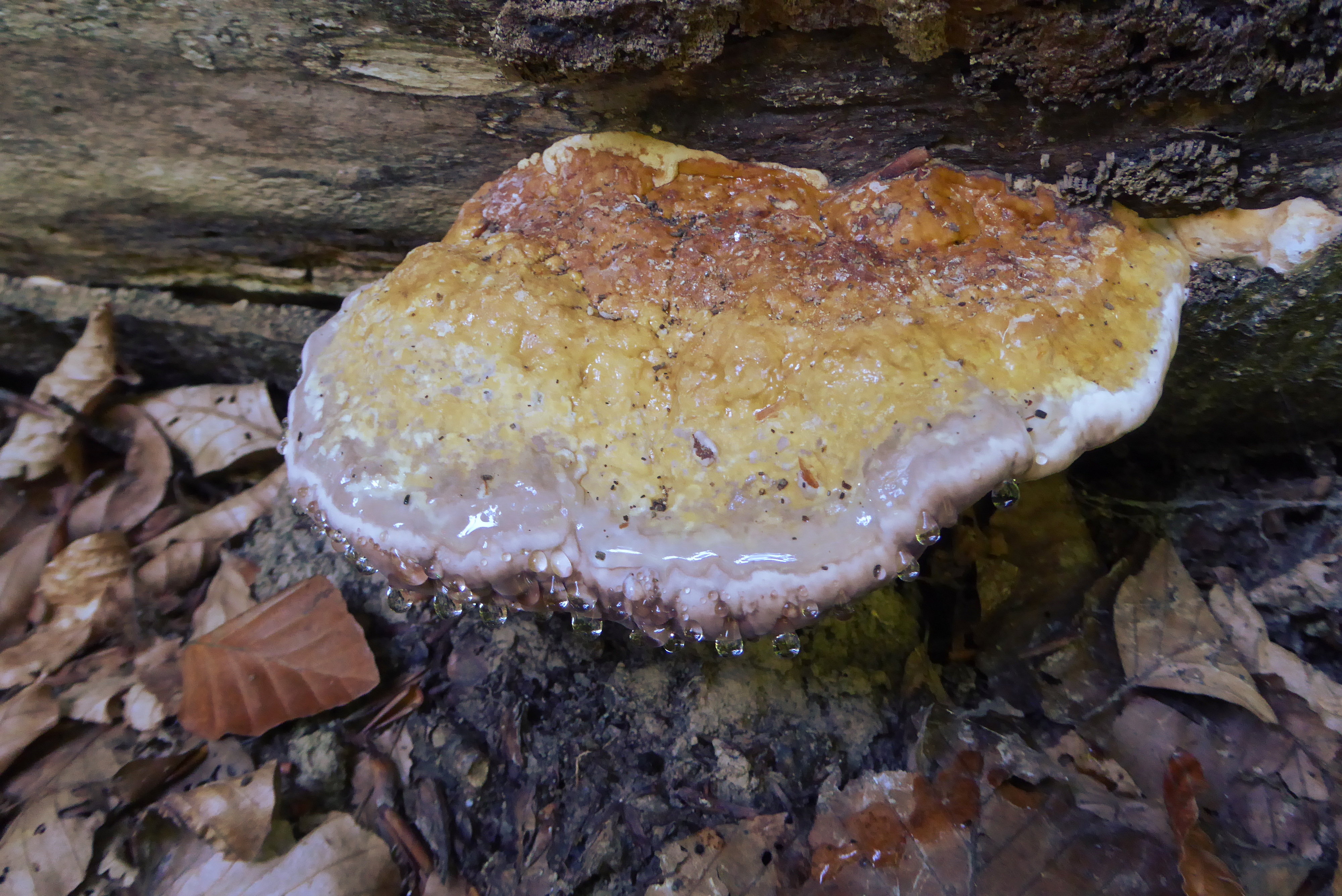
Table of contents
- What is the liquid on the surface of the fruit body and what is termed guttation?
- When can droplets be seen and what governs their formation?
- Guttation, dew, or latex? Field observation tips
- Examples from the atlas: Red-belted Bracket and Bleeding tooth fungus
- How to document droplets and the fruit body during observation?
- Sources
During a walk through a damp forest, one can sometimes spot glistening droplets of liquid on the caps or undersides of fungi. Although in many cases this is simply dew or residual rainwater, there are situations where the liquid does not originate from outside, but is exuded directly by the fruit body itself from an intact surface. In mycology, this distinctive phenomenon is known as guttation. A good deal of mythology has grown up around colourful droplets, so it is worth taking a closer look at how and under what circumstances fungi secrete liquid.
Unlike plants, which discharge water under root pressure through specialised hydathodes in their leaves, fungi transport fluids in a different manner, based on a network of hyphae. Droplets appearing on fruit bodies are an aqueous solution containing dissolved organic and mineral substances. Observing this process allows for a better understanding of how fungi function in the forest environment.
What is the liquid on the surface of the fruit body and what is termed guttation?
Fungal guttation consists of the observed exudation of liquid onto the outer surface of an undamaged fruit body. Droplets appear spontaneously, without cracks, wounds, or insect feeding. The exuded liquid is an aqueous solution containing various organic and mineral substances, the composition of which can vary significantly depending on the fungus and environmental conditions. Unlike leakages caused by damage, this is a natural phenomenon occurring on the intact surface of tissues.
The chemical composition of the droplets and their biological significance vary depending on the species studied and ambient conditions. Review studies indicate that a substantial proportion of detailed analyses concerning metabolites in exudates refers to laboratory cultures of filamentous fungi. In the case of wild fruit bodies, no single universal function of guttation has been demonstrated. Hypotheses regarding the removal of excess water or the translocation of chemical compounds remain the subject of scientific debate, and the mechanism of the phenomenon itself has not yet been fully explained.
When can droplets be seen and what governs their formation?
The appearance of droplets is not a permanent feature of a fruit body, but a variable phenomenon linked to the dynamics of its development. This exudate is often observed during periods of active growth, for example in young specimens or in freshly growing marginal zones of perennial fruit bodies. The ability to exude liquid also depends on the traits of the species itself – some fungi form droplets much more frequently than others.
The course of the phenomenon is also influenced by weather conditions and the state of the substrate. Guttation is favoured by elevated air humidity and the availability of water in wood or soil, from which the mycelium draws moisture. However, this does not mean that the process requires complete atmospheric saturation. Droplets can persist on the fruit body for a period of time, after which, with an increase in temperature or under the influence of wind, they gradually evaporate or disappear.
Guttation, dew, or latex? Field observation tips
During field observations, it is worth distinguishing guttation from water originating from other sources. Rain settles on the fruit body from the outside, whilst dew condenses directly from water vapour in the air. Guttation droplets, by contrast, are exuded by the fruit body itself, which discharges water taken up from the substrate along with compounds dissolved within it. Their concentration in growth zones or on the underside of the cap can serve as a clue, yet the shape and runoff of the liquid depend on the surface structure of the fungus. For this reason, these features remain merely helpful pointers rather than a definitive test.
The exudation of latex (milk), observed in certain agarics following injury, is another distinct process. Such leakage appears exclusively after the disruption of tissue continuity, for instance after cutting the gills, whereas during guttation the surface remains intact. It is worth bearing in mind that guttation droplets can be washed away or diluted by rain, and the mere presence or colour of the liquid does not allow for a reliable identification of the species from a photograph.
Examples from the atlas: Red-belted Bracket and Bleeding tooth fungus
A classic example of a fungus in which guttation can be observed is the Red-belted Bracket (Fomitopsis pinicola). This common wood-inhabiting fungus forms hard, perennial fruit bodies that expand by adding new growth zones. Under favourable conditions, clear, yellowish, or amber droplets appear on freshly growing, pale margins and on the pore surface on the underside of the cap. This phenomenon does not occur in every specimen encountered, but accompanies active growth processes, constituting a characteristic element of this species' biology.
Another striking example is the Bleeding tooth fungus (Hydnellum peckii), a terrestrial fungus growing beneath coniferous trees. Descriptions of fresh fruit bodies of this species draw attention to intensely red droplets appearing on the pale, velvety cap. However, this feature does not persist indefinitely: as the fruit body ages, the liquid disappears and the surface darkens and turns brown, causing older specimens to resemble other tooth fungi.
- Red-belted Bracket (Fomitopsis pinicola) — A perennial wood-inhabiting fungus. On freshly growing margins of the fruit body and on the pores of the tubes, it exudes yellowish or amber droplets of liquid.
- Bleeding tooth fungus (Hydnellum peckii) — A terrestrial fungus associated with coniferous trees. On the pale surface of fresh fruit bodies, it forms intensely red droplets that disappear with age.
How to document droplets and the fruit body during observation?
When documenting a fruit body with droplets, it is worth photographing it from several angles. In addition to a close-up of the exudate itself, a clear view of the top of the cap and its underside – the arrangement of tubes, gills, or spines, which constitute key distinguishing features – is needed. Pay attention to where the droplets accumulate precisely: whether they cover the entire surface, or are concentrated exclusively on the freshly growing margin.
It is also worthwhile noting the substrate, nearby trees, and current weather. It can be instructive to revisit the same fungus after a few hours or the following day to check how the exudate responds to changes in humidity. Remember that the colour of the droplets alone does not determine the species: yellowish liquid can appear in many unrelated fungi, and on drier days the same specimen may exhibit no guttation at all.
Observing droplets on fruit bodies allows us to perceive fungi as active organisms undergoing continuous physiological processes. These exudates provide an intriguing clue in field studies, serving as a reminder of how closely the life of the mycelium is connected to the humidity and temperature of the forest environment.
Sources
- Naturalis Biodiversity Center – Fomitopsis pinicola, description of yellowish guttation droplets on the pore surface in a European fungal atlas
- U.S. Forest Service – Mushrooms of the National Forests in Alaska, characterisation of red droplets on fresh fruit bodies of Hydnellum peckii
- Krain & Siupka (2021) – Fungal Guttation, a Source of Bioactive Compounds, and Its Ecological Role, Biomolecules 11(9): 1270, review of knowledge on the guttation process in fungi
- Fort Worth Botanic Garden – Observations of Xylobolus frustulatus and literature review regarding guttation droplets on fruit bodies